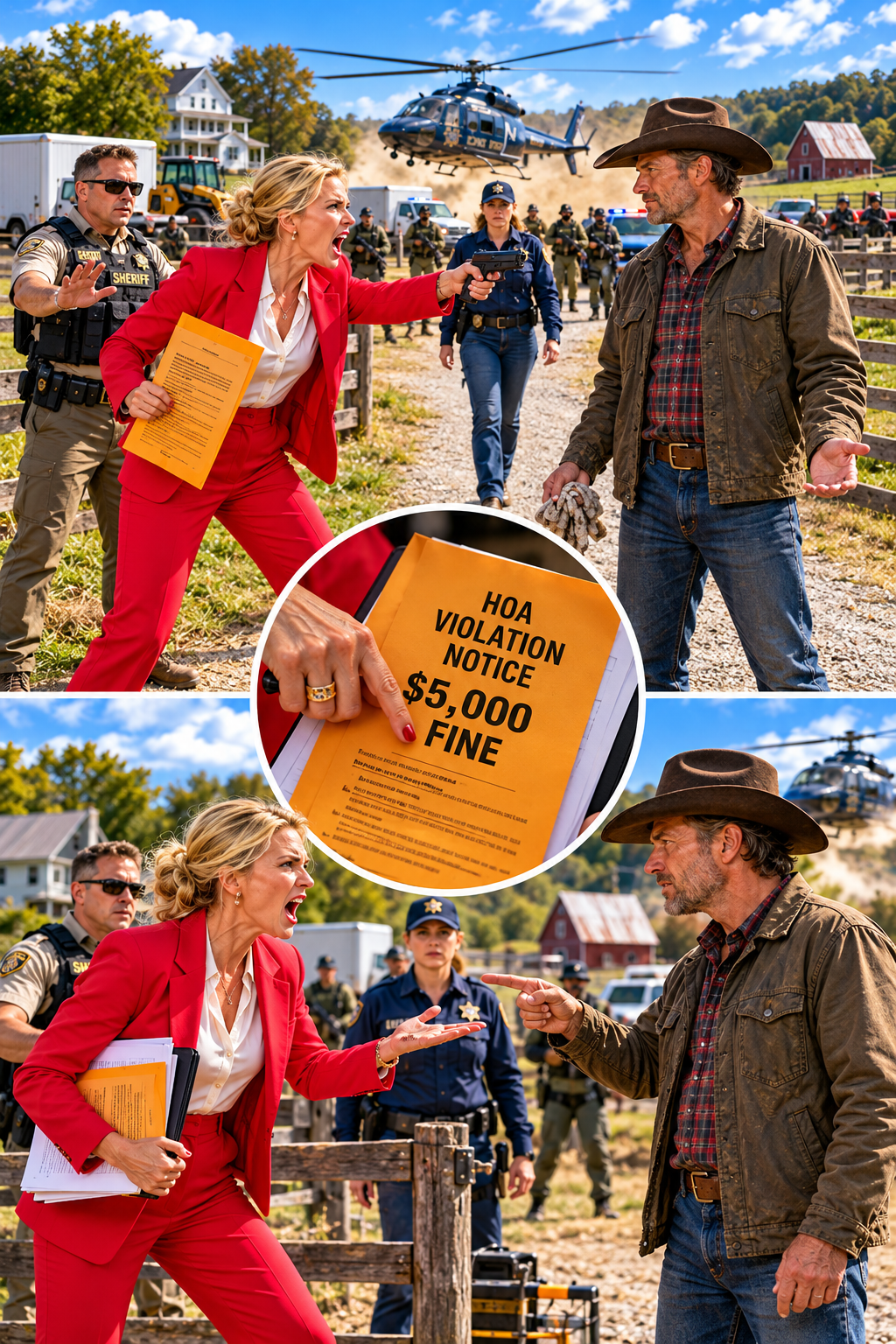
The morning Dana Whitlock arrived at my farm with armed guards, two box trucks,
Part 2: My wife’s careful recusal leaves Dana’s story exposed
Dana recovered first. “Ma’am, this is a private matter,” she said, already filming the helicopter. Adrienne didn’t answer. She walked a short distance away and called 911, reporting armed men removing property from an occupied farm. She gave the dispatcher the address twice. Then she made a second call. “I’m putting this on the record,” I heard her say. “It’s my husband’s property. I’m on scene as a witness. I’ve taken no action, and I’m recusing myself in writing.”
She came back and stood beside me. My welder was still in the truck. “That’s my equipment,” I said. “I know.” “You’re not going to—” “No.” The skid steer was moving along my frontage, pulling fence posts from the soil. Forty feet of woven wire fell over. My cattle were a hundred yards away, and beyond them lay the county road.
I drove across the gap and rattled a bucket of range cubes until the herd came toward me instead of the highway. Two county deputies arrived about twenty minutes later. Dana reached them first, presenting a recorded trustees deed and a board resolution. The older deputy read both, then asked for my papers. I gave him my grandfather’s 1961 warranty deed and my own deed from 2011.
“Do you have a writ of possession?” he asked Dana. “I have a deed,” she replied. “That isn’t what I asked.” She began explaining the foreclosure, but the deputy stopped her. “Nobody’s getting removed today. Take it to a judge.” He turned to Adrienne. “And you are?” “A witness,” she said. That was how he wrote it in his report: spouse of the owner, present as a witness, no direction given.
The men eventually left, but the lowboy was already gone with my Kubota and a round baler leased by my neighbor, Dale Puit. I called Dale before anyone else. “I’ll get it back, Wes,” he said. “I’ve got two hundred acres to cut this week.” “I know. I’m sorry.” The next morning, Adrienne and I spread every document on the kitchen table. Stonewater Ridge had been built around my farm starting in 2018, and its development plat shaded my forty-six acres as future development land. It was a drawing, not a deed—but a company had used it to charge me dues for years.
Part 3: Forgotten notices turn a title error into a courtroom fight
The association’s management company began billing me ninety-five dollars a month in 2019. I wrote in 2020, attached my deed, and said plainly that I was not part of the subdivision. I received a form letter and assumed the matter was over. After that, I threw away the envelopes without opening them. One of them may have contained a lien notice. Another may have warned me about a sale. “You told them in writing,” Adrienne said, studying my certified-mail receipt. “They signed for it.” I had no answer that made the mistake disappear.
A search at the register of deeds showed the association’s trustees deed recorded in June. My lender froze my operating line while the title dispute was unresolved. “The public record says they own it,” my loan officer explained. “I believe you, but I can’t advance money against land with a clouded title.” The fuel and fertilizer draw I needed that week vanished. I drove to Shelbyville and hired Nan Proser, a land attorney with reading glasses on a chain and no patience for easy optimism.
“This is months, not days,” she told me after reviewing the file. My 2011 title insurance covered problems that existed when the policy was issued, not a disputed sale years later. Then she gave me one rule. “You stop talking to Dana. And your wife stays out of this as an official. If she uses her position, your case becomes a story about a state officer leaning on neighbors.” Adrienne had already called 911 as a citizen. From then on, she put every boundary in writing.
The association’s lawyer sent a thirty-day notice to vacate. Someone zip-tied signs to my gate declaring the land association property. Dana posted a message thanking residents for their patience while the association recovered its property. Proser told me the paper trail mattered more than the insult. “If you stay after that deadline, they’ll call you a holdover occupant.” I cut the signs down and stacked them face-first in the barn.
Then I lost a sixteen-thousand-dollar hay contract. The buyer had heard the farm was in foreclosure and wouldn’t risk depending on me for winter feed. Ten days later, a process server delivered the association’s detainer action. They wanted possession. At the hearing, Proser argued that a lower court could not decide who possessed the land while ownership was actively disputed. The judge continued the case and directed the parties toward chancery court. I felt relief in the hallway until Proser warned me, “That wasn’t a win. It was a delay. Watch what Dana does next.”
Part 4: A blocked baler costs me the season’s only clear week
Five days later, the forecast opened a narrow window for hay. My twenty-eight acres were ready, along with roughly three hundred eighty acres belonging to four neighbors who had counted on my custom work. At a quarter to five in the morning, I found two guards at my equipment-lot gate. One sat in a folding chair in front of my baler. “Nothing leaves this lot,” he said. “That’s my equipment.” “I understand. I’ve got instructions.”
He didn’t seem pleased to be there. He was a man working an hourly shift, stuck between a clipboard and a farmer who needed his own machine. When I asked to see the work order, he held it where my flashlight could catch the signature. Dana Whitlock’s name was at the bottom. I photographed it and backed away. Proser had warned me that a tractor pushing through a guard would become the story Dana wanted. So I called the four farmers and told them I couldn’t cut their hay.
I spent a day and a half trying to borrow a baler. Every machine within seventy miles was booked or broken, and the one available required a deposit I couldn’t make with the bank line frozen. Dale’s baler was still locked in a yard in Smyrna. Then a survey crew began marking my field for Stonewater Ridge’s next phase. By evening, pink ribbons ran across the best grass I had.
I baled one reachable corner with an old wagon and got sixty bales. Saturday night, rain came hard and lasted through morning. Most of the cut grass turned to mulch. Between my lost crop and the custom work, the damage approached twenty thousand dollars. I went to Ray Bickers’s shop to apologize. “It’s not your fault, Wes,” he said. “It’s my job to show up,” I answered. Two of the other farmers stopped returning my calls.
That same week, my barn lights went dark. The well pump had lost power, and the utility company said my service had been transferred to the association after it received the trustees deed. Thirty-eight cattle depended on that well. I filled a three-hundred-gallon tank in my truck and drove eleven miles to a public fill station, three times a day. When a pregnant heifer collapsed in the shade, Dr. Sonia Bot treated her with fluids. The heifer stood up, but she lost the calf ten days later. Sonia’s notes recorded the heat, stress, and dehydration. She wrote them because they were true.
Part 5: The barn comes down while I’m buying winter hay
One Saturday night, a guard called the sheriff after seeing me drive in with water. I spent forty minutes explaining to a young deputy why I was watering my own cattle. He read both deeds and let me stay. It was the second report on the address. For a moment, I felt good when I told the guard what the water crisis had cost me. Then I realized I had given Dana a picture of me shouting at a security worker. She filed a professional-standards complaint against Adrienne, accusing her of using her rank to intimidate the crew and influence the sheriff’s response.
Adrienne had been on a scheduled corridor survey flight before the pilot chose my field as the safest place to land. Dana’s video showed her stepping from the helicopter, but not the flight that came before it. Within days, Adrienne was placed on administrative reassignment while the complaint was reviewed. She had to hire her own lawyer. The cost was nine thousand dollars, charged to our home-equity line alongside Proser’s retainer and the money lost to the ruined hay.
A Nashville television station aired Dana’s video, calling it a dispute over unpaid homeowners-association dues. Every word in the segment was technically accurate. The picture it painted was still wrong. Neighbors looked at me differently, and someone spray-painted an insult on my mailbox. I painted over it before Adrienne saw. Our daughter, Callie, came home crying after classmates asked about her mother. Her steer, Rooster, was trapped behind the equipment-lot gate until a guard finally moved his chair so she could get feed.
That night I said what I had been afraid to say. “Let’s sell the forty-six acres. Let them have the land, and let’s be done.” Adrienne turned off the stove and stared at me. “No,” she said, then corrected herself. “I’m saying no, but I don’t know anymore.” It was the lowest point, because even my wife’s certainty had begun to wear thin.
In October, Proser filed for an injunction. While I was away buying winter hay, Callie called. “Dad, there’s a video. You need to come home.” My grandfather’s barn, built in 1948, had its east wall torn down. A track hoe stood among the beams. I stepped in front of it, and the operator shut off the engine. He said he’d been told it was a bank job. Dana was filming nearby. “There have been cows here since 1961,” I said. She ordered me off my own land. I told her to keep talking; her phone was still recording.
Part 6: A recording captures Dana claiming the decision as hers
The crew left within the hour. The east wall and roof were down, the north and west fences were gone, and three hundred bales of winter hay lay beneath the broken loft floor. No equipment had been removed this time. The security company had already learned the hard way that hauling away a neighbor’s leased baler could bring an insurance company to its door. I called Proser from the wreck. “Don’t move anything,” she said. “Photographs first.”
I spent two hours documenting the damage. Last, I photographed the milkhouse slab, twelve by four feet, poured in 1948. My grandfather had scratched his initials and the year into the corner with a nail. Mud covered the marks, so I swept them clean before taking the picture. Later, I pulled the old white-oak header beam from the rubble with the tractor. It took two hours, and I broke a chain hook doing it.
Proser downloaded Dana’s video before it disappeared. In it, Dana narrated the demolition. About six minutes in, someone asked whether the sheriff was there. “No, we don’t need the sheriff for this,” she replied. “It’s our parcel. It’s my call.” Meridian Field Services had also taken photographs during the job. Their report marked the land vacant and abandoned, though cattle appeared in several images.
The injunction hearing came near the end of October. Proser showed the judge the video and the photographs. The association’s new lawyer agreed to stop all work while the ownership case moved forward. The judge ordered them to cease activity on my parcel and return any removed equipment. It didn’t declare me the owner. It stopped the damage long enough for the facts to be heard.
My Kubota came home with a scratch down the hood and a dead battery. Dale’s baler took eleven more days to return. He came to get it himself and refused to let me haul it. “You owe me a hood,” he said. “I’ll paint the whole machine.” “You’ll paint the hood.” We argued about it for a month, and that was how I knew our friendship had survived.
The next months were quiet outside the courtroom. Proser gathered my grandfather’s deed, the 2011 deed, the association declaration, the utility-transfer request, the returned foreclosure notices, the work orders, and Sonia’s veterinary record. A title attorney confirmed there was no recorded written consent adding my land to the association. A surveyor marked the original boundary. At the same time, emails surfaced showing Dana’s brokerage held a commission arrangement tied to the planned development. If my acreage entered that deal, she stood to be paid.
Part 7: The association’s own records reveal the missing consent
The association’s lawyer built a careful argument from true facts. A public plat showed my farm inside the subdivision boundary. I had used a paved entrance maintained by the association for six years. I had thrown away years of mail. The board had hired a management company and a substitute trustee, and its volunteers said they followed professional advice. Proser warned me that a court might view my conduct as implied consent, even without a signature. “We answer with the documents,” she said. “Not with a speech.”
Depositions started in winter. I was first, and I made a mess of it. The association’s lawyer asked about the paved entrance four different ways, and I finally snapped that I hadn’t known there was a toll. Afterward, Proser told me to answer plainly. “You threw away six years of mail. Say that, then stop.” The management company’s representative admitted its assessment list came from the plat, not the deed records. She confirmed the company had received my 2020 letter and deed, but she had no record of anyone bringing them to the board.
The substitute trustee produced four returned envelopes. Each had been addressed to a lot number that didn’t exist. My actual mailing address had been on the county tax rolls since 2011. The trustee said he had used the address the association provided and did not check the property records. The association’s treasurer later testified that the board had voted to send a letter, not to demolish my barn. That answer split the association’s insurance defense from Dana’s personal choices.
Then the emails between Dana and Bellwood’s land manager became evidence. The messages discussed an option deadline and her brokerage’s commission on the development assemblage. The arrangement was not itself illegal, but it had never been disclosed in the association’s board minutes. One email from Dana to the security scheduler was brief: “We don’t have ninety days. Just take it.” The flight log from Adrienne’s case showed the helicopter was already airborne for other work before it landed in my field. Dana’s sworn complaint said no fencing had been removed before Adrienne arrived. My trail camera showed the skid steer pulling posts eighteen minutes earlier.
Adrienne’s review ended in February. The department found the complaint unfounded. There was no apology and no reimbursement for the weeks she spent on reassignment or for her legal bills. She folded the two-page letter and put it in a kitchen drawer. By April, the association’s insurer was willing to settle damages. Dana refused to settle her personal exposure, and the case went to a bench trial on May fourteenth.
The courtroom held eighteen people, about half from Stonewater Ridge. The chancellor read the file for ten minutes before anyone testified. A surveyor explained the old boundaries. The title attorney showed the declaration clause that required recorded written consent before land could be added. No such consent existed. The association’s own representative admitted the board had never been asked about my 2020 letter.
Part 8: The court restores my title and the farm finds its footing
Proser entered the four returned notices, each addressed to the nonexistent lot. Beside them she placed my tax bill with the correct address. Then came the baler’s bill of lading, proving it belonged to Dale, and the demolition video. Dana’s voice filled the quiet courtroom: “It’s our parcel. It’s my call.” Proser followed it with the security company’s report labeling the farm abandoned, and photographs showing cattle in the background.
The flight records and trail-camera stills came next. Proser was careful to say Adrienne’s conduct was not on trial. The records mattered because they contradicted Dana’s sworn account. I testified after lunch. The chancellor asked whether I had thrown away six years of association mail. “I did,” I said. I told him about hauling water, making three trips a day, and holding an IV line above a heifer in the pasture. I didn’t try to make it sound better than it was.
Adrienne testified for six minutes. She said she called 911, identified herself as my wife, gave no direction to anyone, and recused herself in writing. Dana testified the next morning. She described herself as a volunteer acting in the association’s interest and following professional advice. Proser asked about the commission agreement and whether it appeared in the board minutes. Dana acknowledged the arrangement. “Is it in any minutes?” Proser asked. “No.”
The chancellor delivered his findings from the bench. He said the management company’s error had started the dispute, and that Dana believed she was acting for the association. Then he turned to the clause requiring a signature. “The declaration required recorded written consent,” he said. “There isn’t one.” He ruled the attempted annexation void, the assessments never owed, the lien invalid, and the sale and trustees deed set aside. Title to the farm was quieted in my name.
He awarded damages for the barn, fencing, lost hay, custom work, water hauling, and the veterinary bill. Every item had a receipt, invoice, or record behind it. He found Dana had acted outside the board’s authority when she ordered the demolition and reserved punitive damages for a later hearing. There was no gavel, no applause, and nobody arrested. The judge thanked the lawyers and went to lunch. I sat in my truck for twenty minutes before I could turn the key.
The order was entered eleven days later. The association settled through its insurer rather than appeal. It paid the damages and assessed each Stonewater Ridge household about $2,200 for the deductible and its legal costs. Dana lost a recall vote, resigned, contributed to the settlement, and accepted a suspension of her real-estate license over the undisclosed commission. The security firm received a licensing sanction. Bellwood abandoned the phase-four plan. The district attorney reviewed the case and declined criminal charges, citing the association’s reliance on a recorded deed.
The bank restored my operating line after the corrected title was recorded. We paid off the home-equity loan over the next fourteen months. A new post-frame barn rose on the old slab, with the carved milkhouse corner left uncovered. I hung the chain from the cut gate on a nail by the center post, where it could still be useful. Adrienne went back to work, and Callie showed Rooster at the county fair. He placed fourth, and she spent the entire ride home explaining why the judge had been wrong about his manners.
The next August, cattle stood in the front pasture along the highway. The gate was closed. A helicopter passed high overhead, and I glanced up before returning to my work. Adrienne sat on the tailgate in a ball cap and handed me a cold drink. We listened to the trucks move along Route 99. The farm was still ours, the old beam was still overhead, and nobody had to say a word about what it had taken to keep it.
✓ Lynn R. Adams
Part 2: My wife’s careful recusal leaves Dana’s story exposed Dana recovered first. “Ma’am, this is a private matter,” she said, already filming the helicopter. Adrienne didn’t answer. She walked a s…