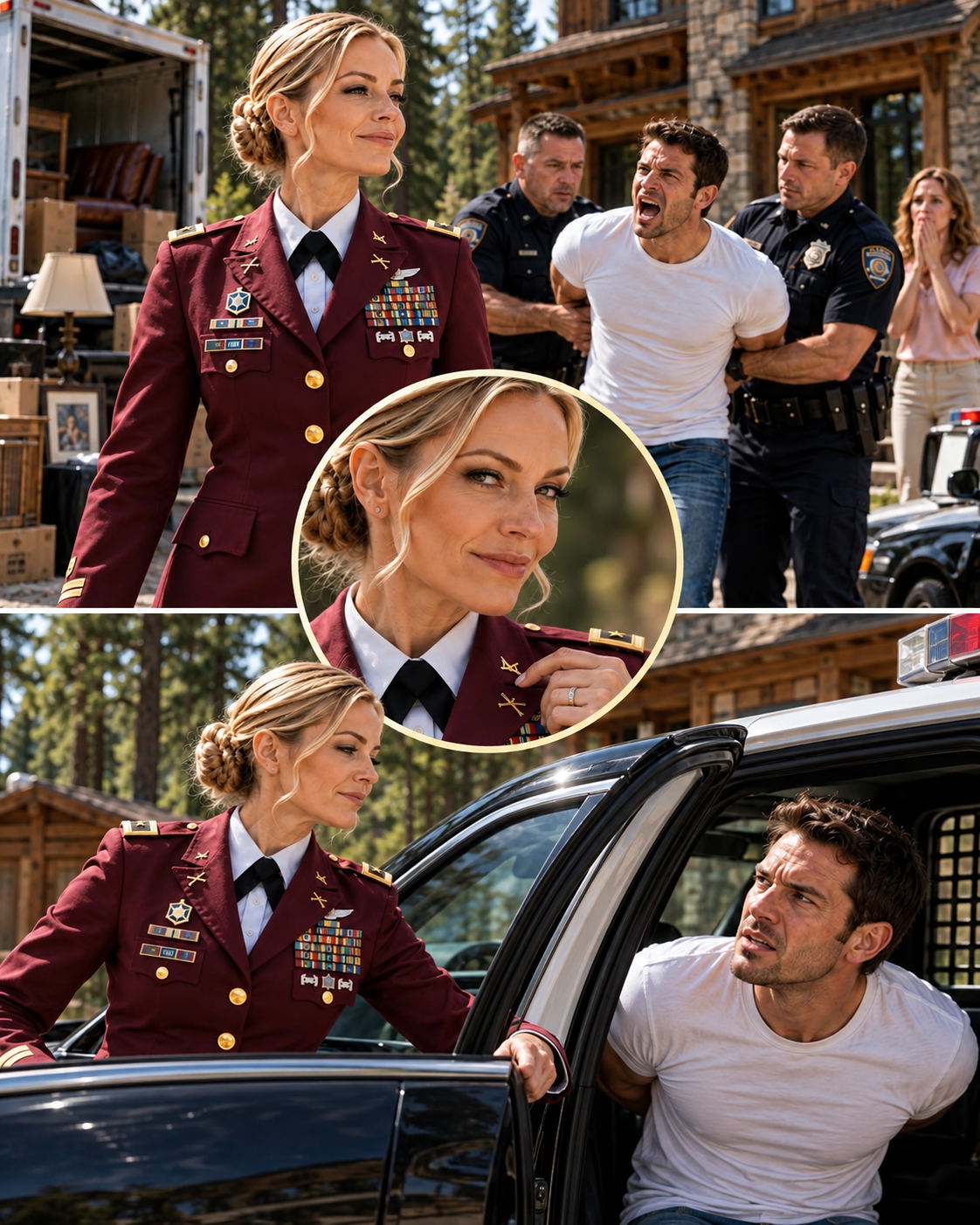
The morning Colonel Emma Carter returned from a sensitive military assignment,
Part 2: Forged papers reveal what they wanted from my house
Luis gave me copies of the demolition plans, emails, invoices, and the names of the workers who had entered the property. The construction focused on the fireplace wall, built-in cabinets, the office floor, and a storage room—places that had no connection to accessibility upgrades. He had heard Michael tell the crew not to throw away any old document, metal box, or ledger they found. I photographed every page and asked Luis to keep the originals safe for investigators. When Deputy Harris obtained a warrant related to the forged paperwork, we followed the trail to a storage unit Michael had rented under a business name. My missing belongings were stacked behind furniture and unopened building supplies.
Lauren’s labels separated jewelry from items marked for sale, and boxes held the photographs and keepsakes she had taken from my house. Beneath loose flooring, deputies found a packet wrapped in oilcloth. Inside was a faded photograph of my grandfather on the original dock, standing beside my father and a young man I did not recognize. A second deed listed the property under my grandfather’s name and Daniel Mercer’s. I had paid the mortgage interest, taxes, insurance, repairs, and improvements for fifteen years, yet the document suggested that someone else might still have a legal claim. When I read Daniel’s name aloud, Linda stopped arguing.
My father finally admitted that Daniel had been his older brother, a man erased from the family after being accused of stealing money from their business. Daniel had disappeared from Texas after a bitter dispute, Linda said, and the old deed meant nothing now. Michael called the whole thing another overreaction, while Lauren denied forging anything, even before anyone accused her. In a carton marked MERCER RECORDS—DESTROY, Deputy Harris found bank statements, letters, ledgers, and a cassette recorder addressed to Robert. The tape held Daniel’s voice: he said he had not stolen the money, accused Linda of moving funds through an account in his name, and said she had threatened to accuse him of violence if he stayed to defend himself.
Daniel’s message continued: his share of the lake property was his, and if anything happened to him, it would pass to his child. The bank records supported his accusation. Linda had controlled the account where the missing money first appeared, and some of it later flowed into an investment under her maiden name. That investment had helped purchase the home where she and Robert still lived. Robert stared at the statements as though our family history were being rewritten line by line. Linda stopped denying the transfers and said she had done what was necessary to protect their future.
Before deputies took Michael and Lauren for questioning, Linda turned to me and asked why my grandfather had left the lake house to me instead of Michael. She asked why I had been sent to boarding school at twelve and why I looked so much like Daniel’s mother. Back at the house, Robert gave me a letter my grandfather had instructed him to deliver when I turned thirty. Linda, he admitted, had persuaded him that the truth would destroy the family. The letter told me never to surrender the property, never to sign anything Linda presented without independent review, and to find Daniel’s son, Samuel Mercer. I was thirty-one. Somehow, the search had begun a year too late.
Part 3: The missing heir was already inside my command
Robert told me Daniel had married a nurse named Rachel and had a son, Samuel. After Rachel died and Daniel’s health began to fail, my grandfather secretly sent him money, but Linda intercepted it before Daniel disappeared again with the boy. I remembered finding one of Daniel’s letters when I was twelve, and Linda snatching it from my hands. Two months later, she sent me to a strict military boarding school while Michael stayed home. Robert admitted Linda said I asked too many questions and needed discipline. He had agreed, believing he was protecting the family, and placed me on a path that taught me to survive without him.
Before I could process that, Colonel Robert Reeves called from headquarters to warn me that the ethics complaint had been reopened. Someone had posted authentic classified photographs from my last overseas assignment. Only a handful of authorized people had ever seen them, which meant my family had help from inside the government. Reporters began waiting outside the lake house, asking if I had used my rank to intimidate my relatives. Then a court petition claimed my military service had made me mentally unstable and unable to manage my property. Attached was an evaluation from a doctor I had never met. My civilian attorney, Rebecca Sloan, said the petition might be an attempt to gain temporary control of the house before I could uncover what the family was searching for.
The forged renovation papers had given Michael access. The moving truck had created a public story about a family dispute. The ethics complaint threatened my career, and the fake evaluation offered a way to take away my legal authority if I reacted badly. I returned to base the next morning, changed into uniform, and entered a secure room with Reeves and Major Chen. Investigators had traced the photo leak to a civilian intelligence liaison named Thomas Vale, a quiet official who processed travel clearances for my unit. Chen placed a birth certificate on the table. The man’s original name was Samuel Daniel Mercer.
Daniel’s missing son had spent years inside federal security systems. He knew who I was before I learned who he was. Instead of reporting to work that morning, he had used his badge to enter a federal archive holding old Mercer records. Agents arrived after he left and found an envelope addressed to me. It asked me to meet him alone at an abandoned boathouse if I wanted to learn why our grandfather had chosen me to protect the lake property. Reeves forbade me to go until I pointed out that Samuel would expect surveillance. We agreed to place a team at a distance, where he would not see them immediately.
Samuel waited by a lantern with a pistol on the table. He looked older and more tired than the forgettable official I remembered from clearance offices. He admitted he had leaked sanitized photographs to force official scrutiny before Linda’s allies could bury the property case. “You gambled with my career without asking me,” I said. He showed me bank transfers proving Linda had paid the private investigator, the false psychiatrist, and county contacts who supported Michael’s petition. Then he opened a folder containing DNA results based on a protected medical sample I had given during a federal screening program. I recognized the violation before he finished speaking. The results showed a 99.8 percent probability that we were half-siblings. “Daniel Mercer wasn’t your uncle,” Samuel said.
Part 4: A gunshot exposes the father my mother erased
Linda appeared in the boathouse doorway with a revolver and said Samuel should have stayed missing. I stepped between them and demanded to know whether Daniel was my biological father. Linda said Daniel would have taken me away if she had let him stay. She had been engaged to him and became pregnant before framing him for theft, she admitted, then married Robert and let him raise me because he was easier to control. Samuel said she had also intercepted money and medication their grandfather sent Daniel when he became ill. Linda claimed she had not known what was in the packages, but her face made it clear she knew far more than she said.
Her finger tightened on the revolver. The shot shattered the lantern, and the boathouse vanished into darkness. Federal agents rushed in from the shore as I forced Linda to the floor. Samuel fell beside the table, blood spreading across his shirt. Paramedics stabilized him while agents searched beneath my dock, where Samuel whispered that a waterproof container was bolted to the submerged supports. Inside were photographs, ledgers, a sealed DNA report, and a video cassette labeled EMMA’S BIRTH—FULL TRUTH. We played it in the damaged living room with Major Chen and federal investigators watching.
Daniel appeared on the screen beside my grandfather, looking into the camera and calling me his daughter. The person behind him wore a uniform, and I recognized him immediately: Colonel Reeves, decades younger but unmistakable. The tape began with my grandfather’s warning. If I was watching it, Samuel had found me—and Reeves could no longer hide what he had done. Reeves arrived without his uniform and admitted he had known Daniel, known I was Daniel’s daughter, and watched my progress from military school through promotion boards. He had never told me why my achievements seemed to matter to him.
He explained that Linda had not invented the original conspiracy alone. A decorated intelligence officer, General Arthur Vale, had recruited her when she worked as an accountant for one of his defense companies. Vale was Daniel’s biological father through an affair with my grandmother, though my grandfather had raised Daniel as his own. When Daniel discovered illegal military-contracting accounts, Vale used Linda to place stolen money in Daniel’s name. Reeves had been Vale’s aide and had helped with surveillance and document transfers before learning Linda was pregnant with Daniel’s child. Vale wanted the baby as an heir he could shape. Reeves helped Daniel and Samuel disappear because Daniel refused to take infant me by force and hoped he could return when the evidence was strong enough.
Daniel never returned, Reeves said, because Vale found him and arranged his death. The false medical story protected everyone else’s silence. Reeves had spent decades collecting evidence against the remnants of Vale’s network, but exposing it would also reveal his own early complicity. His protection of me had been real, but it had never been clean. He handed me one half of a key system leading to Vale’s private archive and said Samuel held the other half. Samuel believed Reeves had helped kill his father. Before I could decide what I believed, a hospital officer arrived with news that Samuel had awakened, overpowered a guard, and disappeared through a service corridor. Reeves knew where he was headed: the hidden archive beneath Robert and Linda’s house.
Part 5: My father’s confession tears apart the family he preserved
Federal agents surrounded my childhood home at dawn and followed Reeves through the basement to a steel door hidden behind shelving. Samuel had already opened one lock but stopped halfway down the corridor when his gunshot wound gave out. I convinced him to lower his pistol so medics could support him. Together, Samuel and Reeves used both halves of the key system to open a vault packed with blackmail files, photographs, banking ledgers, defense-contract records, and letters General Vale had collected on nearly everyone in his network. A cabinet labeled MERCER held hundreds of letters Daniel had written to me over the years, including birthdays I had believed he had forgotten.
The letters described ordinary things: how he heard I loved maps, how he hoped I still laughed at ducks on the lake, and how he wanted me to understand that courage meant choosing whom to protect when fear arrived. I read three before tears blurred the words. The father I thought had abandoned me had spent his remaining life reaching toward a daughter whose mother intercepted every message. At the bottom of the cabinet, a file called FINAL OPERATION described Daniel’s plan to trade evidence for my safety at an airfield. Reeves had arranged a rescue team. The team never reached Daniel because someone used Reeves’s authorization code to redirect it. Samuel immediately accused Reeves of betraying his father.
A voice answered from the corridor. Robert Carter, the man I had called Dad my entire life, stood there with a shotgun. Michael was behind him, having escaped county custody with help from a deputy who had been bribed. Robert admitted he had stolen Reeves’s code because resentment toward Daniel had been part of his life since childhood. He said Linda chose him only after destroying the stronger brother she could not control. Robert claimed he had wanted Daniel frightened and forced out of Texas, not dead, but Vale had arranged the killing after the rescue team disappeared. Samuel told him that leaving Daniel alone had still made him part of what happened.
I asked Robert what I had been to him if everyone knew I was Daniel’s child. He cried as he said he had considered me his daughter, even while obeying Linda whenever fear demanded a sacrifice. Michael tore the shotgun from Robert’s hands and confessed Linda had promised him ownership of the lake house and control of the family assets once the Mercer records were gone. That was why he forged the papers, hired the psychiatrist, coordinated with reporters, and tore apart my home. He accused me of having everything while he got the leftovers, as if I had not bought the house and built my career through years of discipline. When his finger tightened on the trigger, Samuel slammed into him. The shotgun fired into the ceiling.
Agents rushed in as Robert tried to step between them. Another blast struck him in the chest. I dropped beside the man who had raised me while Michael shouted that it had been an accident. Robert held my wrist and apologized for hiding Daniel. He said Daniel loved me. I told him that despite everything he had failed to do, he was still one of my fathers. He died before the ambulance arrived. Agents took Michael away, and Samuel sat stunned, unable to fit the uncle who helped destroy Daniel into the man who had died protecting Daniel’s son.
Major Chen stopped us before we left the vault. A live monitor showed the federal holding facility where Linda was supposed to be secured. Her cell was empty. Investigators found a false fire alarm, a forged transport order, a corrupted camera feed, and a carefully timed extraction. Linda had escaped. Chen uncovered encrypted messages describing a contingency called HEIRLOOM and someone referred to only as “the child.” At first, I thought the messages meant me. Then Samuel turned pale and admitted he had an eleven-year-old daughter named Lily, living under another identity. The former Vale security director who knew her location had just been found dead. Lily’s foster family reported her missing within the hour.
Part 6: My mother kidnaps a child to protect her fortune
Samuel ignored the doctors and joined the federal teams searching for Lily. He had kept her identity secret after learning Vale’s organization still had living members. Only he, his attorney, and the former security director knew where she lived. Agents found a private aircraft waiting at a rural Texas airstrip, and the messages indicated Linda planned to take Lily out of the country. The jet lifted before they could stop it, went dark near the Mexican border, then unexpectedly turned north. I understood before the flight path finished updating: Linda was returning to the lake house. She had spent years trying to reach something hidden there, and now she intended to use Lily to force the last piece of the plan into place.
When we arrived, flames were climbing from the boathouse roof. Linda stood at the end of the dock with one arm around Lily and a pistol beneath the girl’s jaw. She said Daniel’s descendants—Samuel, Lily, and me—were beneficiaries of offshore companies, defense investments, and trusts worth hundreds of millions. The records in the house were valuable because they proved the bloodline behind the inheritance. Linda had spent decades eliminating, discrediting, or controlling anyone whose legal existence could weaken her access to the money. Michael, brought under guard because investigators thought he could identify one of her accomplices, shouted that she had promised him everything. She barely glanced at him.
I saw then that Michael had never been an heir in Linda’s plan. He was another tool she expected to discard after he cleared her path. Samuel begged her to release Lily. Linda said if the girl died, the trust distribution could change, and I might be manipulated into controlling the assets through the scandal surrounding my ethics complaint and the classified-photo leak. I moved closer, telling her that everyone she had tried to destroy had taught me how to survive. Lily remained perfectly still. Michael suddenly shouted that the gun was empty; he had seen Linda remove a magazine in the car. Lily ducked the moment Linda turned toward him.
Michael was wrong: a round remained chambered. Samuel ran forward, and the gun fired into his side. I slammed into Linda, and we both fell from the dock into the lake. Underwater, she clawed at me while holding the pistol. I twisted her wrist until the weapon sank into the dark, then dragged her toward the surface, even though she had just tried to kill my brother. Federal agents pulled us onto the dock. Medics rushed Samuel to surgery, and Lily stayed at his side. Linda was transferred under continuous guard. I watched the boathouse collapse into the water and understood that the sanctuary I had once wanted to preserve exactly as it was had burned with it. Peace built on silence was gone; whatever came next would have to be built from truth.
Part 7: A courtroom exposes the family’s organized fraud
Six months later, Linda entered federal court with the same polished composure she had carried into every family argument. Prosecutors charged her with conspiracy, fraud, obstruction, kidnapping, attempted murder, theft, forgery, and participation in Vale’s surviving network. Michael pleaded guilty and testified. Lauren accepted a shorter sentence after admitting she had knowingly used forged ownership documents. Investigators traced the bribed deputy, false psychiatrist, private investigator, and government contacts who helped the family weaponize official systems against me. Reeves testified for three days about Vale, Daniel, the false rescue orders, my infancy, and his own early complicity. He never claimed his later help erased his earlier choices.
The defense argued Linda had been groomed by a powerful military officer and controlled through fear. Some of that was true, and the testimony made her story sound plausible until prosecutors showed she continued the scheme for years after Vale died. Manipulation explained how she entered the network; it did not explain why she remained its willing leader. Samuel testified with a cane, still recovering from his second gunshot wound. He said Daniel had believed truth would eventually produce justice, while Samuel had believed revenge was the only language people like Linda understood. Watching me preserve evidence, protect Lily, and refuse to punish innocent people for my relatives’ crimes had taught him the difference between accountability and destruction.
The prosecutors introduced Daniel’s letters one by one. Jurors heard a father writing toward birthdays, graduations, and ordinary years he was never allowed to share. Michael lowered his head when the final letter said I had never been abandoned, only hidden. Linda’s expression held until Daniel wrote that none of the hatred around his disappearance had ever been my fault. Then she looked away. In my victim statement, I did not ask the judge for vengeance. I had watched revenge turn Samuel suspicious, Robert cowardly, Michael entitled, and Linda monstrous long before any sentence was imposed.
I told the court that my mother had taught me loyalty meant accepting harm quietly, that she had taught Michael love meant entitlement, and that she had taught Robert to call fear “keeping the peace.” But she had also taught me something she never intended. I placed the photographs, deeds, forged documents, military reports, and Luis’s original paperwork on the podium. “Evidence wins,” I said. Linda was convicted on every major count and sentenced to spend the rest of her life in federal custody. Michael received twelve years, Lauren received four, and members of Vale’s surviving network faced separate prosecutions. Nobody applauded when the verdict was read; justice felt less like victory than the closing of a door that should never have been left open.
Reeves resigned his commission after admitting that his efforts against Vale could not erase the years he helped him operate. Prosecutors declined to imprison him because his evidence dismantled networks beyond my family, but he never used that as a defense. Outside the courthouse, he tried to give me his service insignia, saying he no longer deserved it. I closed his hand around the metal and told him his judgment of himself was not mine to carry. Samuel legally inherited half the lake property. A court dismantled the Vale trust and distributed much of its assets to lawful heirs and victims whose families had been exploited. Samuel and I placed most of our recovery into a foundation supporting children separated from parents through fraud, coercion, or abuse of authority. Lily insisted we name it after Daniel Mercer.
Part 8: My father leaves one final message beneath the cedars
A year after Linda’s conviction, I retired from active military service in a small ceremony attended by people who mattered and few who knew what my career had involved. Samuel and Lily sat in the front row beside Major Chen. Reeves remained near the back, unsure whether I considered his presence an intrusion, and I let him stay. Afterward, he brought me a sealed package recovered from a Vale safe: Daniel’s final letter. Daniel warned me not to inherit the excuses adults used for harming others—fear, duty, family loyalty, or manipulation. He admitted he had made mistakes through anger and pride, and that his hunger for justice had sometimes brought him close to revenge. His last instruction was to look beneath the cedar tree on the eastern shore.
Samuel, Lily, and I dug beneath the cedar roots the next morning. We found a rusted box holding two small wooden boats Daniel had carved years earlier. One bore Samuel’s name; the other, mine. Daniel had made my boat before he disappeared, imagining his children together during years when neither knew the other existed. Samuel sat in the dirt with both boats in his hands and admitted he had hated his father for leaving. I told him learning Daniel had been prevented from returning did not erase what abandonment felt like to a frightened child. Samuel asked when I had become wise enough to hold two truths at once. “About five minutes ago,” I said, and Lily rolled her eyes at both of us.
We buried Daniel’s ashes beneath the cedar without uniforms, reporters, speeches, or cameras. He had spent enough of his life turned into evidence. That summer, the Daniel Mercer Foundation opened its first residential center on land adjoining the lake, offering temporary housing and legal support to children caught in identity fraud, coercive custody arrangements, and cases where powerful adults turned institutions against them. Samuel built a cottage nearby. Lily claimed my old guest room and painted it blue. Major Chen became a regular visitor, while Reeves quietly repaired fences and the dock without asking whether the work had earned him forgiveness. I gave him pieces of it slowly, because he had finally stopped trying to turn remorse into a demand.
Michael wrote from prison through Samuel, saying counseling had helped him understand that Linda never intended to reward him. I declined direct contact. Change did not give him an automatic right to return to the life of someone he had harmed. The lake house itself was rebuilt rather than restored; I no longer wanted to recreate the version of peace that had existed before I knew what was hidden beneath the floors. We preserved one damaged section of the original kitchen wall behind glass, not as a shrine to betrayal but as proof that a home could survive being opened up. Daniel’s letters went into a secure archive where Samuel and I could read them whenever we chose.
My grandfather’s photograph of Daniel and Robert on the dock now hangs in the open, where visitors can ask who the men were and receive the truth. No false deeds, hidden names, or intercepted letters remain in the rooms. I refused to protect the next generation through ignorance. One evening, I stood on the repaired dock with Samuel and Lily while the light faded across the water. My family had not become perfect; it had become honest enough for imperfection to stop being a weapon. The house finally felt safe, not because everyone inside it was innocent, but because nobody was required to lie.
✓ Lynn R. Adams
Part 2: Forged papers reveal what they wanted from my house Luis gave me copies of the demolition plans, emails, invoices, and the names of the workers who had entered the property. The construction …