The morning Catherine Whitmore arrived with three trucks and a forty-eight-hour
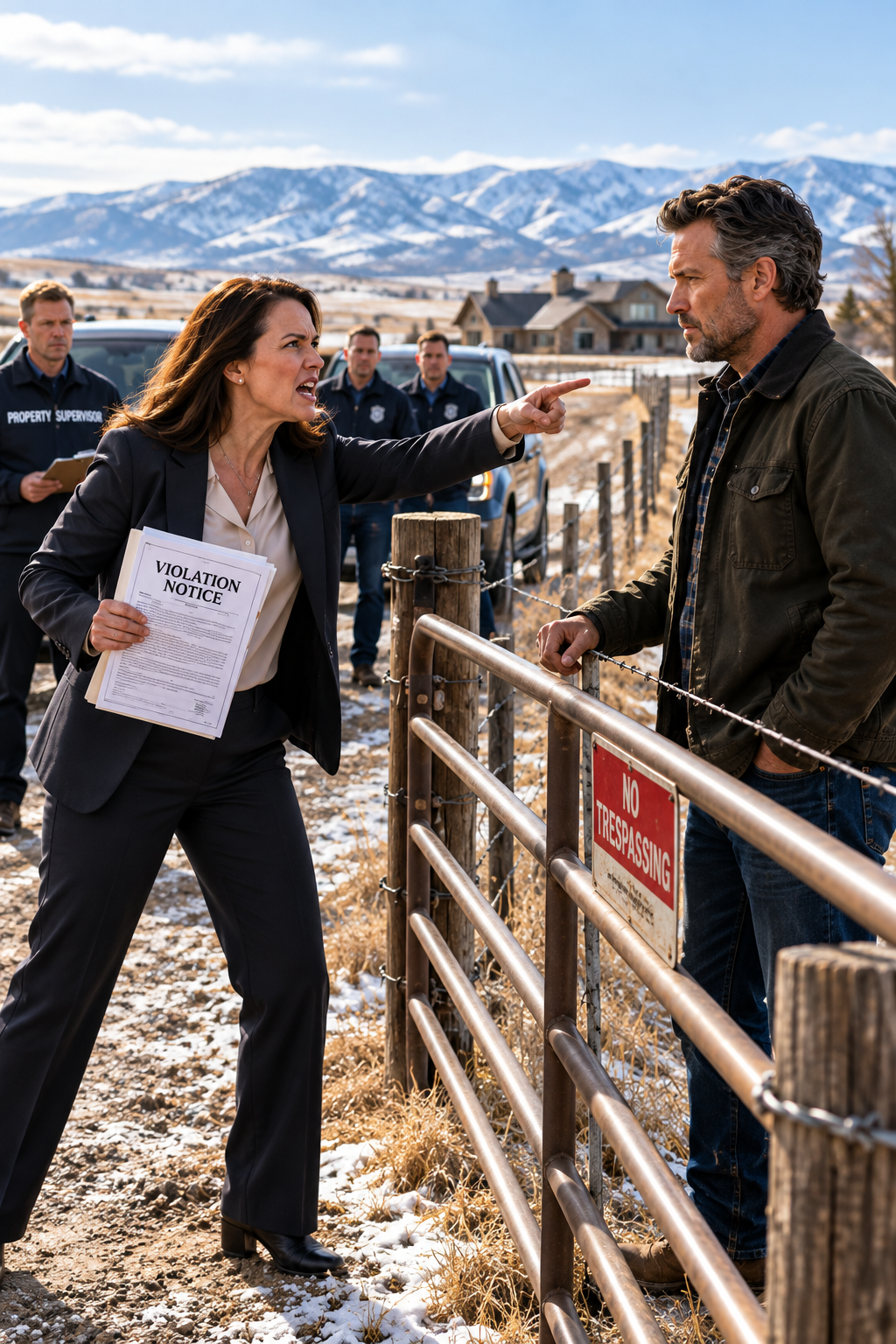
Part 2: The old easement points toward a road the HOA desperately needs
Three weeks before Catherine’s ultimatum, Logan had noticed fresh tire tracks on an overgrown dirt road along his northern boundary. At first, he thought hunters had been cutting through the brush. Then he installed a camera and caught a Silver Pines maintenance truck opening an old gate after dark. Two men drove across his land toward an abandoned substation near the ridge. Logan sent Catherine a polite email asking the association to stop. She answered in seventeen minutes, insisting Silver Pines retained permanent access rights. When he asked for a copy of the easement, nothing arrived.
Three days later, the truck returned. Logan replaced the lock after finding the old one cut clean through. The sheriff’s office called it a civil dispute because Silver Pines claimed access and the immediate damage appeared limited. Catherine followed with a letter warning that Logan could face liability for blocking community infrastructure. That was when he decided a visible boundary was necessary. He designed an electric fence that sat entirely inside his property line, with legally spaced warning signs, certified equipment, and an emergency shutoff inside his barn.
He hired Carter Hayes, a state electrical inspector, to evaluate the system before activating it. Carter examined the voltage, the grounding, the signs, and the emergency controls. His report gave the installation one word: compliant. Logan had not built the fence to injure anyone; he had built it to make trespass harder and the property boundary impossible to overlook. He tested every connection twice before turning it on. When Catherine later appeared beside a contractor who pulled a cutting tool from his truck, Logan called the sheriff, and the two left before deputies arrived.
The fence took nine days to build, with Logan working through wind and frost. He had installed systems around live substations and knew every component needed to meet a clear standard. He kept the voltage at the lowest setting that would deter trespassers without causing lasting harm, and he wired each section to shut down automatically if tampered with. Cameras covered the gate and the northern road. The next morning, Catherine emailed him that the fence had become a safety emergency. Logan saved her message in a new evidence folder.
One video, recorded at 11:43 p.m., showed Catherine standing on his land beside the fence. Her voice carried clearly through the camera microphone: once the fence came down, Logan would not be able to stop the road project. Logan had never heard of a road project. He searched county records and found the Silver Pines Ridge expansion, a plan for forty-two luxury homes, a clubhouse, and an artificial lake. Final approval depended on a second emergency access route because the existing entrance was too narrow. The cheapest route crossed Logan’s old dirt road; going around the ridge would cost $3.8 million.
Part 3: Catherine’s written threats reveal the stakes behind the fence
The development brochures already promised an opening less than eighteen months away. A glossy rendering showed a paved road curling through terrain that matched Logan’s northern boundary. The more he compared the plans, the more obvious the motive became: Catherine did not care about the fence itself. She needed the route it blocked. The 1978 easement had granted temporary access to the local power company for line maintenance, and that right was explicitly tied to the life of the power agreement. The agreement ended in 1996; the substation closed in 1998.
By every document Logan could find, the easement had expired. Yet Silver Pines’s current plans described the same path as permanent community access. Logan found two critical words changed in the newer description, turning limited utility access into something that looked perpetual. He called his attorney, Ryan Caldwell, and laid the maps across his kitchen table. Ryan studied them, then said someone had not merely misunderstood the language. They had built a multimillion-dollar development plan on a right they probably did not possess. He advised Logan to stop confronting Catherine and let her keep putting her claims in writing.
Catherine sent another notice days later, with fines now exceeding four thousand dollars and a demand for an emergency meeting. Logan declined to meet in person and asked that every future communication arrive in writing. In an email meant to force his cooperation, Catherine stated that Silver Pines held an “unrestricted and perpetual right of passage” across his land. Ryan read the phrase twice, then looked at Logan. The next morning, an envelope from the county clerk arrived: Silver Pines had filed a formal notice claiming an easement interest, signed under oath by Catherine herself.
The fines climbed to five thousand, eight thousand, then twelve thousand dollars. A letter from the association’s attorney threatened an emergency court order, legal fees, and a lien against the ranch. Catherine began describing an unnamed landowner in the community newsletter as hostile and dangerous to public safety. Residents sent Logan messages warning him that an ambulance might be unable to reach future homes because of his fence. He checked the emergency route plans; none of them used his property. He saved each message alongside every notice, map, and email.
At a community gathering, Catherine told nearly sixty residents that she alone was protecting them from a safety disaster. Several believed her. Logan’s attorney wanted to respond publicly, but Logan said not yet. When someone was building a false record, he had learned, it could be wiser to let the record grow until the contradictions became undeniable. He created a master timeline of calls, letters, fines, recordings, and planning documents. It reached thirty-seven exhibits before the next move came. Catherine drove to his gate alone and offered to erase every fine if he signed a permanent access agreement.
Part 4: A midnight survey attempt turns pressure into courtroom evidence
Logan asked whether the access would be temporary. Catherine paused. When he asked whether she meant permanent, she brushed the distinction aside as technical language. He asked how much the Ridge expansion was worth. For a moment, something shifted behind her eyes, then she claimed she did not know what he meant. Logan said they had nothing more to discuss. As she turned away, Catherine asked whether he truly believed a fence could protect him. He pointed to the small camera on the gatepost. “Records do,” he said.
At the next morning, Logan’s phone alerted him to a power interruption on the northern fence line. He did not rush outside. He opened the camera feed and saw two trucks and four people near the fence, one wearing a Silver Pines reflective vest and cutting wire away from an insulator. The affected section shut itself down automatically, exactly as designed, and the cameras switched to continuous recording. Logan called the sheriff, then Ryan. Ryan told him not to approach. Logan watched from inside as the men opened the gate, drove across the land, and began setting up survey equipment.
The trucks remained on his property for almost three hours. The cameras caught faces, license plates, equipment, and the moment the men drove away. In daylight, Logan walked the route with a survey-grade GPS unit and marked every tire track and temporary stake. The equipment was not for electrical repairs or emergency access; it was used to measure land. He took the video to Ryan, who called it exactly what it was: evidence that Silver Pines was attempting to establish a route before it had any legal right to use one.
Then they found a message Catherine had overlooked. Three years earlier, Margaret Doyle, the HOA treasurer, had emailed the board warning that the old utility easement had likely expired when the power agreement ended. Catherine’s reply instructed staff to leave the map exactly as it was until the development plans were finalized. Margaret had kept the message because she feared the board might later deny the conversation. When Ryan contacted her, she initially refused to speak. Logan called her himself and told her the email was already part of the discovery file.
Two days later, Margaret arrived at Ryan’s office with a flash drive. It contained minutes from a closed board meeting. In the recording, Catherine said Logan would eventually sell or cooperate; the association only needed to apply enough pressure over time. When a board member asked what would happen if he sued, Catherine answered that he was one man and Silver Pines had a legal budget. Logan listened without visible anger. He asked Ryan if the recording could be used in court. Ryan said yes. A week before the hearing, the HOA offered to erase the fines and pay Logan $75,000 if he signed away permanent road access.
Part 5: The HOA calls Logan’s lawful fence a public danger
Logan read the settlement offer and slid it back across Ryan’s desk. “Simply, court,” he said. On the hearing date, the county courthouse filled with Silver Pines residents, local reporters, and board members curious to see whether one ranch owner could stand against the association’s legal team. Catherine arrived in a tailored dark suit with three attorneys. Logan wore a plain shirt. Ryan brought two boxes of documents, the result of nearly four months of careful recordkeeping.
The HOA’s lawyers described the fence as an aggressive electrical obstruction and claimed the community had long-standing access rights. They said Logan had acted out of spite and created a hazard for residents. Ryan let them finish before calling Carter Hayes to testify. Carter confirmed under oath that the fence was certified, installed within legal limits, and equipped with automatic shutoffs. He had found no documented injury or safety violation. When Ryan asked whether he would classify the fence as an illegal electrical hazard, Carter answered, “No.” The association’s main argument weakened in a single word.
Ryan then introduced the 1978 survey map. The defense suggested the easement had simply carried forward over time, so Ryan asked them to read the termination clause. The judge asked when the underlying power agreement ended. Ryan answered 1996. The judge asked when the substation was decommissioned. Ryan answered 1998. When the judge asked how Silver Pines could describe the access as perpetual, the association’s attorney could only say that it reflected the board’s understanding. Ryan said it was time to examine how that understanding had been formed.
Catherine took the stand. Ryan showed her Margaret’s warning email and asked when she first learned the easement might have expired. She answered that she had learned recently. Ryan displayed the email, dated three years earlier, and her reply instructing staff to leave the map unchanged until the development plans were final. Catherine said she did not remember receiving it. Ryan read her own response aloud, then placed the original 1978 survey and the current Silver Pines map side by side on the screen. Two words had changed. Catherine confirmed under oath that she had approved the newer map.
Ryan moved to the development plan: forty-two luxury homes, a clubhouse, an artificial lake, and a projected value in the tens of millions. Without Logan’s road, an alternate route would cost $3.8 million. Catherine tried to call the dispute a matter of safety, but Ryan showed footage of the men surveying Logan’s land at in the morning. Carter confirmed the equipment was standard surveying gear, not emergency equipment. Ryan asked Catherine what kind of safety emergency required a land survey in the middle of the night. For the first time that day, she had no answer.
Part 6: Catherine’s own recording destroys her safety defense
Ryan played the recording Margaret had saved from the closed board meeting. Catherine’s voice filled the courtroom: Logan would eventually sell or cooperate; Silver Pines only needed to keep applying pressure. Ryan asked whether the daily fines were pressure. Whether the lien threat was pressure. Whether the attempt to force entry and the nighttime survey were pressure. The room stayed still as the audio played again at the judge’s request. One board member lowered his head when his own voice could be heard among the murmurs in the background.
Catherine’s lawyers objected to the recording, but Margaret explained that she had made it as part of the HOA’s routine internal recordkeeping, authorized under its own bylaws. Under questioning, Catherine repeated that everything had been done for community safety. Then frustration broke through. She blurted that Logan was blocking a project that would benefit hundreds of people. Ryan let the silence settle before asking whether it had always been about the project. Catherine’s face showed she understood what she had admitted, and that she could not take it back.
The judge ruled that the 1978 easement had terminated decades earlier. Silver Pines had no access right across Logan’s land, his electric fence was lawful, and every fine issued against him was void from the beginning. The association had to withdraw its claimed easement filing from the county record. A permanent injunction barred Silver Pines and its contractors from entering Logan’s property again. The judge criticized the HOA for continuing to assert a right after internal warnings had said it did not exist. Questions of damages and legal costs were sent to a later hearing.
But the consequences extended beyond the fence. The Ridge expansion could not receive final approval without a second emergency route. The cheaper route across Logan’s land no longer existed, forcing the HOA to consider the alternate road around the ridge. With updated surveys and rising material costs, that route was now projected at $4.6 million. Residents who had put deposits down began demanding answers. When the board released its legal spending, the total was enough to have paid for a third of the road they had tried to avoid building.
The association’s anger turned toward Catherine. Board members learned she had received Margaret’s warning three years earlier and had chosen to conceal it. At a special meeting, Catherine insisted her decisions had been meant to protect property values. Margaret stood and asked why, then, she had buried the warning about the expired easement. No one defended Catherine. The vote to remove her from leadership passed without discussion. She gathered her folder and left through a side door rather than walk past the residents gathered near the entrance.
Part 7: A new board offers a lawful agreement instead of threats
Two days later, Logan was repairing a fence post when a car pulled up outside the gate. This time it was the HOA’s newly retained attorney, carrying an envelope and asking whether Logan would consider a formal offer. Logan looked past him toward the old dirt road, then back at the fence. He asked whether Silver Pines still wanted access. The attorney answered honestly: they wanted it very badly. The new board was not asking him to surrender his property. It was asking to negotiate.
Logan agreed to discuss a legitimate easement, but only on clear terms. The road would shift east, away from the house and the original route. Silver Pines would pay for a sound barrier and proper drainage along the new alignment. The permitted use would be limited to emergency traffic and a short list of specified purposes. The agreement could not contain words like “unrestricted” or “perpetual.” Any future change would require Logan’s written consent, and the association would disclose the legal costs of the dispute to its residents.
The board accepted every condition. An independent appraisal set fair compensation for the easement. Logan was not signing because Catherine had threatened him or because he had been worn down by daily fines. He was signing because the new board had come to him as an equal and offered a document that said what it meant. Ryan drafted the agreement and read each clause aloud twice before they signed. The new chair, Douglas Pharaoh, shook Logan’s hand and said the association owed him an apology. Logan told him a clear agreement mattered more.
The survey crews returned in the weeks that followed, this time with permits, scheduled visits, and a foreman who knocked before entering. The road slowly curved east, away from Logan’s home, as he had required. Silver Pines funded a sound barrier and drainage improvements that proved sturdier than Logan expected. Construction noise became a distant hum rather than a constant intrusion. Residents could see the difference between a demand issued under false authority and a negotiation conducted with respect.
Margaret sent Logan a short note thanking him for never making the fight personal toward her. He wrote back that she was the reason the truth had reached daylight. Carter visited twice that year, not as an inspector but as a neighbor checking on the ranch. He told Logan he had rarely seen a case where the paperwork told such a complete story on its own. By then, the fence remained in place, the road was being built, and the Silver Pines board had learned that access was possible only through honest agreement.
Part 8: The road shifts, the fence remains, and Logan reclaims his quiet
By the time the snow melted, the northern road was taking shape along its new route. The sound barrier softened the construction noise, and the drainage work kept water from cutting through Logan’s land. The fence still stood exactly where he had built it, warning signs fastened at regular intervals. Ryan stopped by one afternoon, looked along the wire, and observed that the fence itself had not won the case. Logan took a slow sip of coffee and agreed. Records had won it.
When Ryan asked why Logan planned to keep the fence up, Logan looked toward the road in the distance. Boundaries only meant something when people could see where they stood, he said. Catherine had lost her position, the expansion had been delayed more than a year, and the association had spent hundreds of thousands on legal fees, surveys, and settlements. It had all begun when she looked at a fence on land she did not own and decided her title gave her the right to cross it. She had been wrong about the law, the easement, and Logan.
The new agreement gave Silver Pines the emergency access it needed without granting ownership or unlimited use. The road was narrower than Catherine’s original plan and ran farther from Logan’s home. Its drainage and sound barrier had been included from the start, rather than added after a dispute. The association had a practical solution, and Logan had a written guarantee that future changes required his permission. The final agreement was clear enough that no one could quietly convert its limited terms into something broader.
Catherine’s case continued through the appropriate legal channels after the judge referred her sworn misstatements for further review. The public record preserved the court’s findings and the association’s withdrawal of its easement claim. Logan did not spend his days following every development. He had done what he could: preserved the maps, recorded the threats, answered questions, and insisted the law be followed. The rest belonged to investigators, attorneys, and the community that had once accepted Catherine’s version of events without asking for proof.
Red Hollow eventually settled into its ordinary rhythm again. Mornings brought frost over the fields, cattle moving slowly beyond the fence, and the low hum of the new road in the distance. Silver Pines residents returned to meetings about landscaping and maintenance, but the conversations had changed. Someone would ask whether a proposed project crossed a property line. Someone else would ask for the survey. The questions were small, but they reflected a difference: no one assumed that a confident voice could make a claim true.
Logan had never built the fence to start a war. He built it after repeated trespass, cut locks, threats, and the discovery that a supposedly permanent access right rested on an expired utility agreement. He had spent years working around infrastructure and security, and he knew patience only mattered when it was paired with careful preparation. He brought the maps, the timeline, the video, the inspector’s report, and the written threats. In the courtroom, the loudest person was not the one telling the truth.
The fence remained along the northern edge of the Mercer ranch, cleanly marked and safely powered. On quiet nights, the warning signs reflected the porch light while the fields froze under the stars. Logan could look across his land without wondering whether someone would arrive before dawn with trucks and survey stakes. The road existed now, but it was where the agreement said it would be. His property, his home, and his right to say no had survived Catherine’s campaign. This time, the record was clear, and the line was his to keep.
✓ Lynn R. Adams
Part 2: The old easement points toward a road the HOA desperately needs Three weeks before Catherine’s ultimatum, Logan had noticed fresh tire tracks on an overgrown dirt road along his northern boun…