The morning a logging crew marked my father’s walnut trees for cutting, I learned our HOA president had sold the rights to all 40 acres behind my house, even though my property had never belonged to her subdivision; when she produced a polished map saying otherwise, I went looking for the older county record she hadn’t counted on…
The morning a logging crew marked my father’s walnut trees for cutting, I learned our HOA president had sold the rights to all 40 acres behind my house, even though my property had never belonged to her subdivision; when she produced a polished map saying otherwise, I went looking for the older county record she hadn’t counted on…
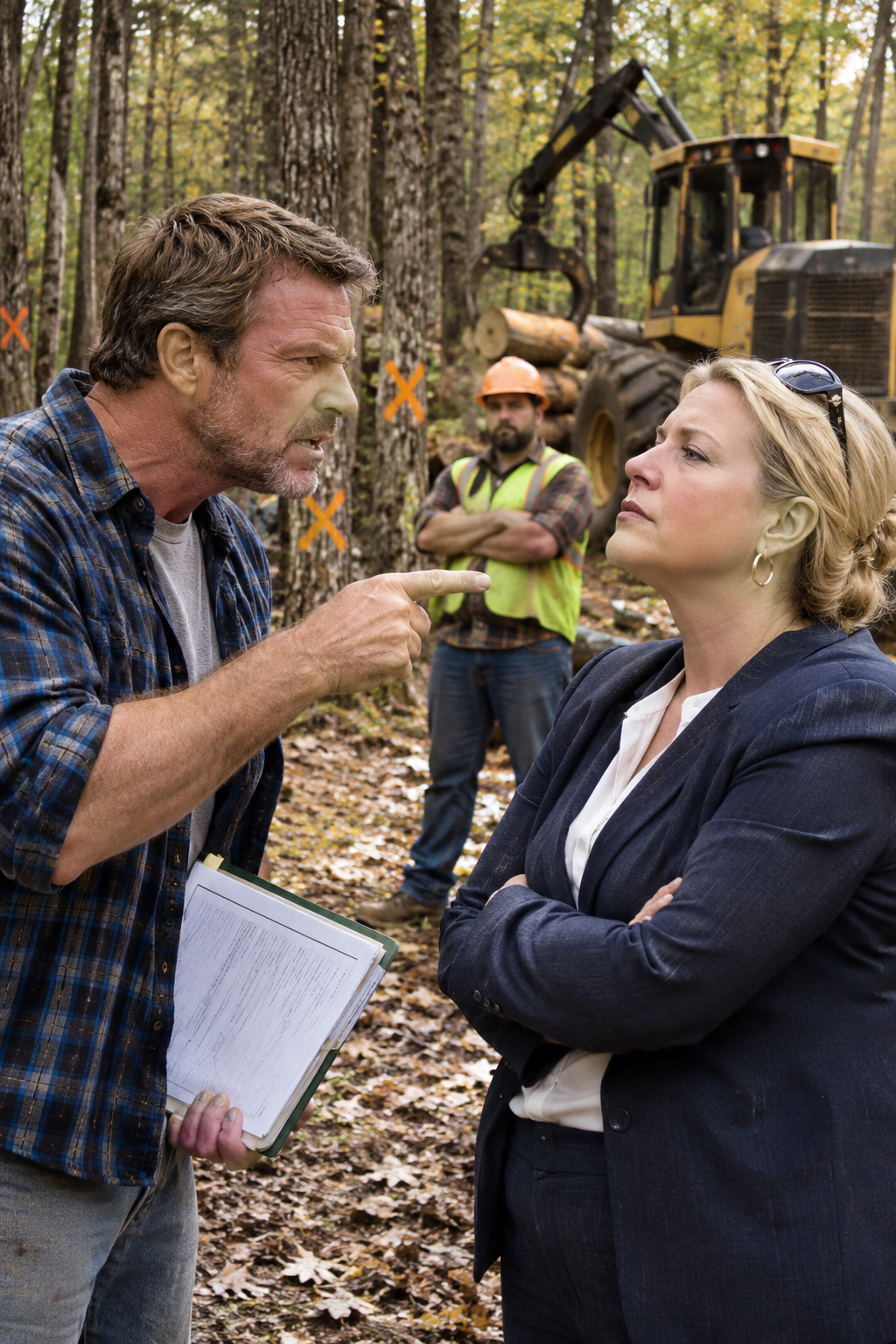
I heard the skidder before I saw it. On Saturday morning, diesel smoke hung between the walnut trees my dad had planted, and fresh orange X marks ran down the trunks along his walking trail. A foreman stepped toward me holding a clipboard, as if the machines tearing through our woods were an ordinary delivery.
The paper on that clipboard was a logging-rights contract. At the bottom was the signature of Denise Caldwell, president of the neighborhood homeowners association, and behind it was a map labeling my back 40 acres as “HOA common area, Lot 12B.” Nobody had asked my permission to bring a crew onto my property, much less sell my trees.
I called Denise while the foreman waited. “Kyle, I’m going to stop you right there,” she said before I could get much out. “That land belongs to the HOA. The board voted, the contract is signed, and you don’t get a vote.”
I told her I had the deed in my house. She called it my “little deed” and said a board resolution overruled it, then threatened daily fines and having me trespassed if I got in the crew’s way. By the time she hung up, I was standing beside trees my father had spent decades tending, trying to understand how a stranger could sign them away.
My name is Kyle Ramsey, and my dad was Ed Ramsey. More than 40 years earlier, he bought our house and the 40 acres of hardwood behind it, all one continuous property. He planted walnut and white oak, measured out rows, and cut trails where he taught me how to work with the grain of a tree and why you never take more from a woodlot than it can replace.
Dad died three years ago and left the place to me. Near the end of his life, he sat with me at the kitchen table and said, “I had every inch surveyed and marked, Kyle. Don’t let anybody tell you different about where it starts and ends.” I remembered nodding without giving those words much thought.
The woods weren’t just sentimental. In five or six years I planned to selectively harvest some mature walnut, replant, and use the income toward retirement while keeping the land healthy. Dad had spent his life thinking in decades, and I intended to do the same.
Fifteen years ago, a developer built a subdivision on farmland surrounding our place. Its homeowners association managed the new homes and common areas, but the Ramsey property was excluded from the development. We had our own deed, our own boundaries, and no reason to join their board meetings.
For 13 years that arrangement caused no trouble. Then Denise became HOA president and knocked on my door with a proposal: give the back 40 to the association as a community green space. She said it would improve neighborhood property values and be a generous thing to do. I told her the land wasn’t available.
Letters followed on HOA stationery, first asking me to reconsider and then referring to the board’s “strong preference” and possible “reclassification.” I kept them in a drawer. When they stopped coming six months ago, I thought Denise had finally accepted my answer.
That Saturday I learned she had been doing something else. The foreman’s contract was with Cascade Timber LLC for rights to log my acreage, and the map attached to it made my private woods look like HOA property. The foreman was working from documents he believed were legitimate; he had no reason to know how Dad’s land had ended up under a subdivision lot number.
After the engines went quiet, I went inside and took my deed from the safe. I called Craig Ellison, a local attorney I trusted, and explained what the crew had handed me. He listened, then said, “Your deed may win in court, Kyle, but a lawsuit takes time. Those trees won’t grow back.”
Sunday morning I laid the deed across the kitchen table. Its legal description covered the house and back 40, with no HOA parcel or common-area exception. Craig confirmed that the recorded deed established my ownership, though he warned that Cascade Timber could argue it had relied on Denise’s contract and map in good faith.
I emailed the company a scan and asked them to stop all work. Their counsel replied that Cascade had a contract with the HOA and that I should take my dispute to the board. So on Tuesday evening, I walked into an HOA meeting carrying the deed and the best patience I could manage.
Denise sat at the head of a row of folding tables beneath bright fluorescent lights. Glenn Tucker, Pam Shields, and Neil Barton sat with her. I read the deed’s parcel description aloud and explained that my father’s land had never been included in their subdivision.
Denise opened a thick binder and spread out a laminated, color-coded map. The green section covering my trees was marked as Lot 12B, HOA common area. She told everyone the map had existed since the subdivision was founded and claimed the board had unanimously approved selling the timber rights to fund the Legacy Clubhouse project.
“How old is that map?” I asked. “It’s been on record from day one,” she answered without looking away. Glenn and Pam nodded, and I could see they trusted the binder more than the deed I was holding.
I asked for a copy. Denise said that would take time, then pushed for a vote to uphold the logging contract. She, Glenn, and Pam voted yes; Neil alone voted no. He didn’t make a speech, but the way he shook his head stayed with me.
The next morning, an HOA violation notice arrived at my house. It demanded $250 a day for obstructing what Denise called authorized land-management operations. The crew was due back Monday, and the association was now billing me for trying to keep chainsaws off my own property.
I could have spent the rest of that week arguing over which paper looked more official. Instead, I drove to the county recorder’s office on Wednesday and asked for the original development plat filed 15 years earlier. A clerk retrieved a large sheet with the county surveyor’s stamp and signature, its edges worn from years of storage.
I unfolded it across the counter and found our property on the first careful pass. The back 40 was clearly identified as “Ramsey Private Parcel” and excluded from HOA common area. On the northeast side of the subdivision, Lot 12B was a little quarter-acre playground, nowhere near my woods.
My hands stayed flat on the county map while I looked from that playground to the 40 acres Denise had colored green in her binder. She hadn’t simply misunderstood a boundary; someone had moved a lot number from a playground onto my father’s land. I photographed the original plat and the version I’d seen at the meeting, but now I had to find out whether proof on paper could stop the crew in time. Part 2…..
I sent both maps to Craig from the recorder’s parking lot. He called back and said the discrepancy was strong evidence that Denise’s HOA map had been altered, but he wanted to know where the timber money had gone. I hadn’t even known she’d been paid yet.
Then Craig told me the contract was worth $185,000, with a $55,000 deposit already paid by Cascade Timber. I pictured the orange X marks on Dad’s walnuts and had to set the phone down for a moment. She had put a price on the woods before I knew a deal existed.
Neil Barton answered when I called. He said he had voted against the contract because the deposit never appeared in the HOA’s general fund. According to him, Denise had opened a separate “HOA Capital Projects Account” and made herself the only person authorized to sign on it.
Neil had questioned the arrangement before, but Denise called it standard procedure for a large project. He told me Glenn and Pam had accepted her explanation. I thanked him and passed everything to Craig, careful not to mistake an unusual account for proof I could already establish where the money had gone.
Craig filed for an emergency temporary restraining order Thursday morning. We asked the court to halt logging while ownership was sorted out, and a hearing was scheduled for that afternoon. Two hours before it began, Neil called again: Denise had learned about the filing and was urging Cascade to start cutting over the weekend instead of waiting until Monday.
At the courthouse, Craig put my deed, the original county plat, Denise’s altered map, and the timber contract before Judge Adler. Denise’s attorney, Lyle Peterson, produced another document: board resolution 2024-09, supposedly signed 18 months earlier by Denise, Glenn, and Pam. It claimed my back 40 had been annexed into HOA property under an unrecorded easement from the original developer.
I knew my father had never given away an acre. But Judge Adler said he had conflicting records before him and couldn’t conclusively settle ownership in that emergency hearing. He denied the temporary order without prejudice and scheduled a full evidentiary hearing for October 14, three weeks away.
Outside the courthouse, Craig rested a hand on the roof of my truck. He still believed the recorded plat and deed would prevail, but a hearing three weeks off couldn’t protect a tree scheduled to be cut on Saturday. I stared at the truck keys in my palm, feeling how little a victory later would mean if the woods were gone.
I called Cascade and asked to speak directly with its owner, Dennis Harlan. He told me he’d been in the timber business 30 years, had a signed contract and a crew to pay, and couldn’t stop operations merely because two sides were arguing over paperwork. Denise, he added, was already threatening him with a breach-of-contract lawsuit if he delayed.
“What would convince you?” I asked. “Proof on the ground,” Dennis said. His men could walk the boundary Saturday morning with their GPS equipment, and if physical markers matched my documents, he promised his crew would not cut a tree.
When I got home, I pulled open the bottom drawer of Dad’s old filing cabinet. Behind tax returns sat a manila folder marked “Back 40 Survey.” Inside were the original survey showing iron pins and concrete monuments at corners and intermediate points, plus a licensed surveyor’s recertification from four years earlier when I’d refinanced the mortgage.
I called Dennis back and explained the survey, the monuments, and the recent verification. He agreed to have his foreman walk the line, though Denise was still pressing him to begin immediately. It was the first practical opening I’d had since the skidder appeared.
That evening I took a flashlight into the woods. The survey placed an iron pin about 12 inches below ground, 40 feet east of an old fence post at the southeast corner. I pushed aside leaves, scraped at the earth, and felt my fingertips strike solid metal exactly where Dad’s paper said it would be.
For a while I stayed on my knees beside that pin. Three years after losing Dad, I could still feel the shape of a promise he’d made at our kitchen table. I didn’t dig up the other markers; I wanted Cascade’s crew to locate them independently, so no one could claim I’d arranged the evidence for a meeting.
Part 3 Saturday morning I reached the clearing at , with fog lying low under the trees. Dennis arrived at six in a white F-350, followed by foreman Travis Cole and four crewmen in two trucks. I had the deed, the original plat, and the survey recertification in a folder, and Travis looked them over before setting out.
Then a black SUV pulled up. Denise stepped out in a blazer and heels, with Glenn in the passenger seat, and warned Dennis that his company would be liable for delaying an approved HOA contract. Dennis kept his voice even: “We’re walking the boundary first. Standard due diligence.”
Denise turned to me and repeated her threats about fines and legal action. I didn’t argue; I led Travis toward the southeast corner, with Dennis, three crewmen, Denise, and Glenn following. I pointed out the area near the fence post and let Travis do the digging.
His spade struck metal beneath the soil. He checked the iron pin against the GPS coordinates on my survey and looked over at Dennis. “It’s a match,” he said, while Denise insisted that one old pin proved nothing.
Dennis told him to keep walking. At the south midpoint the crew found a concrete monument that matched, then another iron pin at the southwest corner. They followed the western boundary north and confirmed the intermediate pin there, each one agreeing with the survey Dad had preserved.
At the northwest corner, Travis brushed dirt from a concrete monument topped with a brass cap. It bore a surveyor’s license number, a date, and the words “Ramsey parcel.” Travis checked the coordinates one more time and spoke into his radio: “Boss, every marker matches his survey. This is not HOA land.”
Dennis’s reply came back through the trees. “Pack it up. We’re done here.” I heard trucks starting in the distance but kept looking at that brass cap, trying to absorb what it meant that the people hired to cut my trees had just verified they stood on my property.
Denise said the board had reclassified the land 18 months earlier and that the old markers didn’t matter. I showed everyone the recertification from four years ago. Glenn looked from it to Denise and said, “You told me there was no survey. You said the developer filed that map.”
Denise told him to stop, but Glenn said he and Pam had failed to check what she’d given them and that he was calling the county. Dennis came over to apologize for nearly proceeding on the wrong land. He promised Cascade’s cooperation with any investigation and said the company intended to recover its $55,000 deposit from Denise.
The last truck left the trail, and Denise walked back to her SUV by herself. I stayed beside the northwest monument until the engines faded. Dad’s trees were still standing, but now I needed to learn whether the people who had signed away my woods would be held accountable.
Craig reported the suspected forgery, fraudulent timber-rights sale, and possible misuse of HOA funds to the county sheriff on Monday morning. Investigators opened a case and obtained records for Denise’s capital projects account within the week. The $55,000 Cascade deposit had gone into that account, and $12,000 had been transferred to Denise’s personal checking account.
That transfer changed the questions the investigators were asking. Neil hadn’t known where the deposit had gone when he called me, and neither had I; now there was a bank trail. The Legacy Clubhouse project had been the board’s stated reason for the sale, but that money had not simply been set aside in the ordinary HOA general fund.
Cascade Timber voided its contract. Dennis provided a sworn statement that his crew had found the boundary markers and that the positions matched the recorded survey. He also made clear the company wanted its deposit returned, rather than treating the agreement as a logging dispute it could simply walk away from.
Neil called an emergency HOA meeting and chaired it himself. Glenn and Pam acknowledged that Denise had shown them the altered map as if it came from the original developer and that they had failed to verify it. Both withdrew their support for resolution 2024-09, and the board voted unanimously to void it.
The $250-a-day fines against me were rescinded, and the HOA issued a written apology. The board removed Denise as president, barred her from future board positions, and took her name off association accounts and committees. I put the apology with my deed instead of hanging it on a wall.
The criminal case took longer than the board meeting. I kept walking the property while the attorneys and investigators worked, noticing tire ruts on Dad’s trail and the paint marks still on the walnuts. The trees were safe from Cascade’s contract, but the damage to the ground and the cost of defending my ownership were real.
Final Eventually Denise pleaded no contest to felony fraud and forgery. The judge sentenced her to 18 months of probation and ordered $15,000 in restitution to cover my legal fees and damage caused by the equipment. The court also ordered the $55,000 timber deposit returned to Cascade Timber; the $12,000 transfer to Denise’s personal account had been part of the evidence examined in the case.
The county records formally reconfirmed the Ramsey property as private land outside HOA jurisdiction, with a notation intended to prevent another unsupported reclassification. Craig called after the last hearing and said, “Your dad would have enjoyed this one, Kyle.” I could almost hear Dad’s laugh when I told Craig he was right.
A few days later, I walked out alone in the late afternoon. Orange paint still showed faintly on some walnut trunks, but every one of them was standing, and the trail through the oaks was quiet again. I passed the row of walnuts Dad had planted the year I was born, then followed the old path to the southeast corner and knelt where I’d scraped away the soil with my flashlight.
My fingers touched the iron pin Dad had placed there decades earlier, cold and solid beneath the earth. “Still here, Dad,” I said. I meant the marker, the trees, and something of him I hadn’t realized I could almost lose.
THE END. I’ve shared the complete story, and I truly hope it touched your heart. If this story moved you, please , like, and share the post. Thank you for reading! ❤️
✓ Lynn R. Adams
The morning a logging crew marked my father’s walnut trees for cutting, I learned our HOA president had sold the rights to all 40 acres behind my house, even though my property had never belonged to h…