The morning a bulldozer demolished my grandfather’s sixty-year-old boathouse,
Part 2: An ancient property deed revealed the HOA’s greatest secret.
The county recorder’s office was an hour away through farmland, and I arrived before opening with terrible gas-station coffee and a folder containing everything I had recovered from Dutch’s workshop. A clerk named Doreen studied the old deed, recognized my grandfather’s name immediately, and told me he had once helped her husband rebuild a barn without accepting payment. She led me to archived records covering Lakewood’s earliest development years, including documents that had never been digitized into the modern search system. I watched faded images appear on an old reader while she traced transfers, recorded agreements, and amendments going back more than half a century. The deeper we searched, the more I realized Dutch had been involved in a property arrangement far more complicated than anyone in the modern subdivision apparently understood.
In 1963, Dutch and Bernard Cross had acquired forty-two acres intending to create an affordable lakeside community for families who could not purchase expensive vacation property outright. Their partnership collapsed during financial difficulties, and recorded documents appeared to show that Bernard transferred his remaining interest to Dutch in 1965. The following year, Dutch established long-term lease arrangements for several homesites while retaining certain surrounding land, roads, and common areas. Later subdivision documents described four separately recognized residential lots but contained troubling inconsistencies about the ownership of the remaining acreage. Doreen cautioned that recorded documents needed professional interpretation, yet the history suggested the modern HOA might have relied on assumptions that no title examiner had ever properly verified.
The most startling entry involved a 1998 plat depicting a large tract of retained land surrounding the original homes, including access roads, drainage areas, and sections now occupied by neighborhood amenities. A later development company had purportedly transferred portions of that land to Mirror Lake Estates when the luxury subdivision was established. However, the chain of title supporting that transfer appeared incomplete, with at least one document referring to a prior conveyance Doreen could not locate. I photographed the records and ordered certified copies, knowing an old filing alone could not magically make me owner of every modern building. Nevertheless, the discrepancies were serious enough that any responsible attorney would need to investigate before accepting the HOA’s claim of unquestionable ownership.
On the drive home, I kept thinking about the land beneath Vivica’s elaborate clubhouse and how confidently she had described herself as the guardian of community property. The possibility that her organization had paid hundreds of thousands for improvements on land it might not own was almost unbelievable. I wanted to call her immediately, but years of engineering had trained me never to announce conclusions before checking the measurements. Instead, I contacted Shauna Briggs, a real estate attorney recommended by a former colleague, and requested an appointment. Her receptionist warned me that complicated title disputes could become expensive, and I told her the situation had already become expensive in ways money could not repair.
Before the appointment, I visited the boathouse ruins again and found an HOA notice demanding that I remove the remaining debris at my own expense. The letter claimed the demolition had been authorized under architectural enforcement provisions, even though I had repeatedly disputed the association’s authority over the historic structure. I photographed the sign and the surviving foundation, then examined the tree line where Dutch used to hang fishing nets after long afternoons on the lake. Beneath a broken board, I found a small brass hook he had installed for Lillian’s old sunhat, which she always forgot on the dock. I held it in my palm and felt a fresh wave of grief that made the entire lawsuit seem both painfully necessary and terribly small.
My daughter Emma called that evening from Seattle after I sent her copies of the title records and photographs of the demolition. She worked as a paralegal and immediately warned me that owning a family residence did not necessarily mean inheriting every asset associated with a decades-old development. I told her I understood, but the incomplete transfers and archived plats suggested something had been overlooked or deliberately concealed. She asked whether I was sleeping, eating properly, or doing anything besides studying property records, and I admitted I had neglected most ordinary routines since the demolition. Three hours later, she texted that she had booked a flight because she intended to help me sort the documents before I buried myself beneath them.
At our first consultation, Shauna examined the recorded plats, the HOA’s fine notices, and the demolition authorization before speaking. She explained that the historical deeds could support claims involving ownership, easements, or improper transfers, but that the answer depended on the complete chain of title and whatever interests later purchasers had lawfully acquired. More immediately, she questioned whether the association had provided adequate notice and possessed the authority to demolish my boathouse over the disputed violation. She recommended an independent survey, professional title examination, and preservation of the demolition records before any further confrontation. When I mentioned that the clubhouse might stand on retained family land, she looked up sharply and said, “Mr. Cordell, this may be much bigger than a three-hundred-dollar fine.”
Part 3: My daughter uncovered a forgotten trust protecting our family legacy.
Emma arrived carrying a suitcase, two laptops, and the kind of irritated affection only an adult daughter can direct toward a father who has forgotten how to take care of himself. She walked into my kitchen, saw the stacks of papers covering every available surface, and announced that I needed a shower before she would discuss a single legal document. I told her the papers were organized, and she replied that arranging piles by how recently I had panicked did not count as a filing system. For the first time since Lillian died, I laughed hard enough to surprise myself. Emma smiled briefly, then rolled up her sleeves and began turning Dutch’s chaotic archive into labeled folders.
We worked through deeds, probate records, old correspondence, tax statements, insurance policies, and photographs until long after midnight. Most items concerned ordinary family expenses, but one yellowed envelope caught Emma’s attention because Dutch had written “Cordell Family Land Trust” across the front in thick black lettering. Inside was a notarized trust instrument from the 1960s, accompanied by amendments and schedules identifying the original forty-two-acre tract. Emma read the language slowly, then compared the property descriptions with the historical records I had collected from Doreen. The documents suggested that Dutch had transferred substantial retained property interests into a family trust intended to benefit his descendants and preserve his original community plan.
We discovered that the trust named successor trustees and outlined procedures for continuing management after Dutch’s death. Although the documents required professional review to determine whether later transactions had altered the trust’s holdings, they provided a plausible explanation for the mysterious gaps in the modern ownership records. Emma found correspondence from Dutch objecting to a proposed redevelopment plan in the late 1990s, arguing that common recreational areas had never been sold outright. Several letters also mentioned long-term homesite arrangements designed to protect residents from sudden displacement. The longer I read, the clearer it became that my grandfather had been defending a particular vision of the lake long before Vivica ever arrived.
At three in the morning, Emma looked at the demolition photographs and asked whether I wanted to establish ownership so I could destroy Vivica’s neighborhood in retaliation. I admitted the idea of watching her confidence collapse was satisfying, especially after she smiled through the destruction of something Lillian treasured. But I also remembered Dutch helping neighbors with repairs, lending tools without keeping score, and letting children fish from his dock regardless of whose property their parents occupied. He never wanted a private kingdom populated by frightened tenants. I told Emma I wanted the truth established, the stolen money returned if wrongdoing was proved, and the community protected from another person who believed power meant making others suffer.
The next morning, Shauna reviewed the trust documents and immediately ordered a comprehensive title search. She explained that trust language about leases and revocation would not automatically erase later property rights, particularly where families had purchased homes relying on recorded instruments and title insurance. Any successful resolution would need to account for legitimate homeowners, lenders, easements, and the public interest rather than using an old document as a shortcut to mass eviction. I told her no one would lose a home simply because I wanted to punish Vivica. Shauna nodded and said that decision would strengthen our credibility more than the most dramatic legal threat imaginable.
We hired a licensed surveyor named Travis Hale, a young professional who arrived with modern measuring equipment and an enthusiasm for historical boundary monuments that would have delighted Dutch. Over two days, his crew compared recorded descriptions, original markers, modern plats, and existing improvements around the lake. Their preliminary report identified significant discrepancies affecting the clubhouse parcel, several road sections, and portions of eleven residential properties. Vivica’s garage appeared to extend several feet into an area whose ownership remained disputed, while portions of the recreation complex overlapped land associated with the old family trust. Travis warned that the survey established physical locations, not ultimate legal title, but his work gave Shauna precise evidence to use in court.
Vivica learned about the survey and posted a warning in the neighborhood’s online group, accusing suspicious outsiders of trespassing around community amenities. She directed residents to report anyone measuring property lines without HOA authorization, ignoring the fact that licensed professionals had been working with permission where necessary. Gus responded that perhaps measurements were appropriate after the association demolished a historic boathouse under disputed authority. His comment disappeared almost immediately, and he called to tell me Vivica had begun contacting neighbors about my supposed conspiracy to seize their homes. I realized she had already chosen her strategy: turn ordinary families against me before they learned what the records showed.
That night, Emma found another document that changed the direction of our investigation. A statement in Dutch’s files suggested property taxes had been assessed differently across the retained land over the years, while modern HOA disclosures described several common areas as though their tax status were settled. We could not determine whether the problem reflected outdated records, legitimate exemptions, or unpaid obligations, so Shauna advised requesting a formal review rather than jumping to conclusions. I stared at the trust document and wondered how many people had relied on questionable information without ever examining the original files. Then I looked through the window at the empty place where the boathouse once stood and knew our next step would need to be public, careful, and impossible to dismiss.
Part 4: Secret HOA payments exposed a devastating scheme against innocent families.
The first residents willing to listen were not wealthy newcomers but older neighbors who remembered Dutch and understood why the boathouse mattered. Gus, a retired postal worker with an extraordinary talent for remembering names, helped arrange conversations without turning them into confrontations. We explained that the legal review concerned disputed historical ownership and improper enforcement, not an attempt to take anyone’s residence. Several homeowners admitted they had long questioned the HOA’s finances but feared retaliation if they challenged Vivica. Within a week, twenty-two households supported a request for an independent audit, including residents who had never spoken to me before.
One of them was Dana Mitchell, a retired accountant who brought a binder of HOA financial statements to my kitchen table. She had served briefly on a finance committee before resigning after Vivica repeatedly refused to provide supporting invoices for expensive consulting arrangements. Dana pointed out recurring payments to a management company connected with Vivica’s husband, Leonard, along with renovation expenses that seemed inconsistent with the work residents remembered seeing. We compared the statements with available business records and discovered that several vendors shared addresses or registered agents. Dana warned us not to equate every questionable payment with embezzlement, but she said the numbers demanded explanations the board had never supplied.
Shauna used the pending litigation to seek relevant contracts, approvals, invoices, and payment records through proper discovery procedures. When the documents arrived, Dana and Emma organized them while I checked dates against construction projects I remembered from the neighborhood. A consulting company associated with Leonard had received monthly transfers totaling hundreds of thousands of dollars over several years without clear evidence of services matching the invoices. Another large payment involved a development consulting business whose registration history did not appear consistent with the dates on the HOA’s records. The discrepancies were substantial enough that Shauna referred the financial evidence to appropriate investigators rather than treating private suspicion as a criminal verdict.
The most disturbing documents concerned the Reagan family, who had once lived four houses down from Gus. The Reagans were schoolteachers who fell behind on disputed association charges during a period of financial hardship, and Vivica’s administration pursued aggressive collection action against their property. They eventually lost their home through a foreclosure process, and a company connected to Leonard acquired an interest before the property was resold at a much higher price. We did not yet know whether the transactions were unlawful, but the timing, related parties, and financial outcome raised serious questions about conflicts of interest. When I saw photographs of the Reagans with their children beside the house they lost, I understood that my ruined boathouse might be only one example of a much broader pattern.
Emma found their current address through lawful public sources, and Shauna arranged for someone from her office to ask whether they wanted to discuss the case. Mrs. Reagan initially refused because the entire experience had left her deeply distrustful of lawyers and anyone connected with Mirror Lake. When she eventually agreed to speak, she described years of escalating notices, collection fees, confusing payment demands, and the humiliation of explaining to her children why their family needed to move. She said Vivica had personally told her that protecting community standards sometimes required difficult decisions. I listened quietly, remembering how casually that same woman watched my grandfather’s handiwork disappear beneath a bulldozer.
Gus and I began organizing small gatherings where residents could ask questions about the title records and financial concerns without committing themselves to any particular legal position. Some feared that challenging the HOA could invalidate their mortgages or create expensive ownership disputes, and their worries were reasonable. Shauna attended several sessions to explain that legitimate interests would need protection and that the outcome of a title lawsuit could not be predicted from a few dramatic documents. I promised to support settlement terms preserving residents’ homes wherever legally possible. Little by little, people began realizing that the safest course was not blind loyalty to Vivica but an honest examination of what their association actually owned and owed.
Vivica responded with an emergency board meeting announcing a proposed special assessment to finance legal defenses against what she called my coordinated attack. Leonard stood beside her and warned that the neighborhood’s reputation would collapse if residents questioned their leadership publicly. Dana rose and asked why the board had paid a large consulting invoice to a company with unclear operations, producing copies of the relevant records. The room grew silent as Vivica refused to answer directly and attempted to end the discussion. For the first time, her neighbors watched her leave a meeting without controlling the final word.
Later that evening, Leonard called me and proposed ending the dispute with a settlement that would waive the contested HOA charges and pay me additional compensation. He insisted the arrangement would spare everyone the expense and embarrassment of continued litigation, but he refused to address the larger title questions or provide an accounting of association funds. I told him any settlement needed to pass through counsel and include appropriate remedies for the destruction of my property. His tone hardened as he warned me that powerful people had invested too much in Mirror Lake to tolerate interference. I ended the conversation and forwarded the details to Shauna, realizing that the Drummonds were no longer confident they could win simply by issuing another fine.
Part 5: She tried to intimidate me while her financial empire unraveled.
The week after the financial questions became public, someone spray-painted the word “THIEF” across my mailbox in red letters large enough to be seen from the road. Another morning, an HOA maintenance truck blocked my driveway while its driver insisted he had been instructed to park there during scheduled work. No permit or maintenance activity justified the obstruction, and the vehicle left after I contacted the proper authorities. Anonymous letters appeared in nearby mailboxes accusing me of trying to take residents’ homes and claiming I had deliberately destroyed my own boathouse for sympathy. I preserved the letters, photographs, camera recordings, and witness accounts without pretending I knew who was responsible for every incident.
The retaliation frightened Emma more than she admitted because she understood how quickly disputes could become dangerous when powerful people believed they were cornered. She urged me to let investigators handle suspicious conduct and reminded me that confronting Vivica personally would only create opportunities for more accusations. I agreed, although every new incident made it harder to remain calm. We changed locks, improved exterior lighting, documented visitors, and arranged for contractors to avoid working alone on isolated parts of the property. The practical steps gave us some sense of control without escalating the conflict.
Meanwhile, a private investigator working with Shauna traced additional corporate connections among the HOA’s vendors. Records suggested that several companies receiving association payments shared financial or administrative relationships with the Drummonds, raising further questions about disclosure and approval. The investigation also revealed that Leonard’s professional activities were already receiving scrutiny unrelated to my property dispute. Shauna cautioned me that an inquiry was not proof of misconduct and that accusations required proper evidence. I accepted that distinction because I wanted a result that could survive examination rather than merely satisfy my anger.
The county tax office also began reviewing assessment records for the disputed common areas after receiving the historical documents through established procedures. The review identified unresolved classification and payment questions that needed correction regardless of the eventual ownership determination. As officials examined the records, the association received notices requiring clarification of substantial potential liabilities. Vivica responded by telling residents that an irresponsible outsider was attempting to create a tax crisis through technicalities. Dana countered that accurate records were not an attack and that homeowners deserved to know whether their association had been managing obligations correctly.
A public meeting at the library drew nearly fifty residents who had grown tired of being told to trust the board without asking questions. I stood beside Emma and displayed the historical maps, emphasizing that many ownership questions remained pending and that no one should treat my interpretation as a final court judgment. Then I described a possible settlement framework preserving residential stability, restructuring disputed common areas, establishing transparent governance, and limiting arbitrary enforcement. Residents asked difficult questions about mortgages, taxes, maintenance expenses, and whether a new land trust could create unexpected long-term obligations. I answered what I knew, acknowledged what remained uncertain, and promised that any proposal would require informed consent and proper legal review.
Forty-two households eventually signed nonbinding expressions of interest supporting negotiations toward a fair community solution. That did not give me authority to change anyone’s deed, but it demonstrated how much confidence Vivica had lost. Gus told me he had never seen residents organize so quickly, especially people who once avoided association meetings entirely. Dana believed the financial disclosures had finally convinced them the problem extended beyond paint colors and landscaping standards. For the first time, I began imagining a future in which Mirror Lake belonged to a functioning community rather than to one woman’s ambitions.
The next morning, I discovered wastewater backing up near a service cleanout beside the house. A plumbing contractor found foreign material obstructing the system and said the circumstances were suspicious enough to document for insurance and investigators. I could not initially identify anyone responsible, but the cost of repairs and the possibility of deliberate interference made me feel violated all over again. We arranged for the material to be documented and preserved where appropriate rather than making accusations based solely on suspicion. Emma sat with me on the porch that evening and said the people who destroyed the boathouse had mistaken our silence for surrender, but the evidence would eventually speak louder than either of us.
Part 6: The public investigation destroyed her carefully manufactured reputation overnight.
Investigative reporter Jake Renfro contacted me after hearing about the disputed titles, financial records, and the Reagan family’s foreclosure. He had spent years covering questionable neighborhood associations and wanted to understand whether Mirror Lake represented isolated mistakes or something more systematic. Shauna helped determine which verified documents could be shared responsibly without compromising litigation or violating privacy obligations. Jake interviewed residents, examined corporate filings, spoke with county officials, and reviewed the history of Dutch’s development. The resulting investigation was more damaging to Vivica than any insult I could have delivered because it relied on documents and witnesses rather than my opinion.
The newspaper’s headline described allegations of financial misconduct and disputed land transfers inside one of Michigan’s most exclusive lakefront neighborhoods. Its accompanying video contrasted photographs of Dutch building the original boathouse with footage of the demolition and modern images of the luxurious clubhouse. Jake included interviews with the Reagans, who described their experience losing their home, and Dana, who explained the unexplained payments that first raised her concerns. He also featured a statement from Shauna outlining the ongoing title litigation and the need to protect legitimate homeowners. Vivica declined to answer several detailed questions and instead accused the reporting team of participating in a personal vendetta.
Within days, state and local investigators requested records concerning the association’s finances, enforcement practices, and transactions with related entities. Leonard’s companies came under additional scrutiny, while the HOA board faced pressure from residents demanding immediate independent oversight. Several directors who had previously supported Vivica said they had not been informed about certain payments or ownership disputes. I was careful not to celebrate the investigation itself because criminal and professional findings belonged to the appropriate authorities. But I felt profound relief knowing the complaints could no longer be dismissed as one bitter homeowner’s imagination.
The legal title case also advanced as experts compared the Cordell Family Land Trust documents with later conveyances, recorded plats, subdivision approvals, and the interests of subsequent purchasers. Shauna explained that the strongest claims concerned identifiable common areas and encroachments where the association’s supposed title appeared defective. Residential ownership questions were more complicated because some homeowners held interests supported by intervening legal protections and later agreements. We adjusted our proposed settlement to focus on curing defects, protecting innocent purchasers, and preventing the Drummonds from using disputed property rights as leverage. The more carefully we defined our goals, the harder it became for Vivica to claim we wanted to evict the neighborhood.
At a crowded public hearing, county officials received testimony concerning the financial irregularities, disputed assessment records, and potential need for supervised management. I spoke about my grandfather’s original intention to create a stable community for working families and the way his legacy had been distorted into a system of threats, secrecy, and expensive enforcement. Behind me, photographs showed Dutch assembling the boathouse in the 1960s and the pile of broken boards left after its demolition. I explained that the building mattered because it represented the lives of people no longer present to defend themselves. Then I told the room that correcting the wrongdoing should never require punishing innocent homeowners for decisions they did not knowingly approve.
Vivica stood to respond and insisted that property values had increased under her leadership. She described countless hours spent managing disputes, approving improvements, and protecting a neighborhood that would supposedly fall apart without her. When officials questioned payments to associated businesses, she argued that management required compensation and that critics underestimated the work involved. Leonard attempted to interrupt and redirect the discussion toward attorney-client matters, but several members of the board demanded independent accounting instead. Their public disagreement revealed how quickly the couple’s united front was breaking apart.
The hearing did not instantly resolve the trust dispute or determine every allegation, but it produced referrals, additional disclosure requirements, and pressure for independent oversight under the appropriate legal process. Outside the building, residents approached me with questions about the proposed community structure rather than accusations of theft. Some apologized for believing Vivica’s warnings, while others admitted they had been afraid to challenge her because they worried about their own homes. I told them I understood, because fear was precisely what had allowed the system to survive for so long. Emma stood beside me beneath the parking lot lights and whispered that Dutch would have loved seeing people finally talk to one another like neighbors again.
That weekend, I visited Dutch’s grave and left one of the wooden duck decoys he carved during his final winter. I told him about the surveys, the financial investigation, the family trust, and the residents who wanted to rebuild the community without surrendering control to another bully. I also admitted that revenge had initially driven me harder than justice, especially when I thought about Lillian’s initials disappearing beneath the bulldozer. But something had changed as I met people who were frightened, financially strained, and desperate for a fair solution. I wanted the Drummonds held accountable, yet I wanted the lake healed even more.
Part 7: Her downfall restored the community my grandfather originally envisioned decades ago.
The eventual civil resolution came after extensive document review, court-supervised negotiations, and settlements designed to address the defective common-area titles while preserving legitimate homeowners’ interests. The Cordell Family Land Trust retained or recovered defined property rights, and carefully structured agreements clarified access, maintenance obligations, and long-term use of shared facilities. Residents were given independent information and opportunities to review how their interests would be affected rather than being asked to sign unfamiliar documents under pressure. The old association’s governance was reorganized through lawful procedures, with transparent financial controls and limits on arbitrary enforcement. It was not the theatrical victory Vivica had imagined I wanted, but it was stronger because it offered people a future they could actually live with.
A court-appointed professional reviewed disputed financial transactions as the relevant authorities continued investigating suspected misconduct. Records established serious failures in oversight, conflicts of interest, and expenditures that had not been properly authorized or explained to residents. The Drummonds faced civil liability and separate legal consequences as the financial and professional proceedings developed. Vivica resigned from leadership, Leonard lost influence over association affairs, and the expensive lifestyle they once displayed so confidently began unraveling. I attended the necessary hearings but refused invitations to comment on their personal humiliation because I had spent too much time living inside their conflict already.
One of the most meaningful outcomes involved the Reagan family, whose foreclosure became part of a broader examination of aggressive collection practices and transactions involving related entities. Through legal negotiations and other available remedies, they received compensation connected to established wrongdoing, although no payment could completely restore the years they had lost. Mrs. Reagan visited me afterward and said she did not know whether she wanted to return to Mirror Lake because the memories remained painful. I told her nobody should feel obligated to move back simply because justice arrived late. She hugged me unexpectedly and said Dutch would have been proud that his grandson cared more about families than winning arguments.
Dana became treasurer of the newly organized community board, while Gus accepted a leadership role after residents insisted they trusted him to keep the process honest. Emma helped establish clear document-retention practices, conflict-of-interest disclosures, and procedures for reviewing major expenditures. The community also created an assistance fund for residents facing genuine hardship, reducing the chance that small disputed charges could spiral into devastating legal costs without careful review. I remained involved with the family trust but limited my own power through written checks and independent oversight. After everything I had witnessed, becoming another unaccountable authority was the one victory I absolutely refused.
The town eventually approved arrangements allowing broader public use of certain recreational facilities while preserving agreed priorities for local residents. Children who had never been allowed through Mirror Lake’s gates began attending swimming lessons and community programs, and the clubhouse hosted charitable events rather than endless arguments about landscaping. The shoreline looked much the same, but the atmosphere changed as neighbors began using common spaces without worrying about violating someone’s personal preferences. People still disagreed over budgets, maintenance, and scheduling, because real communities do not suddenly become perfect. The difference was that disagreement no longer meant being threatened with fines or publicly humiliated by the president.
The boathouse was the final project I addressed because rebuilding it required confronting memories I had avoided since the demolition. I found Dutch’s original plans, collected surviving photographs, and hired carpenters experienced with traditional timber framing. Gus recruited neighbors to help with appropriate tasks, while Emma sorted the rescued materials to identify pieces worth preserving. One afternoon, a worker uncovered part of the original doorway with our initials still visible inside the crooked heart Lillian drew years earlier. I held the damaged timber against my chest and cried openly while everyone nearby quietly gave me room.
We incorporated that surviving piece into the rebuilt entrance, surrounded by new cedar carefully matched to Dutch’s original design. The replacement boathouse was not identical because building standards had changed and some details could never be recovered, but its proportions, green paint, and familiar dock brought back the spirit of the old structure. More than thirty neighbors attended the informal dedication, bringing food, flowers, photographs, and stories about Dutch that I had never heard. Emma made Lillian’s potato salad from one of the recipe cards I had been unable to touch after her death. As we gathered beneath the new roof, I realized the building had become something different from a memorial to people I had lost: it was also proof that living people could repair what cruelty had damaged.
That night, Gus raised a plastic cup and proposed a toast to Dutch, Lillian, and every family that deserved to feel secure in its own home. Emma followed with a laughing reminder that her father remained the most stubborn engineer in Michigan and should never be encouraged to investigate anything without a clear bedtime. Everyone laughed, including me, and the sound drifted across Mirror Lake beneath a sky filled with stars. I looked toward the clubhouse where Vivica once sat issuing threats and thought about how quietly her authority had disappeared once residents stopped accepting it. She had tried to destroy my past, but her actions had accidentally brought my family and neighbors together around something worth preserving.
Part 8: The rebuilt boathouse became the beginning of an extraordinary future.
A year after the settlement, Mirror Lake felt almost unrecognizable, although the houses, roads, and shoreline remained largely unchanged. The transformation came from ordinary things: residents greeting one another without suspicion, budgets appearing before votes, children swimming without complicated membership disputes, and elderly homeowners receiving help instead of threatening letters. Dana organized public financial reviews every quarter, and Gus insisted that important decisions be explained in plain language rather than hidden beneath legal terminology. The family trust supported community improvements through agreements that protected ownership rights while encouraging affordable access. What Dutch tried to create decades earlier was finally beginning to exist in a form that reflected his values.
My own life changed more quietly because I no longer spent every morning checking legal correspondence before drinking coffee. I returned to the dock, repaired Dutch’s old fishing boat, and began exploring the shoreline without mentally calculating disputed boundaries. Emma decided to spend more time in Michigan while continuing her remote work, and my son Daniel visited from California with his wife and their little boy. Holding my first grandson beside the lake felt like meeting a future Lillian had imagined but never lived long enough to see. I told him about his great-great-grandfather Dutch, the man who believed every structure should be strong enough to shelter someone and every promise should be strong enough to survive difficult years.
Emma suggested establishing a scholarship for local students interested in skilled trades, engineering, surveying, and community development. We created the Dutch and Lillian Cordell Memorial Scholarship with support from residents who wanted the family’s history to become something useful rather than merely sentimental. The first recipient was a young woman studying civil engineering who hoped to design affordable housing and better public infrastructure. At the award ceremony, she explained that she had grown up believing important opportunities belonged to people with money and connections. Hearing her describe how the scholarship changed that belief reminded me why Dutch had once taken a financial risk to create a lakeside neighborhood for ordinary working families.
Several months later, an elderly man named Bernard Cross Jr. arrived at my door carrying a cardboard box sealed with yellowed tape. He explained that his father had been Dutch’s original business partner and that the box contained photographs, development sketches, and correspondence from the earliest years of Lakewood. I opened it at the kitchen table and found drawings showing small homes, shared gardens, waterfront trails, and a recreation building that looked remarkably like the modest community facilities we were creating now. One letter described their dream of a place where families could enjoy the lake without needing to become wealthy first. I read it twice before realizing my grandfather had spent much of his life protecting an unfinished promise.
Bernard stayed for dinner, and Emma asked him questions about the original partnership while I studied photographs of Dutch as a young builder. He explained that his father regretted the project’s financial collapse but always spoke warmly about Dutch’s refusal to abandon the families already living on the land. I invited Bernard to advise the community trust on preserving its history, and he accepted with a smile that reminded me of the old photograph from Dutch’s workshop. Over time, we collected more records, oral histories, and family photographs documenting the lake’s transformation across generations. The project became an unexpected source of connection among residents who had previously known almost nothing about the ground beneath their homes.
Not everyone approved of the changes, and I learned to accept that too. Some residents missed the exclusivity of the old neighborhood, while others worried that open community programs would increase maintenance costs or change the atmosphere they had paid to enjoy. The new board reviewed those concerns openly, adjusted schedules when necessary, and required proper budgeting before expanding services. We did not solve every problem through agreement, but disagreements no longer depended upon intimidation. I began understanding that a healthy community was not one without conflict, but one where nobody could use conflict as an excuse to take away another person’s dignity.
Eventually, an attorney in another state contacted Shauna about a similar dispute involving a historic family property and an aggressive neighborhood association. She asked whether I would be willing to describe how I preserved records, selected qualified professionals, and worked with residents rather than treating them all as enemies. I agreed to share my experience, although I made clear that every property dispute required its own legal analysis and no one should assume old deeds automatically defeated modern titles. Emma helped me create a practical guide explaining how to organize documents, verify property records, identify financial conflicts, and communicate constructively with neighbors. The guide attracted attention from people who had endured similar disputes, and I found myself helping others without becoming consumed by their anger.
One afternoon, I discovered my grandson sitting inside the rebuilt boathouse tracing the carved initials in the preserved doorway. He asked why the heart looked different from the surrounding wood, and I told him his grandmother Lillian and I had carved it when we were young and foolish enough to believe we would live forever. He considered that explanation seriously before asking whether I still missed her. I told him I missed her every day, but missing someone did not prevent me from being grateful for the life still unfolding around me. Then he slipped his small hand into mine and asked whether we could go fishing.
We spent the afternoon on the dock catching nothing, which was exactly the kind of fishing trip Dutch would have appreciated. Emma brought sandwiches, Daniel took photographs, and my grandson insisted the fish were hiding because they knew he had forgotten to bring his lucky hat. I listened to everyone laughing while sunlight moved across the water and realized I had not thought about Vivica all day. The anger that once seemed permanent had become a memory with boundaries of its own. It still mattered, but it no longer controlled where my attention went.
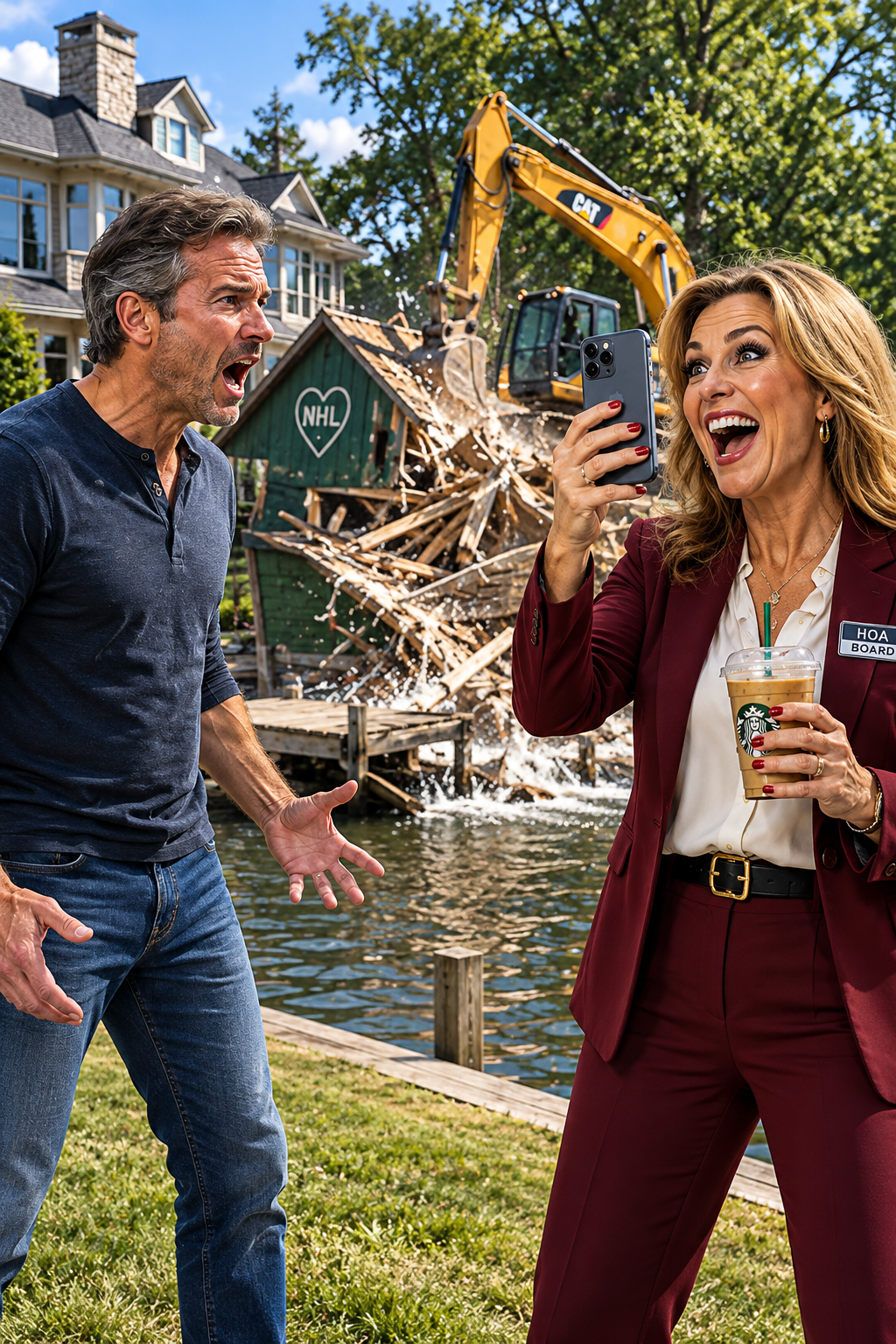
That evening, I sat alone beside the rebuilt boathouse after my family returned to the house. I remembered the bulldozer tearing through cedar, Vivica smiling behind her phone, and the terrible helplessness of watching Lillian’s initials disappear beneath shattered timber. Then I looked at the restored doorway, the lights glowing in neighboring homes, and the children playing along the shoreline where barriers once kept families apart. The past could not be repaired perfectly, but it could be honored through choices that made the future safer and kinder. For the first time since Lillian’s death, I understood that moving forward did not mean leaving her behind.
I took out the old photograph of Dutch and Bernard standing beside the original development sign and placed it against the boathouse window. They looked young, confident, and unaware of how complicated their dream would become, yet something in their expressions reminded me of Emma and the people who had helped rebuild Mirror Lake. Dutch had left me more than a mansion, a trust, or disputed property rights; he had left a responsibility to protect what was valuable without becoming possessive of everything I could control. Vivica had mistaken authority for ownership, intimidation for leadership, and financial success for proof that she was entitled to decide other people’s lives. Her downfall came when the documents finally exposed the difference between what she claimed and what she actually had.
Before going inside, I touched the carved heart and whispered Lillian’s name into the evening breeze. The loons called across the lake, just as they had on the mornings when grief made getting out of bed feel impossible, and the sound no longer seemed quite so lonely. Behind me, the house glowed warmly, filled with people who had chosen to return, forgive, contribute, and build something better together. I had begun this fight believing I needed to defend a broken piece of my past, but I ended it discovering a community and a future larger than anything I could have planned. And when I finally walked toward the lights, I knew Vivica had never understood the one thing my grandfather knew all along: land becomes truly valuable not when one person controls everyone standing on it, but when the people who call it home have a reason to protect one another.
✓ Lynn R. Adams
Part 2: An ancient property deed revealed the HOA’s greatest secret. The county recorder’s office was an hour away through farmland, and I arrived before opening with terrible gas-station coffee and …