The Maid Who Saw Through the Prince’s Test and Changed Rosehaven _064
## **Part 2 – The Final Spin and the Question Alexander Never Expected Emily to Ask**
Emily did not try to fight the water.
That was what every woman before her had done.
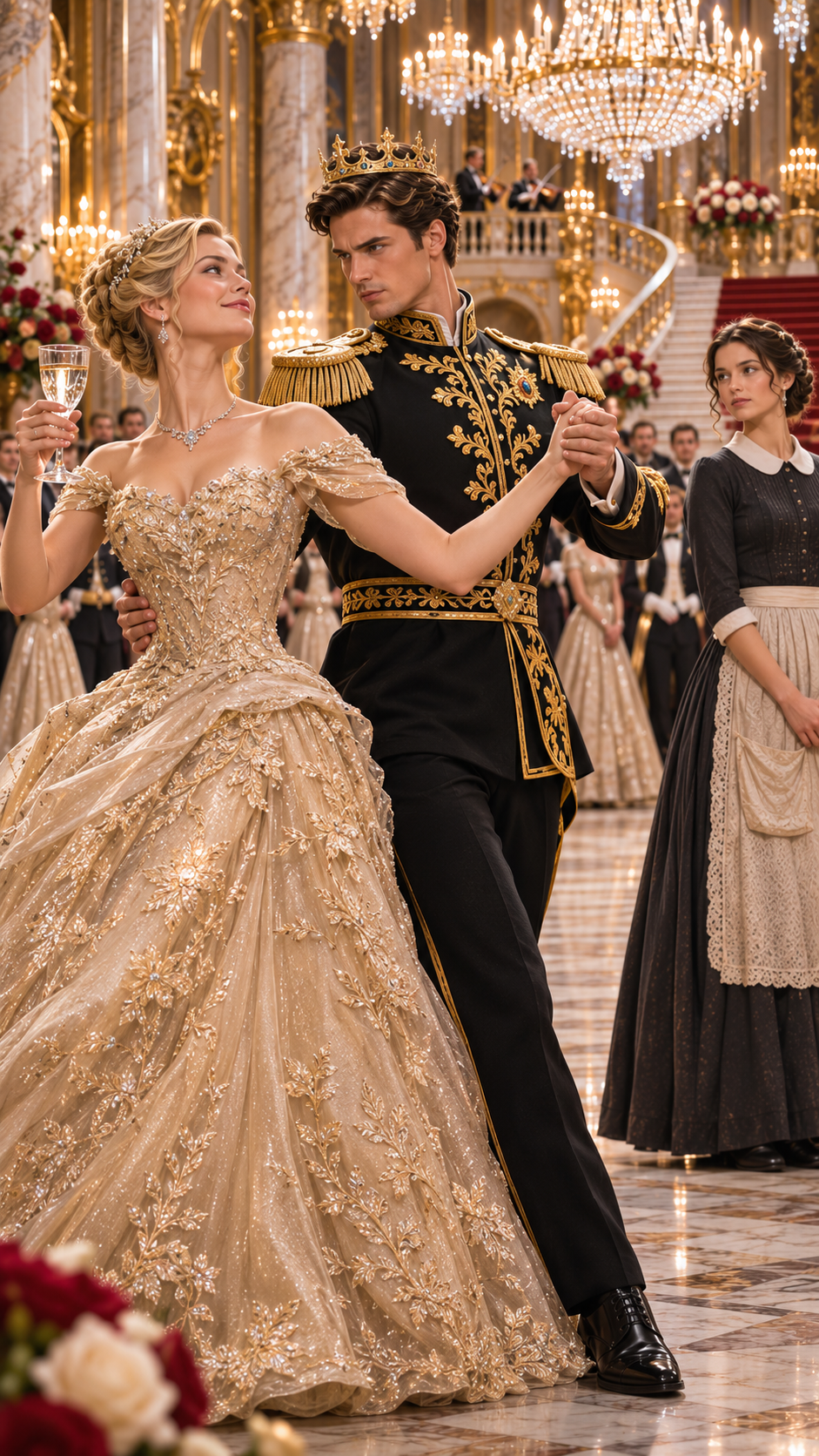
The moment Prince Alexander pulled her into the fast spin, the water climbed one side of the crystal glass in a shining crescent. Lady Victoria leaned forward. Several nobles gasped. The orchestra faltered for half a beat as though even the musicians expected disaster.
Emily did something entirely different.
She stepped toward the prince instead of away from him.
Alexander’s eyes widened.
Her free hand remained in his, but she shortened the distance between them, turning her body so the glass traveled in a smaller circle instead of a wider one. At the same instant, she softened her wrist and let the glass tilt just enough to follow the motion of the water instead of resisting it.
The surface rocked.
Rose nearly to the rim.
Then settled.
Not one drop spilled.
The final violin note rang through the ballroom.
Silence followed.
Emily stood before the prince, breathing quickly, the crystal glass still full.
Victoria’s face had gone white.
Alexander stared first at the glass.
Then at Emily.
“How did you do that?”
Her heartbeat thundered.
She could have given the polite answer.
She could have curtsied.
Could have said she had simply been lucky.
Instead, she looked around the ballroom.
Nineteen eliminated women stood beneath the chandeliers.
Some angry.
Some embarrassed.
Several fighting tears.
Emily had carried trays in this room for three years. She knew what humiliation looked like when powerful people called it entertainment.
So she said:
“I stopped trying to dance against the water.”
Alexander’s expression sharpened.
“Explain.”
“You changed speed each time someone found your rhythm.”
A murmur moved through the room.
Emily continued.
“You reversed direction when they became comfortable. When they adjusted to that, you spun faster. The women weren’t failing because they lacked grace.”
Victoria stared at her.
Emily glanced toward the other contestants.
“They failed because you kept changing the problem.”
Alexander’s jaw tightened.
“And you think that was unfair?”
There it was.
The dangerous question.
A servant could survive insolence if it amused royalty.
She could not survive embarrassing the future king without cause.
Emily chose her words carefully.
“I think it means you were not testing what you announced.”
The room became perfectly still.
Alexander looked at her for a long moment.
“What was I testing?”
Emily raised the glass slightly.
“Whether the woman beside you could adapt when you made the situation harder without warning.”
His eyebrows lifted.
“And?”
“And whether she would panic.”
The prince’s expression changed.
Not anger.
Interest.
Emily had seen that expression once before, when Alexander inspected a young stallion that refused to enter a transport carriage until the handlers changed how they approached it.
He liked problems that resisted easy answers.
“What else?”
he asked.
Emily glanced at the glass.
“You wanted someone who watched you instead of performing for the court.”
Victoria inhaled sharply.
Alexander’s eyes narrowed.
Emily continued before fear could stop her.
“But there is another problem.”
The queen mother, **Queen Helena**, leaned forward from her gilded chair.
“What problem, Miss Carter?”
Emily turned toward her.
It was the first time the queen had ever spoken her name.
Emily curtsied.
“The prince learned something about all nineteen ladies.”
She looked back at Alexander.
“But they learned something about him too.”
The prince became very still.
Emily’s voice softened.
“If Your Highness deliberately makes a task harder without saying why, then success depends partly on guessing your intention.”
A few older nobles exchanged glances.
“And if I became queen,” Emily continued, “I would rather my husband tell me when the problem changes than wait to see whether I fail.”
No one moved.
Then, astonishingly, Queen Helena smiled.
Barely.
But Emily saw it.
Alexander did too.
He looked almost offended by his mother’s amusement.
Then he asked:
“Are you declining victory?”
Emily blinked.
“I don’t know what I’ve won.”
That caused a ripple of laughter.
Not mocking.
Nervous.
Alexander looked toward the royal advisor, **Lord Pembroke**.
Pembroke cleared his throat.
“Technically, Miss Carter is the only contestant who completed the waltz without spilling.”
Victoria stepped forward.
“This is absurd.”
Every head turned.
She was angry, but not wild.
Her humiliation had hardened into control.
“A maid does not become queen because she held a glass correctly.”
Emily looked at her.
“I agree.”
Victoria froze.
That had not been the expected answer.
Emily continued.
“No woman should become queen because of one dance.”
Alexander’s gaze returned to her.
The ballroom shifted.
Something larger than competition had entered the room.
Queen Helena asked:
“Then what should determine it?”
Emily thought of palace kitchens.
Laundry rooms.
Messengers racing between ministers.
The royal council chamber where servants stood invisible behind chairs while men discussed grain tariffs that would affect every family in Rosehaven.
She said:
“I would imagine being queen requires more than pleasing a prince.”
A murmur rolled through the nobles.
Alexander’s expression became unreadable again.
“Careful.”
Emily met his eyes.
Not defiantly.
Steadily.
“I am being careful.”
That, somehow, made Queen Helena laugh aloud.
The entire room turned toward her.
Helena covered the smile with one hand.
“Alexander,” she said, “I believe you have been challenged.”
“Mother.”
“I am observing.”
Victoria’s father, **Duke Montgomery**, rose from his place among the nobles.
“Your Majesty, surely this cannot continue. The selection process was established for daughters of the noble houses.”
Lord Pembroke coughed.
“Not precisely.”
The duke looked toward him.
“What?”
Pembroke lifted a parchment from the table beside the throne.
“The proclamation states that twenty eligible unmarried women of Rosehaven shall be invited to the final trials.”
Victoria’s expression changed.
The duke stared.
“It was understood—”
“Understanding is not law,” Queen Helena said.
The tone was gentle.
Final.
Emily suddenly wondered why she had been invited at all.
She had received a sealed palace notice six weeks earlier, delivered to the servants’ quarters.
No explanation.
The head housekeeper had assumed it was some royal joke.
Emily herself had nearly refused.
Now she looked toward Pembroke.
“Who added my name?”
The advisor glanced toward the queen.
Helena said:
“I did.”
The ballroom erupted in whispers.
Emily stared.
“Your Majesty?”
Queen Helena rose.
She was fifty-seven, elegant without appearing fragile, her silvering dark hair arranged beneath a smaller crown than her son’s.
“For three years, Miss Carter, I have watched you work in this palace.”
Emily’s throat tightened.
“You settle disputes in the laundry without humiliating either side. You read account labels before signing receipts. You once returned a purse belonging to an ambassador even though no one saw you find it.”
Emily remembered.
She had assumed no one noticed.
The queen continued.
“And last winter, when a kitchen boy dropped a tray before the foreign delegation, you stepped forward and took responsibility for reorganizing service so he would not be dismissed for one mistake.”
The boy had been fourteen.
Terrified.
Emily had done what seemed obvious.
Queen Helena looked toward the nobles.
“I did not invite Miss Carter because she was likely to marry my son.”
Alexander folded his arms.
“Comforting.”
His mother ignored him.
“I invited her because I wanted this court to remember that capability does not always arrive wearing diamonds.”
That line landed hard.
Victoria’s face tightened.
Not because it was false.
Because everyone was looking at her diamonds.
Emily felt almost sorry for her.
Then Queen Helena said:
“The final trial is not finished.”
Alexander turned.
“What?”
His mother looked almost pleased.
“You designed the dance.”
“Yes.”
“I permitted it.”
A dangerous distinction.
Alexander’s eyes narrowed.
“Mother.”
“There was always another stage.”
Lord Pembroke opened a second envelope.
The prince stared.
“You knew?”
Pembroke looked uncomfortable.
“Her Majesty is difficult to refuse.”
Emily nearly smiled.
Alexander did not.
“What stage?”
Helena descended one step from the dais.
“The remaining contestant must spend seven days observing the work of the Crown Council.”
The whispers grew louder.
Victoria said:
“Remaining contestant?”
Helena looked at her.
“Miss Carter remains.”
Victoria’s jaw hardened.
Emily immediately said:
“Your Majesty, I am not qualified to advise a royal council.”
“No.”
The queen’s frankness surprised her.
“You are qualified to observe one.”
Emily looked toward Alexander.
He looked irritated.
Not with her.
With the situation.
Good.
At least that was honest.
Queen Helena continued.
“At the end of seven days, you will answer three questions.”
“What questions?”
“You will receive them then.”
Emily exhaled.
Alexander said:
“And if she answers badly?”
Helena turned toward her son.
“Then perhaps she should not become queen.”
“And if she answers well?”
The queen’s gaze sharpened.
“Then you will decide whether you want a wife who notices when you change the problem.”
A few nobles coughed to hide laughter.
Alexander looked at Emily.
She expected annoyance.
Instead, something like reluctant admiration appeared.
Then Victoria stepped forward again.
“I request permission to remain.”
The queen considered her.
“Why?”
Victoria lifted her chin.
“Because Miss Carter is right.”
Everyone stared.
Even Emily.
Victoria looked toward Alexander.
“This test was designed so we would fail once you chose to make us fail.”
Alexander said:
“That was the point.”
“Yes.”
Victoria’s voice remained controlled.
“And I dislike being taught that lesson by a maid.”
Emily winced internally.
There it was.
But Victoria continued.
“Which probably means I need to learn something.”
That surprised the room more than Emily’s victory.
Victoria turned toward Queen Helena.
“I am not asking to remain as a bride candidate.”
The duke stiffened.
“Victoria.”
She ignored him.
“I am asking to observe the council too.”
Emily studied her.
For the first time, Lady Victoria looked less like a jeweled rival and more like a young woman realizing how much of her life had been arranged for display.
Queen Helena asked:
“Why should I allow it?”
Victoria answered:
“Because if I leave tonight, everyone will say I lost to a servant.”
Emily’s stomach tightened.
Victoria continued.
“If I stay, perhaps I can decide whether losing was the important thing.”
Silence.
Then Queen Helena nodded.
“Seven days.”
The duke looked furious.
Victoria did not look at him.
Interesting.
Very interesting.
The ballroom ended without an engagement.
Without a crown.
Without the expected announcement.
Emily changed back into her maid’s uniform before midnight.
She folded the borrowed rose gown carefully and returned it to the wardrobe mistress.
Then she went to her small room beneath the eastern servants’ stairwell.
She expected exhaustion.
Instead she sat awake staring at her hands.
The hands that had held the glass.
The hands that scrubbed silver.
The hands that might, absurdly, be writing notes in the council chamber the following morning.
At dawn, a knock came.
Emily opened the door.
Alexander stood outside.
No crown.
No black-and-gold uniform.
Only dark trousers, boots, and a plain white shirt beneath a riding coat.
She stared.
“Your Highness?”
“I need to ask you something before the council begins.”
Emily glanced toward the corridor.
Two guards stood at a discreet distance.
“What?”
Alexander looked uncomfortable.
That was new.
“Yesterday you said I was testing whether women would panic when I changed the problem.”
“Yes.”
“You also said a husband should explain when the problem changes.”
“Yes.”
He took a breath.
“Do you think I am arrogant?”
Emily nearly closed the door.
He saw her expression.
“That bad?”
“Your Highness.”
“Alexander.”
She froze.
“No.”
He frowned.
“No, you won’t call me Alexander?”
“No, I am not answering that question while you stand in a servant’s corridor at six in the morning.”
For one second he looked stunned.
Then he laughed.
A real laugh.
Emily had never heard it.
“All right.”
He leaned against the stone wall.
“Where should I ask?”
“Somewhere you cannot dismiss me for answering.”
His smile faded.
That answer reached him.
He straightened.
“I would not.”
“You have never needed to know whether you would.”
Silence.
The prince looked at her differently.
Then:
“Fair.”
He stepped back.
“At council, then.”
“No.”
“Why not?”
“Because everyone there depends on you.”
He stared.
Emily continued.
“If you want an honest answer, don’t ask someone who has to calculate what honesty costs.”
Alexander said nothing for several seconds.
Then:
“You really do think the test was wrong.”
Emily shook her head.
“I think the test told you something useful.”
“What?”
“That many people around you are trying to succeed at whatever you put in front of them.”
“And?”
“You still haven’t tested whether they can tell you the task itself is foolish.”
The prince’s face changed.
Emily had gone too far.
She knew it immediately.
Then Alexander smiled slowly.
“Seven days may be interesting.”
He left.
Emily closed the door.
Her knees nearly failed.
At breakfast, Victoria arrived in a simple blue day dress instead of diamonds.
She sat across from Emily in a small antechamber outside the council hall.
Neither spoke for several minutes.
Then Victoria said:
“I hated you yesterday.”
Emily buttered a piece of toast.
“I noticed.”
“I still might.”
“Useful warning.”
Victoria almost smiled.
Then:
“Why didn’t you gloat?”
“About what?”
“Winning.”
Emily looked toward her.
“I haven’t won anything.”
Victoria’s face tightened.
“My family would disagree.”
“Your family wanted you to become queen.”
“Yes.”
“Did you?”
Victoria opened her mouth.
Stopped.
Emily waited.
Finally:
“I wanted to be chosen.”
Not the same thing.
Emily recognized that immediately.
“By him?”
Victoria looked toward the closed council doors.
“By everyone.”
There.
The first crack.
Then Lord Pembroke appeared.
“Ladies.”
They stood.
“The council is ready.”
Emily took one breath.
Victoria straightened her shoulders.
They entered.
Seven ministers sat around a long walnut table.
Alexander occupied the head.
Queen Helena sat to his right.
Maps covered the walls.
Ledgers filled shelves.
This was not a ballroom.
No music.
No gowns.
Problems.
Real ones.
Lord Pembroke handed Emily and Victoria each a blank notebook.
“Observe. You may ask one question per session. No speeches.”
Victoria frowned.
“One?”
Emily whispered:
“Better choose carefully.”
Victoria glared.
Alexander heard.
His mouth twitched.
The morning discussion concerned grain shortages in three northern counties after late frost.
The minister of agriculture proposed releasing royal reserves.
The finance minister objected to cost.
A transport minister warned roads were damaged.
Emily listened.
At first, she understood little.
Then familiar patterns emerged.
Supply.
Storage.
Delivery.
She had spent years managing palace linen and kitchen inventories.
Different scale.
Same logic.
Halfway through the meeting, Alexander turned toward her.
“Miss Carter. Your question.”
Every nobleman looked at her.
Emily glanced at the grain map.
Then asked:
“How much grain spoils in royal storage each month?”
The finance minister blinked.
“What?”
“You are arguing about how much releasing grain costs. I’m asking how much keeping it costs if some spoils before winter.”
Silence.
The agriculture minister slowly turned toward the finance minister.
Alexander leaned back.
“Well?”
The answer required three ledgers.
When they found it, the figure was substantial.
Victoria stared at Emily.
The meeting changed direction.
Afterward, Alexander caught Emily in the corridor.
“That was a good question.”
“Thank you.”
“Did you know the number?”
“No.”
“Then how—”
“In the palace kitchens, storing more flour than we can keep dry wastes money.”
He smiled.
“You compared the royal grain reserves to a pantry.”
“It is a very large pantry.”
He laughed again.
Then his expression became serious.
“One question.”
“Yes?”
“If you became queen, would you expect every minister to listen to kitchen comparisons?”
Emily met his eyes.
“If they are good comparisons.”
He stared.
Then bowed slightly.
Not mockingly.
She walked away before he could see her smiling.
That evening, Emily returned to her quarters and found an envelope beneath her door.
No royal seal.
No name.
Inside was a single sentence:
**Ask why the queen invited you before the competition was announced.**
Emily read it twice.
Then noticed something else.
The handwriting.
She had seen it before.
On palace supply orders.
Orders signed by someone who should have had no reason to know anything about a royal bride competition.
The royal steward.
**Mr. Edmund Vale.**
And suddenly Emily wondered whether Queen Helena had invited her merely to broaden the prince’s perspective—
or because something inside the palace had already gone wrong before the first woman stepped into the ballroom.
**–END OF PART 2– CLICK “NEXT” AT THE BOTTOM OF THE PAGE TO CONTINUE READING**
✓ Lynn R. Adams
## **Part 2 – The Final Spin and the Question Alexander Never Expected Emily to Ask** Emily did not try to fight the water. That was what every woman before her had done. The moment Prince Alexande…