The HOA President Treated My Private Ranch Like Her Own Highway — So I Built a Wall She Could Never Get Past
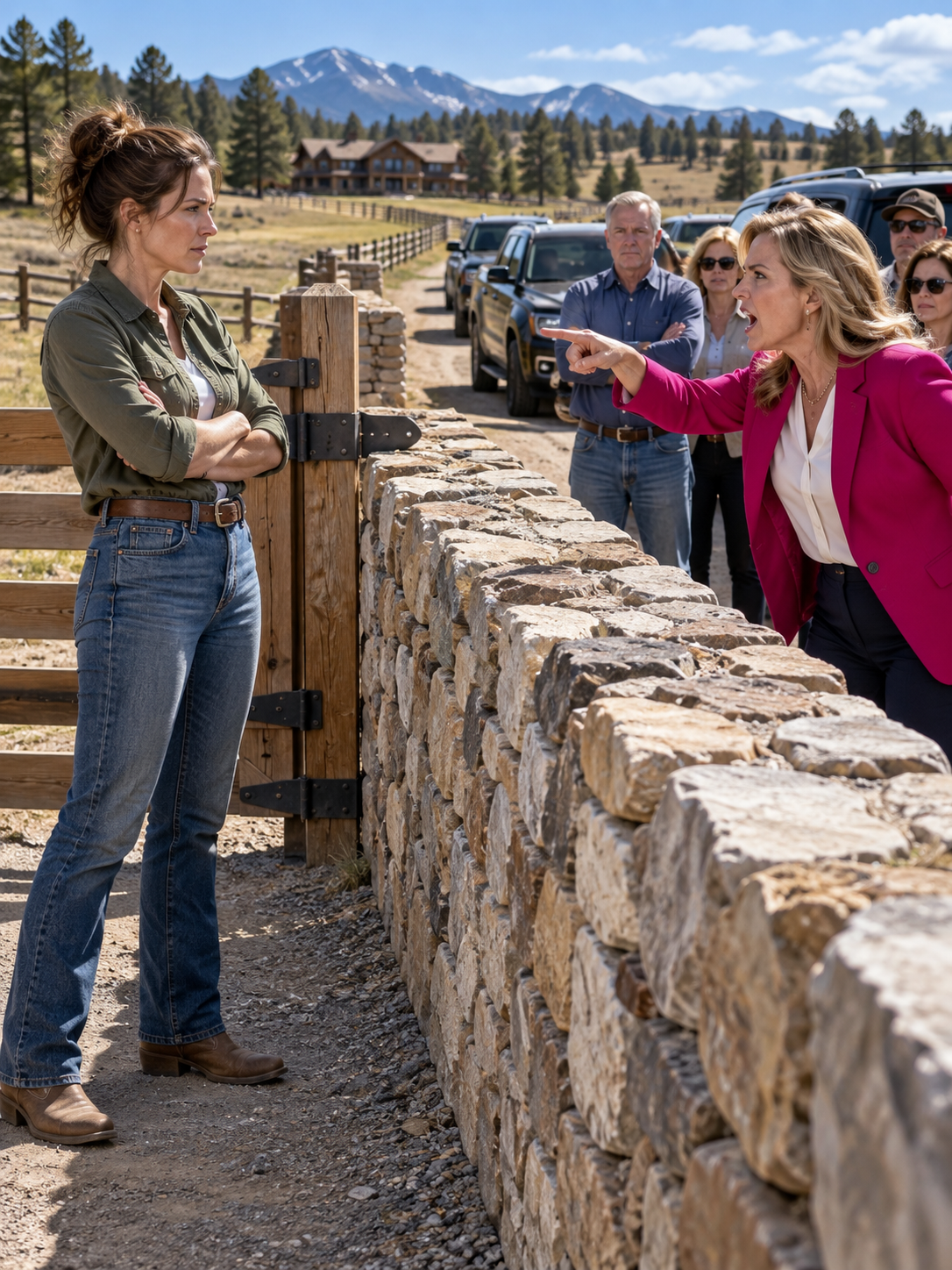
The HOA President Treated My Private Ranch Like Her Own Highway — So I Built a Wall She Could Never Get Past
What do you do when the people sworn to protect your rights decide your land belongs to them instead?
The tire tracks ran straight down my main pasture, churned deep into the fescue, cutting right through the wildflower patch I’d spent three years nursing back to life. And there, parked right in the middle of it, was Karen Miller’s glossy white SUV. She sat there like she owned the place, scrolling her phone, while her kids trampled the fence line throwing rocks at my goats. When I walked out, she rolled down the window and smiled like I was the one in the wrong. “Don’t look so serious, Jared,” she said. “It’s just a shortcut. Saves me twelve minutes to the grocery store. You don’t mind.”
I minded. I minded very much.
I did not storm over and bang on her door. I did not yell or threaten or call her names in the street. I did not let her see how deeply her entitlement stung. I did not give her the satisfaction of knowing she’d rattled me. I did not march to the HOA meeting empty-handed and shout about fairness. I did not beg anyone to do the right thing.
I went home and pulled out the original deed. I went page by page, line by line, until I found the metes and bounds. I traced every property line until I knew it better than the back of my own hand. I marked where the road ran. I marked where it ended. And I marked exactly where their “shortcut” crossed from public right-of-way into land that was mine, all mine, and mine alone.
I sat at my kitchen table that night and made myself one promise: I would not ask for permission. I would not apologize for what was mine. I would not back down.
I’d bought the ranch three years before—sixty acres of rolling grass, oak groves, and a spring-fed creek that ran clear and cold. It was my grandfather’s land. He’d worked it for fifty years. When he passed, I’d come back from the city, rolled up my sleeves, and started over. I’d fixed the fences. I’d restored the barn. I’d breathed life back into a place everyone else had written off. And the very first thing I’d done was file the updated surveys, record the easements, and make absolutely certain every single boundary was clear, public, and legally ironclad.
None of that mattered to Karen.
She was the HOA board president. Everyone in the subdivision downhill answered to her. She decided which lawns got mowed, which fences got painted, which neighbors got a friendly note and which got a fine. And she’d decided, all on her own, that my private driveway was a public thoroughfare.
At first it was just her. Then it was her friends. Then school buses started turning through. Then delivery trucks. Then people I’d never seen in my life were driving across my land like it was an interstate, tossing soda cans out the window, kicking up dust, waking the animals at dawn.
I put up small signs. Private Property — No Trespassing. They vanished overnight.
I put up heavier ones. They got spray-painted over.
I stopped cars myself, polite but firm. “This isn’t a public road. Please don’t cross here.” They’d roll their windows and laugh. “Karen said it’s fine.” “We pay HOA dues, you know.” “You’re being selfish.”
I went to the next board meeting. I laid out copies of the deed. The survey. The county records. Karen didn’t even look at them. She smiled and folded her hands. “Jared, we’re a community. We share. That driveway has always been used. It’s traditional. You can’t just hoard resources when everyone needs them.”
“It’s not a resource,” I said. “It’s my land. I paid for it. I pay taxes on it. And you have no easement, no right-of-way, no legal standing to be there.”
Murmurs rippled through the room. “So greedy…” “He just wants to keep us out…” “What a bad neighbor…”
Karen leaned forward. “Are you sure you want to make this difficult? We handle zoning. We handle complaints. We handle your property value. It would be so much easier if we just worked together.”
It wasn’t a suggestion. It was a threat.
I went home that night and didn’t sleep. I thought about Grandpa. About how he’d always said, “Land’s not just dirt, son. It’s your word. It’s your backbone. And you don’t let anyone bend either one.”
I didn’t file a lawsuit. Lawsuits take years. They cost a fortune. And by the time you win, the damage is done. I decided on something simpler. Something faster. Something visible from a mile away.
I built a wall.
Not a little fence. Not a gate they could cut or climb. A proper barrier. Eight feet tall. Treated timber reinforced with steel posts set four feet deep in concrete. Right across the driveway. Right on the property line. With heavy-duty steel gates that locked with two different keys—both of them mine. And I built it myself, from dawn until dusk, over three straight days.
The first morning Karen drove up. She rolled to a stop, stared at the rising posts, and honked. “What do you think you’re doing?!”
“Securing my property,” I said without stopping.
“You can’t block the road!”
“I’m not blocking a road. I’m blocking access to my land. The public road is a quarter-mile that way.”
She turned purple. “This is obstruction! I’m calling the sheriff!”
“Go ahead,” I said. “I’ll have the deed ready.”
She called. The sheriff came. He walked the line. He checked the papers. He looked at me, then at her, and said, “Ma’am, this is his property. He’s within his rights.”
Karen’s mouth fell open. “But—we’ve always used it—”
“Use doesn’t make it yours,” he said. “If you believe there’s an easement, you’ll need to prove it in court. Until then, he can build where he’s building.”
She stormed off. But she didn’t stop.
The next morning, the wall had graffiti. Bright red, ugly, scrawled across the fresh timber. I photographed it. I cleaned it. And I put up trail cameras—four of them, high up, out of reach, pointed at every angle.
That night I caught them. Karen. Her husband. Two other board members. They’d come after dark with spray cans and crowbars, laughing loud enough to wake the dogs. They thought no one was watching.
I didn’t post the footage. Not yet.
Instead I sent a copy to each of them individually. Certified mail. No note. Just the video, a map, and a single line: Remove your vehicles from my land by Friday. Do not return without written permission.
Karen called me within an hour. She was frantic. “Where did you get this? You can’t use this—this is illegal—”
“It’s my property,” I said. “Recording what happens here is my right. Just like building the wall.”
“You’re blackmailing us!”
“I’m warning you. Stay off my land. That’s all.”
She didn’t listen.
On Friday morning, a county truck showed up. Two men climbed out with a clipboard. “Complaint of unlawful obstruction,” one said. “We’re here to inspect and remove if necessary.”
I handed them the full file. Deed. Survey. Certified letter. Sheriff’s report. They sat on the tailgate and read it all. They talked quietly. Then they looked up, apologetic. “Sir, there’s no violation here. This is clearly your boundary. Whoever filed this didn’t include the legal description.”
I knew Karen had gone over my head. I also knew she’d lied on the form.
The workers left. Karen stood across the road watching, face tight with fury. But she didn’t come over. Not then.
For two weeks it was quiet. Too quiet. I’d see her car slow down at the turn. I’d see neighbors point and whisper. But no one crossed. No one knocked. I thought maybe—just maybe—it was over.
Then I got the notice in the mail. Formal Zoning Hearing — HOA vs. Jared Hale — Claimed Prescriptive Easement — Public Road Designation.
She wasn’t just asking for access anymore. She was claiming the driveway had been used continuously, openly, and without permission for more than twenty years—making it legally public. And she had signatures. Dozens of them. Neighbors, former residents, even people who’d never lived here. All swearing they’d driven that road for decades.
The hearing was packed. Every seat filled. Karen sat at the front, confident, polished, in a navy blazer, surrounded by supporters. She presented the signatures. She showed photos of cars crossing my land. She talked about “community necessity” and “historical access.” She made me sound like a tyrant hoarding a vital lifeline.
When it was my turn, I didn’t raise my voice. I didn’t accuse. I simply laid out Grandpa’s records. His hand-drawn maps. His tax filings going back forty years. Photographs showing the driveway always ending at the old gate—exactly where my wall stood now. And then I played the footage. Not the vandalism. The older clips I’d found in his archives. The ones that showed the neighbors starting to cross only after Grandpa got sick—only after they thought no one was watching.
“Prescriptive easement requires twenty years of open, continuous, unchallenged use,” I told the room. “These people have been using this land for three. And they only felt safe doing it because they thought I wouldn’t notice. Because they thought I wouldn’t fight.”
The room went quiet. Karen’s supporters shifted in their seats. The board looked at one another. The ruling came down that afternoon. No easement. No public road. The wall stays.
I thought I’d won. I thought they’d finally leave me alone.
That night I walked the property line before bed. The wall stood solid, clean and strong, catching moonlight. I felt proud. I felt at peace. And then I saw it—something small, glinting in the beam of my flashlight, half-buried in the dirt right at the base of the gate.
I knelt. I brushed away soil.
It was a metal survey stake. Old, rusted, stamped with a county seal. And it was sitting on my side of where everyone—me, the surveyor, the county—had always drawn the line.
I pulled it carefully from the earth. There was paper wrapped around it, sealed in plastic. Faded. Dated fifty years ago. Signed by the county engineer. And the note written across the bottom in shaky, hurried handwriting turned my blood to ice:
Line was moved 120 feet west without approval to avoid the creek. True boundary runs through the barn. Never recorded. If found, keep buried. They will come for the land.
I stood up slowly. I looked back at my house. My barn. My pastures. Everything I’d restored. Everything I’d fought to protect. And I realized Karen hadn’t just been guessing. She hadn’t just been greedy. She’d known. Someone had told her. Someone who knew the truth about the old line. About the mistake—or the lie—that had been hidden all these years.
The wall hadn’t kept them out. It had only made them desperate enough to dig up the one secret that could take everything away from me.
And somewhere in the dark trees beyond the gate, I heard a branch snap.
✓ Lynn R. Adams
The HOA President Treated My Private Ranch Like Her Own Highway — So I Built a Wall She Could Never Get Past What do you do when the people sworn to protect your rights decide your land belongs to th…