The HOA president ordered a harvest crew to keep cutting my alfalfa even after I told them the field was mine, but the foreman stopped his machines and showed me a work order that made everything worse…
The HOA president ordered a harvest crew to keep cutting my alfalfa even after I told them the field was mine, but the foreman stopped his machines and showed me a work order that made everything worse…
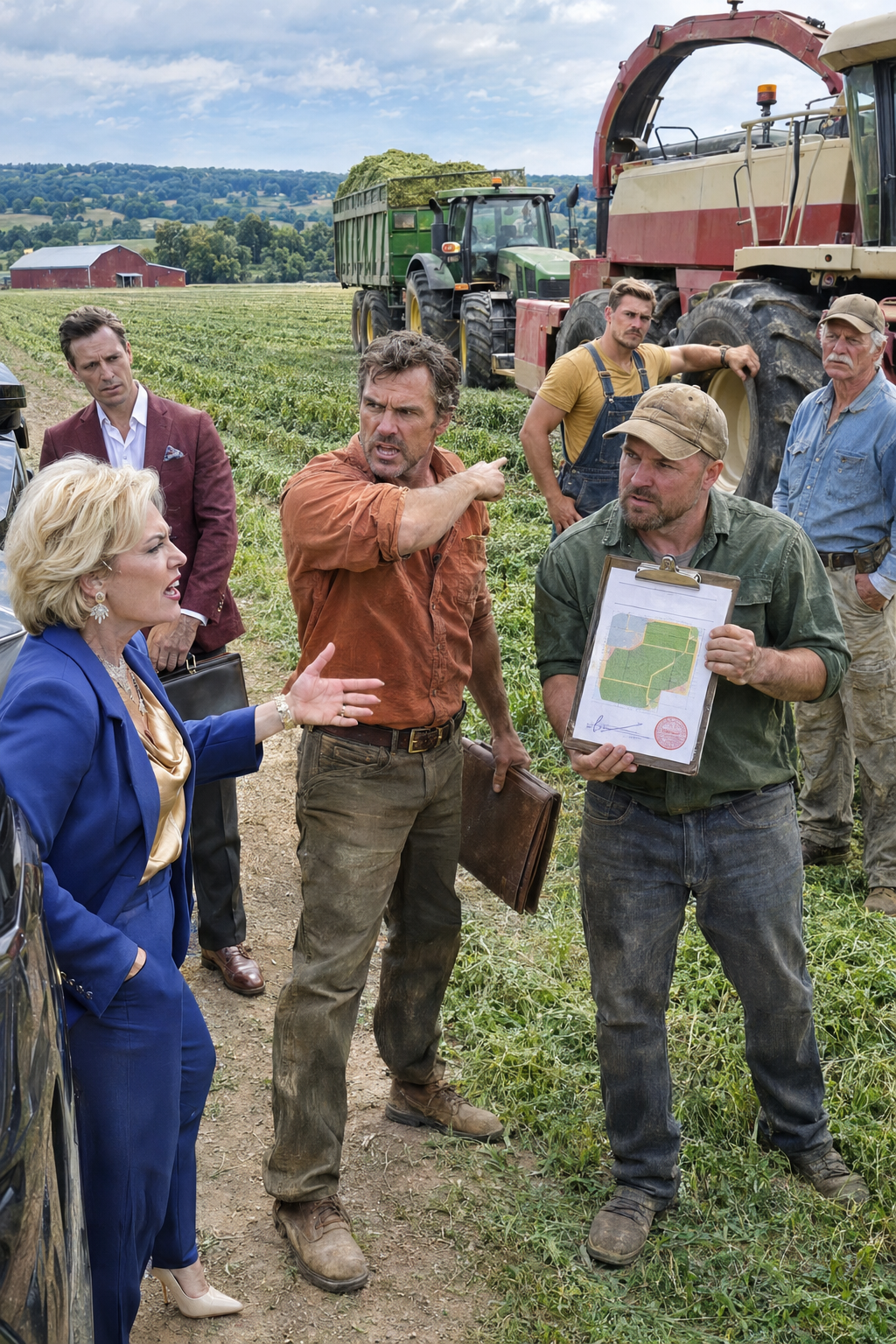
“You don’t get to interfere with HOA contractors,” Monica Reeves shouted over the noise of the swather. She stood at the edge of my north field in an emerald-green blazer, watching a machine cut through alfalfa I had spent months growing, while I tried to understand why anyone from Juniper Crest thought they belonged on my ranch.
“I’m the landowner,” I told her. “Those aren’t your crops.” Monica, the president of the Juniper Crest homeowners association, barely looked at me before telling the crew to keep moving.
The foreman, a man named Caleb Mercer, stood between us with a folded work order in his hand. “Sir, is this field actually yours?” he asked, and before I could answer, Monica announced that it fell under the Juniper Crest maintenance authority.
“My name is on the deed,” I said. “Not Juniper Crest.” Caleb looked toward the swather, but Monica again insisted he continue, and the machine rolled forward through another stretch of green.
I didn’t step in front of that machinery. I moved my pickup across the field entrance, switched off the engine, and started recording, making sure the support truck could not drive out while I tried to sort out what was happening.
“Hold up,” Caleb finally called over his radio. The operators slowed and stopped, and Monica rounded on him for shutting down work she said the board had approved. “I’m not getting my crew caught in a property dispute,” he answered.
Then he handed me the order, despite Monica’s objections. Prairie North Harvesting was the contractor, Juniper Crest Homeowners Association was the client, and the service was described as “vegetation removal and harvest clearance.” A yellow outline on the accompanying map reached well past my boundary fence and deep into the cultivated part of my ranch.
“Eighteen point four acres,” Caleb said, tapping the map. “That’s what they sent us to clear.” I looked toward the cut rows and thought about the buyer waiting for a specific quantity of high-protein hay, the irrigation schedule, and the weather window I had been working around.
That number wasn’t some untended corner of a subdivision. I owned seventy-two acres, and twenty-four acres of the north field produced commercial hay. If someone cut nearly nineteen acres on a schedule I hadn’t chosen, it could affect both this harvest and the next one.
I’d bought the ranch thirteen years earlier with a loan that kept me awake at night. The ground had been rough pasture, the irrigation leaked, and the north field wasn’t properly leveled; I spent years making payments, replacing equipment, and putting any profit back into the place.
I started alfalfa on eight acres because that was all I could afford to seed. When it worked, I expanded to twelve, then eighteen, and finally twenty-four, learning the soil and the pumps well enough to know how much difference a few days could make to a cutting.
Juniper Crest came later, across my northern boundary. One year there were survey stakes; then came streets, matching houses, a stone entrance sign, and an HOA whose rules had never applied to my property. I wasn’t a member, didn’t pay dues, and had never voted on one of their decisions.
Until that morning, our dealings had been ordinary neighbor matters. A landscaper once checked which side of the fence he was trimming, and another contractor asked if he could turn around at my gate. Neither had treated my hay like a maintenance problem the subdivision was entitled to solve.
Caleb walked the cut area with me after the machines stopped. There were windrows on the ground, some finished bales near the lane, and two bales already loaded on a trailer, so I photographed the truck plate, the equipment, and every stretch of cut crop I could see.
“Nothing moves until our office sorts this out,” Caleb told me. Monica called across the lane that the contract authorized removal, but Caleb told her a contract didn’t settle ownership, and for once she had no immediate answer to that.
She said I had been notified, though she couldn’t tell me where any notice had been sent. Before she drove away, she warned that my “obstruction” would be documented, as if I were the one who had entered somebody else’s land.
I stayed after the crew pulled back, recording the time, the machinery positions, the tire tracks, and the corners of the damaged area against my irrigation markers. Using my field maps later that afternoon, I estimated that 5.8 acres had already been cut, and I saved the photographs and video with their timestamps.
Alfalfa doesn’t reset its schedule just because somebody makes an unauthorized pass with a mower. The cut section would regrow differently from the rest, and I had to call my buyer and admit I could no longer promise the quantity we’d discussed. “How bad is it?” he asked. “I don’t know yet,” I said.
Back in my small farm office, I opened the fireproof cabinet that held my deed, tax papers, title policy, and irrigation receipts. The county parcel record and the legal description both confirmed my seventy-two acres, with no indication that the ranch had become a Juniper Crest lot.
I also checked for a recorded restriction or agreement that might explain Monica’s confidence. I couldn’t find anything granting the HOA control over my cultivated field, but I knew the absence of a name on one page wasn’t enough to settle a property dispute.
At that afternoon, an email arrived from the HOA manager with Monica copied. It called my actions “interference with authorized maintenance,” reserved Juniper Crest’s right to charge me for the contractor’s standby time, and demanded that I not interfere when the machines returned.
I read the notice twice. They had cut my crop, and now they were threatening to bill me for stopping them, without attaching a deed, an agreement, or even a proper explanation of the ground they claimed.
My reply was short: I disputed their authority, prohibited further entry without written permission, and requested every document supporting their claim. I didn’t call Monica a thief or threaten a lawsuit; I wanted to see what she had relied on before sending expensive equipment into my field.
The next morning she called and said the contractor would return. “Notice isn’t proof that you have a right to come onto my land,” I told her, and she responded that the association’s access “predates your current objections.” When I asked what that meant, she said the relevant material would come through proper channels and hung up.
An hour later, Caleb called instead. Prairie North had seen my email, and he wasn’t comfortable returning until somebody verified the job; more important, he had found a source reference in the packet his scheduling office received from the HOA manager.
We met at a fuel station a few miles from the ranch. Standing beside the diesel pumps, Caleb opened a manila folder and let me photograph one page, explaining that his company checked who ordered a job but didn’t conduct land-title investigations.
Under the service-area information was a single line: “2017 temporary vegetation access license, Exhibit C.” Caleb said the job notes had described my field as overgrowth and vegetation control, not a commercial alfalfa crop, and that the broad yellow area on the work map came from the HOA’s instructions.
I drove home with that photograph on my phone and the words running through my head. It was no longer enough to know whose name was on the deed; I needed to know who had signed that old license, exactly what Exhibit C covered, and why Monica believed it still let her cut my hay. Part 2…..
IF FACEBOOK BROUGHT YOU HERE, HERE’S THE CONTINUATION YOU’VE BEEN WAITING FOR. ENJOY! 👇 The next morning, I took the photograph of that reference line to real estate attorney Daniel Price, who had dealt with farm boundaries and development disputes for years. I told him what I could document: an HOA had ordered work across 18.4 acres of my field, roughly 5.8 acres were already cut, and its contractor was relying on a temporary license dated 2017.
Daniel listened and asked who had owned the ground when the document was signed and who had developed Juniper Crest. I knew the ranch’s history better than the subdivision’s, so he had his staff work through the county’s older land records while I searched the planning files.
By lunchtime, we’d identified Redwood Development Partners, the company that assembled Juniper Crest’s original parcels and later turned common areas and responsibilities over to the HOA. At , Daniel’s office located the recorded instrument: a six-page temporary vegetation access license from May 2017 with three exhibits attached.
I drove to his office to look at it. Daniel laid the license on a conference table, and when he turned to Exhibit C, I leaned so far over the map that I nearly knocked my coffee into the paperwork.
What it showed was a narrow, uneven strip along part of my ranch’s northern edge, near a planned perimeter route. It did not show an eighteen-acre rectangle reaching into the middle of the cultivated field, the shape Caleb had shown me on the contractor’s work order.
“That’s the whole area?” I asked. “That’s what’s drawn,” Daniel answered, but he wouldn’t let me declare the matter finished. We needed to read the license’s purpose, duration, and assignment language before making claims about what the drawing meant.
The document named the earlier ranch owner and Redwood Development Partners and described temporary entry for vegetation management, grading preparation, and work associated with a perimeter improvement project. It did not transfer ownership of the land, and I could find nothing in it authorizing a later HOA to harvest commercial hay across an expanded field.
I kept coming back to the word “temporary.” Daniel put his finger on the page and said, “Don’t hang your whole argument on one word. Let’s find out what project it was meant to serve.”
The planning search led us to a perimeter access route described in the Juniper Crest development records. Then we found a final completion certification dated September 2019, referring to the same improvement project associated with the earlier development documents.
“So the license ended in 2019,” I said. “Possibly,” Daniel replied, “but we still have to check whether anything survived, and if so, exactly what.” I was grateful he would rather disappoint me with caution than give me certainty he couldn’t support.
He printed the completion record and requested the full chain of filings concerning the developer’s rights and obligations. Now we had a narrow access map and evidence the related work had been completed years before, but nothing explaining how the association came to authorize eighteen-plus acres.
That evening, a Juniper Crest resident named Ellen Briggs emailed me. She had heard about the problem in my north field and said she might have something I needed to see, though she was uneasy about becoming involved in a lawsuit.
I called and told her I wasn’t asking her to take sides. Ellen explained that at a board meeting Monica had shown an internal maintenance map, and when someone questioned a large green area behind the subdivision’s south row of houses, Monica cited an old developer access arrangement.
Ellen forwarded the homeowner meeting packet. The minutes recorded a motion authorizing seasonal vegetation clearance in the south perimeter maintenance area, approved four votes to one, and the attached map showed a broad green block stretching into my ranch.
I set it beside the Prairie North work order I’d photographed. The outlines were almost identical, right down to the way the colored area reached across the field, and I called Daniel before I’d even finished looking at it.
“The HOA map appears to be where the contractor got its acreage,” he said after reviewing the files. He emphasized “appears” because we’d need the actual source files or confirmation to prove the connection; I was beginning to appreciate how carefully he chose each word.
The old recorded Exhibit C was narrow. The newer internal map was wide, and that wider map looked like the one Prairie North followed; my deed hadn’t changed between them, and the difference was too large to overlook.
The next morning, the HOA manager answered Daniel’s records request. The packet included the board minutes, the internal map, the 2017 license, and something Ellen hadn’t seen: an email exchange between Monica and the manager from three weeks before the crew entered my field.
The manager had asked whether the contractor should be limited to the historical access strip. Monica answered, “Use the full maintenance area shown on the current association map,” adding that the board was responsible for vegetation along the south perimeter.
I sat still for a minute after reading that. Someone had asked the exact question I’d been asking since the swather entered my field, and Monica had expressly chosen the larger area without explaining where the additional authority came from.
Daniel didn’t call it fraud or say the email decided our case. He said it established which map Monica instructed the manager to use, while leaving the central question unanswered: where had the association obtained the right to enlarge the old access area?
He sent preservation requests for the board packets, emails, map versions, contractor instructions, and any related insurance records. Prairie North also agreed to preserve its GPS guidance data, operator logs, and dispatch records, though Caleb told me those records would need to come through the company’s office or lawyer.
That night, I spread the three maps across my kitchen table: the recorded strip, the HOA’s green block, and the contractor’s yellow work area. The first barely hugged the boundary; the other two reached deep into the field I’d built and tended for years. I wasn’t looking for an argument to win anymore. I wanted a reliable explanation for how a narrow temporary permission had become an order to cut my crop.
Part 3 Daniel reviewed the 2017 license, the 2019 completion record, the map, and the chain of development paperwork before offering an opinion. The original document granted Redwood limited, purpose-specific access to a defined area; it was not a deed to my land, and it wasn’t a standing permission to manage any vegetation near Juniper Crest forever.
The completion certification raised a serious question about whether the temporary work rights still had any purpose. Daniel said that some obligations could survive a completed project, but even a surviving right would have to be read against its language and mapped boundaries, not against a later board member’s wishes.
He also explained the difference between Redwood and the HOA. Juniper Crest had received common-area responsibilities, but that didn’t automatically prove it inherited this particular license or could exercise it in a different location and for a different task.
“And access isn’t ownership,” he said, sliding the license toward me. Even if the association could show a valid right to enter a narrow strip for specified maintenance, that didn’t by itself give it the right to cut, bale, remove, or sell somebody else’s commercial hay.
Monica’s board could approve spending and instruct a property manager to hire a contractor. It couldn’t create property rights over my ranch merely by voting to put a wider colored shape on an internal map, which was the distinction I’d been trying to put into words since the first morning.
Daniel drafted a formal cease-and-desist letter identifying my parcel and the mismatch between Exhibit C and the area the HOA had ordered Prairie North to harvest. It demanded that the association and its contractors stop entry, cutting, and removal on the disputed acreage unless they could establish a lawful basis.
He wrote separately to Prairie North, asking the company to retain the GPS data, load records, photographs, invoices, instructions, and every version of the work-order map. Within three hours, its attorney confirmed that the company would not return while the dispute was unresolved.
I stood at my north gate that evening and looked over the uneven cut rows. The crew’s decision was a relief, but the crop was already down, the buyer was still waiting for answers, and the HOA hadn’t yet agreed that it would stay off my land permanently.
Juniper Crest’s attorney responded the following morning without admitting any error. He said the association believed the old development documents might provide continuing rights and needed time to review the record; he did not claim that the 18.4-acre area matched Exhibit C or that the license expressly authorized taking my alfalfa.
Monica’s phone calls had sounded final. Her attorney’s letter sounded careful, and although that wasn’t a victory, it was the first indication that the documents might matter more than the president’s insistence.
Three days later, Prairie North produced the GPS records Daniel had requested. A mapping technician placed the swather’s track over my parcel boundary and the recorded Exhibit C, and the screen showed the equipment working well beyond the old narrow strip, along the broad area from Juniper Crest’s later map.
The baler’s log showed the same general pattern. Caleb’s crew hadn’t simply wandered across an uncertain boundary; they’d worked where their customer had instructed them to work, with paperwork that described a commercial hayfield as vegetation to be cleared.
Daniel sent the plots to Juniper Crest’s lawyer, who replied before lunch that the association’s insurer had been notified. Suddenly no one was demanding contractor standby fees or warning me not to interfere with the machinery.
The insurer’s involvement meant the financial loss had to be measured properly. Daniel asked me for planting records, sales tickets, irrigation schedules, expected yield, and anything showing how the interruption affected the current and next cuttings.
We hired Ruth Keller, an agricultural appraiser who walked the 5.8 affected acres and compared them with the standing alfalfa beside them. She reviewed seed and fertilizer invoices, past scale tickets, field maps, and my planned harvest schedule, asking questions about weather and irrigation that no one at the HOA had thought to ask.
I wanted her to count every bad possibility that kept me up at night. Ruth shook her head and said, “We need the losses you can support, not every loss you’re afraid of.” She was right, and I handed her the records instead of another guess.
Her preliminary report addressed the value of the crop cut or compromised, disruption to later regrowth, and reasonable costs to restore the field. It was detailed enough that someone on the other side could test the figures without dismissing them as anger written on a page.
Daniel again requested a written promise that Juniper Crest would not send contractors onto the disputed ground. Its lawyer offered a temporary pause while the board reviewed matters, but nothing firm enough to protect the field for the remainder of the dispute.
So Daniel applied to civil court for temporary relief. I wasn’t looking for someone to arrest Monica or announce a punishment; I wanted a binding way to keep another machine from cutting another acre before the ownership and access questions were resolved.
The hearing was quieter than people imagine courtrooms to be. Daniel presented my deed, the 2017 exhibit, the 2019 completion certification, the HOA map, and the equipment plots, while the association’s attorney asked for time to finish reviewing possible continuing access rights.
The judge didn’t decide every legal question or award me damages that day. Instead, the lawyers agreed to a stipulated temporary order keeping Juniper Crest and its contractors off the disputed part of the ranch while the parties worked through the documents and losses.
I drove home and found an empty access lane. I could still see the abrupt lines where the swather had cut, but I knew no one could lawfully return under the order just because Monica picked up a phone and told them to.
Part 4 Ruth’s final appraisal arrived after the temporary order, and I read it twice at my desk. It gave a reasoned value to the lost or compromised hay, the disrupted cutting cycle, and restoration work, without pretending we could put a price on every worry I’d had since the machines appeared.
Daniel assembled the demand package with her report, my field photographs, the contractor’s GPS tracks, the work orders, and the correspondence about the maps. We didn’t need to claim that someone had committed a crime; we needed to show what had happened, why the HOA’s claimed authority was disputed, and what repairing the damage would reasonably cost.
The temporary order kept the machinery away, but it didn’t make the damaged alfalfa grow back faster. I adjusted irrigation on the cut section and kept checking the regrowth, trying to keep the rest of the field on the schedule I’d promised my buyer.
The settlement meeting took place six weeks after the temporary order took effect. Juniper Crest’s insurer had examined the records, and by then the discussion was about money, the maintenance map, and how to prevent another unauthorized work order rather than about sending Prairie North back.
The first offer covered the hay that had already been cut. Daniel rejected it because the appraisal documented additional losses: the interruption to the growing cycle, practical restoration costs, and expenses we’d incurred to establish what happened.
Two more offers followed. The third gave us enough room to negotiate, and the agreement required Juniper Crest to pay the documented crop losses and restoration costs, reimburse Ruth’s appraisal, and contribute toward my legal fees.
The standby charge the HOA had once threatened to bill me was formally withdrawn. I sat with that part of the agreement longer than I expected, remembering the email that arrived after their machines cut my field and told me I might have to pay for stopping them.
Prairie North was released from the dispute after providing written confirmation that it would not enter my parcel again without authorization directly from me or some new legal documentation its counsel accepted as sufficient. Caleb called once the letter was complete.
“I’m guessing we won’t be cutting your place again,” he said. “Not unless I hire you,” I answered, and he laughed. I didn’t blame the men who had stopped when the ownership problem became clear, but I never forgot how easily a contractor could be given the wrong map.
There was still the HOA’s internal maintenance map to fix. It showed my cultivated acreage as a green association work zone, and Daniel insisted that the settlement address that document as well as the money.
At its next board meeting, Juniper Crest adopted a corrected map removing my field from the maintenance zone. The directors also approved a procedure requiring the manager to verify recorded authority before commissioning work outside the association’s common areas, rather than treating a colored internal map as proof of access.
Ellen Briggs called after the meeting with one more detail. Monica Reeves was no longer the HOA president; another director had been chosen as chair in a four-to-one vote, though Monica remained on the board until the next election.
“She said it was a documentation failure,” Ellen told me. I thought of the manager’s email asking whether the contractor should stay within the old narrow strip, and of Monica’s instruction to use the larger area instead. “I suppose that depends on whose documentation we’re talking about,” I said.
I wasn’t interested in showing up at a board meeting to watch her lose face. I wanted the people in those houses to have a functioning association, and I wanted its decisions to stop crossing my fence line without a valid reason.
Once the settlement documents were signed, the parties filed a joint notice resolving the dispute, and the temporary court matter was closed without a drawn-out trial over the ranch’s ownership. The agreement dealt with the loss and changed the practices that had allowed the wrong work order to reach my gate.
Final The paperwork was finished before the field was. Ruth helped me work out a recovery plan: adjust irrigation for the damaged section, monitor the difference in regrowth, and reseed the weak areas that weren’t recovering well enough on their own.
For weeks I could see exactly where Prairie North had been. One section stood taller than the next, and the cutting lines reminded me every time I crossed the north end that the loss had been measured in living plants, not just in acres on a map.
I kept the records anyway, in the same office cabinet where the deed had sat all along. The photographs, work order, emails, old license, and corrected maintenance map weren’t trophies; they were reminders of what I’d needed to show before anyone would listen.
By the next growing cycle, the difference between the sections was harder to see. One evening I opened the valve at the end of the north irrigation line and watched the sprinklers turn across the area that had been cut, then carry water into the rows beyond it.
There were no contractor trucks parked at my gate, no HOA representative telling me how to manage the crop, and no map on my dashboard claiming a right over the field. I stayed there a while listening to the irrigation and looking over the ground I’d spent years making productive.
What stayed with me wasn’t Monica’s green blazer or even the threat to charge me for stopping a crew. It was the difference between a map somebody had colored in and a legal right somebody could actually prove, and how much damage could happen before anyone checked.
If someone claims authority over land you own, ask for the underlying documents and record what happens on the ground. I wish I’d never needed that lesson, but at least the field was growing on my schedule again.
THE END. I’ve shared the complete story, and I truly hope it touched your heart. If this story moved you, please , like, and share the post. Thank you for reading! ❤️
✓ Lynn R. Adams
The HOA president ordered a harvest crew to keep cutting my alfalfa even after I told them the field was mine, but the foreman stopped his machines and showed me a work order that made everything wors…