The HOA president ordered…
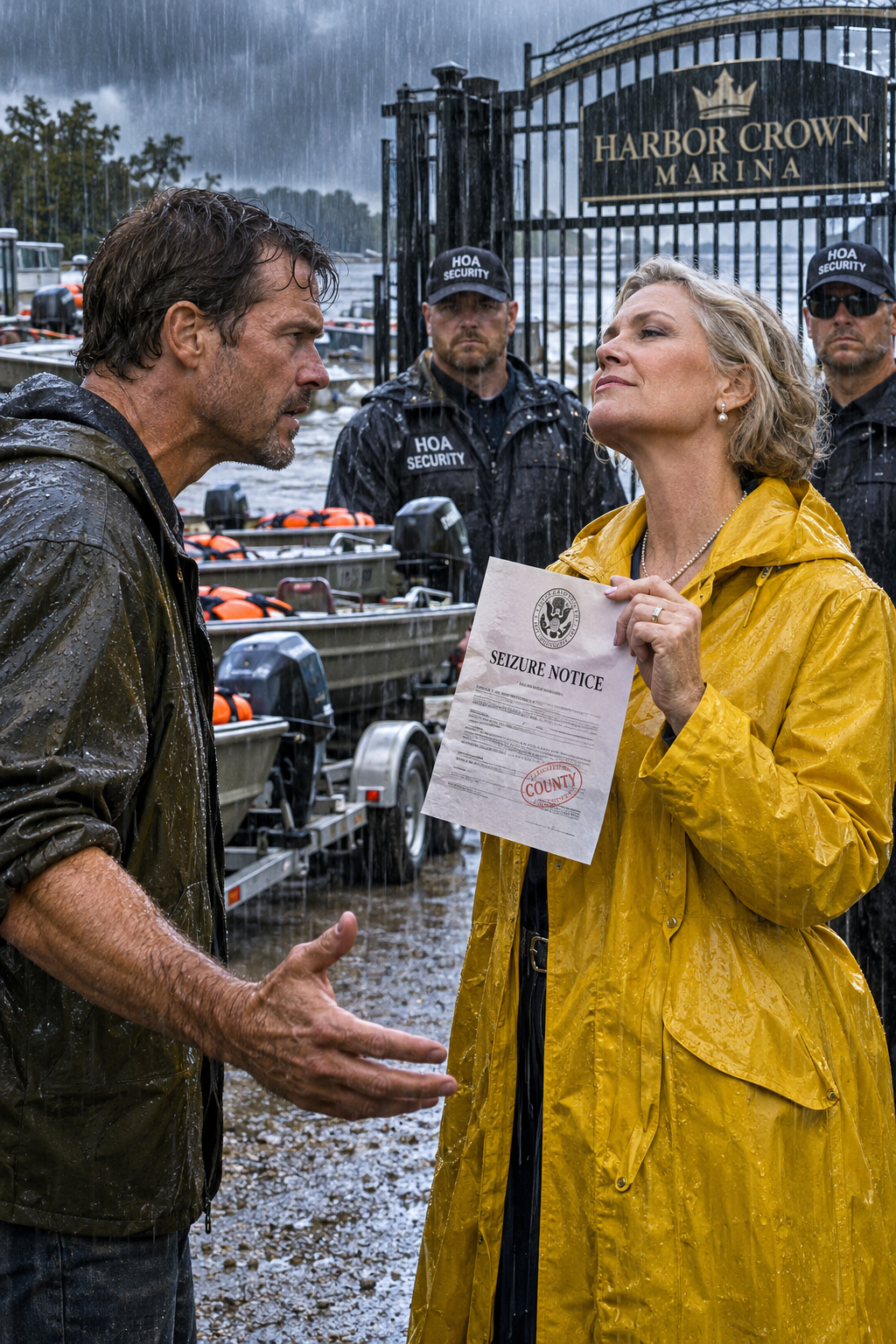
The HOA president ordered my six volunteer rescue boats off land she didn’t own as a flood approached. That night, I found tow trucks hauling them through her marina gates beneath a county order I had never seen….
The river was already climbing when Beverly Straoud told me to get rid of my rescue boats. I was standing in a muddy gravel lot with an engine wrench in my hand, looking at a woman in a spotless raincoat who seemed more worried about her marina’s appearance than the flood warning coming over my radio. I had no idea that before morning, all six boats would be gone.
My name is Nolan Pritchard. I’m 43, a marine mechanic in Willowbend County, and I’ve spent years volunteering on flood rescues along the Stonewater River. I bought my six flat-bottomed boats one paycheck at a time, fitted them with searchlights, radios, life jackets, and trauma kits, and kept their shallow-draft engines ready for the kind of water that swallows roads and parking lots. I’ve never charged anybody to climb aboard.
Tessa Monroe, our 39-year-old county emergency management director, had listed my volunteer team as an available resource in the county response plan. That didn’t make me some important official. It meant that when the river rose, someone could call and I could bring boats that were already fueled, equipped, and familiar to the local crews. The weather service was predicting a crest well above flood stage, and I knew how quickly a warning could become a rescue.
My staging lot bordered Harbor Crown Marina, the waterfront business serving the expensive homes of Harbor Crown Estates. The lot was privately owned, outside the homeowners association’s boundaries. A recorded easement also let me travel down a short gravel lane to the river, past an old wooden pier and a sign that used to say emergency access must remain clear. Somebody had painted over most of that sign in marina blue.
Beverly was 56, silver-haired, and president of the Harbor Crown HOA. She also controlled the company operating the marina, and she’d spent two years insisting the lane was hers to regulate. That afternoon she arrived in a white SUV with two security guards, photographing my boats as if she were inspecting abandoned junk. She called them an eyesore and ordered every trailer removed by six that evening.
Then she handed me a $2,400 fine for storing unauthorized industrial equipment. I put down my wrench, took a plat map and the easement record from my truck, and showed her where the HOA boundary ended. She refused to look. She said her marina controlled that stretch of shoreline, and she dismissed my recorded rights as scraps from another century.
I pointed toward the brown water pressing against the banks. “The river doesn’t care about your HOA rules, Beverly,” I told her. “Neither will the people who get trapped when it rises.” She didn’t argue about the weather. Instead, she asked me for every boat’s registration, hull identification number, engine serial number, and insurance record.
That request bothered me more than the fine. Registration documents weren’t something an HOA president needed to complain about a trailer. I told her I’d provide them to any official who actually had legal authority, but not to her. Her expression changed, and she left with her guards without another word.
A little later, a flatbed truck with the Harbor Crown Marina logo pulled near the lot. The driver used a measuring tape on my trailers and wrote down figures while talking on his phone. I photographed his license plate. I thought Beverly was arranging another nuisance complaint, and I went back to testing the engines because the weather radio was getting worse.
By evening, rain had turned the gravel slick. I checked fuel lines, charged batteries, counted life jackets twice, and made sure the trauma bags were secured under the consoles. I knew people who lived east of the river and people who drove the low road to the warehouse district every day. I pictured their houses in the path of the forecast water and stayed at the lot until there was nothing left to service.
Just after midnight, all my security cameras went dark at once. I didn’t know it then, but headlights from three tow trucks were shining outside my gate. At in the morning, a separate backup camera I’d hidden inside a storage shed sent a motion alert to my phone. I was in my pickup so fast I barely remembered grabbing my keys.
When I turned into the lot, a heavy tow truck was pulling one of my trailers off its blocks. Two boats had already disappeared through the marina’s service entrance, and workers were winching the remaining four toward flatbeds. I ran into the headlights and raised both hands until the lead driver braked. There was no time to wonder whether the storm would reach us first.
A broad-shouldered man in a Harbor Crown security jacket told me he was the HOA’s chief of security. He claimed he was executing an emergency maritime equipment enforcement order and opened a paper under his flashlight. A raised seal said Willowbend County. The format looked official enough to make me stop, but the seal’s border and the language underneath didn’t sit right with me.
Beverly appeared by the marina office under an umbrella. She calmly announced that my fines had grown to $41,600 and that the six boats would remain in her marina until I paid that amount, plus towing and storage. I told her again that my land wasn’t in her HOA and that she had no authority to take my property. She laughed and waved the tow operators onward.
I tried to reach the trauma kit on the last boat before they lifted it. Two guards stepped between me and the trailer. I backed away, turned on my phone camera, and recorded Beverly warning me that if I crossed her marina gate, she would have me arrested for trespassing. “You should have paid your fines,” she said. “Now your boats belong to my marina.”
Behind the chain-link fence, the workers lined all six rescue boats along an inner dock and locked heavy chains around them. Then they removed the portable fuel tanks and starter batteries, carrying everything into a shed. I could still see the rescue decals on the hulls, but I knew that even a broken lock wouldn’t get those engines running quickly enough when somebody needed them.
I phoned the sheriff’s office and the county emergency line, sending the backup footage, tow truck plates, and boat registrations. Deputy Wyatt Hargrove, the 47-year-old water patrol supervisor, told me he would verify the order before trying to force open a private marina in a storm. Beverly refused his dispatcher’s request to release the boats. When I looked through the fence again, her workers were peeling off my volunteer rescue decals. I couldn’t understand why she needed to make my boats look as though they belonged to somebody else. Part 2…..
By dawn, Cutter Road’s bridge had closed and every route to the east bank was flooding. Thirty adults were sheltering upstairs at Cedar Point Community Center, where the generator fuel and drinking water were running low. Tessa called just before seven and asked how quickly I could launch all six boats. When I told her where they were, I heard her turn and order staff to request boats from neighboring counties.
I went to the gate with Dale Whitaker, a county field coordinator in a soaked orange vest. He brought a formal request to release the boats under the county rescue plan. Beverly kept the gate locked and claimed she had special rights over every vessel inside her marina, even during the declared emergency. Then she offered to release two of my own boats if I paid $15,000, accepted HOA authority over my land, and signed away my right to sue.
I photographed her terms and refused. The papers would have treated my property as hers and could have left me responsible for whatever happened next. Tessa warned Beverly directly that blocking rescue resources could bring serious legal consequences. I later learned Beverly was advertising premium emergency transportation to paying waterfront members while her staff were being told to protect expensive yachts and clients first.
Ruth Ellison, a 64-year-old retired nurse helping the people at Cedar Point, called me around nine. A few people needed medicines they’d left at home, and the bottled water was almost gone. I passed that information to the official teams. As Dale spoke to a marina employee over speakerphone, Beverly’s voice cut in, saying people who wanted guaranteed evacuation should have paid for premium protection. Dale saved the call log, and neither of us forgot what we’d heard.
At a hardware store parking lot on higher ground, I spread my records across Deputy Hargrove’s patrol truck: six registrations, engine receipts, photos of hull numbers, and the easement. He examined my photo of the supposed enforcement order. Its form number was unfamiliar, its seal didn’t match county records, and it listed a government job title that no longer existed. He suspected a forgery but insisted on confirmation from the clerk rather than building a case on a guess.
That afternoon Glenn Foster, the marina’s 52-year-old technical manager, asked to meet quietly behind a closed gas station. He said Beverly had ordered his crew to strip my rescue decals, attach temporary commercial identifiers, and move the boats to a VIP dock. She had scheduled an inspection by a commercial lending and insurance firm. When he’d objected, she threatened his job.
Glenn showed me copies of work orders identifying the boats registered to me as backup equipment owned by Harbor Crown Marina. Suddenly her questions about hull numbers and engine serials made sense. She hadn’t needed those details to fine me; she needed them to make a company inventory look legitimate. Glenn agreed to provide the documents through the sheriff’s evidence process.
Beverly learned he’d talked and took away his access badge. She tried to make him sign a statement saying he’d ordered the boats moved without permission. He refused and gave Hargrove a formal statement instead. Before midnight Glenn sent another image, an asset inventory pricing my six boats at more than $200,000. A confirmation box carried my name, even though I’d signed no transfer.
I could have cut the fence, but I didn’t. Trespassing would have handed Beverly a charge to use against me and might have complicated the evidence that was finally coming together. I kept searching for a spare boat while the river kept rising, because whether or not I won the argument, people still needed rides out of the flood.
Part 3 By the following morning, six workers were trapped in a repair shop in the flooded warehouse district. Earl Dawson, a retired fisherman in his seventies, loaned me a small aluminum johnboat with a tired outboard. It wasn’t built like my rescue fleet; it had no searchlight or reinforced hull and could carry only a few people. Tessa approved an assessed backwater route, and county rescue technician Travis Boyd came with me.
Floating pallets and a submerged power cable made the trip dangerous. An uprooted tree broke loose and rolled toward us, and I eased the throttle until the current took it past the bow. At the repair shop we brought three people out at a time, returning for the other three. When the last worker reached dry ground, a mechanic named Curtis Bell asked why we weren’t using the bigger boats he’d seen at the county fair. I pointed across the river at six boats chained under the marina floodlights.
Tessa sent another written demand to Beverly. The reply was an invoice charging hourly rental rates and an extra nighttime fee for using my own vessels. Hargrove documented her notice of the emergency, contacted the on-call prosecutor, and sought confirmation of the false order. Meanwhile, floodwater was reaching the marina’s fuel and electrical systems. Glenn warned former coworkers that the hazardous docks needed shutting down, but Beverly refused to interrupt service to premium clients.
Ruth called again that evening. Water was entering Cedar Point’s ground floor, and her voice had grown tired, though she stayed calm for the others. I promised the rescue teams would keep working; I wouldn’t promise a time I couldn’t control. Then a loud bang came from the marina’s generator area, and Glenn reported that Beverly had told staff to conceal a fuel-system failure.
Late that night Beverly called me with a softer voice. She said she’d release two boats as a goodwill gesture if I signed a settlement. She emailed the packet, and the first clause said all six boats had legally belonged to the marina before the flood, with two merely loaned back to me. Other clauses required me to waive claims about damages and delays and allowed commercial use of my photographs and registration records.
I didn’t sign. I sent the packet and her messages to my lawyer and Hargrove. She was trying to get a genuine signature from me to support an ownership claim I’d never agreed to. At the same time, Marlene Prescott, a retired auditor on the HOA board, was asking Beverly about payments from the association’s reserve fund to Beverly’s marina company for supposed flood-response services. Beverly called the accounting confidential and refused to produce invoices.
A marina employee told Glenn that Beverly was boxing up accounting records and taking them to her personal vehicle. He reported it, and Hargrove began the procedures to preserve those records. At sunrise Tessa issued a final written demand to open the gates, stop interfering with emergency operations, and surrender my six registered boats. Beverly still insisted the county wouldn’t shut down a marina full of influential yacht owners.
Then the marina’s chief accountant, Viola Hartley, contacted Hargrove. She was 45 and had kept the books for eleven years. She offered a folder containing a $480,000 emergency-services contract and an addendum bearing a signature that looked like mine. Whatever Beverly had been planning, that paperwork gave investigators a way to see far beyond an HOA fine.
Part 4 Viola explained that a coalition of private riverfront properties had contracted with Harbor Crown Marina for guaranteed flood evacuation. The agreement required six operational rescue boats at all times. Beverly had already collected a $160,000 advance, although her marina had never owned six specialized rescue vessels. She’d used my hull identification numbers and photographs to convince the coalition that she could fulfill the contract.
The attached addendum claimed I’d agreed to supply my fleet. Hargrove put it in front of me; the signature resembled mine, but it wasn’t mine. Soon the county clerk confirmed that no enforcement order had ever been issued against my property. The seal on Beverly’s paper was fake. The $41,600 fine had been pressure, the inspection had been theater, and the settlement she sent me was a way to put my real signature behind her false records.
Viola’s records also supported what Marlene suspected: Beverly had routed HOA reserve money to her own marina company for a rescue guarantee without disclosing her interest or obtaining a board vote. Homeowners were paying for a service based on boats she didn’t own. Glenn’s work orders and formal statement, Viola’s records, my registrations, the false order, and my recordings gave investigators more than accusations.
Safety inspectors confirmed the flood had compromised fuel piping and electrical equipment. The fire marshal and county officials issued orders closing unsafe operating areas. Hargrove obtained a judicial warrant for evidence and property connected to the suspected theft and forged records. Staff with authority to assist gave investigators safe access to the office, where they found the $480,000 contract, the false addendum, and the commercial inventory listing all six of my boats.
Beverly arrived furious, calling the contracts confidential and demanding the deputies leave. Hargrove showed her the inventory and asked why boats she described as impounded over HOA fines appeared as marina-owned equipment in commercial agreements. I stood near the doorway and told her my supposed signature wasn’t a private matter. The warrant and safety closure did not depend on her consent.
When patrol cars and water patrol trucks arrived to secure the property, Beverly initially seemed to think they’d come to save her yachts. Deputies posted officers at the gates, sealed the relevant offices and hazardous docks, and documented vessels tied to the investigation. Privately owned boats unconnected to it remained private property, with any later movement handled by authorized crews when conditions were safe.
Glenn noticed Beverly slipping down a side dock with a leather bag toward her speedboat. He alerted a deputy. Officers stopped her as she was untying the line, and the bag contained financial records and vessel-transfer documents that matched Viola’s account. With the evidence verified, Beverly was arrested on allegations related to the taking of my boats and falsified paperwork.
My fleet was inspected, photographed, and confirmed to be mine. After the necessary procedures, the boats were released for county-coordinated rescue work, and Glenn’s crew reinstalled fuel tanks and batteries. All six engines started. I didn’t stay to watch Beverly in handcuffs, because the thirty adults at Cedar Point were still upstairs with the river rising outside.
Final Tessa organized the crossing, and our crews made repeated trips to Cedar Point through water that had covered the parking lot and climbed halfway up the first floor. We brought all thirty adults to higher ground. Ruth was the last to get off, after making sure everyone else was safe. She held my hand for a moment, then went to help count people and blankets.
Back at the marina, I saw Beverly being placed in a patrol car. Only two days earlier she’d told me nothing moved through her gates without her permission. Now the unsafe docks were dark, deputies controlled access under lawful orders, and those same gates had been opened for rescue work. I didn’t feel like celebrating. There were still flooded roads and families who needed help.
After the storm, investigators traced how the seizure had been planned and how my boats had been entered into the marina’s business records using forged documents. Prosecutors reviewed the case, and the coalition canceled the $480,000 contract, demanded its $160,000 advance back, and pursued its losses. Safety inspectors cited dangerous fuel and electrical conditions, and the marina’s operating permits were suspended pending repairs and required approvals.
At a packed HOA meeting, Marlene showed neighbors the reserve-fund transfers to Beverly’s company and the lack of board authorization. Under the association’s voting rules, homeowners removed Beverly as president. An independent audit found further questionable payments, and affected parties filed civil claims. One creditor sought a court-appointed receiver to manage the marina assets, and the court granted the request. The privately owned yachts weren’t treated as stolen just because they had been docked there.
I filed my own claim for damaged equipment and other losses I could document. A lawyer for Beverly’s company offered a substantial payment if I signed a confidentiality agreement. I declined. Later, at trial, the prosecution showed the jury the forged signature, the invented county order, the asset records, the advance payment, and the settlement Beverly had tried to make me sign. She was convicted on the charges proved in court, sentenced to seven years in prison, and ordered to pay restitution and damages.
There was one last discovery. The county land office found a waterfront record dating to 1978: the original property owner had established a permanent emergency-access easement along the lane to the river, and it had never been revoked. Beverly’s barriers, toll equipment, and painted-over warning sign had obstructed a protected route. With the court-appointed receiver managing the marina and the county overseeing compliance, crews removed unauthorized barriers, repaired the gravel lane, and restored the sign.
A new community rescue organization formed with Tessa’s county office, and I agreed to oversee the boats and their maintenance. On opening day, Ruth and other people we’d brought out of Cedar Point and the warehouse district came down to the pier. She handed me a small metal plaque made from a piece of the chain that had once held my boats. It read, “No rescue boat will be chained here again.”
I hung it beside the restored emergency-access sign. The six boats sat ready with fresh rescue decals and serviced engines, and beyond them the Stonewater River had finally gone calm. Beverly believed power meant controlling a gate and deciding who deserved help. I watched our volunteer crews head out for a training drill and thought about the people who would never again have to buy the right to be rescued.
THE END. I’ve shared the complete story, and I truly hope it touched your heart. If this story moved you, please , like, and share the post. Thank you for reading! ❤️
✓ Lynn R. Adams
The HOA president ordered my six volunteer rescue boats off land she didn’t own as a flood approached. That night, I found tow trucks hauling them through her marina gates beneath a county order I had…