The HOA president insisted
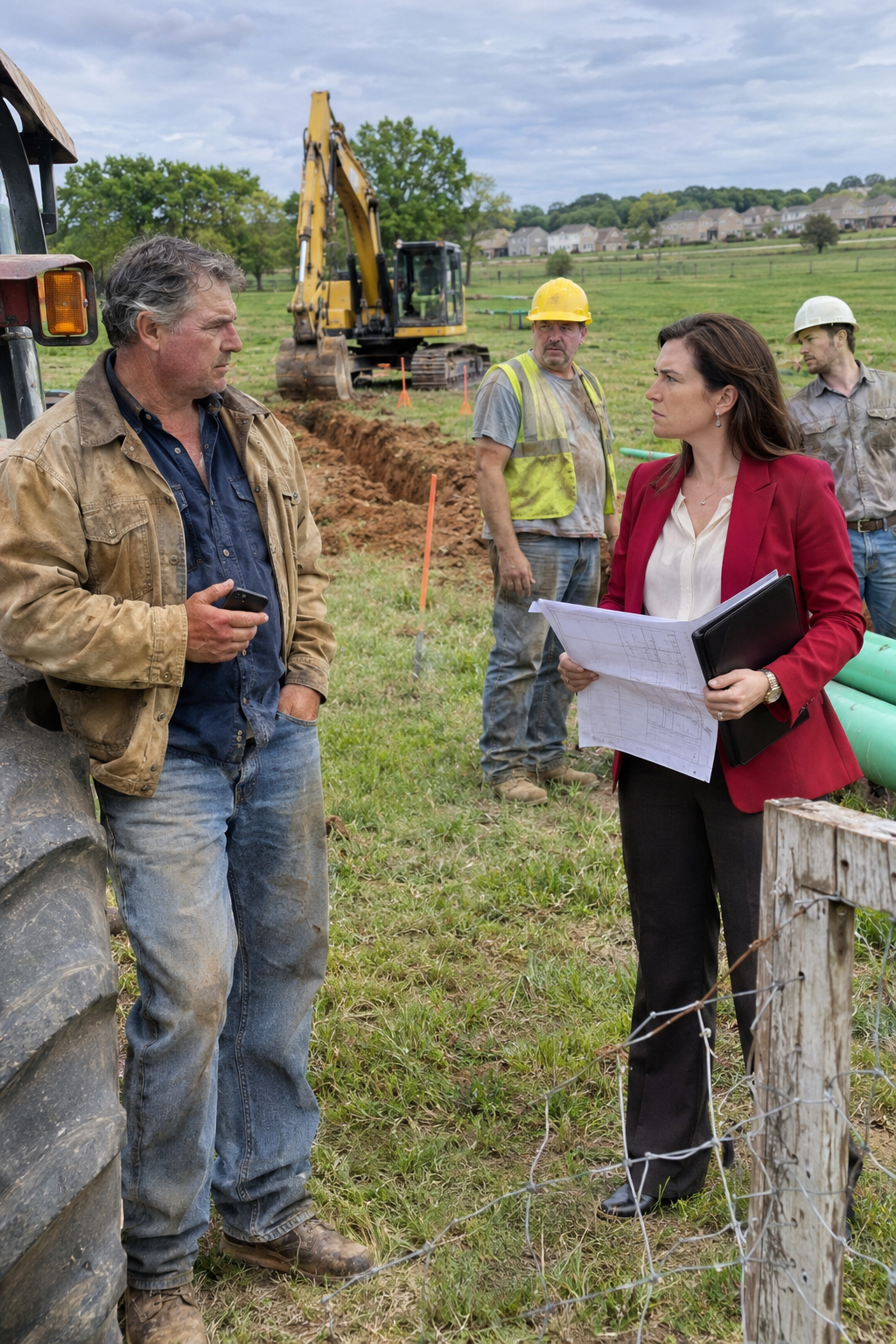
The HOA president insisted her sewer crew had every right to dig through my pasture, but when I checked the county’s recorded easement that same morning, one detail made her official construction plan look very different….
The first thing I noticed was the noise. At on a spring morning, diesel engines were growling beyond the low rise in my southern pasture. I came over that hill in my tractor and saw a yellow excavator digging a trench through grass my cattle had grazed the night before. Green sewer pipe lay on wooden blocks. More pipe was already in the ground. Someone had even covered about thirty feet of it with compacted soil.
My name is Cole Bennett. I was fifty-four that spring, and Cedar Hollow Ranch was the only place I wanted to be. My father had worked these fields before me, and I’d owned the ranch myself for seventeen years. It wasn’t a showplace, just 214 acres of pasture, hay fields, two stock ponds, a cattle shed, and an old equipment barn. I knew which gates stuck after rain and where the ground stayed soft in April. I certainly knew I hadn’t ordered a sewer line.
Along the southern edge of my land sat Silver Creek, a subdivision built less than twelve years earlier. Its fancy stone entrance was nearly half a mile from my driveway. We didn’t share roads, utilities, or common property. My deed didn’t put a square foot of Cedar Hollow inside the Silver Creek Homeowners Association, and the fact that my fence met their boundary didn’t change that.
I drove closer, thinking there had to be some explanation. Then I saw that a section of my wire fence had been deliberately removed. Heavy tire tracks came straight through the opening from the subdivision’s maintenance lane. Orange stakes marched across the pasture and turned back toward the houses. A contractor hadn’t wandered in by mistake. Somebody had planned this route, brought heavy machinery onto my land, and started burying pipe without speaking to me.
For a moment I just sat there with my hands on the steering wheel. That pasture wasn’t empty space waiting for somebody else’s project. Fences kept cattle where they belonged. Drainage determined when I could move equipment. A trench and a buried line could change how I used the ground for years. I couldn’t pretend this was a minor inconvenience.
I parked my tractor across the temporary access lane, not across the trench, and climbed down. I took photographs of the broken fence line, the tracks, the stakes, the soil piles, the exposed pipe, the piece already backfilled, and the contractor’s trucks. I stayed away from the open excavation and didn’t touch a single machine. When the crew stopped to ask what was going on, I said I needed to see the document that gave them permission to work here.
The workers didn’t have a deed or an agreement with my signature. They had a project plan and instructions to follow it. I told them the access lane would remain blocked until somebody could explain the property rights. The crew shut down the work. Less than forty minutes later, a dark SUV rolled up from Silver Creek.
Out stepped Dana Kesler, the HOA president. She was forty-one, dressed in a tailored crimson blazer that looked painfully out of place against fresh dirt and spring grass. She carried a thick black portfolio and came toward me with the certainty of someone who expected the argument to be finished before it started. The sewer extension, she said, had approvals. The contractor had an engineered plan. The association had a recorded utility easement.
I listened, then asked to see that easement. Dana opened her portfolio and showed me a construction drawing instead. It had engineering stamps, revision numbers, manholes, technical notes, and a shaded strip running straight across my southern pasture. It certainly looked official. But a drawing of where somebody intended to dig wasn’t proof that they owned the right to dig there.
I’d dealt with enough ranch paperwork over the years to know an easement wasn’t a loose promise that could drift wherever a project needed it. It applied to particular ground, described in an actual legal instrument. If Silver Creek had the right to put sewer pipe underneath Cedar Hollow, there ought to be a recorded document or another valid agreement showing that right. Dana’s sheet showed a route. It didn’t show my consent.
I kept my voice level. I wasn’t asking whether the subdivision needed a sewer extension, and I wasn’t trying to make the contractor’s day worse. I wanted to know why their new trench crossed land I owned. Dana continued to refer to the approvals and the plan. Nobody produced a recorded easement that named my ranch or an access agreement that I had signed.
The crew left the excavation inactive while we disputed the property question. I checked that the opening in the fence was documented and took more photographs from safe ground. By nine-fifteen I was on my way to the county recorder’s office with dust still on my boots. I knew a piece of paper couldn’t fill the trench, but it could tell me whether I was standing on solid ground in more ways than one.
At the recorder’s office I asked for my deed first. Then I pulled the Silver Creek subdivision plat and the utility easement referenced by book and page number in the project’s materials. The clerk located the instrument. So there really was a recorded utility easement; that much of Dana’s claim was true. I took the time to read its legal description, not just the heading.
The easement described a thirty-foot-wide utility corridor along the eastern side of property that once belonged to Silver Creek’s developer. Its bearings, distances, and monument references could be compared against the subdivision plat. I spread the records beside my deed and followed the boundary one segment at a time. The more closely I checked, the less sense the construction drawing made.
The recorded corridor remained east of Cedar Hollow Ranch. It didn’t cross my southern pasture. It didn’t clip the corner of the property or overlap it by a few disputed feet. The easement existed, but it never entered my ranch at all. I asked for certified copies, then went through the documents again to be certain I wasn’t missing an amendment or a separate right covering my land.
Outside, I enlarged a photograph of the construction plan on my phone. Beside the shaded route through my pasture was a small notation: “Temporary construction access per owner coordination.” I read those words twice. In seventeen years of owning this place, no engineer had coordinated access with me. No contractor had asked to open my fence. No HOA representative had offered an agreement to cross my land.
I had never signed a temporary right of entry, never sold a permanent sewer easement, and never granted anyone permission to bury pipe under my cattle pasture. Yet the drawing treated access as if it had already been arranged. By the end of that first day, I’d uncovered the contradiction at the center of the whole project: Silver Creek had a real easement, but its crew was digging somewhere else. Who had told everyone my permission was already taken care of? Part 2…..
The next morning I laid three documents across my kitchen table: my deed, the certified easement, and the contractor’s plan. My ranch appeared in one place on the legal records and in quite another place on the construction sheet. I took the stack to Mark Ellison, an attorney who handled agricultural land disputes and easement issues. He didn’t begin by arguing about whether the sewer was needed. He asked what property rights actually existed, and where.
Mark traced the history of Silver Creek’s development. Years earlier, its developer had granted a utility corridor on land the developer owned. That document covered sewer, water, and related infrastructure, but nothing in it mentioned Cedar Hollow. It didn’t give anyone temporary construction access over my pasture, and it didn’t say the corridor could be moved if digging along the original route got expensive. Mark sent preservation notices to the HOA, engineering firm, and contractor, then requested permit and project records from the county and utility district.
Those records started coming in over the next several business days. Most were the usual engineering details: manholes, pipe depths, inspections, slope calculations. Then Mark found the design revisions. Revision zero followed the recorded easement and stayed inside Silver Creek. Revision one adjusted a manhole. Revision two changed pipe depth. Revision three moved the sewer west, crossing my pasture before curving back toward the subdivision.
There was a reason for the switch. Testing along the original corridor had found dense basalt. Breaking and hauling that rock would take special equipment, more money, and nearly three additional weeks. My pasture offered softer, easier ground. The engineering alternatives memorandum compared the routes. The western option was faster and cheaper, but only if Silver Creek obtained additional property rights. That condition was written down before an excavator ever crossed my fence.
The title review said the same thing. It correctly identified the old utility easement, then warned that construction outside it would require new rights. The county’s construction permit approved technical work subject to lawful property access; it didn’t hand an HOA the use of somebody else’s land. But on a later drawing, the warning had been replaced with the innocent-sounding words “temporary construction access.” Somewhere between design and construction, an unresolved requirement had quietly become an assumption that everything was handled.
A utility district checklist made that shift even clearer. Property access was marked complete, with a note saying owner coordination had been confirmed by the project client: Silver Creek HOA. No agreement, recording number, compensation record, or letter from me accompanied that checkmark. Revision three named Dana Kesler as the board-level project liaison. Her name on the sheet didn’t prove she had authorized trespass, but it told Mark which communications we needed to examine next.
Before the paperwork could carry us any further, we needed to establish the route on the actual ground. Mark hired Elena Ruiz, a licensed surveyor, who arrived with survey-grade GPS equipment, a robotic total station, the deeds, and the subdivision plat. She located two old boundary monuments and checked them against the recorded controls. Then she marked my boundary in blue, the legal easement in white, and compared both against the contractor’s orange sewer stakes.
The colors told the story better than an argument ever could. The white easement flags stayed inside Silver Creek. The orange construction stakes crossed west of my blue boundary line. Elena measured the offsets along the route. Near one section the excavation was more than twenty feet into Cedar Hollow; at its widest point, the sewer centerline lay almost forty-two feet inside my property. This wasn’t a misplaced fence post or a survey tolerance. It was a different route entirely.
Part 3 Elena prepared an overlay showing the deed boundary, the recorded corridor, and the trench as built. She also documented pipe staging, soil stockpiles, the fence opening, and the temporary equipment lane. The damage extended beyond the narrow trench itself. Mark sent her preliminary results to the utility district. The dispute was no longer just my word against an HOA drawing. A licensed survey now showed construction outside the land described in the easement.
District staff reopened their property-rights file. They searched by my name, by the ranch parcel number, and by the recorded easement references. They found no access license, no temporary construction easement, no permanent sewer easement, and no recorded amendment for Cedar Hollow. Then an archived file pointed to a numbered temporary right-of-entry agreement. For a moment, that seemed like it might explain the checkmark on the project’s checklist.
It didn’t. The document covered a narrow strip behind three homes on the eastern side of Silver Creek, for earlier drainage work. It did not identify me, my parcel, my pasture, or this sewer project. An access agreement existed in the file, but it belonged to another piece of property. Mark was careful not to call that fraud on sight. An old file can be attached by mistake, and someone can misunderstand a legal description. We needed to know when it appeared and what people had been told.
As more engineering records, HOA board packets, correspondence, and preserved electronic files arrived, we put them in date order. Board members had seen that the basalt made the lawful eastern route more expensive. They had also seen the western alternative presented with construction savings. Initially, property access was listed as “coordination in progress.” Eleven days after the title warning, that status changed to complete, although nobody had approached me.
A coordination log showed an earlier version with western access unresolved and a later one closing the item. Metadata associated the later save with Dana’s HOA account, though it could not tell us who typed every word. More importantly, an engineer had asked for confirmation that the western landowner had completed a temporary right-of-entry agreement. A reply from Dana’s authenticated account represented that owner coordination was complete and field access could proceed. That statement fed into the project’s access checklist.
Then Mark found that the wrong-parcel agreement had been uploaded to the sewer archive the same day the access issue was marked complete, again through Dana’s HOA account. Three business days before that upload, the title company had explicitly identified Cedar Hollow Ranch as separate property owned by Cole Bennett. Its clarification said the existing easement stayed east of my boundary and no recorded right had been found for the proposed western route. Dana had been included among the recipients.
The HOA’s internal cost-control materials assigned outside property coordination to Dana nine days before the excavator entered my pasture. The contractor’s preconstruction records showed it had proceeded based on client confirmation, with the mismatched agreement as the supporting document. That still didn’t reveal Dana’s private motive, and Mark refused to pretend it did. It did show that the project team had been warned, that the correct parcel and owner had been identified, and that someone on the HOA side had represented access as resolved without an agreement from me.
Mark sent the complete chronology to the county engineering department and utility district: deed, easement, design revisions, title warnings, survey overlay, access checklist, account records, and the wrong-parcel document. The utility district suspended further work on the disputed segment pending proof of lawful property access. The county scheduled an inspection. What began as me blocking a lane with my tractor had become a formal review of the project’s paper trail.
Part 4 At the inspection, county personnel, the utility district engineer, Elena, Mark, and a contractor representative walked the site. Dana arrived with her black portfolio, wearing another dark red jacket. But this time the controlling evidence wasn’t simply the construction drawing she carried. The survey monuments had been verified. Blue flags marked Cedar Hollow’s boundary, white flags the recorded utility easement, and orange stakes the actual pipe route. The mismatch was visible to everyone standing there.
Inspectors documented the open trench and the short section of sewer already installed and partly backfilled on my side. The access document was checked against the affected parcel. Wrong owner. Wrong land. Wrong purpose. The agencies didn’t have to decide what Dana intended in order to answer whether the project had legal authorization. The applicant hadn’t shown a right to construct on Cedar Hollow Ranch. A formal stop-work notice followed for the disputed portion.
The contractor stabilized the excavation, secured loose material, and maintained safety and erosion controls. The buried section was left in place temporarily, not because Silver Creek had won a right to keep it, but because removing underground pipe safely required an approved corrective plan. That distinction mattered to me. My tractor was no longer the reason work had stopped. County and utility officials had independently confirmed the property-rights problem.
Silver Creek had two choices: negotiate new rights across my ranch or move its sewer back into the lawful corridor. Its representatives offered compensation for temporary construction access and a permanent easement across my pasture. The request came after part of the sewer was already under my land, even though the project file had treated those rights as settled before construction. I discussed it with Mark and declined the permanent easement.
That wasn’t a choice I made to punish anyone. A permanent underground utility corridor could affect future fencing, drainage, equipment access, livestock operations, and what I might build on the ranch. Maintenance crews could need access years from now. It would burden land my family depended on. The association’s earlier mistake didn’t obligate me to accept that lasting change, whatever price was offered.
The engineering team returned to the original eastern route and the basalt it had tried to avoid. Now it also had to remove the pipe from my pasture, restore the trench, repair the fence, loosen compacted ground, replace topsoil, check drainage, and reseed damaged areas. Revised estimates included shutdown, site stabilization, engineering changes, removal, remobilization, and corrected construction. The new costs exceeded the rock-excavation premium the shortcut was supposed to save.
Mark separated my property claim from the HOA’s internal disputes. We documented the disturbed area through Elena’s survey, photographs, contractor records, and restoration estimates. We sought compensation for verified damage, temporary loss of normal use, survey costs, and property-related legal expenses. We didn’t demand some imaginary jackpot. Silver Creek notified its insurer, which reviewed the claim while reserving coverage questions; an insurance investigation wasn’t a promise that every project expense would be covered.
Meanwhile, HOA board members requested the full chronology. The evidence showed the board had selected a cheaper engineering option that required new land rights; it did not show the board had voted knowingly to trespass. But the records also showed an access item was marked complete without valid support. Dana was removed from overseeing the sewer project while the board reviewed the procedure. That was an administrative response, not a criminal conviction or court finding.
Final With the stop-work order still controlling the disputed area, the contractor submitted a safe removal and restoration plan. Under that approved plan, the installed pipe was uncovered and taken out of Cedar Hollow. The trench was backfilled, the opened fence rebuilt, the compacted lane treated, and the topsoil replaced. Elena recorded the conditions so we would have an objective basis for deciding whether the repairs worked. Fresh grading and seed weren’t enough if the next rain caused the ground to settle or sent water in a new direction.
Silver Creek agreed to cover the verified damage to my ranch, the needed restoration, and reasonable surveying and property-related legal costs. How the HOA, contractor, insurer, and any other parties ultimately divided those bills was their business. My goal was simpler: Cedar Hollow shouldn’t have to pay to undo construction I never authorized. The restoration remained open for follow-up checks, because pasture isn’t fully repaired just because the machines have gone home.
Several weeks after the stop-work order, the sewer extension resumed under a different HOA liaison. The new alignment stayed east of my boundary in the original recorded utility corridor. The county reviewed corrected plans, and the utility district required parcel-specific verification of the access rights involved. Contractors had to deal with the difficult basalt after all. Progress was slower and excavation cost more, but the pipe was going into land Silver Creek actually had the right to use.
On my side, the first substantial rainfall showed why we’d insisted on follow-up inspections. Elena and the restoration contractor checked the repaired strip, fence, and drainage. Two low spots needed more fill. Another area was still too compacted. The contractor corrected those problems, and the ground was inspected again before the final restoration signoff. Seed came in unevenly at first, but the pasture gradually recovered.
The HOA also changed its procedures for future work beyond association-owned property. A project could no longer close an access item on someone’s word alone. Parcel numbers, legal descriptions, construction routes, and signed access documents had to match, and ownership needed to be verified before fieldwork. Dana did not return to the sewer project’s oversight. The records supported those practical changes without telling me anything certain about her personal motives.
Months after that first morning, Elena completed a final survey package. It showed Cedar Hollow’s boundary, the recorded utility easement to the east, and the corrected sewer line entirely within that legal corridor. I filed it with my deed, certified easement, and restoration papers. By late summer, replacement grass covered most of the disturbed strip, the cattle were back, and the rebuilt fence stood on its old line.
One afternoon I walked down to the spot where the excavator had been. No orange stakes, no temporary barriers, no pipe beneath my grass. Silver Creek still had its sewer project, and I still had my ranch. The lesson wasn’t about a red blazer or who had sounded most confident that first morning. A permit didn’t create ownership, an engineering revision didn’t move an easement, and a right-of-entry agreement for another parcel couldn’t become mine by being put in the wrong folder.
The line that mattered most wasn’t drawn by the excavator. It was the property line that had been there all along.
THE END. I’ve shared the complete story, and I truly hope it touched your heart. If this story moved you, please , like, and share the post. Thank you for reading! ❤️
✓ Lynn R. Adams
The HOA president insisted her sewer crew had every right to dig through my pasture, but when I checked the county’s recorded easement that same morning, one detail made her official construction plan…