The HOA president had a giant electrical transformer lowered into my cattle pasture and insisted I had no right to object, but one line on a contractor’s work order made me question who had really chosen that spot…
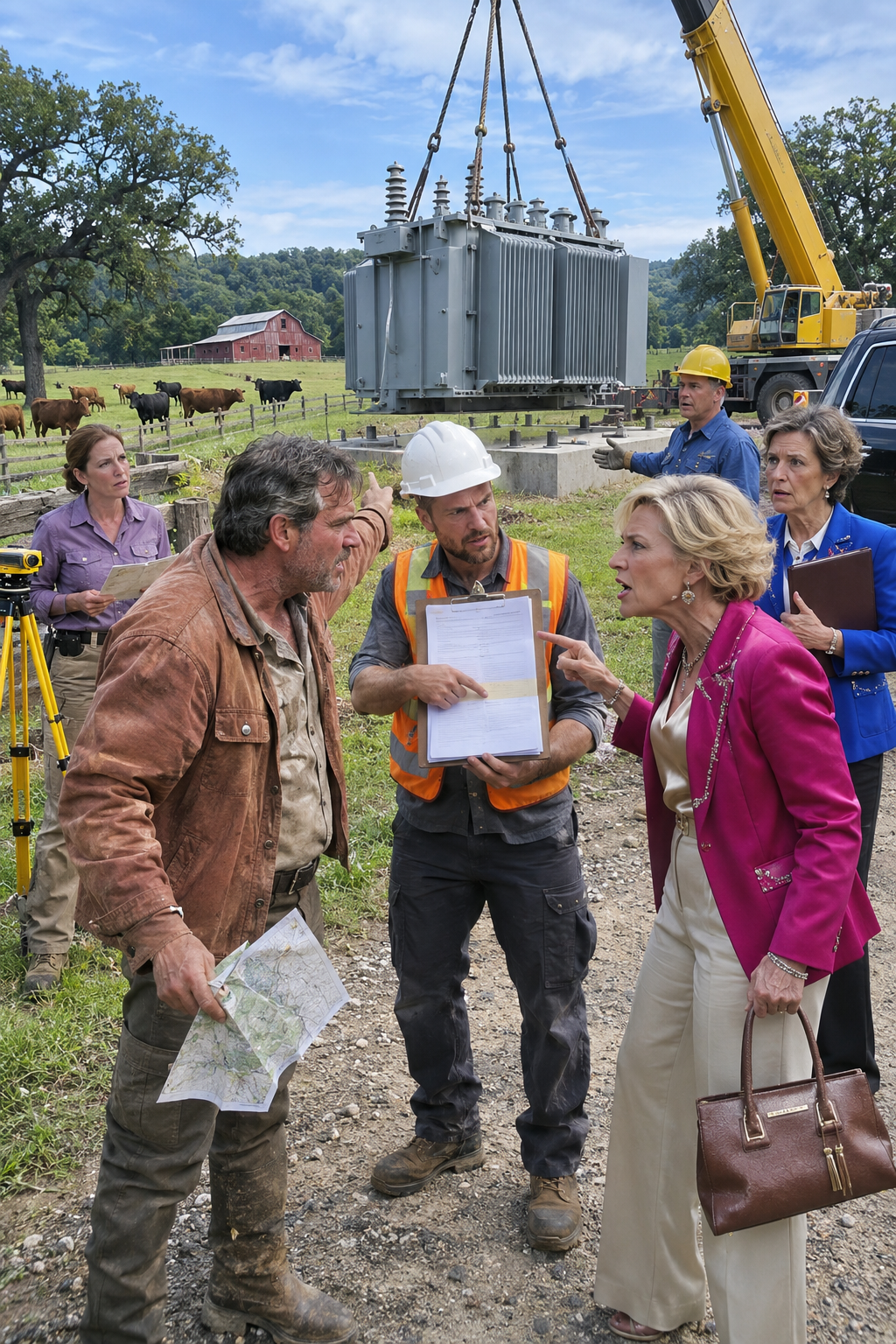
The HOA president had a giant electrical transformer lowered into my cattle pasture and insisted I had no right to object, but one line on a contractor’s work order made me question who had really chosen that spot…
The crane was still running when I drove down to my south pasture and saw a green electrical transformer hanging over my fence. A section of wire had been pulled loose, and a fresh concrete pad waited thirty yards inside my property. By the time I stopped my truck, the crew was lowering the equipment as though this were an ordinary workday on land they owned.
Vanessa Hart stood beside the pad in a bright red blazer, holding a black folder against her hip. She was president of the Stonegate Hills homeowners association across the county road, and she pointed at my truck before I had even closed the door. “Move it, Daniel. The board approved this utility corridor.”
“My name’s Daniel Mercer, and this is Mercer Ranch,” I told her. I was fifty-seven years old, and I had spent more of those years working this ground than Stonegate Hills had spent existing. Still, I wasn’t about to settle a boundary question by raising my voice beside a crane.
I looked past Vanessa at the technician standing beside a utility truck, his meter case still shut. “If everything’s approved, why isn’t he turning it on?” I asked. Vanessa’s face changed just enough for me to notice, but she recovered quickly and opened her folder.
She held up a color map with a highlighted strip running beside the subdivision. “Existing utility corridor,” she said. “We don’t need your permission.” I asked whether the drawing came with a recorded easement number or a survey showing that the highlighted area reached this far into my field.
“You’ll get whatever you’re entitled to,” she answered. The technician stepped closer before I could reply and told us the transformer would not be energized that day. Vanessa demanded to know why, and he said there was a hold on the location and that he needed to make a call.
Nobody offered to explain the hold to me. The crane operator had already unhooked his chains, and the contractors were standing around a piece of equipment that looked terribly permanent. I photographed the pad, the torn-open fence, the orange trench marks, the tire tracks, and every truck I could see.
By evening the crews had left, and Vanessa was the last to drive away. I stayed until the sun dropped behind the cottonwoods, walking the damage instead of touching anything. That open section was one I had rewired the previous spring after a storm brought down a limb, and I could still remember which fence posts had needed replacing.
My parents bought the first eighty acres before I was born. They added neighboring pieces whenever they could, and by the time my father retired from the daily work, Mercer Ranch covered 180 acres. I kept his cattle rotation going because the pastures, gates, and lanes had been arranged for reasons a person couldn’t see from the road.
The south pasture wasn’t vacant ground somebody could borrow. Its cattle lane kept the herd clear of a drainage swale and guided them toward the gate back to the barns. A transformer, gravel access route, and underground cable in the wrong place could affect livestock movement and the trucks we used to feed them.
That night I spread my deed, tax records, old parcel maps, and aerial photographs across my office desk. The photographs showed the fence standing where it stood now, long before the subdivision was built. I found nothing giving Stonegate Hills ownership of my pasture, but I knew an easement could exist without announcing itself on the first page of a deed.
So I wrote down what I actually needed: the document behind Vanessa’s claim. The next morning, before feeding, I photographed the pasture from the same direction as an old aerial print and marked the new pad on a parcel map. I started a notebook with dates, vehicle descriptions, what each person had said, and the changes I could verify.
I didn’t call Vanessa to argue. I didn’t move the orange stakes or lay a hand on the transformer. If the association had a valid right to be there, I wanted to read it; if not, I wanted a record made before more ground was disturbed.
Two days later a certified letter arrived on Stonegate Hills letterhead, signed by Vanessa as board president. It accused me of interfering with authorized electrical improvements by parking near the work and warned that the HOA might seek contractor standby fees and other delay costs. I sat at the kitchen table and read it twice, wondering how they could already be discussing my financial responsibility without showing me their authority.
I scanned the letter and wrote back in plain language. Their transformer and construction markings were inside my fence, I said, and I had received no documentation authorizing that placement. Until the claimed right was identified, I did not consent to more work on that portion of Mercer Ranch.
Vanessa emailed almost immediately: “Your consent is not required.” I printed those five words and put them in the folder with her letter. They told me she wasn’t waiting for a question to be resolved; she was acting as though the question had never existed.
The following morning, I heard a skid steer before I reached the pasture. Contractors were spreading pale gravel through the opening in my fence, making an access strip toward the transformer. I pulled over short of their equipment and began taking photographs without stepping into the work zone.
The foreman approached with his hands at his sides. His shirt said Ray. “Mr. Mercer, we’ve got authorization to continue the access work,” he told me, then admitted the authorization came from Stonegate Hills.
“Do you have the document that lets them put a road through my pasture?” I asked. Ray frowned and said he had a work order, not property records. When I asked to see it, he called his office and waited beside me while the skid steer idled.
Ten minutes later he returned with two clipped pages. His office had agreed I could photograph them, though he couldn’t release the originals. The order listed pad preparation, transformer installation, access grading, and future trenching for the Stonegate Hills electrical service project.
At the top was a project number, which I photographed clearly. At the bottom of the second page, beneath the description of the work, was a line I might have missed if I’d been watching Ray instead of the paper. It read: “Field location per HOA direction.”
I asked Ray what that meant. “The final spot was given to us out here,” he said, looking toward the pad. He didn’t know the design history, and he wasn’t going to guess who had made the decision.
I thanked him and emailed the pictures to myself before leaving the pasture. A work order wasn’t proof that Vanessa had acted without an easement, and I wasn’t going to pretend otherwise. But her map had made the location sound fixed long before construction began, while the contractor’s own instructions said somebody from the HOA had directed where the equipment went.
Standing beside the damaged fence, I looked from those words on my phone to the transformer sitting in my cattle lane. If that was always the authorized site, why did the work order call it a field location—and what had the original plan actually shown? Part 2…..
IF FACEBOOK BROUGHT YOU HERE, HERE’S THE CONTINUATION YOU’VE BEEN WAITING FOR. ENJOY! 👇 Vanessa sent another email that afternoon, calling the gravel temporary and accusing me of harassing authorized contractors. I asked again for the recorded instrument or agreement that allowed permanent electrical equipment at that precise spot. She did not send one.
Instead, more orange markings appeared across the pasture. Wooden stakes traced a line from the transformer toward the county road, right across the lane I used to move cattle. Once someone dug that trench and buried cable, undoing the work would become harder and more expensive.
I stopped asking the HOA to explain itself and called the utility company with the project number from Ray’s paperwork. Customer service confirmed a pending distribution service job but wouldn’t decide property rights or interpret an engineering plan for me. The representative did say the job carried an engineering-review hold and gave me the regional office number.
At that office I reached Marcus Reed. He asked for the nearby road, the pole number, and the identification tag on the transformer, so I drove back to the pasture and read each one to him. After confirming the unit, he told me the installed location couldn’t be energized until engineering cleared it.
“Does that mean the HOA owns the ground?” I asked. “I can’t make that determination,” Marcus replied, and I told him I wasn’t asking him to. I wanted to know whether the equipment sitting inside my fence matched what his company had approved.
He said field changes sometimes required reviews of design, access, and supporting site documents. He couldn’t release internal engineering records on that call, but he could provide a basic status email. Fifteen minutes later, I had it: the Stonegate Hills distribution extension was on hold pending location review.
I laid that message next to Vanessa’s warning and Ray’s work order on my kitchen table. Vanessa said she didn’t need consent; the contractor said the field location came from the HOA; the utility said the location still needed review. None of those documents settled ownership, but together they gave me a reason to keep asking.
The next morning Ray called to say trenching was paused for utility coordination, though the transformer and gravel were staying put. Vanessa’s next email described a routine coordination matter and again mentioned costs she might try to charge me. She didn’t explain why her contractors had been directed into my pasture.
On Monday I took the folder to Clare Donovan, a real estate attorney in the county seat who had handled a grazing lease for me years earlier. She read the certified letter, email exchanges, work order, utility status notice, and photographs. When she got to “Field location per HOA direction,” she tapped the page and said, “That line needs an explanation, but the land records matter more.”
Clare wanted a complete search for recorded easements, a licensed survey locating the pad, the utility’s approved design, and any documents authorizing a change in the field. “I’m not promising where this leads,” she told me. “Good,” I said. “I want to know what’s true.”
Her paralegal found several old recorded interests before locating an electric easement from decades earlier. It described a narrow strip along the eastern side of a parcel now included in Mercer Ranch. Clare ordered a certified copy and called Mark Ellison, a surveyor who had worked county land for twenty-seven years.
Mark spent a morning checking corners, control points, and the legal description. He set temporary stakes near the eastern side of the pasture, then glanced toward the transformer farther into my field. He wouldn’t give me a distance before processing the measurements, but he said the staked strip and the transformer pad did not sit on top of each other.
Two days later his preliminary overlay arrived. It showed the old easement strip, ranch boundary, fence, cattle lane, gravel track, and pad, with the transformer visibly away from the recorded strip. I wanted to ask whether we’d won, but Clare answered before I could: another amendment or separate agreement might still exist, and we had to search for it.
Clare requested the utility project file and sent Stonegate Hills a preservation and records request. While we waited, Ray called from the pasture with news I didn’t want: his crew had been released to prepare the site again. When I arrived, a skid steer was moving gravel, conduit lay strapped to a truck, and an excavator stood near the painted trench route.
Ray said they were staging and waiting for instructions about digging. I called Clare with the engine growling behind me, and she told me to photograph everything without getting in the crew’s way. She contacted the utility and the HOA’s lawyer while I kept my distance and recorded what was happening.
By midafternoon she’d delivered written notice disputing further excavation. The skid steer stopped, but the excavator stayed beside my cattle lane overnight. Every morning and evening I took another photograph from the same fence post, recording exactly what had changed and what hadn’t.
The next morning, the first useful design sheet came from the utility records office. It showed the county road, the subdivision streets, and the edge of my ranch, with a transformer symbol inside an area labeled HOA common property. I stared at it, then checked the location against the survey: the approved drawing put the transformer across the boundary from where it actually stood.
Marcus confirmed to Clare that this was the original approved service layout. He also explained that field changes could require a revised design, engineering notes, or other authorization. After the call she wrote a few words on her legal pad: “Find the change document.”
The HOA first produced ordinary board agendas, budgets, and project summaries that didn’t answer our question. Clare sent a more specific request using the contractor’s project number and the installation dates. Three days later, additional records arrived, and this time there was a two-page change order tucked among the invoices and scheduling emails.
The original line item placed the transformer on Stonegate Hills common property. The revised item moved it to a west field position beside the Mercer parcel, and Vanessa Hart’s electronic signature appeared in the approval box. A contractor note described the purpose in three words: “Field routing savings.”
My hands were flat on Clare’s conference table when I finished reading it. We finally knew the installed location hadn’t simply appeared on a map by mistake; a documented change had moved it, and Vanessa had approved that change. What we still didn’t know was whether anyone had secured the land rights needed to put it there.
Part 3 The next record helped explain why the relocation had been attractive. An HOA board packet compared the original electrical route with a shorter alternative, including conduit, trenching, pavement repair, and labor. The shorter option was projected to save a little over $41,000.
“So that was why she put it on my property,” I said. Clare slid the packet back toward me. “It tells us there was a financial incentive,” she replied. “It doesn’t tell us everything Vanessa was thinking, and savings don’t create an easement.”
She arranged the records across the table: the old recorded easement, Mark’s overlay, the approved design, Vanessa’s signed change order, and the cost comparison. We could now trace the move from HOA land to mine, but we still needed the utility’s own assessment of the installation. The records office had located engineering notes and told Clare they would release them the following morning.
The excavator was still parked beside the cattle lane when those notes arrived. Clare called me into her office and laid Mark’s survey next to the approved design. On one drawing the authorized utility strip ran along the east side of the parcel; on the other, the original transformer sat within Stonegate Hills common property.
Then she circled the actual pad on Mark’s drawing. That circle was somewhere else entirely, outside the recorded easement we’d found. Clare reminded me that a different valid agreement could change the legal picture, but Stonegate Hills still hadn’t produced one covering the installed pad.
The new engineering note was direct: the as-built location didn’t match the approved design. Energization was suspended pending confirmation of site rights, access, and engineering acceptance. I reread those lines while Clare lined up the design, change order, survey, and hold notice in chronological order.
For weeks Vanessa had treated the completed pad as proof that the matter was settled. The papers showed the reverse: the utility had approved one site, the HOA had directed a move, and the utility refused to energize the new site without the proper requirements being met. The concrete had made the problem visible, not legal.
Marcus joined a call later that day. He explained that a relocated transformer had to meet operational and engineering requirements and have documented property rights for permanent access and maintenance. When Clare asked whether an HOA board vote alone met those requirements, he said no.
I asked whether the company could energize the transformer in its current position without a new agreement from me. Marcus said not under the existing hold. He wasn’t issuing a ruling on who owned the pasture; he was explaining why the project couldn’t go forward as things stood.
That evening Vanessa sent a proposal through the HOA manager. Stonegate Hills would pay me for a permanent easement covering the transformer pad, a gravel access lane, underground conductors, and future maintenance rights. The access language covered more of my pasture than the pad and gravel they had already put there.
I read the proposal at my kitchen table, then opened the email in which Vanessa had said my consent wasn’t required. Now the board wanted my signature to make that location usable in the future. Clare’s reply was short: don’t sign anything before we review it.
The next morning a formal utility letter confirmed that the transformer would remain deenergized at its current location unless the engineering, access, and site requirements were resolved. Mark also delivered his signed survey certification, documenting the relationship between the recorded easement, the property boundary, and the installed pad. Clare attached both to a demand sent to Stonegate Hills.
We demanded no more entry or excavation without permission, no expanded gravel access, and no attempt to energize the equipment in place. We also asked for preservation of project communications and a plan to remove the transformer, tear out the pad, and restore the pasture and fence. By then my goal had become very practical: I wanted my cattle lane back, not a years-long argument over who could talk the loudest.
Vanessa stopped answering personally. Stonegate Hills hired attorney Michael Trent, who denied wrongdoing and asked whether I would consider a larger payment for an easement. Clare explained exactly what the proposed rights would allow, including ongoing access for maintenance across my ranch.
“No,” I told her. I was willing to discuss removal, restoration, and the costs I’d incurred, but I wouldn’t sign away a permanent route through the south pasture. Clare sent that answer to Trent without adding any threats.
Two days later Ray called to say a crew was being sent back to secure the equipment and possibly do more access work. He didn’t yet have a complete scope, and I had learned what “possibly” could mean when there was an excavator near my cattle lane. I called Clare before the crew arrived.
She and Trent exchanged messages through the morning. By afternoon she had filed in county court for temporary injunctive relief to preserve the site while the property rights were disputed. The request wasn’t a trial over every inch of the pasture; it was an effort to prevent new trenching, access expansion, and construction from making the disagreement harder to resolve.
Neither side wanted an emergency hearing if a temporary agreement could hold the ground still. By day’s end, the attorneys had agreed that HOA contractors would not enter without notice and consent, no trenching or new work would occur, and the transformer would remain deenergized while removal and restoration were discussed. I drove out the following morning and found the fence line quiet.
Vanessa stood outside it, speaking to a contractor from the roadside, still dressed in red. A utility crew checked the transformer and posted a notice marking the engineering hold. Nobody shouted or got arrested; the difference was that everyone now had to work within a written arrangement instead of treating a highlighted map as permission.
Clare called while I was looking at the pad. Trent wanted a settlement meeting, and the association finally seemed prepared to discuss taking the equipment away. I looked at the gravel cutting through my grass and told her I would be there.
Final The meeting was the following Tuesday in Clare’s conference room. Vanessa arrived with Michael Trent and two board members, while I sat with the survey, utility letter, photographs, and estimates for repairing the ground. This time Clare opened with a question about logistics rather than a speech about ownership.
“How quickly can the equipment come out?” she asked. Trent said it could be removed within ten business days. It was the first time I’d heard anyone from Stonegate Hills describe the transformer as something that would leave instead of something I had to accept.
We reached a settlement that required removal of the transformer and pad, excavation of the gravel, regrading and reseeding of the disturbed ground, and rebuilding the damaged fence. Stonegate Hills would pay for the restoration, reimburse the survey expenses, and cover a substantial portion of Clare’s legal fees. I agreed not to pursue additional damages if the work was completed correctly and the HOA stayed off my property afterward.
Vanessa never admitted wrongdoing. She sat with her arms crossed while the other board members asked pointed questions about the change order and the route that had been abandoned. I didn’t need a confession; I needed a cattle lane that was safe for cattle again.
The following week the crane came back. I stood inside my fence as Ray and the crew prepared the transformer for lifting, while Vanessa watched from the county roadside in a dark red jacket. The steel cable tightened, the green box lifted off the concrete, and the operator swung it slowly toward the flatbed.
It landed with a metallic thud that sounded almost exactly like the one I’d heard when they installed it. For a moment I thought about how much effort had gone into putting that machine in the wrong place. This time no one had to ask me to move my truck.
The crew broke apart the pad and hauled out the concrete. They scraped away the gravel access, worked the damaged soil back into shape, and repaired the fence. When somebody asked where to stage the debris, Ray pointed beyond the boundary and said to keep it outside Mr. Mercer’s fence.
I noticed Vanessa look toward the old opening in the wire. She had stepped through there more than once without asking, but now she stopped on the roadside. After a moment she took a step back and let the workers continue.
The transformer was eventually installed on a new pad inside Stonegate Hills common property, close to the location shown in the utility’s original design. The association completed the longer trench route and the necessary pavement work, and the subdivision got its electricity. I had never wanted the homeowners across the road to go without power.
A month later, Stonegate Hills held a special board meeting. The association adopted procedures requiring documented rights before future construction projects could use land it didn’t own, and Vanessa was removed as president. I heard the outcome without celebrating in anyone’s face; most of my attention was on whether the repaired fence would hold through another season.
By early fall, grass was growing where the concrete pad had been. One evening I moved the herd through the south pasture toward the barns, and the cattle crossed the old construction site without hesitating. Across the county road, lights came on in Stonegate Hills one house at a time.
Their electricity worked, and my pasture worked. The fence my father had helped build stood where it belonged, and so did the property line. I hadn’t needed an HOA board to lose a fight; I had needed it to understand that a convenient place to build isn’t automatically a place you have the right to use.
THE END. I’ve shared the complete story, and I truly hope it touched your heart. If this story moved you, please , like, and share the post. Thank you for reading! ❤️
✓ Lynn R. Adams
The HOA president had a giant electrical transformer lowered into my cattle pasture and insisted I had no right to object, but one line on a contractor’s work order made me question who had really cho…