The HOA President Gave Her Son My Cabin—Then One Quiet Question Turned Their Victory Into a Criminal Investigation
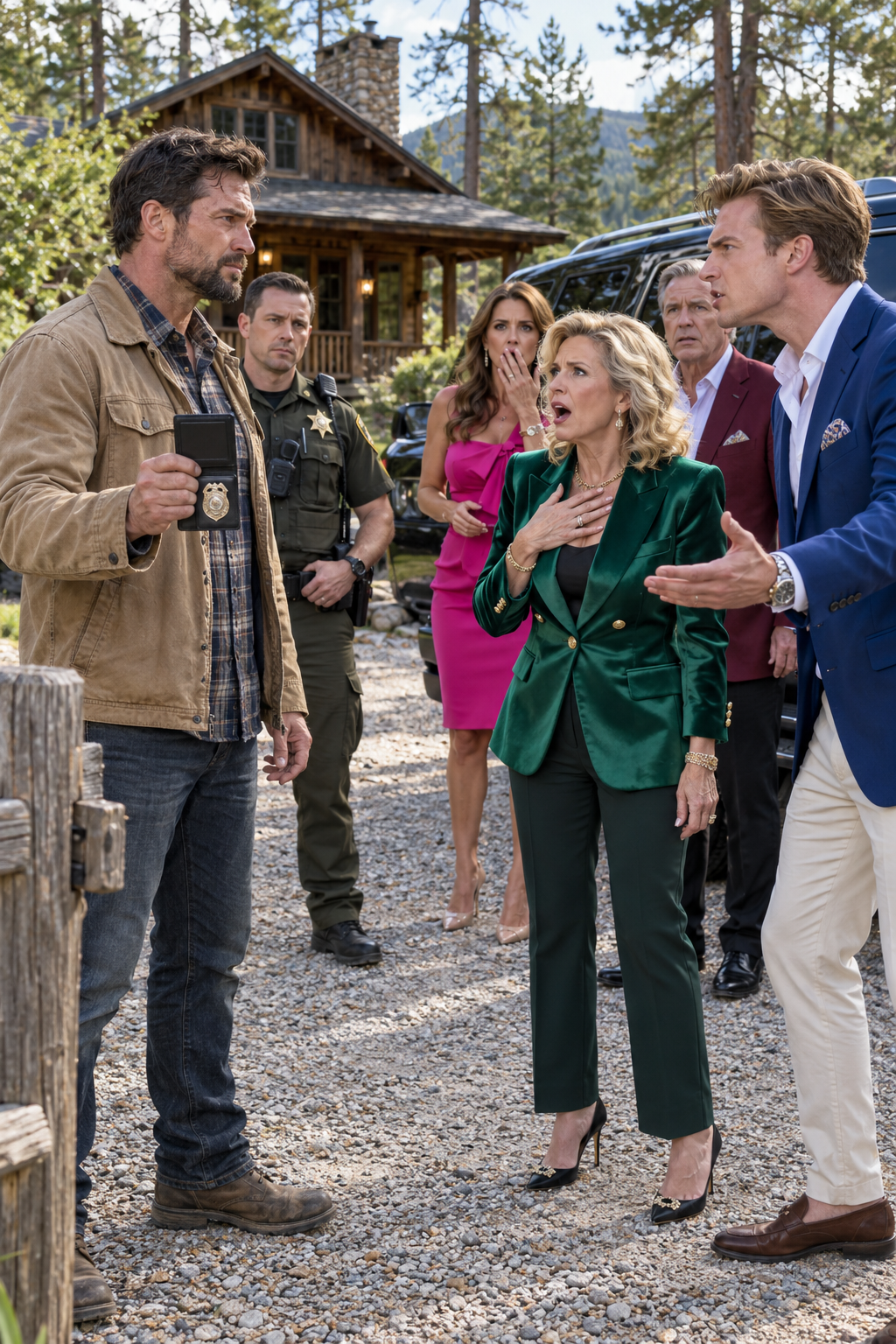
The HOA President Gave Her Son My Cabin—Then One Quiet Question Turned Their Victory Into a Criminal Investigation
“Pack whatever you can carry, Evelyn. You have seventy-two hours.”
Margaret Voss said it from my front porch as if she were reminding me when trash pickup was.
Her son stood beside her holding a new brass key to my cabin.
My younger brother stood behind them.
And he would not look me in the eye.
The paper taped to my front door said POSSESSION TRANSFER in block letters. Beneath it was the name of a company I had never heard of until that morning.
Voss Ridge Holdings, LLC.
Owner: Mason Voss.
Margaret’s thirty-eight-year-old son.
The man currently smiling at my cedar porch like he had already chosen where to put his grill.
“This is ridiculous,” my neighbor Susan whispered from the gravel driveway.
Margaret heard her.
She always heard anyone who questioned her.
She turned, adjusted the cream-colored scarf at her throat, and gave Susan the same thin smile she used at HOA meetings when announcing another “community improvement fee.”
“It’s unfortunate,” Margaret said, “but rules are rules.”
Then she looked at me.
“And some people spend so many years being accommodated that they confuse kindness with ownership.”
That was meant to hurt.
I just didn’t give her the satisfaction of seeing where it landed.
I was sixty-three years old.
I had lived in that cabin for twenty-seven years.
I had replaced its rotten porch boards with my husband, Daniel.
I had slept on the kitchen floor beside my mother during the final month of her cancer because she said the bedroom smelled too much like medicine.
I had buried Daniel’s old Labrador under the sycamore tree.
I had planted the hydrangeas.
I had painted the shutters.
I had held Daniel’s hand at our kitchen table when the cardiologist told him that his heart was failing faster than expected.
And seventeen months after I buried my husband, an HOA president whose subdivision had not existed when we bought the property was standing on my porch telling me that her son owned my home.
My brother finally spoke.
“Evie, don’t make this harder than it needs to be.”
That hurt worse than Margaret’s words.
Richard was fifty-eight.
When he was nineteen, I paid the tuition deposit that kept him in college.
When he was twenty-seven and his transmission shop failed, Daniel and I covered his mortgage for seven months.
When his wife left him, he slept in our guest room.
When our father had a stroke, Richard promised he would take Wednesdays.
He came twice.
When our mother started forgetting our names, Richard said seeing her like that was “too difficult.”
So I did the appointments.
I did the medications.
I did the midnight wandering.
I did the diapers.
I did the funeral.
Richard did the eulogy.
Then he told everyone at the reception how much family meant to him.
Now he stood behind the woman taking my house.
I looked at him.
“What did you sign?”
His mouth tightened.
Margaret answered for him.
“A family interest affidavit.”
I kept my eyes on Richard.
“What did you sign?”
He looked toward the trees.
“They said Dad never properly transferred the cabin.”
“Who said?”
“Mason’s attorney.”
Mason laughed softly.
“I am an attorney.”
He was wearing dark loafers that had already gathered dust from my driveway. Expensive watch. White shirt. No tie. The uniform of a man who wanted everyone to know he was successful but also wanted credit for being relaxed about it.
He lifted the brass key.
“You had a life interest, Evelyn. At most.”
I almost smiled.
“That’s what the title review found.”
“What title review?”
Mason’s smile widened.
“The one that matters.”
Margaret stepped closer.
“You ignored assessments for eleven years.”
“I was never a member of your HOA.”
“The property was incorporated into Cedar Crest.”
“Your husband was notified.”
Her smile vanished for half a second.
That half second told me more than another hour of arguing would have.
Mason stepped between us.
“We’re not litigating this in the driveway.”
“No,” I said. “I suppose not.”
He looked almost disappointed.
They had expected tears.
Maybe screaming.
Maybe me threatening to call the sheriff.
Maybe me grabbing the possession notice and ripping it down.
Instead, I walked inside.
Margaret called after me.
“Seventy-two hours, Evelyn.”
I did not answer.
I walked through the living room.
Past Daniel’s leather chair.
Past the stone fireplace.
Past the framed photograph of us standing in Yellowstone in 2004, both soaked from rain and laughing like idiots.
Then I went to our bedroom.
At the bottom of my closet sat a narrow cedar box.
Daniel had made it thirty-one years earlier.
It was ugly.
The lid sat slightly crooked.
One corner was darker because he had spilled stain and tried to sand it out.
Richard had once offered to throw it away while helping me clean after Daniel died.
I had nearly broken his hand when he reached for it.
Not because the box was valuable.
Because of what Daniel had told me three weeks before his surgery.
“If anyone from Cedar Crest ever tries to take this place, don’t argue with them.”
I had thought he was joking.
He had been lying in the hospital bed, oxygen line under his nose, skin gray from exhaustion.
“Daniel, nobody is taking the cabin.”
He squeezed my fingers.
“Promise me.”
“Let them talk. Let them file whatever they’re going to file. Let them put their names on everything.”
“You sound like you’re planning something.”
“I already planned it.”
“Promise me, Evie.”
I promised.
Then he said something that made no sense at the time.
“When they think they own it, ask them which map they used.”
I remembered that sentence as I carried the cedar box to our kitchen table.
Outside, Margaret was telling someone on the phone that “the transition” had gone smoothly.
Mason was measuring my porch with his eyes.
Richard was still standing beside his truck.
I opened the cedar box.
Inside were Daniel’s old survey compass, his father’s pocketknife, our marriage license, several photographs, a brass key, and a blue envelope with my name written across it.
DO NOT OPEN UNLESS THEY COME FOR THE CABIN.
I stared at it.
Seventeen months I had owned that box.
Seventeen months I had obeyed him.
My fingers rested on the envelope.
Outside, Mason laughed.
Then I opened it.
Inside was one handwritten page.
If you are reading this, Margaret finally found someone stupid enough to believe her version of the property line.
Do not show them anything yet.
First, let the foreclosure or transfer record.
Second, photograph every notice.
Third, take the compass apart.
Fourth, call the number on the back of this page.
Most importantly:
Do not protect Richard from what he chose.
I stopped breathing.
Not for long.
Maybe two seconds.
Then three.
I read that last sentence again.
Do not protect Richard from what he chose.
My brother had been involved before Daniel died.
That realization was colder than anger.
Anger burns.
This settled.
I turned the page over.
CAROLINE HALE.
A phone number with a Raleigh area code.
And beneath it:
Ask for Exhibit G.
I put the letter down.
Then I picked up Daniel’s old brass compass.
He had carried it for decades.
Daniel had started his career surveying mountain properties before moving into land records and title research. By the time we married, he could look at a fence line and tell you almost to the foot where an old deed description had gone wrong.
The compass had a dent near the hinge.
I pressed my thumb against it.
Then I remembered the letter.
Take the compass apart.
I twisted the outer brass ring.
Inside the back plate was a tiny folded strip of paper.
Three lines.
Archive Drawer 12-C.
Then one final sentence.
THE CABIN IS NOT THE ASSET.
I sat quietly.
A shadow crossed the kitchen window.
He came to the back door.
I folded the note and put everything back in the box before opening it.
He looked older than he had that morning.
“Can I come in?”
“It’s still my house for seventy-one hours.”
He flinched.
He walked in.
“I didn’t know they were going to do it this fast.”
“You signed something.”
“They told me Dad’s estate had an unresolved interest.”
“You signed something.”
“I thought it was paperwork.”
“What did they pay you?”
His face changed.
There it was.
Not surprise.
Calculation.
Richard sat across from me.
“How much?”
“Thirty thousand.”
I said nothing.
He rubbed both hands over his face.
“They said they’d pay another seventy when the title cleared.”
“One hundred thousand dollars.”
“It wasn’t like that.”
“What was it like?”
“They said you had no children. Daniel was gone. The property was tied up. They were going to settle it either way.”
“So you thought you might as well get paid.”
“I thought we both would.”
“Did you ask me?”
“You never listen about money.”
I almost laughed.
That was rich.
I had spent half my adult life quietly fixing his money problems.
The mortgage.
The business.
The hospital deductible when his son broke his arm.
The $11,000 tax bill he hid from his first wife.
The loan Daniel made him that he never repaid.
But there are people who remember every dollar they believe you owe them and forget every dollar you gave when they were drowning.
Richard was one of those people.
He leaned closer.
“Mason says the property is worth maybe six hundred thousand. They’re putting in a clubhouse and some rental cabins. You could have fought for years and lost anyway.”
“Rental cabins?”
He hesitated.
“How many?”
“I don’t know.”
“Fifty, maybe.”
Something inside me clicked into place.
Not emotionally.
Cedar Crest had been built in phases around the lower edge of Black Pine Lake, two miles east of our cabin.
For years, the HOA had maintained walking trails, a boat ramp, and one narrow private road connecting the southern homes to State Route 47.
Daniel and I had always wondered why Margaret kept asking to “formalize access” to a strip of forest west of the lake.
Daniel always refused.
Once, after a particularly ugly board meeting, he had come home and said, “That woman isn’t fighting over a trail. She’s positioning something.”
Fifty rental cabins.
Not a neighborhood improvement.
A commercial development.
I looked at Richard.
“Did Mason tell you where they plan to build them?”
He shrugged.
“Up here somewhere.”
“On this parcel?”
“And you signed an affidavit saying Dad owned it?”
“He did own it.”
Richard blinked.
I continued calmly.
“Dad never owned this cabin.”
His mouth opened.
I watched the blood leave his face.
“You heard me.”
“Our family—”
“Daniel and I bought it from Howard Bell in 1999.”
“Dad owned thirty acres south of here. He sold them in 1988.”
Richard stared at me.
I could see him searching old memories, looking for a version that would save him.
“What exactly did your affidavit say?”
“I need to go.”
“I said I need to go.”
For the first time that morning, fear had entered my cabin.
It just wasn’t mine.
I watched him drive away.
Then I called Caroline Hale.
She answered on the fourth ring.
“Caroline Hale.”
“My name is Evelyn Hart.”
Then she said, “Daniel’s Evelyn?”
Another pause.
A softer voice.
“Oh, Evelyn.”
“You knew my husband?”
“For thirty-four years.”
I looked at the cedar box.
“He told me to ask you for Exhibit G.”
Caroline exhaled.
“So they finally did it.”
“Who is they?”
“Cedar Crest?”
“Did they record the transfer?”
“I believe so.”
“Are you still in the cabin?”
“For seventy-one more hours, according to Margaret Voss.”
Caroline laughed.
Not because anything was funny.
It was the laugh of somebody watching a trap close around the wrong animal.
“Good,” she said.
“Daniel wanted them to record it.”
“Because suspicion isn’t evidence.”
I looked toward the front door.
“And a recorded fraudulent transfer is.”
My grip tightened around the phone.
“Who are you?”
“I’m the attorney Daniel hired twelve years ago when he discovered Cedar Crest’s original development records had been altered.”
The kitchen seemed to get quieter.
I heard the refrigerator click off.
A bird landed on the porch rail.
“What did he discover?”
“Don’t do this over the phone.”
“Caroline—”
“I’ll be there tonight.”
“You’re in Raleigh.”
“I’m already in Boone.”
That surprised me.
Another pause.
“Because Daniel asked me to keep watching after he died.”
I sat down.
“He knew this was going to happen.”
“He knew someone wanted it to.”
The first forty-eight hours after Margaret gave me my eviction notice were remarkably busy.
Not for me.
Two survey trucks arrived before noon.
A landscape architect walked my creek line.
Three board members toured my property.
A contractor attached orange ribbon to twenty-three trees.
Mason brought two investors up in a black Range Rover and stood on my meadow explaining where a “premium wellness lodge” would have mountain views.
I listened from my kitchen.
They never asked permission.
That was important.
I took photographs.
Every truck.
Every license plate.
Every person.
Every orange ribbon.
At four, Margaret entered my barn without knocking.
I was carrying a box of Daniel’s books.
“You won’t need the old equipment,” she said.
“I’ll decide what I need.”
Her lips tightened.
“Don’t be difficult.”
I put the box down.
“Margaret, you are standing in my barn.”
“Not for long.”
I looked at her.
She had spent fourteen years running Cedar Crest as if the HOA were a small country and she had been elected president for life.
People feared her.
Not because she was powerful.
Because she was persistent.
A cracked mailbox became a violation.
A boat parked six inches too close to a property line became three certified letters.
A family who planted the wrong shrubs received a $1,900 fine.
She knew exactly how much pressure ordinary people could tolerate before surrender became cheaper than resistance.
That was her real talent.
She had learned that most people did not lose because they were wrong.
They lost because they had jobs.
Sick parents.
Limited vacation days.
Limited savings.
Limited patience.
Margaret had built a kingdom out of other people’s exhaustion.
And she had looked at a sixty-three-year-old widow living alone in a modest cabin and assumed she had found the easiest target yet.
“You’re very quiet,” she said.
“I’m packing.”
“I expected more resistance.”
“I’m sure you did.”
“Your brother said you could be stubborn.”
“My brother says many things when someone pays him.”
Her cheek twitched.
A second confirmation.
I went back to packing.
Margaret remained in the doorway.
“You should understand, Evelyn, Mason is giving this community something valuable.”
“Fifty rental cabins?”
She went still.
“Richard talks too much.”
Her stare sharpened.
“It’s a carefully planned hospitality concept.”
“A resort.”
“A low-density retreat.”
“A resort.”
“You don’t understand development.”
“I understand nouns.”
She folded her arms.
“This area needs jobs.”
“This road cannot handle resort traffic.”
“It will be improved.”
“The association.”
“With whose land?”
I watched her.
She watched me.
Then I asked, very softly, “Which map did Mason use?”
The effect was immediate.
Not dramatic.
Better than dramatic.
Margaret’s eyes moved.
Toward the west wall of the barn.
Daniel’s old survey cabinet had stood there for twenty years.
It was empty now.
I had emptied it after he died.
She recovered quickly.
“The title review. Which map did he use?”
“You’ll have to ask Mason.”
She left five minutes later.
She did not look nearly as pleased as when she arrived.
Caroline Hale pulled into my driveway at that night.
She was seventy, silver-haired, straight-backed, and wearing a navy coat that looked older than Mason.
She carried one leather briefcase.
No assistant.
When she saw me, she hugged me.
That almost broke my composure more than the eviction notice had.
Daniel had trusted this woman.
That alone made her feel like someone from home.
We sat at the kitchen table.
She placed a thick file between us.
“Before we begin,” she said, “I need you to understand that Daniel did not keep this from you because he thought you were incapable.”
“I didn’t think that.”
“Yes, you did.”
I stared at her.
She smiled faintly.
“He said you would.”
I looked away.
Caroline opened the file.
The first document was dated August 4, 1989.
The second was a recorded plat.
The third was labeled PRIVATE LICENSE AGREEMENT.
“Cedar Crest was originally developed by Bell Mountain Properties,” Caroline said. “Howard Bell owned about nine hundred acres. He sold residential parcels around the lake. But he never sold everything.”
She slid the map toward me.
A large irregular section surrounded the western half of Cedar Crest.
“What is that?”
“Bell retained it.”
“How large?”
“Six hundred and twelve acres.”
My eyes lifted.
Caroline continued.
“In 1999, Howard sold that land.”
“To Daniel?”
“To both of you.”
I stared at her.
“We bought eleven acres.”
“That is what Daniel believed during the first month.”
Caroline pointed to the deed description.
“The cabin sits on an eleven-acre tax parcel created for billing convenience. But the deed you signed references the parent tract by metes and bounds.”
I remembered the closing.
I remembered papers.
Stacks of them.
Daniel had handled most of the legal descriptions.
I had been thirty-six, exhausted, and focused on the fact that we were finally going to own a home.
“You’re saying we bought six hundred acres?”
“Six hundred twelve.”
“For eighty-nine thousand dollars?”
“In 1999, most of it was steep timber, unusable ravines, an old utility corridor, and landlocked acreage.”
I looked at the map again.
“But Cedar Crest uses this road.”
“And their pumping station…”
She tapped a tiny square near the lake.
“Is on the tract.”
My stomach tightened.
She showed me Exhibit G.
There it was.
A signed agreement between Howard Bell and the original Cedar Crest developer.
The HOA and its successors had permission to maintain one road, one foot trail, and one water pumping facility across Bell’s retained land.
One dollar per year.
The license contained conditions.
Residential access only.
No commercial traffic.
No transfer of rights without written approval from the landowner.
No expansion beyond the recorded footprint.
And one sentence in bold type:
ANY ATTEMPT TO CLAIM, CONDEMN, ENCUMBER, FORECLOSE UPON, OR OTHERWISE ASSERT OWNERSHIP OVER THE LICENSED PREMISES SHALL CONSTITUTE IMMEDIATE TERMINATION.
I read it twice.
Then three times.
Caroline waited.
“They foreclosed on my cabin.”
“They claimed my parcel belonged to the HOA.”
“They terminated their own license.”
I looked toward the dark window.
Beyond it was the road serving forty-one homes.
A road Margaret’s board had treated like HOA property for years.
“And the resort?”
Caroline slid another document toward me.
A site plan.
Fifty-eight cabins.
A restaurant.
A conference center.
Parking for 146 cars.
All accessible through the licensed road.
“They need your land,” she said.
“How badly?”
“Without it, the project has no legal western access, no permitted commercial water route, and no compliant emergency entrance.”
I stared at the site plan.
“What is the project worth?”
“Projected buildout?”
“Twenty-eight to thirty-two million.”
There it was.
The number.
The thing Richard had sold his sister for one hundred thousand dollars to help them reach.
But the money did not make me angry.
What made me angry was remembering my father after his stroke.
My mother calling me at two in the morning because she thought there was a strange man in her kitchen.
Daniel quietly transferring money from our retirement account when Richard was about to lose his home.
Christmases where I bought Richard’s children presents and wrote his name on half the tags because he was broke.
Thanksgivings where I cooked while he arrived late and left early.
Years of being the reliable one.
The woman nobody worried about because Evelyn handled things.
The woman nobody thanked because Evelyn always handled things.
The woman people assumed would absorb one more insult because she had absorbed all the previous ones.
I remembered my mother once squeezing my hand and saying, “You know, sweetheart, people can love the shelter you give them without ever learning to love you.”
At the time, I told her she was tired.
Now I understood exactly what she meant.
I had been the one who stayed.
I had been the one who paid.
I had been the one who forgave.
I had been the one who made things easy.
I had been the one they mistook for weak because I never made them watch what strength cost me.
Caroline closed the file.
“Daniel found evidence in 2014 that Margaret was trying to convert the license into a permanent easement.”
“By altering the association’s master map.”
That was the second time my kitchen went completely still.
“She changed a recorded map?”
“Not the original. A later compilation map used by the association and some county departments.”
“Daniel knew?”
“He suspected.”
“Why didn’t he sue?”
“Because a bad map hanging in an HOA office is sloppy. A bad map used to transfer real estate is evidence.”
I understood.
“Let them file.”
Caroline nodded.
“That’s why Daniel told you not to stop them.”
I looked at the file.
“What happens tomorrow?”
“You leave.”
I stared at her.
She held my gaze.
“You promised Daniel.”
“They’re taking my house.”
“No. They are taking possession under a document we are going to ask a judge to void.”
“They could damage it.”
“We’ll inventory everything tonight.”
I hated the idea.
Every instinct in my body wanted to lock the door.
Chain the gate.
Call every newspaper.
Tell Margaret exactly what I knew.
But Daniel had known me better than anyone.
He knew that once someone attacked my home, my instinct would be to defend it immediately.
He also knew that timing mattered.
So the next afternoon, I packed two suitcases.
I put Daniel’s photographs in my car.
I moved his woodworking tools to Susan’s garage.
I took the cedar box.
At p.m., Mason arrived.
Margaret came with him.
So did Richard.
Mason held a clipboard.
“Vacated voluntarily?”
I looked at him.
“Is that what you need me to say?”
His expression tightened.
“No. I’m confirming surrender of possession.”
“I’m leaving under protest.”
Margaret sighed.
I turned to her.
“You’ve won. Enjoy it.”
That made her smile.
She couldn’t help herself.
Behind her, Richard looked sick.
Mason reached for my keys.
I gave them to him.
He held them up.
A tiny victory gesture.
I let him have it.
Then I looked toward the cabin.
“Take care of the south window,” I said.
Mason frowned.
“It sticks when the weather changes.”
For the first time, he looked uncertain.
I walked to my car.
Margaret called after me.
Her face softened into something almost resembling sympathy.
“There’s a lovely condominium complex near Boone. People your age like it.”
I looked at her for several seconds.
Then I smiled.
“I’ll keep that in mind.”
I spent the night at a roadside motel nine miles away.
The heater rattled.
The blanket smelled like industrial detergent.
At the next morning, Susan texted me a photograph.
Margaret had hung a banner across my porch.
FUTURE SITE OF BLACK PINE RETREAT.
At , another photo arrived.
Mason standing with investors.
At , Richard texted.
Please don’t make a scene.
I stared at that message for a long time.
Then I forwarded it to Caroline.
She replied with two words.
Don’t answer.
At , Caroline filed our complaint.
Fraudulent foreclosure.
Wrongful possession.
Slander of title.
Civil conspiracy.
Declaratory judgment.
Temporary restraining order.
At 10:11, she sent formal notice to the title company.
At 10:24, the title company suspended coverage.
At 10:51, the construction lender froze the project draw.
At 11:18, the county planning department placed the resort permit on administrative hold.
At 12:06, the first investor left my cabin.
At 12:17, the second investor left.
At 12:29, Margaret called me.
I let it ring.
At 12:31, she called again.
At 12:36, Mason called.
At 12:43, Richard called.
At , Margaret left a voicemail.
“Evelyn, whatever stunt you’re pulling, you need to stop. You are interfering with contracts you don’t understand.”
I saved it.
At , she left another.
“Mason says your filing contains knowingly false claims.”
At , Richard left a voicemail.
“Evie, they’re saying I could be named in this. Call me.”
At , Caroline called.
“The judge granted the temporary order.”
I sat on the edge of the motel bed.
“What does that mean?”
“No construction. No transfer. No alteration of the cabin. No destruction of records.”
I closed my eyes.
“Can I go home?”
That was harder than I expected.
They had stolen my home.
The court had stopped them from destroying it.
But for the moment, they still had the keys.
The first hearing was three days later.
Margaret entered the Watauga County courthouse like she was attending a charity luncheon.
Mason carried two leather binders.
Richard sat behind them.
He had hired his own attorney.
That told me everything I needed to know about how well their alliance was holding.
Caroline and I sat quietly at the other table.
Mason’s attorney argued first.
He called the case a “routine dispute regarding title and association assessments.”
He said the HOA had annexation records showing my property had entered Cedar Crest in 2008.
He said dues had accumulated.
He said notices were sent.
He said a lawful lien was recorded.
He said the property had been sold following default.
Then he displayed a map.
Caroline did not react.
I did not react.
The judge leaned forward.
It was a clean, modern map.
Color-coded lots.
Common areas.
The western tract marked as CEDAR CREST COMMUNITY PROPERTY.
My cabin sat inside it.
Parcel C-17.
The judge looked at Caroline.
“Ms. Hale?”
Caroline stood.
“May I ask opposing counsel the source of that map?”
Mason whispered something.
His attorney answered.
“Association master plan, revised 2011.”
“Recorded?”
“Book and page?”
A hesitation.
“Your Honor, I don’t have the recording reference directly in front of me.”
Caroline turned toward Mason.
He looked irritated.
Then I saw it.
His eyes moved to the projection.
To the lower right corner.
A survey certification.
Daniel Hart.
Professional Land Surveyor.
My husband’s name.
My husband’s signature.
Caroline sat down.
The judge frowned.
“You don’t wish to continue, Ms. Hale?”
“Not yet, Your Honor.”
Mason’s confidence returned.
They thought Caroline had backed away.
The judge did not issue a final ruling that day.
He extended the temporary order but allowed Mason’s company to retain limited possession pending the title hearing.
Margaret called that a victory.
By the time we left the courthouse, she was already telling two board members that the judge had “recognized the legitimacy” of their ownership.
Richard avoided me again.
In the parking lot, Caroline handed me a coffee.
“You all right?”
I looked at her.
She smiled.
“People who say they’re fine during something like this worry me.”
I almost laughed.
Then I said, “That map has Daniel’s signature.”
“He didn’t sign it.”
“How do you know?”
“Because I was with him the day that revision was supposedly certified.”
“At Duke Medical Center.”
I stopped walking.
Caroline turned.
“The map is dated March 14, 2011.”
I remembered that week.
Daniel’s first major cardiac procedure.
He had spent four days in a hospital bed.
“He couldn’t have surveyed anything.”
“He didn’t.”
I felt the anger finally rise.
“What happens now?”
“Now we get the county archive.”
Archive Drawer 12-C.
The brass compass.
Daniel had left breadcrumbs because he knew digital records could be replaced.
Paper was harder.
Old paper in forgotten drawers was harder still.
The next morning, under court-approved discovery, Caroline and a county records supervisor opened Drawer 12-C.
Inside were rolled plats from the original Cedar Crest development.
The paper smelled like dust and old basements.
The original western boundary was unmistakable.
Cedar Crest stopped nearly half a mile east of my cabin.
The road was labeled LICENSE ACCESS—NO PROPERTY INTEREST CONVEYED.
The water station carried the same notation.
There was no Parcel C-17.
There was no HOA community property west of marker 44.
And in the lower corner was Daniel’s real signature on an older boundary verification.
I knew it instantly.
Daniel’s D leaned backward.
His H had an exaggerated second stroke.
The forged signature on the 2011 map was neat.
Someone had copied his name.
They had not copied his hand.
Caroline photographed every page.
Then the records supervisor found something worse.
A removal slip.
Someone had checked out the original 1989 supporting documents in 2010.
The name on the slip was Margaret Voss.
Purpose: HOA boundary reconciliation.
Returned: two weeks later.
Caroline stared at it.
“She had access.”
The supervisor nodded uneasily.
I asked, “Who authorized her?”
He checked the old log.
“Assistant records clerk.”
He hesitated.
Then read it.
“Richard Cole.”
I stared at the paper.
My brother.
Before he opened the auto shop, Richard had worked for the county for six years.
He had never mentioned this.
Maybe because I had forgotten.
Maybe because he wanted me to.
I went outside.
Caroline followed me.
I stood beneath a bare maple tree beside the courthouse.
“He was involved in 2010.”
“Possibly.”
“Daniel knew.”
“Daniel suspected.”
“That’s why the letter said not to protect him.”
Caroline did not answer.
My phone rang.
I answered.
“We need to talk.”
“We’ve needed to talk for about sixteen years.”
“Not on the phone.”
“Because Margaret lied to me.”
I looked at Caroline.
“No, Richard. She paid you.”
“I didn’t know about the old map.”
“Which old map?”
“How did you know we found a map?”
He hung up.
That was the moment my grief for my brother ended.
Not my anger.
Not my sadness.
There is a strange kind of freedom when somebody finally becomes exactly who their actions have been telling you they are.
You stop waiting for the better version.
You stop translating their cruelty into stress.
You stop calling betrayal confusion.
You stop giving history veto power over truth.
Richard was my brother.
He was also a man who had taken money to help strangers take my home.
Both could be true.
Only one mattered in court.
Discovery moved fast after that.
The HOA’s bank records showed $186,000 paid to a consulting company owned by Mason.
The stated purpose was “property integration.”
Another $74,000 had gone to Richard through two payments labeled “land research.”
Margaret had approved both.
Emails showed Mason discussing “western tract consolidation” eighteen months before Daniel died.
One message to Margaret read:
Once D.H. is gone, resistance should become manageable.
Daniel Hart.
I read it once.
Caroline tried to take the page.
“Let me finish.”
A later message said:
E. has no descendants and limited resources. Family affidavit should solve standing issue.
Limited resources.
That almost made me smile.
They had looked at my clothes.
My old Subaru.
My plain cabin.
My lack of social media.
My refusal to renovate the kitchen just because granite countertops had become fashionable.
They had looked at a woman who clipped grocery coupons and assumed poverty.
Daniel and I had never cared about looking rich.
We cared about being free.
We owned our home.
We carried no debt.
We had invested slowly.
We had land no one understood.
And, after Daniel’s death, I had inherited his retirement accounts, two timber leases, and an investment portfolio worth a little over four million dollars.
I had not told Richard.
Why would I?
The only person who knew the exact number was Caroline.
Margaret and Mason had built their strategy around the assumption that I could not afford a serious fight.
They had mistaken modesty for helplessness.
The second hearing filled the courtroom.
Residents from Cedar Crest came.
So did reporters.
Word had spread that the HOA’s private road might not belong to the HOA.
People were frightened.
I understood why.
Some of them had done nothing wrong.
They had bought houses.
Paid mortgages.
Raised children.
Followed rules.
Now they were learning that the board that sent them violation notices for bird feeders might have spent years lying about the ground under their tires.
Margaret sat rigidly at the defense table.
Mason looked thinner.
Richard sat alone with his lawyer.
Caroline called the county records supervisor.
Then a forensic document examiner.
Then the surveyor who had worked with Daniel.
Each answer removed another brick from Margaret’s story.
The 2011 map was not a properly authorized subdivision plat.
Daniel had not signed it.
My cabin had never been annexed.
The HOA had no authority to assess it.
No lawful dues existed.
No lawful lien existed.
No lawful foreclosure existed.
Mason’s company had purchased nothing.
Then Caroline introduced Exhibit G.
The private license agreement.
Mason’s attorney objected.
The judge read the termination clause twice.
He looked toward the defense table.
“Counsel, am I understanding this correctly?”
Mason’s attorney stood slowly.
“Your Honor, we dispute the plaintiff’s interpretation.”
“Then interpret it for me.”
The attorney swallowed.
The courtroom was silent.
The judge continued.
“It appears your client asserted ownership over land it possessed only under a conditional license.”
“The association believed—”
“I did not ask what the association believed.”
Margaret’s face had gone pale.
The judge pointed toward the agreement.
“I am asking what this document says.”
No answer came.
The judge looked at Caroline.
“What is your client seeking regarding access?”
This mattered.
Every Cedar Crest homeowner leaned forward.
Margaret expected revenge.
I could see it.
She expected me to close the road.
Cut the water.
Strand families.
Make ordinary homeowners pay for what the board had done.
That was probably what she would have done.
Caroline looked at me.
“Your Honor, may I answer?”
The judge nodded.
“I have no intention of blocking residents from their homes.”
A murmur moved through the courtroom.
I continued.
“The original license was designed to protect residential access. I want that protected.”
Margaret looked confused.
“But I will not restore commercial access for Black Pine Retreat.”
Mason leaned toward his attorney.
“The homeowners can receive direct access rights,” I said. “Independent of the HOA. I’ll sign them.”
The room changed.
People turned toward Margaret.
That was the moment she truly lost.
Not when her documents collapsed.
Not when the judge questioned her attorney.
When the homeowners realized they did not need her.
I was not threatening their homes.
Her project was.
Her scheme was.
Her son was.
For fourteen years, Margaret had convinced Cedar Crest residents that she stood between them and chaos.
Now they could see that Margaret had been the chaos.
The judge voided the foreclosure.
Effective immediately.
He declared the HOA lien invalid.
He ordered possession of the cabin returned to me before sunset.
He referred the forged survey and county records issue to the district attorney and state investigators.
He froze Voss Ridge Holdings from transferring assets connected to the disputed project.
Then he looked at Mason.
“Mr. Voss, you are an officer of the court.”
Mason stood.
“Yes, Your Honor.”
“You should obtain independent counsel.”
Mason’s face changed.
Only slightly.
Outside the courthouse, Cedar Crest residents surrounded Margaret.
One wanted to know why $186,000 had gone to Mason.
Another wanted copies of the resort contracts.
A third asked who had authorized the foreclosure.
Susan walked over and hugged me.
“You’re going home.”
“What are you going to do when you see what they did?”
“Document it.”
She laughed.
“I was expecting something more emotional.”
“I’ll be emotional after the photographs.”
My front door opened at that evening.
The county deputy handed me the new keys.
Mason had changed the locks.
Of course he had.
Inside, my furniture had been moved.
Daniel’s chair had been pushed into the guest room.
A designer had left fabric samples across my table.
Someone had removed my curtains.
The banner outside was gone.
There were champagne glasses in the sink.
I stood in the middle of the living room.
For several minutes, nobody spoke.
Then Susan said, “You want me to help put it back?”
“You sure?”
I walked into the guest room.
Daniel’s chair sat in the corner.
I ran one hand across the worn leather.
“I want to do this part myself.”
Over the next two weeks, Cedar Crest began eating itself.
The board held an emergency meeting.
Margaret refused to resign.
The homeowners recalled her anyway.
Seventy-three percent voted her out.
Mason resigned as association counsel.
Two board members hired attorneys.
The property manager turned over emails.
The title insurer filed its own claim.
The construction lender sued Voss Ridge Holdings.
Richard came to my cabin eleven days after the hearing.
He parked near the road and walked up slowly.
I opened the door before he knocked.
“You shouldn’t be here.”
He looked terrible.
Good clothes.
He held an envelope.
“I brought the money back.”
“One hundred thousand?”
“Thirty. I never got the second payment.”
I did not reach for it.
He placed it on the porch table.
“I didn’t know they were forging anything.”
“You knew enough.”
“I thought Dad had an interest.”
“No, you didn’t.”
His eyes filled.
I felt nothing.
That surprised me.
Maybe someday I would.
“You knew Daniel and I bought this place,” I said.
“I remembered it differently.”
“You attended the housewarming.”
He looked down.
“You gave us the toaster.”
“You also checked Margaret’s files out of the county archive in 2010.”
His face tightened.
“She said the HOA needed them.”
“And you gave them to her.”
“It was my job.”
“Then why didn’t the access log show the required supervisor signature?”
“I don’t know.”
“You bypassed procedure.”
“I was helping someone I knew.”
“Margaret.”
“How well?”
He looked at me.
There it was again.
A silence with weight.
I understood before he answered.
“You were involved with her.”
He closed his eyes.
I almost laughed.
Not because it was funny.
Because betrayal is sometimes so ordinary.
Not a conspiracy born in a dark room.
Not masterminds.
Just weakness.
A man wanting to feel important to a woman who knew how to use him.
“After Lisa left.”
“So Margaret gets access to county records through you.”
“I never altered anything.”
“I didn’t say you did.”
His head snapped up.
That told me something too.
I let the silence sit.
Then Richard whispered, “Daniel knew.”
“He hated me.”
That hurt him more.
I could see it.
“Daniel didn’t hate you, Richard.”
“He must have.”
“No. He kept saving you.”
He looked away.
“That’s worse, isn’t it?”
His mouth trembled.
I continued.
“You want to know what Daniel said about you the year before he died?”
Richard said nothing.
“He said, ‘Your brother keeps waiting for somebody to stop him from becoming the man he already is.’”
Richard began crying.
I did not comfort him.
He wiped his face.
“I’m sorry.”
“I believe you.”
Hope appeared in his eyes.
I finished.
“I just don’t think being sorry repairs everything.”
For once, he did not argue.
“What happens to me?”
“I don’t know.”
“Are you going to tell investigators everything?”
His face folded.
“I’m your brother.”
That was all I said.
He stood on my porch for another minute.
Then he left.
I donated the thirty thousand dollars he returned.
Half went to the county’s legal aid office.
Half went into a fund for elderly homeowners fighting abusive lien actions.
I did not put Richard’s name on it.
I did not put mine on it either.
Three months later, I signed permanent residential access agreements for every Cedar Crest household using the western road.
No HOA control.
No commercial use.
No surprise fees.
No ability for a future board president to threaten families by closing a gate.
Caroline drafted the documents.
I signed eighty-one pages over two days.
The residents paid one dollar each.
The same amount Howard Bell had charged.
Mason’s resort died.
Without commercial access, no lender would touch it.
Without the resort, Voss Ridge Holdings collapsed.
Margaret sold her house six months later.
I heard she moved to Charlotte.
I never checked.
People expected me to feel victorious.
Justice is not joy.
People confuse them because both can make you stand taller.
But they are not the same thing.
Justice returns.
It returns your name.
Your dignity.
Sometimes your money.
Sometimes the part of yourself you kept lending to people who never intended to give it back.
The western tract was appraised at $14.8 million after the access issues were clarified.
Developers called.
I declined.
A timber company offered eleven million.
I declined.
A luxury hotel group offered seventeen.
I declined.
Because Daniel’s note had been right.
The cabin was not the asset.
The asset was the choice.
For the first time in my life, nobody else needed my choice more than I did.
So I placed 540 acres into a permanent conservation trust.
The lake corridor stayed protected.
The residential road stayed open.
The forest could never become another resort.
I named the trust after my mother.
Helen Hart Land Preserve.
Some people asked why I would “give away” land worth millions.
I stopped trying to explain.
There are things more expensive than land.
There are things harder to inherit than money.
My mother spent her final years believing she was a burden.
My father spent his life afraid that everything he built could disappear.
Daniel spent twelve years quietly protecting a home he suspected greedy people would someday try to take from me.
The trust meant none of them were wrong to care.
It meant what they protected would outlive the people who mocked them for protecting it.
That was enough.
By spring, my porch had been repaired.
The orange survey ribbons were gone.
Hydrangeas returned.
Susan brought wine every Friday.
Sometimes Cedar Crest residents waved when they passed.
Sometimes they stopped.
One family brought cookies.
Another brought a handmade sign for the road.
PRIVATE RESIDENTIAL ACCESS — PLEASE DRIVE SLOWLY.
No HOA logo.
I liked that.
Richard pleaded guilty to a misdemeanor records charge and cooperated with investigators.
He received probation.
We did not reconcile.
Maybe we never would.
Forgiveness is not the same as restoration.
You can forgive a person and still refuse to hand them another key.
Margaret faced civil fraud claims.
Mason’s law license was suspended while the state bar investigated his conduct.
The criminal investigation into the forged map remained open.
Caroline told me these cases moved slowly.
I told her I had waited twelve years without knowing I was waiting.
I could manage.
Then, one rainy Thursday in October, almost eleven months after Margaret stood on my porch and told me her son owned my home, a dark sedan pulled into my driveway.
Two people stepped out.
One was Detective Laura Chen from the state financial crimes unit.
I knew her.
The other man I did not.
They carried a flat archival box wrapped in plastic.
I invited them in.
Detective Chen declined coffee.
That worried me.
People accepted coffee when the news was ordinary.
She placed the box on my kitchen table.
“We found something during the forensic review of the county archive.”
Caroline had warned me investigators were examining every document connected to the 2011 map.
Chen glanced at the man beside her.
He opened the box.
Inside was another survey.
Not the one used to steal my cabin.
An older one.
Marked with Daniel’s name.
My stomach tightened.
Chen placed a photocopy beside it.
“We ran the ink.”
“The signature isn’t original.”
“I know Mason’s map was forged.”
“This isn’t Mason’s map.”
She turned the page.
The date at the bottom was June 18.
I stopped breathing.
Daniel had died on February 2.
Four months earlier.
I looked up.
Chen’s face was careful.
Too careful.
“This document transferred an interest in another section of the western tract.”
“What section?”
“The northern ridge.”
“That’s protected land.”
“Not according to this.”
She slid a second document toward me.
The grantee name was hidden beneath a legal entity I had never seen.
BLACK PINE LEGACY TRUST.
I stared at it.
“Who owns that?”
“That’s what we’re trying to determine.”
My skin went cold.
The man beside her finally spoke.
“We traced the filing fee.”
“To Mason?”
“Margaret?”
He placed a bank record on my kitchen table.
One name had been circled.
A name I recognized.
Someone who had been inside my home.
Someone who had known Daniel.
Someone I had trusted after his death.
Someone who still had a key to my cabin until three months ago.
I looked at Detective Chen.
She said, “Mrs. Hart, we believe the Voss foreclosure may have been the second attempt to take your land.”
“The second?”
I looked again at the forged date.
Four months after I buried my husband.
Rain tapped softly against the kitchen windows.
The same windows Margaret had once planned to replace.
I thought of Daniel’s letter.
Let them file.
Let them put their names on everything.
I thought of his compass.
The archive.
Then I noticed something written faintly along the bottom edge of the newly discovered survey.
A parcel number.
It was not my cabin.
It was the cemetery ridge where Daniel was buried.
I raised my eyes to the investigators.
My voice stayed quiet.
“Before you leave, could someone explain to me why my dead husband supposedly signed away his own grave four months after I buried him?”
✓ Lynn R. Adams
The HOA President Gave Her Son My Cabin—Then One Quiet Question Turned Their Victory Into a Criminal Investigation “Pack whatever you can carry, Evelyn. You have seventy-two hours.” Margaret Voss sa…