The HOA President Cut My Heat at Twenty Below — She Never Expected Me to Own the Gas Line Feeding Her Entire Neighborhood
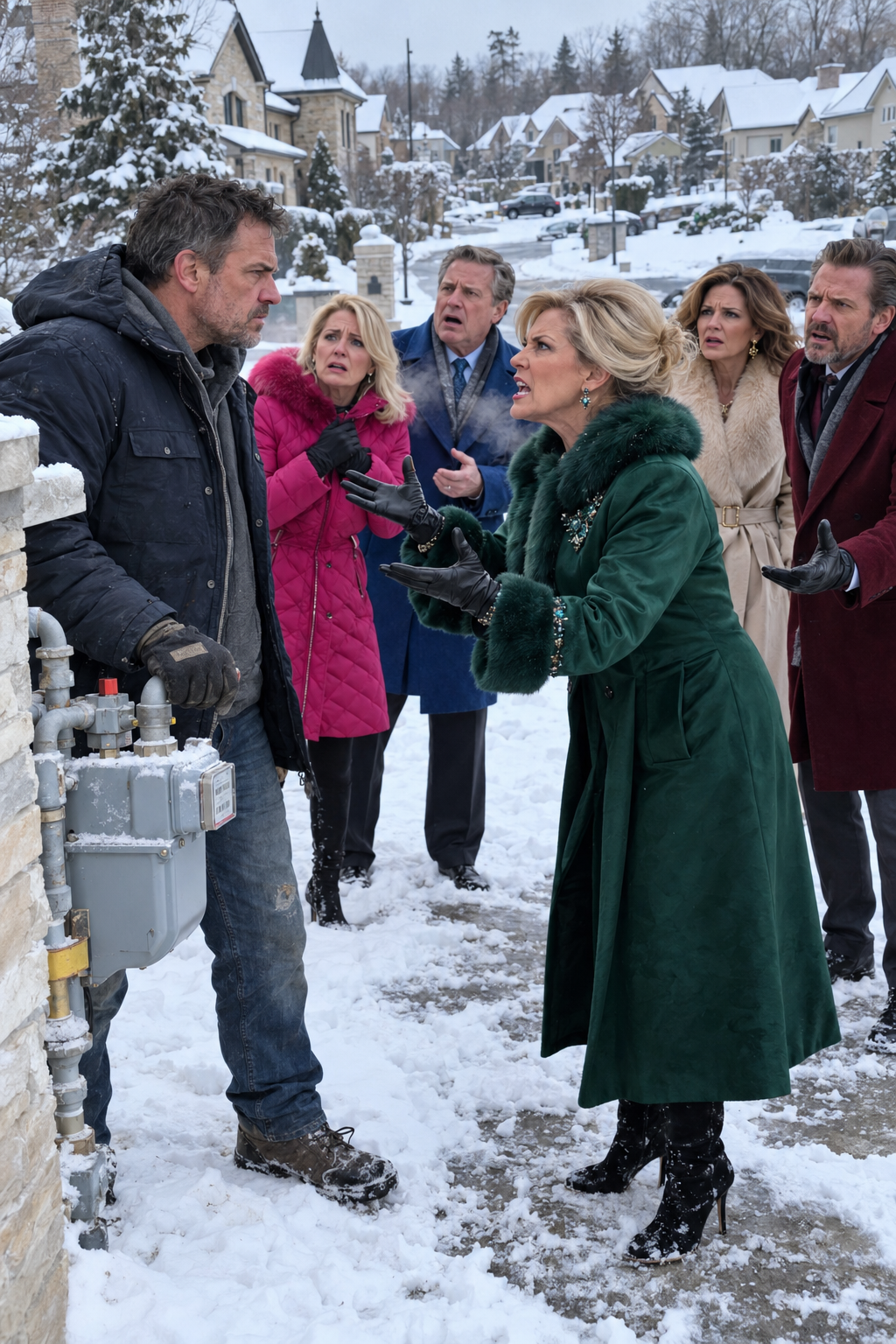
The HOA President Cut My Heat at Twenty Below — She Never Expected Me to Own the Gas Line Feeding Her Entire Neighborhood
At in the morning, I woke up because my bedroom was cold enough to hurt.
Not chilly.
Not drafty.
Cold enough that the glass of water beside my bed had a skin of ice forming across the top.
Outside, the temperature in northern Minnesota had dropped to twenty degrees below zero, and somebody had shut off the heat to my house while I was sleeping.
I knew exactly who had done it.
Karen Whitmore had warned me six hours earlier.
“You’ll learn,” she’d said from the heated leather seat of her white Range Rover. “Everybody learns eventually.”
I hadn’t believed even Karen was stupid enough to turn a property dispute into something that could kill a man.
I was wrong.
I sat upright beneath two wool blankets and listened.
No furnace.
No soft rush of air through the vents.
No familiar vibration beneath the floor.
Only the faint cracking sounds of a house losing heat faster than it could hold it.
My phone showed a.m.
Indoor temperature: 41°F.
I pulled on thermal pants, a sweatshirt, insulated boots, and the heavy canvas coat hanging over the bedroom chair.
When I crossed the hallway, my breath was already visible.
I didn’t panic.
I didn’t call Karen.
I didn’t run outside waving my arms.
I walked downstairs, turned off the main water supply before the pipes could freeze, opened the cabinet doors beneath every sink, and checked the emergency heater in my workshop.
Then I made coffee on the little propane camping burner I kept for power outages.
Not because I needed coffee.
Because routine keeps anger from making decisions.
And I was angry enough to make a very expensive mistake.
My name is Jack Mercer.
I was fifty-two years old that winter.
I’d spent twenty-six years working in pipeline engineering, industrial safety, and rural utility infrastructure before retiring early to the property my grandfather left me outside Black Pine, Minnesota.
It was forty-three acres of pine, birch, frozen creek bed, and stubborn family history.
My grandfather had bought the land in 1968.
My father built the original cabin in 1981.
I rebuilt it into a permanent house after my wife, Laura, died.
The house sat on the west side of a ridge overlooking what used to be empty farmland.
Then developers arrived.
First came roads.
Then model homes.
Then stone entrance pillars.
Then decorative ponds.
Then one hundred expensive houses with names like Aspen View, Timber Crest, and Monarch Circle.
The development called itself North Ridge Estates.
And North Ridge Estates came with an HOA.
Karen Whitmore became its president three years before my furnace went silent.
That was when my quiet retirement ended.
The problem was simple.
Karen believed everything she could see belonged to her HOA.
The road beside my land.
The creek crossing my south pasture.
The old maintenance shed near the ridge.
The gravel turnaround my father built.
Even the line of blue spruce trees my mother planted when I was a kid.
Karen didn’t see property boundaries.
She saw unfinished paperwork.
She saw obstacles.
She saw people waiting to be corrected.
But she had overlooked something.
Something buried beneath all one hundred homes in North Ridge Estates.
Something older than her HOA.
Older than the clubhouse.
Older than the decorative stone gates.
Something my grandfather had installed fifty-five years earlier.
And at that morning, Karen gave me a reason to finally open the file.
Before that night, I had tolerated her.
I tolerated the warning letters.
I tolerated the photographs.
I tolerated HOA volunteers wandering toward my fence with clipboards.
I tolerated the orange violation stickers she placed on my mailbox even though I wasn’t an HOA member.
I tolerated her telling neighbors that my workshop lowered their property values.
I tolerated her calling my tractor “commercial equipment.”
I tolerated her demanding that I repaint my barn in one of six HOA-approved colors.
I tolerated everything because fighting stupid people can become a full-time occupation if you let them schedule your life.
But there are lines.
There are lines you negotiate.
There are lines you document.
There are lines you take to court.
And there are lines you do not cross when it’s twenty below zero and someone is sleeping inside a house.
Karen crossed that one.
The strange thing was, until six months earlier, Karen and I had barely spoken.
Then North Ridge Estates announced Phase Four.
Twenty-four additional luxury houses.
A fitness center.
A second gated entrance.
And a heated community pool.
The plans looked beautiful.
There was only one problem.
Their preferred access route crossed the northeast corner of my land.
About six hundred feet.
But enough to matter.
The developer offered me $85,000 for a permanent access easement.
I declined.
They raised it to $140,000.
I declined again.
It wasn’t about money.
Their proposed road would cut through the stand of white pines where Laura’s ashes were scattered.
I explained that once.
The project manager understood.
Karen didn’t.
At first, she tried charm.
She appeared at my house one September afternoon wearing an emerald-green winter coat that probably cost more than my first truck.
She brought cookies.
Store-bought.
Still in the plastic tray beneath the decorative napkin.
“Jack,” she said, smiling as though we were already friends, “I think there’s been some unnecessary tension.”
“There hasn’t been any tension.”
Her smile tightened.
“Well. Maybe misunderstanding.”
“No misunderstanding either.”
She glanced past me toward the workshop.
“You’re holding up improvements that benefit the entire community.”
“I’m not part of your community.”
“You live beside it.”
“So you benefit from our property values.”
I leaned against the doorframe.
“Karen, I owned this property before the first house in North Ridge existed.”
“That doesn’t mean progress stops.”
I looked toward the ridge.
“It just means progress goes around my pines.”
She left the cookies on my porch.
I gave them to my neighbor’s kids.
Two weeks later, I received an HOA violation notice.
Apparently my mailbox was “nonconforming.”
I mailed it back.
Three days later another arrived.
Outdoor equipment violation.
Then landscaping standards.
Then prohibited vehicle parking.
Then “visual nuisance.”
I kept every letter.
Photographs.
That was another habit from my engineering years.
If something seems ridiculous, document it anyway.
Ridiculous things have a way of becoming evidence.
In October, Karen sent a landscaping crew onto my property.
They cut down three small spruce trees before I stopped them.
The crew foreman looked horrified when I showed him the survey stakes.
He apologized immediately.
Karen did not.
“They were blocking sight lines,” she told me at the next county planning meeting.
“They were on my land.”
“They affected our entrance.”
“You keep saying that like it ends the conversation.”
“It usually does.”
People around us laughed.
Karen’s face changed.
Just slightly.
That was the moment it became personal.
After that, she stopped pretending the dispute was about development.
She started telling homeowners I was extorting them.
That I wanted half a million dollars.
That I had threatened to block emergency vehicles.
None of it was true.
I corrected the record once.
Then stopped.
Never wrestle publicly with someone who needs an audience.
But Karen had one hundred households watching her.
And she needed to look powerful.
December arrived with heavy snow.
The development plows began using my gravel turnaround without permission.
I installed a chain and a PRIVATE PROPERTY sign.
Karen sent me a $500 HOA fine for “obstructing emergency winter access.”
I framed it.
Hung it in the workshop.
My daughter Megan laughed when she saw it.
Megan was twenty-eight and worked as a civil engineer in Duluth.
She inherited Laura’s dark hair and my habit of reading fine print.
“You know she’s escalating,” Megan said.
“You should have an attorney send something.”
“Yesterday.”
She raised an eyebrow.
“You didn’t mention that.”
“You didn’t ask.”
The attorney was Daniel Brooks.
He’d handled land and utility disputes for most of northern Minnesota since before Megan was born.
Daniel sent Karen and the HOA a cease-and-desist letter.
It was only three pages.
Professional.
Almost gentle.
The HOA had no jurisdiction over my parcel.
No right to enter.
No right to issue fines.
No right to interfere with utilities, access, landscaping, equipment, buildings, or private infrastructure.
The final paragraph warned that further interference could result in civil claims.
Karen received it on December 18.
On December 19, she came to my house.
No cookies this time.
She stood outside my workshop holding Daniel’s letter like it smelled bad.
“You lawyered up.”
“I hired a lawyer.”
“Against your neighbors.”
“You’re not my neighbors. You’re an incorporated association.”
She slapped the paper against her palm.
“You think this scares me?”
“I don’t need it to scare you.”
“What do you need?”
“For you to stop trespassing.”
Her cheeks reddened.
“You have no idea what you’re doing to property values.”
“I know exactly what I’m doing to my property.”
“You’re one man.”
“We represent one hundred families.”
“We have resources.”
“I’m sure.”
She stepped closer.
“This is bigger than your little sentimental patch of trees.”
That annoyed me more than anything else she’d said.
But I kept my voice even.
“It’s not sentimental to you.”
“It is to me.”
“That’s not how development works.”
“It is when I own the land.”
For five seconds we stood there with snow falling between us.
Then Karen smiled.
Not a friendly smile.
Not even an angry one.
The satisfied smile of someone who believed she had discovered leverage.
“Everybody has something they depend on, Jack.”
I looked at her.
“That a threat?”
She laughed.
“Of course not.”
She turned and walked away.
That should have bothered me more than it did.
Three days later, on December 22, somebody removed the snow stakes from the northeast corner of my property.
I replaced them.
On December 23, an excavator belonging to the development contractor appeared twenty feet from my boundary.
I photographed it.
On Christmas Eve, someone spray-painted an orange line across the snow leading straight through the pine stand.
Megan saw it when she arrived for dinner.
“What’s that?”
“The road Karen wants.”
“They marked it on your property?”
“Looks that way.”
“I already sent pictures to Daniel.”
Megan stared toward the orange line.
“You’re being too calm.”
“No such thing.”
“There absolutely is.”
We ate roast beef, watched an old movie, and exchanged gifts.
Before leaving, Megan made me promise to call if anything else happened.
Six days later, everything happened.
December 30.
Weather alert.
Arctic air.
Temperatures expected to fall from five below zero at sunset to twenty or twenty-five below overnight.
Wind chills near forty below.
The county warned people to stay inside.
I spent the afternoon preparing the property.
Generator checked.
Fuel checked.
Emergency heaters checked.
Truck plugged in.
Wood stacked near the fireplace.
I had both natural gas service and backup heat because, after thirty years around infrastructure, redundancy becomes religion.
At that evening, I heard tires outside.
Karen’s Range Rover.
She parked beside my mailbox.
I walked out.
She lowered the window two inches.
Warm air poured through the gap.
“You got my notice?”
“What notice?”
“The emergency utility inspection.”
She held up a white envelope.
“Your exterior gas connection conflicts with North Ridge safety requirements.”
I stared at her.
“My gas connection doesn’t belong to North Ridge.”
“It serves infrastructure connected to our network.”
“No, it doesn’t.”
“We’ve received complaints.”
“From whom?”
“That’s confidential.”
“About what?”
“What safety issue?”
She gave me that same smile.
“Compliance isn’t optional just because you disagree.”
“If anyone from your HOA touches my gas service, I will treat it as utility interference and call the sheriff.”
Her eyes hardened.
“There you go again. Threatening people.”
“That wasn’t a threat. It was a description of what happens next.”
“You’ll learn.”
“Learn what?”
“Everybody learns eventually.”
Then she drove away.
At , I checked everything again.
At 11:00, the furnace was running.
At midnight, the house was seventy degrees.
I went to bed.
At , I woke up freezing.
After I shut down the water and started the emergency heater, I stepped outside with a flashlight.
The cold hit my lungs like broken glass.
Snow squeaked under my boots.
That sound only happens when it gets brutally cold.
I walked around the side of the house.
The utility enclosure stood near the old pump building.
My flashlight landed on the latch.
A bright red plastic tag hung from it.
HOA SAFETY LOCKOUT.
I stared at it.
For maybe ten seconds.
Then I laughed once.
Not because it was funny.
Because there are moments when stupidity becomes so complete that anger almost feels unnecessary.
I photographed the tag.
Then the enclosure.
Then the boot prints.
Then the tire tracks.
Then the small security camera mounted under the workshop eave.
Its green light was blinking.
Still recording.
Back inside, the thermostat read thirty-eight degrees.
I called the county sheriff’s non-emergency line.
The dispatcher answered on the third ring.
“Pine County dispatch.”
“My name is Jack Mercer. I’m at 1184 Old Mill Road. Somebody has interfered with my heating system during the cold emergency.”
Her tone changed immediately.
“Is anyone in immediate danger?”
“I’m okay right now. I have backup heat. But my primary service has been shut off.”
“Do you smell gas?”
“Do not touch any gas equipment.”
“Are you alone?”
“We’ll send someone.”
Ten minutes later, I called the gas utility emergency number.
Twenty-six minutes after that, Deputy Eric Nolan pulled into my driveway.
Eric was thirty-five, broad-shouldered, and looked permanently tired.
He stepped from his cruiser wearing a black winter jacket over his uniform.
“What happened?”
I showed him the red tag.
He read it twice.
“HOA safety lockout?”
“Apparently.”
“You’re in the HOA?”
“Karen Whitmore?”
“You know her?”
“Everybody knows Karen Whitmore.”
The utility technician arrived soon after.
His name was Travis.
He took one look at the tag and swore under his breath.
“I’ve never seen this.”
“Is it yours?” Eric asked.
“Could the HOA legally lock this?”
Travis looked at him.
He didn’t touch anything immediately.
He photographed the equipment, called his supervisor, verified the account, and checked the service.
While he worked, Eric stood beside me.
“You have cameras?”
“Anything useful?”
“Probably.”
We went into the workshop.
I pulled up the feed.
At a.m., a dark Ford pickup entered my driveway.
Two people got out.
One was a man wearing an orange contractor jacket.
The other wore a long white parka.
Even in grainy infrared, I recognized Karen.
They walked directly to the utility enclosure.
No hesitation.
No inspection.
No confusion.
They knew exactly where they were going.
The man did something behind the enclosure while Karen held a flashlight.
Then Karen attached the red tag.
Before leaving, she turned toward the house.
For two seconds she just stood there.
Looking at my bedroom window.
Eric leaned closer to the monitor.
“Can you back that up?”
We watched it again.
When Karen looked toward the window, Eric stopped chewing his gum.
“She knew you were home.”
“You tell her you’d be home tonight?”
“She saw me six hours ago.”
He nodded slowly.
“That helps.”
At a.m., Travis restored service.
The furnace started.
The sound of warm air moving through the vents felt like hearing a heartbeat return.
I should have gone back to bed.
Instead, I opened an old gray filing cabinet in the corner of my workshop.
Bottom drawer.
Folder marked:
NORTH RIDGE / UTILITY EASEMENTS / 1969–PRESENT.
The folder was nearly three inches thick.
My grandfather had kept everything.
Survey maps.
County permits.
Maintenance agreements.
Tax records.
Pipeline drawings.
Handwritten correspondence.
Some documents were older than I was.
I spread them across the workbench.
And found the deed I remembered.
In 1969, my grandfather, Walter Mercer, had allowed a rural gas cooperative to install a feeder line across his land.
The line served farms east of the ridge.
Decades later, those farms were sold.
Then subdivided.
Then transformed into North Ridge Estates.
The utility company changed twice.
The old cooperative dissolved.
But the original right-of-way remained.
The feeder line still crossed my property.
That wasn’t unusual.
The unusual part was the valve station.
Grandpa had insisted it remain on his parcel.
Not because he wanted power over anybody.
Because he maintained the access road and wanted the cooperative responsible for infrastructure safety.
Over the years, the system changed.
Modernized.
New meters.
New regulators.
New equipment.
But the physical trunk line beneath the ridge remained the primary feed serving nearly the entire North Ridge development.
I had known that.
What I had forgotten was the second agreement.
Signed in 1997.
An indemnification clause.
Any entity interfering with utility infrastructure on the Mercer parcel could trigger an emergency suspension pending a safety inspection of downstream connected infrastructure.
I read it twice.
Then a third time.
The clause wasn’t mine to activate casually.
I couldn’t simply walk outside and turn a valve.
And I never would.
But I could formally notify the utility that unauthorized third-party interference had occurred at a protected location tied to a downstream distribution network.
At a.m., I called Daniel.
He answered sounding like a man being awakened at a.m.
“Karen shut off my heat.”
“She what?”
“I have video.”
Longer silence.
“How cold is it?”
“Twenty below.”
“Call the sheriff.”
“Already here.”
“Here too.”
“I found the 1997 indemnification agreement.”
Now he was awake.
“What agreement?”
“The old feeder easement.”
“Jack, slow down.”
I explained.
Daniel said nothing for almost a minute.
Then he asked one question.
“Does North Ridge still use that line?”
“You’re sure?”
“Almost certain.”
“Do nothing yourself.”
“I mean it.”
“I know you know. I’m saying it anyway.”
“I’m not touching anything.”
“Send me photographs of every page.”
At , Daniel called back.
His voice had changed.
Professional now.
“I think you need to formally report interference with a protected feeder location.”
“That’s what I thought.”
“But listen carefully. You don’t request a neighborhood shutdown. You report the incident. The utility makes the safety decision.”
“Understood.”
“If they inspect only your service, fine.”
“If they determine downstream pressure integrity has to be verified…”
“That’s their decision.”
I looked through the workshop window toward North Ridge.
One hundred houses glittered beyond the trees.
Warm yellow windows.
Christmas lights.
Gas fireplaces.
Heated garages.
Karen’s house sat near the top of Monarch Circle.
Seven thousand square feet.
Three fireplaces.
Snow-melt driveway.
Outdoor heated pool.
All fed from infrastructure crossing land she had spent months pretending she controlled.
I called Travis’s supervisor.
Then the regional utility safety office.
Then the county emergency management coordinator.
I gave them everything.
Photographs.
The red HOA tag.
The old agreement.
The subdivision utility map.
I never asked them to punish anyone.
I asked one question.
“Can you certify that nothing else connected to this feeder was touched?”
They couldn’t.
By a.m., three utility trucks were parked near my property.
By , a fourth arrived.
At , I received a call from a regional operations manager named Susan Hale.
“Mr. Mercer?”
“We’ve reviewed the video and site information.”
“Because the interference occurred at an upstream control location and involved an unauthorized third party, we cannot guarantee downstream system integrity without inspection.”
I looked toward the ridge.
“What does that mean?”
“We’re initiating an emergency suspension of the North Ridge distribution segment.”
“How many homes?”
“Approximately one hundred.”
I stood completely still.
Outside, one of the technicians closed a steel cabinet and signaled toward another truck.
Then I heard it.
Nothing dramatic.
No explosion.
No giant mechanical bang.
Just radios crackling.
Engines idling.
Professionals doing what professionals do when someone creates a safety problem in dangerous weather.
Susan continued.
“We’re coordinating with county emergency management. Residents will be advised to use approved backup heat or relocate temporarily. Fire services are being notified. Restoration requires inspection and verification.”
“How long?”
“We don’t know yet.”
I closed my eyes.
This was bigger than I had expected.
“Twenty below is serious.”
“Some residents might not have backup heat.”
“We’re arranging warming locations.”
Then Susan said something that changed how I felt about everything.
“Mr. Mercer, this isn’t because you reported it.”
“It’s because somebody interfered with regulated infrastructure.”
“I understand.”
“Whoever did that created this situation.”
At , the first call came.
I watched her name flash on my phone.
I let it ring.
Thirty seconds later, again.
Then a text.
WHAT DID YOU DO?
I took a screenshot.
Another text.
TURN IT BACK ON NOW.
Another screenshot.
YOU ARE ENDANGERING 100 FAMILIES.
That one almost made me laugh.
I typed nothing.
At , Megan called.
“Why is North Ridge Facebook exploding?”
“I don’t know. I’m not on Facebook.”
She groaned.
“What happened?”
“Karen shut off my furnace at this morning.”
Then a very quiet:
“I have video.”
“Sheriff has it.”
“What happened to North Ridge?”
“Utility suspended their gas service for inspection.”
“Did you shut it off?”
“Promise me.”
“I never touched their equipment.”
She exhaled.
“I reported interference at the feeder site.”
“And the utility shut them down?”
Another silence.
Then Megan said, “Karen is going to lose her mind.”
“She has one available.”
“You know what I mean.”
By eight o’clock, North Ridge looked like an evacuation zone.
Utility trucks.
Sheriff cruisers.
Fire department vehicles.
County emergency management vans.
Residents in expensive parkas walking toward the clubhouse with blankets.
Some houses had electric backup.
Others didn’t.
The clubhouse had generator power and portable heaters.
A nearby church opened as a warming shelter.
Nobody was abandoned.
Nobody was left to freeze.
That mattered to me.
I wasn’t interested in hurting innocent families because their HOA president was reckless.
At , Karen arrived.
She came on foot because utility trucks blocked the entrance nearest my property.
Her white parka was zipped to her chin.
Her blonde hair whipped across her face.
Deputy Nolan stepped between her and my workshop.
“You can’t be here.”
“This is HOA business.”
“This is private property.”
“I need to speak with him.”
Karen pointed at me.
“He shut off gas to one hundred houses!”
Eric glanced back.
“Utility shut down the system.”
“Because of him!”
“Because someone interfered with his service.”
Karen’s face went pale.
Only for a second.
Then the anger returned.
“That is a lie.”
I said nothing.
She looked directly at me.
“You staged this.”
Still nothing.
“You’ve been looking for an excuse!”
Eric said, “Ma’am.”
Karen ignored him.
“You think you can freeze families because I sent an inspector?”
That was interesting.
Not because of what she said.
Because of the word inspector.
The man in the orange jacket.
Eric heard it too.
“What inspector?”
Karen froze.
“A contractor.”
“Because he was on Mr. Mercer’s property at this morning.”
“He was conducting an emergency inspection.”
“Who authorized it?”
Eric stared at her.
“The HOA authorized someone to interfere with private gas service?”
“I didn’t say interfere.”
“You said emergency inspection.”
“At one-thirty in the morning?”
“Because of the cold.”
“The cold was the reason you shut off his heat?”
“I never said we shut anything off.”
Eric looked toward me.
I almost smiled.
Karen had spent years talking until rooms surrendered.
This time, every sentence made the hole deeper.
A black SUV pulled up behind the utility trucks.
Two men stepped out.
One introduced himself as Martin Reeves, regional safety supervisor.
The other was an investigator from the Minnesota Office of Pipeline Safety.
Karen stopped talking.
Martin walked toward us carrying a tablet.
“Mr. Mercer?”
“That’s me.”
“We need access to the original feeder easement location.”
“Of course.”
Karen stepped forward.
“I’m Karen Whitmore, president of North Ridge Estates.”
Martin nodded.
“When will our service be restored?”
“After verification.”
“How long?”
“That’s unacceptable.”
“It’s a safety inspection.”
“One hundred families are without gas.”
“We’re aware.”
“Then turn it back on.”
“We cannot.”
“I’m the HOA president.”
Martin looked at her for half a second.
Then at Eric.
Then back at his tablet.
“I don’t know why that would affect pipeline safety requirements.”
I had to look away.
Karen’s jaw clenched.
The investigator asked her name.
She gave it.
Then he asked, “Were you present at this property at approximately this morning?”
Her eyes moved toward me.
I said nothing.
She answered carefully.
“I accompanied a contractor.”
“Routine inspection.”
“What was the contractor’s name?”
“I’d have to check.”
“I don’t remember.”
“You hired a contractor whose company name you don’t remember?”
“The HOA uses many vendors.”
“Did you direct that contractor to manipulate gas infrastructure?”
“Did you attach a red lockout tag?”
That was the first clear lie.
Eric knew it.
The camera knew it.
The investigator probably knew it too.
He didn’t challenge her.
He just wrote something down.
Karen looked almost relieved.
People who lie often mistake silence for success.
At , a neighbor named Linda Foster walked up my driveway.
Linda lived in North Ridge but had never cared much for the HOA.
She was sixty-four, retired from teaching, and owned a small terrier that hated snow.
She looked exhausted.
“Can I ask you something?”
“Did you do this?”
She studied my face.
I pointed toward the red tag sitting in an evidence bag on Eric’s cruiser hood.
“Someone shut off my heat overnight.”
Her expression changed.
“At your house?”
“Last night?”
“Utility shut North Ridge down because they couldn’t verify the system.”
Linda looked toward the neighborhood.
“They’re saying you deliberately cut everyone off.”
“I figured.”
“Karen called an emergency board meeting at ten.”
“Of course she did.”
“She’s telling people you sabotaged the neighborhood.”
“Also expected.”
Linda lowered her voice.
“You need to come.”
“I’m not part of the HOA.”
“That’s why you need to come.”
I looked at her.
She continued.
“Because she’s going to make you the monster before anyone hears what she did.”
For the first time that morning, I hesitated.
Not because I cared what Karen said about me.
But because lies become stronger when reasonable people leave the room.
At , I walked into the North Ridge clubhouse.
The place was packed.
Nearly seventy residents.
Children wrapped in blankets.
Coffee urns.
Portable heaters humming near the walls.
People angry, scared, confused.
Karen stood near the fireplace beneath a giant television.
She had changed clothes.
Royal-blue blazer.
Black pants.
Perfect hair.
That told me everything about how she planned to handle the crisis.
This wasn’t an emergency anymore.
It was theater.
When I entered, conversations stopped.
Karen stared at me.
Then she smiled.
“Mr. Mercer has decided to join us.”
Several people turned.
One man near the back shouted, “Turn our gas back on!”
Another woman said, “My house is forty-six degrees!”
I raised both hands slightly.
“I don’t control your gas.”
Karen laughed.
“You expect us to believe that?”
“I expect the utility company to explain it.”
“This happened immediately after your dispute with the HOA.”
“Because you retaliated.”
She walked toward me.
“You’ve opposed North Ridge for months.”
“I opposed a road across my property.”
“You blocked emergency access.”
“My property.”
“You chained the turnaround.”
“My property.”
“You threatened the HOA.”
“My attorney sent you a cease-and-desist letter.”
Someone near the front said, “Karen, what happened to his heat?”
She turned.
“Excuse me?”
Linda stood near the wall.
“What happened to Jack’s heat?”
Karen’s expression barely moved.
“There was a safety concern.”
“What safety concern?”
“Linda, this isn’t the time.”
“I think it is.”
People started murmuring.
Karen raised her voice.
“Last night our contractor observed unsafe conditions connected to infrastructure affecting the community.”
I spoke for the first time in nearly a minute.
“What conditions?”
She looked at me.
“You know perfectly well.”
“No. Tell everyone.”
“I’m not going to debate technical matters with you.”
“You sent someone onto my property at one-thirty-eight this morning.”
Murmurs grew louder.
Karen said, “Emergency situations don’t follow business hours.”
“Was there an emergency before you arrived?”
“What was it?”
“You were noncompliant.”
A man laughed from the back.
Not happily.
“Noncompliant with what?”
Karen ignored him.
I pulled out my phone.
“I have video.”
That changed the room.
Karen’s eyes sharpened.
“Video can be manipulated.”
“So let’s watch it.”
“You don’t have permission to display private security footage at an HOA meeting.”
“It’s my footage.”
“This meeting has procedures.”
“Then follow them.”
Her hands tightened around a folder.
I connected my phone to the clubhouse television.
Karen moved toward me.
“You cannot hijack this meeting.”
Linda said, “Let him show it.”
Another voice.
Then another.
“Yeah, show it.”
The room shifted.
Karen felt it.
For three years, she had controlled meetings because nobody wanted conflict badly enough to fight for the microphone.
That morning people were cold.
Cold changes patience.
I played the recording.
Pickup truck.
Two figures.
Orange jacket.
White parka.
Nobody spoke.
The video showed them walking to my utility enclosure.
The contractor crouched behind it.
Karen held the flashlight.
Several seconds passed.
Then she attached the red tag.
Then looked toward my bedroom window.
I paused the video there.
Her face in profile.
White parka hood.
My dark house behind her.
Someone whispered, “Oh my God.”
I looked at Karen.
“Was that you?”
Her lips parted.
She recovered quickly.
“Yes. As I said, I accompanied an inspector.”
“Did you authorize him to shut off my heat?”
“Then why did you put a lockout tag on the equipment?”
“It was a safety notice.”
“Where did you get the tag?”
“Through a vendor.”
“Which vendor?”
“That’s irrelevant.”
A man near the front stood.
His name was Greg Carlson.
I knew him only because he had once returned my dog after she wandered into North Ridge.
“Karen, did you know shutting his gas off would trigger this?”
“Did you shut it off?”
“Then who did?”
“The contractor may have identified a hazardous condition.”
“Which contractor?”
She slammed the folder onto a table.
“This meeting is about restoring heat to our homes, not conducting a witch hunt.”
That was mistake number two.
The room erupted.
Not violently.
Specific questions.
People wanted names.
Authorization.
Board votes.
Insurance documents.
Karen kept trying to pull the conversation back toward me.
It wasn’t working.
Then the clubhouse doors opened.
Daniel Brooks walked in carrying a leather briefcase.
Karen saw him and went quiet.
Daniel removed his glasses, wiped condensation from them, and looked around.
“What are you doing here?”
“You sent me a video of your client being accused of freezing a subdivision.”
“I thought you were in Minneapolis.”
Karen crossed her arms.
“This is a private HOA meeting.”
Daniel smiled.
“Excellent. My client isn’t a member.”
He walked beside me.
“Jack, do not answer further questions without context.”
“I haven’t said much.”
“I’m proud of you.”
A few people laughed.
Karen didn’t.
Daniel turned toward the homeowners.
“For anyone confused about what occurred, here are the relevant facts. Mr. Mercer’s private heating service was interfered with overnight during an extreme cold warning. He notified law enforcement and the utility. The utility discovered the interference occurred at a site connected to upstream infrastructure requiring safety verification. The utility—not Mr. Mercer—suspended service.”
Karen interrupted.
“He knew it would happen.”
Daniel looked at her.
“That’s an interesting statement.”
“Because it suggests you believe the consequences were foreseeable.”
Her expression tightened.
“I said no such thing.”
“You just said my client knew what would happen.”
“How would he know?”
“He worked in pipelines.”
“How would you know?”
The room went silent again.
Karen realized too late what Daniel had done.
He wasn’t trying to prove she knew.
He was watching how she reacted to the question.
She picked up her folder.
“This meeting is adjourned.”
A board member named Bill Harris stood.
Karen looked at him.
Bill was a seventy-year-old accountant with white hair and the permanently disappointed expression of a man who had spent forty years reviewing other people’s numbers.
“I said no.”
“I’m president.”
“And I’m treasurer.”
“This meeting is adjourned.”
“Not until we discuss the contractor.”
Karen glared at him.
“There is nothing to discuss.”
“I’ve never seen an invoice.”
“For an emergency inspection.”
Karen hesitated.
Bill continued.
“I approve vendor payments.”
“It hasn’t been processed.”
“Then who hired him?”
“Under what authority?”
“Emergency authority.”
“What emergency?”
The same question.
Karen’s mouth opened.
Then one of the portable heaters clicked off.
Everyone looked toward it.
A county employee walked over and checked the plug.
The interruption broke the confrontation.
But not the suspicion.
Karen walked out.
Nobody stopped her.
By noon, North Ridge’s gas service was still off.
Utility crews inspected each distribution branch.
No pressure problems.
At p.m., they began staged restoration.
The county kept warming centers open.
Residents returned home in groups.
By four o’clock, most houses had heat again.
Mine had been warm since sunrise.
Karen did not call.
At five thirty, Deputy Nolan stopped by.
He removed his hat in the doorway.
“Got a minute?”
We sat at the kitchen table.
He placed a small notebook between us.
“We identified the man in the video.”
“Name’s Dale Haskins.”
“Contractor?”
“What does that mean?”
“Handyman. Snow removal. Some electrical work. No gas utility certification we can find.”
I stared at him.
“You’re kidding.”
“Who hired him?”
“Still working on that.”
“He says he got the job through North Ridge.”
“That’s not an answer.”
“What does he say he was told to do?”
Eric paused.
“Inspect a suspected unauthorized connection.”
“There is no unauthorized connection.”
“Did he admit shutting it off?”
Another pause.
“He asked for a lawyer.”
That was answer enough.
Eric tapped his notebook.
“There’s something else.”
“The red tags.”
“What about them?”
“We found a box in his truck.”
“They weren’t made by the HOA.”
“Who made them?”
“No company listed.”
“Then what?”
He looked at me.
“They were printed recently.”
“How recently?”
“We’re checking.”
“Why does that matter?”
Eric leaned back.
“Because there were forty-seven tags missing from the box.”
I felt something cold move through me that had nothing to do with the weather.
“Forty-seven?”
“You think he used them somewhere else?”
“We don’t know.”
“Did he say?”
I looked toward the window.
North Ridge lights glowed through the trees.
Forty-seven tags.
Maybe meaningless.
“Anything else?”
Eric nodded.
“Do you know someone named Michael Trent?”
The name didn’t mean anything.
“Worked for North Ridge Development?”
“I’ve dealt with a lot of people.”
“This was about eighteen years ago.”
“I wasn’t living here full-time then.”
“He was a surveyor.”
“Still nothing.”
Eric took a folded photocopy from his pocket.
“His name was on an old utility map we found in Dale’s truck.”
I unfolded it.
My stomach tightened.
It was a map of my property.
Not current.
Not even close.
The date in the corner read 2008.
Blue lines marked the gas feeder.
Red lines marked proposed subdivisions.
And across the northeast corner of my land—the exact route Karen wanted for Phase Four—someone had drawn a thick black line.
FUTURE PRIMARY ACCESS.
I looked at Eric.
“Where did Dale get this?”
“He says he doesn’t know.”
“Of course.”
“Recognize the handwriting?”
“Look at the lower-right corner.”
There was a faded stamp.
North Ridge Land Holdings LLC.
The original developer.
Long before Karen became HOA president.
Long before the current Phase Four proposal.
Someone had planned a road across my property eighteen years earlier.
I called Daniel.
He came over after dinner.
Megan drove down from Duluth despite my telling her not to.
By eight o’clock, the three of us were sitting around my kitchen table with maps spread everywhere.
Old surveys.
County plats.
Development plans.
The 2008 map.
Megan traced the black road line with one finger.
“This isn’t conceptual.”
“What do you mean?” I asked.
“The curves.”
“Look here.”
She pointed.
“The road bends around this elevation change.”
She moved her finger east.
“Then ties into Monarch Circle at almost exactly the current proposed intersection.”
Daniel leaned closer.
“You’re saying they surveyed it?”
“I’m saying somebody had topographic information.”
I pulled out a 2007 county survey.
The contour lines matched.
Megan whispered, “Dad, this road was engineered.”
Daniel looked at me.
“Who owned North Ridge land in 2008?”
I searched old records on my laptop.
North Ridge Land Holdings.
Managing partner: Richard Whitmore.
I stopped typing.
Megan saw my face.
I turned the screen toward them.
Richard Whitmore.
Karen’s father-in-law.
Daniel sat back.
Megan looked from the screen to the map.
“She knew.”
“We don’t know that,” Daniel said.
“She married into the family that developed North Ridge.”
“That isn’t proof.”
“Then why does her handyman have this map?”
Daniel looked at me.
“Good question.”
I thought about Karen’s words.
This is bigger than your little sentimental patch of trees.
Everybody has something they depend on.
Everybody learns eventually.
Maybe she hadn’t been improvising.
Maybe the road dispute hadn’t started six months ago.
Maybe someone had been waiting eighteen years for the Mercer property to become available.
At , Daniel found another problem.
I looked up.
“This utility easement.”
“What about it?”
“Your grandfather signed it in 1969.”
“Then amended in 1997.”
“Have you ever seen this?”
He pointed at a reference number near the bottom.
ADDENDUM C-4.
“Neither have I.”
We searched the folder.
More boxes from the workshop.
County digital records.
Index only.
Addendum C-4.
Filed September 14, 1997.
No scanned image available.
Megan asked, “What would an addendum cover?”
“Anything,” Daniel said. “Maintenance, liability, additional rights, termination conditions.”
“Could it affect the road?”
“Unlikely.”
Daniel stared at the reference number.
“But I don’t like missing documents.”
At 10:10, he submitted a request to the county archive.
We expected an answer the next morning.
It came at 10:18.
Automated response.
FILE RESTRICTED — ORIGINAL RECORD REQUIRES IN-PERSON REVIEW.
Daniel frowned.
“Why would a utility easement addendum be restricted?”
Megan said, “Maybe fragile original?”
I closed the laptop.
“We’ll go tomorrow.”
Daniel gathered his papers.
“We don’t know what this is yet.”
“Exactly why we go.”
“It’s my property.”
“And somebody shut off your heat last night.”
“I’m aware.”
“Which means we stop assuming everything is administrative.”
Megan pointed at Daniel.
“For once, listen to the lawyer.”
She ignored me.
At 10:43, headlights appeared on the road.
All three of us looked toward the window.
A dark pickup slowed near my driveway.
Didn’t enter.
Just slowed.
Then continued.
Megan moved toward the glass.
“You expecting anyone?”
Daniel picked up his phone.
“Couldn’t see it.”
The truck disappeared.
At 11:15, Daniel left.
Megan stayed.
She slept in the guest room.
I checked every door.
Every camera.
Every exterior light.
The temperature dropped to twenty-three below.
The house was warm.
But I didn’t sleep well.
At a.m., a motion alert woke me.
SOUTH PROPERTY CAMERA.
I opened the feed.
Then movement.
A figure near the old maintenance shed.
Another alert.
CAMERA OFFLINE.
I pulled on clothes.
Megan stepped into the hallway.
“What happened?”
“Camera went down.”
“Don’t go outside.”
“I’m checking from the workshop.”
We moved downstairs.
The workshop monitors showed eleven cameras.
Ten active.
South camera.
Then the barn camera flickered.
Megan whispered, “Someone’s out there.”
I called Eric.
He answered immediately.
“Two cameras just went offline.”
“I’m coming.”
A third camera flickered.
This one covered the northeast pines.
Before the image disappeared, I saw headlights.
Then darkness.
I stayed inside.
Five minutes later, Eric’s cruiser arrived without siren.
Another deputy came from the south road.
They searched the property.
At , Eric knocked on the workshop door.
His face was serious.
“We found something.”
Near the pine stand, someone had cut the cable leading to one camera.
Not damaged.
Beside the cable lay an empty red lockout tag.
Same style as the one placed on my gas enclosure.
Eric bagged it.
Then his flashlight landed on the snow.
Boot prints leading toward the old maintenance shed.
The shed hadn’t been used in fifteen years.
My father stored tools there.
Later, I used it for irrigation equipment.
Now it mostly held rust and mice.
The padlock was gone.
Eric drew his weapon.
The other deputy opened the door.
Inside, beneath a layer of dust, someone had moved an old workbench.
Behind it was a plywood panel.
New screws.
Fresh wood.
I had never seen it.
Eric looked at me.
“That yours?”
He removed one screw with a multitool.
Then another.
Behind the panel was a narrow cavity.
Inside sat a black plastic document box.
Megan stood behind me.
Eric pulled it out.
The lid was secured with two metal clips.
He opened it.
Dozens of documents wrapped in clear plastic.
Photographs.
Copies of deeds.
Daniel arrived twenty minutes later.
Nobody knew who called him.
Probably Megan.
Probably Eric.
Maybe both.
We spread the documents across my workshop table.
Most were copies.
North Ridge development agreements.
Utility maps.
Road plans.
Land acquisition notes.
Then Daniel stopped.
His hand froze over one page.
He slowly lifted the document.
At the top:
ADDENDUM C-4.
September 14, 1997.
My throat tightened.
“That’s the missing one.”
“How did it get in my shed?”
“I have no idea.”
Daniel read silently.
His face changed.
He didn’t answer.
He looked at me.
“This isn’t just a utility amendment.”
“What is it?”
“It’s a conditional transfer agreement.”
Megan stepped closer.
“Transfer of what?”
Daniel read again.
Then looked toward the ridge.
“The feeder corridor.”
“That doesn’t make sense.”
“It does if this clause is enforceable.”
He pointed halfway down the page.
Upon commercial residential development exceeding seventy-five downstream service connections, operational ownership of designated feeder infrastructure shall transfer—
Daniel pointed lower.
The Mercer Land Trust.
I stared at him.
“My grandfather’s trust?”
“But that dissolved when Dad died.”
Daniel shook his head.
I looked up.
“What do you mean, no?”
“It wasn’t dissolved.”
“It absolutely was.”
“Jack, this document says the trust remains active for the purpose of utility corridor ownership.”
Megan whispered, “So Dad owns the gas line?”
Daniel answered carefully.
“Maybe more than that.”
He turned the page.
Attached was another document.
Not the 2008 map.
The utility corridor wasn’t a narrow strip.
It widened near the ridge.
Then continued east.
Directly beneath what became Monarch Circle.
The clubhouse.
The entrance road.
And forty-two houses.
Megan stared.
“That can’t be right.”
Daniel’s face had gone pale.
“It may not mean ownership of the surface land.”
“What does it mean?”
“I need to review title history.”
Eric shifted beside us.
“Could somebody explain this in normal English?”
Daniel pointed to the map.
“North Ridge may have built part of the subdivision over land rights they never legally extinguished.”
Eric stared.
“How much?”
Daniel didn’t answer.
Because beneath Addendum C-4 was another folder.
Inside was a photograph.
My grandfather.
Walter Mercer.
Standing beside a much younger Richard Whitmore.
Karen’s father-in-law.
They were shaking hands in front of the old maintenance shed.
On the back, handwritten in Grandpa’s block letters:
RICHARD AGREED. NO ROAD. NO DEVELOPMENT OVER CORRIDOR. COPIES STORED SEPARATELY.
September 14, 1997.
Megan covered her mouth.
Daniel whispered, “Oh, hell.”
I looked deeper into the box.
There was one final envelope.
Newer than everything else.
White paper.
Modern adhesive.
My name written across the front.
JACK MERCER.
Not Grandpa’s handwriting.
Mine was the only name.
I opened it.
Inside was a single photograph.
Taken recently.
Very recently.
It showed me standing beside Laura’s pine trees.
The same trees Karen wanted removed.
The photograph had been taken from somewhere inside North Ridge.
On the back were six words.
HE STILL DOESN’T KNOW WHAT’S UNDER THEM.
Nobody spoke.
I read it again.
Megan’s voice came out barely above a whisper.
“What’s under the trees?”
I looked through the workshop window.
Toward the white pines.
Toward the untouched snow.
Toward the place where I had scattered my wife’s ashes eleven years ago.
Then Eric’s radio crackled.
His face changed as he listened.
He turned toward me.
“They caught someone near the county archive.”
Daniel stood.
Eric looked from the photograph in my hand to the dark ridge outside.
“Dale Haskins.”
The handyman from Karen’s video.
“He broke into the archive room twenty minutes ago.”
My stomach tightened.
“What was he trying to take?”
Eric hesitated.
Then answered.
“Every original document connected to your grandfather’s 1997 agreement.”
Megan whispered, “Why?”
Eric wasn’t finished.
“He had a second phone on him.”
“There’s one saved number.”
He looked directly at me.
“Label says K.W.”
Karen Whitmore.
I felt the room go completely still.
Then Eric added the part that made every other discovery suddenly seem small.
“There was also a message sent to him at this morning.”
Three minutes before my cameras began going dark.
“What did it say?”
Eric looked toward the pine trees.
“DON’T WORRY ABOUT THE PAPERS.”
“GET WHAT WALTER BURIED FIRST.”
✓ Lynn R. Adams
The HOA President Cut My Heat at Twenty Below — She Never Expected Me to Own the Gas Line Feeding Her Entire Neighborhood At in the morning, I woke up because my bedroom was cold enough to hurt. Not…