The HOA President Blocked My Driveway Seventeen Times—So I Brought Her a Gift That Made Her Attorney Leave the Room
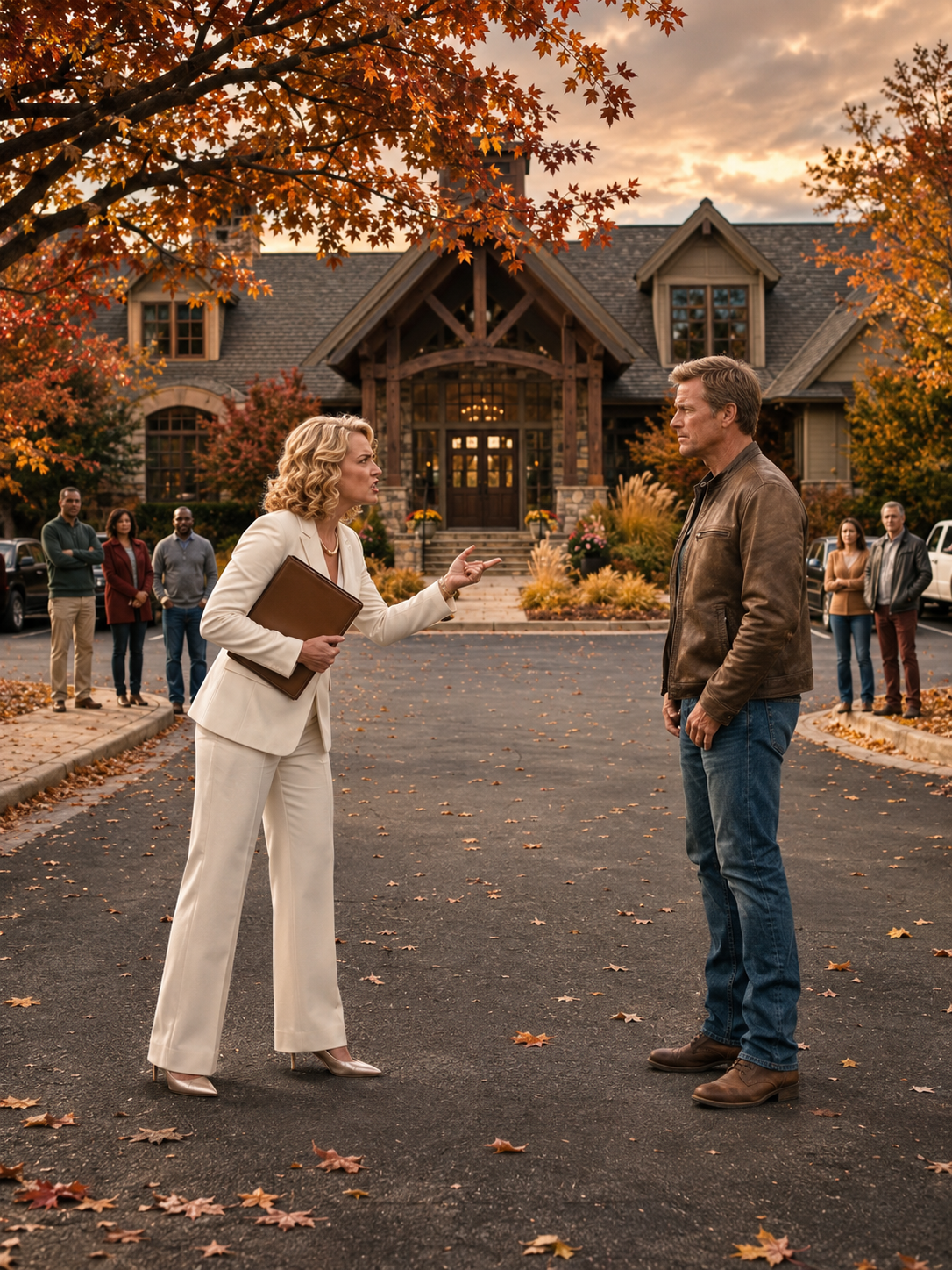
The HOA President Blocked My Driveway Seventeen Times—So I Brought Her a Gift That Made Her Attorney Leave the Room
The seventeenth time Meredith Vale blocked my driveway, she left a note on my windshield saying my daughter’s wheelchair was “not an exemption from community standards.”
My daughter read it before I did.
Then Meredith smiled from her SUV and asked whether I was finally ready to be reasonable.
I folded the note once.
Then again.
Then I put it in my shirt pocket, where I used to keep the grocery lists my wife wrote on the backs of envelopes.
“Go wait by the side door, Lucy.”
My daughter looked up at me.
She was eleven. Old enough to recognize cruelty. Young enough to wonder whether it happened because she had done something wrong.
“Did we break a rule?”
“Then why does she keep doing it?”
Across the driveway, Meredith lowered her window.
“Because some people need consistency.”
I looked at her.
She wore a cream jacket, pearl earrings, and the expression of a woman who had never mistaken an apology for something she owed.
Behind her white SUV, my wheelchair-accessible van sat trapped in our garage.
Lucy had a medical appointment in forty minutes.
Meredith knew that.
I had told her the night before.
What would you do if someone kept taking away your family’s ability to leave home—and called your resistance the problem?
I took out my phone.
Meredith’s smile widened.
“Calling the police again, Daniel?”
“Good. They have real emergencies.”
I photographed her license plate.
Then the position of her tires.
Then the note.
Then the space between her rear bumper and the brick pillar at the edge of my driveway.
I had asked politely. I had asked in writing. I had asked while standing in the rain with groceries dissolving through a paper bag. I had asked while my daughter waited in a van she could not exit without a ramp. I had asked with my wife’s memorial flowers still drying on the kitchen counter.
I was finished asking.
Meredith lifted a travel mug.
“Are we done?”
“For this morning,” I said.
She mistook that for surrender.
That was the last useful thing she gave me for free.
We lived at the edge of Birch Hollow, a neighborhood in a growing suburb outside Columbus.
Most of the houses were newer than mine. Brick fronts. Three-car garages. Curving sidewalks that looked lovely in sales brochures and became inconvenient whenever someone actually needed to go somewhere.
Our house was an old white farmhouse with a blue front door and a maple tree that dropped helicopters into the gutters every spring.
My wife, Claire, had loved that tree.
She said a house should have at least one thing older than the people trying to improve it.
We bought the place twelve years earlier, before Birch Hollow had a fountain, a clubhouse, or an entrance sign large enough to suggest the residents had won a war.
Back then, there had been an orchard beyond our east fence.
Lucy learned to count by pointing at the trees from my shoulders.
Claire planted lavender beside the porch.
I built a workshop in the detached garage.
We were not rich.
We had a mortgage, a minivan, and enough ordinary hope to mistake plans for guarantees.
Claire worked as an elementary school librarian. I ran a small business restoring old windows and doors.
Then Claire got sick.
There was no dramatic final conversation in a hospital room.
There were eighteen months of appointments, medication schedules, insurance calls, and learning which foods she could still tolerate.
There were evenings when we pretended not to see how tired the other person was.
There were mornings when Lucy brought her mother library books and carefully turned the pages.
Claire died in October.
Meredith’s first warning letter arrived in November.
It concerned the temporary ramp I had built beside our front steps while the permanent side entrance was being installed.
The letter said the structure was inconsistent with the neighborhood’s “visual character.”
I wrote back that the ramp would be removed in six weeks.
Meredith wrote back asking for photographs of the proposed replacement.
I sent them.
She objected to the handrail color.
That was how it started.
Small enough to sound ridiculous when described out loud.
Small enough that people smiled sympathetically and said, “You know how HOAs can be.”
By January, she was parking across my driveway.
Not accidentally.
Not because the clubhouse lot was full.
She lived four houses away.
Her own driveway could hold six cars.
The first time, she said she was dropping off committee materials.
The second, she said she would only be a minute.
The third, she said the narrow strip at the end of my driveway was common property.
When I asked for documentation, she told me the board had already reviewed it.
That phrase would become one of her favorites.
The board had reviewed it.
The board had approved it.
The board had determined I was being difficult.
Eventually, I learned that when Meredith said “the board,” she often meant Meredith at her kitchen island while two people nodded over coffee.
I did not know that on the seventeenth morning.
What I knew was that Lucy needed to leave.
So I called the nonemergency number, explained the obstruction, and gave the dispatcher the event numbers from two previous reports.
Meredith saw the call connect.
Her smile disappeared.
She started the SUV.
“I was leaving anyway.”
“Please wait for the officer.”
“I have a meeting.”
“So do we.”
She backed away from the driveway.
Not enough to admit anything.
Enough to keep herself moving.
I did not step in front of her.
I did not touch her vehicle.
I kept recording until she turned the corner.
Then I went inside.
Lucy was by the side door, coat zipped, backpack on her lap.
“Did she move?”
“Are we going to be late?”
“A little.”
Lucy looked at my pocket.
“Can you throw the note away?”
I sat on the bench beside her.
Her face fell.
“Not because I want to keep what she said,” I added. “Because sometimes the thing that proves someone is wrong is the thing they think they can make you ashamed of.”
She considered that.
Then she nodded.
“Can I have pancakes afterward?”
“With the good syrup?”
“We are absolutely entering good-syrup territory.”
That made her smile.
I carried that smile through the appointment.
I carried it through the pancakes.
I carried it until she fell asleep that evening.
Then I sat at the kitchen table and took the note out of my pocket.
I laid it beside sixteen other incidents.
Photographs.
A small pile of evidence that had begun to resemble the size of my life.
My older brother, Ryan, called at nine.
He was a real estate agent. Successful enough to talk about interest rates at Thanksgiving as if they were weather conditions he personally controlled.
He had sold three houses in Birch Hollow.
When I told him what happened, he sighed.
“Dan, she’s a pain. Everybody knows that.”
“Then everybody can tell her to stop.”
“It’s more complicated.”
“Because you still have to live there.”
I looked at Claire’s empty chair.
“I am trying to.”
Ryan went quiet.
Then he said, “Have you considered signing the parking arrangement she sent?”
“It gives you a designated access window.”
I looked down at the papers.
“My driveway does not need an access window.”
“I know how that sounds.”
“I’m saying there may be a practical solution.”
I picked up Meredith’s proposed agreement.
The title sounded harmless.
NEIGHBORHOOD ACCESS AND PARKING ACCOMMODATION.
Claire would have circled the word accommodation.
She had been good at words that pretended to help.
“I’m having someone look at it,” I said.
“An attorney?”
“That could get expensive.”
“So can being trapped at home.”
Ryan exhaled.
“Just don’t turn a parking issue into a war.”
After the call, I opened my laptop.
I searched for local attorneys who handled property disputes.
Not the firm Meredith recommended.
Not the firm whose logo appeared on the bottom of her letters.
Someone who did not know how reasonable she looked at a neighborhood brunch.
At ten fourteen, I found Rachel Bennett.
Her website had no photograph of a handshake.
That helped.
At ten twenty, I sent an email.
At eight the next morning, her assistant called.
Rachel’s office occupied the second floor of a plain brick building beside a dentist.
There was a coffee stain on one arm of the reception sofa.
A child’s drawing hung behind the front desk.
I felt better immediately.
Rachel was in her fifties, with short dark hair and reading glasses she used like punctuation.
She let me talk for eleven minutes.
Then she held up one finger.
“Before we discuss how unpleasant this woman is, I need to know what she actually has the legal authority to do.”
“Block my driveway?”
“No. That answer is likely simple. I mean everything she claims gives her the right.”
I handed her the folder.
She read Meredith’s agreement first.
Then the warning letters.
Then the deed I had downloaded the night before.
She stopped on the second page.
“Do you have your owner’s title policy?”
“In a box.”
She went back to the agreement.
“What did she tell you this document does?”
“Clarifies parking.”
Rachel made a small mark in the margin.
“What does it actually do?”
She looked up.
“It appears to do considerably more than that.”
My stomach tightened.
“It includes a release of objections connected with future access modifications along the eastern boundary. It incorporates a site plan that isn’t attached. It waives certain claims against the association and unnamed successors.”
I stared at her.
“It’s a parking form.”
“That’s what they called it.”
“Would signing it let them change my driveway?”
“I’m not going to give you an answer without the survey and the referenced documents.”
She tapped the page.
“But I would not sign this.”
“Have you already signed anything else?”
“Given oral permission?”
“Accepted compensation?”
Rachel nodded.
“Now show me the photographs.”
She studied every one.
The tire positions.
The narrow clearance.
Lucy’s van.
She asked about the ramp deployment.
The side entrance.
The appointment times.
Then she read Meredith’s note.
Her face did not change.
That made the next sentence land harder.
“Keep the original.”
I leaned back.
“I was planning to give her a gift.”
Rachel looked at me.
“What kind?”
“A very complete record.”
She took off her glasses.
“Mr. Mercer, there are useful gifts. There are expensive gifts. And there are gifts that end up being exhibits against the person who thought of them.”
“I’m not touching her car.”
“Excellent start.”
“I’m not blocking hers.”
“Even better.”
“I want her to understand that the next time she parks there, something happens that she can’t undo with a smile.”
Rachel put her glasses back on.
“That,” she said, “we can work with.”
For the next three days, I did things that would have bored anyone watching.
I found the title policy.
I requested recorded documents.
I downloaded the association declaration.
I read amendments.
I copied the purchase file Claire had organized in a binder labeled HOUSE—BORING BUT IMPORTANT.
Inside the front cover, she had drawn a small face asleep on a stack of papers.
I sat on the floor with that binder for a long time.
Then I kept working.
The house had not originally belonged to Birch Hollow.
Our parcel had been carved out of the old orchard property decades before the subdivision.
When the development came, the previous owner signed a limited agreement concerning drainage and shared maintenance along the entry lane.
That agreement did not look like the declaration covering the newer houses.
I was not qualified to say exactly what it meant.
Rachel was.
She requested the earlier instruments.
Then she asked me to hire an independent surveyor.
The surveyor’s name was Paul Henderson.
He arrived on Friday in a muddy pickup with a thermos between the seats.
Meredith arrived twelve minutes later.
She must have seen the truck from her window.
“What’s happening?”
Paul looked up from his equipment.
“A boundary survey.”
“I’m the association president.”
“Congratulations.”
I nearly smiled.
Meredith did not.
“You need board authorization for work affecting common property.”
Paul glanced toward me.
I said, “He’s surveying my parcel.”
She folded her arms.
“This area is under review.”
Paul looked at the sidewalk.
Then the driveway.
Then his tablet.
“The board.”
“Do you have a survey?”
“We have the community plat.”
“Wonderful. Send it to my office.”
Meredith looked at me.
“You’re escalating this.”
I had begun recognizing the pattern.
When she obstructed my driveway, it was policy.
When I measured it, it was escalation.
“I’m getting information.”
“You could have asked.”
She looked at Paul again.
He had already turned back to his equipment.
There are few things more irritating to a person accustomed to controlling conversations than a competent professional who has work to finish.
Meredith stayed another minute.
Then she left.
Paul waited until she was inside her house.
“She always like that?”
“She’s having a good day.”
“Then I’ll be careful where I set the tripod.”
The survey took time.
So did the document review.
Meanwhile, Meredith parked across my driveway again.
Not the white SUV this time.
Her husband’s dark blue sedan.
She left it at an angle that kept the sidewalk mostly clear while preventing the van from turning out safely.
I photographed it.
I called the nonemergency number.
An officer named Mark Delaney arrived.
He had been to our house before.
He walked the distance between the sedan and my driveway.
Then he knocked on Meredith’s door.
She answered holding a folder.
I watched from my porch.
She spoke for several minutes.
Officer Delaney listened.
Then he said something.
Meredith stopped smiling.
He pointed toward the street.
She looked at me.
Then she moved the car.
Afterward, the officer came over.
“She’s been advised.”
“What happens next time?”
“Keep calling when the access is obstructed. Don’t get into a confrontation. Don’t move the vehicle yourself.”
“Understood.”
He looked toward the van.
“How old’s your daughter?”
“My niece uses a chair.”
He did not say it like a speech.
Just a fact.
Then he handed me the incident information.
“Keep this with the others.”
That afternoon, Meredith emailed the neighborhood.
The subject line read:
REMINDER REGARDING CIVILITY AND EMERGENCY RESOURCES.
She wrote that certain residents had recently involved law enforcement in “minor parking misunderstandings” that could have been resolved through cooperation.
She did not name me.
She described my house.
Three people replied with thumbs-up symbols.
One wrote, Thank you for all you do.
Then a woman named Denise Carter replied to everyone.
If a car prevents someone from leaving their driveway, moving the car resolves the misunderstanding.
I read that sentence four times.
Denise lived across the street.
She was a retired school bus driver with a gravelly voice and no known interest in impressing Meredith.
I had waved to her for years.
We had never done much more.
I walked over that evening with a loaf of banana bread Lucy had insisted on helping make.
Denise opened the door.
“Is that a peace offering?”
“No. An appreciation offering.”
She took the plate.
“Good. I don’t want peace with people who park like that.”
She invited me inside.
Her kitchen smelled like onions and coffee.
On the refrigerator was a photograph of her late husband holding a fish too small to justify his expression.
Denise cut two slices of bread.
“I’ve got video.”
I looked up.
“Her parking.”
She pointed toward the living room.
“Doorbell camera sees half your entrance. I started saving clips after the ambulance.”
I went still.
There had been an ambulance in December.
Lucy had developed a respiratory infection.
Her breathing worsened after midnight.
I called for help.
Meredith’s SUV was across the driveway.
The paramedics came through the side yard with their equipment while a police officer woke her.
Lucy was treated and taken in.
She recovered.
I had tried not to think about the extra minutes.
People do that after a frightening thing.
They bargain with the outcome.
Everything worked out, so perhaps the delay did not matter.
Denise saw my face.
“I’m not saying anything happened that didn’t,” she said. “I’m saying the car was there. The camera shows it.”
I set my coffee down.
“Can you preserve the original files?”
She smiled.
“Already did. My nephew taught me.”
Then she added, “She wasn’t at a meeting that night.”
“She told the officer she’d come home late from a board meeting and forgot where she parked.”
Denise shook her head.
“She moved the SUV from her driveway at ten forty-three. Put it across yours. Walked home.”
I stared at her.
“Are you sure?”
She slid a tablet across the table.
The timestamp glowed in the corner.
The SUV moved.
The driver’s door opened.
Meredith stepped out.
She looked toward our dark house.
Then she walked back to her own.
No committee materials.
No groceries.
No reason to be there.
Just a decision.
I watched it again.
My coffee went cold.
When I left Denise’s house, she put a hand on my sleeve.
“Don’t do anything tonight.”
“Good. Angry men make excellent distractions from guilty people.”
“Who told you that?”
“Thirty-two years driving a school bus.”
Rachel watched the video the next morning.
Then she watched the earlier footage Denise had saved.
The longest obstruction lasted six hours.
The shortest lasted eleven minutes.
Several began shortly before Lucy’s regular therapy appointments.
Meredith knew that schedule because she had requested it.
She had said the board needed to understand when accommodation might be necessary.
I had sent it in good faith.
Rachel looked at the email.
Then at me.
“Don’t blame yourself for answering a question honestly.”
“I handed her the times.”
“You handed her a schedule so she could avoid interfering with your daughter’s access.”
I looked down.
“She used it.”
“Yes,” Rachel said. “That is a fact about her.”
For a moment, I could not speak.
Then I asked what came next.
Rachel sent a formal demand.
No threats she could not support.
No adjectives.
The letter identified the incidents.
It demanded that Meredith stop obstructing access.
It asked the association to preserve relevant communications, meeting records, parking complaints, and documents concerning my parcel.
It requested the missing site plan.
It made clear that I had not authorized the proposed arrangement.
Meredith responded within two hours.
Not to Rachel.
I am disappointed you have chosen hostility over a neighborly solution.
I forwarded it without answering.
Ten minutes later, another arrived.
Legal expenses caused by your conduct may be assessed according to governing documents.
I forwarded that too.
Rachel replied:
Do not engage. We will request the specific authority.
For the first time in months, I did not spend the afternoon composing a response in my head.
Someone else was holding the line.
That did not make me weak.
It made me less tired.
At dinner, Lucy asked why I was smiling at my phone.
“Someone sent a useful email.”
“Is that a grown-up thing?”
“Sounds terrible.”
“It usually is.”
She pushed a pea across her plate.
“Is the driveway lady mad?”
“Probably.”
“Because of us?”
“No. Because people are starting to tell her no.”
Lucy considered that.
Then she picked up her fork.
The survey came back on Monday.
Paul called first.
“Have your attorney ring me.”
“Did you find something?”
“I found the boundary.”
“That sounds like the job.”
“Sometimes people don’t like the job.”
Rachel scheduled a meeting.
I brought the original purchase binder.
Paul brought the survey.
The lower section of my driveway—the part Meredith called an association parking area—was inside my parcel.
Not mostly.
Not ambiguously.
The association held a narrow maintenance right relating to the drainage swale beside the entry lane.
It did not hold ownership of my driveway.
It did not have a parking easement across it.
The documents also preserved my residential access.
Rachel laid the records side by side.
“She’s been combining three different things in her letters.”
“A drainage obligation. A shared maintenance arrangement. And the association’s general authority over its own common property.”
“None of which lets her park there.”
I looked at the survey.
Blue lines.
A corner marker.
Months of humiliation reduced to something that could be measured.
“Does that mean I can have her towed?”
“It means we can establish a procedure supported by the actual property rights and local requirements. We’ll handle notice, signage if appropriate, and a qualified operator. I don’t want you improvising.”
“There’s something else.”
She turned the proposed parking agreement toward me.
The missing site plan had finally arrived.
A new access lane ran along the eastern edge of my property.
It widened at the exact place Meredith kept blocking.
Then it continued toward the old orchard.
“That isn’t parking.”
“Where did this come from?”
“The association’s counsel sent it after our third request.”
I leaned closer.
The orchard was labeled:
FUTURE RESIDENTIAL PHASE.
I had known the land was for sale.
Everyone did.
A sign had gone up near the county road in February.
But the proposed subdivision entrance was supposed to be on the far side.
Not beside my kitchen.
Not across the strip where Lucy’s ramp deployed.
Rachel watched me.
“This agreement may be intended to obtain your consent to something much larger than parking.”
I looked at the signature page.
Meredith had highlighted the line with a yellow tab.
SIGN HERE TO RESOLVE.
I thought about how tired I had been the evening she dropped it off.
Lucy had a fever.
The washing machine had stopped draining.
There were insurance letters on the counter.
Meredith had stood in my doorway and said she wanted to make things easier.
I had almost signed.
Not because it sounded fair.
Because I wanted one problem to stop.
Rachel let me sit with that.
Then she said, “You didn’t.”
I looked up.
“You didn’t sign.”
“Keep that fact in the room.”
I called Ryan afterward.
“Did you know about the orchard plan?”
He was quiet.
Then he said, “There have been proposals.”
“Did you know the parking agreement included an access lane?”
“I hadn’t read every attachment.”
“The attachment wasn’t there.”
“You told me to sign.”
“I told you to consider a practical solution.”
“Did you know?”
A car horn sounded on his end.
He said, “I’m driving. Let me look at it when I’m home.”
“Send me whatever you have.”
He did not.
That was the first thing I wrote down about my brother.
I felt disloyal doing it.
Later, I would wish I had started sooner.
The next neighborhood meeting was held on Thursday.
I had never enjoyed those meetings.
Twenty people in folding chairs arguing about mulch while someone at the front used a microphone in a room small enough to hear a sneeze from the parking lot.
This time, I went with a folder.
Denise sat beside me.
Meredith stood behind a table decorated with a small vase of flowers.
Two board members sat to her left.
The treasurer, Ellen Brooks, sat to her right.
Ellen had worked as a bookkeeper for a plumbing company. She was quiet, careful, and generally the person who reminded people that bills did not pay themselves.
Meredith called the meeting to order.
There were reports on landscaping.
Pool maintenance.
A missing package.
Then she said, “Before we conclude, I want to address rumors concerning a private driveway matter.”
Denise made a small sound beside me.
I kept my hands still.
Meredith continued.
“The association has been working tirelessly to balance individual preferences with community needs.”
I raised my hand.
She looked past me.
I kept it raised.
Finally, Ellen said, “Daniel has a question.”
Meredith smiled tightly.
“We’re not taking individual disputes tonight.”
“Then don’t describe mine.”
The room quieted.
“I have a survey confirming the driveway is on my parcel. I have written notice from counsel. I’m requesting that the board instruct its president not to obstruct it.”
Meredith lifted a paper.
“Your legal representative is communicating with ours.”
“Then the board should have no difficulty confirming there will be no further obstruction.”
She looked toward the other directors.
One adjusted his glasses.
The other looked at the agenda.
Ellen said, “That seems straightforward.”
Meredith turned.
“There are disputed access considerations.”
I opened my folder.
“Which ones?”
“This is not the appropriate forum.”
“You chose the forum.”
A man in the third row leaned forward.
“Is this about the car?”
Meredith said, “There have been misunderstandings.”
Denise stood.
“I’ve got video of the misunderstandings.”
“Meredith.”
Nobody laughed.
That made it stronger.
Ellen looked at me.
“May I see the survey?”
I handed it over.
Meredith reached for it first.
Ellen held out her hand.
“I’d like to read it.”
That was the first crack I saw in the front of the room.
Not mine to widen.
I sat down.
After the meeting, three neighbors approached me.
One said he had always thought the parking was wrong.
One said he had not realized it was serious.
The third, a young father named Mike Donnelly, said, “I should have said something.”
I liked him best.
He did not ask me to make his silence feel better.
The following week, Meredith stopped parking across my driveway.
For four days.
On the fifth, she placed orange traffic cones across it.
A laminated notice hung from one.
TEMPORARY COMMUNITY ACCESS REVIEW.
I stood in the kitchen window and looked at them.
Lucy rolled up beside me.
“Does she own the cones?”
“Probably.”
“Can cones have lawyers?”
“Everything can have a lawyer if people work hard enough.”
I photographed the placement.
Then I called Rachel.
She listened.
“Is there a vehicle?”
“Any work underway?”
“Anyone directing traffic?”
“Document the condition. Then clear your own access without damaging anything. Place the cones safely on the portion of her property where she can retrieve them, or arrange pickup through counsel if that’s cleaner.”
I chose cleaner.
I moved the cones to the side of my driveway, where they obstructed nothing.
Then I emailed the association office.
Your property is available for collection by appointment.
Meredith came herself.
She walked up with her phone already recording.
“You are interfering with official safety measures.”
“What safety work?”
“This is an active review.”
“What work is being performed?”
She looked at the cones.
Then at my phone, which was also recording.
“You are creating a hostile environment.”
I stood beside the open garage.
Behind me, the van ramp lowered to the pavement.
Lucy rolled out.
Meredith glanced at her.
I stepped slightly to the side, keeping myself between them.
“Your cones are there. Please take them.”
One by one.
No victory speech.
No audience.
Just a woman carrying back the objects she had hoped would make her authority visible.
That evening, an envelope appeared in my mailbox.
Inside was a notice of a proposed fine.
Five hundred dollars.
Unauthorized removal of safety barriers.
Rachel wrote one letter.
The fine disappeared.
The board called it an administrative correction.
I called it the first expensive lesson Meredith had declined to learn.
Two days later, the association’s management company emailed me.
A woman named Laura Kent requested a meeting to “de-escalate the situation.”
Rachel agreed to attend.
We met in the clubhouse.
Meredith wore navy.
Laura wore the slightly strained expression of someone discovering that a simple account had become a file with tabs.
Ellen was there too.
So was the association’s attorney, a man named Thomas Reed.
Rachel placed the survey on the table.
Thomas read it.
Then the limited agreement.
Then the proposed accommodation form.
He looked at Meredith.
“Who drafted this?”
She folded her hands.
“It was provided as a working document.”
“A consultant.”
“Crestline.”
Laura shifted in her chair.
Crestline Communities was the developer seeking to buy the orchard.
I had seen the name on the sign.
Thomas looked at the site plan.
“Why is a developer’s access plan attached to an association parking agreement?”
Meredith smiled.
“We were exploring options.”
Rachel said, “My client was told he needed to sign to preserve access to his own driveway.”
“That is not how I phrased it.”
I took out the email.
Thomas read it.
His expression did not change.
But he turned the page very slowly.
Laura said, “Meredith, did management review this before it went out?”
“I don’t need permission for every neighbor conversation.”
“This wasn’t a conversation,” Ellen said.
Everyone looked at her.
She met Meredith’s eyes.
“It was six pages.”
I liked Ellen more by the minute.
Thomas closed the folder.
“The association does not concede every interpretation today. But there should be no personal vehicle obstruction while the documents are reviewed.”
Meredith looked at him.
“You’re rewarding his tactics.”
Thomas adjusted his pen.
“I’m advising my client.”
For the first time, I realized Meredith had expected the attorney to be another version of the microphone.
Something she could speak through.
She did not like discovering he had an independent job.
We left without a final resolution.
But I left with a written interim commitment.
No parking across the driveway.
No unilateral fines over the disputed area.
A deadline for records.
Rachel told me not to celebrate too early.
I took Lucy out for ice cream anyway.
Some days did not require final victory.
They required a scoop of strawberry and enough room to deploy a ramp.
At the ice cream shop, she asked, “Is the driveway ours now?”
“It was ours yesterday.”
“Then why does everybody have to decide?”
I looked at her.
“Because sometimes people act as if you need their permission for something you already have.”
She licked the edge of her cone.
“That’s stupid.”
“Can I say that?”
“In this specific case, I’ll allow it.”
She smiled.
On the way home, I stopped at the cemetery.
Lucy waited beside me while I brushed dead leaves from Claire’s stone.
I told her about the survey.
The attorney.
The ice cream.
Nothing dramatic.
Claire had hated people speaking to her as if every moment needed a meaning.
Before we left, Lucy placed a smooth gray pebble beside the flowers.
“Dad’s being really boring about it,” she told her mother.
Then I had to turn away for a moment.
Still here.
Claire would have approved.
The records arrived in pieces.
Landscaping invoices.
Redacted minutes.
A list of committee assignments nobody had asked for.
Rachel kept requesting the documents actually relevant to the access plan.
Laura kept promising to locate them.
Ellen began emailing from her personal account.
At first, only brief questions.
Had I received a notice dated March 4?
Had I been told about a board vote on a boundary agreement?
Did I know why an invoice for “resident access coordination” had been paid from the landscaping account?
I sent everything to Rachel.
She responded through the proper channels.
I did not ask Ellen to become a spy.
I did not need to.
She was a treasurer beginning to realize numbers had been used to tell her a story.
Then she came to my workshop.
It was late afternoon.
I was repairing a walnut door from a house built in 1911.
Lucy sat at a folding table doing math.
Ellen stood in the doorway with a bakery box.
“I brought muffins.”
Lucy looked up.
“Are they evidence?”
Ellen blinked.
I closed my eyes.
“We’ve been discussing paperwork.”
Then Ellen laughed.
“No. Just blueberry.”
Lucy accepted that distinction.
I set the tools down.
Ellen waited until Lucy went inside for plates.
Then she said, “I may have approved something I shouldn’t have.”
I did not move.
“A reimbursement. Meredith said it was for community planning. There were attached invoices. They looked ordinary.”
“The consultant was Crestline’s consultant.”
I leaned against the bench.
“What does that mean?”
“I don’t know yet.”
She looked toward the house.
“I’m not asking you to forgive anything. I’m asking whether your attorney would look at the documents.”
Her shoulders lowered.
“I should have asked more questions.”
“Yes,” I said.
She nodded.
I did not rescue her from the sentence.
After a moment, she took out the folder.
Inside were invoices for traffic consultation, resident outreach, and access coordination.
The association had paid several thousand dollars.
But one reimbursement request stood out.
Meredith had received money personally.
The description read:
ADVANCE—NEIGHBOR RELATIONS EXPENSE.
No receipts were attached.
Ellen pointed.
“She said she’d reconcile it after the access agreement.”
I looked at her.
“After I signed?”
Ellen’s eyes filled.
“I think so.”
That night, I sat at the kitchen table with the folder open.
The parking had been petty.
The note had been cruel.
The cones had been ridiculous.
But this was not a woman losing her temper over neighborhood standards.
There was money moving toward a result.
My signature.
My boundary.
My daughter’s access.
I did not feel triumphant.
I felt cold.
Rachel called the next morning after reviewing the records.
“We need an independent accounting.”
“Is it fraud?”
“Don’t use that word as a conclusion yet.”
“What word can I use?”
“Unexplained.”
I looked at the invoice.
“It feels explained.”
“I know. We prove the explanation.”
We requested records.
We preserved originals.
We compared dates.
The first “neighbor relations” payment preceded the first obstruction by six days.
The proposed access form appeared a week later.
The second payment came after Meredith reported that the Mercer parcel was “approaching resolution.”
I had not been approaching anything except exhaustion.
Rachel asked whether I would authorize a narrowly tailored filing to enforce access and seek immediate relief.
I said yes.
She explained the costs.
I said yes again.
Then she asked whether I understood that this might become public.
I looked through the kitchen window.
Lucy was on the porch, feeding crumbs to a squirrel she had named Chairman because he kept taking more than his share.
I understood.
I had spent too much time protecting Meredith from the embarrassment of her own conduct.
The filing was not exciting.
It was precise.
That made it worse for her.
The chronology ran several pages.
Each incident had a date.
Each claim had support.
The survey established the location.
The videos established the conduct.
The emails established notice.
Meredith’s own words established that she knew Lucy required accessible vehicle access.
Rachel requested limited relief focused on stopping the interference while the larger issues were resolved.
I signed my declaration at her conference table.
My hand shook once.
Not because I doubted what I wrote.
Because putting the truth somewhere official made me realize how long I had been trying to carry it by myself.
Outside, Ryan was waiting by my truck.
I had not told him where I was.
He lifted a hand.
“Rachel’s assistant said you were finishing.”
“What are you doing here?”
“Trying to talk before this gets out of control.”
“It’s under control.”
“You filed?”
He looked at the building.
I had known that tone since childhood.
The older brother tone.
The one that meant he had already decided the size of my mistake.
“I’m not taking her side.”
“Then stop sounding like her.”
He looked hurt.
That used to end arguments.
I hated noticing that it did not work anymore.
“I’m trying to protect you.”
“From what?”
“Legal bills. Bad publicity. A neighborhood that turns against you.”
I opened the truck.
“People can turn whichever direction they like. I still need to leave my house.”
Ryan put a hand on the door.
“What if there’s a settlement?”
“Have them contact Rachel.”
“What if Crestline offers to buy the strip?”
“What strip?”
“The frontage.”
I looked at him.
He removed his hand.
“You said you hadn’t read the plan.”
“I asked around.”
“Who asked you to?”
He looked away first.
“Don’t make everybody an enemy.”
I got into the truck.
“I’m not making everybody anything.”
At home, I wrote down that conversation too.
The temporary order came after a hearing at which Meredith appeared with Thomas Reed and a confidence that lasted through the first video.
I wore my only dark suit.
It had been altered for Claire’s funeral.
I hated putting it on.
Rachel asked clean questions.
I answered only what she asked.
Meredith’s side described a boundary disagreement.
Rachel showed the survey.
They described temporary misunderstandings.
Rachel showed seventeen incidents.
They suggested no actual harm had resulted.
Rachel played the footage from the ambulance night.
The room became very quiet.
The judge did not deliver a speech.
He asked whether there was any credible basis for claiming Meredith’s personal vehicle needed to occupy that location.
Thomas said no.
Meredith tried to add something.
Thomas touched her sleeve.
The order prohibited obstruction and interference with access, with further proceedings reserved.
Costs and the remaining claims would be addressed later.
It was limited.
It was enforceable.
It was more than I had possessed the morning Lucy read that note.
Outside the courtroom, Meredith stood beside a vending machine.
She looked at me as if I had done something indecent by letting other people see her.
“You’re enjoying this.”
“Then why keep going?”
I looked at the folder in my hand.
“Because stopping before it stops isn’t the same thing as being done.”
Rachel opened the outer door.
I walked through it.
Meredith did not follow.
For six days, the driveway stayed clear.
I did not realize how much of my life had become listening for an engine until I stopped doing it.
I drank coffee without checking the window.
I loaded Lucy without scanning the street.
I took a customer call while standing in the garage and did not interrupt myself to see whether a white SUV had turned the corner.
Peace felt embarrassing at first.
Too ordinary to have cost so much.
Then, on the seventh morning, a landscaping truck blocked the driveway.
A trailer sat behind it.
The driver was spreading mulch near the entrance sign.
I walked over.
“Can you move?”
He looked surprised.
He reached for his keys.
Then Meredith appeared from the clubhouse path.
“No. They’re working.”
The driver stopped.
I looked at him.
“Who told you to park there?”
He pointed at Meredith.
She folded her arms.
“It’s a service vehicle.”
“It’s obstructing access.”
“For twenty minutes.”
Lucy waited in the van.
The ramp was up.
We were due at school.
I took out my phone.
Meredith looked at it.
“You can’t threaten contractors.”
“I’m asking him to move.”
The driver looked between us.
“I can move.”
“Finish the section first,” Meredith said.
He did not.
He got into the truck.
He moved it.
As he passed, he rolled down the window.
“Sorry, man. She said it was the staging spot.”
I thanked him.
Then I called Rachel.
She was silent for a moment.
“Send the video.”
The order was not a puzzle Meredith was entitled to solve by changing vehicle categories.
Rachel wrote to Thomas.
Thomas called a special board meeting.
This time, Meredith did not control the invitation.
I was not present.
I did not need to be.
At eight thirty that evening, Laura emailed confirmation that Meredith was no longer authorized to direct contractors concerning my property or access.
At eight forty, Ellen called.
“She’s furious.”
“I assumed.”
“She said you’re trying to humiliate her.”
“I’m trying to take my daughter to school.”
Ellen was quiet.
Then she said, “I know.”
The association hired an independent accountant.
A board member resigned.
Another admitted he had approved matters by email without opening the attachments.
I thought about how many expensive mistakes were made by people determined not to appear uninformed.
The accountant requested the full Crestline file.
Meredith said there was no full file.
Then Laura found one.
It had been stored in the management system under a landscaping project.
Rachel received a copy of the relevant documents through counsel.
At the top was a letter.
PER OUR DISCUSSION, THE ASSOCIATION’S COOPERATION IS ESSENTIAL TO A TIMELY APPROVAL.
Below that were payment milestones.
An initial consulting amount.
A second amount upon neighborhood consent.
A final amount upon delivery of access documentation.
The last number made my throat tighten.
Thirty-five thousand dollars.
Not all payable directly to Meredith.
Some to a neighborhood improvement fund.
Some described as consulting compensation.
Enough ambiguity to look respectable from a distance.
Enough clarity to explain why she kept returning to my driveway.
Rachel read it.
Then looked at me.
“This is the first major thing.”
“The difference between someone behaving badly and someone trying to achieve a concealed financial objective.”
I stared at the page.
“She was being paid to wear me down.”
“We’re going to let the records establish the exact arrangement.”
“She used my daughter.”
Rachel did not soften that.
I looked toward her window.
Traffic moved below.
People carried coffee.
Someone laughed on the sidewalk.
I wanted five minutes with Meredith in which I did not have to be the calm one.
I wanted to ask what she had told herself when she wrote the note.
Whether she thought Lucy’s chair was useful leverage.
Whether she had gone home afterward and made lunch.
Instead, I asked, “What happens next?”
Rachel nodded once.
That was the question that could move something.
The accountant’s preliminary findings went to the board.
The board referred them to counsel.
The association notified its insurer.
Crestline denied wrongdoing and described the compensation as ordinary community coordination.
Thomas asked Meredith whether she had disclosed her potential personal compensation to the full board.
She said everybody knew.
Ellen said she had not.
The remaining director said he thought the money was for a new playground.
Nobody had approved Meredith personally interfering with my access.
That was the line everyone suddenly wanted clear.
It did not make them innocent of ignoring it.
But it made them less willing to stand in front of her now.
At home, I began preparing the gift.
Not because Rachel had suggested theater.
Because Meredith had announced the annual Birch Hollow Appreciation Night would proceed as planned.
The event would honor volunteers.
There would be a catered dinner.
A neighborhood slide show.
A presentation about the orchard development.
And, according to the flyer, a special recognition of “leadership under pressure.”
Meredith’s photograph appeared beneath it.
Denise brought the flyer over.
“She’s giving herself a prize.”
“Looks like it.”
“What are you going to do?”
I looked at the workshop.
Then at the stack of documents.
“Bring something.”
Denise smiled slowly.
“Please tell me it has a bow.”
The box was cedar.
I made it myself.
Clean corners.
A fitted lid.
Brass hinges.
Nothing mocking on the outside.
Nothing that could be mistaken for a threat.
Claire used to say a gift should be wrapped as if the recipient had already pleased you.
I worked on it after Lucy went to bed.
The smell of cedar filled the garage.
For the first time in months, I was making something because I wanted the finished object to exist.
Not because someone needed an emergency repair.
Not because a deadline was chasing a bill.
I sanded the lid until the grain shone.
Then I lined the inside with dark blue felt.
Lucy came out one evening while I was fitting the hinges.
“Is that for her?”
“Why are you making it nice?”
I set down the screwdriver.
“Because what’s inside needs to be taken seriously.”
“Is it a snake?”
“Denise said maybe a snake.”
“I’m going to have a word with Denise.”
Lucy grinned.
Then she touched the corner.
“It’s pretty.”
“Thank you.”
“What’s inside?”
“The record.”
“Like a song?”
“More like a very long explanation.”
She sighed.
“Grown-ups ruin surprises.”
Then I showed her the brass plate I had ordered.
FOR ALL YOU HAVE DONE HERE.
Lucy read it.
Her mouth opened.
Then she looked at me.
“That sounds nice.”
“It is accurate.”
She thought about that.
Then she smiled in a way that reminded me so sharply of Claire I had to look down at the hinge.
The gift was not only for Meredith.
That was the part I did not tell anyone yet.
Inside were indexed copies of the obstruction records.
The survey.
The formal notices.
The correspondence concerning the proposed access agreement.
And, if the final board review supported it, the documents showing how she expected to benefit.
There would also be a proposed resolution.
Not a handwritten resignation demand.
A board-prepared set of corrective actions.
Independent oversight.
A clear prohibition on personal enforcement.
Repayment review.
A special election.
A commitment that accessibility requests would never again be routed through one neighbor’s discretion.
I was not giving her revenge in a box.
I was giving the room a version of events too organized to dismiss.
Rachel reviewed every page.
She removed three sentences I had written myself.
I did not argue.
Those sentences had felt wonderful.
They would have aged badly.
“Remember,” she said, “the object is not to make her angry.”
“She’ll be angry.”
“Yes. But that’s not the object.”
The week before the dinner, Crestline sent a new offer.
They would pay for a redesigned driveway.
A privacy fence.
Landscaping.
A cash payment.
In exchange, I would agree to the access configuration.
The total was enough to erase a frightening portion of our mortgage.
I sat at Rachel’s table and stared at it.
She did not rush me.
“What would you do?” I asked.
“I would understand exactly what was being sold before deciding.”
She slid over the revised plan.
The service lane would pass twelve feet from our side entrance.
Delivery vehicles.
Construction traffic during development.
Eventually, regular access to a utility area and emergency route serving the new phase.
The accessible loading space would move behind the house.
Lucy would travel farther in bad weather.
The garden Claire planted would be removed.
The cash number looked different beside the drawing.
I asked whether they could redesign the project around another entrance.
“They say it’s impractical.”
“Impractical or less profitable?”
Rachel gave me a small smile.
“That is an excellent question.”
The traffic consultant’s report showed the alternate route required additional work and a separate agreement with another landowner.
More expensive.
Not impossible.
I sent a response through Rachel.
I was willing to review alternatives that preserved our access, privacy, and safe loading area.
I was not willing to surrender the strip under the proposed terms.
Crestline replied that time was limited.
I replied through counsel that my property rights did not become smaller because their deadline was approaching.
Ryan called that evening.
“You turned down how much?”
“Who told you?”
“It’s a small town.”
“No. It’s not.”
He was quiet.
Then he said, “You need to think about Lucy.”
I stood from the kitchen table.
“Choose your next sentence carefully.”
“I mean financial security.”
“I know what you mean.”
“You could pay down the house.”
“And put a service lane beside her bedroom.”
“Traffic studies—”
“Have you read them?”
“I know people who have.”
I looked at the window.
Across the street, Denise was bringing in her trash can.
Normal life.
Always there.
Always interrupted by someone else’s urgency.
“Why are you so invested in this?”
“I’m invested in you not making a decision out of pride.”
“Then stop giving me reasons to wonder.”
He said my name.
The soft version.
The brother version.
I almost answered to it.
Instead, I said, “Send whatever you want me to know to Rachel.”
Then I ended the call.
I hated that afterward.
Not because it was wrong.
Because it should not have been necessary.
The night before Appreciation Night, Ellen came by with the accountant’s updated report.
Rachel had already received the legal copy.
Ellen wanted me to know what the board intended to do.
Meredith’s authority would be suspended pending a special election and completion of the review.
The board would formally withdraw the accommodation form.
The association would disclaim any claim that it owned my driveway.
It would adopt a written access policy.
It would seek repayment of unsupported personal expenditures, subject to the full accounting and legal advice.
It would refer any potentially unlawful conduct to the appropriate authorities.
The wording was cautious.
It was also real.
Ellen looked exhausted.
“She’s saying we’re betraying her.”
“Then let her say it.”
She nodded.
Then she looked at the cedar box.
“That’s beautiful.”
“Thank you.”
“Is it wrong that I’m looking forward to seeing her open it?”
I considered that.
“No. Just don’t let the looking-forward part do the decision-making.”
Ellen smiled.
“Your attorney?”
“My neighbor.”
“Which one?”
“The bus driver.”
At dinner, Lucy asked if I was scared.
“Of Meredith?”
“A little.”
Her eyes widened.
I set down my fork.
“Not because I think she’s stronger. Because telling the truth in a room where people have been avoiding it can feel frightening.”
Lucy thought.
“Like telling the teacher somebody cheated.”
“Even if you have the paper.”
“Especially if everybody likes the person.”
She looked at her plate.
“Do people like her?”
“Do they like us?”
I reached across the table.
“People liking us is not how we decide whether we deserve to leave our own driveway.”
She put her hand in mine.
I hoped she did.
I hoped I had said it enough times that her body would eventually believe it when the next cruel person smiled.
Appreciation Night began at six.
I arrived at six fifteen.
Denise came with me.
Lucy stayed with my sister-in-law, Beth, who had brought a stack of movies and promised not to call them educational.
The cedar box rested on the passenger seat.
A dark blue ribbon crossed the lid.
I carried it into the clubhouse.
The room smelled of roast chicken, coffee, and the particular floral scent of centerpieces ordered by someone who expected photographs.
Meredith stood near the entrance.
She saw the box.
Her expression changed.
For one strange second, she looked pleased.
A gift could do that to her.
She assumed it meant surrender.
“Meredith.”
“I’m glad you came.”
Her eyes moved to the brass plate.
She read it.
Then smiled.
“That’s very thoughtful.”
Thomas Reed stood beside the refreshments.
He saw Rachel enter behind us.
His face changed slightly.
Preparation.
He knew something was coming.
I did not put the box on the gift table.
Several neighbors watched.
Mike Donnelly raised a hand.
Ellen nodded from near the front.
Laura stood beside the projector, checking a cable.
At six forty, dinner began.
At seven ten, Meredith took the microphone.
She thanked the landscaping committee.
The pool volunteers.
The welcome team.
Then she spoke about leadership.
How difficult it could be.
How often people misunderstood the sacrifices.
How important it was to stand firm when a small number of residents challenged the good of the whole.
I sat with my hands folded.
Denise leaned toward me.
“If her violin gets any louder, I’m leaving.”
I nearly laughed into my water.
Meredith continued.
“We cannot let personal preferences jeopardize the future value of our community.”
There it was.
Not the driveway.
A word big enough to hide almost anything inside it.
Then she announced a short presentation from Crestline Communities.
A man named Scott Halden stood.
Expensive watch.
A smile that looked rented by the hour.
He spoke about thoughtful growth.
Green space.
Improved traffic flow.
Benefits to existing residents.
The slide behind him showed happy families walking through a development that did not yet exist.
Then the site plan appeared.
My house was a pale rectangle near the corner.
The new access lane ran beside it.
My name was not on the slide.
Neither was Lucy’s.
Scott pointed.
“We’re pleased that the remaining neighborhood access matters are substantially resolved.”
I felt Rachel shift beside me.
Ellen stood.
“Before that goes further, the board needs to clarify something.”
Meredith turned.
“This is a development presentation.”
“It concerns the board.”
Scott lowered the pointer.
Ellen walked to the front.
Laura joined her.
Thomas approached too.
Meredith’s smile tightened.
“We can discuss administration afterward.”
“No,” Ellen said.
No microphone.
Everybody heard it.
The room went still.
Ellen looked toward me.
“Daniel has asked to provide a record concerning the access matter. The board has agreed he may do so before any representation is made about his consent.”
Meredith looked at Thomas.
He did not look at her.
I carried the box forward.
It was not heavy.
It felt heavy.
I set it on the table beneath the screen.
“For all you have done here,” I said.
Meredith looked at the brass plate.
Then at me.
“I don’t understand.”
“You will.”
Rachel stood a few feet away.
Not beside me.
Close enough that I knew where the line was.
I lifted the lid.
Inside, the first page rested beneath a clear cover.
SEVENTEEN REQUESTS TO MOVE.
Under it was the first photograph.
The white SUV.
The driveway.
Meredith’s face changed.
I took out the binder.
“I asked this to be reviewed in private. I asked for the behavior to stop. I asked for the document explaining why I was being told I needed permission to leave my own property.”
A man in the back lowered his fork.
“I’m not going to read every incident. The record is available through counsel and the board.”
I turned one page.
“This is the survey.”
“This is the limited maintenance agreement.”
“This is the court order.”
Meredith reached toward the binder.
I moved it gently out of reach.
“These are copies. The originals are preserved.”
She withdrew her hand.
“This is harassment.”
Thomas said, “Meredith.”
She looked at him.
He lowered his voice.
“Let him finish.”
I took out the note.
Not the original.
A clear copy.
I placed it under the document camera Laura had connected for the presentation.
The words appeared on the screen.
My daughter’s wheelchair was not an exemption from community standards.
The room became so quiet I could hear the refrigerator behind the kitchen counter.
Meredith looked up.
Then at the audience.
“That is being taken out of context.”
I looked at her.
“What context would you like to add?”
She opened her mouth.
Not triumphantly.
Not kindly.
Just long enough for the room to notice there was no missing sentence that could improve it.
Then I removed the page.
“My daughter read that.”
A woman at the front covered her mouth.
I kept my voice level.
“She asked whether we had broken a rule. We had not.”
I put the note back in the binder.
“The driveway is not an association parking area. There is no agreement granting Meredith the right to block it. I have not consented to the development access plan shown tonight.”
Scott Halden stepped forward.
“Our understanding—”
Rachel spoke.
“Any statement about my client’s consent should be supported by a document he actually signed.”
Scott stopped.
I took out the proposed accommodation form.
“This was presented as a way to resolve parking. The attached plan was not provided when I was first asked to sign. The document included releases concerning access changes affecting my property.”
People began shifting in their chairs.
The sound of a room realizing it had been seated inside a different story.
Then Ellen took the microphone.
“The independent accounting review has identified undisclosed compensation arrangements and unsupported expenditures connected with this process.”
Meredith turned sharply.
“That is not a final finding.”
“No,” Ellen said. “The review is ongoing. That is why the corrective measures are written accordingly.”
She read them.
Suspension of unilateral enforcement authority.
Special election.
Withdrawal of the proposed form.
Acknowledgment of the surveyed boundary, subject to the recorded documents.
Preservation of records.
Independent review.
My driveway.
Meredith stood rigid.
Scott looked at Thomas.
Thomas looked at Rachel.
Then Scott said, “Could we have a moment privately?”
Thomas turned to him.
“Not with Mr. Mercer present.”
I looked between them.
Something had shifted.
Not because of the note.
Not because of the box.
Scott held a folder I had not seen before.
A thick one.
He took out a document.
“Our closing file includes an executed access consent.”
Rachel’s expression changed.
“My client has signed no such consent.”
Scott looked at the page.
“Then there may be an administrative issue.”
He placed it on the table.
I saw my name.
My address.
My parcel number.
And beneath them, a signature.
Except it wasn’t.
The room went distant.
Rachel stepped closer.
“Do not move that document.”
Scott’s face drained.
Thomas took off his glasses.
He read the page.
Then he read the signature block.
Then he looked at Meredith.
She had gone still in a way I had never seen before.
Thomas said, very quietly, “I need to step out.”
Meredith reached for his sleeve.
He moved his arm.
“I need to make a call.”
Then he left the room.
That was the moment the gift stopped being a presentation.
And became something nobody could put back in the box.
I did not accuse Meredith of forging it.
I did not know who had.
I stood beside Rachel while she asked for a copy and preservation of the complete file.
Scott said he needed to speak with counsel.
Rachel said that was sensible.
Ellen ended the development presentation.
Laura asked everyone to remain calm.
Nobody had been loud.
That made the request sound almost absurd.
Meredith kept looking at the signature page.
I looked at it too.
The handwriting resembled mine at a distance.
The broad D.
The impatient line through the M.
But the ending was wrong.
I had spent twenty years signing work orders on truck hoods.
My signature rose at the end because I usually lifted the pen before the paper could shift.
This one trailed down.
Not lived in.
Rachel asked, “What date does it claim?”
Scott answered.
“April eighteenth.”
I looked at Denise.
She looked back.
April eighteenth.
Lucy’s science fair.
I had taken the whole day off.
There were photographs.
School sign-in records.
A receipt from the diner afterward.
That did not prove I could not have signed something elsewhere.
But it gave the day a shape.
A shape I remembered.
Rachel asked who had witnessed delivery.
Scott hesitated.
Then he turned the second page over.
The name at the bottom did not register immediately.
Sometimes the mind refuses a familiar thing when the context is wrong.
My brother.
Denise touched my elbow.
I did not feel it.
Ryan had delivered the document.
Ryan had certified that the property owner’s consent was complete.
Ryan had been part of the transaction file.
I could hear his voice.
Just don’t turn a parking issue into a war.
Rachel looked at me.
“Do you recognize the name?”
She waited.
“My brother.”
Across the room, Meredith sat down.
Not gracefully.
As if her knees had stopped accepting instructions.
I looked at her.
For the first time, she looked afraid of something other than losing control of the room.
Scott’s phone rang.
He looked at the screen.
Then declined the call.
It rang again.
I knew whose name I would see before he turned it over.
RYAN MERCER.
The room had not heard every detail.
It did not need to.
People could recognize the sound of a story collapsing.
Rachel closed the folder without disturbing the page order.
“We are not resolving this tonight.”
Her voice was calm.
“The access consent is disputed. My client denies executing it. All parties need to preserve the original document, related communications, delivery records, and transaction materials.”
Scott nodded.
Too quickly.
Thomas returned.
He spoke briefly to Laura.
Then to Meredith.
He did not resume his place beside her.
The dinner ended without dessert.
People stacked plates quietly.
The centerpieces remained perfect.
I remember that.
How the flowers looked untouched while everything around them changed.
Outside, the air was cold.
Denise walked with me to the truck.
The cedar box was under my arm.
Rachel had the binder and copies.
I looked toward Meredith’s house across the lane.
Her porch lights were on.
Her driveway was empty.
Mine was clear.
For the first time, I could not enjoy it.
Denise waited until I unlocked the truck.
Then she said, “One thing at a time.”
I laughed once.
There was no humor in it.
“My brother.”
“He told me I was making enemies.”
Denise looked at the clubhouse.
“Sometimes people call it peace when they mean you haven’t found out yet.”
I sat behind the wheel.
My hands stayed on the keys.
Rachel knocked lightly on the window.
I lowered it.
“Don’t call him tonight.”
“I wasn’t going to.”
She studied me.
Then nodded.
“Good. Go home. Be with Lucy. I’ll contact you in the morning.”
At home, Beth was asleep on the couch.
Lucy was awake.
She looked up when I came in.
“How was the party?”
I put the empty cedar box on the table.
“Complicated.”
“Did she like the gift?”
Lucy considered that.
“Did she understand it?”
I sat beside her.
She leaned against me.
For a few minutes, I let the whole night become the weight of her shoulder against my arm.
Then she said, “Uncle Ryan called.”
I went still.
“About an hour ago.”
“What did he say?”
“He asked if you were mad.”
I looked at Beth.
She was awake now.
Watching me.
“What did you tell him?”
“That you were at the party.”
“Anything else?”
Lucy nodded.
“He said if you found some papers with his name on them, there was an explanation.”
I closed my eyes.
“He told you that?”
“He said grown-up paperwork can look confusing.”
I took a breath.
“Lucy, you do not have to carry messages between adults.”
“If he calls again, give the phone to me or Beth.”
She looked at my face.
“Is he in trouble?”
“I don’t know everything yet.”
I said it firmly enough that I needed to believe it.
Then I tucked her in.
She asked me to leave the hall light on.
Afterward, Beth stood in the kitchen.
“What happened?”
I told her.
Not every detail.
She sat down.
She rubbed her forehead.
“I told him you weren’t home.”
“That’s fine.”
“He asked whether you’d signed anything at the dinner.”
I looked at her.
“Before he spoke to Lucy.”
I took out my phone.
Wrote it down.
Beth watched.
“You’re making a record.”
She nodded slowly.
Then she stood.
“I’m staying tonight.”
“You don’t have to.”
She took a blanket from the closet.
Family, I thought, should not always be the person sharing your name.
Sometimes it was the person choosing the couch without making you ask.
I did not sleep much.
At six, I made coffee.
At six twenty, I found the old purchase binder again.
Ryan had helped with the closing twelve years earlier.
Not as our agent.
As my brother.
He knew the property.
He knew the access strip.
He knew how much Claire had loved the orchard view.
I turned through the pages.
Then I found a business card tucked behind the title policy.
Ryan’s old firm.
On the back, in Claire’s handwriting, were three words.
Ask about frontage.
I sat very still.
I did not turn it into a theory.
I photographed it.
Sent it to Rachel.
Then I closed the binder.
One thing at a time.
Rachel called at eight.
Crestline’s counsel had confirmed the consent was in the closing file.
The transaction had not yet closed.
That mattered.
The disputed document was being segregated and preserved.
The association’s board had issued a written statement withdrawing any representation that I had consented.
Thomas had advised Meredith to obtain separate counsel concerning certain matters.
The independent review would continue.
Rachel had also referred the suspected forgery to the appropriate investigators.
“What do I do today?”
“Keep your routine. Don’t contact Ryan. Don’t discuss details publicly. Send me anything he sends.”
“What about Lucy?”
“Tell her what she needs to know without making her responsible for protecting you.”
I looked toward the hallway.
She was still asleep.
“I can do that.”
After breakfast, I took her to school.
The driveway was clear.
At the drop-off, a teacher helped with the door.
Lucy looked back.
“Are you okay?”
She narrowed her eyes.
“Real yes?”
“Working-on-it yes.”
She accepted that.
Then she rolled inside.
I sat in the van for a minute after she disappeared.
Being a parent means sometimes the bravest thing you do all day is drive away from the place where you have left the person you love most.
At ten, Ryan came to the workshop.
I saw his car on the camera.
I locked the inner door before opening the outer one.
He stood beside a stack of reclaimed trim.
His tie was loose.
He had not slept either.
“I’m not discussing this without counsel.”
He looked hurt.
This time it looked rehearsed because I knew what it was trying to achieve.
“I’m your brother.”
“You know me.”
“I thought so.”
He stepped closer.
I did not move.
“There was a preliminary authorization. You signed things when Claire was sick. You may not remember—”
He stopped.
“I did not sign that document.”
“You haven’t even seen the whole file.”
“Then send it to Rachel.”
He ran a hand through his hair.
“You don’t understand how transactions work.”
“I understand my name.”
“Don’t make this theatrical.”
I looked around the workshop.
A coffee cup.
The place where I made my living one repair at a time.
“You came here.”
He looked toward the house.
“Can we sit down?”
Something hard flickered across his face.
There and gone.
“I’m trying to keep this from becoming something you can’t control.”
I took out my phone.
“I’m recording now.”
Then he laughed bitterly.
“Of course you are.”
“I’ve asked you to leave.”
Before getting into his car, he turned.
“You think Meredith is the whole problem.”
I said nothing.
He opened the door.
Then added, “Ask your attorney what happens when the closing fails.”
He drove away.
I saved the video.
Then I stood at the bench until my hands stopped shaking.
For years, Ryan had been the successful brother.
The one with clean shoes.
The one people asked about the market.
I had been the one who arrived at family dinners with sawdust on my sleeve and repaired somebody’s sticking back door before dessert.
I had never resented that.
Not really.
But I had mistaken polish for stability.
I would not make that mistake again.
The next week moved in careful increments.
The association held a special meeting.
Meredith was removed from her officer role.
A special election was scheduled under the governing procedures.
Ellen became interim president.
Laura sent a neighborhood notice with plain language.
No resident was authorized to obstruct another resident’s access.
No private payment arrangement would be pursued without disclosure and appropriate approval.
The association would not use my driveway as a staging area.
Any future proposal affecting my parcel would be directed to my counsel.
The email contained no photograph.
No quotation about leadership.
It was the most reassuring communication I had ever received from Birch Hollow.
Several neighbors apologized.
Some did it well.
Some did it as if they expected me to apologize for making the apology necessary.
I thanked the first group.
I was polite to the second.
I did not invite either to revise the past.
Mike Donnelly came over with a bag of salt for the walkway.
“I know you didn’t ask.”
“I figured this was more useful than telling you again that I should’ve spoken up.”
Then he helped me spread it before the temperature dropped.
That was a better apology than most.
The court proceedings continued.
Meredith’s side agreed to a more durable arrangement prohibiting interference.
The association formally acknowledged it had no ownership interest in the driveway area shown on the survey, while preserving the limited maintenance rights actually recorded elsewhere.
The disputed fine was canceled in writing.
The unsupported charges were removed.
There would be further questions about fees and damages.
I did not need every issue finished to notice that we could leave home without negotiating with a neighbor.
On Saturday morning, Lucy asked if we could go to the farmers market.
“No appointment?”
“No schedule?”
“Just because?”
She grinned.
“Just because.”
I stood at the kitchen counter.
Then I picked up the keys.
We bought apples, cinnamon rolls, and a jar of honey Lucy said tasted like flowers being polite.
I bought a small pot of lavender.
At home, we planted it beside the porch.
Claire’s old plants had not survived the winter well.
I had neglected them.
Grief had a way of making living things seem demanding.
Lucy held the pot while I loosened the roots.
“Mom would like that one.”
“Do you think she knows about Meredith?”
I pressed soil around the plant.
“I don’t know.”
Lucy looked thoughtful.
“If she does, I bet she’s annoyed.”
“She was very good at annoyed.”
“She did the eyebrow.”
I did Claire’s eyebrow badly.
Lucy laughed so hard she nearly dropped the empty pot.
For a few minutes, the driveway was not evidence.
The house was not a parcel.
We were just there.
That afternoon, Rachel called.
The transaction records showed Ryan was not merely acting as a local agent.
He had a contingent consulting arrangement tied to obtaining access commitments.
His payment depended in part on delivery of the Mercer consent.
The amount was larger than Meredith’s.
Much larger.
I sat on the porch step.
“How much?”
Rachel told me.
I looked at the lavender.
It moved slightly in the wind.
“Did he forge it?”
“We don’t have a final answer. The investigators are examining the original and the transmission history.”
“But he delivered it.”
“He certified it.”
I closed my eyes.
Rachel let the silence stand.
Then she said, “There is evidence of financial pressure. Business debts. A private note coming due. It may explain motive. It does not excuse conduct.”
I thought about Ryan calling me proud.
Impractical.
All while he had a number waiting behind my signature.
“Did Meredith know?”
“We’re still establishing who knew what.”
I opened my eyes.
Across the street, Denise was shaking a rug over her porch rail.
Still stubbornly ordinary.
“What do I tell Lucy?”
“Your brother made choices that are being investigated. You do not need to explain every transaction to an eleven-year-old.”
Then remembered Rachel could not see it.
“All right.”
After the call, I sat until Denise noticed.
She crossed the street.
She sat beside me.
I told her.
She stared at the driveway.
Then she said, “I’m sorry.”
That was all either of us had.
Sometimes it was enough.
The accountant’s final report did not answer every question.
It answered enough.
Meredith had accepted personal compensation without adequate disclosure.
She had used association resources for a process benefiting a private development proposal.
She had represented her individual actions as board-approved when no proper approval existed.
Some expenses were unsupported.
Some records had been incomplete.
The report carefully distinguished poor governance from matters requiring legal investigation.
It did not call her a cartoon villain.
That made it more damaging.
She had been given duties.
She had used them badly.
No insult improved that sentence.
The board sought reimbursement.
Its insurer appointed separate counsel for covered issues.
The association adopted controls Ellen had wanted for years and Meredith had called unnecessary bureaucracy.
Two approvals for payments.
Recorded conflicts.
Complete attachments before votes.
No “consensus” manufactured from unanswered emails.
The neighborhood did not become perfect.
It became harder for one person to be the whole system.
That mattered.
Meredith put her house up for sale six weeks after Appreciation Night.
The listing described a peaceful community and convenient access.
Denise sent me a screenshot.
I replied with a single period.
She called immediately.
“You can do better than that.”
“I’m practicing restraint.”
“Well, stop practicing at me.”
It felt good.
A moving truck came in June.
It parked in Meredith’s driveway.
I did not photograph it.
That felt good too.
She came to my house the day before closing on her sale.
I saw her through the window.
She stood on the porch holding a small envelope.
For a second, I thought it might be an apology.
Not because I expected one.
Because some part of me still believed people eventually reached a point where truth became easier than maintaining the performance.
I opened the door.
She looked older.
No committee jacket.
Just a woman in a cardigan with tired eyes.
“I wanted to give you this.”
I did not take it immediately.
“What is it?”
“A contribution.”
“Your daughter.”
I looked at the envelope.
Then at her.
Her face tightened.
“I’m trying to be gracious.”
“Then speak to her as a person if you ever have a legitimate reason to do so. Don’t turn her into the place you leave money to feel better.”
She drew back.
“I didn’t mean—”
“I know what you want me to say.”
She looked toward the driveway.
For the first time, she seemed to see the ordinary concrete.
The side door.
Not a bargaining position.
“I was under pressure,” she said.
There was more she could have said.
I was wrong.
I hurt your child.
I knew what I was doing.
Instead, she said, “You have no idea how difficult those people can be.”
I let the silence answer.
She put the envelope back in her purse.
Then she left.
I watched until she reached the sidewalk.
I did not feel victorious.
I felt relieved that I no longer needed her to understand in order for us to be safe.
That evening, I put the cedar box in the workshop.
For weeks, people had asked what I planned to do with it.
Keep the binder inside.
I did none of those.
I removed the brass plate.
Turned it over.
On the blank side, I engraved something else.
MERCER HOUSE.
Then I filled the box with small things.
Lucy’s first school photograph.
A key to the front door.
Claire’s library card.
The pebble Lucy had brought home from our first vacation after her surgery.
The screwdriver my father had used to help me install the porch light.
A copy of the survey.
Not because I wanted to live inside the fight.
Because knowing where home begins is worth keeping.
Lucy watched me close the lid.
“Is it ours now?”
She ran a finger over the wood.
“It was too nice for her.”
She nodded solemnly.
Then she asked if we could order pizza.
We ate on the porch while the sky turned pale gold over the old orchard.
For a little while, I believed the worst part was finished.
The access consent remained under investigation.
Ryan communicated only through attorneys.
His business sign disappeared from the corner office near the grocery store.
Our mother called once to ask whether I could “find a way to keep this in the family.”
I asked which part she wanted kept there.
The forged signature.
Or Lucy reading the note.
I did not enjoy that.
But I did not take it back.
Love could explain why someone wanted the facts softer.
It did not require me to soften them.
Eventually, she came over.
She sat at the kitchen table.
She told Lucy she loved her.
Then she told me she was sorry for asking.
No conditions.
No explanation attached.
I took her hand.
We began there.
In July, the revised orchard proposal was withdrawn.
Crestline said it would reevaluate the site.
Its counsel reserved rights concerning contractual disputes with consultants.
That was a polished way to say people were going to argue about who had promised what.
Not my argument.
Rachel told me to keep the files.
She told me not to assume every consequence would arrive quickly.
The suspected forgery investigation moved at its own pace.
There were interviews.
Document examinations.
Requests I was not entitled to know about.
I learned to live without an update every day.
I reopened my work schedule.
I accepted a large restoration job at an old church.
I hired a part-time assistant named Caleb who showed up early and labeled every screwdriver.
Lucy began summer art classes.
She made a clay bird with one wing larger than the other.
I put it on the kitchen windowsill.
She told me it was supposed to look that way.
I believed her.
One Friday, Ellen came over with a letter.
The association had completed the special election.
She was officially president now.
She looked mildly offended by the result.
“I said I wanted someone else.”
“Democracy is cruel.”
She handed me the envelope.
Inside was a formal apology from the association.
It acknowledged failures in oversight.
It acknowledged that my requests had not been handled appropriately.
It committed to preserving access and improving procedures.
It did not mention misunderstandings.
I noticed that.
Ellen watched me read.
“We argued over the wording.”
“I can tell.”
“Some people wanted it less specific.”
“What did you say?”
“That if it was so harmless, they shouldn’t mind writing down what happened.”
“Good answer.”
She looked at the lavender.
It had grown.
“Lucy doing okay?”
She started toward the street.
Then turned.
“By the way, we found another box in the old management files.”
My smile faded slightly.
“What kind?”
“Paper records. Before Laura’s company. Old correspondence. Most of it routine.”
“There’s something about your parcel. I sent it to counsel.”
“What something?”
“A proposed access amendment from years ago.”
“How many?”
Claire had still been healthy then.
Ryan had still come by on Saturdays and brought doughnuts.
The orchard had still seemed permanent.
Ellen saw my face.
“It may be nothing.”
But she had said it in the voice people use when they know it might not be.
Rachel called the next Monday.
“I have the older file.”
I sat down.
“What is it?”
“A proposed transaction involving the orchard owner, an earlier development entity, and the frontage parcels.”
“Was it completed?”
“Not in the form shown.”
“Did I sign?”
I breathed.
Then she said, “Claire sent correspondence.”
I looked at the kitchen doorway.
“What correspondence?”
“She questioned a document Ryan brought to the house.”
The room went quiet.
I could hear the refrigerator hum.
I remembered the business card.
Ask about frontage.
Rachel continued.
“She apparently refused to sign until the property description was clarified.”
I closed my eyes.
She had always read the last page.
“She asked questions about the access lane and compensation. There are replies.”
“From Ryan?”
“What do they say?”
“I want you to see the full sequence.”
I stared at the table.
She paused.
“Did he try this before?”
A long silence.
“There was an earlier attempt to obtain substantially similar rights.”
I looked out at the driveway.
“How much earlier?”
“Before Lucy was born.”
For a moment, I did not understand.
Then I did.
This had not begun with Meredith’s first warning.
It had not begun with my refusal.
It had not even begun with grief making our house look easier to pressure.
Someone had been waiting.
I went to Rachel’s office that afternoon.
The file was thin.
That made it worse.
A few letters.
A proposed consent.
An email chain.
Enough to show that an earlier development company had sought the same strip.
Claire had caught the language.
She had asked why a routine neighborhood document conveyed rights to a separate entity.
Ryan had told her she was overthinking it.
She had replied:
Then it should be easy to correct.
I read that sentence three times.
My wife’s voice.
Alive on a page.
The earlier deal had died.
The developer’s financing collapsed.
The proposal was shelved.
But not forgotten.
In the final email, Ryan had written:
We’ll revisit if circumstances change.
I set the paper down.
Rachel waited.
“Circumstances,” I said.
“Claire died.”
Rachel did not answer.
She did not need to.
I had spent months wondering why Meredith suddenly became so interested in our driveway.
Now I understood that grief had not merely made us inconvenient neighbors.
It had made us look available.
I pressed my palms flat on the table.
I wanted to break something.
Not a metaphor.
The clean little clock on the wall that kept moving as if the world had not become uglier.
Instead, I asked for copies.
Rachel gave them to me.
At home, I did not tell Lucy the details.
I told her I had found some old papers Mom wrote.
“Was she being smart?”
“She was good at that.”
I went to the workshop.
I opened the cedar box.
I put Claire’s letter beside the survey.
Then I closed the lid.
That night, I dreamed she was standing by the maple tree.
Just Claire.
She had a pencil tucked behind her ear.
She was looking at me as if I had misplaced something obvious.
When I woke, I could almost hear her.
Read the attachment.
The room was dark.
For a moment, I thought it was only grief doing what grief does.
Taking the person you miss and making them useful.
Then I remembered the older email.
The proposed consent had referenced an attachment.
A schedule of parcels.
I had not seen it in the thin file.
At eight, I called Rachel.
“Was the old parcel schedule included?”
She went quiet.
Then she said, “No.”
“Can we get it?”
“We can try.”
The request went out.
A week passed.
Then another.
Nothing urgent happened.
That was almost enough to make me dismiss the feeling.
Lucy went to art class.
The driveway stayed clear.
Meredith’s house acquired new owners, a couple with two dogs who introduced themselves carrying cookies.
They asked whether there were any neighborhood rules they should know.
I told them to read what they signed.
They laughed.
Then Ellen called on a Thursday evening.
“I have the attachment.”
I stood from the couch.
“In an archived email export. Counsel has it.”
“What does it show?”
“I don’t want to interpret it.”
Her voice tightened.
“Call Rachel.”
She answered on the second ring.
“Come in tomorrow morning.”
“What is it?”
“I need to verify two things first.”
“Is my driveway still mine?”
I let out the breath I had been holding.
Then she said, “But this may not have been only about your driveway.”
The next morning, I took Lucy to Beth’s before going to the office.
She protested.
“I’m eleven. I can stay home.”
“Then why?”
“Because I’ll focus better if I know you’re with someone.”
She studied me.
Then she nodded.
At Rachel’s office, the attachment lay across the conference table.
A list of parcel numbers.
A schedule of proposed acquisition rights.
My property was marked.
So were five others.
And the narrow private lane connecting the back of the neighborhood to the county road.
The lane had never interested me much.
It served utility access and several older parcels.
It was not the main Birch Hollow entrance.
But it mattered to the orchard development.
Rachel pointed.
“The new phase needs reliable access. Your strip solves one part. This lane solves another.”
“Who owns it?”
“That’s what we’re tracing.”
I looked at the schedule.
A company name appeared in the owner column.
MERCER LAND HOLDINGS.
“We don’t know the current ownership yet.”
“The entity was created years ago.”
I leaned closer.
A second name appeared beneath the authorization section.
Not Ryan’s.
Daniel Mercer.
I looked at Rachel.
“I’ve never owned a land company.”
“I understand.”
“I’ve never signed for one.”
“I understand.”
The room felt suddenly colder.
She slid a document toward me.
An old filing.
A membership schedule.
My name appeared as a minority member.
A percentage.
A signature block.
Again, something that resembled my handwriting.
Again, not mine.
I stared until the letters stopped looking like language.
Rachel spoke carefully.
“This is not a final conclusion. We have to obtain the original records, trace formation and amendments, and determine whether the filing was authorized.”
I looked up.
“Are you telling me he used my name before?”
“I’m telling you your name appears in a place you say it should not.”
I sat back.
There was the line.
The one that kept the room from becoming a theory.
Facts first.
Then my phone rang.
We both looked at it.
I let it ring.
A voicemail appeared.
Rachel said, “Don’t play it until we can preserve it.”
I handed her the phone.
Her assistant handled the copy.
Then we listened together.
Ryan sounded out of breath.
Not theatrical.
Not polished.
“Dan. I know you won’t talk to me. Listen anyway. Do not sign anything about the old lane. Not for Ellen. Not for Crestline. Not for anybody.”
A car door slammed in the background.
He lowered his voice.
“There’s a note secured against the holding company. I thought I could fix it before the orchard closed.”
Rachel’s pen stopped.
Ryan continued.
“I didn’t know they’d use your house as part of the guarantee.”
My hands went numb.
“I’m trying to get the originals. I have a meeting at eleven. If I don’t call you by noon, give everything to—”
The message ended.
Not because he finished.
Because something struck the phone.
A hard sound.
Then silence.
I looked at the clock.
Eleven forty-seven.
Rachel was already reaching for her phone.
“What meeting?” I asked.
“I don’t know yet.”
“What guarantee?”
She held up one hand.
Not dismissing me.
Holding the room steady.
She contacted the investigator handling the disputed consent.
She gave the voicemail details.
She asked that Ryan’s location and welfare be checked.
I sat with my palms on my knees.
The man who may have used my name.
The brother who had delivered the false consent.
The person who knew how I took my coffee.
All of him existed at once.
I hated that.
At noon, no call came.
At twelve twelve, I received a text from an unknown number.
A photograph.
The blue front door of my house.
Taken from the sidewalk.
The lavender visible beside the porch.
Under it were seven words.
Your brother promised more than a driveway.
Rachel leaned over the screen.
Her face changed.
I stood so fast the chair struck the wall.
“Call Beth.”
She answered immediately.
Lucy was there.
Eating macaroni.
Watching a movie.
I told Beth to stay inside and keep the doors locked.
She did not ask me to make the reason sound less frightening.
Then another message arrived.
The first page carried the logo of a private lending company.
The second contained a property schedule.
My address.
My parcel number.
The signature on the last page was Claire’s.
Dated four months after we buried her.
I stared at it.
Rachel took the phone gently.
“Daniel. Look at me.”
The office felt far away.
“They cannot make a forged document true by sending it to you.”
She kept her voice steady.
“We act on the evidence. We protect the property. We protect your family. One step at a time.”
Then the unknown number called.
Rachel signaled for me not to answer.
It stopped.
A final text appeared.
You have until six to withdraw the complaint.
Outside the conference room, someone laughed at the reception desk.
A printer started.
Normal sounds.
A world that had not yet noticed the edge of mine had moved.
I looked at the cedar dust still caught in the seam of my thumbnail.
I thought of the gift.
The careful box.
The room where Meredith’s attorney walked away.
I had believed I was showing one woman what she had done.
Now somebody had my dead wife’s signature on a claim against our home.
And my brother was missing.
My phone vibrated one more time.
This time, it was a video.
Ryan sat in the passenger seat of a car.
His face was pale.
A split at the corner of his mouth had dried dark.
He looked directly into the camera.
“Dan,” he whispered, “the reason they kept blocking your driveway wasn’t to make you sign.”
He glanced at someone outside the frame.
Then he said the sentence that made every photograph in my folder turn into something else.
“It was to make sure you never saw what was coming in through the back.”
✓ Lynn R. Adams
The HOA President Blocked My Driveway Seventeen Times—So I Brought Her a Gift That Made Her Attorney Leave the Room The seventeenth time Meredith Vale blocked my driveway, she left a note on my winds…