The HOA Locked a Montana Rancher Out of His Own Land, Then Woke Up Christmas Morning to Find His Bridge Gone
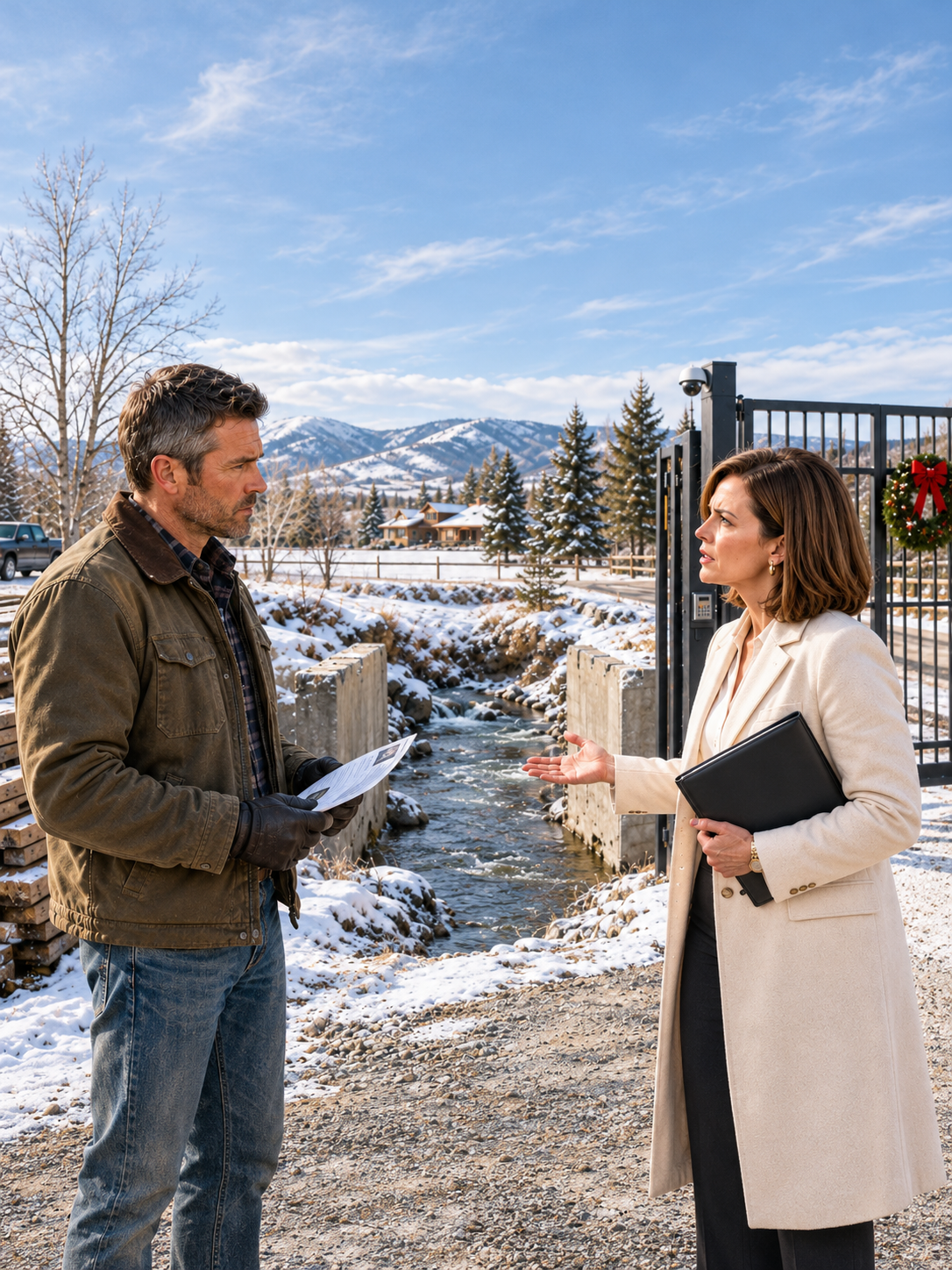
The HOA Locked a Montana Rancher Out of His Own Land, Then Woke Up Christmas Morning to Find His Bridge Gone
The woman who locked Wade Callahan out of his ranch called at 11:14 p.m. to tell him he could apply for permission to go home.
Then she read him the license plate of his pickup.
He looked up from his phone and saw the little red light on the camera above the gate.
“An application takes forty-eight hours,” Maribel Voss said. “I can make an exception tonight if you give me your word you’ll sign in the morning.”
Wade turned off his headlights. Thirty yards beyond the gate, somebody had left the porch light on at his house. He’d left it on himself that morning. The light came through the snow in a yellow blur, low enough on the hill that he could see it between the new bars.
“Sign what?”
“An acknowledgment that access across the bridge is administered by Silver Pines.”
The truck heater was still blowing. Wade held the phone away from his ear for a second so he could hear the creek. It was running hard under the bridge. There’d been a little thaw on the southern exposures two days ago. His father had said you could tell exactly what the weather was doing a mile upstream if you listened where the water came through the rock garden.
“How many codes did you hand out?” Wade asked.
“Only board members have a permanent code.”
“How many people did you give permission to drive home tonight?”
Maribel let the silence go on just long enough for him to understand she’d heard the question.
“Wade,” she said, “you can own the ranch. We decide who goes across that bridge.”
He took his phone out of his truck, stood beside the front fender, and looked down the row of steel bars. A man had cut the chain on his pasture fence and hauled it aside to set the first post. The chain lay just where it had fallen, red rust showing at the cut.
At the top of the gate the association’s pine tree seal was stamped into an aluminum sign. The big lettering underneath said SILVER PINES PROPERTY. Behind it lay the bridge his father had put up in the summer of 1996.
His father had marked the first steel beam with his own initials because he was afraid the man who owned the trailer would get it mixed up with a load going to a warehouse in Billings.
His father had marked the rail where a boy of fourteen was supposed to put his hands while the circular saw was running.
His father had marked the highest place the creek reached in a storm, and made the boy go back with a tape measure when he guessed.
His father had marked every check he wrote for the bridge with the words Callahan place, including the one he didn’t have the money to cover until he sold a bull that Friday.
His father had marked the north abutment with a crooked C while the concrete was still wet, and let Wade put his own hand beside it.
Maribel had paid for a sign.
“All right,” Wade said.
He was surprised to hear how easily it came out. In the small red light over the gate he caught his reflection in the window of the truck. He was smiling. The smile went away when a calf bawled up at the barn. The calf could hear his pickup. It always heard him first.
“Does that mean I can put you down for nine?” Maribel asked.
“It means I heard you.”
He ended the call. He photographed the gate, the cut chain, the setting on his dashboard clock, and the strip of gravel beyond the gate where lights from the road picked out the smooth new concrete. Then he got back in his truck and backed up all the way to the turn.
The back way took forty-eight minutes that night. You drove north past Elk Hollow, Montana, and picked up Forest Road 19 where the county plow turned around. The graded portion ended after the second cattle guard. After that you crawled four miles through federal timber, two more under a barbed-wire power line, and took a ranch lane behind the hill. In summer, Wade sometimes took the loop for the hell of it. In December he put chains in the bed before he left the paved road.
One mile from his gate he passed the empty pullout where his father used to let him practice backing a trailer. A green pickup had parked there after it snowed. He knew the tracks were from a pickup because the rear tires were narrower than the ruts he was in. He kept moving. At the ranch gate he got out and worked the latch with the heel of his glove. It was midnight by then. Ice had formed along the tops of the gate tubes in a thin ridge as straight as a chalk line.
At the barn, he found the calf and gave it half a bottle. Its name on the feed chart was 214. He lived alone and there was nobody to hear him call it Winnie. When her ears warmed up he set the bottle down and stopped for a while with the back of his hand against her neck.
Through the barn door, he could see snow collecting on the rail his father used to sit on while Wade carried feed.
He checked the winter feed inventory, called his hay supplier to confirm the date of the next delivery, and went up to the house. The house would hold when things went wrong elsewhere. His father used to say that about the old Ford. He had never needed to say it about the house while he was alive.
At nine the next morning, Wade walked into the Silver Pines clubhouse.
A tall silver Christmas tree stood in front of the window. Five white felt houses made a little village across the base. Each one had an electric candle in the front room. Maribel sat where she could see the door without turning her chair.
She wore a cream wool jacket. Her pen was out already.
“Glad we could do this in person,” she said.
Wade pulled out the chair and sat. She gave him a blue folder. Inside were nine pages about vehicle registration, visitor clearance, and approved delivery hours. Commercial vehicles would pay two hundred and fifty dollars per crossing. The board could waive a fee at its discretion. No wording allowed Wade to waive a fee on his own bridge.
He went back to the top page.
“You’ve got two different addresses here.”
Maribel bent forward just enough to see where his finger was.
“One is the formal mail address for association matters.”
“The other one is the ranch.” Wade turned the page so she could read the bottom line. “Why does it say that’s an association asset?”
“It’s within our area of responsibility.”
“How far does that area go?”
She folded her hands. Her left thumb moved twice across the right one.
“You’ve been part of this community for longer than most of the people who live here,” she said. “Your father agreed that members of this community ought to be able to reach their homes.”
“He agreed to plowing on the spur to our gate. You got a check from me for it in May.”
“You’re welcome to bring that up at the appropriate time.”
“I’m bringing it up now.”
Maribel slid the pen across the desk. For a second it went faster than she intended. Wade caught it before it rolled off.
“You can have an unrestricted code,” she said. “I can have it sent to your phone before you leave. Anyone who works for you regularly can be put in the system over the next few days. I think when you’ve had some experience with it, you’ll see it’s quite painless.”
“How does a vet get in at two in the morning?”
“Call the emergency number.”
“Who picks up?”
He set the pen beside the folder. “Give me the document that lets you decide.”
Something changed in her face. The mouth stayed pleasant. A small spot below her cheekbone went red.
“Some things are understood,” she said. “That road has been a part of this neighborhood a long time.”
“You paid for that gate out of the association account?”
“You’ve got the invoice?”
“Certainly.”
“Then we should each be able to show what we bought.”
Maribel gave him time to pick up the pen again. When he didn’t, she took it back.
“The gate is association property,” she said. “If you damage it, we will expect you to pay for the gate and what it costs us to enforce our rights.”
“I’d like a copy of what you’re asking me to sign.”
Her fingers tightened on the pen. Wade kept his hands on his knees while she went through the nine pages. She took the signature sheet off the bottom and set it face down on her desk.
“You can read the rest at home,” she said.
In the parking lot, a man in a county highway jacket had leaned a shovel against Wade’s truck. It looked like a polite way of making somebody wait. Wade knew the man by sight. Frank Oakley. He had built county roads for thirty-one years before he retired, and since then he’d come to every neighborhood weed pickup wearing the same jacket.
“Was that your vote?” Wade asked him.
Frank picked the shovel up and held it with the blade on the ground between his boots. “I voted last month to get an estimate for a gate at the subdivision entrance.”
“Any idea what they spent?”
“The estimate we got was eleven thousand. That gate you saw last night would cost at least twice that with the cameras.”
Frank looked toward the window behind Maribel’s desk.
“Two on the list,” he said. “One pointed down the entry lane and one meant to catch the rear plates when people drove through.”
Wade knew he could ask three more questions and get less information than he already had. He thanked Frank and drove around the north side of the ranch. By the time he got home, the thinnest silver line of sunlight lay across the top of the snow fence.
He parked on his own side of the creek and walked to the bridge.
A second camera had gone up at the north abutment. Its pole was clamped to the concrete. The ladder tracks from the installation ran straight across the deck to the gate. Two sets of boots had gone up the gravel to where he parked his truck and turned back. He knelt, took a picture, and walked in front of the camera to see its angle.
From there, somebody could watch the door of his house, the whole barn lane, and the place his truck sat at night. They’d mounted the camera while he was in the clubhouse.
Wade took a picture of the pole clamp. Then he went home and moved the feed chart away from the window.
For lunch he fried three eggs. He ate two before he could taste them. After that he called a lawyer named Elias Mercer. Elias had helped Wade take over the ranch after Thomas died. He remembered which cousin had held up the signature on the old stock well agreement and why Wade had given that cousin Christmas beef anyway.
“Put it in an email tonight,” Elias said. “Your objection. The time and date you first saw the gate. I want it very clear that you’re refusing to authorize it. I’ll send you language. Then get what you have about the bridge.”
Wade looked toward the hallway closet, where a little metal fireproof box sat behind his father’s rain boots.
“You know when I used to have to find anything for him,” he said, “I’d call you and ask where he put it.”
“He liked the bottom of a stack,” Elias said. “Better start there.”
The bridge permit was in a filing cabinet in the barn, stuck inside a folder for a grain bin that had never been built. The receipt from the steel yard was folded around an old calendar page. When Wade eased it open, he found the name of the man who had loaned them his flatbed, and a note in his father’s handwriting reminding himself to replace the left trailer tire.
In the middle of a plank invoice, under his father’s thumbprint in black ink, there was a three-line calculation about which rails he could bring home if he drove back with the trailer empty on Tuesday.
Wade made copies. He scanned the insurance schedule that described the bridge as a ranch improvement. He found years of tax receipts and dragged the cursor across the blank between the number of the ranch parcel and the little asterisk that linked it to the bridge.
The word Silver appeared only once, on the receipt for his annual contribution to the entrance road. He copied that, too.
At ten that night, an email from Bradley Pike, the association’s lawyer, told him in bold letters that he was prohibited from interfering with, altering, or removing the association’s gate. An account would be opened in his name for a hundred dollars a day in fines if he did so. The association reserved the right to suspend all access.
Wade called Elias and read the subject line.
“You cut anything?” Elias asked.
“I made two eggs and a third I didn’t need.”
“Did they specify the gate?”
“They specified it three times.”
“Send me all three.”
Wade sent the email. As he closed his laptop a new neighborhood alert came in. He still got the alerts because it was how he learned what days the snowplow would be around. A bright blue banner announced that the board had secured a valuable second entrance for Silver Pines.
The email loaded in pieces. First the banner, then a photograph. In the picture there was a Christmas bow tied to the new gate. On the far side of it Wade could see the little yellow boards his father had nailed on the railing so a hay driver coming down the grade would know where the bridge began.
At the bottom of the announcement, between a note about the clubhouse holiday hours and a reminder to bring cookies, there was a link to a list of donors.
Wade clicked it.
Three families had given five hundred dollars each. Somebody he didn’t recognize had given seven thousand. Beside the amount, the report identified the donor as Juniper Basin Land Partners.
He wrote the name on the back of the letter threatening him over the gate.
Then he downloaded the original photograph. In the lower right corner, under the bow, somebody had been careful to crop out most of a surveyor’s stake. They’d left just enough of it to show a black number and the end of an arrow pointing toward his house.
The next morning, a man in a white ski jacket waited for Wade beside the roadside mailboxes. Gary Pruitt had bought the stone-front house nearest the bridge. He kept a heated birdbath on his deck through the winter. Six evenings a week, when Wade came home, Gary’s birdbath was the only thing steaming that close to the road.
“Can I talk to you like a neighbor?” Gary asked.
Wade put his key into his box. “Sure.”
“I think a lot of people would feel better if you signed an agreement. Some of us have kids. My daughter waits for the school bus where those trucks come down the hill.”
“Would you rather she waited by your driveway? The hay driver can hold up on delivery days until the bus leaves. Let me know what time.”
Gary hadn’t expected an actual question. He looked past Wade at the road.
“That’s one truck,” he said. “I’m talking about a system. Everybody gets used to doing it the same way.”
“How often does she wait by the road after dark?”
“She doesn’t.”
“Then how come they put the second camera where it can see my kitchen?”
Gary’s nose had gone pink in the wind. He put both hands in his jacket pockets.
“She told me that camera was to see traffic from the other direction,” he said.
Wade took out his phone and showed him the picture from the north abutment. Gary leaned in just far enough to make out the house, then drew back when he understood what he was looking at.
“My daughter didn’t say anything about a road.” Behind him stood a woman Wade knew from the school bus stop, holding a red envelope. She looked at Gary rather than Wade. “You told me this was to keep people out at night.”
Gary looked at the mailbox in front of him. The metal slot had filled up with snow since he’d been talking.
Wade took his mail and went around them to his truck.
Three years earlier, when rain washed out part of the county road, Gary’s wife had crossed Wade’s bridge on her way to meet her sister after surgery. Wade had run a tractor bucket down both approaches so she wouldn’t get stuck. A week later there’d been a box of doughnuts on his step. It might have come from anybody who used the bridge that week. He had thought it was probably her.
On the drive to Bozeman he put his phone face down so he wouldn’t see the alerts.
Elias’s office was above a saddle shop on Main Street. The window in the stairwell gave you a view of the delivery entrance next door, and the first time Wade had been there he’d watched a bakery truck pull in with his father’s funeral papers in his lap. This time the bakery had sent a man out with a shovel. He worked along the edge of the walk where packed snow made a low step he could shear off in long pieces.
Elias cleared his desk, brought over a second chair for the boxes, and started reading.
They looked at the deeds, the certified plat, two surveys, and the old bridge drawings. One county sheet had been copied badly enough that the creek disappeared in gray. Elias set that aside and went through the copies Wade had picked up himself. Wade spent forty minutes on a floor map with his finger on one black line. When Elias said something from across the desk he kept his finger there while he looked up.
“Your dad had me send two copies of the same letter once,” Elias said. “There was a fence dispute with a fellow on the north end. Took me an hour to figure out what he wanted out of it.”
“What’d he want?”
“One for the man and one for the man’s wife. Said she was the one who had to walk the line when the calves got out.”
Elias pulled a thin attachment from the association’s founding declaration. “Can you read this sideways?”
Wade stood and came around the desk.
Exhibit D put a line where the Silver Pines common area ended. Thomas had agreed to help pay for plowing on the short paved section because he and the residents both needed it. In the same attachment the association agreed it had no authority to regulate privately owned improvements beyond the common area boundary.
Elias held the plat by its corners. He put the declaration down over it and drew a finger along the edge.
“Let’s find out where they poured concrete,” he said.
A surveyor named Marcy Reed met Wade at the gate after lunch. She found the first old pin under seven inches of snow and a little wedge of ice. She left the whole top clear and put an orange marker beside it. On the other side of the road a man came out of a house in house shoes and held his phone up. Wade waved, then held the end of the measuring tape where Marcy showed him.
The gate stood forty feet inside the ranch line.
When Marcy looked for the companion pin, she found a newer stake. Its little white strip rattled against the wood. The top had been painted blue. On one edge there was a black 6 and a turn arrow.
“Did you set that?” Wade asked.
“No.” She pulled a glove off with her teeth and took out her phone to photograph it. “This one’s aimed through your pasture.”
“Through the bridge?”
Marcy looked downhill, then turned the other way and looked at the row of bare willows on the far bank. “Bridge is where it crosses. Somebody set an offset from the stake underneath here.”
She brushed the snow away with the side of her glove. A sliver of fresh orange flagging came into view beside it. Wade thought of the green pickup’s tire tracks behind his house. One surprise at a time was what his father used to say when he got something stuck under the snowplow. Usually it meant stop driving until you knew what the first noise had been.
He sent Elias a picture of both stakes.
An hour later Elias called. A planning clerk had forwarded him the exhibits from a work session on expansion at Silver Pines. He’d asked her to look for Juniper Basin Land Partners. The name was on almost everything in the folder.
Wade parked outside a feed store and opened the file on his phone. It showed the existing houses in gray and future houses in pale yellow. Across the creek, over the exact place where his father had set the bridge, a red route curved up past the barn, skimmed his hay pasture, and ran behind the house to a state highway spur.
There was a black 6 at the turn.
The plat was dated three years earlier. In a later appendix was a line saying the landowner had declined to discuss a purchase. Wade remembered a realtor calling him while he stood in the checkout line with three winter coats he was trying to buy for the church coat rack. She’d asked whether he would sell an easement to a client. She hadn’t said which client. He’d said no, put the phone away, and asked the cashier for a bigger bag.
He enlarged the plan. A drawing in the upper corner showed a stone entrance marker with a pine tree cut into it. The proposed highway entrance would save a driver twenty minutes if the lights in Elk Hollow all turned red.
Elias waited for Wade to speak.
“Was this ever approved?”
“The plan in the folder is preliminary. The clerk flagged the access letter because it wasn’t signed by you. There was another update listed in the index, and it wasn’t attached to the copy she sent. She’s looking for it.”
“They knew who owned it three years ago.”
“Keep that thought. I want to see how they described the road after you said no.”
Wade looked across the lot. There was a truck driver standing behind his trailer, comparing numbers on a bale tag with numbers on an invoice. The driver drew a pencil out of his hat and went back to the second bale.
“They wrote me that I can’t touch the gate,” Wade said.
“I read that.”
“Is there anything in what you’ve got that says I have to leave the bridge open?”
Elias was quiet for a second.
“Do you mean close it or take it down?”
“Take it down.”
A bus carrying skiers pulled through the gas pumps. Wade watched it in his mirror until the windows were clear.
“I’ve got a quote to lift the steel from October,” he said. “Nora Whitaker looked at the decking then. She told me we’d want to replace more of it than I thought. I was planning to get through calving first.”
“How much heavy traffic do you need to get to the house between now and March?”
“Hay comes once more. I can buy ahead. The school bus never comes past the other end of their road. In a storm the forest lane could be trouble. I’ll talk to the people who have to get to me. And to Nora.”
“All right. Send me that quote. I’ll check the title one more time and call the county before you commit to anything.”
Wade looked at the red curve again. The road went past the whole length of his barn. In the drawing there was no barn.
At four thirty he called Nora. She met him at the ranch the next morning, Christmas Eve, in a hard hat with a county fair sticker half peeled off the back. She walked the deck from the ranch side. At the approach gate she stopped, turned, and took a picture without getting close enough for the snow on the bars to fall on her.
The last quarter of the deck was darker than it had been when she first saw it. She took the tip of a tool and pressed it against the underside of a plank where water had found a knot. The tool went in deeply enough that her glove touched the wood.
“I had trouble getting it that far in October,” she said.
She let Wade try it on the board beside it. He felt resistance for about half an inch, and then the tool slid through soft brown fibers.
“How far can your man get his crane?” she asked.
He pointed to the level place above the north bank where his father had once driven the cement truck. The grass died there earlier in the summer and came back later in the spring. A year after they buried Thomas, Wade had looked down from the kitchen window and seen that lighter patch of ground for the first time.
Nora got the old measurements from her clipboard. She set a schedule for the rig and marked where all the lifting would take place. The rig could stay on the ranch bank. The crew would take up the bad planks from the sound part of the deck, then finish each lift from solid ground. The two abutments would stay put. She told Wade the demolition contractor would need one additional person devoted to the opposite end of the site. Wade said he’d pay for one.
By noon Elias had confirmation of the county’s sign-off for the maintenance work, checks on the title and stream requirements for the plan, and written notice ready. Wade signed a copy at his own kitchen table. It put the closure effective immediately and the lifting work at midnight, the first available crane slot Hank Brewer had been able to give them. Hank had a bigger job up by Big Timber on the twenty-sixth, and the equipment was on its way through anyway. He had quoted a price that accounted for what he would have to pay four men on Christmas.
“Some of my guys have morning things with their kids,” Hank told him over the phone. “If it carries past six, we suspend until I can get everybody back.”
“Put that in the quote,” Wade said. “I’ll pay for both trips if it happens.”
He called the sheriff’s dispatch desk and gave them the location of both ends of the drive and the GPS coordinates for the north gate. He gave the fire chief the number for his phone and one for the man out by the pasture. The chief asked for an updated map and told Wade where he wanted the spare gate key put for the duration. Wade drove out and put it there himself. When he came back he took a photo of the turn from the perspective of a driver arriving after dark, and added the eastbound view to the map.
The hay supplier had one trailer left in the yard. Wade paid to have it brought immediately and spent two hours with his gloves on unloading it before a storm blew into the foothills. He let the driver stay in the kitchen until the plow came up the forest road as far as it was scheduled to go that day. After that he followed him to the plowed county pavement in his pickup. The driver left a packet of chocolate-covered cherries on the dashboard before he drove away.
Wade kept it there until the windshield began to ice up.
At the clubhouse, Elias delivered the closure notice in person. The association’s assistant timestamped it and put a copy in the outgoing rack for Maribel. Elias asked her to watch him send the duplicate to Pike from his phone. She watched him hit send and asked if any new plans affected Christmas Eve cookies.
“Same door as usual,” Elias said. “Nothing about cookies changes.”
Maribel found him at the table with the second copy in his hand.
She read it to the end. “He needs that bridge,” she said.
“I suggest you let the residents know it will be closed. Here’s the survey with the stop points.”
She looked down at the proposed warning lights, then back up.
“He has cattle in there all winter.”
“He knows.”
She gave the paper back. “I’m sure your client knows how much a crane costs. We have a meeting at six, Mr. Mercer. If he wants to join the community tonight, he is welcome to make his case.”
Elias put the paper neatly under the edge of an empty plate someone had brought down for cookies. “I’ll tell him you received it.”
Forty people went to the meeting that evening. Several had driven over in the same cars they were taking to church afterward. Gary stood in the back near a woman with a knitted sweater over her uniform from the hospital. He told her the road closure had been brought up by Wade’s lawyer, and that they were trying to make a point.
“What time does he start?” she asked.
“He isn’t really going to start.”
Up by the tree, Maribel showed the new lighted gate on the projector. In the picture with the bow and the new sign, she had drawn a yellow line over the approach where she said the association would eventually install an emergency entrance button for first responders. She described the closed bridge notice as a regrettable misunderstanding between neighbors.
Frank Oakley had come in with a rolled-up copy of Marcy’s survey. He unrolled it on the table in front of the treasurer, Dale Hutchins. Dale watched him point to the stake and to the gate. Then Dale went to the podium and asked which line on the estimate the camera had come out of.
Maribel said she would be happy to get back to him after the holiday.
Back at the ranch, Wade brought a tray of sandwiches out to the warm cab of Hank Brewer’s truck. Hank had his clipboard against the steering wheel. On it were four names, the weather forecast, Nora’s wind limits, and the time the crane had come through the back gate. One of the men had put a tree ornament on the hook that held the spare keys. It was made with construction paper and a photograph of a child with sweater sleeves twice as long as her arms.
“Do you mind if I leave one light on till we get back?” the man asked Wade.
“You can leave all of them on.”
At eleven fifty-nine he stood out by the north abutment with a flashlight in his pocket. The gate at the other end was close enough to look through, across sixty feet of old timber. He thought he could see the bow until he realized the shape he was looking at was the radio on the gatepost, tucked underneath the camera in a weatherproof box.
The little red light held steady.
At midnight Hank leaned out of the cab and turned on the work lights. Snow jumped into view in front of the boom.
The first rail came off in one piece. A man named Gus and another named Tim carried it up the bank and set it on blocks inside the barn. Wade recognized it by a little notch halfway down where his father had pulled the head off the wrong nail and left the rest in the wood.
Gus came back for the next section. He found Wade touching the notch with his finger. He waited until Wade had taken his hand away before he asked where the two pieces ought to go.
“Beside each other,” Wade said. “The ends match up.”
They decided to number the rails. The older wood had gone light on top and dark where it lay over the stringers. Wade used pieces of blue tape because the marker wouldn’t write directly on the frost.
On the south bank, the man who was keeping people away shook snow off his hat and walked up and down in front of the bridge closure sign. The gate was still locked. Nobody came from the clubhouse. Once, headlights swept the bend and held there until a set of tires finished turning and went back the way they had come.
Nora watched from below the crane while the men moved the planks. Every so often she called a pause so she could look at the angle from somewhere else. The creek carried the light in narrow orange stripes until the snow got heavy, and then it carried no light at all.
Wade found his father’s initials on a beam at ten past two. He had looked for them on the drawing for years, where they were faint and out of proportion to the things around them. Now he looked down at them from his side of the water. The T was shallow. His father had hit the C twice.
Over the radio, Nora and Hank agreed they had enough time before the wind came up. A chain snugged against the steel. The beam lifted evenly. There was a sound Wade remembered from the summer they built it. The beam left the abutment with the same deep note it had made when it settled down the first time.
Hank held it over the water until everybody was in the right place. Then he swung it up the bank.
The second lift took longer. Somebody lost the light from the clasp of his coat and had to go back and borrow one. As soon as the last piece came clear, they set up another line of barricades at the edge of the north footing. On the subdivision side, the spotter signed off with a picture of the warning lights, his boots, and the untouched gate. The keypad was still glowing green.
At four seventeen, the creek went through an empty space sixty feet wide. The two concrete abutments, freshly white, faced each other across the current.
Wade put a hand lightly on the barricade. For the first time that night, he was close enough to hear the rocks under the water. There had never been a morning at the ranch when he couldn’t have picked up his keys and driven the way his father had driven home.
He stood there a little longer.
Then he went to make coffee for the men.
At seven ten, the first person to see the gap from Silver Pines was Gary Pruitt’s daughter. Liv had been given a pair of binoculars. She tried them from her bedroom before she finished taking the tape off one eyepiece.
“Dad,” she called from the window. “Did the bridge fall?”
Gary came in with a mug of coffee. He looked over her shoulder. From the house, if there had been a bridge, they would have seen an unbroken line of snow. Instead he could see a bare rectangle of concrete and a white sign nailed to a ranch post.
BRIDGE REMOVED FOR MAINTENANCE. PRIVATE PROPERTY.
He had a moment in which he honestly believed he could go down to the gate, open it, and see the bridge from the right angle. He pulled a pair of boots on under his pajamas and went to look.
Two more people were already there. One asked him where the boards had gone. He answered that he didn’t know. Then he did something he regretted by the time he got home. He punched his board-issued guest code into the keypad.
The gate slid open. On the other side there was the sign, a weighted barricade, and what looked like a permanent end to the road.
Nobody asked him to put it back.
At eight forty, the president’s white SUV pulled around the bottom of the hill. Maribel walked through the people who had come out to look. She wore one leather glove. She’d given up looking for the other by the time she got to the clubhouse parking lot.
Gary raised a hand to her. Maribel and the dozen people standing around the gate looked at the water for a while. The pointed ends of two decking boards, carried up the ranch bank during the night and left waiting for the trailer, showed through the snow.
“Did you read the closure notice?” Gary asked.
“I was handed a notice,” she said.
“I told my daughter the bridge had fallen.”
Maribel turned. “What do you want me to do about that?”
He looked at her, started to say something, thought better of it, and kept his mug in both hands.
Dale Hutchins, the treasurer, pulled in behind her. He had the key to the clubhouse and a plate from his daughter with four sticky buns wrapped on it. He asked Maribel to follow him. He’d agreed before they took the holiday break to receive any further papers about the gate on behalf of the board.
At nine he met Elias at the clubhouse door.
Elias carried a thick brown envelope. His wife had written oven off in pen on the back of his hand so he wouldn’t stop at the grocery store on the way home. She said it was the only reason she could imagine he’d forget to return before breakfast.
Dale took the envelope to the long oak table in the boardroom. By then Frank Oakley had come down in a coat and tie. He was on his way to his granddaughter’s house. He pulled a chair out and left his coat on.
Dale cut the envelope open with the flat end of his clubhouse key.
The demand was dated Christmas Day. It gave the board ten days to arrange the removal of the gate and both cameras and repair the damaged fence and driveway. It withdrew any informal permission its representatives might have believed they had to enter the ranch. Any arrangement to retrieve the equipment would have to be scheduled in writing. Another sheet demanded that the board preserve footage and account records from both cameras.
Under the demand was the certified survey, the bridge permit, Thomas’s steel invoices, and a copy of Exhibit D. The last attachment showed the blue expansion plan as it had been filed when the developer first approached the county. Wade’s ranch and the future lots were on separate pages. Elias had copied the page where the developer acknowledged it didn’t have permission for the route.
Dale looked at the paper for a while. Then he took a binder off the window ledge, where people put down their hats. He found the estimate the board had signed off on in November and opened it for Frank.
“Are you seeing a gap between what we authorized and what’s there?” he asked.
“Forty feet, for a start,” Frank said.
They left the papers in front of Maribel’s chair.
On the day after Christmas, a courier came to Wade’s back gate. He hadn’t brought boots. Wade went out to his truck in the falling snow so the man could lower the window far enough to hand him the envelope.
Inside was the board president’s demand for immediate restoration. Wade was directed to return the bridge to its original condition within thirty days, under association supervision. He was notified that a fine had already started to accrue. At the bottom, in a paragraph below the space for the signature, he was told that ordinary members had been deprived of the safe use of critical community infrastructure.
Wade took it inside. He opened it flat beside the photo of his father’s initials.
Then he called the courier company and asked them to put a note on his address about making the final turn downhill when the snow was deep.
Elias’s answer to the president fit on half a page. It asked her to identify the document, page and paragraph granting the board the right to compel Wade to build a bridge. He copied Pike and the entire board.
For three days, no answer came.
There was, however, a message at the diner in Elk Hollow in front of the peppermint pie. It was a printout of Maribel’s notice. The owner took it down after a customer read the fine aloud and asked when their bridge had ever been a way to get into Silver Pines.
The woman who had been wearing her hospital uniform at the Christmas Eve meeting called the fire chief. He told her the new gate had blocked access to one ranch. The neighborhood fire plan used the main paved entrance. He had never told anybody to put a gate by the creek. The woman asked if he would say it again in an email so she could show her husband.
At the mailboxes, Wade ran into Gary, who was fixing the little drift that formed between the row of boxes and a trash barrel. They stood opposite each other a moment. Then Gary leaned down and pulled his shovel blade out of the snow.
“She’s got another story up,” he said.
Wade waited.
“She says there’d be an ambulance route over there if you put it back. I called the chief, too.” Gary tapped a little snow off the blade. “I should’ve started there. Liv thought I knew.”
“What’d you tell her?”
“That I was wrong.”
Wade looked down the line toward the gate. “My hay truck can still wait for her bus when we put it back.”
Gary nodded once, hard. Before he went home he finished the path all the way down to Wade’s box. He opened the box and packed the snow away from the little hinge. Then he shut it gently.
Elias put a letter in the mail to all 112 Silver Pines households. He attached copies of the common-area plan and the board’s holiday announcement about the gate, alongside the certificate showing when the maintenance notice was hand-delivered. On the last page there was a picture of Wade’s house from the angle of the second camera. Wade had let him send it with the front windows blacked out.
The state of the neighborhood changed with small, distinct sounds. A red binder snapped shut in the clubhouse when Dale found the minutes about the unsuccessful offer to purchase the bridge. A printer ran after dinner in Frank Oakley’s basement while his wife slept upstairs. At four homes near the entrance, people set their letters on counters while somebody else was standing there. The people at the counters had to read the letters upside down.
On December thirtieth, Dale asked Maribel a question in the clubhouse lobby. A dozen people heard him.
“Why did our minutes say the bridge owner declined to sell three years ago?”
Maribel said, “You understand what a set of minutes records. There can be a motion to explore something that never gets done.”
“I do understand.” Dale set the old minutes down. “What I’m asking is why we’d have to buy something you now say we already have.”
A family had come in with leftover cookies from their second Christmas. One of their children put both gloved hands against the glass cabinet where the association kept its donated trophies. Through the end of his hat you could see the knobs of both ears.
Maribel told the family she would be with them in a minute. When she looked back, Dale was still waiting.
She went into her office, closed the door, and left his copy of the minutes on the lobby table.
The next afternoon Ruth Delaney, the retired association secretary, drove out to the back gate.
Wade found her sitting with her coat unbuttoned in a cold car. Her glasses had gone cloudy because she’d been holding a paper cup of tea too close to her face. She rolled down her window a little and pointed at his thermos.
“Any of that left?”
Wade poured her a cup. She drank it down to where she could hold it without spilling, then opened the passenger door for him.
She had a printed email on her lap. Four years before, Maribel had sent it to the board and copied a man at Juniper Basin whose signature block said he worked in acquisition. The email said the developer’s first step should be a quiet offer to purchase. If Wade didn’t sell, the board ought to control the crossing with a security gate and give him a code. Ruth had put a fingernail below the last sentence.
Once he gets used to asking, they’ll have a route we can show a lender.
“I used to file the emails when the meeting minutes were done,” Ruth said. “That way I could remember how things had been decided if anybody asked after the fact.”
“Did she tell you to leave it out?”
“It wasn’t voted on. I could have sent the whole thing to the board packet anyway. I folded it in half instead.”
Wade took the cup from her and set it in the empty holder beside his knee.
“It’s here now,” he said.
“There’s something else on the printout.” Ruth moved her hand.
Below the signature, in a string of quoted correspondence at the bottom, there was a note from the acquisition man. The text had started to come out gray where Ruth’s printer ran low. Wade tilted the paper until he could see the end of the sentence.
The first time he read it, he thought the man had made a mistake. He read it again and thought of the bow on the gate, the new camera on the north side, and the little strip of white flagging marked with a 6.
The developer had asked Maribel to have the gate installed before its lender checked the property again. They wanted outside photographs of a controlled access lane. And a photograph dated before any new discussion with the owner.
Wade looked up at Ruth. “Do you still have this in your email?”
“In a folder,” she said. “There are two copies of everything I put in a folder.”
They drove the rest of the way together. At his kitchen table he watched her type her password with both hands. When the message appeared she let him get a chair close enough to read it. Then she clicked on the forwarded portion and showed him which date to look at first.
The date Ruth pointed out was the nineteenth of December. In what she’d printed, the old chain had been forwarded again by the acquisitions man, who had marked the parts still in effect and attached a revised schedule. There was a December deadline for Juniper to show its lender a second route. In return for a preliminary access agreement, the developer was supposed to cover part of the cost of Silver Pines’s failing storm drains. The association would have got money it badly needed. Juniper would have got financing for the lots. Wade would have got a keypad.
Ruth slid a page from her bag. It was an estimate for repairs to the drains. Every homeowner had been sent a portion of it eight months earlier, with a note telling them how much the association might have to assess against each house. Ruth had put a small X where she had done the math for her lot.
“It came to seventeen thousand for me,” she said. “I got a second opinion on my driveway because I thought at first that was the part I had to pay.”
Through the window Wade could see a new calf wandering up to the barn door. Its mother pushed it back with one short movement of her head.
“Was it the board who sent Juniper a photograph?”
Ruth opened the attachment. It had space for two pictures. In the first, the ranch gate was decorated with the bow. In the second, taken from beyond the north abutment, Wade could see his house in the background. The note above the photographs read Alternate entrance in present use, access controlled by Silver Pines, owner coordination complete.
“Get Elias on the phone,” Wade said.
Ruth moved her chair closer to him until she could see the dates without her glasses.
“I’ll tell him where it came from,” she said. “You make sure I say it slow.”
Elias took the call at his own kitchen table. He listened to Ruth’s account and helped her preserve the original email. Then he called Pike and asked if his clients had actually sent the attachment to the developer’s lender. Pike called back an hour later and said he was learning about the financing for the first time. He asked whether Wade was prepared to have a conversation about restitution.
Wade looked down at the photograph of his house.
“I’ll have one with the board,” he said. “I’d like them to know what they’re paying for first.”
On January eighth more cars came to the Silver Pines clubhouse than had come out to look at the empty crossing on Christmas. People parked along the curb facing the wrong way because they couldn’t turn around in the lot. Gary walked from his house. He held the side door open for Ruth when she took both hands off her walker to adjust her gloves.
A petition signed by more than half the homeowners had forced the meeting. Frank had booked the projector and carried a box of extension cords down from his attic. He’d run tape across the floor so nobody tripped in the aisle.
Maribel opened the meeting with a silver binder in front of her. She spoke about the responsibilities of a board that had to get people through an expensive year. There was a leaking culvert. There was water under a retaining wall. The numbers were real, and Wade watched two people he’d never seen before lean forward in their seats when she read them. One had moved in a month ago. Someone sitting next to her touched the sleeve of her coat as if to say there would be time to talk about it later.
Elias gave Frank the floor plan when it was his turn. Then Ruth gave him the email herself. She had made forty copies. She said that if people shared, everybody could read it while Wade spoke.
Wade put his father’s invoice down on the table beside the board’s gate estimate. He held both sheets there for a second.
“The steel on that bridge was bought by my dad,” he said. “He put his name on it so he’d get the right pieces off a truck. His name is on the permit and mine’s on the taxes. My house is the place you see if you look through that second camera. I want that camera down.”
From the third row a man asked how many days the gates and fines had been authorized for.
“None,” Dale said. He’d put the binder on the seat next to him because there was no space for it at the table. “I have a written vote for a quote. I have an invoice to an outside company. And I have a series of notices sent under our seal I was never given the opportunity to vote on.”
The man wanted to know where Juniper had paid the money. Dale had checked. The seven thousand dollars listed as a donation had gone directly from a Juniper account to the installer, to cover an expedited job. The association’s checking account had paid the balance.
A woman near the front raised her hand.
“Were we supposed to borrow against the rancher’s bridge?” she asked.
“Juniper was doing the borrowing,” Maribel said.
The woman left her hand up. “Were they supposed to tell their bank you had permission?”
Maribel looked down at her binder. For the first time since Wade had met her, she took her watch off. She placed it across a piece of paper to keep the paper flat.
“I believed we would be able to come to an agreement,” she said.
Wade put the two sheets back in his folder.
“You came to my house while you knew I was in your office,” he said. “What did you need to agree on that for?”
There was a rustle at the back of the room when Gary shifted from one foot to the other. Maribel’s eyes went to the window. The little Christmas village had been packed away. The lights from the parked cars moved across the bare tabletop and out of the room.
She said the camera placement had been undertaken by the contractor.
Frank took an open envelope out of the box by his feet. He read the contractor’s work order aloud. There were separate instructions for the second camera. Somebody had drawn a rectangle around the house with two lines slanting out from the lens. He passed the sheet to Maribel. She looked directly at it for a long time.
There were eighty-one votes to take control of the dispute away from her. Nine people voted against. Wade waited on the other side of the room from the door until the count was complete. He wanted Ruth to be able to get out without catching somebody’s coat on her walker. When he caught up to her, Gary had already moved a chair out of her way.
There was a moment on the walk to the truck when Ruth went back to check whether she’d left a copy on Maribel’s desk.
“Let her have it,” Wade said.
Ruth paused, then put her other hand back on the walker.
The gate contractor came in on a Tuesday. Two of the men were the same ones who had set the posts. One put a tarp down underneath the keypad before he opened it, so he wouldn’t lose the screws in the snow. Wade had approved their route in writing. When they took the north-side camera off, he stood at the ranch house window and watched them carry it all the way down the hill.
By the end of January, the association had withdrawn the fines, circulated a correction to every household, and restored the driveway and fence. The settlement covered most of Wade’s legal costs and went on record with a statement that Silver Pines had no ownership or access rights over the bridge. Pike sent Elias a copy with the recording stamp circled. He’d penciled a question in the margin about where to refund one small fee. Wade’s yearly road payment had been credited to an account created to collect bridge fines.
Wade asked him to pay it back by check and write road plowing in the memo.
Maribel resigned as president. Before February was over she drove to Wade’s back gate and waited in her white SUV, parked just far enough away for him to be able to open it. She had a letter with no seal on it. He took it and offered to let her warm up in the truck. She said she could give him the minute he needed to read it.
She wrote that she and her mother had once had to leave a place because of an assessment they couldn’t afford. That she had thought she could keep it from happening to somebody else by getting the new development through. That she had been offered a consulting fee once the permits cleared and had told herself she’d earned it. She had written all three things on the same page. Halfway through the third, her letters began to lean.
At the bottom was one short sentence.
I’m sorry I used your father’s bridge that way.
Wade folded the letter along the crease she had made.
“Did you keep any of the camera footage?” he asked.
“I turned over the association account. Juniper had an installer login. They wanted it in their name at first. I made them put the HOA on the bill.”
“How long did they keep access?”
“They were supposed to lose it when the equipment came down.”
Wade watched her eyes as she said supposed.
“Will you write down the name of the person who had it?” he asked.
She took his pen and used the hood of the truck to write it. The paper slid around under her palm. He held one corner for her until she finished.
Spring came late enough that Wade had stopped looking for it when it arrived. The replacement bridge used his father’s abutments and the sound sections of his old railings. Nora signed off on the work in September. Wade and Hank made coffee at the tailgate before the first crossing and drank it there, looking down at the new deck. The stock trailer went first. Wade swung out wide to stay off the grass. From the far end, he could see how slight a turn it took for somebody to make the straight line of the bridge line up exactly with the driveway.
Silver Pines found a piece of its own common land for a second entrance. Frank called Wade to ask permission for two surveyors to cross the far corner of the ranch to pin a tie-in. He gave him their names before Wade had to ask. Elias drew up a single page. On the fourth day one of the surveyors came to the house to return a borrowed wrench. He left it on the woodpile in exactly the place Wade showed him.
They were good neighbors that summer. Gary changed Liv’s bus stop to the top of his driveway and got a light installed beside it. Wade went up to his house once to fix a mower that could have been left till the next day. If he came back down after dark, the light by the Pruitts’ driveway made it easier to know where the bend began.
One year after the bridge came down, Wade walked out to the center of the new deck on Christmas morning. The weather was clear, with a little dry snow sitting on the old timber rails. He saw the skid mark in the wood from the nail his father had pulled. In a year of looking, he’d never been able to find it on a day when he had somebody to show.
Elias was due up with a tin of cookies. Wade heard a car at the south end of the road and expected to see Elias’s station wagon.
A white SUV stopped at the line. Maribel stepped out. For a while she stood beside the survey pin with her scarf pulled up to her eyes. Then she lifted a hand to Wade. He raised his cup.
“Looks beautiful from here,” she called.
“Thank you.”
She stood there until Wade saw her look up the hill behind him. She reached into her coat for her phone.
“Did you finally get them out to close those test holes?” she called.
Wade tasted coffee in the back of his throat. He lowered the cup.
“Which test holes?”
Maribel looked down at her screen. “Behind the barn. Juniper’s survey crew wanted a place to pull off Forest Road 19 last Christmas. I thought all this time that was because you wanted them entering from the other end.”
Wade left the cup on the railing.
Across the water Maribel went on looking through her phone. She found something and turned it his way before she realized how far apart they were.
“The little green truck,” she said. “I have the plate.”
Wade had got halfway to the ranch bank when his phone rang. Elias’s name came up. He answered it without looking away from the road by the barn.
“Where are you?” Elias asked.
“Bridge. You coming in from the north?”
“I was. I turned back to the county road. There’s drilling equipment taking up the whole lane past your cattle guard.” He stopped a second. Wade heard another man speaking beside him. “They showed me a packet that says you granted Juniper permission to take water from a test well under the lower pasture. It has your signature. And it appoints them to use the same well to supply the new subdivision if the test passes.”
“I didn’t sign anything for Juniper.”
“I know. I need you to see what they used. I’m sending it now.”
A photograph came through. Wade opened it with the tip of one thumb. The access sheet bore the same signature he’d written to give two named surveyors four days on the far corner of the ranch. He could tell by the stray tick of ink under his last name. He had made that tick deliberately, agreeing with Elias that it would be on only the copy he left with the survey crew so if anything turned up elsewhere, they’d know where it had come from.
Here it was under a paragraph giving strangers access to every pasture, shed and well on the ranch.
Behind the permission sheet Elias had photographed a well map. It showed the state highway, the Silver Pines drainage ditch, and the locations of twelve homes and ranch houses that relied on wells downstream. A thick black line ran beneath all twelve. A proposed draw limit was printed beside it, with the numbers changed by hand.
“Tell them to stop,” Wade said, already walking.
“I did. The crew foreman has stopped the rig at the gate. Wade, he says he’s there to service a pump, and the men who put it in came up over the old bridge.”
“That bridge hasn’t been there for a year.”
“He gave me their work dates. December twenty-second through the twenty-fourth. Last year.”
Wade got to the foot of the barn lane. Past the stock tank where Winnie drank, a man was kneeling beside a patch of snow scraped down to gravel. There was a coil of heavy black hose at his feet. The man rose when he saw Wade, collected a spare key from the top of a post, and opened the door to the pump house like he’d done it before.
On Wade’s phone, another picture finished loading. This one was a page of the drilling crew’s work log. It gave the hour they’d been told to come through. It also gave the hours Wade had left his house and come back, and the exact minute he’d moved the feed chart away from the kitchen window.
At the bottom of the page were two photographs. The first showed a drill next to the pump house. In the second, taken an hour later, Wade was standing by the north abutment, staring straight into the camera he’d just found.
Under the photographs were five words.
Second well. Owner still unaware.
Then the pump started.
✓ Lynn R. Adams
The HOA Locked a Montana Rancher Out of His Own Land, Then Woke Up Christmas Morning to Find His Bridge Gone The woman who locked Wade Callahan out of his ranch called at 11:14 p.m. to tell him he co…