The HOA Dumped Landscaping Waste Into My Creek—Then One Storm Put Their Million-Dollar Golf Course Underwater
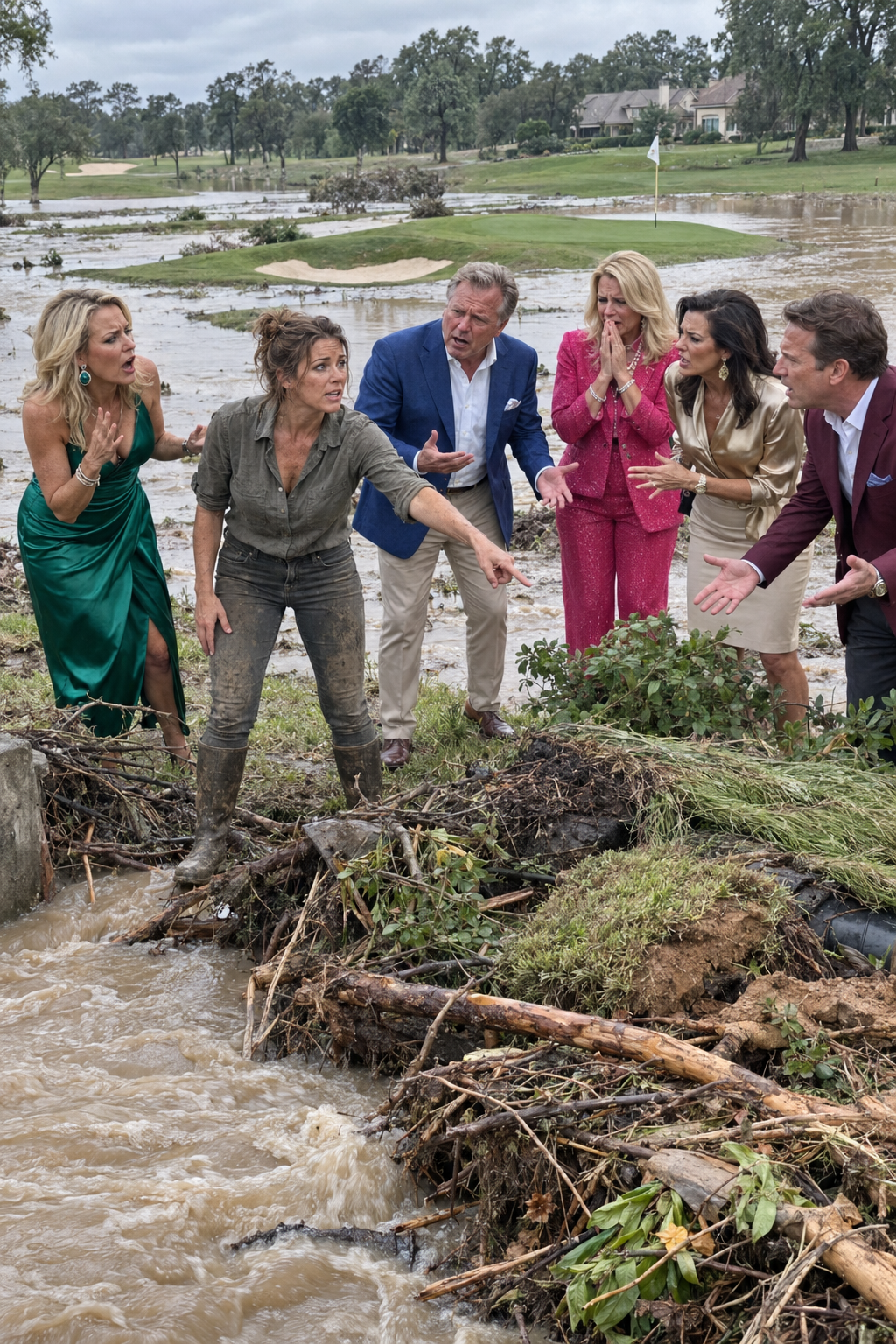
The HOA Dumped Landscaping Waste Into My Creek—Then One Storm Put Their Million-Dollar Golf Course Underwater
The first thing I saw floating across the ninth fairway was a white golf cart.
The second thing was the wooden sign that used to stand beside my creek.
PRIVATE PROPERTY.
NO DUMPING.
By noon, both were drifting through four feet of muddy brown water while the president of Cedar Ridge Estates stood on the clubhouse balcony screaming my name like I had summoned the storm myself.
Three weeks earlier, that same woman had smiled across my fence and told me the creek behind my house was “basically a drainage ditch.”
Then her HOA filled half of it with tree limbs, sod, mulch, broken retaining blocks, and enough landscaping waste to bury a pickup truck.
They did it because moving the debris legally would have cost money.
They did it because the creek crossed my property.
And they did it because they were certain I was too quiet to fight them.
They were right about one thing.
I was quiet.
My name is Claire Bennett. I was thirty-nine years old, divorced, and living on twenty-seven acres outside Millbrook, North Carolina, in a farmhouse my grandfather had built before Cedar Ridge Estates existed.
My property sat lower than the subdivision but higher than the county wetlands to the south.
A creek called Walker Branch curved through the eastern half of my land.
Most days it was eight feet wide and shallow enough for my Labrador, Hank, to splash across without getting his belly wet.
But Walker Branch was older than every house in Cedar Ridge.
Older than the golf course.
Older than the clubhouse.
Older than the expensive stone entrance where bronze letters announced CEDAR RIDGE COUNTRY LIVING as if the mountains themselves had approved the branding.
And during heavy rain, Walker Branch changed.
My grandfather used to say, “Never judge a creek in July.”
He had carved small marks into one of the sycamores near the bank showing flood levels from 1976, 1989, 1996, and 2004.
The highest mark was almost five feet above the normal waterline.
That tree had taught me more about hydrology than the Cedar Ridge board ever bothered to learn.
The trouble began on a Monday morning in late August.
I heard chainsaws behind my barn.
At first I thought Duke Energy was clearing branches along the utility easement.
Then I heard a diesel engine.
Then another.
I walked through the back pasture and found three landscaping trucks parked along the narrow maintenance lane bordering my eastern fence.
Workers were dragging brush toward the creek.
Not small branches.
Whole sections of ornamental pear trees.
Dead shrubs.
Chunks of broken concrete edging.
Black plastic irrigation tubing.
A loader pushed it all down the slope.
I stood there for maybe ten seconds before one of the workers noticed me.
He shut off his chainsaw.
“Can I help you?”
“You can stop dumping on my property.”
He looked toward the loader.
Then back at me.
“We were told this was Cedar Ridge.”
“It isn’t.”
A second man walked over.
His shirt said HOLLAND GROUNDS & TURF.
He was older. Mid-fifties.
Supervisor, probably.
He pulled a folded work order from his pocket.
“We’re clearing storm debris from the subdivision.”
“That part I can see.”
He pointed toward the creek.
“They told us disposal area was here.”
“Who told you?”
He hesitated.
That told me he already knew something was wrong.
“HOA board.”
“Which person?”
Before he answered, a voice came from behind us.
Only one person in Cedar Ridge could make my name sound like a violation notice.
Pamela Voss.
President of the Cedar Ridge Homeowners Association.
Pamela was sixty-one, silver-blonde, thin, always dressed as if a photographer might appear unexpectedly.
That morning she wore white pants, a coral blouse, oversized sunglasses, and shoes that had no business being near mud.
She stepped around the truck and gave me the smile she usually reserved for people she expected to obey.
“There you are.”
“I live here.”
She ignored that.
“We’re finally cleaning up the storm damage. Isn’t it wonderful?”
“You’re dumping it into Walker Branch.”
“Beside Walker Branch.”
A chunk of concrete slid off the pile and splashed directly into the water.
Pamela lowered her sunglasses.
“You know what I mean.”
“I know exactly what you mean.”
I walked to the edge.
The debris already narrowed the creek by nearly half.
“Move everything back onto Cedar Ridge property.”
Pamela sighed.
Disappointed.
Like I was a difficult waitress.
“Claire, we talked about cooperation after your father passed.”
“My father died twelve years ago.”
“And we’ve tried to maintain a neighborly relationship ever since.”
“No. You’ve tried to use my land whenever it saves the HOA money.”
Her smile tightened.
The landscaping supervisor looked at the ground.
Pamela stepped closer.
“The creek serves Cedar Ridge.”
“The creek serves gravity.”
“You know what I mean.”
“I do. That’s why you’re going to remove this.”
Her voice dropped.
“Do you have any idea what hauling all this debris to the county transfer station would cost?”
“Almost fourteen thousand dollars.”
“Then I guess the HOA should write a check.”
She laughed once.
Not because anything was funny.
“Fourteen thousand dollars to dispose of branches and dirt when there is an unused ravine sitting twenty feet away?”
“That unused ravine is my creek.”
“It’s a drainage ditch.”
I looked at the supervisor.
“Stop work.”
Pamela snapped, “Keep working.”
Nobody moved.
She turned toward him.
“You have a contract.”
He held up both hands.
“Ma’am, if she owns this parcel—”
“She does not own the waterway.”
I nearly smiled.
That was the sentence that told me Pamela had done just enough research to become dangerous.
“Who told you that?”
“Natural waterways aren’t private property.”
“That isn’t how riparian ownership works here.”
She blinked.
But I saw it.
Pamela had expected an argument about mud.
Not property law.
I had spent seventeen years working as a civil claims adjuster before opening my own consulting business.
Floods, drainage failures, landslides, fallen trees, construction defects.
I wasn’t an engineer.
But I had sat through enough depositions involving stormwater to recognize a very expensive mistake while it was still being made.
Pamela turned toward the workers.
“Continue.”
I pulled out my phone.
Not to threaten her.
To document.
Photos first.
Video second.
License plates.
Company name.
Creek width.
Debris dimensions.
Water flow.
People make mistakes when they get angry.
Documentation doesn’t.
Pamela stared at my phone.
“Oh, for heaven’s sake.”
I kept recording.
I didn’t yell when the loader pushed another pile downhill.
I didn’t threaten when Pamela told the workers to ignore me.
I didn’t argue when she said Cedar Ridge had “historical rights.”
I didn’t flinch when she told me I would look ridiculous calling the county over branches.
I didn’t stop recording when she smiled and said, “Claire, some battles just make people look petty.”
That was the moment I knew I wasn’t dealing with a misunderstanding.
This was a calculation.
She believed embarrassment would do what authority couldn’t.
I called the sheriff’s non-emergency number.
Deputy Aaron Mills arrived forty minutes later.
By then, Pamela had called two other board members.
One was Randall Pierce, the HOA treasurer, who arrived in a Mercedes SUV and spent five minutes pacing beside the road while talking loudly on his phone.
The other was Susan Caldwell, chairwoman of the landscaping committee.
Susan immediately began photographing me.
That was fine.
Deputy Mills walked the property line with me.
I showed him the survey pins.
The recorded plat on my phone.
The deed description.
The debris.
He looked toward Pamela.
“Ma’am, why are your contractors working past the boundary markers?”
Pamela folded her arms.
“We dispute the boundary.”
That was new.
I turned toward her.
“You’ve never disputed it before.”
“We’ve recently reviewed historical documents.”
“Which documents?”
“Our attorney has them.”
Deputy Mills scratched the side of his jaw.
“This is probably going to end up civil.”
“I understand.”
He pointed toward the landscaping crew.
“But until ownership is resolved, I’d recommend nobody puts anything else over that fence.”
Pamela smiled.
“That seems reasonable.”
The landscaping supervisor looked relieved.
For about thirty seconds, I thought the problem might pause there.
Then Randall stepped forward.
“What about what’s already been placed?”
Deputy Mills looked at him.
“What about it?”
“We’re not spending thousands moving material if ownership is disputed.”
I said, “Then I’ll give you written notice to remove it.”
Randall laughed.
“Written notice.”
He looked toward Pamela.
“See? This is what I mean.”
Pamela gave him a tiny warning glance.
I had heard it.
“What do you mean?”
Randall shook his head.
“Sounds like you two have discussed me.”
Pamela stepped between us socially, if not literally.
“Claire, Cedar Ridge has ninety-eight homeowners. Decisions have to consider everyone, not just one person.”
“My land isn’t a group decision.”
Her smile vanished.
For the first time that morning, I saw what lived beneath all that polished civility.
Entitlement.
She looked at the creek, then back at me.
“This water comes from our property.”
“So we have certain drainage rights.”
“You have a right for water to follow its natural course. You don’t have a right to obstruct that course on my land.”
“Again, that’s your interpretation.”
“No. That’s physics.”
Deputy Mills coughed into his fist.
I’m pretty sure he was hiding a smile.
The contractors left.
Pamela didn’t.
She stood by the fence while I took measurements.
Finally she said, “You really intend to make this an issue.”
“I intend to keep my creek open.”
“You always were stubborn.”
“My grandfather called it maintenance.”
Her head tilted.
“Your grandfather understood Cedar Ridge depended on that creek.”
“My grandfather understood Cedar Ridge shouldn’t have been built where it was.”
Cedar Ridge had been developed in the early 1990s around a private eighteen-hole golf course.
Beautiful property.
Terrible drainage.
The north side sat on a slope.
The south side wrapped around Walker Branch’s floodplain.
The original developer had elevated the clubhouse and several fairways with imported fill.
Over the years, homeowners complained about soggy yards and standing water after storms.
Instead of redesigning their stormwater system, the HOA had installed more drains.
More pipes.
More swales.
More water aimed downhill.
Most of the time Walker Branch handled it.
Until people started messing with it.
That afternoon I sent certified letters to the HOA, Holland Grounds & Turf, and Cedar Ridge’s registered agent.
Remove all foreign material from my property within seventy-two hours.
Cease entry.
Restore the creek bank.
No machinery without my written permission.
I also contacted the county stormwater office.
A technician named Luis Mendoza came the next morning.
He took one look at the debris pile and stopped walking.
“Who did this?”
“Cedar Ridge.”
He stared upstream.
Then downstream.
“How long ago?”
“Yesterday.”
Luis stepped into the shallow water wearing rubber boots and photographed the channel from multiple angles.
He pushed a measuring rod into the pile.
Branches shifted under mulch.
“This is packed deeper than it looks.”
He frowned.
“Depends how much rain we get.”
That answer bothered me more than if he had said terrible.
Because it meant uncertainty.
“How much rain would cause a problem?”
He looked toward the subdivision.
“Claire, there’s a tropical system forming off the coast.”
“Forecast says it should turn north.”
“If it doesn’t, get out of the low pasture.”
“What about Cedar Ridge?”
He looked up toward the golf course through the trees.
“If this channel backs up?”
He didn’t finish.
He didn’t need to.
Luis issued a notice of violation that afternoon.
Unauthorized placement of material within a regulated drainage channel.
The HOA had ten days to respond.
Pamela called me at p.m.
I let it go to voicemail.
Her message lasted forty-seven seconds.
“Claire, I just received an absurd notification from the county apparently based on your complaint. I don’t know what you told them, but this type of escalation is exactly why neighboring communities struggle to cooperate. Our attorney will address the matter. In the meantime, I strongly suggest you stop interfering with Cedar Ridge maintenance activities.”
I saved it.
Then I poured iced tea and watched thunderheads build over the western ridge.
The next day, Cedar Ridge’s attorney sent me a letter.
According to him, the HOA possessed a “prescriptive drainage easement” over Walker Branch based on decades of stormwater discharge.
That part wasn’t entirely ridiculous.
The conclusion was.
He claimed the easement included “incidental maintenance and stabilization rights.”
Apparently, dumping twenty tons of landscaping waste into a creek now qualified as stabilization.
I forwarded the letter to my attorney, Matthew Sloan.
Matt called me ten minutes later.
“Have they lost their minds?”
“I was hoping you’d tell me.”
“This easement theory doesn’t give them disposal rights.”
“And even if they had maintenance rights, they’d have a duty not to materially obstruct flow.”
“You sound annoyingly calm.”
“I’m looking at the weather.”
“I’m not doing anything.”
“That sentence usually means you’ve already documented everything.”
“Fine. Send me the photos.”
Thursday morning, the HOA sent workers back.
Different company this time.
No logos on the trucks.
They arrived at a.m.
I was already awake.
Hank started barking before the first engine stopped.
Two men climbed over the fence carrying shovels.
A mini excavator waited on the Cedar Ridge side.
I walked outside with coffee in one hand and my phone in the other.
One man froze.
“You’re trespassing.”
He looked uncomfortable.
“We’re supposed to level this slope.”
“No, you’re not.”
A black SUV rolled up behind them.
Pamela stepped out.
I looked at the workers.
“Did she tell you there’s an active county violation here?”
Pamela walked toward us.
“They’re correcting erosion.”
“They’re touching nothing.”
“Claire, don’t be dramatic.”
I pointed toward the county notice I had laminated and attached to the fence.
Pamela glanced at it.
Then laughed.
“You laminated it?”
“Rain’s coming.”
Her eyes narrowed.
“How convenient.”
That was the first time she said something that made absolutely no sense.
“Convenient?”
“What exactly is convenient about rain?”
She stepped closer.
“You’ve been threatening Cedar Ridge about flooding for years.”
“I’ve warned the board about drainage.”
“And now, suddenly, there’s a storm.”
I looked at her for a few seconds.
“You think I scheduled a hurricane?”
Her face flushed.
“That’s not what I said.”
“No. It was somehow stupider.”
One of the workers looked down to hide a grin.
Pamela spun toward him.
“Get started.”
I called Deputy Mills again.
This time he arrived with another deputy.
After seeing the previous incident report and the posted county violation, he was less patient.
“Everybody off Ms. Bennett’s property.”
Pamela said, “We have an easement.”
Deputy Mills looked at me.
I said, “Drainage easement is disputed. Entry and excavation rights are not established.”
He turned back to Pamela.
“Then you can establish them in court. Today, you’re leaving.”
But before she got into her SUV, she stopped beside me.
“You’re making enemies you don’t need.”
“Over a creek?”
“Over control.”
There it was.
A small truth slipped through.
Then she drove away.
By Friday, the tropical storm had a name.
Tropical Storm Iris.
Most forecasts still showed it brushing the coast and moving northeast.
Millbrook sat more than two hundred miles inland.
The local forecast called for two to three inches of rain.
Not pleasant.
Not catastrophic.
I walked Walker Branch twice that day.
The HOA’s debris pile had settled.
Water squeezed through small gaps near the bottom.
A few branches had shifted.
The channel looked ugly but stable.
Still, something bothered me.
The pile wasn’t just random waste.
It had been pushed into a specific bend where the creek narrowed naturally between two rocky banks.
Almost like someone had chosen the best possible place to build a plug.
I took more photographs.
Then I walked upstream.
About four hundred yards north, the creek passed beneath the edge of Cedar Ridge’s fifteenth fairway through two large culverts.
Water flowed normally.
Beyond that, three stormwater outlets emptied into the creek.
I photographed those too.
While I was standing there, a golf course maintenance cart approached.
The driver was a man in his late forties with a sunburned neck and a Cedar Ridge Grounds shirt.
“You Claire Bennett?”
“Depends who’s asking.”
He smiled faintly.
“Tom Reeves.”
I recognized the name.
Head groundskeeper.
We had met once years earlier.
He looked toward the creek.
“You still fighting Pamela?”
“I’m maintaining my reputation.”
That earned a laugh.
Then his expression changed.
“You should watch this place tonight.”
He rubbed the steering wheel with his thumb.
“Just watch it.”
“What does that mean?”
Tom looked toward the clubhouse.
Then at me.
“They’ve been having drainage problems.”
He hesitated.
“You didn’t hear it from me.”
“I haven’t heard anything yet.”
“The course renovation last spring changed the grading around twelve through sixteen.”
I knew about the renovation.
Cedar Ridge had spent nearly $1.4 million redesigning six holes.
New bunkers.
New cart paths.
New irrigation.
New drainage.
“What kind of drainage changes?”
“More water coming here.”
He pointed toward Walker Branch.
“How much more?”
Tom shook his head.
“I told the board the system was overloading after heavy rain.”
“What did they say?”
“Pamela said Walker Branch had capacity.”
“Based on what?”
Another hesitation.
“That’s the problem.”
He drove away before I could ask.
I stood beside the culverts, listening to water slide over stones.
Then I called Luis at the county.
He answered on the third ring.
“Stormwater.”
“It’s Claire Bennett.”
“I figured I’d hear from you.”
“Did Cedar Ridge file plans for golf course drainage work last spring?”
Keyboard clicks.
“Give me a second.”
More clicks.
“Not seeing anything.”
“Could it be exempt maintenance?”
“Depends what they changed.”
“They may have rerouted runoff from six holes.”
That got his attention.
“Toward Walker Branch?”
“Send me whatever you have.”
I sent photos.
Tom’s statement wasn’t evidence yet.
But the outlet pipes were.
Two looked newer than the surrounding infrastructure.
Fresh concrete collars.
New riprap.
One pipe was eighteen inches.
The other looked twenty-four.
That was not decorative drainage.
At Friday evening, Iris changed course.
The storm stalled against a cold front in western North Carolina.
Rainfall predictions jumped from three inches to six.
Then eight.
A flash flood watch appeared on my phone.
At , Pamela emailed every Cedar Ridge resident.
I knew because one of my neighbors forwarded it to me.
“Recent social media rumors regarding drainage concerns near Cedar Ridge are exaggerated. The association’s infrastructure has been professionally maintained and there is no reason for alarm.”
Social media rumors.
That meant me.
Apparently county violation notices had become rumors.
At 10:02, rain started.
Soft at first.
By midnight it was hammering the metal roof of my barn.
I didn’t sleep.
At 12:40 a.m., I walked outside in a rain jacket with a flashlight.
Walker Branch had doubled in width.
The debris pile caught leaves and branches.
Water swirled behind it.
At , the creek rose another eight inches.
At , water reached the lower pasture fence.
I moved Hank, my truck, and two utility trailers to higher ground.
At , I called the sheriff’s dispatch.
Not because I needed rescue.
Because I wanted a timestamp.
“I’m reporting rising water at Walker Branch near Cedar Ridge. There is an active county violation involving an obstruction.”
The dispatcher logged it.
At , I called the county emergency line.
At , I began recording video from the hill behind my barn.
Lightning flashed over Cedar Ridge.
For a split second, the golf course appeared through the trees.
White rain.
Black pines.
Silver water.
Then darkness again.
At , something changed.
Floodwater has a voice.
People imagine rushing water sounds like a river.
It doesn’t.
Not when it’s carrying trees.
Then it sounds like distant freight cars.
I aimed my flashlight toward the creek.
The debris pile had become a dam.
Water piled behind it, spreading sideways into the woods.
Upstream, Walker Branch disappeared beneath a broad sheet of brown water.
I called 911.
“This is Claire Bennett on Walker Branch Road. The creek is blocked and backing toward Cedar Ridge.”
“Are you in immediate danger?”
“No. I’m on high ground.”
“Is anyone else?”
“I don’t know.”
At , my phone rang.
I stared at her name.
Then answered.
Her voice was breathless.
“The sixteenth fairway is flooding.”
I looked through the trees.
“I warned you.”
“You need to open the creek.”
For a second I genuinely thought I had misheard her.
“Remove whatever is blocking it.”
“Your debris is blocking it.”
“Then remove it!”
“With what?”
“You have a tractor.”
I almost laughed.
“My tractor is forty horsepower. Your pile is underwater during a flash flood.”
“You can pull branches out.”
“Pamela, nobody is going near that creek.”
“Claire, water is approaching the maintenance building.”
“Call emergency services.”
“We need the channel opened.”
“You needed the channel opened three days ago.”
She lowered her voice.
“This is not the time to make a point.”
“No. This is the time to stay alive.”
Then I hung up.
At , the first golf course siren sounded.
I hadn’t known they had one.
By , the fifteenth and sixteenth holes were underwater.
By , water reached the cart storage building.
Emergency vehicles began arriving on Cedar Ridge Parkway.
I could see flashing red and blue lights through the rain.
At , the debris dam partially failed.
The sound shook the ground.
A wall of water surged through the lower section of my property, carrying mulch, shrubs, plastic pipes, pieces of fence, and at least two golf course benches.
But the release came too late.
Upstream drainage had already overwhelmed the course.
Worse, the partial collapse sent debris downstream into a county road culvert.
That culvert clogged too.
Water jumped the road.
A sheriff’s cruiser barely backed away in time.
At , I saw a golf cart float past.
At , my PRIVATE PROPERTY sign followed it.
And shortly after sunrise, I saw Pamela standing on the second-floor clubhouse balcony in a yellow raincoat, pointing toward my land.
Even from three hundred yards away, I knew she was blaming me.
The rain weakened around a.m.
By nine, Cedar Ridge looked like someone had dropped pieces of a golf resort into a lake.
The clubhouse survived because it sat on higher fill.
The course did not.
Holes twelve through seventeen were under water.
Sand traps had vanished.
Cart paths were broken.
The maintenance building had eighteen inches of muddy water inside.
Three utility carts floated into the woods.
A small pedestrian bridge ended up against my pasture fence.
Nobody died.
That mattered more than anything else.
Two people were treated for minor injuries.
One groundskeeper had gotten trapped inside a utility shed but firefighters reached him.
When the rain finally stopped, I made coffee.
Not because I was relaxed.
Because I had been awake for twenty-seven hours.
At 10:14, three vehicles pulled into my driveway.
A sheriff’s SUV.
A county stormwater truck.
And Pamela’s black Lexus.
I almost admired the nerve.
Deputy Mills got out first.
Luis followed.
Pamela came last.
Her white pants were gone.
Now she wore jeans, rubber boots, and a navy rain jacket.
Mud streaked one sleeve.
She marched toward me.
“This is catastrophic.”
I looked toward the course.
“That appears accurate.”
“You knew this would happen.”
Deputy Mills looked at her.
“No, I want this documented. She threatened us with flooding.”
“I warned you about flooding.”
“You said our development shouldn’t have been built here.”
“Twenty years ago.”
“You said it again Monday.”
“Because your development has drainage problems.”
Pamela pointed at me.
“You allowed that obstruction to remain.”
I stared at her.
For several seconds, nobody spoke.
Then Luis did.
“Ms. Voss, your association placed the obstruction.”
“Our contractor placed landscaping debris along the bank.”
“In the channel.”
“Under her supervision.”
I actually laughed.
Not loudly.
“That’s your story?”
Pamela looked at Deputy Mills.
“She stopped our workers from correcting the issue.”
“No,” I said. “I stopped unpermitted excavation on my property after your workers arrived with an excavator and no restoration plan.”
Luis pulled out his tablet.
“The county notice specifically required removal.”
Pamela turned toward him.
“We intended to comply.”
“Our attorney was reviewing jurisdiction.”
Luis’s expression hardened.
“Water doesn’t wait for attorneys.”
Pamela opened her mouth.
Then closed it.
A truck door slammed behind us.
Tom Reeves walked up from the road.
His clothes were soaked and muddy.
Pamela saw him.
Something changed in her face.
Not fear exactly.
Recognition.
“Tom,” she said.
He ignored her and handed Luis a folder.
“I think you need these.”
Pamela moved immediately.
“What are those?”
Tom looked at me.
Then at Luis.
“Drainage plans.”
The air seemed to sharpen.
Luis opened the folder.
Inside were engineering sheets.
Colored markings.
Flow arrows.
Elevation notes.
Tom pointed at one drawing.
“This is what the contractor installed during the golf course renovation.”
Luis examined it.
“Who designed this?”
“Northpoint Golf Design.”
“County-approved?”
Tom looked at Pamela.
Pamela stepped forward.
“That is not accurate.”
Tom finally looked at her.
“You told me permits weren’t required because it was maintenance.”
“It was maintenance.”
“You added two storm drains, rerouted a swale, raised the twelfth fairway, and connected the upper retention basin overflow to Walker Branch.”
Luis’s head came up.
“You connected the basin overflow?”
Pamela said, “Temporarily.”
Nobody spoke.
Luis looked back at the plans.
Then toward the flooded course.
“How large is the upper basin?”
Tom answered.
“About six acres at full pool.”
My stomach tightened.
I had seen that retention pond before.
It sat above the golf course.
“What happened to it last night?”
Tom wiped rain off his forehead.
“It overtopped around two.”
Luis went pale.
“Where did the overflow go?”
Tom pointed toward the stormwater outlets I had photographed.
Luis stared at Pamela.
“You sent basin overflow into an obstructed tributary?”
“We did not know the tributary was obstructed.”
I said, “You dumped the obstruction there.”
Pamela turned on me.
“I didn’t personally operate the loader.”
There it was.
The sentence people use when responsibility starts looking expensive.
Deputy Mills began writing.
Luis took more photographs.
By noon, state environmental officials were on-site.
By one, Cedar Ridge’s insurance company had sent two adjusters.
By three, the HOA’s attorney arrived.
By four, nobody was calling Walker Branch a drainage ditch anymore.
The preliminary damage estimate reached $1.8 million before sunset.
Two days later, it passed $2.6 million.
That included the golf course, maintenance equipment, landscaping, drainage systems, erosion, cart paths, and damage to county infrastructure downstream.
My property?
Mostly mud.
One section of pasture fence was gone.
Three trees fell.
The creek banks were shredded.
My barn remained dry.
My house never came close to flooding.
Pamela’s problems had only started.
The county issued emergency orders requiring Cedar Ridge to stabilize the site.
The state environmental agency opened an investigation.
The golf course closed indefinitely.
Homeowners started asking questions.
Expensive questions.
Why had drainage work been performed without permits?
Why had board minutes described it only as “course beautification”?
Why had landscaping debris been dumped outside HOA property?
Why had Pamela assured residents everything was safe hours before the flood?
And the biggest one:
Who was paying for this?
Cedar Ridge carried insurance.
But insurance companies have an unpleasant habit of reading documents before writing million-dollar checks.
Especially when those documents contain words like known condition, unauthorized work, and intentional disposal.
On Tuesday, five days after the storm, an insurance investigator named Rebecca Shaw asked to meet me.
She arrived at a.m. carrying a leather portfolio.
Early forties.
The kind of person who listened more than she talked.
We sat at my kitchen table.
Hank slept near the refrigerator.
Rebecca reviewed my photos one by one.
Monday dumping.
Boundary markers.
County notice.
Thursday workers.
Stormwater outlets.
Flood progression.
She stopped at the photograph of Pamela standing beside the loader.
“When was this?”
“Monday at a.m.”
“And she directed the contractor?”
“You heard her?”
“I have video.”
Rebecca looked at me.
“May I hear it?”
I played the clip.
Pamela’s voice came clearly from my phone.
“Continue.”
“They’re on my property.”
Then Pamela.
“We have drainage rights.”
Rebecca didn’t react.
She just wrote something down.
Next video.
Pamela telling workers the creek was basically an unused ravine.
Randall saying they weren’t paying to remove material while ownership was “disputed.”
Rebecca wrote again.
After forty minutes she closed the portfolio.
“Ms. Bennett, I need to ask something unrelated to the debris.”
“Did Cedar Ridge ever offer to buy your property?”
That surprised me.
“Several times.”
“How recently?”
“Maybe eight months ago.”
“Who approached you?”
“For the HOA?”
“She said a developer was interested.”
“What developer?”
“She never named them.”
“What did they want?”
“My eastern acreage.”
“How much?”
“About eleven acres.”
“The creek area?”
Rebecca leaned back.
“What price?”
“Three hundred thousand.”
“Did you accept?”
“It splits my property in half and includes the only natural drainage corridor.”
“What happened after you declined?”
“Pamela raised the offer.”
“Four hundred.”
Rebecca’s pen stopped.
“Did you get that in writing?”
She looked disappointed.
Then I remembered something.
“Actually, maybe.”
I opened my email.
Seven months earlier Pamela had sent a message titled COMMUNITY EXPANSION OPPORTUNITY.
I found it.
Rebecca read over my shoulder.
Her expression changed.
The email mentioned “future recreational development potential.”
I had never paid much attention to that phrase.
Rebecca did.
“What recreational development?”
“I don’t know.”
“Did Cedar Ridge have plans to expand the golf course?”
“Not that I knew.”
She photographed the email.
Then asked, “Can you forward this to me?”
Before leaving, she handed me a card.
“If anyone from Cedar Ridge asks you to sign anything, call your attorney first.”
“I already do that.”
She walked to her car.
Then stopped.
“Ms. Bennett?”
“Keep your original videos backed up somewhere other than your house.”
That got my attention.
Rebecca hesitated.
“Because people behave differently when insurance coverage is threatened.”
That afternoon, I made three copies of everything.
One cloud backup.
One external drive at Matt’s office.
One drive locked in my bank deposit box.
Maybe Rebecca was being cautious.
The homeowners revolted faster than I expected.
Thursday evening, a Cedar Ridge resident named Allison Grant knocked on my door.
I knew Allison casually.
She lived near the seventh hole and had two teenagers.
She looked exhausted.
“Can we talk?”
I invited her inside.
She didn’t sit.
“Our board says you caused the flood.”
“Of course they do.”
“They held an emergency meeting.”
“Did they mention dumping debris into the creek?”
“Yes, but they’re saying you prevented removal.”
I handed her a copy of the county notice.
She read it.
Then the timeline.
Then photographs.
Her face went from confused to angry.
“They told us the county approved the drainage project.”
“It didn’t.”
“They told us the creek was HOA-controlled.”
“It isn’t.”
“They told us insurance would cover everything.”
“That remains to be seen.”
Allison put the papers on my table.
“How bad could this get?”
“Financially?”
“I don’t know.”
She closed her eyes.
“My husband lost his job in June.”
I suddenly understood why she looked frightened instead of merely angry.
“Special assessment?”
“They’re discussing twenty thousand per home.”
Cedar Ridge had ninety-eight houses.
Twenty thousand each.
Almost two million dollars.
“That’s preliminary?”
“Don’t pay anything until you understand what happened.”
“They want a vote Saturday.”
“That fast?”
She nodded.
Something about that didn’t feel right.
“What exactly are they voting on?”
“Emergency repairs and litigation.”
“Litigation against whom?”
Allison looked embarrassed.
Not because it was funny.
Because it was predictable.
Pamela needed the homeowners emotionally committed before facts caught up with her.
A lawsuit against me turned the flood into an external attack.
And once people paid twenty thousand dollars to believe that story, admitting they were wrong became harder.
“What evidence did they show?”
“Then ask for it.”
“They won’t give us documents.”
“Ask in writing.”
Allison looked toward my back window where the muddy creek moved between damaged banks.
“Did you know this would happen?”
“I knew blocking the creek was dangerous.”
“That’s not what I asked.”
I looked at her.
“No. I didn’t know Cedar Ridge had secretly rerouted extra stormwater into it.”
She went still.
“That’s part of the investigation.”
“Secretly?”
“Unpermitted, according to the county.”
Allison’s jaw tightened.
She picked up the copies.
“Can I show these to neighbors?”
By Friday, fifty-three homeowners had signed a petition demanding all board records related to drainage, insurance, and the golf course renovation.
Pamela sent a mass email calling the petition “premature and divisive.”
That added twelve signatures.
Saturday’s emergency meeting was held inside Cedar Ridge’s ballroom because the regular boardroom was too small.
I didn’t attend.
I wasn’t a member.
But Allison called me afterward.
“You’re not going to believe this.”
“I probably will.”
“They voted down the assessment.”
“By how much?”
“Seventy-one to twenty-two.”
“Still blaming you.”
“What about Randall?”
“What do you mean gone?”
“He resigned.”
That mattered.
“This morning. Before the meeting.”
“Personal obligations.”
Personal obligations were doing a lot of work.
I called Matt.
“Treasurer resigned.”
“His attorney called mine.”
I sat straighter.
“He wants to distance himself from the board.”
“Depends what he knows.”
There was a pause.
Then Matt said, “Claire, there’s something else.”
“The HOA filed suit against you yesterday.”
I closed my eyes.
“Of course they did.”
“They’re seeking damages for obstruction of drainage maintenance.”
“They obstructed the drainage.”
“I’m aware.”
“And an injunction?”
“To do what?”
“Access your property.”
I looked toward the creek.
“They say emergency restoration requires entry.”
“County told them not to enter without approval.”
“Are they trying to get legal access before investigators finish?”
“That was also my question.”
I didn’t need to think long.
“Fight it.”
“Already drafting.”
The hearing was scheduled for Monday.
Pamela arrived with two attorneys.
I arrived with Matt, county photographs, incident reports, three videos, and a letter from the state environmental agency advising that the debris placement was under active investigation.
Judge Elaine Harper watched Pamela’s attorney speak for twelve minutes.
He described Walker Branch as “a shared drainage resource.”
He described Cedar Ridge as “a community facing an environmental emergency.”
He described me as a landowner who had “repeatedly interfered with necessary maintenance.”
Then Matt stood.
“Your Honor, we have video showing the plaintiff placing material into the waterway over Ms. Bennett’s objection.”
He played it.
Pamela’s voice echoed through the courtroom.
The judge looked over her glasses.
Matt played the second clip.
Keep working.
Then the third.
The county notice.
Then he displayed before-and-after photographs.
The judge looked at Cedar Ridge’s attorney.
“You are requesting emergency access to remedy an obstruction your client created?”
The attorney stood.
“The facts regarding responsibility remain disputed.”
Judge Harper pointed toward the screen.
“I’m looking at your client beside a loader.”
Pamela whispered to her attorney.
The judge continued.
“What exactly does the association intend to do if I grant access?”
“Restore the natural channel.”
“Under whose supervision?”
“Our contractor.”
“Is that contractor approved by the county?”
“Does the county support immediate mechanical work?”
“We believe—”
“I asked what the county believes.”
Matt handed up Luis’s letter.
Judge Harper read it.
Then looked at Pamela.
“Request denied.”
Small victory.
Big consequences.
The judge also ordered the HOA not to enter my property without written county authorization.
Mini-payoff number one.
Pamela walked past me outside the courthouse.
She didn’t look angry anymore.
She looked tired.
For half a second I almost felt sorry for her.
Then she stopped.
“You think you won.”
“I won the hearing.”
“You have no idea what you’ve done.”
That phrase again.
Consequences.
I said, “Then explain it.”
Her eyes moved toward Matt.
Then back to me.
“You should have sold when we offered.”
My stomach tightened.
She smiled faintly.
But this smile was different.
“Ask your grandfather.”
Then she walked away.
My grandfather had been dead for nineteen years.
I stood on the courthouse steps watching Pamela get into her Lexus.
Matt came beside me.
“What was that?”
“I don’t know.”
But I intended to find out.
That night I pulled every property file from the cabinet in my upstairs office.
Tax records.
Old easement maps.
Farm receipts.
My grandfather saved everything.
He saved spark plug receipts from 1978.
He saved veterinary invoices for cows that had been dead longer than I’d been alive.
He saved handwritten notes about fence repairs.
If Cedar Ridge had ever negotiated with him, there would be something.
At 11:30 p.m., I found a folder labeled WALKER BRANCH.
Inside were old flood maps.
County correspondence.
A 1991 letter from the original Cedar Ridge developer.
Dear Mr. Bennett,
As previously discussed, Cedar Ridge Development Corporation wishes to acquire approximately 10.8 acres along the Walker Branch drainage corridor…
10.8 acres.
Almost exactly what Pamela had offered to buy from me.
The letter proposed $74,000.
My grandfather had written NO across the top.
There were four more letters.
Each increased the offer.
The last was dated March 1992.
Then I found a handwritten note.
Met with Price again.
They need branch acreage for future drainage expansion.
Engineer says lower course grading questionable.
Told him no.
Do not let them turn our creek into their storm sewer.
I read that twice.
Future drainage expansion.
Underneath it was a folded map.
The original Cedar Ridge development plan.
I spread it across the floor.
The golf course layout looked familiar.
But the drainage system did not.
A large dotted area covered part of my grandfather’s property.
PROPOSED FLOOD STORAGE EASEMENT.
My land had been part of Cedar Ridge’s original flood control concept.
Except they never acquired it.
I grabbed the modern drainage plans Tom had shown the county.
The original project expected heavy stormwater to spread across eleven acres of my property during major storms.
A flood storage basin.
But because my grandfather refused to sell, Cedar Ridge had apparently redesigned the subdivision.
Or claimed to.
I called Matt at 11:52.
He answered sounding half asleep.
“This better involve murder.”
“Maybe hydrology.”
“I found the original Cedar Ridge drainage plan.”
He became awake instantly.
“What does it show?”
“My land as flood storage.”
“Did they acquire an easement?”
“Then what did they build instead?”
“That’s what I don’t know.”
I didn’t sleep much.
Tuesday morning, Matt sent the map to Luis.
Luis called twenty minutes later.
“Where did you get this?”
“My grandfather’s files.”
“This plan isn’t in our digital records.”
“It’s from 1991.”
“I need to check archives.”
At noon he called again.
His voice sounded strange.
“We found something.”
“Original engineering review.”
“The county rejected the first Cedar Ridge plan.”
“Insufficient flood storage.”
I looked at the map spread across my kitchen table.
“So they changed it.”
“Supposedly.”
“What does that mean?”
“The final approved plan shows an underground diversion system.”
“Running south beneath holes fourteen and fifteen, bypassing your property and discharging near County Road 18.”
“I’ve never seen an outlet there.”
“Neither have we.”
“What are you saying?”
“We’re trying to determine whether the approved system was ever built.”
A chill moved up my arms.
“If it wasn’t?”
“Then Cedar Ridge may have been relying on Walker Branch for thirty-four years.”
Without legal rights.
Without adequate storage.
Without telling anyone.
And last spring they had sent even more water there.
Twist number one.
By Wednesday, the county brought ground-penetrating radar equipment to the golf course.
Cedar Ridge tried to block access.
The county obtained an administrative warrant.
I watched from outside the fence.
Pamela wasn’t there.
Neither was Randall.
Tom Reeves stood near the maintenance building with Luis.
They marked utility lines.
They opened drainage structures.
They inspected culverts.
Around p.m., a county excavator dug near the edge of the fourteenth fairway.
They found pipe.
But not the large underground diversion system shown on the approved plans.
Just an old irrigation line.
By sunset, Luis looked sick.
I walked toward him.
“Don’t tell me.”
“We found no evidence the bypass was installed.”
“Anywhere?”
“What does that mean for Cedar Ridge?”
“It means I have to make some calls.”
“State regulators.”
The next morning, Cedar Ridge canceled all board meetings.
Friday, Pamela resigned as HOA president.
Her resignation letter blamed “personal attacks, misinformation, and an increasingly hostile atmosphere.”
She did not mention the creek.
Randall remained gone.
Susan Caldwell resigned two hours later.
Homeowners elected an interim board.
Allison became secretary.
For the first time since the flood, things seemed to be moving toward the truth.
Then Rebecca Shaw called.
The insurance investigator.
“I need to meet you somewhere private.”
“My house?”
That got my attention.
“Because this may involve more than the HOA.”
We met at a diner twenty miles away.
She sat in a booth at the back.
No portfolio this time.
Just a laptop.
She turned the screen toward me.
“I reviewed Cedar Ridge’s insurance applications.”
“Every year, the association answers questions regarding drainage, flood exposure, infrastructure, and known claims.”
She clicked a document.
“Three years ago, they reported no known drainage defects.”
“Two years ago, same.”
“Last year, same.”
“But they knew.”
“Tom warned them.”
“More than Tom.”
She opened a scanned letter.
An engineering firm.
Date: eighteen months earlier.
The letter warned that Cedar Ridge’s stormwater discharge toward Walker Branch exceeded the original design assumptions.
It recommended immediate hydraulic evaluation.
Estimated cost: $38,000.
The board declined.
Rebecca opened another document.
Meeting minutes.
Pamela: Full engineering study unnecessary at this time.
Randall: Potential exposure if report identifies major capital repairs.
I stared at that sentence.
“Potential exposure.”
Rebecca nodded.
“They didn’t want to know officially.”
“That’s bad.”
“It gets worse.”
She opened an invoice.
A consulting engineer had visited Cedar Ridge anyway.
Not for a full study.
For something called a preliminary site assessment.
The invoice was $6,800.
“What did they find?”
Rebecca turned the laptop back toward herself.
“That report is missing.”
“Missing from where?”
“HOA files.”
“Maybe the engineer has it.”
“The firm closed last year.”
“Being investigated.”
I leaned back.
“What does this have to do with my property?”
Rebecca looked at me for a long second.
“Your purchase offer happened eleven days after that engineer visited.”
There it was.
The timing.
The reason Pamela had suddenly wanted my eastern acreage.
Maybe they knew the drainage system was inadequate.
Maybe buying my creek corridor was cheaper than rebuilding theirs.
Maybe when I refused, they decided to use it anyway.
But Rebecca wasn’t finished.
“Claire, who owns Cedar Ridge’s golf course?”
I stared at her.
“Yes, they do.”
“They operate it.”
“Then who owns it?”
She rotated the screen.
County corporate records.
Cedar Ridge Golf Holdings LLC.
I had never heard the name.
“Who’s behind that?”
“Three members.”
She clicked.
Pamela Voss.
Randall Pierce.
And a third name.
David Mercer.
“Who is David Mercer?”
“Developer.”
“Which developer?”
Rebecca opened another document.
A land acquisition proposal.
I saw my parcel number.
My eastern acreage outlined in yellow.
Across the top:
MERCER COMMUNITIES — CEDAR RIDGE PHASE II CONCEPT.
My throat went dry.
“Phase II?”
“Forty-two luxury homes.”
“On the golf course?”
She zoomed out.
The proposed road crossed holes fifteen and sixteen.
Several houses occupied land currently used as fairway.
But the center of the plan extended onto my acreage.
Right across Walker Branch.
“They wanted my land for development.”
“Then why flood the golf course?”
“I don’t think flooding it was the plan.”
I understood.
“Making it unusable might help.”
Rebecca said nothing.
“A damaged golf course becomes easier to redevelop.”
Still nothing.
“And if the HOA receives insurance money—”
Rebecca closed the laptop.
“I’m not saying anyone intentionally caused the flood.”
“But you’re investigating whether they benefited.”
Twist number two.
Suddenly Pamela’s choices looked different.
The cheap dumping.
The refusal to remove it.
The drainage modifications.
The pressure to buy my creek corridor.
The lawsuit for access.
Maybe it was just arrogance stacked on bad judgment.
Or maybe the flood had landed near an outcome somebody already wanted.
I went home and locked every door.
Not because I thought Pamela was coming.
Because I finally understood why Rebecca told me to back up the evidence.
Money changes people.
Land changes them faster.
Over the next two weeks, Cedar Ridge became a battlefield of subpoenas, emergency meetings, angry homeowners, insurance lawyers, engineers, and state investigators.
The interim board voted unanimously to cooperate.
Pamela stopped answering reporters.
Randall hired a criminal defense attorney.
David Mercer released a statement saying the Phase II concept was “preliminary and unrelated to recent weather events.”
Nobody believed the word unrelated anymore.
Crews finally removed the remaining landscaping debris from Walker Branch under county supervision.
They restored the banks.
They installed temporary erosion controls.
For the first time in weeks, clean water flowed freely past the sycamore tree.
I stood there one evening with Hank.
The sunset reflected gold between the branches.
The flood line remained visible high on the trunk.
My grandfather’s old marks sat beneath the new one.
Another date for the tree.
Another warning.
I thought maybe the worst was over.
That was my mistake.
Three nights later, at 11:18 p.m., headlights appeared at the end of my driveway.
Not one vehicle.
I turned on the porch light.
A county sheriff’s cruiser pulled up first.
Behind it came Luis Mendoza’s truck.
Deputy Mills stepped out.
Luis came around the other side carrying a large plastic evidence bag.
Even from the porch I could see mud inside it.
“What happened?”
Luis didn’t answer immediately.
He looked toward the creek.
Then toward my house.
“We found the missing bypass.”
My heart kicked.
“The underground pipe?”
“Then what?”
He held up the evidence bag.
Inside was a rusted steel plate.
A valve wheel.
And a section of corroded metal pipe.
“These were buried behind the old maintenance building.”
I stepped off the porch.
“How is that the bypass?”
“It isn’t.”
“Then what am I looking at?”
Luis swallowed.
“An abandoned control structure.”
“For what?”
He opened a rolled site map on the hood of his truck.
Not the 1991 Cedar Ridge plan.
Much older.
County archive stamp: 1967.
Walker Branch appeared across the center.
Upstream from my property was a reservoir I had never seen on any modern map.
A spillway.
A control gate.
Luis pointed to a faded line running toward the present-day golf course.
“This valley used to have a flood-control reservoir.”
I stared at him.
“There’s no reservoir.”
“Not anymore.”
“What happened to it?”
“Drained in the seventies.”
“Why does Cedar Ridge have parts of the control gate?”
“That’s what we’re trying to determine.”
Deputy Mills said nothing.
His face told me there was more.
I looked at Luis.
“What aren’t you telling me?”
He slowly unrolled another sheet.
A newer survey had been drawn over the old reservoir boundary.
The abandoned dam sat north of Cedar Ridge.
The former spillway ran beneath land now occupied by six homes.
And the emergency overflow channel—
I stopped breathing.
It crossed my property.
Not near Walker Branch.
Under my barn.
Luis nodded grimly.
“We checked historical aerial photographs.”
“My barn has been there since 1983.”
“The overflow predates it.”
“Then it’s inactive.”
“We thought so.”
I hated that word.
“What changed?”
Luis looked toward Deputy Mills.
Mills opened the rear door of his cruiser.
He removed a cardboard evidence box.
Inside were folders soaked along one edge but still readable.
He placed one on the hood.
CEDAR RIDGE INFRASTRUCTURE — CONFIDENTIAL.
The signature at the bottom belonged to Pamela Voss.
Another belonged to Randall Pierce.
The document was dated six years earlier.
I read the first paragraph.
Then the second.
By the third, my hands were cold.
Six years ago, Cedar Ridge had discovered subsidence near the abandoned reservoir structure.
An engineering inspection warned that remnants of the old dam might still impound stormwater underground during extreme rainfall.
The report recommended excavation.
They never did it.
Instead, somebody had covered the area with fill.
Then redesigned part of the golf course above it.
I looked at Luis.
“The flood wasn’t only from the blocked creek.”
“We don’t know yet.”
“But something else happened.”
He pointed toward an elevation map.
“During Iris, instruments downstream recorded a second surge at a.m.”
I remembered.
The debris dam failed around .
“That was my creek releasing.”
Luis shook his head.
“We modeled your debris failure.”
“It doesn’t account for the volume.”
The night suddenly felt much colder.
“Where did the extra water come from?”
“We think part of the buried reservoir system reactivated.”
“That’s impossible.”
Another terrible word.
Deputy Mills opened one more folder.
“This was found with the reports.”
Inside was a property acquisition list.
Several parcels were marked.
Mine was first.
Next to it, in handwritten ink:
Acquire before next major event.
I stared at the sentence.
“Whose handwriting?”
“We don’t know yet.”
“What does ‘major event’ mean?”
Luis didn’t answer.
Then headlights appeared on the county road.
Three vehicles.
Black SUVs.
They slowed near my driveway.
Deputy Mills turned immediately.
“Were you expecting anyone?”
He stepped away from the truck.
The first SUV stopped.
A man in a dark jacket climbed out.
Then another.
The second vehicle door opened.
A woman stepped onto the road holding a government credential.
Not county.
She walked toward us.
“Claire Bennett?”
She looked at the documents spread across Luis’s hood.
Then at the creek.
“My name is Special Agent Rachel Monroe.”
“With who?”
“Environmental Protection Agency, Criminal Investigation Division.”
Nobody moved.
She held up a sealed evidence sleeve.
Inside was an aerial photograph.
Taken before Tropical Storm Iris.
Someone had excavated a narrow trench near the abandoned reservoir site.
A trench that did not appear in any county permit.
A trench leading toward Cedar Ridge.
Agent Monroe placed the photograph beside the old map.
The lines matched.
Almost perfectly.
I looked at Luis.
Then at Deputy Mills.
Then back at the agent.
“What am I looking at?”
Her face didn’t change.
“Evidence that someone may have reopened part of the old overflow system before the storm.”
My mouth went dry.
“We don’t know.”
She turned the aerial photograph over.
On the back was a timestamp.
Six days before Pamela’s contractors dumped landscaping waste into my creek.
The debris wasn’t the first thing that had changed.
It was the second.
Agent Monroe reached into her case and removed one last photograph.
This one showed a truck parked beside the excavation site.
The image was grainy.
But the logo on the door was visible.
MERCER COMMUNITIES.
And standing beside the truck, looking directly toward the camera, was a man I recognized from the courthouse parking lot.
David Mercer.
Agent Monroe looked at me.
“Ms. Bennett, we believe the flood may have exposed something much larger than an HOA drainage violation.”
Behind her, another vehicle turned onto my road.
Then another.
And another.
Deputy Mills reached for his radio.
“What’s happening?”
Agent Monroe stared past us toward the darkness above Cedar Ridge.
“We just received an emergency engineering assessment.”
Luis went pale.
“What did it find?”
She looked at my farmhouse.
Then my barn.
Then the ground beneath our feet.
“The old reservoir isn’t empty.”
For a second, nobody spoke.
I heard Walker Branch moving quietly through the trees.
Agent Monroe pointed toward the hill above Cedar Ridge.
“There’s still water trapped behind the buried structure.”
“How much?”
She hesitated.
That hesitation scared me more than the answer.
“Potentially millions of gallons.”
My eyes went to the barn.
The old overflow line.
“You said the system reactivated during Iris.”
“Then where is that water going now?”
Agent Monroe looked toward my pasture.
“It may already be moving.”
A low vibration rolled through the ground.
Not thunder.
Not a truck.
Something deeper.
Hank began barking inside the house.
Luis turned his flashlight toward the lower field.
A thin crack appeared in the mud beside the barn.
Then another.
Water bubbled through the grass.
Clear water.
Not rainwater.
Not creek water.
Pressure water.
Agent Monroe grabbed my arm.
“Get away from the barn.”
The ground dropped six inches.
A fence post tilted.
Somewhere beneath us, something made a sound like metal tearing underwater.
Deputy Mills shouted into his radio.
The black SUVs erupted with movement.
Agents ran toward the house.
Luis stared at the widening crack.
And from beneath the barn my grandfather had built forty-three years earlier came the unmistakable roar of water rushing through a passage nobody alive was supposed to know existed.
Then my phone rang.
Unknown number.
I almost ignored it.
Agent Monroe looked at the screen.
For three seconds, there was only breathing.
Then Pamela Voss whispered,
“Claire, if they found the old reservoir, you need to leave your property right now.”
I looked toward the hill.
“Pamela, what did you do?”
Then she said the words that changed everything.
“It wasn’t the HOA who built Cedar Ridge over that dam.”
My grip tightened around the phone.
Another crack split the pasture.
Pamela started crying.
Not loudly.
Not theatrically.
For the first time since I had known her, she sounded terrified.
“Your grandfather did.”
✓ Lynn R. Adams
The HOA Dumped Landscaping Waste Into My Creek—Then One Storm Put Their Million-Dollar Golf Course Underwater The first thing I saw floating across the ninth fairway was a white golf cart. The secon…