The HOA Dumped 4,000 Tons of Dirt on My Ranch—Then One Storm Turned Their Perfect Neighborhood Into a Crime Scene
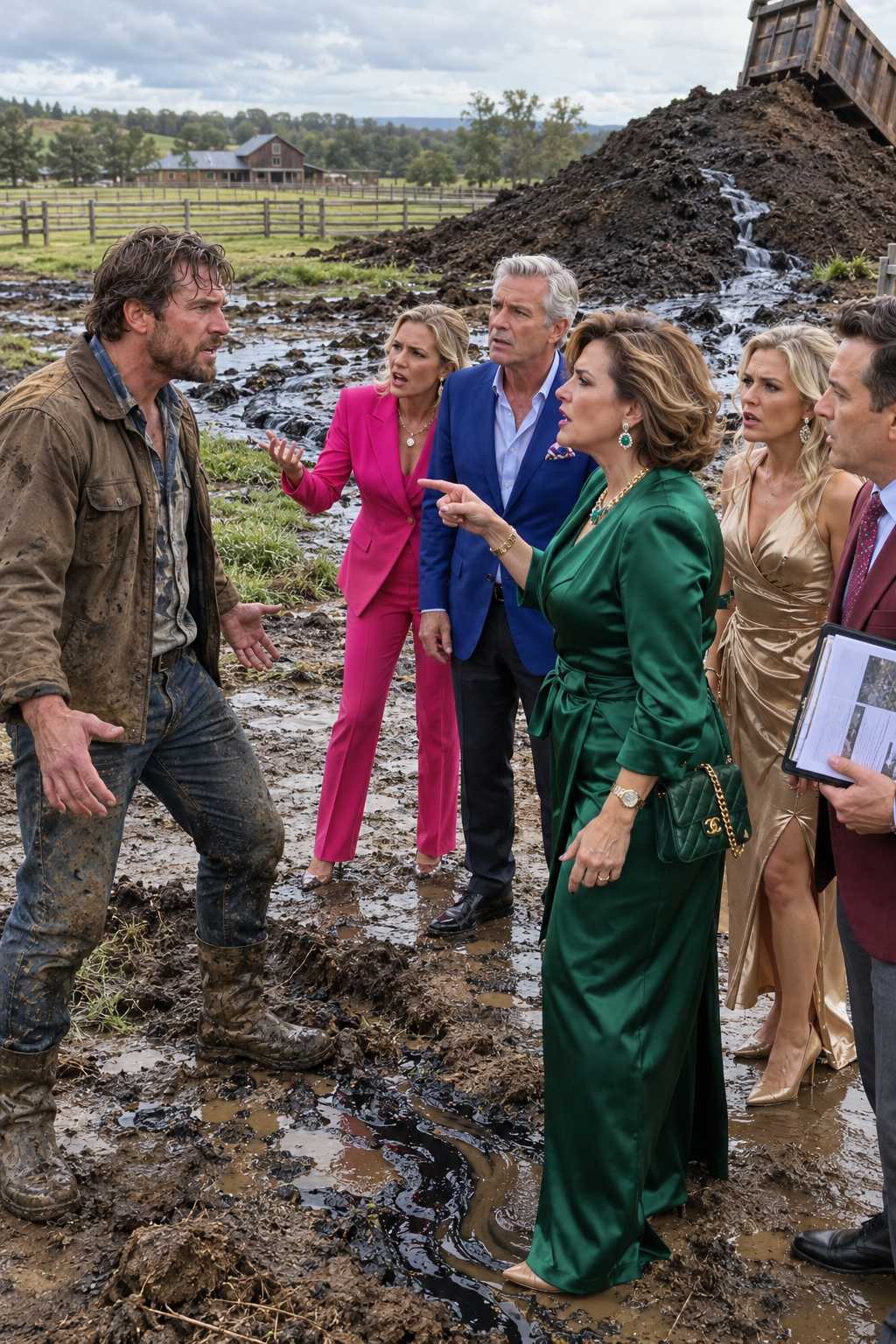
The HOA Dumped 4,000 Tons of Dirt on My Ranch—Then One Storm Turned Their Perfect Neighborhood Into a Crime Scene
The first dump truck crossed my cattle guard at on a Tuesday morning.
By noon, there were forty-three of them.
And when I told the HOA president to get every truck off my ranch, she smiled through the open window of her white Mercedes and said, “Mr. Mercer, you’re standing on land that doesn’t belong to you anymore.”
I didn’t yell.
I didn’t threaten her.
I didn’t put my hands on the excavator operator who was chewing through a fence my father had built with his own hands thirty-two years earlier.
I just took out my phone, photographed the license plates, photographed the company logos, photographed the temporary hauling permits taped inside the windshields, and then I called my attorney.
Because Karen Voss had made one mistake.
She thought a rancher standing quietly beside a broken fence was a rancher who didn’t know what to do.
My name is Cole Mercer.
I’m forty-four years old, and I own 186 acres outside Cedar Ridge, Colorado, where the foothills flatten into cattle country and the subdivisions keep creeping west every year like concrete water.
My grandfather bought the first eighty acres in 1968.
My dad added another sixty in the nineties.
I bought the final forty-six from our neighbor when he moved to Wyoming.
The place wasn’t fancy.
We had one weathered red barn, two equipment sheds, three stock ponds, a narrow creek called Miller Run, and a farmhouse with a porch that leaned slightly east because my grandfather believed fixing perfectly usable things was a form of vanity.
Then Cedar Ridge Estates appeared on our eastern boundary.
Three hundred and twelve homes.
Stone entrances.
Decorative ponds.
Matching mailboxes.
A clubhouse with a pool no one seemed to use.
And an HOA board that behaved as if the entire valley had been waiting for them to arrive.
For the first few years, we mostly ignored one another.
Their residents complained about manure smells.
I reminded them that cows had lived there before granite countertops.
They complained about tractor noise at six in the morning.
I pointed out that my agricultural zoning permitted farm operations.
They sent me letters about the appearance of my western fence.
I framed one and hung it in the barn.
Then Karen became HOA president.
Karen Voss was fifty-three, maybe fifty-four, with silver-blonde hair cut perfectly at her shoulders and the particular smile of someone who believed every disagreement was simply a meeting she had not yet controlled.
She didn’t live in the largest house in Cedar Ridge Estates.
She didn’t need to.
She lived in the one directly behind the clubhouse, close enough that she could walk to every board meeting in heels without touching dirt.
Our first real confrontation happened the previous summer.
She came to my porch carrying a leather folder.
“Cole,” she said, as though we were old friends, “the board would like to discuss an easement.”
“For what?”
“A landscaped walking trail.”
“Across my ranch?”
“Along the eastern edge.”
She blinked.
Not because I’d been rude.
Because I’d answered too quickly.
“We would compensate you.”
“The community has been discussing connectivity.”
“My cattle aren’t interested in connectivity.”
Her smile tightened.
“It could benefit your property value.”
“I’m not selling.”
“Everyone sells eventually.”
That was the first time I noticed something in Karen’s expression.
She already believed the answer would become yes.
She just hadn’t figured out what mechanism would turn it.
The second time she came, she brought a survey map.
The third time, she brought two board members.
The fourth time, she brought a county planning consultant.
Every time, I said no.
Then the letters started.
Stormwater concerns.
Fence-line complaints.
Alleged drainage violations.
A claim that runoff from my pasture was entering Cedar Ridge’s decorative retention pond.
A claim that my hay storage attracted rodents.
A claim that my cattle disturbed “community tranquility.”
My attorney, Melissa Grant, answered each one.
Melissa was forty, sharp, patient, and built for people who confused politeness with weakness.
She had grown up three towns away.
Her father still ran a tire shop.
She knew agricultural law, property disputes, water rights, and, more importantly, she knew exactly when not to reply immediately.
“They’re building a record,” she told me.
“For what?”
“Don’t know yet.”
“So what do we do?”
“Build a better one.”
That was how I began photographing everything.
Fence conditions.
Drainage culverts.
Creek levels.
Property markers.
Trespass signs.
Cattle locations.
Every letter.
Every survey stake that mysteriously appeared near my eastern pasture.
Every vehicle that stopped on the county road and pointed cameras toward my land.
It felt paranoid.
Until Tuesday morning.
The first truck belonged to Halden Earthworks.
The driver stopped when he saw me standing beside the cattle guard.
“You Mercer?”
He looked down at a clipboard.
“We’re supposed to stage through here.”
“No, you’re not.”
He glanced behind him.
Three more trucks were already lined up on County Road 14.
“You’ll have to talk to the project manager.”
“What project?”
He looked confused.
“The berm.”
“What berm?”
That was when Karen’s Mercedes appeared.
Behind her came a white pickup with the Cedar Ridge Estates logo on the door.
Behind that came two excavators on flatbed trailers.
I walked toward her car.
She lowered the window exactly four inches.
“Morning, Cole.”
“Turn them around.”
“We sent notice.”
“No, you didn’t.”
“The association delivered notice Friday.”
“You sent a certified letter claiming you were conducting drainage work near the boundary.”
“That’s correct.”
“You’re on my property.”
She tilted her head.
“This parcel has been identified as part of the Cedar Ridge stormwater control corridor.”
“No, it hasn’t.”
“Our counsel reviewed the plat.”
“Your counsel can review it from the county road.”
She exhaled.
“Cole, this doesn’t need to become dramatic.”
One of the excavators started unloading.
The steel tracks hit the asphalt trailer ramps with a metallic bang that rolled across the pasture.
My cattle lifted their heads.
“Stop the equipment.”
“I can’t stop a permitted environmental project because you’re emotional about a fence line.”
That sentence told me more than the folder ever could.
She wasn’t trying to persuade me anymore.
She had come prepared to create a scene where I became the unreasonable one.
So I did the opposite.
I stepped backward.
Took out my phone.
Started recording.
“Karen Voss, president of Cedar Ridge Estates HOA, are you authorizing these vehicles to enter Mercer Ranch?”
Her face changed.
Just slightly.
“Cole, don’t be ridiculous.”
“Are you authorizing them?”
“We have documentation.”
“That wasn’t my question.”
She raised the window.
Then she drove through my open gate.
That was when I called Melissa.
She answered on the second ring.
“Tell me you didn’t punch anybody.”
“I haven’t even raised my voice.”
“Good. What happened?”
I told her.
There was a two-second silence.
“Photograph everything.”
“Already doing it.”
“Do not block the trucks physically.”
“Wasn’t planning to.”
“Call the sheriff’s office. Report trespass. Be factual. Then send me every document you have from the HOA.”
“What are they dumping?”
I looked toward the first truck as it backed into my eastern pasture.
The tailgate released.
A waterfall of brown soil poured onto grass where my cattle had grazed three days earlier.
Dust rose in a thick cloud.
I smelled wet clay.
Something faintly chemical underneath.
“I’m about to find out.”
By nine o’clock, there were fifteen piles.
By ten, there were twenty-nine.
By noon, the eastern pasture looked like someone had dropped a small brown mountain beside my creek.
The sheriff’s deputy arrived at 10:14.
His name was Daniel Ruiz.
I knew him.
His wife taught science at Cedar Ridge Middle School.
He listened to me.
He listened to Karen.
Then he studied the paperwork she handed him.
“I’m not a surveyor,” he said finally.
Karen folded her arms.
“The HOA has a recorded easement.”
Melissa, who had arrived ten minutes earlier, held out her hand.
“May I see that?”
Karen hesitated.
Then passed her the copy.
Melissa read one page.
Then another.
Then she looked at me.
Her face showed almost nothing.
That was never good.
“What?” I asked.
She handed me the document.
It was a stormwater easement recorded in 2004 when Cedar Ridge Estates was first developed.
The easement covered a thirty-foot strip along part of my eastern boundary.
Not ownership.
Not unrestricted access.
Not dumping rights.
A drainage easement.
But attached to it was another page.
On that map, the shaded corridor wasn’t thirty feet wide.
It expanded west nearly six hundred feet.
Across eleven acres of my pasture.
Right to Miller Run.
My name appeared beneath a signature line.
I stared at it.
“Cole?” Melissa asked quietly.
“That’s not my signature.”
Karen gave a little laugh.
“Your signature was notarized.”
“I didn’t sign this.”
“You may not remember.”
I looked at her.
“I remember signing legal documents.”
“People forget.”
“Not eleven acres.”
Deputy Ruiz shifted his weight.
Melissa pointed to the notary stamp.
“I want the original recording information.”
Karen’s attorney, a thin man named Peter Lang, finally stepped forward.
“This is becoming confrontational.”
Melissa didn’t look at him.
“No. It’s becoming interesting.”
Karen checked her watch.
“We have one hundred and ninety truckloads scheduled today. We’re not paying detention fees because Mr. Mercer suddenly disputes a document that has been of record for years.”
One hundred and ninety truckloads.
I looked across the pasture.
A truck was unloading every few minutes.
“How much soil?”
The project manager answered before Karen could stop him.
“Little over four thousand tons.”
Melissa’s head snapped toward him.
“Four thousand?”
“It’s engineered fill.”
“From where?”
He looked at Karen.
That was the first moment I saw fear.
Not in Karen.
Karen answered.
“A permitted construction site.”
“Which site?” Melissa asked.
Peter Lang stepped between them.
“That’s not relevant.”
Melissa smiled.
“It became relevant when you dumped it on my client’s property.”
A gust of wind crossed the pasture.
Dust rolled toward us.
The project manager turned away and covered his mouth with his sleeve.
I looked down.
Near my boots, a chunk of soil had fallen from one truck’s tire.
It wasn’t normal fill.
Mixed through the dirt were pieces of crushed asphalt.
Black pebbles.
And a tiny curl of something pale blue.
Maybe insulation.
Maybe nothing.
I crouched.
Karen watched me.
“Don’t touch that,” Melissa said.
Karen laughed again, but this time it sounded thinner.
“It’s dirt, Cole.”
I had grown up digging fence holes in every corner of that ranch.
I knew sandy topsoil.
I knew red clay.
I knew river gravel.
I knew manure-rich pasture soil and the heavy gray mud that collected below the north pond after snowmelt.
This was none of those.
The material was too uniform in some places and too mixed in others.
Like somebody had crushed a building, mixed it with excavated earth, and hoped nobody would look closely.
“Where did it come from?”
Karen’s eyes settled on me.
“An approved source.”
“You’re not entitled to interfere with contracted operations.”
That answer mattered.
More than if she had named somewhere.
Because Karen loved paperwork.
She loved authority.
She loved quoting rules.
If this dirt had come from somewhere harmless, she would have said the location and shoved the permit under my nose.
Instead, she hid behind phrasing.
Approved source.
Contracted operations.
Stormwater corridor.
I watched another truck unload.
Then I said, “Melissa, get an injunction.”
Karen’s jaw tightened.
Peter Lang gave the smallest shake of his head.
By , Melissa had filed for emergency relief.
By , Halden Earthworks had received notice that the property rights were disputed.
By , the company’s operations manager called the crew and told them to suspend hauling until their insurer reviewed the situation.
The final count was 173 truckloads.
Not the full 190.
Still enough.
Approximately 3,900 tons, according to Halden’s weight slips.
The eastern pasture disappeared under a ridge thirty feet high in places.
My fence lay flattened beneath it.
Three cottonwoods had been snapped.
The seasonal drainage swale feeding Miller Run was buried.
And the cattle couldn’t go anywhere near the area.
Karen stood beside her Mercedes while the last truck left.
“You’ve created a serious liability for yourself,” she said.
I almost admired the sentence.
“You dumped four thousand tons of material on my ranch.”
“Material necessary to protect three hundred homes.”
“Then put it on your land.”
“The easement gives us authority.”
“The easement is thirty feet wide.”
She glanced at Melissa.
Peter Lang stepped closer to Karen.
“Let’s go.”
Karen ignored him.
She looked back at me.
“You don’t understand what’s at stake.”
There it was.
Not a confession.
Something better.
“Then explain it.”
She opened her car door.
“You’ll find out.”
I watched her drive away.
Melissa stood beside me until the Mercedes disappeared beyond the stone Cedar Ridge entrance.
Then she said, “Your signature is a forgery.”
“No. I mean it’s a bad forgery.”
“You sign your last name with an open M.”
“Always have.”
“The document has a closed M.”
I looked at her.
She continued.
“And the notary stamp belongs to someone whose commission expired three years before the date on that page.”
For the first time all day, I smiled.
“How fast can we hurt them?”
Melissa looked at the mountain of dirt.
“We don’t hurt them.”
“What do we do?”
“We let documents hurt them.”
That night I stayed awake until after midnight.
Not because I was frightened.
Because I was thinking.
Thinking about Karen asking for the walking trail.
Thinking about the widening easement map.
Thinking about why an HOA would spend enough money to move four thousand tons of soil onto land it didn’t own.
Thinking about why Peter Lang had wanted Karen to leave the moment she said I didn’t understand what was at stake.
Thinking about the smell.
At a.m., I walked outside.
The valley was quiet.
A few Cedar Ridge porch lights glowed beyond the fence.
The new soil pile rose against the dark horizon like a dead hill.
I could smell it even from the house.
Not strong.
Just wrong.
Like hot electrical wire after rain.
My father taught me something when I was twelve.
Never ignore what doesn’t belong.
A broken strand of wire doesn’t belong.
A cow standing alone doesn’t belong.
A dry creek during snowmelt doesn’t belong.
A strange truck at a gate doesn’t belong.
And four thousand tons of mystery soil definitely didn’t belong.
So I stood there beneath the porch light and repeated the same thought until it became a promise.
I would not touch their dirt.
I would not move their dirt.
I would not let my cattle near their dirt.
I would not let them call it harmless without proving it.
I would not let Karen Voss decide what happened on my ranch.
At the next morning, I called an environmental consultant.
Her name was Dr. Erin Wallace.
She worked for Front Range Environmental Services out of Fort Collins.
Melissa recommended her.
Erin arrived that afternoon wearing work boots, jeans, safety glasses, and the focused expression of someone who had learned not to speculate until a laboratory agreed with her.
I walked her to the eastern pasture.
She stopped fifty yards from the pile.
“Did they give you a materials characterization report?”
“Waste profile?”
“Soil testing?”
“Source address?”
She stared at me.
“They moved almost four thousand tons without giving the property owner a source profile?”
“They claim the easement authorized it.”
“That wasn’t my question.”
She pulled nitrile gloves from her bag.
Then she did something I appreciated.
She didn’t march to the most suspicious-looking spot.
She created a grid.
Photographed each sample location.
Recorded GPS coordinates.
Used clean tools.
Sealed jars.
Changed gloves between samples.
Kept a chain-of-custody form.
“You expecting litigation?” I asked.
She looked at me over her glasses.
“You already have litigation.”
Fair enough.
Near the middle of the pile, she found black material mixed into the soil.
She touched none of it directly.
“Could be asphalt.”
“Could be several things.”
At the southern edge, she found fragments of concrete.
At the northern edge, she found greenish-gray clay with a chemical odor.
Then she stopped near the buried drainage swale.
“What?” I asked.
She pointed.
The soil there was damp even though it hadn’t rained in five days.
A thin rainbow sheen floated in a shallow puddle.
“Do not let animals down here.”
“They’re fenced out.”
“Fence farther back.”
“For now? As far as you can.”
That got my attention.
“You think it’s contaminated?”
“I think I don’t know what it is.”
“Different answer.”
“It’s the only responsible answer.”
She took water samples from Miller Run upstream and downstream of the fill.
Then she packed everything into coolers.
“Preliminary results tomorrow on some compounds. Full panel takes longer.”
“What are you testing?”
“Metals. Petroleum hydrocarbons. VOCs. SVOCs. Anything obvious that gives us a direction.”
I nodded toward Cedar Ridge.
“If it came from a construction site, could it still be clean?”
“Absolutely.”
“And if it didn’t?”
She sealed the cooler.
“Then somebody has a very expensive problem.”
That evening Karen emailed me.
Not a letter.
Not through attorneys.
Your refusal to cooperate has delayed emergency stormwater improvements before an incoming weather event. The board considers you responsible for any resulting damage to Cedar Ridge property. We strongly encourage you to allow our contractor to complete grading immediately.
Karen Voss President Cedar Ridge Estates Homeowners Association
I forwarded it to Melissa.
Her response came three minutes later.
Do not reply.
At that night, my neighbor Sam Daugherty called.
Sam was sixty-eight and had ranched the property north of mine before selling most of it to his daughter.
“You watching the forecast?” he asked.
“Storm coming Saturday.”
“They’re saying two inches.”
“Mountains get hammered, you might get more.”
I walked to the kitchen window.
The new soil ridge was barely visible in the moonlight.
“Sam, you ever hear of an HOA moving dirt before rain?”
He laughed.
Then stopped.
“Actually…”
“About six months ago there were trucks behind the old Marlowe commercial site.”
“What Marlowe site?”
“You know that empty strip center east of town?”
“The one Cedar Ridge Development bought?”
An abandoned 1980s shopping plaza stood three miles east of the subdivision.
Dry cleaner.
Auto parts store.
Old grocery store.
A restaurant that had closed before I finished high school.
A development company had bought it the previous year and announced luxury townhomes.
“What about it?”
“They dug a lot of dirt out of there.”
“Off and on all summer.”
“Where’d it go?”
“Company name?”
“Can’t remember.”
I looked at Karen’s email.
“Was Cedar Ridge Estates involved?”
Sam was quiet.
“Why would an HOA be involved in a strip mall?”
“Good question.”
The next morning, Erin called at .
Her voice was controlled.
Too controlled.
“Cole, are you alone?”
“I have preliminary screening results.”
I sat down at the kitchen table.
“What did you find?”
“Elevated petroleum hydrocarbons in multiple samples.”
“How elevated?”
“High enough that this is not something I’d classify as ordinary clean fill.”
My hand tightened around the phone.
“What else?”
“Preliminary VOC screen indicates chlorinated solvents in two locations. I need confirmation before I give you names and concentrations.”
“Chlorinated solvents from what?”
“They can come from various industrial or commercial uses.”
“Dry cleaners?”
“Yes. Some chlorinated solvents are historically associated with dry-cleaning operations.”
I looked toward the east window.
Marlowe Plaza.
The old dry cleaner.
“What happens now?”
“You preserve the site. Nobody moves material. Nobody disturbs it. You keep people and animals away. And you notify the state.”
“Can we prove where it came from?”
“Not from chemistry alone.”
“What would prove it?”
“Hauling manifests. Load tickets. excavation records. Source documentation.”
I had 173 trucks photographed.
Melissa had subpoena power once litigation progressed.
Halden Earthworks had weight slips.
And someone, somewhere, had ordered those loads.
I called Melissa.
She listened without interrupting.
Then she said, “I’m calling the state environmental hotline.”
“And Cole?”
“Do not tell Karen what the lab found.”
“Because I want to know what she says before she knows what we know.”
That afternoon, a state environmental investigator named David Chen arrived with two technicians.
No dramatic convoy.
Just a gray state SUV and three people carrying cases.
They sampled the pile.
They sampled Miller Run.
They sampled sediment.
They photographed the buried swale.
David asked me the same questions Erin had.
Where did the soil originate?
Who ordered it?
Who approved it?
Who owned the receiving property?
Did I consent?
Had livestock contacted it?
Had anyone attempted to remove it after I objected?
Then he asked something I hadn’t expected.
“Did the HOA ever discuss acquiring this part of your property before the dumping?”
“How recently?”
“Last summer through this spring.”
“For what purpose?”
“Walking trail, according to them.”
He made a note.
“Anything else?”
“Drainage.”
Another note.
Then he looked toward Cedar Ridge.
“Any planned construction over there?”
“Not that I know of.”
He put his notebook away.
“If anyone enters the disposal area, call us.”
“You think they might?”
“I think people sometimes become interested in material after learning regulators are interested in it.”
That night, at 11:43, my motion camera sent an alert.
A white pickup had stopped near my eastern gate.
I opened the live feed.
Two people got out.
One wore a reflective vest.
The other wore a hooded jacket.
They walked toward the soil pile carrying something long and dark.
I called the sheriff.
Then I put on boots and went outside.
I did not approach them.
I stood beneath the yard light, one hundred and fifty yards away, and turned on every exterior floodlight facing the pasture.
The two figures froze.
One looked toward the house.
Then both walked quickly back to the truck.
By the time Deputy Ruiz arrived, they were gone.
But the camera caught the plate.
The pickup belonged to Cedar Ridge Estates.
Karen emailed me at the next morning.
A maintenance employee mistakenly entered your property last night while checking stormwater infrastructure. Please advise your household not to confront association personnel performing safety work.
I forwarded it to Melissa.
This time Melissa replied with only four words.
She’s getting nervous now.
The storm arrived Saturday afternoon.
Not gradually.
At the sky was gray.
At thunder rolled over the foothills.
At rain hit the metal barn roof so hard I couldn’t hear my own phone ring.
Water rushed off the pasture in sheets.
I pulled on a rain jacket and stood beneath the equipment shed.
Miller Run climbed fast.
The new dirt pile darkened almost black.
Then the first section collapsed.
Not all at once.
A vertical cut simply folded inward.
Tons of wet soil slid toward the buried swale.
Water pushed through channels the contractors had never compacted.
Brown runoff surged downhill.
I called Erin.
Then David Chen.
Then I saw the color change.
The water coming from beneath the southern edge wasn’t brown.
It was gray-green.
Almost milky.
And on top of it spread an iridescent sheen that moved with the rain.
I took video from fifty yards away.
The odor reached me seconds later.
My eyes stung.
I backed farther away.
Across the property line, Cedar Ridge residents had begun gathering behind their decorative iron fence.
Someone shouted.
A woman pulled a child backward.
Another section of the dirt pile slumped.
Something metal rolled free.
At first I thought it was a piece of scrap pipe.
Then lightning flashed.
I saw the curve of a steel drum.
Half crushed.
Then another appeared.
Then a third.
Buried inside the soil.
I stared at them through the rain.
No one spoke.
Even from across the pasture, I could hear the metallic clank as one drum rolled ten feet and stopped against a cottonwood stump.
My phone rang.
I answered.
“Cole, you need to stop filming.”
Her voice was breathless.
I looked toward the subdivision.
She was standing beyond the HOA fence holding a red umbrella.
Even from that distance I could recognize her.
“That material is association property.”
“Interesting.”
“You are not authorized to publish images of active infrastructure.”
“You buried drums on my ranch.”
“You don’t know what those are.”
“I know what a drum looks like.”
“They could be empty.”
“Then why do you care if I film them?”
Another pause.
“Cole, listen to me carefully. Do not let state inspectors disturb those containers until our counsel arrives.”
That was the moment I knew.
Maybe Karen didn’t know every detail.
Maybe she hadn’t personally arranged every load.
But she knew enough.
I looked at the gray-green runoff streaming from the pile.
“You could cause a release.”
“The rain already did.”
“If you interfere—”
“I’m hanging up now.”
I ended the call.
Forty minutes later, the eastern pasture was full of vehicles.
Sheriff’s deputies blocked the access road.
State environmental officers established a perimeter.
The county emergency manager arrived.
A hazmat unit parked near the barn.
Cedar Ridge residents gathered on their side of the fence until deputies told them to return home.
Karen and Peter Lang appeared beneath umbrellas.
Melissa arrived soaked from the shoulders down because she refused to wait for someone to bring her a poncho.
David Chen walked out of the rain toward us.
“Three drums visible,” he said.
“Any markings?” Melissa asked.
Karen approached.
“These activities need to stop.”
David turned.
“Who are you?”
“Karen Voss. President of Cedar Ridge Estates.”
“Did your association arrange disposal of this material?”
“We arranged an authorized stormwater project.”
“That wasn’t my question.”
Peter Lang stepped forward.
“My client will respond through counsel.”
David nodded.
“That’s fine.”
Karen pointed toward the drum.
“You cannot open those without coordinating with the association.”
David stared at her for a second.
“Ma’am, if those containers present an environmental hazard, we will handle them according to state law.”
“You don’t understand the liability exposure.”
“No,” David said. “I understand it very well.”
Peter touched Karen’s elbow.
“Stop talking.”
She pulled away from him.
Then she looked at me.
Her face was pale.
Not angry anymore.
Calculating.
The investigators excavated carefully around the first drum after the rain slowed.
I watched from the established boundary.
The drum had no intact label.
The second had a faded white stencil.
David used binoculars.
Then he handed them to Erin.
She stared.
“What?” Melissa asked.
Erin lowered them.
“Solvent waste.”
Karen turned toward Peter.
That tiny movement told Melissa everything.
“You knew,” Melissa said.
Karen snapped back.
“I knew there had been industrial material at the original excavation site. That does not mean these containers are hazardous.”
Original excavation site.
Melissa’s eyes narrowed.
“No one asked about an excavation site.”
Karen realized it immediately.
Peter closed his eyes.
Just for half a second.
Melissa pulled out her phone.
“Thank you.”
“For what?”
“For identifying the source category.”
Karen’s voice sharpened.
“I identified nothing.”
“You just said original excavation site.”
“I was speaking generally.”
“Which site?”
Peter stepped between them.
“We’re done.”
But the damage was already done.
The next twenty-four hours moved faster than the previous six months.
Halden Earthworks suspended all communication with the HOA.
Their insurer assigned counsel.
The state issued a formal order prohibiting disturbance of the soil.
Miller Run was temporarily dammed downstream with absorbent controls and emergency containment.
My cattle were moved to the west pasture.
County health officials contacted residents whose private wells were located near the drainage corridor.
And Cedar Ridge’s residents began asking the question Karen had spent months preventing them from asking.
Where did the dirt come from?
On Sunday afternoon, I received a call from a man named Rick Dalton.
“I drive for Halden,” he said.
I recognized the voice.
He had been in the third truck Tuesday morning.
“What can I do for you?”
“You got a lawyer?”
He hesitated.
“I need to tell somebody something.”
“Tell my attorney.”
“I will. But I want you to hear it first.”
I sat on the porch.
“All right.”
“The loads weren’t supposed to go to your place.”
“Not originally.”
“Where were they supposed to go?”
“There was a disposal facility listed on the first ticket.”
“Which facility?”
“Mountain West Industrial Recovery.”
I knew the name only vaguely.
A regulated waste facility two counties east.
“So why did the destination change?”
Rick breathed into the phone.
“Dispatcher got revised tickets Monday night.”
“The night before?”
“From who?”
“Project coordinator.”
“Nolan Pierce.”
I wrote it down.
“Works for Halden?”
“Who does he work for?”
“Cedar Ridge Development Partners.”
The strip mall developer.
My grip tightened.
“Marlowe Plaza?”
“That’s where we loaded.”
There it was.
Not proof yet.
“Rick, were you told what the material was?”
“We were told nonhazardous soil.”
“But the first ticket sent it to an industrial recovery facility.”
“Don’t know.”
“Why are you calling me?”
Then he said, “Because I drove a load to Mountain West two weeks ago.”
“From Marlowe?”
“What happened?”
“They rejected it.”
“Guy at the scale told us paperwork didn’t match the waste profile.”
“Did you tell anyone?”
“We told dispatch.”
“Two days later, different tickets.”
“Where to?”
He exhaled.
“Your ranch.”
I called Melissa before Rick finished telling me he wanted his identity protected.
She arranged a statement.
By Monday morning, we knew more.
Marlowe Plaza had been purchased eighteen months earlier by Cedar Ridge Development Partners.
The development company planned eighty-four luxury townhomes.
The managing member of Cedar Ridge Development Partners was a man named Douglas Voss.
Karen’s husband.
That was the first real twist.
Karen wasn’t moving dirt to protect three hundred homes.
She was moving a problem away from her husband’s redevelopment project.
The HOA’s so-called emergency stormwater improvement had become a disposal destination.
And the forged easement gave them the paper excuse to place contaminated excavation material on my land instead of paying to handle it properly.
Melissa found the financial connection before lunch.
Cedar Ridge Estates HOA had approved a “regional drainage partnership” payment of $640,000 the previous quarter.
The recipient?
Cedar Ridge Development Partners.
When residents asked about the expense, the board minutes described it as “shared infrastructure improvements benefiting community resilience.”
No mention of contaminated soil.
No mention of Marlowe Plaza.
No mention that the HOA president’s husband controlled the company receiving the money.
That evening, seventy-one Cedar Ridge residents packed into their clubhouse meeting room.
I didn’t attend.
I watched the livestream someone posted online.
Karen sat at the front table beneath recessed lighting.
Peter Lang sat to her right.
Two board members sat to her left.
Residents shouted from the back.
“Where did the dirt come from?”
“Did you know there were drums?”
“Why did we pay your husband’s company?”
“Is our water safe?”
Karen tapped the microphone.
“Please maintain order.”
Nobody did.
She tried again.
“The board acted based on professional recommendations regarding regional stormwater mitigation.”
A man in a Broncos sweatshirt stood.
“Did the dirt come from Marlowe Plaza?”
Karen glanced at Peter.
“We cannot comment on active litigation.”
A woman near the aisle shouted, “That means yes!”
The room erupted.
Karen raised her voice.
“This is exactly why misinformation is dangerous.”
Another resident stood.
His name, I later learned, was Mark Ellison.
He had lived in Cedar Ridge for twelve years.
“My daughter plays in Miller Run.”
The room went quiet.
Karen’s expression softened.
“I understand your concern.”
“No, you don’t.”
“Mr. Ellison—”
“You moved industrial waste behind our houses.”
“We moved engineered fill as part of—”
“Stop calling it engineered fill!”
Applause broke out.
Karen looked toward the camera.
For one second, her face changed.
The calm disappeared.
What replaced it wasn’t guilt.
It was fury.
Not at the contamination.
At losing control of the room.
That told me what kind of fight this would become.
Karen wasn’t going to admit anything.
She was going to redefine everything.
The soil wasn’t waste.
It was fill.
The trespass wasn’t trespass.
It was easement access.
The forged map wasn’t forged.
It was an administrative correction.
The $640,000 wasn’t self-dealing.
It was regional infrastructure funding.
The drums weren’t evidence.
They were unidentified containers.
Every fact would get a softer name.
Every consequence would become someone else’s misunderstanding.
So Melissa and I stopped arguing adjectives.
We focused on dates.
Dates don’t care how confidently someone speaks.
The original easement: recorded in 2004.
The altered map: supposedly executed in 2019.
Notary commission: expired in 2016.
My signature: forged.
Marlowe Plaza acquisition: April 2025.
Environmental assessment: June 2025.
Excavation began: May 2026.
Mountain West rejection: September 2026.
HOA “stormwater partnership” payment: September 2026.
Revised hauling tickets: Monday.
Dumping began: Tuesday.
Storm: Saturday.
It formed a sequence.
And sequences are dangerous when people lie.
On Tuesday, exactly one week after the first truck crossed my cattle guard, state investigators executed an administrative inspection order at Marlowe Plaza.
They found excavation pits behind the former dry-cleaning unit.
They found stockpiled soil beneath tarps.
They found several empty drum spaces.
They found old groundwater monitoring wells.
And they found something even more useful.
A subcontractor had kept copies of waste characterization tests.
The tests were dated three months before Karen told me the fill came from an “approved source.”
The soil contained tetrachloroethylene—PCE—associated with dry-cleaning solvents.
It also contained petroleum compounds and elevated lead in several zones.
Not every truckload was equally contaminated.
That mattered.
Because it made the scheme harder to detect.
Some loads were relatively ordinary excavation soil.
Some were heavily impacted.
Mixed together, they created thousands of tons of material that could be described casually as dirt while hiding the worst sections inside the larger volume.
That same afternoon, I received a certified letter.
Not from Karen.
From Cedar Ridge Development Partners.
They claimed I had unlawfully interfered with a lawful environmental remediation project.
I read it twice.
Then laughed.
Melissa didn’t.
“They’re setting up a defense.”
“What defense?”
“That your ranch was an authorized staging location.”
“Based on a forged document?”
“Maybe they’ll claim they relied on it in good faith.”
“Karen’s husband owns the company.”
“That helps us.”
“Cole, we need evidence that connects knowledge to action. Family relationship is suspicious. It isn’t proof by itself.”
I hated that she was right.
“What do we need?”
“Emails. Texts. invoices. meeting notes. communications between Karen, Douglas, the contractor, and whoever changed those manifests.”
“How do we get them?”
“And when they refuse?”
“We compel.”
That process began immediately.
Document requests.
Preservation notices.
The HOA board received instructions not to delete electronic communications.
Cedar Ridge Development Partners received the same.
Halden Earthworks turned over dispatch records.
Mountain West turned over rejected load documentation.
The county recorder preserved imaging logs for the suspicious easement attachment.
Then something unexpected happened.
A woman named Diane Keller knocked on my door Thursday evening.
She looked to be in her early sixties.
Short brown hair.
Blue raincoat.
Nervous hands.
“I live on Aspen Court,” she said.
Cedar Ridge.
She looked surprised.
“You know me?”
“I know most vehicles that pass my gate. You drive the red Subaru.”
That made her smile briefly.
“I was on the HOA board.”
“Until February.”
I opened the screen door.
She sat at my kitchen table but refused coffee.
“I shouldn’t be here.”
“Then why are you?”
She stared at the wood grain.
“Because Mark Ellison’s daughter plays near that creek.”
Diane opened her purse and took out a thumb drive.
“I kept copies.”
“Board packets.”
My heart rate climbed.
“How many?”
“About two years.”
“Karen had a habit of changing minutes.”
I didn’t touch the drive.
“We’d vote on something. Then the official minutes would describe it differently.”
“In January, we discussed a payment to Douglas’s company.”
“The six hundred forty thousand?”
She looked up.
“You know about that.”
“The motion was supposed to authorize engineering studies up to sixty thousand.”
“But the minutes?”
“Approved regional partnership expenditures up to six hundred fifty thousand.”
I stared at her.
“That’s a zero.”
“Was that a typo?”
“How do you know?”
“Because I objected.”
“What happened?”
“Karen said I had misunderstood the motion.”
“And you resigned?”
“Not immediately.”
“What changed?”
Diane’s mouth tightened.
“February meeting.”
“What happened?”
“She asked the board to approve a drainage corridor agreement using your property.”
“What did she say?”
“That Cedar Ridge had historic rights.”
“Did she show the easement map?”
Diane nodded.
“The wide one.”
“The forged one.”
“I don’t know whether it was forged.”
“My signature is fake.”
She looked sick.
“I wondered.”
“Because I asked when you agreed.”
“What did Karen say?”
“She said you were difficult in person but cooperative when legal documents were presented.”
I almost laughed.
Instead, I said, “That sounds like her.”
Diane folded her hands.
“Then another board member asked why the corridor was so wide.”
“Karen said they needed room for soil stabilization.”
“When was this?”
“February.”
Marlowe excavation had begun in May.
Three months later.
The destination had been planned before the trucks ever arrived.
“Did she mention Marlowe Plaza?”
Diane shook her head.
“Not in the meeting.”
Diane looked toward the window.
“She mentioned it afterward.”
“What did she say?”
“We were walking to the parking lot. She was angry because I kept questioning the agreement.”
“She said, ‘If Douglas doesn’t get Marlowe cleared before financing closes, we could lose everything.’”
There it was.
Not enough alone.
But a window into motive.
I slid the thumb drive back toward her.
“Don’t give this to me.”
She looked startled.
“Give it to Melissa with a written statement. We preserve the chain.”
For the first time, Diane seemed relieved.
“You’ve been listening to lawyers.”
“A lot lately.”
At the door, she stopped.
“There’s something else.”
“The board never voted to hire Halden.”
She looked directly at me.
By Friday, the soil pile had become a fenced environmental investigation zone.
Yellow tape.
Sampling stakes.
Portable monitoring equipment.
The ranch looked less like a ranch and more like the scene of an industrial accident.
News vans began appearing on the county road.
I refused interviews.
That drove them crazy.
One reporter shouted through my gate, “Mr. Mercer, do you believe the HOA knowingly poisoned your property?”
I kept walking.
Because “poisoned my property” made a great headline and a terrible legal strategy.
We still didn’t know the full extent.
We knew some soil was contaminated.
We knew drums were present.
We knew documents had been altered.
We knew payments created conflicts.
But I wasn’t going to exaggerate facts just because cameras wanted anger.
Karen did the opposite.
She gave an interview Saturday morning.
Standing outside the Cedar Ridge clubhouse in an ivory coat, she looked calm and wounded.
“This community has become the target of irresponsible accusations,” she said. “Our board acted in good faith to address legitimate drainage concerns. We relied on licensed professionals at every stage.”
The reporter asked whether her husband’s company had supplied the soil.
Karen answered, “My husband is involved in several local development projects. That fact is being weaponized.”
“Did soil come from Marlowe Plaza?”
“We are awaiting complete environmental findings.”
“Did the HOA pay your husband’s company six hundred forty thousand dollars?”
“The association participates in regional infrastructure partnerships.”
“Did you disclose your financial interest?”
“My family’s business interests are publicly known.”
Not an answer.
“Did you authorize trucks to enter Mercer Ranch?”
“I relied on recorded property documents.”
Not an answer.
Melissa sent me the clip.
Her text said:
Every sentence is designed to avoid a fact.
She called immediately.
“Why is that good?”
“Because people avoiding facts leave space for documents.”
There was a pause.
Then she laughed.
“Okay. Now you’re becoming annoying.”
“Learning from professionals.”
The next mini-payoff came Monday.
The county recorder’s office completed a review of the altered easement attachment.
The image had been added to the electronic record eighteen months earlier.
Not in 2019.
Not when my fake signature supposedly appeared.
Eighteen months earlier.
Two days after Cedar Ridge Development Partners purchased Marlowe Plaza.
The upload originated from an account belonging to a local title-services firm.
That firm employed a woman named Melanie Ross.
Melanie was Karen Voss’s younger sister.
Melissa called me from her car.
“Now we have family on both ends.”
“Karen’s husband benefits from the development.”
“Karen’s sister works at the title firm.”
“And the fake easement appeared two days after Marlowe was purchased.”
“That seems bad.”
“Criminal?”
“Don’t get ahead of the evidence.”
“You lawyers hate fun.”
“We love admissibility.”
But even Melissa sounded energized.
Investigators questioned Melanie.
We didn’t know exactly what she said.
We learned only that she hired her own attorney within twenty-four hours.
Then Karen disappeared from public view.
No interview.
No board meeting.
No Mercedes at the clubhouse.
Peter Lang issued a statement saying the HOA president was “temporarily stepping back from public responsibilities while the association cooperated with multiple inquiries.”
Three board members resigned.
Residents circulated a recall petition.
By Wednesday, 211 homeowners had signed.
But the biggest surprise came from Halden Earthworks.
Their attorney requested a meeting with Melissa.
Halden had something.
A voicemail.
Nolan Pierce, the project coordinator from Cedar Ridge Development Partners, had left it for Halden’s dispatcher the night before hauling began.
The voicemail was short.
“We have approval to shift the Marlowe loads to the Mercer corridor. Use the revised profile. Mrs. Voss says the property paperwork is handled. We need all loads moved before Saturday’s weather.”
Before Saturday’s weather.
They knew the storm was coming.
They wanted the material moved before rain hit Marlowe Plaza.
Erin answered that.
“Because rain through contaminated excavation can create runoff they’d have to collect, test, manage, and report.”
“So they moved it to me.”
“That’s what the timeline suggests.”
“Before the rain exposed it.”
I looked toward the eastern pasture.
Except the rain exposed it anyway.
Just on my land.
That night, I drove into town for feed.
On my way back, a black SUV followed me for fourteen miles.
Maybe coincidence.
I turned onto County Road 14.
It followed.
I passed my own driveway.
It followed.
I turned into Sam Daugherty’s gravel entrance.
The SUV continued past.
No plate visible beneath the mud.
Sam stepped out of his barn.
“You got trouble?”
He looked down the road.
“Want coffee?”
“No. Just making sure somebody saw me.”
That was ranch-country language for understood.
I waited ten minutes before driving home.
My gate camera caught the same SUV passing twice that night.
The sheriff added extra patrols.
Melissa told me not to become paranoid.
Then she added, “But save the video.”
Three days later, the state confirmed contamination in the soil and elevated concentrations in localized runoff below the fill area.
The creek samples downstream showed detectable contaminants requiring continued monitoring.
Not catastrophe.
Cleanup would be extensive.
Potentially millions.
The HOA’s insurer sent a reservation-of-rights letter.
Cedar Ridge Development Partners’ lender froze construction draws on Marlowe Plaza.
The county suspended related permits.
Homeowners learned that association legal expenses had already crossed $180,000.
And Karen’s carefully managed world began collapsing.
The recall vote happened Friday night.
I watched from home.
Karen attended.
That surprised everyone.
She walked into the clubhouse in a navy suit, shoulders straight, face composed.
People booed.
She sat anyway.
The board’s acting secretary read the results.
Two hundred forty-seven votes to remove her.
Twenty-eight to retain.
Four abstentions.
Karen nodded once.
Then stood.
“I respect the community’s decision.”
Someone shouted, “Where’s our money?”
Another voice yelled, “Did you forge the easement?”
Karen paused at the door.
For a second I thought she might answer.
Instead, she said, “You’ll regret turning this into a spectacle.”
Then she left.
That sentence bothered me.
Not because it sounded threatening.
Because it sounded confident.
Even after everything, Karen believed something worse remained hidden.
Saturday morning, Melissa came to the ranch carrying two paper cups of coffee and a banker’s box.
“What’s that?”
“Discovery production.”
“From who?”
“Cedar Ridge Development.”
“How much?”
“Partial production.”
“Meaning they sent enough paper to claim cooperation and not enough to make me happy.”
We sat at the kitchen table.
Engineering reports.
Meeting notes.
Hauling estimates.
Insurance correspondence.
Most of it was boring.
That was normal.
Real evidence rarely arrived with red arrows pointing to it.
Around noon, I found a spreadsheet.
“Marlowe Soil Management Alternatives.”
Option A: regulated disposal.
Estimated cost: $3.8 million.
Option B: onsite treatment and containment.
Estimated cost: $2.6 million plus schedule delay.
Option C: beneficial reuse at approved offsite civil project.
Estimated cost: $780,000.
Next to Option C was a note.
Potential receiving site: CR drainage corridor.
Cedar Ridge.
I handed it to Melissa.
She read silently.
Then turned the page.
Attached was an email chain.
Nolan Pierce to Douglas Voss.
Subject: RECEIVING SITE.
If HOA finalizes corridor documentation, engineering can characterize majority volume as structural fill pending exclusion of hot zones. Need confirmation Karen can secure board posture and site control.
Douglas replied:
She’ll handle Cedar Ridge. Focus on schedule.
My skin went cold.
“Board posture,” I said.
Melissa nodded.
“Site control.”
“Meaning my ranch.”
“Looks like it.”
But then we reached another email.
Three months later.
From Douglas to Nolan.
Do not send any drums. Only excavated soil. Drums stay onsite until specialty contractor removes them.
Melissa froze.
I leaned closer.
“Read that again.”
Do not send any drums.
Yet drums had ended up inside the pile.
“That means Douglas knew drums existed,” I said.
“But he specifically said not to move them.”
“So who moved them?”
Melissa began searching the production.
We found truck logs.
We found excavator schedules.
We found subcontractor invoices.
But no document instructing anyone to load the drums.
That was strange.
If the entire scheme was simply Douglas and Karen dumping contaminated waste to save money, why specifically order the drums to remain?
Then bury them anyway?
Maybe a worker ignored instructions.
Maybe the drums were hidden in soil and loaded accidentally.
But Erin had seen where they emerged.
“They weren’t randomly mixed,” she told us later.
“What do you mean?”
“The three recovered drums were in the same general section of the pile.”
“Could the excavator have loaded them together accidentally?”
“Possible.”
“Large steel drums make noise when an excavator bucket hits them.”
“So the operator should have noticed.”
“I would expect them to.”
A second twist began forming.
The soil disposal itself looked planned.
But perhaps the drums served a different purpose.
Someone wanted them gone badly enough to ignore Douglas’s written order.
The question was who.
Two days later, federal investigators contacted Melissa.
Not because federal jurisdiction had officially taken over everything.
Because one of the recovered drums contained something unexpected.
Old records.
Metal sample canisters sealed inside plastic containers.
Some went back twenty-two years.
The earliest labels did not say Marlowe Plaza.
They said MERCER EAST FIELD.
I read the photograph three times.
“That’s impossible.”
Melissa said nothing.
“My family owned this land.”
“We never stored chemicals.”
“What year?”
The same year Cedar Ridge Estates was originally developed.
My father had been alive then.
I was twenty-two.
Working construction in Denver during the week and helping on the ranch weekends.
I remembered bulldozers building the subdivision.
I remembered my father arguing with developers over drainage.
I remembered him coming home one night furious because someone had cut part of our fence.
But contamination?
“Where exactly were they taken?” I asked.
Melissa pointed at the label code.
“Erin is trying to decode the old coordinate system.”
By sunset, she had.
The samples came from land twenty yards inside my current eastern boundary.
The exact area beneath the new soil pile.
My stomach tightened.
“They sampled my ranch in 2004?”
“We don’t know yet.”
“Why would sample canisters from my property be stored at Marlowe Plaza?”
“We don’t know.”
“Why were they inside a drum someone just dumped back onto the same property?”
“We don’t know.”
I hated those words.
Not because Melissa was withholding anything.
Because for the first time, the case had stopped making sense.
The first story made sense.
Karen and Douglas needed to avoid multimillion-dollar disposal costs.
They forged access documents.
They used the HOA as cover.
They dumped contaminated soil on my ranch.
But twenty-two-year-old sample records changed everything.
Someone had investigated my eastern field before Cedar Ridge Estates was finished.
And those records somehow ended up hidden at Marlowe Plaza.
That evening, I went into my father’s old office.
We hadn’t called it that in years.
It was just the small room behind the kitchen where tax folders, cattle records, and old maps went to die.
My father, Jack Mercer, had passed away nine years earlier.
Heart attack.
Sixty-eight.
He was stubborn, funny, private, and incapable of throwing away a receipt.
If something happened on the ranch in 2004, there might be a record.
I searched until midnight.
County notices.
Fence invoices.
Veterinary bills.
Seed receipts.
Aerial maps.
Water-rights correspondence.
Then I found a yellow folder.
CEDAR RIDGE.
Inside were letters.
Most I expected.
Disputes over fencing.
Construction access.
Stormwater.
But near the back was one I had never seen.
July 16, 2004.
Addressed to my father.
From an environmental consulting firm called Pace & Hollis.
Mr. Mercer,
Thank you for allowing limited access to the eastern agricultural parcel for supplemental soil and groundwater screening associated with adjacent development activities.
My hands went cold.
He had allowed sampling.
I kept reading.
The letter said results would be provided separately.
There were no results in the folder.
Only a handwritten note from my father across the bottom.
NO REPORT RECEIVED. CALLED 8/9. CALLED 8/16. TOLD CLIENT CONFIDENTIAL. B.S.
I kept searching.
Another letter.
September 2.
From my father to the Cedar Ridge developer.
Your consultant entered my property with permission based on your representation that testing concerned runoff from the construction site. I was promised results. Provide them immediately.
No response attached.
Then a final handwritten page.
Dad’s handwriting.
September 11, 2004.
Talked to Ray.
Says they hit something near old drainage trench.
Developer wants quiet until closings.
Ray nervous.
Ask county.
I read it twice.
Who was Ray?
What did they hit?
What drainage trench?
At 12:37 a.m., I called Melissa.
She answered groggily.
“Somebody better be dead.”
“I found my dad’s files.”
She woke up instantly.
I read the notes.
“Photograph everything,” she said.
“Already did.”
“Don’t remove staples. Don’t reorganize. Put the folder somewhere secure.”
“Who’s Ray?”
“My dad said the developer wanted something quiet until closings.”
“Go lock your doors.”
That was not what I expected.
“You think someone’s coming?”
“I think we just learned the soil dumping may be sitting on top of an older environmental issue.”
I walked toward the front window.
The porch lights reflected on black glass.
“And somebody buried the old samples in the new waste.”
“Maybe to get rid of them.”
“Then why dump them where they were originally taken?”
Another silence.
Finally Melissa said, “That’s the part that scares me.”
At a.m., my motion camera alerted.
Eastern fence.
I opened the feed.
The black SUV was back.
This time it didn’t stay on the county road.
It entered through a maintenance gate bordering Cedar Ridge.
Headlights off.
Moving slowly toward the environmental containment area.
I called 911.
Then I watched.
One person got out.
He wore a dark jacket and cap.
He carried bolt cutters.
He cut through the temporary fence.
Walked directly toward the section where the old drums had been recovered.
Not wandering.
Not searching randomly.
He knew exactly where to go.
Then a second vehicle appeared behind him.
A white pickup.
Cedar Ridge Development logo.
The man waved it forward.
Two more people got out.
They carried shovels.
And a large black plastic container.
They weren’t stealing equipment.
They weren’t checking drainage.
They were retrieving something.
I saved the footage remotely.
The first man turned toward my house.
For a moment, even through the grainy night camera, I felt as if he were looking directly at me.
Then red and blue lights flashed on County Road 14.
The men ran.
The black SUV disappeared through the subdivision.
The white pickup got stuck trying to reverse across wet pasture.
Deputies caught one man.
The other escaped on foot.
The driver refused to speak.
The man they caught wasn’t Nolan Pierce.
Wasn’t Douglas Voss.
Wasn’t anyone I recognized.
But inside the black container they left behind, deputies found printed maps.
One showed Cedar Ridge Estates before construction.
Another showed my eastern pasture.
A red X had been marked near Miller Run.
Beside it, handwritten in black marker:
When Melissa arrived before sunrise, I showed her my father’s note.
Then the map.
“Could B-7 be a sample location?”
Erin arrived at six.
She compared it against the recovered sample labels.
Her face changed.
She pulled up a photo on her tablet.
One of the old canisters.
MERCER EAST FIELD — B7 — 8/12/04.
Nobody spoke.
The red X on the trespassers’ map marked the location of the twenty-two-year-old sample.
Only now the X sat beneath roughly twelve feet of newly dumped soil.
Deputy Ruiz looked toward the contaminated mound.
“You’re telling me those guys came here in the middle of the night to dig under that?”
“Yes,” Melissa said.
“For what?”
No one answered.
At seven thirty, county crews brought ground-penetrating radar.
By nine, they had identified an anomaly beneath the original ranch soil.
Not in Karen’s new fill.
David Chen ordered everyone back.
Excavation began carefully just before noon.
They removed the newly dumped material first.
Then the original topsoil.
Then old compacted earth.
At eleven feet, an excavator bucket scraped steel.
Work stopped.
Hands took over.
Small tools.
By late afternoon, the top of a buried steel container appeared.
Not a barrel.
Roughly eight feet long.
A faded inspection plate remained bolted to one side.
Erin cleaned it gently.
There was a manufacturer’s date.
And beneath layers of rust, another marking.
PROPERTY OF CEDAR RIDGE DEVELOPMENT CO.
Not Partners.
The original developer from 2004.
I stared at it.
“Same company?”
Melissa shook her head.
“Different legal entity.”
“We’re checking.”
David ordered evacuation of the immediate area.
The tank would not be opened until a specialized team arrived.
Then, just before sunset, Melissa’s phone rang.
She walked away to answer.
I watched her face.
At first, concentration.
Then confusion.
Then something I had never seen from her before.
She came back slowly.
“What happened?”
“That was the county clerk.”
“She found the old corporate registration for Cedar Ridge Development Company.”
“Who owned it?”
Melissa looked toward the subdivision.
Then at me.
“Three partners.”
She swallowed.
“Douglas Voss’s father was one.”
That didn’t surprise me anymore.
“Who else?”
“A developer named Harold Kemp.”
“And the third?”
She hesitated.
“The third partner was Raymond Mercer.”
The world seemed to narrow.
“My last name?”
I stared at her.
“My father’s name was Jack.”
“My grandfather was Henry.”
“We don’t have a Raymond Mercer.”
Melissa held my gaze.
“According to the state filing, Raymond Mercer listed this ranch as his mailing address.”
I shook my head.
“The filing is from 2001.”
“My father would have told me.”
“He hated Cedar Ridge.”
“Maybe later.”
“He wrote that Ray was nervous.”
Melissa said nothing.
The sentence hit me.
Talked to Ray.
Says they hit something near old drainage trench.
Ray nervous.
I had assumed Ray was a worker.
A neighbor.
A contractor.
What if he wasn’t?
I ran back to the house.
Pulled open the old yellow folder.
Turned the handwritten page over.
There, faintly visible against the back, was another line written in pencil.
So light I had missed it at midnight.
Ray says Jack can’t know his name is still on company paperwork.
I stopped breathing.
Whoever Ray was, he had spoken to my father about a company using our ranch address.
A company that owned the buried tank.
A company connected to the subdivision.
A company my father later fought.
The next page in the folder had been torn out.
Only the top edge remained beneath the staple.
Melissa held it toward the light.
“There was something else here.”
“I don’t know.”
Then my phone rang.
Unknown number.
I almost ignored it.
Something made me answer.
“Cole Mercer?”
The voice belonged to an elderly man.
“My name is Walter Hayes.”
I put the phone on speaker.
Melissa listened.
“I worked for Pace & Hollis Environmental in 2004,” Walter said.
The room went silent.
“You sampled my ranch.”
A long breath came through the line.
“We were told it was routine.”
“What did you find?”
Another breath.
Then he said, “You need to understand something before I tell you.”
“The contamination at Marlowe Plaza is not the reason those people were afraid of your land.”
I looked at Melissa.
“What are they afraid of?”
Walter’s voice lowered.
“The test results from your ranch were worse.”
Neither of us spoke.
He continued.
“We sampled three locations near the drainage trench. B-5. B-6. B-7.”
“What did you find?”
“I don’t want to say this over the phone.”
“You called me.”
“Because I saw the news.”
“Then tell me.”
“B-7 contained compounds that shouldn’t have been there.”
“From the tank?”
“Probably.”
“What compounds?”
He hesitated.
“Industrial solvents. Heavy metals. Some things we couldn’t explain from subdivision construction.”
“The developer stopped the investigation.”
“I was told the client considered the result a false positive.”
“And you believed that?”
“Did my father know?”
“He demanded the report.”
“We were instructed not to release it.”
“By Raymond Mercer?”
“Where did you hear that name?”
My pulse jumped.
“Who was Raymond Mercer?”
Walter didn’t answer.
“You really don’t know?”
Melissa leaned toward the phone.
“Mr. Hayes, this is Melissa Grant, Mr. Mercer’s attorney. We need you to preserve every record you have.”
“I kept one thing.”
“The original field notebook.”
Melissa grabbed a pen.
“Where are you?”
“I’ll bring it tomorrow.”
“Mr. Hayes, given what’s happened, I’d rather arrange secure transfer tonight.”
He laughed once.
Not because it was funny.
“You sound like Jack.”
“You knew my father?” I asked.
“He found me after the project.”
My throat tightened.
“What did he want?”
“The same thing you want.”
“The truth?”
Walter’s voice became almost a whisper.
“He wanted to know who buried the tank.”
I stared out the window toward the eastern field.
Floodlights surrounded the excavation.
State vehicles sat beyond the barn.
The contaminated soil mountain loomed behind them.
“What did you tell him?”
“I told him the name I saw on the disposal paperwork.”
“What name?”
Walter inhaled.
Then the line went dead.
I looked at the screen.
Call ended.
“Call him back,” Melissa said.
Straight to voicemail.
Melissa grabbed her phone.
“I’m contacting the sheriff.”
Before she could finish dialing, my own phone buzzed.
Unknown number.
One photograph.
A scanned page from an old field notebook.
At the top:
MERCER EAST FIELD — AUGUST 12, 2004.
Below that were handwritten sample results.
And beneath the last entry, one sentence had been circled in red.
Possible buried industrial waste source extends west beyond test area.
Not east toward Cedar Ridge.
Toward my barn.
Toward my house.
Another message arrived.
This one contained only seven words.
Your father found the second site in 2009.
I stared at the screen.
Melissa read over my shoulder.
Then a third message appeared.
A photograph.
Older than he had been in 2004.
Standing beside an open excavation somewhere on our ranch.
Behind him was a rusted steel drum.
Beside him stood a man I had never seen.
On the back of the photograph, someone had written two words.
RAY MERCER.
And under the picture came one final message.
Don’t dig near the north pond.
Because Karen’s four thousand tons of toxic soil had never been the real secret buried on my ranch.
They had only shown us where to start looking.
✓ Lynn R. Adams
The HOA Dumped 4,000 Tons of Dirt on My Ranch—Then One Storm Turned Their Perfect Neighborhood Into a Crime Scene The first dump truck crossed my cattle guard at on a Tuesday morning. By noon, there…