The HOA Cut My Power to Drive Me Out—Then They Learned I Owned the Company Keeping Their Entire Community Alive
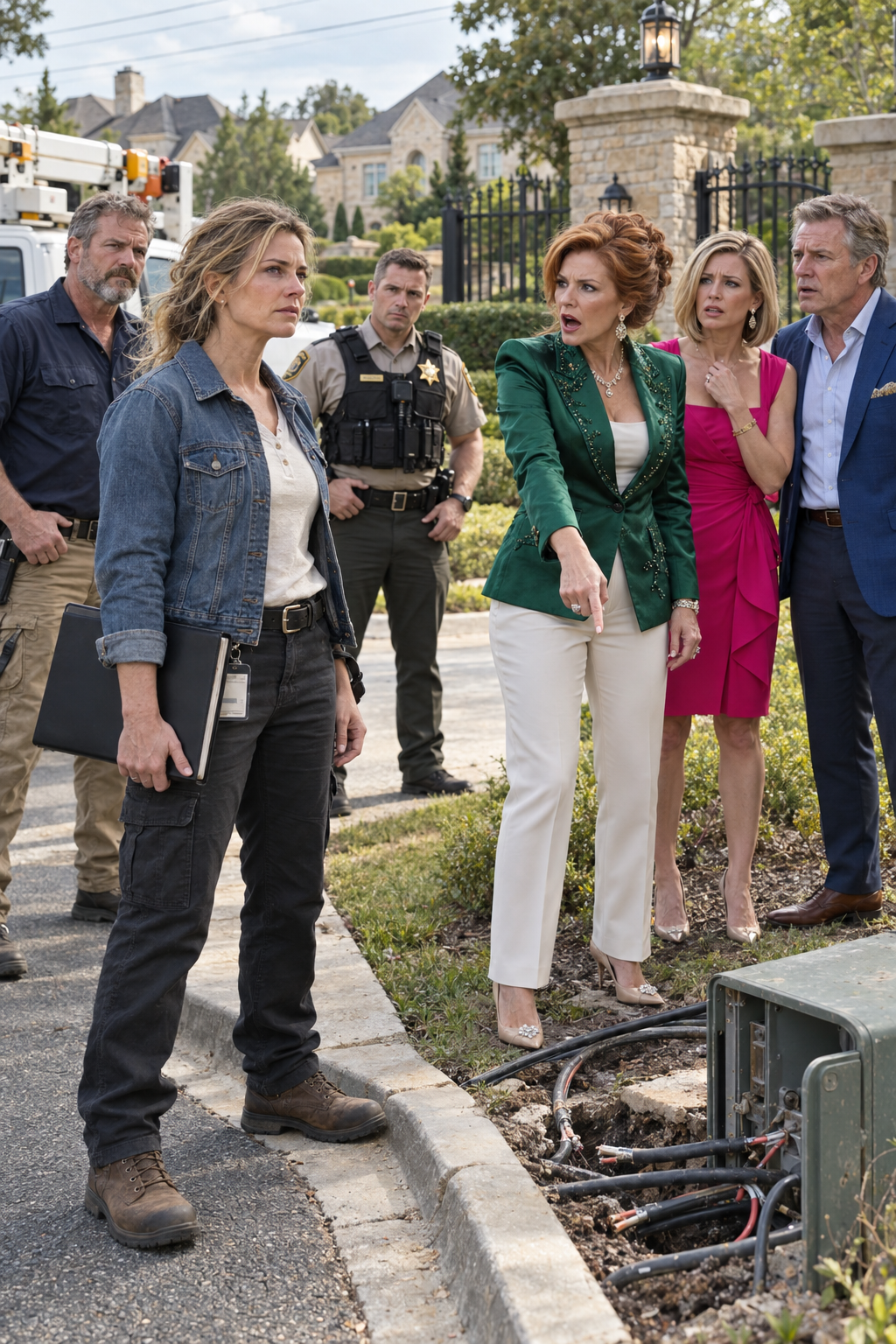
The HOA Cut My Power to Drive Me Out—Then They Learned I Owned the Company Keeping Their Entire Community Alive
The first thing my daughter-in-law said when I found three men cutting the power line to my house was, “Good. Maybe now you’ll finally understand that nobody wants you here.”
My son was standing beside her.
He didn’t stop them.
He didn’t even look ashamed.
He just stared at the gravel driveway where his father had taught him to ride a bicycle thirty-four years earlier and said, “Mom, you have seventy-two hours to leave.”
The hydraulic cutter snapped through the insulated cable with a sound much smaller than betrayal should have made.
A hard little crack.
Then my porch light died.
The refrigerator went silent.
The well pump stopped humming beneath the kitchen floor.
And the big cedar house my husband and I had built with our own hands became still enough for me to hear my daughter-in-law’s bracelets clicking when she folded her arms.
Her name was Vanessa Carter, although lately she preferred Vanessa Whitmore-Carter because she thought the extra name looked better on invitations.
At forty-one, Vanessa had become president of the Whispering Pines Estates Homeowners Association, chairwoman of something called the Community Enhancement Committee, and the unofficial queen of 186 expensive houses wrapped around Lake Bellamy in northern Missouri.
She wore a cream blazer that morning.
White pants.
Gold heels.
Not exactly the outfit most people chose for overseeing the destruction of an elderly widow’s electrical service.
Behind her stood two HOA board members, a property manager named Curtis Bell, and three workers from a contracting company I had never hired.
One of those men wouldn’t meet my eyes.
The others probably didn’t.
I looked at the severed cable hanging from the pole near my barn.
Then I looked at my son, Ryan.
“How long?” I asked.
Ryan frowned.
“How long what?”
“How long have you known they were doing this?”
Vanessa rolled her eyes.
“Please don’t turn this into one of your emotional scenes.”
That almost made me smile.
For thirty-eight years, I had been accused of not being emotional enough.
When my husband nearly lost our first business loan, I didn’t cry.
When a tornado tore the roof off our original workshop, I didn’t cry.
When Ryan broke both legs in a highway accident at nineteen, I spent three nights sleeping upright beside his hospital bed and never cried where he could see me.
When my husband, Thomas, died from pancreatic cancer six years ago, I cried exactly once.
In the shower.
With the water running so our son wouldn’t hear.
So when Vanessa warned me not to make an emotional scene, I simply adjusted the cuff of my blue work shirt and asked again.
“How long, Ryan?”
His jaw tightened.
“A few weeks.”
There it was.
Not the cruelty.
The planning.
Cruelty can happen in a moment.
Planning requires breakfast meetings.
Phone calls.
Signatures.
It requires sleeping at night after deciding what you will do to someone in the morning.
I looked toward the contractor’s truck.
Magnetic sign.
Red letters.
BELLAMY INFRASTRUCTURE SERVICES.
Curtis Bell noticed me studying it.
“This is completely legal, Mrs. Carter.”
“You were given notices.”
“I was given HOA violation letters.”
“Which you ignored.”
“They told me my barn was the wrong shade of brown.”
Vanessa gave a short laugh.
“It’s more than the barn.”
“Then perhaps one of you should explain it.”
She stepped closer.
The smell of her perfume reached me before she did.
Something expensive and sharp.
“You’ve refused architectural compliance. You’ve refused landscape maintenance standards. You’ve refused the road assessment. You have commercial vehicles entering residential property. You maintain utility equipment that isn’t approved by the neighborhood. Your generator creates noise. Your trees obstruct approved lake views. And you’ve repeatedly refused mediation.”
“My house predates your HOA by twenty-seven years.”
Vanessa’s smile hardened.
“That argument is getting old.”
“So is the Constitution.”
Curtis coughed into his fist.
Ryan whispered, “Mom.”
I turned to him.
There had been a time when one word from that boy could make me stop anything.
If he called, I answered.
If he needed money, Thomas and I found it.
If he made a mistake, we helped him stand back up.
When his first business failed, we paid the warehouse lease for eight months.
When Vanessa wanted a $94,000 wedding, Thomas said no.
I quietly transferred them forty thousand anyway.
When their daughter Sophie was born premature, I ran our company from a hospital cafeteria for five weeks so Ryan wouldn’t have to choose between work and his child.
He had forgotten all of it.
Maybe worse.
Maybe he remembered and had simply decided it didn’t matter anymore.
“Say what you were going to say,” I told him.
Ryan lowered his voice.
“This doesn’t have to get ugly.”
I glanced at the severed power line.
Then at the contractor standing beside a hydraulic cutter.
“I’d hate to see ugly.”
Vanessa’s mouth tightened.
“You know exactly what he means.”
“No. I don’t.”
“You can move somewhere easier.”
“Easier for whom?”
“For everyone.”
That word landed harder than she intended.
Not Vanessa.
Not the board.
As though the entire community had gathered in a room and voted that Evelyn Carter was an inconvenience.
I nodded slowly.
“All right.”
Ryan blinked.
Vanessa actually looked disappointed.
She had prepared for shouting.
I could see it.
She wanted anger because anger can be quoted later.
Anger can be called instability.
Anger looks excellent in affidavits.
Instead, I walked past them toward my porch.
“Where are you going?” Curtis asked.
“The property is without power.”
“I noticed.”
“It could be unsafe.”
“So could cutting energized infrastructure without confirming ownership.”
The man holding the hydraulic cutter finally looked at me.
Only for a second.
But I saw the fear.
Vanessa didn’t.
She said, “The association has authority over exterior utility connections.”
I stopped with one hand on the screen door.
“Who told you that?”
“The board’s attorney.”
“Which attorney?”
Ryan looked away.
That told me more than any answer could.
My son was a lawyer.
Not a courtroom lawyer.
A corporate real estate attorney.
For fifteen years, I had bragged about him to anyone patient enough to listen.
Our Ryan went to Washington University.
Our Ryan made partner before forty.
Our Ryan understands property law better than anybody I know.
Three years earlier, after Thomas died, Ryan had started “helping” the HOA with documents.
He never charged them officially.
He called it community service.
Now I understood the service.
Vanessa took one deliberate step toward me.
“We have a temporary occupancy order coming from the county. Without compliant electric service, the house can’t legally remain occupied. You can stay with us for a night or two while you arrange assisted living.”
For the first time that morning, I almost lost control.
Not because she wanted my land.
Not because my son had betrayed me.
Because she said assisted living with the same tone someone might use for storage.
I was sixty-four years old.
I still climbed utility poles when storms made the younger crews nervous.
I still drove a truck with a manual transmission.
I still hiked the northern service corridor twice every spring.
Last winter, I had carried a seventy-pound transformer component twenty yards through ice because the cart couldn’t get traction.
But Vanessa had decided I was an elderly inconvenience.
I watched her for several seconds.
Then I said, “That’s thoughtful.”
She smiled.
Ryan exhaled, relieved.
They thought I was surrendering.
That was their first mistake.
My father taught me something when I was twelve.
If somebody walks into your house looking for a fight, don’t show them the weapon you intend to use.
Let them believe you don’t have one.
I stepped into the dark kitchen.
Behind me, Vanessa began giving instructions to the contractors.
I heard words like compliance.
Then I heard Ryan say, “Give her a couple days.”
A couple days.
Forty-one years earlier, Thomas and I bought the land beneath that house for $36,000.
There had been no lakefront development then.
No stone entry gates.
No tennis club.
No fountain spraying chlorinated water fifty feet into the air.
Just 312 acres of scrub oak, pasture, and a collapsing equipment shed.
Thomas saw something nobody else saw.
Not luxury homes.
Infrastructure.
A regional power route could cross the ridge without touching federal wetlands.
A service road could connect County 17 to the eastern agricultural basin.
A narrow strip along Bellamy Creek was perfect for underground transmission.
Everyone thought Thomas wanted a farm.
Thomas wanted a utility corridor.
He was twenty-nine.
I was twenty-six.
We had eleven thousand dollars in savings, an old Ford, and enough confidence to qualify as stupidity.
For eight years, we lived inside unfinished rooms while building Carter Rural Electric Systems from nothing.
I answered phones.
Thomas climbed poles.
Then we switched.
I learned line work because we couldn’t afford another technician.
He learned bookkeeping because I got pregnant with Ryan.
We worked storms.
We worked Christmas.
We worked funerals.
We restored electricity to people who couldn’t pay us yet because frozen pipes did not care about bank accounts.
Eventually Carter Rural Electric became Carter Regional Utility Holdings.
Then Carter Regional became CRU Energy.
Then it grew again.
Three counties.
Eleven substations.
More than fourteen thousand service accounts.
But Thomas hated publicity.
Most customers assumed CRU was owned by some investment fund in St. Louis.
Thomas owned 52 percent.
I owned 43.
Five percent belonged to an employee trust we created so linemen who spent their lives keeping other people warm could retire with dignity.
After Thomas died, his shares went into a trust.
Not to Ryan.
Ryan never liked discussing that detail.
He knew I owned CRU.
What he did not know was everything else.
I crossed my dark kitchen and opened a drawer beneath the breadboard.
Inside lay a brass key no longer than my thumb.
Tied to a faded red string.
Thomas had handed it to me nine days before he died.
We were sitting on the back porch wrapped in the ugly green blanket Ryan gave us one Christmas.
Thomas weighed maybe 138 pounds by then.
His hands shook.
His voice didn’t.
“If anybody ever comes for the land,” he said, “don’t argue with them.”
I thought the morphine was making him paranoid.
“Who’s coming for the land?”
“Maybe nobody.”
“Promise me.”
“Promise you what?”
“Don’t argue.”
I remember laughing softly.
“You spent forty years arguing with everybody.”
“That’s why I know when it’s useless.”
Then he pressed that brass key into my palm.
“There are things Ryan doesn’t understand.”
I looked at him.
“About the company?”
“About ownership.”
“Ryan is our son.”
“He would never hurt us.”
Thomas stared across the pasture for so long I became angry.
Even dying, he had a way of answering without speaking.
“What are you trying to tell me?” I asked.
He finally looked at me.
“If they ever try to push you off this ridge, use the key.”
I hated the sentence.
I hated the possibility inside it.
And because I hated it, I ignored it for six years.
The key stayed in the drawer.
Until the morning my son watched strangers cut power to my home.
I closed my fist around it.
I didn’t call the sheriff.
I didn’t call a lawyer.
I didn’t call Ryan.
I didn’t call Vanessa.
I didn’t call anybody.
I made coffee on the propane stove.
I sat at Thomas’s old kitchen table.
And I waited until the HOA finished congratulating itself outside.
They cut my electricity at a.m.
By , the contractors were gone.
At , Vanessa’s Mercedes disappeared down the driveway.
At , Ryan sent me a text.
WE CAN TALK TONIGHT WHEN EVERYONE IS CALMER.
I stared at the message.
Then I typed one word.
Nothing frightens arrogant people faster than unexpected cooperation.
That afternoon, the county inspector arrived.
His name was Gregory Shaw.
I had met him twice before.
Both times at HOA events.
Both times standing beside Vanessa.
He wore khaki pants, a county windbreaker, and the expression of a man pretending not to recognize me.
“Mrs. Carter?”
“I’m here regarding an electrical habitability concern.”
He seemed surprised.
I showed him the dead outlets.
The disconnected well pump.
The severed service line.
He made notes.
“You understand this house can’t remain occupied without basic utilities.”
“Who disconnected them?”
“My understanding is the homeowners association authorized work.”
“Your understanding?”
“That’s what the report says.”
“Who filed the report?”
Another pause.
“I’d have to check.”
“Please do.”
His pencil stopped moving.
“Mrs. Carter, I’m not here to assign fault.”
“I’m simply documenting conditions.”
“Please document all of them.”
He looked toward me.
“The cut cable. The pole number. The transformer tag. The contractor tire tracks. Everything.”
His face changed.
But enough.
“You know electrical infrastructure?”
“A little.”
He looked around my kitchen.
For the first time, I think he noticed the framed photograph on the far wall.
Thomas and me standing beside a newly installed transformer in 1989.
Both twenty years younger than common sense.
Both covered in mud.
Under the photograph was a small brass plaque:
CARTER REGIONAL UTILITY — FIRST EAST RIDGE LINE.
Gregory Shaw read it.
Then looked back at me.
“You worked for Carter?”
He swallowed.
I didn’t correct him.
He completed his inspection much faster after that.
Before leaving, he taped a yellow notice near my front door.
TEMPORARILY UNSUITABLE FOR OCCUPANCY.
Vanessa arrived twelve minutes later.
Coincidence, I’m sure.
She walked up carrying a folder.
“I’m sorry it came to this.”
“No, you aren’t.”
She looked almost offended.
“I’m trying to help.”
“Then help me understand something.”
She shifted the folder against her hip.
“What happens to this property after I leave?”
For one beautiful second, Vanessa’s eyes moved toward the lake.
The answer.
Not in words.
In instinct.
My property sat on the only undeveloped ridge overlooking the western side of Bellamy Lake.
Three hundred twelve acres.
Mature oak.
Private shoreline.
Two miles of county road frontage.
And beneath it, something much more valuable than scenery.
A utility corridor.
Vanessa recovered.
“The board hasn’t discussed that.”
“Of course not.”
“We’re only concerned about compliance.”
“Of course.”
“You’ve been difficult for years, Evelyn.”
“You refuse to cooperate with the community.”
“My property isn’t part of your community.”
Her smile vanished.
“We disagree.”
“That sounds expensive.”
She stared at me.
Then she lowered her voice.
“You know what your problem is?”
“You think because you and Thomas were here first, everybody else has to live by your rules.”
“My rule is simple. Don’t touch what you don’t own.”
“That’s exactly the attitude I mean.”
She handed me the folder.
Inside was a purchase offer.
$2.4 million.
For 312 acres worth several times that.
The buyer was Bellamy Ridge Development LLC.
I recognized the name.
They had purchased fourteen acres near the HOA clubhouse the previous year.
“Generous,” I said.
Vanessa seemed pleased.
“It solves everything.”
“For whom?”
“You walk away with more money than you could possibly need.”
“How much money do you think I need?”
She gave me a thin smile.
“At your age?”
There it was again.
At your age.
A phrase people use when they want your future discounted.
I closed the folder.
Her jaw flexed.
“You should think about it.”
“For more than two seconds.”
“I’m old. I think quickly.”
She didn’t laugh.
“You have forty-eight hours before the occupancy order becomes enforceable.”
“You cannot remain here.”
“And continued violations will accumulate fines.”
“How much?”
“One thousand dollars per day.”
“That’s ambitious.”
“They attach to the property.”
“So does poison ivy. I’ve survived both.”
Her face flushed.
“You think this is funny?”
I handed the offer back.
“I think it’s educational.”
That night, I slept in the small equipment office behind my barn.
Technically a commercial building.
Technically served by a separate meter.
Technically outside the county occupancy order.
Nobody had thought to cut that line.
At 11:20 p.m., Ryan called.
I answered on the sixth ring.
“Mom, where are you?”
“On my property.”
“You can’t stay in the house.”
He went quiet.
“Vanessa said you refused the offer.”
“Because it’s my land.”
“It’s three hundred acres you barely use.”
That sentence cut deeper than the power line.
Barely use.
Ryan had grown up on that land.
His father taught him to fish at Miller Pond.
I taught him to drive on the north service road.
We buried his first dog beneath the elm near the barn.
Thomas broke his arm building the west fence.
Ryan kissed his first girlfriend in our hay shed and denied it until age twenty-seven.
Every mile held something.
But people who want your property often begin by convincing themselves you aren’t using it correctly.
“I use it enough,” I said.
“Mom, nobody is trying to hurt you.”
“Then they have terrible aim.”
“Vanessa is under pressure.”
“From whom?”
“The board.”
“She is the board president.”
“You know what I mean.”
Another silence.
Then Ryan said, “The neighborhood is changing.”
“There it is.”
“The truthful sentence.”
“Don’t do this.”
“I’m listening.”
“Investors are interested in the western ridge. New development would raise everyone’s property values.”
“Everyone?”
“The community.”
“I’m not part of the community when they want dues. I am part of the community when they want my land.”
“You’re making this ideological.”
“No. I’m making it geographic.”
His patience broke.
“Dad would have understood.”
I looked at the brass key lying on the desk beside me.
That was Ryan’s second mistake.
Using his father against me.
“Would he?”
“Then perhaps we should ask him.”
“I’ll call you tomorrow.”
I ended the call.
At seven the next morning, I drove forty-six miles to our original headquarters in Hartwell.
The building had changed.
Glass entryway.
Electronic badges.
Digital screens showing outage maps.
But Thomas’s first wooden desk still sat in my private office because I refused to throw it away.
My chief operating officer, Samuel Grant, looked up when I entered.
Sam was fifty-eight, six foot four, and had worked for us since he was nineteen.
He had once restored service during an ice storm with a broken wrist because the nearest hospital was using emergency generators.
He trusted me.
More importantly, Thomas trusted him.
“Evelyn,” he said. “I heard.”
“From whom?”
“Dispatch flagged a disconnected service at your address yesterday. I figured there had to be a story.”
“There is.”
“Do I need trucks?”
“Probably.”
Sam leaned back.
“What happened?”
“The HOA hired Bellamy Infrastructure Services to cut my primary residential feed.”
His chair stopped moving.
“They did what?”
“They disconnected service at Pole E-17.”
Sam stared at me.
“You’re serious.”
“I saw them do it.”
“E-17 is not customer-side infrastructure.”
“That pole belongs to us.”
“They cut company equipment?”
He stood so quickly his chair rolled backward.
“Then this is not an HOA dispute.”
“This is utility sabotage.”
“Evelyn, why the hell didn’t you call me yesterday?”
“Because I wanted to see what they did next.”
Sam stared.
Then slowly sat.
His anger became something more cautious.
“You’re doing the Thomas thing.”
“What Thomas thing?”
“The thing where you let stupid people continue until they produce evidence.”
I almost smiled.
I placed the brass key on his desk.
Sam’s face changed.
“You recognize it.”
He didn’t answer.
“Thomas told me you might bring that someday.”
My throat tightened.
“About two months before he died.”
“What does it open?”
He looked toward my office door.
Then closed it.
“Not here.”
We drove across town to First Bellamy Bank.
The manager knew me.
Sam did not speak during the elevator ride to the basement.
Safe deposit box 417 was longer than I expected.
The brass key turned smoothly.
Inside were three things.
A sealed envelope with my name written in Thomas’s handwriting.
A leather-bound binder.
And an old-fashioned portable hard drive.
I touched the envelope first.
For six years, I had missed Thomas in ordinary moments.
Reaching for a second coffee mug.
Hearing a truck on gravel.
Finding one of his pencils behind the microwave.
Nothing prepared me for seeing my name in his handwriting.
All capitals.
His engineer’s handwriting.
Straight lines.
No decoration.
I opened it.
If you are reading this, someone has pushed harder than I hoped they ever would.
First: do not sell the ridge.
Second: do not sign any HOA acknowledgment, easement amendment, community annexation, or utility waiver, no matter who brings it.
Third: if Ryan is involved, remember he may believe he is protecting the family. Belief does not make him correct.
My vision blurred.
I blinked until the page returned.
Sam looked away.
I continued.
There are two ownership systems operating around Bellamy Lake.
One is visible.
Houses, deeds, HOA lots, docks, roads.
The other is underneath.
Utility corridors, access rights, water controls, transformer sites, buried transmission, emergency service routes.
We own most of the second system.
Whispering Pines was built around it.
Not the other way around.
Years ago, the developer attempted to secure permanent control of our western corridor. I refused. Instead, I granted a conditional service easement renewable every twenty years.
There is a termination clause for intentional interference, unauthorized modification, fraud, or obstruction of company infrastructure.
If someone intentionally cuts CRU equipment to force a property transfer, the board may suspend the easement after safety review.
Do not use that power for revenge.
Use it only if public safety requires it.
If they come for your house, it means they already believe they own something they do not.
Find out what.
I lowered the letter.
Sam said nothing.
I opened the binder.
Property maps.
Original utility easements.
Transmission diagrams.
Contracts signed in 1997.
And there it was.
WHISPERING PINES MASTER SERVICE AND ACCESS AGREEMENT.
The HOA did not own the final two miles of underground distribution feeding its community.
The HOA didn’t even hold a permanent easement.
It held a conditional license across infrastructure corridors located partly beneath my property.
More important, the entire development’s western feeder crossed a switching station on sixteen acres that Thomas and I had deliberately excluded from every annexation agreement.
The switching station belonged to CRU.
The land beneath it belonged to me personally.
Vanessa had cut a line attached to the same regulated system.
Maybe she thought she was disconnecting an old woman.
She had actually tampered with the infrastructure supplying 186 houses.
Sam turned pages slowly.
Then he found something.
He pointed.
A margin note in Thomas’s handwriting.
CHECK ALL 2019 ANNEXATION DOCUMENTS. RYAN REVIEWED.
My stomach dropped.
The year after Thomas’s cancer diagnosis.
The year Ryan started “helping” more with family paperwork.
The year Whispering Pines expanded west.
“Do you remember this?” Sam asked.
“Did you sign an annexation consent?”
He pulled the portable hard drive from the box.
“We need legal.”
Sam stared.
“First we need evidence.”
“We have evidence.”
“We have Thomas’s suspicion.”
“The HOA cut our line.”
“That is evidence of one thing. I want the rest.”
He studied me.
“What are you thinking?”
I closed the binder.
“I’m moving out.”
He looked at me as if I’d lost my mind.
“Temporarily.”
“Because Vanessa needs to believe the pressure is working.”
“That woman cut company equipment.”
“And if we confront her today, she’ll stop.”
“That’s the point.”
I slid Thomas’s letter back into the envelope.
“The point is to find out why they needed me gone in seventy-two hours.”
That afternoon, I returned home.
A moving truck was waiting.
Ryan had sent it.
Of course he had.
Two men stood near my porch.
Ryan stood beside them.
Vanessa was inside my kitchen.
Without permission.
When I entered, she was attaching little adhesive labels to cabinets.
Something inside me became very quiet.
My grandmother used to say silence has temperatures.
There is warm silence between people who love one another.
There is cold silence between strangers.
Then there is the absolute silence before ice breaks.
Vanessa held up a ceramic bowl.
“Oh. You’re back.”
I looked at the bowl.
Thomas made it in a pottery class thirty years ago.
It leaned slightly to one side.
Ugliest bowl ever created by human hands.
I loved it.
The label said DISCARD.
“Put that down.”
Vanessa hesitated.
Then set it on the counter.
Ryan entered.
“Mom, this is just temporary.”
“You sent movers.”
“Your wife is labeling my belongings.”
Vanessa crossed her arms.
“You have to prioritize.”
“You cannot fit an entire house into assisted living.”
“I’m not going to assisted living.”
Ryan stepped between us.
“We found you a furnished rental.”
That surprised me.
“How thoughtful.”
“Mom, please.”
I looked around the kitchen.
Then nodded.
Vanessa blinked.
“I’ll leave.”
Ryan’s shoulders relaxed.
“Thank you.”
“For seven days.”
Vanessa’s eyes narrowed.
“Why seven?”
“Because I need time to decide what comes next.”
She smiled.
The wolf hearing the gate latch.
“Seven is reasonable.”
“I’ll take personal things.”
“Of course.”
“No one touches the barn.”
Vanessa hesitated.
“The barn is part of the property.”
“No one touches it.”
Ryan whispered something to her.
Finally she nodded.
I packed one suitcase.
Thomas’s letter.
The binder.
The hard drive.
Three photographs.
Two sweaters.
A pair of work boots.
And the ugly ceramic bowl.
As I carried the suitcase outside, seventeen neighbors had gathered along the road.
Some pretended to walk dogs.
Others stood with phones.
Nobody approached me.
Nobody said they were sorry.
People dislike injustice until opposition carries a social cost.
Then injustice suddenly becomes complicated.
Mrs. Davison from Lot 42 looked at me.
We had restored her electricity for free after her husband died because she had spent her savings on chemotherapy.
She looked away.
Richard Cole from Lot 11 watched from his golf cart.
His house flooded three winters earlier after a frozen pipe burst during an outage.
Sam and I personally helped move his furniture.
He looked away too.
Vanessa stood on my porch like she already owned it.
I loaded the suitcase into my truck.
Then I turned.
“You’ll secure the property?”
Ryan said, “Absolutely.”
“You’ll make sure nobody modifies anything?”
“You’re sure?”
Vanessa sighed.
“Evelyn, nobody is stealing your house.”
I met her eyes.
“That isn’t what I asked.”
“We’ll make sure nothing is touched.”
I opened the truck door.
Ryan walked closer.
“I’m sorry this happened.”
No, he wasn’t.
He was sorry I was making him watch.
There is a difference.
I said, “I know.”
Then I drove away.
For six days, nothing happened publicly.
Privately, everything moved.
Sam ordered a full engineering inspection of the Whispering Pines feeder.
No announcement.
Routine safety procedure.
Our compliance director documented the cut line.
Unauthorized.
No work order.
No CRU clearance.
No lockout authorization.
No underground service review.
Bellamy Infrastructure Services had violated three state utility rules just touching that pole.
Their owner panicked the moment our investigator called.
By lunchtime, we had emails.
Vanessa had instructed them to “remove private service infrastructure interfering with HOA enforcement.”
Infrastructure.
She had put it in writing.
That gave us the first mini-payoff.
The second came from the county.
Gregory Shaw, the inspector who condemned my house, had inspected the disconnection after it occurred.
He had not verified who owned the line.
He had not contacted CRU.
He had simply used the condition created by Vanessa’s contractor as grounds to declare the house uninhabitable.
Cause the violation.
Punish the owner for the violation.
Force the sale.
Almost elegant.
Except arrogant people always assume procedure is decoration.
On day three, our IT department unlocked Thomas’s old hard drive.
There were scanned contracts.
Photographs.
And a folder labeled WEST RIDGE.
Inside, one document made Sam curse aloud.
An unsigned draft development map.
Whispering Pines Phase IV.
Date: 2019.
My house was gone.
My barn was gone.
My 312 acres had been divided into 122 residential lots, a private marina, and a commercial lodge.
Across the top:
PROPOSED RIDGE ACQUISITION — CARTER PARCEL.
Projected gross sales: $67.4 million.
I stared at the screen.
Not because of the money.
Because the access roads were already drawn.
They had been planning my disappearance before Thomas died.
Sam leaned closer.
“Who created the file?”
“Metadata?”
He checked.
Original author:
I sat very still.
Sam muttered, “Jesus.”
“It’s his file.”
“It could mean anything.”
“You know what it means.”
“No. I know what I fear it means.”
That distinction mattered.
I would not convict my own son because a computer file made me angry.
I needed facts.
Day four gave me one.
A title researcher found a 2019 document filed with the county recorder.
CONSENT TO ANNEXATION AND UTILITY EASEMENT MODIFICATION.
It supposedly carried my signature.
EVELYN M. CARTER.
The signature looked good.
Except I had been in Rochester, Minnesota, that day.
Thomas was undergoing surgery at Mayo Clinic.
I had hotel receipts.
Hospital visitor records.
Company travel records.
My phone location.
The notarization belonged to a woman named Diane Mercer.
Diane had worked for Ryan’s law firm.
Now she worked for Bellamy Ridge Development.
I read the document twice.
Then a third time.
The document claimed my land had consented to future annexation upon “transfer, incapacity, vacancy, or regulatory uninhabitability.”
Regulatory uninhabitability.
The same phrase used in Vanessa’s email to the county inspector.
Now I understood the seventy-two hours.
They didn’t merely need me uncomfortable.
They needed the property vacant.
Vacancy triggered their forged annexation document.
My son had told me to leave because someone needed me to satisfy a clause attached to a signature I never wrote.
For the first time since Thomas died, I sat alone in my office and cried.
Not loudly.
Not dramatically.
Maybe three.
Then I washed my face.
Because grief is not surrender.
At the next morning, I called Ryan.
He answered immediately.
“I’m ready to talk about selling.”
Then, carefully, “Okay.”
“I want everyone involved.”
“Vanessa. Curtis. The development company. Whoever needs to sign.”
“I can arrange that.”
“Tomorrow.”
“That fast?”
“You told me I should move on.”
His voice softened.
“I think this is best.”
I stared at his name on the 2019 file.
“I’m sure you do.”
The meeting was held at the HOA clubhouse.
They chose the room.
Another mistake.
There were twelve people around the long oak table.
Curtis Bell.
Four HOA board members.
Two attorneys.
Gregory Shaw from the county, who probably should not have been there.
A representative from Bellamy Ridge Development named Derek Vaughn.
And two men I did not recognize.
I came alone.
At least, that’s what they thought.
Sam waited three miles away with our compliance director.
Our outside counsel waited in a conference room in St. Louis.
And every relevant document had been copied into three separate secure systems.
Vanessa wore emerald green.
She looked radiant.
People often look best immediately before discovering consequences.
“Evelyn,” she said warmly. “I’m glad we can finally resolve this.”
Derek Vaughn slid a new offer across the table.
$3.1 million.
They had increased it by seven hundred thousand.
Still absurdly low.
I read every page.
Nobody spoke for the first five minutes.
Then Curtis began tapping his pen.
One attorney checked his watch.
Vanessa finally said, “Is there a problem?”
“I’m reading.”
“We’ve summarized everything.”
“I’m old. Humor me.”
Ryan’s eyes met mine.
He looked nervous.
Page twelve referred to annexation rights.
Page eighteen referred to existing infrastructure obligations.
Page twenty-one required me to waive claims regarding “prior interruption of electrical services.”
There it was.
They were buying silence too.
I looked up.
“Who owns the electrical infrastructure crossing Parcel 312-C?”
One of the attorneys answered.
“The association holds utility control within the common service boundary.”
“That wasn’t my question.”
Vanessa sighed.
“Why does this matter?”
“I like knowing what I’m selling.”
Ryan said, “Mom, utility easements are complicated.”
“You don’t need to worry about them.”
That answer bothered him.
Derek Vaughn leaned forward.
“The buyer will assume all related infrastructure responsibilities.”
“Can they?”
“Who told you?”
“Our title review.”
“Did your title review include the 1997 Master Service and Access Agreement?”
The room changed.
Tiny movements.
Vanessa’s fingers stopped.
One attorney looked at the other.
Ryan’s face drained.
Derek said, “I’m not familiar with that document.”
“That surprises me.”
Ryan spoke quickly.
“Mom, where did you hear that name?”
“Where did you get that?”
I tilted my head.
“Shouldn’t I have it?”
Nobody answered.
I reached into my handbag.
Vanessa’s gaze followed my hand.
I removed Thomas’s old brass key.
Nothing else.
I placed it on the table.
Ryan stared at it.
He recognized it.
That was the moment I knew my husband had been right.
“What does that open?” Vanessa asked.
Ryan said sharply, “It doesn’t matter.”
I looked at him.
“Doesn’t it?”
His face hardened.
“Thomas gave me this before he died.”
Vanessa turned to Ryan.
Something silent passed between them.
Not confusion.
I folded my hands.
“Would anyone like to revise the offer?”
Derek Vaughn looked toward his lawyers.
Vanessa said, “This is ridiculous.”
“Probably.”
“You’re trying to intimidate everyone with an old key.”
“Then what are you doing?”
“Listening.”
“For what?”
“The first person who explains why you needed my property legally vacant.”
Gregory Shaw shifted in his chair.
Curtis stopped tapping the pen.
One board member whispered, “What does she mean?”
Vanessa’s face went pale.
“You’re confused.”
“The county declared the property uninhabitable.”
“After you cut the electricity.”
“We disconnected an unauthorized private service.”
The single word stopped her.
I continued.
“You cut equipment owned by Carter Regional Utility Holdings.”
Nobody moved.
Derek Vaughn frowned.
Ryan closed his eyes.
Only briefly.
Vanessa laughed.
A bad laugh.
“That’s impossible.”
“Because CRU supplies half the county.”
“Closer to forty percent.”
She stared.
I watched the calculation reach her.
“You worked there.”
“For forty-one years.”
“But you retired.”
Ryan whispered, “Vanessa.”
She looked at him.
He didn’t say anything.
Her eyes returned to me.
“What aren’t you telling me?”
“Apparently the same thing my son never told you.”
Ryan pushed back from the table.
“Mom, don’t.”
The room went dead.
I looked at him.
“Don’t what?”
“This isn’t necessary.”
“You told me leaving was best.”
“I was trying to protect you.”
“From what?”
He had no answer.
I turned to Vanessa.
“My husband founded CRU.”
She blinked.
“I know that.”
“I co-founded it.”
Another blink.
“Thomas retained controlling ownership until his death.”
Her face changed slowly.
I continued.
“His shares transferred into a marital control trust.”
Derek Vaughn stopped touching the purchase agreement.
“I control that trust.”
One of the HOA attorneys whispered something under his breath.
“I personally own forty-three percent of CRU. The trust controls another fifty-two. Five percent belongs to our employees.”
Nobody moved.
I leaned back.
“So when you hired contractors to cut my line, you did not interfere with a private electrical connection.”
I looked around the table.
“You ordered unauthorized destruction of regulated utility infrastructure belonging to a company I control.”
Vanessa stared at Ryan.
“You knew?”
He said nothing.
“You knew?”
The word was barely audible.
Her face transformed.
“You told me she had shares.”
“I said it was complicated.”
“You said she was basically retired.”
I almost laughed.
Derek Vaughn stood.
“I think we need to pause.”
“Sit down,” I said.
He looked at me.
I didn’t raise my voice.
“You’ve wanted my land for seven years. Surely you can spare another five minutes.”
I opened my handbag again.
This time I removed a copy of the 1997 agreement.
I placed it on the table.
“The HOA’s western electrical feeder operates under a conditional access license.”
One of the board members said, “What?”
The HOA attorney grabbed the document.
I continued.
“The license prohibits unauthorized interference with CRU equipment.”
He flipped pages.
“The agreement also requires immediate safety review after intentional damage.”
Vanessa looked at him.
“What does that mean?”
He didn’t answer.
“It means our engineers inspected your feeder yesterday.”
Every face turned toward me.
Vanessa’s voice had lost its confidence.
“And they found fourteen unauthorized modifications installed during your clubhouse expansion.”
“That is not true.”
“We had permits.”
“County building permits. Not utility clearance.”
Gregory Shaw stopped breathing normally.
I looked at him.
“You know those aren’t the same thing.”
He swallowed.
“Our engineers also found two access gates chained shut across emergency utility lanes.”
Curtis said, “Those are private HOA security gates.”
“Built across CRU access easements.”
He shut up.
“We found landscaping walls covering service junctions. We found an unapproved pump tied into backup power. And we found evidence that your contractor cut one of our lines without isolating the upstream system.”
One board member whispered, “Could someone have been killed?”
I looked at him.
That mattered more than everything else.
For six days I had imagined revenge.
I am human.
I imagined Vanessa opening her refrigerator to darkness.
I imagined Curtis sweating in his expensive house when the air-conditioning stopped.
I imagined Ryan sitting inside the community he helped build while every light went dead.
But Thomas’s letter stopped me.
Do not use that power for revenge.
Use it only if public safety requires it.
So I didn’t disconnect Whispering Pines.
I did something worse for them.
I followed the law.
“Our compliance division notified the state utility commission this morning,” I said.
Vanessa shot upright.
“You reported us?”
“I reported damaged infrastructure.”
“You did this deliberately.”
“No. You did.”
“You’re going to cut power to 186 families because you’re angry?”
I looked directly at her.
She hesitated.
“I would never punish homeowners for what their board did.”
The board members visibly relaxed.
“However, effective at five this afternoon, CRU is suspending all nonessential expansion service, new connection approvals, marina feeds, clubhouse backup service, and construction energization inside Whispering Pines until the safety violations are corrected.”
Derek Vaughn’s face went gray.
His new phase required construction power.
Without CRU clearance, his project stopped.
Not delayed.
Vanessa pointed at me.
“This is extortion.”
“You’re using your company to force us—”
“I haven’t asked you for anything.”
That silenced her.
“I’m not asking you to resign.”
“I’m not asking you to apologize.”
I looked at Ryan.
“I’m not asking anyone to return my home.”
His face tightened.
“I am simply refusing to allow my company to energize infrastructure that your board has altered without authorization.”
The HOA attorney was reading faster now.
He reached the termination clause.
His face collapsed.
“What?” Vanessa demanded.
He didn’t answer.
He whispered, “There’s a revocation provision.”
“For what?”
“Intentional interference.”
Her eyes snapped toward me.
I said nothing.
That silence frightened her more than threats would have.
Then Derek Vaughn did something unexpected.
He turned on Ryan.
“You told us that agreement expired.”
Every head moved.
Ryan’s face became white.
I looked at my son.
He looked back.
There it was.
The first twist I had feared.
Not ignorance.
Participation.
Ryan said, “I said there was an argument it could be superseded.”
Derek slammed his palm on the table.
“You said it was expired.”
“Calm down.”
“You gave us a title opinion.”
Vanessa whispered, “Ryan?”
He ignored her.
Derek continued.
“You certified Phase IV had clean utility access.”
The room exploded.
Board members shouted.
Curtis demanded documents.
Gregory Shaw began gathering his folder.
One attorney told everyone to stop talking.
Vanessa stood in the middle of it, staring at her husband.
The child I once carried through an emergency room with blood on his face.
The boy who used to leave wildflowers on my pillow after he got in trouble.
The man who had told developers my husband’s agreement was meaningless.
I wanted to scream at him.
Instead I asked the quietest question in the room.
“Ryan, did you forge my signature?”
Everything stopped.
He looked at me.
“Do you know who did?”
Vanessa whispered, “What signature?”
I placed the 2019 annexation consent on the table.
Ryan’s eyes dropped.
That was enough.
Vanessa grabbed the paper.
“What is this?”
I said, “Apparently I agreed to surrender annexation rights when my property became vacant.”
Her lips parted.
“I’ve never seen this.”
For once, I believed her.
That was the second twist.
Vanessa had been cruel.
She had ordered my power cut.
But she had not created the original trap.
Someone had given it to her.
Someone had convinced her the property would automatically fall under HOA control once I left.
She turned toward Ryan.
“Where did this come from?”
He didn’t answer.
“I’m not discussing privileged legal work in this setting.”
Derek laughed bitterly.
“Privileged? You dragged all of us into fraud.”
“That document predates our current transaction.”
“It has her forged signature.”
“We don’t know that.”
I took out my phone.
“June 14, 2019.”
Ryan looked at me.
“The notarization date.”
His jaw tightened.
“I was at Mayo Clinic with your father.”
No one spoke.
“I have travel records.”
His throat moved.
“Hospital records.”
“Company records.”
More silence.
“Thomas’s surgery lasted nine hours.”
I stared at my son.
“So unless I learned to be in Minnesota and Missouri at the same time, that isn’t my signature.”
Vanessa backed away from him.
“Oh my God.”
Ryan snapped, “Stop.”
“You knew?”
“I said stop.”
“You knew?”
“This is more complicated than she’s making it.”
I almost admired the sentence.
People say things are complicated when the simple version makes them guilty.
I gathered my papers.
Ryan looked at me.
“Where are you going?”
“You can’t.”
“The occupancy order.”
I looked toward Gregory Shaw.
“Mr. Shaw?”
He cleared his throat.
“CRU submitted confirmation this morning that the line was illegally disconnected and can be restored safely.”
He looked miserable.
“I have no basis to maintain the order once service is restored.”
Vanessa stared at him.
“You told me—”
He raised both hands.
“I acted on the information provided.”
“The restoration crew is already there.”
Ryan stepped closer.
“Mom, please.”
I picked up Thomas’s brass key.
“You had six years to say please.”
Then I left.
At that evening, my porch light came back on.
I stood alone in the kitchen and watched the refrigerator display glow blue.
The well pump kicked beneath the floor.
The old clock above the sink resumed blinking.
For some reason, that nearly broke me.
Not the million-dollar land.
Not the forged signature.
Not my son.
Because Thomas had fixed that clock three times when any sensible man would have bought another.
I set the time.
Then I cooked soup.
At , someone knocked.
Mrs. Davison from Lot 42 stood on my porch holding a casserole.
“I’m sorry,” she said.
“For what?”
“For watching.”
I looked at her.
She swallowed.
“We all knew it was wrong.”
I said nothing.
“We were scared of Vanessa.”
“Fines. Liens. Social stuff. Her committees. You know.”
“She made people feel like they could be next.”
Mrs. Davison glanced at the house.
“Is it true you own the power company?”
“I own part of it.”
She gave a shaky laugh.
“Apparently a fairly important part.”
Then she became serious.
“There’s something you should know.”
“Vanessa’s been telling people you’re shutting off electricity tomorrow unless we sign a petition supporting your land sale.”
Of course she was.
“What petition?”
Mrs. Davison handed me a paper.
EMERGENCY COMMUNITY PROTECTION RESOLUTION.
It accused me of abusing utility control for personal retaliation.
It demanded state intervention.
At the bottom were thirty-eight signatures.
I recognized fourteen.
People whose homes we had restored after storms.
People we had helped with payment plans.
People who had watched me leave my home with one suitcase.
I folded the paper.
Mrs. Davison looked ashamed.
“I didn’t sign.”
“Your name isn’t there.”
That made her laugh.
Then she started crying.
I didn’t tell her everything would be fine.
I was too old to make promises the world hadn’t authorized.
I simply took the casserole and said, “Thank you.”
The next morning, Sam called at .
“Turn on Channel Eight.”
Local news.
Vanessa stood outside the HOA clubhouse.
Perfect hair.
White coat.
Concerned expression.
Behind her were families.
Older homeowners.
She told the reporter an “outside corporate power interest” was threatening residents.
I had lived there before the first HOA house existed.
I had repaired those lines with my own hands.
Threatening.
We had not disconnected a single home.
It was clever.
But clever.
Then Vanessa looked into the camera and said, “No private individual should be able to hold an entire community hostage.”
Sam muttered through the phone, “Want me to release the emails?”
“She’s burying you.”
“She has television cameras.”
“She has today.”
“What do you have?”
I looked at Thomas’s binder.
“Tomorrow.”
By afternoon, the story had spread online.
I became the Evil Utility Widow.
The Power Baroness of Bellamy Lake.
Somebody posted a picture of my house and estimated my net worth.
Somebody else claimed I had disconnected sick children.
Ryan did not call.
That hurt more than the internet.
At four, the state utility commission requested records.
We gave them everything.
Not selected documents.
Everything.
Full outage logs.
Safety inspection.
Contractor emails.
Ownership maps.
The severed cable.
Photographs.
CRU’s policies.
My personal conflict disclosure.
And one thing Vanessa did not know existed.
Pole E-17 carried a security camera.
Not because of my house.
Because copper theft had increased across rural lines.
The camera showed the contractor arriving.
Vanessa standing beside him.
Curtis pointing at the cable.
Walking up to the pole.
The microphone wasn’t designed for conversation, but a few words were audible.
Contractor: “This utility-owned?”
Ryan: “The association has authority.”
Contractor: “You sure?”
Ryan: “Cut it.”
I watched the video once.
Then never again.
The commission investigator watched it twice.
By Friday, Bellamy Infrastructure Services lost permission to perform utility work pending review.
Gregory Shaw was placed on administrative leave.
The county reopened the occupancy case.
The state referred the forged annexation document to the attorney general’s real estate fraud division.
And the HOA’s insurer sent Vanessa a letter reserving the right to deny coverage for intentional acts.
That was when the community finally turned.
Not because they discovered morality.
Because they discovered invoices.
CRU estimated correction costs at $418,000.
The HOA had spent nearly $90,000 on legal fees in one week.
Bellamy Ridge Development suspended the Phase IV acquisition.
Two lenders froze construction financing.
Homeowners realized Vanessa’s decisions might cost each household thousands.
Suddenly my phone filled with messages.
Evelyn, we’ve always supported you.
Evelyn, we had concerns about Vanessa for months.
Evelyn, please understand we didn’t know.
I replied to none.
Then, on Sunday morning, Ryan came home.
Not his home.
He stood on the porch in jeans and a gray sweater.
No lawyer face.
He looked tired.
For half a second, I saw the little boy who once waited outside my bedroom after breaking a window.
I opened the door.
“Can I come in?”
He entered.
His eyes moved around the kitchen.
The ugly ceramic bowl sat on the counter.
He noticed it.
His face twisted.
“Dad made that.”
“Vanessa was going to throw it out?”
He sat at the table.
I remained standing.
After a while he said, “I didn’t forge your signature.”
“I believe you.”
His eyes lifted.
Relief flashed across his face.
Too quickly.
“But you know who did.”
Relief disappeared.
He rubbed both hands over his face.
“This got out of control.”
“No. It got exactly where it was going.”
“I never wanted you hurt.”
“You ordered a contractor to cut my power.”
“I thought it was a private feed.”
“You’re an attorney.”
“I was told—”
“You told him to cut it.”
His eyes closed.
“I was trying to force a negotiation.”
“You mean force me to sell.”
“The development would have made everyone money.”
“Not everyone.”
“You would have gotten millions.”
“I already have millions.”
He looked at me.
“That’s not the point.”
“No. It isn’t.”
I sat across from him.
“The point is that you decided your mother’s consent was inefficient.”
His face crumpled.
He looked away.
For several minutes, neither of us spoke.
Finally he said, “Dad never trusted me.”
I felt the old instinct.
Defend him.
Comfort him.
Tell him Thomas loved him.
But love and trust are not identical.
“Your father loved you.”
“That’s not what I said.”
“He kept things from me.”
I touched the brass key resting beside my coffee.
“Maybe he was waiting for you to become someone he could tell.”
Ryan flinched.
I regretted the cruelty.
Not enough to retract it.
“I’m going to cooperate with investigators.”
“I resigned from the firm.”
That surprised me.
“Vanessa and I are separating.”
That didn’t.
He walked toward the door.
Then stopped.
“The 2019 document.”
“I didn’t forge it.”
“You said that.”
“Dad knew about it.”
The room went cold.
“He knew someone was trying to file it.”
I stood slowly.
Ryan looked terrified now.
Not ashamed.
“Because he confronted them.”
“Them who?”
Ryan’s hand tightened around the doorknob.
“I thought you found everything in the box.”
“I found what he left me.”
“There was another file.”
“What file?”
He looked toward the window.
“Black folder.”
“There was no black folder.”
His face changed.
“Then somebody got there first.”
My pulse quickened.
He opened the door.
“Ask Sam about Substation Four.”
Then he left.
I stood in the doorway watching his truck disappear.
For twenty minutes, I did nothing.
Then I called Sam.
He answered on the first ring.
“What happened?”
“How did you know something happened?”
“You only call this early when something happened.”
“What is Substation Four?”
Not confusion.
Recognition.
“Where did you hear that?”
Another silence.
“What is it?”
“I need to come over.”
“No. Tell me now.”
He exhaled.
“Substation Four was Thomas’s private project.”
“What project?”
“I don’t know all of it.”
“That is not an answer.”
“He thought someone was manipulating land records around the utility corridor.”
“He never told me names.”
“Because one of the names was inside CRU.”
My hand tightened around the phone.
“He believed someone within the company was leaking future expansion routes to developers.”
I sat down.
For forty-one years, CRU had been more than a company to me.
It was the thing Thomas and I built when nobody believed we could.
Every pole.
Every truck.
Every employee Christmas party.
Every storm night.
And now someone inside it had been selling information.
“Where is Substation Four?”
“You know where.”
“The old northern switching yard.”
My breath stopped.
The abandoned yard near Miller Creek.
On my land.
We stopped using it eighteen years earlier.
“Why would Thomas hide anything there?”
“Because nobody went there anymore.”
I looked toward the window.
“Meet me in twenty minutes.”
The switching yard sat behind two rusted gates at the north edge of my property.
By the time Sam arrived, I had already cut the old padlock.
We walked through knee-high grass.
Four concrete service sheds remained.
Three empty.
The fourth smelled like dust, mice, and transformer oil that had seeped into the concrete decades ago.
Sam used his flashlight.
“Thomas came here a lot during his last year.”
“You knew?”
“I knew he was working on something.”
“And you never asked?”
“You knew Thomas.”
Behind an electrical cabinet we found a steel plate secured with four bolts.
Fresh bolts.
Not eighteen years old.
Sam looked at me.
“Someone’s been here.”
We removed them.
Behind the plate was a narrow recess.
A black folder had been there.
We could see its rectangular outline in the dust.
My stomach sank.
Then Sam shone the flashlight lower.
Something had slipped behind the conduit.
A plastic evidence sleeve.
Inside was a single photograph.
Derek Vaughn.
Gregory Shaw.
And three other men.
Standing in front of a development map.
The date stamp read May 2019.
One month before my forged signature appeared.
I recognized one of the three men immediately.
County Commissioner Harold Pierce.
The second was the president of First Bellamy Bank.
Sam leaned closer.
The third man was our own chief legal officer.
A man who had worked for CRU for twenty-two years.
A man who attended Thomas’s funeral.
A man who gave the eulogy.
Robert Hale.
On the back of the photograph, Thomas had written six words.
FOLLOW THE EMERGENCY EASEMENTS. NOT THE MONEY.
Below that:
IF THEY FORCE EVELYN OUT, THEY’RE READY.
Ready for what?
We searched another hour.
No black folder.
No documents.
Someone had beaten us there.
Someone knew Thomas had hidden evidence.
And someone had entered my property recently enough to replace the bolts.
That night, for the first time since the whole thing began, I locked my bedroom door.
At a.m., my security system sent an alert.
MOTION — NORTH FIELD.
I opened the camera feed.
Headlights.
One vehicle.
Then another.
Both driving toward Substation Four.
I called Sam.
Then the sheriff.
By the time deputies arrived, the vehicles were gone.
But they left tire tracks.
And one thing lying in the grass.
A burned black folder.
Most pages were ash.
One corner survived.
A transfer schedule.
Parcel numbers.
Utility easements.
County approvals.
And one line that changed the entire case.
WESTERN RIDGE PHASE IV — EXECUTE UPON E. CARTER VACANCY.
PHASE V — 640 ACRES.
My blood ran cold.
My property was only 312 acres.
Phase V covered land CRU did not own.
Land belonging to farmers.
Retired couples.
Families who had lived there for generations.
The scheme had never been about my house.
My house was the door.
My land was the corridor.
If they controlled it, they controlled access to hundreds of additional acres behind me.
Thomas had seen it.
That was why he warned me.
That was why he created the trust.
That was why he protected the easement.
And that was why somebody needed me gone.
Three weeks later, Vanessa resigned.
The HOA board voted unanimously to reverse every violation notice against my property.
Bellamy Ridge Development withdrew its purchase offer.
Derek Vaughn retained criminal counsel.
Gregory Shaw remained suspended.
The contractor signed a cooperation agreement.
CRU restored every legal access route and offered homeowners independent safety inspections at no charge.
I refused reimbursement for my inconvenience.
I did, however, require the HOA to establish a fund for homeowners who had been unfairly fined under Vanessa’s board.
Some neighbors thought that was generous.
It was justice.
There is a difference.
Ryan cooperated with investigators.
He admitted writing the 2019 development concept.
He admitted issuing a flawed title opinion.
He admitted telling the contractor to cut my line.
He still denied knowing the annexation consent carried a forged signature.
Maybe he was telling the truth.
Maybe he wasn’t.
He lost his partnership.
He lost Vanessa.
He almost lost me.
I have not decided what forgiveness looks like yet.
People think forgiveness means restoring someone to the seat they had before they hurt you.
You can forgive someone from across a locked gate.
You can love someone without handing them your keys.
Two months after I returned home, the HOA held a public meeting in the clubhouse.
More than two hundred people came.
State investigators sat in the back.
Reporters lined the wall.
For the first time in years, I walked into that room without anyone calling me difficult.
Funny how quickly stubborn becomes principled after evidence arrives.
The new HOA president apologized publicly.
I accepted.
Then the county attorney announced that investigators had opened a broader inquiry into land transfers surrounding Bellamy Lake.
Murmurs filled the room.
He mentioned forged easements.
Improper permits.
Bank financing.
Possible insider disclosures.
Then the rear doors opened.
Robert Hale walked in.
CRU’s chief legal officer.
Thomas’s old friend.
The man from the photograph.
He had resigned that morning.
He carried a leather briefcase.
He looked straight at me.
Not surprised.
Not ashamed.
Almost relieved.
The county attorney called his name.
Robert did not respond.
Instead, he walked toward the front table.
He placed the briefcase down.
“Evelyn,” he said quietly, “Thomas wanted you to have this if everything failed.”
Every camera turned.
My heartbeat pounded in my ears.
I stared at him.
“You took the black folder.”
Sam stood behind me.
Two investigators moved closer.
Robert raised one hand.
“I didn’t destroy it.”
“Then where is it?”
He touched the briefcase.
“Most of it is here.”
His expression changed.
“There’s one document I never found.”
“What document?”
“The original Phase V deed.”
I remembered the burned schedule.
Six hundred forty acres.
“Whose land?”
Robert looked around the room.
Then at Ryan.
My son was sitting in the second row.
Robert whispered, “That’s the problem.”
He opened the briefcase.
Inside were contracts, maps, copies of checks, and photographs.
On top lay a deed.
My husband’s name appeared on the first page.
THOMAS EDWARD CARTER.
The date was eight months after his death.
I felt every sound in the clubhouse disappear.
Robert said, “Somebody used Thomas’s identity to transfer the emergency corridor.”
I looked at the signature.
It was perfect.
Better than mine.
Better than the forgery on the 2019 annexation form.
Almost as if someone had practiced for years.
The county attorney reached for the document.
I stopped him.
“One second.”
Across the room, Harold Pierce, the county commissioner from Thomas’s photograph, quietly stood from his chair.
He began walking toward the exit.
The sheriff noticed.
Pierce froze when two deputies stepped in front of the doors.
I picked up the deed.
My voice came out much calmer than I felt.
“Commissioner Pierce?”
Two hundred people watched us.
I held up the document carrying my dead husband’s name.
Then I asked the smallest question I could think of.
A weak question.
A polite question.
The kind of question an old widow might ask because she was confused.
“Before you leave,” I said, “would you mind explaining how my husband signed this eight months after I buried him?”
And that was when Ryan whispered from behind me—
“Mom, don’t let them open the second page.”
✓ Lynn R. Adams
The HOA Cut My Power to Drive Me Out—Then They Learned I Owned the Company Keeping Their Entire Community Alive The first thing my daughter-in-law said when I found three men cutting the power line t…