The HOA Crushed My Yacht Over Unpaid Fees—Then Learned the Marina, the Docks, and Their Clubhouse Were All Mine
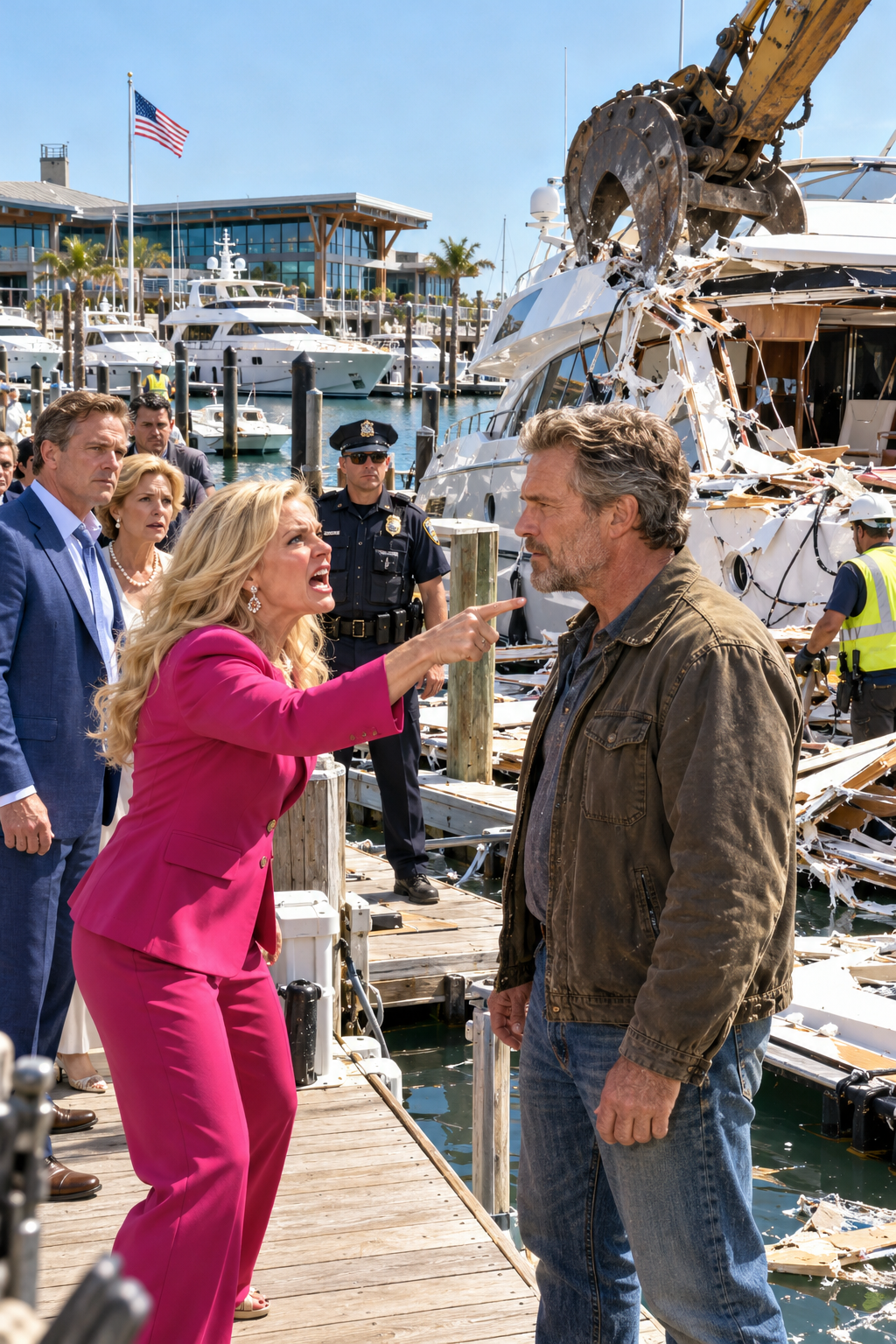
🔥HERE’S THE NEXT PART OF THE STORY, ENJOY !! The explosive twist and the final ending of this story ! ⬇️💬 Thank you ❤
They were about to learn the difference.
The crane operator climbed down from his cab.
He walked toward me.
His jacket had HASKELL MARINE RECOVERY stitched across the chest.
He looked about forty.
Weathered face.
The expression of a man realizing his work order might become evidence.
“You Evelyn Cross?”
He looked at Marjorie.
Then back at me.
“You own the vessel?”
Marjorie cut in.
“The association seized the vessel.”
The contractor frowned.
“Our paperwork says abandoned property.”
There it was.
First crack.
I kept my eyes on him.
“May I see your work order?”
Marjorie stepped between us.
The contractor hesitated.
I did not raise my voice.
“What’s your name?”
“Ben Haskell.”
“Mr. Haskell, did anyone give you a title, court order, sheriff’s seizure notice, Coast Guard abandonment record, or signed authorization from the registered owner?”
His face tightened.
“No court order.”
“Did anyone tell you there was an ownership dispute?”
Marjorie snapped, “You were retained by the association. Continue the job.”
Ben didn’t move.
I turned my phone so the camera captured him, Marjorie, Daniel, and the ruined bow of Second Chance behind them.
“Mr. Haskell, I am telling you now, on video, that the vessel is privately owned, currently registered, not abandoned, and that I do not consent to demolition.”
Ben looked over his shoulder toward the crane.
Then he pulled a radio from his belt.
“Shut it down.”
Marjorie’s head whipped around.
“Shut the machine down,” Ben repeated.
The crane engine went quiet.
The sudden silence felt enormous.
I heard gulls.
Wind against halyards.
Water slapping the pilings.
And somewhere across the parking lot, someone started clapping.
One person.
I looked toward the bait shop.
Old Frank Delaney stood outside holding a Styrofoam coffee cup.
Frank had rented Slip 12 for twenty-two years.
He lifted the cup toward me.
Marjorie turned crimson.
“This is not your decision.”
Ben removed his hard hat.
“Until somebody shows me legal authority, it is absolutely my decision.”
Mini-payoff number one.
But satisfying.
Daniel walked toward me, keeping his voice low.
I looked at him.
“You knew they were doing this?”
“Everyone knew.”
“That wasn’t my question.”
His jaw tightened.
“Dad left a mess. Somebody has to clean it up.”
Behind him, Second Chance hung broken from the crane straps.
A coffee mug was still sitting in the shattered cabin.
Blue ceramic.
I had given it to Dad fifteen years earlier.
For one second, anger hit me so hard that my fingers went numb.
But anger was expensive.
I had learned that during three decades of investigations.
Spend it too early and you had nothing left when it mattered.
So I put my phone back into my pocket.
I looked at Daniel.
And I said nothing.
I had stayed quiet when Daniel missed Dad’s first chemotherapy appointment.
I had stayed quiet when Daniel borrowed forty thousand dollars from Dad and never repaid it.
I had stayed quiet when his wife complained that Dad’s wheelchair scratched their hardwood floors.
I had stayed quiet when Daniel arrived twenty minutes late to our mother’s funeral because he had been taking a business call.
I had stayed quiet when he threw four cardboard boxes onto the porch and told me I had “lived off Dad long enough.”
Five sentences.
Same beginning.
Five layers of history.
Daniel had always interpreted my silence as surrender.
That morning, standing beneath the broken hull of Second Chance, he finally began to understand that silence could also be a countdown.
I reached into my coat.
His eyes dropped toward my hand.
I removed the brass key.
Daniel stared at it.
It was tiny.
Stamped with the number 14.
His face lost color.
Only for a moment.
But that was enough.
“Where did you get that?” he asked.
I slipped it back into my pocket.
“Dad’s desk.”
“Dad’s desk didn’t have—”
He stopped.
Marjorie looked between us.
“What is it?”
Daniel answered too quickly.
That was when I knew Box 14 mattered.
I had not opened it yet.
That may sound strange.
If someone’s dying father leaves a key and a warning, why not run straight to whatever it opens?
Because my father taught me patience.
Because the morning after Daniel threw me out, I went to First Chesapeake Bank, where Dad had kept a safe-deposit box for decades.
The bank manager confirmed Box 14 existed.
But the estate record had temporarily restricted access after Dad’s death.
I could open it Monday morning after the bank’s legal department verified my authorization.
It was Saturday.
Daniel apparently knew what was inside.
And he apparently needed something to happen before Monday.
Suddenly the destruction of my yacht made more sense.
Not complete sense.
But enough.
I turned to Ben Haskell.
“Can you stabilize the boat?”
He looked at the damage.
“She’s hurt bad.”
“Can you keep her from being destroyed any further?”
“Please do.”
Marjorie raised the clipboard.
“The vessel remains seized.”
I looked at her.
“Then call the sheriff.”
She actually laughed.
“I don’t need the sheriff.”
“That’s what I thought.”
Then I walked away.
Daniel followed me halfway across the parking lot.
I kept walking.
I stopped beside my truck.
He came close enough that I smelled his cologne.
For a few seconds, neither of us spoke.
Then he said, “Whatever Dad put in that box, don’t make this uglier than it needs to be.”
I studied my brother.
There are moments when somebody accidentally tells you the truth because they’re trying too hard not to.
“Ugly for whom?”
He looked toward the marina.
Marjorie was speaking furiously into her phone.
Behind her, two board members had appeared.
Robert Kline, the HOA treasurer.
And Gregory Vale.
Marjorie’s husband.
Owner of Vale Coastal Communities.
Now the picture sharpened.
Harbor Ridge had been built beside Cross Harbor Marina fifteen years earlier.
Dad sold the developer forty acres uphill from the shoreline.
But he never sold the marina.
Never sold the launch ramp.
Never sold the tidal rights.
Never sold the access road.
He licensed certain access privileges to Harbor Ridge residents under a thirty-year agreement.
That agreement was generous.
Too generous, according to every attorney Dad ever hired.
Residents got discounted slips.
Emergency storm docking.
Pedestrian waterfront access.
Use of the clubhouse twice a month.
Dad kept the arrangement because he believed neighbors should behave like neighbors.
Then Marjorie became HOA president.
Fees started appearing.
Landscaping assessment.
Security assessment.
Private waterfront improvement assessment.
Community beautification surcharge.
Marina integration fee.
They sent invoices to Dad even though his contract said the marina was not part of the HOA.
He ignored them.
Then, while he was sick, they became more aggressive.
Daniel told me he would “handle it.”
Apparently he had.
Just not for Dad.
I opened my truck door.
Daniel touched the frame.
“Listen to me.”
“I’m listening.”
“Sign whatever Marjorie sends you.”
There it was.
Not negotiate.
Not review.
“And then?”
“We sell the marina parcel to Vale Coastal. You get your portion. I get mine. Everybody walks away.”
“My portion of what?”
He stared at me.
“Our inheritance.”
I almost laughed.
“Do you know what’s in Dad’s will?”
“Obviously.”
His expression hardened.
“You’re not the only person who cared about him.”
That sentence did something strange to me.
Not because it was cruel.
Because Daniel believed he had earned the right to say it.
I leaned closer.
“When Dad stopped eating, what soup could he still keep down?”
Daniel blinked.
“What soup?”
“For God’s sake.”
“Which side did we put the bed rail on after he fell in March?”
His eyes shifted.
“What song did Mom ask him to play at her funeral?”
“What was the last thing he said before he died?”
Daniel’s face turned hard.
I stepped back.
“That’s what I thought.”
I closed the truck door.
Then I lowered the window.
Daniel stood there in the cold.
For the first time that morning, he looked less like a winner.
I asked quietly, “Why are you so scared of Box 14?”
He said nothing.
A weak-sounding question can be stronger than an accusation.
Accusations make people defend themselves.
Questions make them wonder what you already know.
I drove away.
At Monday morning, I entered First Chesapeake Bank.
At , the branch manager escorted me into the safe-deposit room.
At , she left me alone with Box 14.
The brass key turned smoothly.
Inside were four things.
A sealed envelope.
A black ledger.
A flash drive.
And a certified copy of a deed.
I opened the envelope first.
Dad’s handwriting filled three pages.
My hands shook once.
If you are reading this, Daniel has probably already told you that the marina must be sold.
Do not believe him.
The next sentence was underlined twice.
YOU OWN CROSS HARBOR MARINA.
I stopped breathing for a second.
Not because of the money.
Because suddenly I could hear Dad saying it.
Not in his sick voice.
In his old voice.
The letter continued.
Twelve years earlier, after my mother died, Dad had transferred ownership of the marina, shoreline parcels, access road, submerged land rights, service buildings, and clubhouse into the Margaret Cross Family Preservation Trust.
Named after Mom.
I was sole successor trustee.
Sole beneficiary after Dad’s death.
Daniel was not included.
Dad explained why.
Not because he loved Daniel less.
Because Daniel had spent years pressuring him to sell.
Three developers had made offers.
Dad refused all three.
Cross Harbor wasn’t just property.
It was the place where my grandfather repaired shrimp boats after World War II.
It was where my parents met.
It was where Dad employed men coming out of addiction programs because, as he liked to say, “A man with grease on his hands doesn’t have time to put trouble in them.”
It was where we let the volunteer rescue squad keep a boat free of charge.
It was where families who could never afford country clubs brought children to catch bluegill from the public pier.
You were the one who understood that land can be valuable without being for sale.
Then came the warning.
If Harbor Ridge ever claims authority over the marina, read the 2009 access agreement. They have use rights only. No ownership. No assessment authority. No lien rights.
If Gregory Vale tries to buy the waterfront through the HOA, check the submerged parcel map before signing anything.
And if Daniel tells you he has already signed for me, do not confront him.
Take the black ledger to Margaret Sloan.
Margaret Sloan was Dad’s attorney.
Retired judge.
Seventy-three years old.
Terrifying.
I opened the deed.
Parcel numbers covered two pages.
The marina.
The shoreline.
The access road.
The service yard.
The launch ramp.
The clubhouse.
Even the narrow strip of landscaped land under Harbor Ridge’s decorative entrance sign.
All owned by the trust.
All controlled by me.
Then I opened the ledger.
Most pages showed ordinary marina expenses.
Slip rental income.
But near the back, Dad had taped copies of checks.
Checks from Vale Coastal Communities.
Made payable to Daniel Cross Consulting.
One for $75,000.
One for $110,000.
One for $250,000.
Beside the largest payment Dad had written:
D says consulting. G.V. says waterfront option. I signed nothing.
My brother had been paid $435,000 by the developer trying to acquire my father’s marina.
I inserted the flash drive into my laptop.
There were scanned contracts.
Audio files.
And one video.
The video had been recorded in Dad’s kitchen eight months earlier.
Dad sat at the table wearing his oxygen tube.
Daniel sat across from him.
Gregory Vale sat beside Daniel.
I pressed play.
Gregory slid a document toward Dad.
“This preserves your family’s interest while giving Harbor Ridge operational control.”
Dad looked toward Daniel.
“What is it?”
Daniel said, “Just the marina management amendment we discussed.”
Dad read the first page.
Then the second.
His hand started shaking.
Daniel leaned forward.
“I said no.”
“You don’t understand the tax exposure.”
“I understand the word ownership.”
Gregory’s voice remained smooth.
“Mr. Cross, the waterfront is becoming difficult to maintain.”
“Then stay off it.”
Daniel looked toward the camera.
Not directly.
Then he lowered his voice.
“Dad, Evelyn can’t manage this place.”
Dad stared at him.
“She already does.”
Daniel’s mouth tightened.
“She’s sixty.”
“She has no children.”
Dad sat back.
“Neither does that dock crane. Still useful.”
Despite everything, I laughed.
A small broken sound in the bank room.
Then came the moment that froze me.
Daniel pushed the document closer.
“If you don’t sign, Harbor Ridge may begin enforcement.”
Dad asked, “Enforcement against what?”
Gregory answered.
“Outstanding assessments.”
Dad smiled.
It was the same smile I had inherited.
“You can’t assess property you don’t own.”
Gregory’s face changed.
Dad pointed toward the document.
“And you can’t buy property from a man who already gave it away.”
The video ended.
For several seconds, I stared at the black screen.
Dad had transferred the marina twelve years ago.
He had protected it before anyone knew it needed protecting.
The asset wasn’t simply money.
It wasn’t a jackpot.
It wasn’t revenge from beyond the grave.
It was Dad’s final decision about who had respected the life he built.
I called Margaret Sloan.
She answered on the second ring.
“You knew.”
“Why didn’t you tell me?”
“Your father wanted the documents released after the funeral. Then your brother filed an emergency estate objection Friday morning.”
Of course he did.
“What kind of objection?”
“He claimed your father lacked capacity when the trust was amended.”
“Which amendment?”
“The one confirming you as successor trustee.”
I closed my eyes.
“Can he win?”
Margaret sounded almost offended.
“Your father completed two independent capacity examinations, recorded the signing, used separate counsel for the trust, and had his physician present.”
“But,” Margaret continued, “Daniel doesn’t need to win if his goal is delay.”
“Because Vale Coastal filed a waterfront redevelopment application with the county last month.”
There was the second shoe.
“What application?”
“Private marina conversion. Gated yacht club. Thirty-seven luxury slips. Restaurant. Event pavilion.”
I looked around the quiet bank room.
“They’re planning to redevelop my property.”
“Without owning it.”
“And the HOA demolished my yacht because…”
Margaret was silent for a moment.
Then she said, “I think you should come to my office.”
By noon, my father’s old attorney had spread eleven documents across a conference table.
Margaret Sloan was five feet three inches tall, silver-haired, and wore red reading glasses.
She had the temperament of a courthouse fire alarm.
She pointed at a map.
“Your father’s trust owns everything in blue.”
Most of the waterfront was blue.
She pointed at yellow.
“Harbor Ridge owns the residential common areas.”
“Vale Coastal owns these undeveloped parcels.”
I leaned closer.
The red parcels sat behind the marina.
Landlocked.
No direct waterfront access.
Unless they controlled my access road.
Margaret tapped another document.
“Gregory has investors.”
“How much?”
“Roughly eighteen million committed.”
“For land he doesn’t own?”
“For a project represented as having secured waterfront control.”
I sat back.
There it was.
Not an HOA feud.
Not really.
The HOA was the crowbar.
The real prize was my shoreline.
Marjorie’s board created false assessments.
Daniel challenged the trust.
Gregory prepared redevelopment financing.
Then they tried to manufacture a default severe enough to claim operational control.
The yacht demolition wasn’t random cruelty.
It was theater.
They wanted the marina staff, residents, lenders, and county officials to believe the HOA had authority.
Possession first.
Paperwork later.
That afternoon, Margaret filed for an emergency temporary restraining order.
At p.m., Circuit Judge Leonard Price signed it.
Harbor Ridge HOA, its officers, contractors, representatives, and agents were prohibited from entering, altering, managing, seizing, damaging, or exercising authority over Cross Harbor Marina.
At , the sheriff served Marjorie during an HOA board meeting.
Frank Delaney called me afterward.
“I wish you’d seen her face.”
“I’ll survive.”
“She told the deputy it was HOA property.”
“What did he say?”
Frank chuckled.
“He asked her if she wanted to tell that to the judge.”
Mini-payoff number two.
Tuesday morning, I returned to the marina.
This time the gate opened for me.
Ben Haskell met me beside Second Chance.
The boat rested on blocks in the service yard.
Damage was worse than I expected.
Cabin crushed.
Radar mast gone.
Starboard side split.
Interior exposed.
Ben stood beside me.
“I’m sorry.”
“You stopped when it mattered.”
“Not soon enough.”
I touched the broken teak rail.
“Not soon enough.”
He handed me a folder.
“Our full work order.”
Marjorie had claimed the vessel had been abandoned for eighteen months.
She claimed the HOA had obtained title through a marina lien.
She claimed all statutory notices had been completed.
Then I saw the signature authorizing destruction.
Daniel Cross.
Agent for Property Owner.
My own brother.
I photographed the page.
Ben watched me.
“You going after him?”
“I’m going after the truth.”
“That sounds expensive.”
“Only for the people who lied.”
At ten o’clock, I changed every administrative lock at Cross Harbor.
Not residents’ access.
Not boat owners’ slips.
Only the marina office, fuel controls, service building, records room, and clubhouse management doors.
At eleven, Harbor Ridge’s property manager arrived with two maintenance employees.
His access card failed.
He called Marjorie.
Marjorie called me.
First call since Dad’s funeral.
“Evelyn, you need to stop escalating.”
I stood inside the marina office overlooking the water.
“I changed locks on my buildings.”
“The clubhouse is a Harbor Ridge amenity.”
“No. Harbor Ridge has a limited use license.”
“You can’t simply shut us out.”
“I didn’t. Your scheduled community use remains available.”
“Then why doesn’t our manager have a key?”
“Because he isn’t my manager.”
Then she said, “This can still be resolved.”
“Gregory is willing to make you an offer.”
“You haven’t heard it.”
“Five million.”
I looked at the framed photo on Dad’s office wall.
Fourth of July, 1998.
All smiling.
“Evelyn, this is ridiculous.”
“You demolished my father’s boat Saturday.”
“Your boat.”
Interesting correction.
She knew ownership now.
“Then you agree it was mine.”
Another silence.
“Margorie?”
“Thank you.”
“For what?”
“Confirming you knew.”
I ended the call.
Mini-payoff number three.
By Wednesday, Harbor Ridge residents knew something was wrong.
The HOA sent an email claiming a “temporary legal dispute” had interrupted marina operations.
Then somebody leaked the restraining order.
Then somebody leaked the deed.
By dinner, residents were asking why they had paid $1,200 annual “marina maintenance assessments” for years if the HOA didn’t own the marina.
Frank told me the Facebook neighborhood group nearly caught fire.
Systems survive when victims are isolated.
They weaken when victims compare receipts.
Thursday brought the first ugly surprise.
Daniel petitioned the court to remove me as trustee.
His filing accused me of manipulating Dad during his illness.
Financial exploitation.
Undue influence.
Isolation from family.
Four years of caring for my father had been rewritten into four years of abusing him.
That hurt more than the yacht.
I wish I could say it didn’t.
But dignity doesn’t mean feeling nothing.
It means deciding what feelings are allowed to control.
I read every paragraph.
Then I closed the file.
Margaret looked at me.
“You all right?”
“Good answer.”
She slid a tissue box toward me.
I didn’t take one.
“What happens next?”
“He asked for an emergency hearing Monday.”
“Can we move faster?”
Margaret’s mouth twitched.
That was the closest she came to smiling.
“I was hoping you’d ask.”
Monday morning, the courtroom was full.
Daniel sat with two lawyers.
Marjorie and Gregory sat behind him.
Three HOA board members filled the next row.
Residents packed the gallery.
I wore a charcoal suit.
Dad’s Navy pin was fastened inside my jacket where nobody could see it.
Daniel looked at me once.
His lawyer argued first.
He described me as “financially dependent” on Dad.
I had retired with a pension.
He said I “restricted family access.”
Dad restricted visitors during chemotherapy because infections could kill him.
He said the marina transfer was suspicious.
Twelve years old.
He said Dad’s mental state had declined.
The judge interrupted.
“When was the relevant trust amendment executed?”
The attorney checked his notes.
“Approximately eighteen months ago.”
“And when did Dr. Feldman complete the capacity evaluation?”
“Same day.”
“Findings?”
The lawyer hesitated.
“Competent.”
“And the second physician?”
“Competent.”
Judge Price leaned back.
“What exactly is the emergency?”
Daniel’s lawyer tried.
“The property may be impaired by Ms. Cross’s unilateral actions.”
Margaret stood.
“Your Honor, the property was impaired when Mr. Cross falsely authorized destruction of a vessel he did not own while representing himself as agent of a property owner who did not appoint him.”
Every head turned toward Daniel.
His neck went red.
Margaret continued.
“We have the authorization.”
She handed it up.
Mini-payoff number four.
Daniel’s attorney asked for a recess.
Margaret introduced the trust.
The access agreement.
Dad’s capacity records.
Then she requested permission to play the video.
Daniel’s attorney objected.
Judge overruled.
The courtroom monitor came alive.
My father appeared.
Oxygen tube under his nose.
When he said, “You can’t assess property you don’t own,” someone in the gallery whispered, “Jesus.”
Then came the line:
“You can’t buy property from a man who already gave it away.”
Marjorie lowered her head.
Gregory didn’t move.
Daniel stared straight ahead.
The video ended.
Judge Price removed his glasses.
“Mr. Cross.”
Daniel looked up.
“You were present for this conversation?”
“You heard your father say he had already transferred the property?”
Daniel swallowed.
“Yet you later signed a demolition authorization identifying yourself as agent for the property owner?”
“My understanding was—”
“That was not my question.”
Daniel’s lawyer touched his arm.
The judge repeated it.
“Did you sign the document?”
“Were you authorized by Ms. Cross?”
“Were you authorized by the trust?”
Judge Price looked toward Margaret.
“Petition to remove trustee denied.”
Three words.
Daniel’s entire strategy collapsed.
But Margaret remained standing.
“Your Honor, we also request an order confirming the HOA has no assessment or lien authority over the trust property.”
Daniel’s lawyer objected that the HOA wasn’t the petitioner.
Marjorie’s attorney stood.
Then something beautiful happened.
He hesitated.
Only half a second.
But everyone saw it.
The documents were bad.
The judge scheduled a separate hearing for the HOA and extended the restraining order.
Outside the courthouse, reporters waited.
Local story.
Destroyed yacht.
Family betrayal.
Waterfront development.
It had everything local television loved.
I walked past the microphones.
Marjorie didn’t.
She stopped.
Big mistake.
She said the association had “acted in good faith based on information supplied by the Cross family.”
Daniel heard her.
I watched his head turn.
There it was.
The alliance cracking.
Systems of dishonest people always look strong until consequences arrive.
Then everyone remembers they were merely cooperating.
That evening, Daniel came to my motel.
I saw him through the peephole.
I opened the door but left the chain attached.
He looked exhausted.
No camel coat.
No polished smile.
“Can I come in?”
His jaw moved.
“Marjorie is blaming me.”
“She told them I represented myself as trustee.”
“I thought Dad was going to leave us both the marina.”
“That isn’t what I asked.”
He looked down the hallway.
“Can we not do this like an interrogation?”
“You signed paperwork that destroyed my boat.”
“I was trying to force negotiations.”
I stared at him.
He realized what he had said.
Another truth escaping by accident.
“Force negotiations.”
“That came out wrong.”
“No. It came out clean.”
He lowered his voice.
“Gregory said the old boat was worth maybe forty grand.”
Not because it was funny.
“You thought price was the problem?”
Daniel looked away.
“It was Dad’s.”
“You hated that boat.”
“I hated cleaning it.”
“You complained every summer.”
“I was sixteen.”
He rubbed his forehead.
Then he said, “Gregory owes me money.”
“How much?”
I didn’t tell him about the ledger.
He didn’t know what I knew.
“How much, Daniel?”
“It doesn’t matter.”
“Then why are you here?”
He leaned closer to the door.
“Sell the marina.”
“You don’t understand who the investors are.”
That caught my attention.
“Who are they?”
“People with money.”
“Real money.”
I almost smiled.
“Is there imaginary money?”
“This isn’t funny.”
He looked frightened now.
Not financially worried.
Frightened.
“What did you promise them?”
His face changed.
But enough.
I asked again.
“What did you promise them, Daniel?”
He stepped away.
“Forget it.”
I spoke before he reached the elevator.
“Dad left a ledger.”
He stopped.
His back remained toward me.
“The black one.”
Slowly, he turned around.
For the first time in my life, I saw my younger brother look genuinely afraid of me.
Not because I had threatened him.
Because I had proof.
He walked back toward the door.
“Give me that ledger.”
“You don’t know what you’re holding.”
“That sentence usually means the person saying it wishes I didn’t.”
“Good night.”
I closed the door.
At the next morning, someone tried to enter my motel room.
The electronic lock beeped twice.
Then stopped.
I sat upright.
A shadow moved beneath the door.
I called the front desk.
Security reached the hallway in ninety seconds.
Whoever had been outside was gone.
The camera showed a man in a baseball cap.
Gray hoodie.
Nothing identifiable.
But he had not come empty-handed.
Security found a small screwdriver near the stairwell.
And a photocopy of my motel registration folded beside the vending machine.
Someone knew where I was staying.
Margaret moved me into her guest house before sunrise.
“That’s it,” she said. “No more assuming this is just aggressive civil litigation.”
We called Detective Marcus Reed with the county financial crimes unit.
Reed was forty-five, broad-shouldered, patient, and almost unnervingly quiet.
I liked him immediately.
He examined the ledger.
The contracts.
The demolition order.
The motel footage.
Then he asked for the flash drive.
“May I keep this?”
“With a receipt.”
He looked at me.
“Insurance investigator?”
“Thirty-four years.”
“That explains the folders.”
By Friday, the HOA’s world started collapsing.
First, their insurer issued a reservation-of-rights letter questioning coverage for intentional destruction of property.
Then Haskell Marine filed a sworn statement confirming the HOA had falsely represented Second Chance as abandoned.
Then three residents requested a forensic audit.
Then the association’s management company resigned.
Then the treasurer, Robert Kline, hired his own lawyer.
Always watch the treasurer.
People become very honest when prison enters the conversation.
Robert requested a meeting with Detective Reed.
By Monday, the county had more than my father’s ledger.
They had HOA banking records.
For six years, Harbor Ridge residents had paid special marina assessments totaling more than $2.1 million.
Only $318,000 had ever reached Cross Harbor.
And most of that consisted of ordinary slip rental payments falsely coded as HOA “maintenance.”
Where did the rest go?
Consulting.
Development studies.
Legal structuring.
And payments to companies connected to Gregory Vale.
Marjorie had not simply bullied my father.
Her board had used the marina as a fundraising story for a private redevelopment project.
Residents believed they were maintaining an amenity.
They were financing an attempted takeover.
At the HOA hearing, the courtroom was standing-room only.
Margaret presented the access agreement.
The language was brutally clear.
Harbor Ridge received recreational use privileges.
It did not receive ownership.
It did not receive authority to levy assessments against the marina.
It did not receive lien rights.
It did not receive management authority.
Marjorie’s attorney tried to argue “historical operational integration.”
Judge Price stared at him.
“Counsel, are you asking me to replace a written property agreement with vibes?”
Someone laughed.
The judge banged his gavel.
I looked down to hide my smile.
Then Margaret introduced invoices.
Assessment notices.
The demolition order.
And the HOA board minutes.
One set of minutes contained a sentence that ended the argument.
Motion approved to accelerate enforcement against Cross property to ensure marina control before Vale financing deadline.
Before Vale financing deadline.
Not safety.
Not unpaid landscaping.
Not community welfare.
Gregory stood up.
His lawyer pulled him back down.
Judge Price read the sentence twice.
Then he looked at Marjorie.
“Mrs. Vale, did you vote on this motion?”
Her attorney stood.
“She will invoke her Fifth Amendment rights regarding any matter potentially connected—”
The gallery erupted.
The judge restored order.
Then he ruled.
The HOA had no ownership interest in Cross Harbor Marina.
No assessment authority.
No lien authority.
No right to seize property.
No right to manage operations.
All outstanding assessments against the marina were declared void.
The demolition authorization had no lawful basis.
The restraining order became a permanent injunction.
Harbor Ridge’s waterfront access license remained temporarily intact for ordinary residents, because I had asked the court not to punish homeowners for their board’s misconduct.
That mattered to me.
Dad would have wanted it.
Justice did not require becoming cruel.
Outside court, Frank Delaney hugged me.
I normally hate hugs from people smelling like fish bait.
A woman named Susan Keller approached next.
She lived in Harbor Ridge.
Late sixties.
She held a folder against her chest.
“I’ve paid almost fourteen thousand dollars in marina assessments since my husband died.”
“I’m sorry.”
She looked embarrassed.
“I should have asked questions.”
Her eyes lifted.
“You should have been able to trust the people handling your money.”
She started crying.
Not dramatic.
I understood that kind of crying.
The kind that comes when someone finally confirms you were not foolish for believing people were supposed to behave decently.
I told Susan to give her records to the forensic accountant.
Then I returned to the marina.
The sun was low.
Second Chance remained in the service yard.
For weeks, I had avoided deciding what to do with her.
Ben Haskell met me by the hull.
“She can be rebuilt.”
“How much?”
“Worth it?”
He looked at the boat.
Then at me.
“Financially?”
“Then yes.”
We rebuilt her.
Not exactly as she had been.
Some things should not be restored into pretending nothing happened.
We saved the original helm.
The brass compass.
Dad’s cracked coffee mug.
A section of teak railing.
On the new cabin wall, I mounted a small plaque.
Not with my name.
THOMAS CROSS 1938–2026 KEEP THE WATER OPEN.
The marina changed too.
I canceled Harbor Ridge’s exclusive clubhouse schedule.
Not as punishment.
Because Dad’s trust documents contained one more instruction.
The clubhouse was to become a community maritime center after his death.
Free boating safety classes.
Veterans’ fishing programs.
Water rescue training.
Scholarships for local students entering marine trades.
The HOA residents could still use it.
So could everyone else.
That decision made Gregory’s private yacht club plan impossible even if he somehow found a legal path back to the waterfront.
Six weeks later, Daniel lost Dad’s house.
To reality.
The house had never been his.
Dad had placed it into the same preservation trust three years earlier, with instructions that I could choose to live there, rent it, or sell it after his death.
Daniel had changed the locks without authority.
His attorney notified him on a Tuesday.
He was out by Friday.
A few days.
Exactly as quickly as he had expected me to disappear.
I did not move back in immediately.
I walked through the rooms first.
Dad’s recliner was gone.
Daniel had sent it to charity.
Mom’s dining table remained.
The marks from our childhood were still underneath.
A fork scratch from Thanksgiving 1978.
A burned ring from a casserole dish.
Daniel’s initials carved where Dad never saw them.
I found my four cardboard boxes stacked in the garage.
He had not opened them.
For some reason, that hurt and relieved me at the same time.
I took Dad’s Navy medals back inside.
I placed them above the fireplace.
Then I sat alone in the living room until dark.
No victory speech.
No champagne.
Just silence.
Because justice does not always feel like happiness.
Sometimes it feels like finally being allowed to stop carrying something.
Daniel called three times.
I ignored the first two.
I answered the third.
He was crying.
I had heard my brother cry only twice before.
When Mom died.
And when he broke his collarbone at thirteen.
“Gregory says I owe him the advance.”
“The consulting money?”
“He says it was contingent on closing.”
“That sounds like something you should discuss with your lawyer.”
“They froze one of my accounts.”
“I didn’t do that.”
He breathed heavily.
Then he said, “I messed up.”
“I thought Dad was punishing me.”
“Maybe he was protecting what you were willing to sell.”
“He loved you more.”
There it was.
The wound beneath everything.
Not entirely.
Comparison.
Daniel had spent his whole life convinced love was a scoreboard.
I looked across Dad’s living room.
“You got everything.”
“No. I got responsibility.”
“You got the marina.”
“I spent four years cleaning vomit from Dad’s sheets.”
He went silent.
“I got the house.”
“I spent Christmas Eve sleeping in a hospital chair because Dad had pneumonia.”
“I got the trust.”
“I learned how to puree chicken because he couldn’t swallow.”
My voice remained quiet.
“You want to know why Dad trusted me? Because I stayed when there was nothing to inherit.”
Daniel began crying harder.
I did not enjoy it.
That surprised me.
For weeks, I had imagined him finally understanding what he had done.
I thought it would feel satisfying.
He was still my brother.
He was still the boy who taught me to skip stones.
Still the boy who once punched a classmate for insulting me.
Still the twenty-two-year-old who danced badly at my wedding.
People are rarely only the worst thing they have done.
But they still have to answer for it.
“What happens now?” he asked.
“I don’t know.”
“Can you help me?”
“With what?”
“The investigation.”
I closed my eyes.
“I won’t lie for you.”
“I’m not asking—”
“I won’t hide documents.”
“I won’t change my statement.”
He said nothing.
“But,” I continued, “if you decide to tell the complete truth, I’ll sit behind you while you do it.”
His breathing stopped for a second.
“Because Mom would want somebody there.”
That was all I could give him.
It turned out to be enough.
Daniel met with Detective Reed two days later.
He brought emails.
Bank records.
Text messages.
And a second phone.
That phone changed everything.
Gregory Vale had used Daniel as an intermediary for years.
The plan was simple enough to sound legal if nobody looked too closely.
Create HOA assessments against the marina.
Let them accumulate.
Claim default.
Pressure Dad into an operating agreement.
If he resisted, challenge his capacity.
If he died, challenge the trust.
Meanwhile, represent to investors that waterfront control was essentially secured.
Daniel was supposed to become temporary marina manager after the transfer.
His reward was money and a small equity stake.
He told himself he was modernizing Dad’s outdated business.
He told himself I would get paid.
He told himself the marina would eventually fail without redevelopment.
People can build magnificent houses out of excuses.
But the foundation remains the same.
They wanted something that belonged to somebody else.
The county prosecutor eventually announced charges.
Conspiracy.
Forgery-related offenses.
The exact counts varied by defendant.
Marjorie resigned before the HOA could remove her.
Gregory stepped down from Vale Coastal.
Robert Kline, the treasurer, cooperated.
Two other board members were not charged after investigators determined they had relied on false information and had opposed parts of the enforcement plan.
Daniel accepted a plea agreement.
He avoided prison.
Restitution.
Community service.
A felony record that ended his consulting career.
Some people thought I should have wanted more.
Consequences are not supposed to satisfy hunger.
They are supposed to stop harm.
Harbor Ridge elected a new board.
Susan Keller became president.
Her first act was eliminating every unsupported special assessment.
Her second was putting all association spending online for residents to review.
Her third was walking into my office carrying a plate of lemon bars.
“I come in peace,” she said.
I looked at the plate.
“That depends on the lemon bars.”
She laughed.
We negotiated a new waterfront agreement.
Transparent.
No fake ownership language.
No surprise assessments.
Residents paid directly for the services they actually used.
The marina remained private property but continued serving the neighborhood.
Dad would have liked that.
By spring, Second Chance returned to the water.
The entire community came to watch.
Even people I didn’t know.
Veterans Dad had taken fishing twenty years earlier.
Former marina employees.
Boat owners.
Kids from the rescue program.
Ben Haskell stood beside the travel lift.
“You ready?”
I looked at the rebuilt yacht.
New hull panels.
Old compass.
Dad’s plaque inside.
The straps lowered.
Second Chance touched the bay.
For one perfect moment, the water went still around her.
Then she floated.
Frank cheered.
Everybody followed.
Not because I lost.
Not because I won.
Because some things survive being broken.
That summer, we held the first Thomas Cross Veterans Fishing Day.
Forty-three veterans came.
Harbor Ridge volunteers cooked hamburgers.
Susan organized registration.
Ben donated fuel.
Daniel attended too.
He had asked first.
He arrived at six in the morning wearing jeans and an old marina shirt.
No expensive watch.
No polished shoes.
He spent four hours carrying coolers without complaining.
We barely spoke.
Near noon, he stood beside Dad’s plaque.
“I forgot he used to say that.”
“Keep the water open.”
“He said it constantly.”
Daniel touched the edge of the plaque.
“I thought he meant boating.”
“So did I.”
He looked at me.
“What do you think he meant?”
I watched an old Marine help a ten-year-old girl tie a fishing knot.
“More than boating.”
Daniel nodded.
We never became the siblings we had been before.
That version of us was gone.
Maybe it had never existed the way I remembered it.
But we learned how to occupy the same room without pretending.
Sometimes that is forgiveness.
Not erasing.
Not excusing.
Just refusing to spend the rest of your life inside the worst day.
By September, Vale Coastal Communities filed for bankruptcy protection.
Their waterfront project died.
Investors sued.
Gregory’s mansion went on the market.
Marjorie moved to Florida.
Harbor Ridge residents joked that she would probably find another HOA within twenty-four hours.
I hoped, for Florida’s sake, she wouldn’t.
The marina became profitable again.
Not luxury-profitable.
Not developer-profitable.
Real profitable.
Enough to repair docks.
Pay employees well.
Keep the rescue boat free.
Fund scholarships.
Maintain the public pier.
I created the Margaret and Thomas Cross Maritime Fund with part of the settlement money from the yacht destruction case.
The first scholarship went to a nineteen-year-old named Caleb Morris, whose father had died from an overdose.
Caleb wanted to become a diesel mechanic.
Dad would have hired him immediately.
I kept the rest of the settlement in reserve.
Not because I suddenly cared about becoming wealthy.
Because I had finally understood what Dad had given me.
For most of my life, other people decided what my sacrifice was worth.
My husband had died young, and people called me “strong” because it was easier than asking if I was lonely.
My employer praised loyalty while giving promotions to louder people.
Daniel treated my caregiving like proof that my time had less value than his.
Even Dad, without meaning to, sometimes assumed I would be there because I always had been.
Then, at the end, he saw it.
He saw all of it.
The inheritance was his way of saying:
I noticed who stayed.
I noticed who protected.
I noticed who did the invisible work.
I noticed who loved without sending an invoice.
That was why the marina mattered.
Not because waterfront property was worth millions.
Because for once, the quiet person had not been forgotten.
I thought that was the end.
I truly did.
Then, one Thursday in October, Detective Reed came to my office.
No phone call first.
He simply appeared in the doorway holding a brown evidence envelope.
His expression told me immediately something was wrong.
“Do you have a minute?”
“For you? Apparently.”
He closed the door.
That bothered me.
Reed rarely closed doors.
He placed the envelope on my desk.
“What is it?”
“We finished processing Gregory Vale’s off-site storage unit.”
“We found corporate files his attorney said didn’t exist.”
“About the marina?”
He did not sit down.
That bothered me more.
“What else?”
Reed slid the envelope toward me.
Inside was a photograph.
Maybe twenty-five years old.
Dad stood on the marina dock beside Gregory Vale.
Both younger.
Both smiling.
Between them stood a third man I did not recognize.
On the back, someone had written:
CROSS HARBOR — ORIGINAL PARTNERS.
My stomach tightened.
“Dad knew Gregory?”
“Apparently.”
“How well?”
“We’re still determining that.”
I looked up.
“You drove here for a photograph?”
He handed me a photocopied deed.
At first, nothing looked unusual.
Cross Harbor property description.
Parcel numbers.
Shoreline boundaries.
Then I saw the date.
Six months after my father died.
I read it again.
Then the signature.
Thomas Cross.
My father’s name.
Perfect handwriting.
Perfect enough to fool somebody.
My hands went cold.
“What is this?”
“A transfer deed.”
Reed pointed.
A corporation I had never heard of.
Atlantic Heritage Holdings LLC.
“Who owns that?”
“That’s where it gets complicated.”
“How complicated?”
“The company was created twenty-seven years ago.”
“So Gregory Vale wasn’t the original owner.”
Reed hesitated.
Then he placed one more document on my desk.
Articles of incorporation.
Three founding members.
Gregory Vale.
The unknown man in the photograph.
And Thomas Edward Cross.
I stared at the page.
“We verified the filing.”
“He never mentioned this.”
“He warned me about Gregory.”
“He recorded Daniel and Gregory trying to take the marina.”
“Then why would he own a company with him?”
“That’s what we’re trying to understand.”
Outside my window, Second Chance rocked gently in Slip 1.
Beyond it, Harbor Ridge shimmered in the autumn sun.
For months, I had believed I finally understood my father’s last secret.
I owned the marina.
Daniel had betrayed us.
The Vales had tried to steal it.
Justice had worked.
But the forged deed in my hand said somebody was still trying to move the property.
And the twenty-seven-year-old corporation said the story had started long before Daniel, long before the HOA, maybe even long before my mother died.
Reed reached for the evidence envelope.
“One more thing.”
He removed a yellow legal page.
Dad’s handwriting.
Not copied.
The note contained only two lines.
If Atlantic Heritage ever appears again, Evelyn must not trust the deed.
And she must ask Daniel what happened in 1999.
I read it twice.
Daniel had been twenty-nine in 1999.
I picked up my phone.
Reed said, “You calling him?”
Daniel answered on the fourth ring.
His voice sounded relaxed.
I looked at the photograph of Dad, Gregory, and the stranger.
Then at the forged deed dated six months after Dad’s death.
Then at my father’s warning.
I kept my voice soft.
Almost gentle.
The kind of voice people underestimate.
“I just have one small question.”
He went quiet.
I could hear traffic behind him.
“What question?”
I looked out at the marina my father had protected for a lifetime.
Then I asked:
“What happened at Cross Harbor in 1999?”
Daniel stopped breathing.
And after five long seconds, he whispered:
“Evelyn… who gave you that date?”
✓ Lynn R. Adams
🔥HERE’S THE NEXT PART OF THE STORY, ENJOY !! The explosive twist and the final ending of this story ! ⬇️💬 Thank you ❤ They were about to learn the difference. The crane operator climbed down from …