The HOA Burned My Truck to Drive Me Out—They Didn’t Know My Father Left Me the Evidence That Would End Them
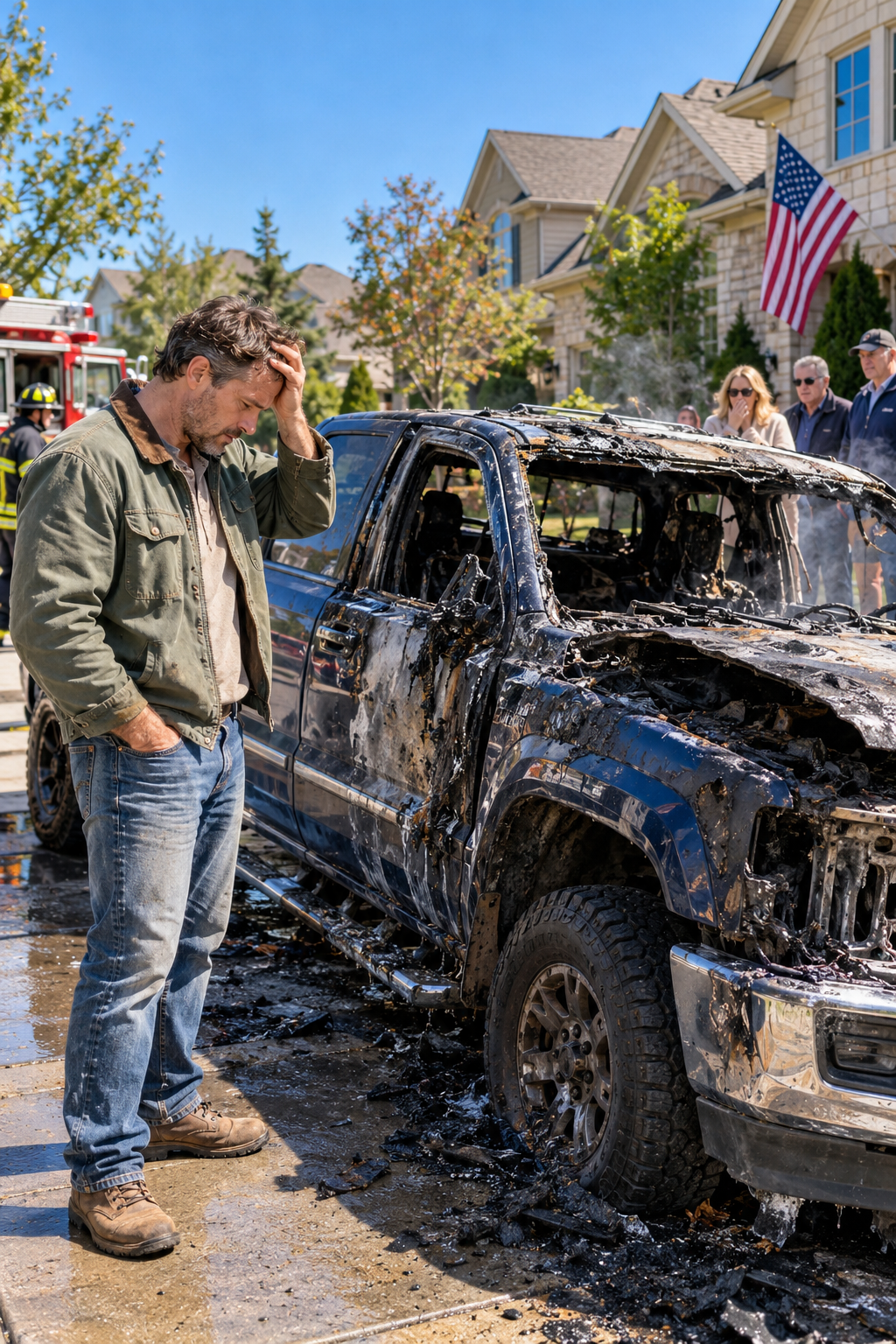
🔥HERE’S THE NEXT PART OF THE STORY, ENJOY !! The explosive twist and the final ending of this story ! ⬇️💬 Thank you ❤
I kept my voice calm.
“Interesting timing.”
For the first time, Marlene stopped smiling.
Evan stepped forward.
“Rachel, don’t make this harder than it needs to be.”
I looked at him.
“What exactly is it?”
“This thing that doesn’t need to be harder.”
He swallowed.
“The transition.”
“From what?”
“Dad’s property.”
Marlene interrupted.
“This isn’t the time.”
“No,” I said.
“I think four in the morning beside a burned truck is actually an excellent time.”
Evan looked toward Deputy Keller.
Then toward the firefighters.
He understood the trap.
Anything he said could become part of a report.
So he stepped backward.
I almost admired him for finally learning something.
The state fire marshal arrived shortly after sunrise.
His name was Samuel Ortiz.
He was in his late fifties, gray at the temples, patient eyes.
He spent fifteen minutes looking beneath the Ford.
Then he asked everyone except me to move away.
“Ms. Mercer, did you park this truck here last night?”
“Anything unusual?”
“Gasoline containers?”
“Lawn equipment nearby?”
He pointed toward the rear passenger-side wheel.
“I’m seeing something I don’t like.”
“Possible accelerant pattern.”
I said nothing.
He studied my face.
“You don’t seem surprised.”
“I received three threats in four days.”
His eyes sharpened.
“What kind?”
“Two written. One verbal.”
“Still have them?”
That surprised Marlene.
I could tell because she shifted her weight.
The first threat had been slipped beneath the front door Monday night.
LEAVE BEFORE THIS GETS EXPENSIVE.
The second arrived Tuesday afternoon.
A printed photograph of Dad’s house taken from the road.
On the back someone had written:
YOU HAVE UNTIL FRIDAY.
The verbal threat came from Greg Hale, HOA vice president.
He had blocked my driveway with his golf cart Tuesday evening and told me:
“You may have grown up here, Rachel, but Clearbrook has evolved. Don’t force people to protect what they’ve built.”
I had recorded the final thirty-seven seconds on my phone.
Greg didn’t know that.
Neither did Marlene.
Neither did Evan.
That was another lesson Dad taught me.
Never announce evidence before you know who needs to fear it.
Fire Marshal Ortiz photographed the letters.
Then I played him the recording.
When it ended, he asked, “Did you tell your brother about these?”
I watched Evan speaking to Marlene near the sidewalk.
“Because my brother stopped behaving like my brother.”
Ortiz followed my eyes.
“That’s usually when family problems become expensive.”
He gave me his card.
“Don’t throw anything away. Don’t repair anything yet. And don’t confront anyone.”
“I wasn’t planning to.”
“You’d be surprised how many people say that.”
He walked back toward the truck.
I carried the toolbox inside.
Dad had kept it behind the rear seat for years.
Old wrenches.
Electrical tape.
Tow straps.
A tire pressure gauge.
That was what I expected.
Instead, when I forced the damaged latch open, I found a second bottom.
A thin steel panel lifted beneath the tray.
Under it was a waterproof document pouch.
Inside the pouch were five things.
A brass key.
A flash drive.
A folded survey map.
A notarized letter dated eleven months earlier.
And a yellow envelope with my name written in Dad’s hand.
My fingers started trembling.
Not because of the money I suspected might be involved.
Not because the house might secretly be worth more than I knew.
Because Dad had expected this.
I opened the letter.
If you’re reading this, they either tried to take the house or frightened you enough that you finally looked inside the toolbox.
Possibly both.
There are things I should have told you while I was alive, but some truths become more dangerous when the wrong people know you know them.
Your mother and I did not build this place just for ourselves.
Before Clearbrook Ridge existed, the Mercer farm covered 146 acres.
When I sold most of it to the developer in 1998, I refused to sell three things: our home parcel, the old service road, and the twelve-acre watershed tract behind the ridge.
Those three pieces matter.
The HOA has been pretending they don’t.
Read the original development agreement before you sign anything.
Especially Exhibit D.
And Rachel?
If Evan tells you there is nothing you can do, ask him whether he has ever actually seen my signature on the transfer document.
I read that sentence twice.
Then a third time.
My brother was an accountant.
He had handled Dad’s bills during the final months.
He had access to his files.
His computer.
His signature samples.
The forged-transfer possibility stopped being theoretical.
I plugged the flash drive into Dad’s old desktop.
There were seven folders.
CLEARBROOK ORIGINAL PLAT.
ROAD LICENSE.
BOARD MINUTES.
HARRINGTON DEVELOPMENT.
And one called:
READ THIS LAST.
I didn’t open that one.
The files answered most of my questions.
In 1998, Clearbrook Ridge had been developed from land Dad sold to a company called Harrington Residential.
But Dad had retained ownership of the narrow private road connecting the neighborhood’s eastern entrance to the county highway.
The HOA had a ninety-nine-year license to use it.
One dollar per year.
There were conditions.
The road could not be transferred.
It could not be commercially exploited.
The HOA had to maintain drainage infrastructure according to county standards.
And the license could be suspended if the association knowingly used the road to facilitate unlawful seizure, trespass, or fraud involving retained Mercer property.
That clause was unusual.
Almost paranoid.
Then I saw who drafted it.
Before illness forced her to stop working, Mom had been a real-estate attorney.
I sat back in Dad’s chair.
Suddenly I could hear her voice from thirty years earlier.
Never sign what you haven’t read, Rachel.
Never assume the biggest document controls.
And never confuse confidence with authority.
I kept reading.
The watershed tract was even more important.
Nearly every stormwater channel in the upper half of Clearbrook Ridge drained through it.
The HOA did not own the retention pond.
And under a separate agreement, he allowed the association to use the watershed infrastructure as long as it remained a nonprofit residential association and maintained required environmental inspections.
The moment the association transferred its assets to a commercial developer—or knowingly falsified ownership records—the agreement could terminate.
Clearbrook Ridge had spent twenty-eight years depending on land it did not own.
That was Dad’s secret.
Not millions sitting in an account.
Protection.
A legal structure designed by two stubborn people who had once owned a farm and didn’t trust developers promising they would “take care of the community.”
But there was more.
The board minutes on Dad’s flash drive showed that Marlene, Greg, Evan, and two other directors had secretly approved a redevelopment deal.
Harrington Development—the successor company to the original builder—wanted to demolish twenty-six older homes on the east side of the neighborhood and replace them with luxury townhouses.
Dad’s house sat at the entrance to the proposed expansion.
So did three homes owned by elderly residents.
One belonged to eighty-one-year-old Ruth Callahan, who had lived there since 2001.
One belonged to Daniel Ruiz, a retired high school janitor caring for his disabled adult son.
The third belonged to ninety-year-old Walter Pierce, who used an oxygen concentrator and had once repaired Dad’s tractor for free after a winter storm.
The board had begun targeting them with violations.
Grass too high.
Mailbox wrong shade.
Wheelchair ramp improperly approved.
Trash bins visible from road.
Holiday decorations removed three days late.
Then came liens.
Then inflated legal fees.
Then purchase offers from Harrington.
Dad had been collecting copies.
That was the moral center of the entire thing.
He wasn’t protecting the house because he couldn’t let go of the past.
He was protecting people.
People the board had decided were financially inconvenient.
I closed my eyes.
That was Dad.
He would complain about a twelve-dollar restaurant tip and then quietly pay somebody’s electric bill.
He would drive a twenty-year-old truck while loaning a neighbor money for a new transmission.
He never called it generosity.
He called it “what you do when someone needs help.”
And now they had burned his truck.
By noon, I had copied every file onto three drives.
One went into my purse.
One went inside a safe deposit box at Dad’s bank.
The third went to a lawyer named Caroline Beckett.
Caroline had been my mother’s law partner twenty-five years earlier.
She was seventy-one now and supposedly semi-retired.
When I walked into her office with Dad’s documents, she looked at the first page and stopped being retired immediately.
“Where did you get this?”
“My father.”
“After somebody burned his truck.”
She removed her glasses.
“Start again.”
I told her everything.
She listened without interrupting.
When I finished, she leaned back.
“Rachel, your father came to see me fourteen months ago.”
That stunned me.
“He suspected the HOA was preparing to forge his consent.”
“Why didn’t you stop them?”
“We didn’t know who ‘they’ were.”
“Did he suspect Evan?”
Caroline looked toward the window.
That was answer enough.
My chest tightened.
“What did Dad tell you?”
“He said Evan was under financial pressure. Your brother had made several bad investments. He also said the HOA president had started inviting Evan to private meetings.”
I thought of Marlene standing beside him in the rain.
“What kind of pressure?”
“Harrington offered him something.”
“How much?”
“We never confirmed it.”
Caroline opened another file.
“But your father did something clever.”
She showed me a notarized declaration.
Dad had filed a notice with the county stating that no conveyance of his retained property would be valid unless witnessed by Caroline and accompanied by a specific authentication code.
The notice was recorded nine months before the transfer document the HOA claimed gave them Dad’s house.
Their document had neither.
“They don’t own the property,” I said.
“And they know it?”
Caroline tilted her head.
“That depends on how stupid they are.”
“Marlene isn’t stupid.”
“Evan isn’t either.”
“So they know.”
Caroline folded her hands.
“Probably.”
That changed everything.
This was no longer a property dispute.
If they knowingly recorded a false instrument, pursued liens based on it, collected money from residents, and signed a redevelopment contract using property they didn’t own, we were looking at potential criminal conduct.
Maybe conspiracy.
Maybe fraud.
Maybe forgery.
And if the fire marshal was right about my truck—
Caroline must have seen the thought cross my face.
“Do not confront them.”
“Everybody keeps telling me that.”
“Good. Maybe eventually you’ll listen.”
“What do we do?”
Caroline smiled back.
“We let them think you’re scared.”
By Thursday morning, I packed three suitcases.
I carried them out where Marlene’s security cameras could see me.
I loaded them into Caroline’s sedan because my truck was gone.
Then I drove away.
At eleven, Evan texted.
THANK YOU FOR BEING REASONABLE.
I stared at the message for a long time.
Then I replied.
I DON’T WANT TROUBLE.
His answer came immediately.
YOU’RE DOING THE RIGHT THING.
That sentence almost made me laugh.
Instead, I sent one more.
I JUST WANT DAD’S THINGS.
Evan replied:
WE CAN ARRANGE THAT AFTER THE TRANSFER.
There it was.
He thought the house was theirs.
Or wanted me to believe it was.
I spent Thursday afternoon visiting people the HOA had targeted.
Ruth Callahan opened her door wearing purple slippers and holding a violation notice.
“They say I owe eleven thousand dollars.”
“For what?”
She gave me a plastic grocery bag filled with letters.
Her original fine had been seventy-five dollars.
Late fees had turned it into four hundred.
Management charges pushed it past a thousand.
Attorney fees took care of the rest.
“They told me Harrington would buy the house and forgive everything.”
“Did you sign?”
Her eyes filled.
“Your father said the same thing.”
Of course he had.
Walter Pierce showed me six years of letters.
Daniel Ruiz had fourteen.
One cited him for leaving a mobility van in his own driveway overnight.
Another threatened fines because his son’s medical transport vehicle had a commercial logo.
By sunset, I understood how the machine worked.
Marlene supplied the aggression.
Greg supplied enforcement.
A management company called ClearPath Residential supplied the fees.
Evan supplied the numbers.
Harrington supplied the money.
And frightened residents supplied the property.
Not a bully.
A business model.
That night, Caroline filed for an emergency injunction preventing any transfer of Dad’s house.
We didn’t notify the HOA personally.
The court did that for us.
At Friday morning, Marlene called me.
I let it ring.
At she called again.
At Greg called.
At Evan called.
Then came a text from my brother.
WHAT THE HELL ARE YOU DOING?
I replied with three words.
Collecting Dad’s things.
He called again.
I answered.
“You lied to me.”
His voice was shaking.
“You said you were leaving.”
“I did leave.”
“You filed against the HOA.”
“My lawyer filed something.”
“Rachel, you don’t understand what you’re interfering with.”
That phrase interested me.
“Then explain it.”
“This deal is bigger than Dad’s house.”
Another silence.
Longer this time.
“How much do you know?”
I looked at the original development agreement spread across Caroline’s conference table.
“Enough to ask better questions.”
“Rachel, please.”
The first human word he had spoken to me all week.
“You need to withdraw the injunction.”
“Because people are committed.”
“Investors.”
“What investors?”
He breathed hard into the phone.
“You always do this.”
“Act like you’re smarter than everybody.”
“No, Evan. I read things.”
“You think that makes you better than us?”
He stopped.
There it was.
One mistake.
I wrote it down.
“Evan,” I said softly, “did you sign Dad’s name?”
He hung up.
Caroline looked at me from across the table.
“That went well.”
“Better than expected.”
At noon, Fire Marshal Ortiz called.
He had confirmed gasoline residue beneath the truck.
The fire was intentionally set.
Even more interesting, a neighbor’s doorbell camera had captured a dark SUV entering Dad’s driveway at a.m.
The license plate wasn’t visible.
But the vehicle had a broken passenger-side taillight.
I knew a vehicle with a broken passenger-side taillight.
Clearbrook Ridge HOA Security Unit Two.
Greg Hale drove it.
I did not call Greg.
I called Ortiz.
He already knew.
At three that afternoon, state investigators arrived at Clearbrook.
Not because of me.
That was the first real twist.
Someone else had already been talking.
The state attorney general’s Charitable and Nonprofit Organizations Division had received complaints about Clearbrook Ridge six months earlier.
An elderly widow named Margaret Clay had lost her house through an HOA foreclosure.
Her daughter believed the lien was fraudulent.
She had sent documents to the state.
Dad had apparently sent documents too.
Our evidence didn’t start the investigation.
It completed it.
By Friday evening, subpoenas were being prepared.
And Marlene still thought she could win.
That was the most dangerous part.
People become reckless when reality stops matching the story they have already told themselves.
Saturday morning, I returned to Dad’s house.
There was a security vehicle blocking the driveway.
Greg Hale stepped out.
“You can’t enter.”
I looked toward my porch.
“Property under HOA control.”
I held up the injunction.
“Court says otherwise.”
He didn’t read it.
“Marlene says you surrendered possession.”
“I packed suitcases.”
“You left.”
“So every vacation is a real-estate transaction now?”
His jaw tightened.
Two neighbors were watching.
I kept my voice low.
“Move your vehicle.”
“You don’t give orders here.”
“No. The court does.”
He stepped closer.
Greg was a big man.
Six-foot-three.
Former private security contractor.
He liked using size as punctuation.
I didn’t move.
He said, “Your father created a lot of problems before he died.”
I looked him directly in the eyes.
“Did that make you angry?”
His face changed.
“With what?”
“Accusations.”
“I didn’t accuse you of anything.”
He realized what I had done.
I asked questions.
They supplied the fear.
The security vehicle moved five minutes later.
Inside the house, nothing appeared disturbed.
Except Dad’s study.
One drawer had been opened.
The file cabinet lock was scratched.
Someone had searched it.
They had probably been looking for the same documents I had found in the truck.
Which meant the fire might not have been intended merely as intimidation.
They may have believed the toolbox contained evidence.
Maybe Evan had told them.
That thought stayed with me all afternoon.
Late Saturday, I opened the folder on Dad’s flash drive labeled EVAN.
There were bank statements.
And photographs.
My brother had received three payments from a consulting company called Ridge Strategic Services.
The company’s registered agent was an attorney who also represented Harrington Development.
A fourth payment was scheduled after “vacant possession of Mercer parcel.”
I stared at the screen.
Two hundred forty-nine thousand five hundred dollars.
That was what my brother had priced our father at.
Less than a quarter-million.
I expected anger.
What came instead was grief.
Almost embarrassing.
I remembered buying Evan his first suit for a college interview.
I remembered covering his rent after his divorce.
I remembered Dad defending him every time Evan failed.
“He’ll find his way,” Dad always said.
Maybe he had.
Maybe this was it.
Sunday morning, Evan came to the house.
I let him in.
He looked exhausted.
“You found the payments.”
It wasn’t a question.
“They weren’t bribes.”
“What were they?”
“Consulting fees.”
“What did you consult about?”
“Financial projections.”
“For a project requiring Dad’s land.”
He rubbed his forehead.
“You don’t understand.”
“I keep hearing that.”
“Dad was dying.”
“He didn’t need the property.”
I stared at him.
There are sentences that divide your life into before and after.
That was one.
“He didn’t need it?”
“That’s not what I meant.”
“What did you mean?”
“Harrington offered a fair deal.”
“Then why forge anything?”
His eyes snapped toward mine.
“I didn’t forge it.”
“I don’t know.”
“But you knew the transfer wasn’t real.”
He sat down.
That was answer enough.
I remained standing.
“They promised everyone would make money,” he said.
“Everyone?”
“The association. Investors. Property values would go up.”
“Ruth Callahan?”
“Would Ruth make money after you pushed eleven thousand dollars in fees onto her house?”
He looked away.
“Daniel Ruiz?”
“Walter Pierce?”
“Margaret Clay?”
His face shifted.
He knew that name.
“How many people, Evan?”
“It wasn’t supposed to happen like this.”
“How many?”
“Marlene handled enforcement.”
“And you handled money.”
“I didn’t know how aggressive she was getting.”
“You were treasurer.”
“I saw numbers.”
He stood abruptly.
“You think Dad was some saint?”
“He controlled everything. The road. The pond. The easements. He held the whole neighborhood hostage for twenty-eight years.”
“He charged one dollar a year.”
“That isn’t the point.”
“Then what is?”
“The point is he could say no.”
I understood then.
Evan didn’t hate Dad because Dad had hurt him.
He hated Dad because Dad still possessed something Evan wanted.
The ability to say no.
No to developers.
No to money.
No to pressure.
No to his own son.
Evan looked at me.
“Harrington’s expansion is worth forty-two million dollars.”
There it was.
The size of it.
Not Dad’s little house.
Not the truck.
Not my inheritance.
Forty-two million dollars of development depended on pieces of land my parents had intentionally withheld from people exactly like these.
“You could walk away rich,” Evan said.
“How rich?”
He hesitated.
“Three million personally.”
I laughed once.
Not because it was funny.
Because Dad had predicted this too.
Money would arrive disguised as inevitability.
“Three million for me?”
“And what happens to Ruth?”
“She gets bought out.”
“At what price?”
“Whose market?”
He didn’t answer.
I stepped closer.
“Did you know they burned the truck?”
I watched him carefully.
“I swear, Rachel.”
For the first time, I believed him.
Not because I trusted him.
Because fear looked different from guilt.
Evan was afraid.
“They’re losing control,” he whispered.
He shook his head.
Another shake.
“There are people above them.”
“Harrington?”
He looked toward the window.
“Walk away.”
“Because this stopped being about the HOA months ago.”
That was the second twist.
And the one Dad had been warning me about.
The HOA was not the top of the system.
It was the tool.
I asked, “Who ordered the truck burned?”
“I don’t know.”
“But you suspect.”
His silence answered.
I lowered my voice.
“Then help me.”
“Can’t or won’t?”
“They have everything.”
He looked at me.
“On everybody.”
He left ten minutes later.
But before he reached the door, I asked one final question.
“Did Dad ever show you Exhibit D?”
Evan stopped.
His shoulders stiffened.
He was lying.
That afternoon, state investigators executed search warrants at the HOA office.
Marlene tried to stop them.
Neighbors filmed the entire thing from sidewalks.
Boxes came out.
Computers came out.
Financial records came out.
At p.m., investigators removed a locked metal cabinet.
Inside were unsigned deed templates for nine homes.
Every homeowner was over seventy.
Four lived alone.
Two had serious medical conditions.
One was Ruth Callahan.
One was Walter Pierce.
The state froze the HOA’s foreclosure actions before midnight.
Monday morning, Greg Hale was arrested.
Not for the fire.
He was charged with evidence tampering after surveillance footage showed him removing the HOA security server three hours after my truck burned.
Investigators recovered it from a storage unit.
He had deleted the driveway recordings.
He hadn’t deleted them correctly.
At a.m., Security Unit Two entered Dad’s road.
At , it returned.
At , the neighbor’s camera saw the SUV enter my driveway.
At , it left.
Twenty-three minutes later, the truck was on fire.
Greg lasted fourteen hours before asking for a lawyer.
Marlene lasted twenty-seven before blaming Greg.
Evan lasted two days.
Wednesday afternoon, my brother walked into the state attorney general’s regional office carrying a laptop.
He requested immunity discussions.
I wasn’t there.
I learned about it later.
Apparently, the laptop contained accounting records proving Harrington had routed more than $1.8 million through consulting companies connected to HOA officers in four communities.
Clearbrook Ridge was just the latest.
By Thursday, Marlene Whitcomb was arrested at her home.
Two counts of conspiracy.
Multiple fraud-related charges.
Attempted theft by deception.
Forgery-related offenses.
Witness intimidation.
The arson investigation remained open.
The news vans arrived before breakfast.
For six years, Marlene had walked through Clearbrook Ridge as though the sidewalks belonged to her.
Now she walked down her driveway between two state investigators while half the neighborhood watched.
She saw me standing beside Ruth Callahan.
Marlene stopped.
Only for a second.
Her face contained something I had never seen there before.
Not regret.
She still could not understand how she had lost.
People like Marlene rarely fear consequences until consequences stop asking permission.
The state moved quickly after that.
An emergency court hearing was scheduled regarding the HOA’s corporate status.
Investigators presented evidence of fraudulent liens, unauthorized property transfers, concealed developer payments, altered meeting minutes, and misuse of association funds.
ClearPath Residential terminated its contract and claimed it had been misled.
Harrington Development suspended its Clearbrook project and blamed “rogue local representatives.”
Everyone suddenly became innocent alone.
Funny how systems work that way.
They coordinate while profitable.
They become strangers when subpoenas arrive.
At the hearing, the judge asked whether the association could continue functioning with an interim board.
The state attorney’s answer was simple.
Too many records had been corrupted.
Too many directors were compromised.
Too many enforcement actions were potentially fraudulent.
The attorney general requested judicial dissolution of the nonprofit HOA corporation and appointment of a temporary receiver to preserve legitimate common services while property rights were untangled.
Then Caroline stood.
She carried one folder.
The courtroom became quiet.
Caroline explained that the association’s eastern access road, watershed infrastructure, and several utility-support parcels were never conveyed to the HOA.
They remained part of the Mercer family trust.
Marlene’s attorney objected.
Caroline smiled.
Then she produced twenty-eight years of recorded documents.
Original deeds.
Tax payments.
County acknowledgments.
And Dad’s authentication declaration.
The judge read in silence.
Then looked toward Marlene.
“Your redevelopment contract represents that the association owns these parcels.”
Marlene stared at her attorney.
Her attorney stared at the table.
The judge continued.
“Who verified ownership?”
Nobody answered.
I almost heard Dad laughing.
The biggest piece of paper.
The smallest forgotten one.
The judge dissolved Clearbrook Ridge Homeowners Association that afternoon.
Not the neighborhood.
Not the community.
The corporation that had spent years pretending it was the same thing.
Residents would form a new voluntary maintenance association later, limited to roads, landscaping, drainage, and common services.
No foreclosure power.
No predatory fines.
No secret development deals.
Ruth’s lien disappeared.
Daniel’s disappeared.
Walter’s disappeared.
Margaret Clay’s daughter was allowed to reopen the foreclosure case that had taken her mother’s home.
The state receiver began auditing six years of collections.
Harrington withdrew entirely when it became obvious that acquiring Dad’s retained parcels would require negotiating with me.
Their attorney offered four million dollars.
I declined.
“Ms. Mercer,” their attorney finally said, “everyone has a number.”
I looked through Caroline’s conference-room window toward the mountains.
“My father did.”
“What was his?”
“One dollar.”
The attorney frowned.
“For what?”
“The road.”
He understood.
Dad had never been against development.
He had been against people using development to erase neighbors who couldn’t fight back.
So I made my decision.
The road license would continue.
One dollar per year.
The watershed agreement would continue.
One dollar per year.
Ruth could stay.
Daniel could stay.
Walter could stay.
Any future association could maintain shared infrastructure but could never use Dad’s property to support forced commercial redevelopment of owner-occupied homes.
Caroline drafted it.
I signed it.
That was my inheritance.
Not a mansion.
Not three million dollars.
Not forty-two million dollars of potential development.
The right to say no when people with more money believed everyone eventually had to say yes.
Three weeks after the fire, I stood in Dad’s driveway while a tow truck removed the burned Ford.
The neighborhood was quiet.
No security patrol.
No violation letters.
No golf carts stopping people over mailbox colors.
Ruth brought lemonade.
Daniel brought sandwiches.
Walter came slowly with his walker.
Somebody placed a folding chair beneath Dad’s oak tree.
For the first time since the funeral, Clearbrook felt like the neighborhood I remembered.
Evan arrived near sunset.
Nobody spoke to him.
He had reached an agreement with prosecutors.
He would testify.
He would repay the money.
He would probably lose his accounting license.
Whether he served time would depend on the judge.
He looked smaller.
Not physically.
He walked toward me.
“I’m sorry.”
He waited for something more.
Forgiveness, probably.
People often want forgiveness to arrive immediately after confession, as though honesty is a receipt that cancels damage.
I wasn’t cruel.
But I wasn’t generous with something that hadn’t healed.
“Why did you do it?” I asked.
He stared at the burned shell of Dad’s truck.
“I was tired.”
“Being the son who always needed help.”
That answer surprised me.
“Dad never saw you that way.”
He looked toward the house.
“You were always the capable one.”
“You fixed things. Mom trusted you. Dad trusted you. When he got sick, everybody called you.”
“You could have come.”
“You could have helped.”
“You could have asked.”
His eyes filled.
That was enough.
Not forgiveness.
Sometimes truth is the first honest thing left after everything else burns.
He reached into his jacket.
“I found something.”
My body went still.
“When investigators searched the HOA office, they gave me personal items that weren’t evidence.”
He held out a small brass key.
It looked almost identical to the one in Dad’s toolbox.
“This was taped inside the back of Dad’s old accounting folder.”
“What does it open?”
“I don’t know.”
Then Evan handed me an envelope.
Dad’s handwriting.
FOR RACHEL.
ONLY AFTER CLEARBROOK IS SAFE.
I stared at it.
Evan stepped backward.
“I never opened it.”
I believed him.
That night, after everyone left, I sat alone at Dad’s kitchen table.
The house sounded the way old houses do after midnight.
Refrigerator humming.
Pipes settling.
Branches brushing the roof.
I placed the first brass key beside the second.
Then I remembered the final folder on Dad’s flash drive.
READ THIS LAST.
I opened the computer.
Clicked it.
Password protected.
One hint appeared.
YOUR MOTHER’S LAST QUESTION.
My breath caught.
Mom had died eleven years earlier.
Near the end, when morphine blurred most of her sentences, she had repeatedly asked Dad something strange.
“Did they ever find the original?”
I had assumed she meant her will.
Or some family photograph.
Or an old legal file.
Now I wasn’t sure.
I opened Dad’s new envelope.
Inside was one page.
If Clearbrook is safe, then you did what I hoped you would do.
I’m proud of you.
But the HOA was never the whole problem.
Your mother discovered something during the original Harrington closing in 1998.
Something that made a powerful man very angry.
She hid the original document before she became ill.
I never found it.
I believe Harrington has spent twenty-eight years trying to determine whether we still had it.
That is why I kept the road.
That is why I kept the watershed tract.
And that is why you must be careful.
The second key belongs to a safe-deposit box your mother opened under her maiden name.
I stopped reading.
There was one final sentence.
If the box is empty, do not tell Evan.
I read it again.
Then I heard tires crunching slowly over the gravel outside.
Not a neighbor.
Not a delivery.
It was after midnight.
Headlights swept across Dad’s kitchen wall.
A dark sedan stopped at the edge of the property.
Nobody got out.
My phone vibrated.
Unknown number.
YOU SHOULD HAVE TAKEN THE THREE MILLION.
I looked through the window.
The sedan’s headlights went dark.
I didn’t panic.
I didn’t call Evan.
I didn’t walk outside.
I took a photograph of the vehicle.
Sent it to Fire Marshal Ortiz.
Sent another to Caroline.
Then I placed Mom’s key inside my pocket.
The sedan remained there another thirty seconds.
Then it slowly reversed toward the road.
Before it disappeared, I whispered the question that sounded almost helpless.
“Why are you so afraid of what my mother left me?”
✓ Lynn R. Adams
🔥HERE’S THE NEXT PART OF THE STORY, ENJOY !! The explosive twist and the final ending of this story ! ⬇️💬 Thank you ❤ I kept my voice calm. “Interesting timing.” For the first time, Marlene stopp…