The HOA Bulldozed My Well Shed and Left 438 Homes Dry—They Didn’t Know My Father Had Buried the Only Valid Water Deed
The HOA Bulldozed My Well Shed and Left 438 Homes Dry—They Didn’t Know My Father Had Buried the Only Valid Water Deed
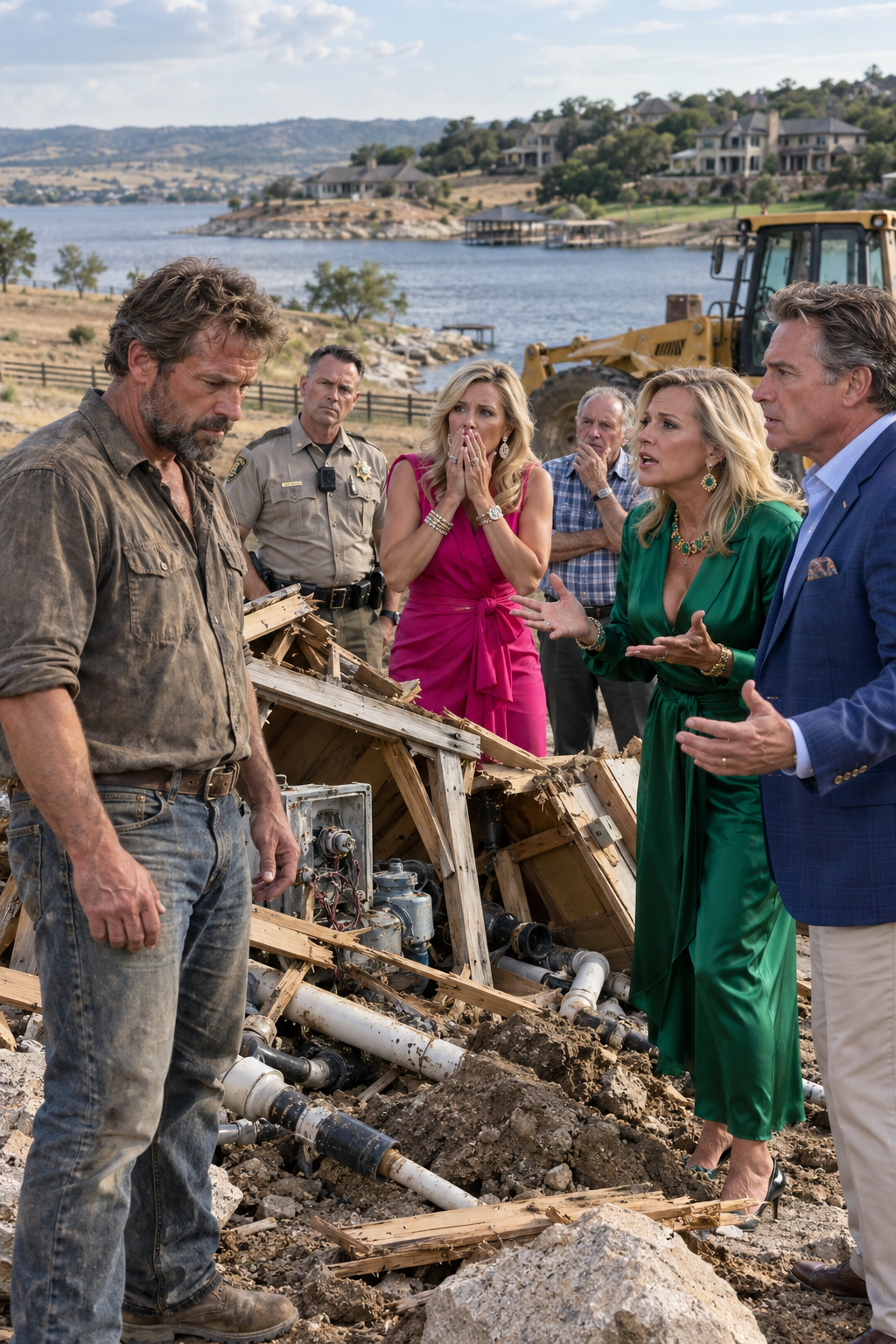
The bulldozer hit my father’s well shed at on a Tuesday morning while my younger brother stood beside the HOA president holding a spare key to my ranch.
At , faucets inside 438 homes began coughing air.
By , the woman who had ordered my building flattened was pointing at me in front of two sheriff’s deputies and saying, “Arrest her. She shut off our water.”
I looked at the wreckage behind her.
Then I looked at my brother.
Grant wouldn’t meet my eyes.
That hurt more than the bulldozer.
The shed had been nothing fancy.
Twelve feet by sixteen.
Cedar siding gone gray with age.
A rusted green roof.
One little window facing Bellweather Lake.
My father had built it in 1984 with lumber he milled himself, and he had carved three tiny lines into the doorframe to mark my height when I was nine, eleven, and thirteen.
Now the roof was folded beneath the blade of a yellow Caterpillar.
The pressure manifold lay twisted in the mud.
A steel control cabinet had been ripped from its concrete pad.
Blue electrical conduit stuck out of the ground like broken veins.
And under one shattered wall, still visible through dirt and splintered cedar, was the corner of a brass plate my father had told me never to remove.
Rebecca Sloan saw me staring at it.
She smiled.
Rebecca had been president of the Silver Pines Lake Association for six years, and everything about her looked expensive enough to make people hesitate before telling her no.
Cream-colored slacks.
White leather loafers that should never have been near ranch mud.
Diamond studs.
A fitted emerald jacket.
Perfect ash-blonde hair.
She was fifty-four and had the kind of smile that didn’t appear until someone else had lost something.
“This structure was inside the utility corridor,” she said.
“No,” I replied.
She blinked.
People were used to giving Rebecca paragraphs.
I gave her one word.
Behind her stood Clifton Hale, the developer who had spent three years buying parcels around the east side of the lake.
He wore a navy field jacket over a shirt that probably cost more than my first pickup.
Beside him was Martin Voss, the HOA attorney.
Beside Martin stood Darren Pike, the contractor whose excavator had just destroyed a seventy-year-old family water station because somebody had handed him a permit with three signatures and a highlighted map.
And beside Darren stood Grant.
My brother.
Fifty-six years old.
Silver at the temples.
Soft hands.
Brand-new boots with no mud above the soles.
In his right hand was the brass ring containing the spare key to my north gate.
The same key I had given him fourteen years earlier when his daughter got married at the ranch.
“Where did you get that?” I asked.
Grant finally looked at me.
“Nora, don’t make this ugly.”
That was when I knew.
Not suspected.
My brother had not wandered into Rebecca’s plan.
He was part of it.
Sheriff’s Deputy Miles Carter stepped between us.
He was a decent man.
He knew me.
He had bought hay from my father.
His son had fished our west cove since high school.
“Nora,” he said quietly, “Rebecca says the association has recorded rights to this site.”
“Then she should show them.”
Martin Voss immediately lifted a leather folder.
“We have the deed.”
Rebecca smiled again.
Grant stared at the mud.
I said nothing.
That unsettled them.
I could see it.
Rebecca expected rage.
Martin expected threats.
Grant expected me to say something about Dad.
Clifton expected a frightened ranch woman to start talking fast enough to make a mistake.
Instead, I walked past them.
I stepped over a piece of broken siding.
I knelt beside the crushed doorframe.
Then I reached under a slab of cedar and pulled free a small blackened object about the size of a deck of cards.
It was an old tobacco tin.
My father had not smoked in forty-one years.
He kept tobacco tins anyway.
For fence staples.
Things he believed the world would eventually try to steal.
Grant’s head snapped up when he saw it.
Rebecca’s smile disappeared.
I wiped the dirt from the lid with my thumb and slipped the tin into my jacket pocket.
“What’s that?” Martin asked.
Rebecca took a step toward me.
“This is now association utility property.”
“No,” I said again.
That second no bothered her more than the first.
Because by then phones were ringing.
One after another.
Then another.
Darren’s foreman answered his first.
His face changed.
“Pressure dropped?”
Another phone.
Clifton checked his.
From somewhere down the hill, a truck horn sounded three times.
A man in an orange vest came running up the service road.
“Main loop is collapsing,” he shouted. “We’ve lost pressure at Stations Three, Four, and Five.”
Rebecca turned toward me.
“What did you do?”
“Turn it back on.”
Her face hardened.
That distinction would matter later.
At , Darren Pike’s bulldozer had pushed through the west wall of the well shed.
At , the blade had crushed the primary chlorination feeder.
At , the excavator had severed one of two control cables from the deep-well array.
At , the ranch safety system detected loss of telemetry and shut three pumps down automatically.
At , the elevated tanks serving Silver Pines began losing pressure.
At , the highest houses lost water first.
At , the first emergency call reached county dispatch from a homeowner whose oxygen concentrator humidifier needed distilled water.
By , Rebecca Sloan was trying to have me arrested for the consequences of her own bulldozer.
And I still hadn’t raised my voice.
People mistake silence for weakness because weakness is easier to understand.
Silence makes them wonder what you know.
I had stayed when Grant left.
I had stayed when Mom got sick.
I had stayed when Dad’s hip gave out.
I had stayed through drought, debt, funerals, surgeries, frozen pipes, wildfire smoke, and five summers when the lake dropped low enough to expose the old stone fences beneath it.
I had stayed when everyone called the ranch a burden.
I had stayed long enough to learn exactly what the burden was worth.
And I had learned something else.
My father never trusted a handshake that involved water.
Bellweather Ranch covered 5,612 acres in northern Missouri.
Most people simply called it the Whitaker place.
My great-grandfather had assembled it from twelve smaller farms between 1919 and 1937.
At the center sat Bellweather Lake, a long blue body of water fed by limestone springs and two creeks flowing south through wooded ridges.
The lake itself was not natural.
My grandfather and forty-two local farmers had built the first earthen dam after the Dust Bowl years, mostly for cattle, irrigation, and fire protection.
By the 1960s, people from Kansas City began buying weekend cottages along the eastern shoreline.
Weekend cottages became permanent homes.
Permanent homes became subdivisions.
Subdivisions became Silver Pines.
By the time Rebecca Sloan arrived, Silver Pines had stone entrance columns, a tennis club, three pools, private security, a marina, and 438 houses averaging more than $900,000 each.
But the water still came through pipes connected to wells on our ranch.
That part mattered.
My father never bragged about it.
In fact, he rarely mentioned it.
The original water arrangement began during a brutal drought in 1988.
Silver Pines had only fifty-seven homes then.
Their shallow community wells went bad.
Then bacteria.
Dad let them connect temporarily to the ranch system.
Not because he was a businessman.
Because families had kids.
Because old people needed toilets.
Because the volunteer fire department needed hydrants.
The agreement was supposed to last eighteen months while Silver Pines built its own system.
They never did.
One year became five.
Five became twenty.
Twenty became almost forty.
The HOA paid operating costs.
Dad maintained the pumps.
No one got rich.
That was intentional.
When Rebecca became president, she decided anything that had existed long enough must belong to her.
She renovated the clubhouse.
Raised dues.
Hired security.
Changed marina rules.
Fined residents for mailbox colors.
Then she began calling the ranch water system “our utility.”
Dad corrected her every time.
“Our homes depend on it,” she told him once.
“That doesn’t make it yours,” he answered.
I was standing ten feet away.
Rebecca laughed.
Dad didn’t.
He had turned eighty by then.
Hands bent from arthritis.
Shoulders narrow.
Eyes still sharp.
Later that night, he handed me a brass key.
Square-headed.
Number seven scratched into one side.
“If anybody ever tears into the well house,” he said, “you open the box before you open your mouth.”
I asked what box.
He took another sip of coffee.
“You’ll know.”
That was Walter Whitaker.
He could turn a legal emergency into a scavenger hunt.
He died eleven months later.
Grant arrived for the funeral in a black Lexus.
He stayed six days.
On the third day, he told me we needed to “professionalize the ranch.”
On the fourth, he brought an appraiser.
On the fifth, he had the locks changed on Dad’s farmhouse.
I came back from the south pasture and found my key no longer worked.
Grant was standing on the porch.
“Nora, the house is part of the estate.”
I stared at him.
I had lived there eighteen years.
I had cooked Dad’s meals.
Managed his medication.
Driven him to cardiology appointments in Columbia.
Bathed him after his second surgery.
Signed payroll when he couldn’t hold a pen.
Refinanced my own little rental house to cover ranch taxes during the 2019 cattle crash.
Grant had visited at Christmas.
But he stood on the porch four days after we buried our father and told me I had to leave.
“You can stay in the bunkhouse temporarily,” he said.
I remember staring at his polished shoes.
Not crying.
Not screaming.
Not asking why.
I just walked to my truck.
Grant called after me.
“Aren’t you going to say anything?”
I turned around.
“Did Dad give you a copy of the trust?”
That was all.
Grant’s face changed for half a second.
Then he smiled.
“I’m executor.”
“That wasn’t my question.”
Three days later, my attorney filed the recorded memorandum showing that most of Bellweather Ranch had been placed into the Whitaker Land and Water Trust twelve years before Dad died.
Dad’s probate estate included the farmhouse contents, vehicles, cash accounts, and a few small parcels.
Not the 5,600 acres.
Not the lake.
Not the main wells.
Not the springs.
Not the underground water rights.
Grant had not inherited half the ranch.
Neither had I, technically.
I had become successor trustee.
There was a difference.
A very big one.
Grant stopped returning my calls after that.
Then, six months later, he started speaking to Rebecca Sloan.
I didn’t know it at first.
They were careful.
Rebecca called asking for “updated utility documentation.”
Martin Voss sent letters describing the water arrangement as a “perpetual easement.”
Clifton Hale’s surveyors began appearing near the eastern boundary.
Twice I found orange stakes inside our fence.
Once I found a drone hovering over Well Seven.
I sent notices.
I documented everything.
And then I did the thing people like Rebecca mistake for fear.
The county had issued no demolition permit for the well shed.
The state had issued no authorization to alter the pump system.
The trust had granted no access.
So how had they arrived with a bulldozer, an excavator, a utility crew, an attorney, and my brother carrying my gate key?
That was the question.
Not how angry I should be.
Not how expensive the shed had been.
Not whether Rebecca had insulted me.
The question was how deep the lie went.
Deputy Carter stepped toward the wreckage.
“Everybody stop moving equipment.”
Rebecca spun around.
“You cannot shut down an active utility conversion.”
Carter looked at the broken chlorination line.
“I can shut down a possible crime scene.”
Martin raised his hands.
“Let’s not dramatize this.”
Carter looked at him.
“Four hundred thirty-eight homes are losing water.”
“That is because Ms. Whitaker has refused to cooperate.”
I almost admired how smoothly he said it.
Then Rebecca’s phone rang again.
She answered.
She listened.
Her eyes moved toward me.
“What do you mean the school?”
Silver Pines Academy sat outside the gated residential section but used the same pressure loop.
Its kitchen had lost water.
So had the fire station.
That ended the performance.
By , the county emergency management office was involved.
By , a water tanker was dispatched from a neighboring district.
At , I called ranch manager Eli Boone.
“Open the south livestock standpipe.”
“For the HOA?”
“For anybody who needs water.”
There was a pause.
“You sure?”
Rebecca heard me.
Her expression became almost triumphant.
“You see?” she said to Carter. “She controls it.”
I looked at her.
“I control my standpipe.”
“You control the entire system.”
“I control ranch equipment located on trust land.”
“Then restore service.”
There it was.
The word she wanted.
She stepped forward.
“So you admit you’re withholding water.”
“I’m refusing to restart three deep wells through a destroyed treatment station until a licensed engineer confirms the system is safe.”
Martin interrupted.
“That is unnecessarily cautious.”
I turned to Deputy Carter.
“Would you drink from a system after a bulldozer crushed its chlorine feeder?”
Carter looked at Martin.
Martin said nothing.
A woman in expensive workout clothes came running up the road from the subdivision.
Her hair was wet with shampoo.
Actually wet.
Foam still near one ear.
“What happened?”
Rebecca walked toward her.
“We’re handling it.”
“My mother is on dialysis.”
“Bottled water is coming.”
“You told us last month the new utility project guaranteed uninterrupted service.”
Rebecca’s eyes flickered.
New utility project.
That was the first public crack.
The residents did not know what Rebecca had done that morning.
But apparently she had told them something.
Within forty minutes, cars were lining the county road.
Residents stood outside the gate.
Phones out.
Children in pajamas.
A man carrying two empty five-gallon jugs.
A woman with a baby.
Two elderly couples.
One homeowner shouted, “Why is there construction on the ranch?”
Rebecca tried to move everybody back.
Then a white county pickup arrived.
Out stepped Dr. Ellen Marlowe from the county health department.
Ellen was sixty-two, small, practical, and almost impossible to intimidate.
She walked straight to the broken chlorination feeder.
Looked at it.
Looked at the severed control lines.
Then looked at Darren Pike.
“Who authorized demolition?”
Darren pointed at Martin.
Martin pointed verbally at paperwork.
Rebecca pointed at me.
Nobody pointed at Grant.
That interested me.
Ellen pulled on blue gloves.
“This system is offline until inspection and bacteriological clearance.”
Rebecca’s voice rose.
“How long?”
“Minimum twenty-four hours after repairs and testing. Possibly longer.”
The crowd outside the gate heard her.
The shouting started.
Rebecca turned on me.
“You’re enjoying this.”
That was one of the things she never understood.
I knew people inside Silver Pines.
Retired mechanics.
Families who had spent everything to buy one pretty house near a lake.
They were not Rebecca.
They were not Martin.
They were not Grant.
Their toilets didn’t flush because powerful people had gambled with something ordinary people needed.
I stepped closer to her.
“No one should lose water because you wanted control.”
For the first time that morning, Rebecca looked uncertain.
Then Grant finally spoke.
“Nora, we can fix this if you stop fighting.”
He looked older than he had at Dad’s funeral.
Not guilty.
Just tired.
That was worse.
“Fighting what?”
“The sale.”
There it was.
Rebecca closed her eyes briefly.
Martin looked furious.
Clifton Hale stared at Grant as if he wanted to push him into the lake.
I asked, “What sale?”
Grant swallowed.
He had always been bad at silence.
As children, if Dad stared at us long enough, Grant confessed things nobody had accused him of.
“The corridor parcel.”
“What corridor parcel?”
“The association bought it.”
“From whom?”
He looked at me.
Then I understood why he had the gate key.
Why Rebecca had a deed.
Why Clifton’s surveyors had been mapping the wells.
Why they had arrived like people walking onto property they already believed belonged to them.
Grant had sold them something.
Something he thought he owned.
Rebecca stepped in quickly.
“The association acquired all rights necessary to control, modernize, and operate the water infrastructure.”
“From my brother?”
“From a lawful beneficiary.”
I looked at Grant.
“How much?”
“Nora, this isn’t the place.”
“How much?”
He rubbed his jaw.
“Eight hundred fifty thousand.”
The ranch seemed to go very quiet.
Even with people shouting at the gate.
Eight hundred fifty thousand dollars.
For land he didn’t own.
For wells he didn’t own.
For water rights he didn’t own.
And he had done it using Dad’s name.
I felt something cold settle inside me.
Grief is hot at first.
This was colder.
Dad had defended Grant his entire life.
When Grant crashed a tractor at seventeen, Dad repaired it.
When Grant dropped out of college, Dad paid his rent.
When Grant’s first business failed, Dad guaranteed the loan.
When Grant got divorced, Dad paid his attorney.
When Grant said ranching was “a dead man’s life,” Dad still left him the lake cabin, investment accounts, and the family’s Kansas City property.
More than enough.
But apparently not enough to keep him from selling my father’s water.
Grant stepped closer.
“You got the ranch.”
“I got responsibility.”
“You got five thousand acres.”
“I got five thousand acres with taxes, payroll, fencing, dams, roads, cattle, erosion control, pump maintenance, firebreaks, and forty years of deferred repairs.”
“It’s worth tens of millions.”
“So that makes theft reasonable?”
His face flushed.
Rebecca interrupted.
“This family argument is irrelevant. The deed was reviewed by counsel.”
I turned toward Martin.
“Did you review the trust?”
He hesitated.
Only slightly.
But I saw it.
“What trust instrument did you review?” I asked.
Martin opened his folder.
“I’m not conducting a title seminar in the mud.”
“Then don’t.”
I reached into my pocket.
The tobacco tin was still there.
Dad’s voice came back to me.
If anybody ever tears into the well house, you open the box before you open your mouth.
I had not opened it yet.
I knew better than to do that in front of them.
So I stepped away.
Rebecca followed.
“Where are you going?”
“To call my attorney.”
“You need to authorize repairs.”
“The health department already shut the system down.”
“You know what I mean.”
She didn’t want repairs.
She wanted acknowledgment.
If I signed a work authorization treating the HOA as owner or operator, Martin would use it later.
A little signature.
A little emergency consent.
A little sentence written under pressure.
Dad had spent eighty-one years teaching me that people rarely steal ranches with guns.
They steal them with paper.
I walked fifty yards to my truck.
Locked the doors.
Pulled out the tin.
The brass key fit a tiny lock under its folded metal lip.
Inside were three things.
A folded letter.
A flash drive.
And another key.
This one was silver.
I opened the letter first.
Dad’s handwriting shook near the end, but I recognized every stroke.
If you are reading this because somebody tore down the well house, then Rebecca finally stopped pretending.
I laughed once.
Couldn’t help it.
Then I kept reading.
The 1988 agreement is a license, not an easement.
The 1996 amendment did not change that.
The trust owns the source wells, collection pipes, lake recharge rights, and every inch of land beneath the treatment site.
Grant cannot convey them.
Neither can any probate executor.
If they claim otherwise, somebody is using the unsigned draft from 2003.
Do not argue about the shed.
Do not argue about the pumps.
Pull Book 19.
Then ask why the county’s copy of Exhibit C is missing page four.
My hands stopped.
I read that line again.
Why the county’s copy of Exhibit C is missing page four.
Below it, Dad had written:
If page four is missing, this is bigger than Rebecca.
The final line was underlined twice.
Do not save people from the consequences of a lie by joining the lie.
I stared through the windshield at my brother.
Grant was talking to Martin.
Martin was talking to Clifton.
Rebecca was pointing toward the residents at the gate.
I looked back at the letter.
The silver key.
Dad had not hidden proof because he distrusted one HOA president.
He had hidden proof because he thought someone might alter a public record.
I called my attorney, Claire Benton.
She answered on the second ring.
“I’m in court in twenty minutes.”
“Dad left me a letter.”
Claire had represented him for twenty-seven years.
“What kind of letter?”
“Book Nineteen.”
Another silence.
Then: “Where are you?”
“At the north well.”
“Is anybody with you?”
“About eighty people.”
“Nora, do not show that letter to anyone.”
“I wasn’t planning to.”
“Is the well house intact?”
Claire swore.
Claire never swore.
“Listen carefully. Go to First County Bank in Ashbridge. Dad kept a document box there.”
“What’s in Book Nineteen?”
“I don’t know.”
“You knew about the box.”
“I witnessed instructions for access. I never saw the contents.”
“I’m serious.”
She lowered her voice.
“Your father said I was not to open it unless you brought the B-19 key.”
I looked at the silver key.
“You’re coming?”
“I’m leaving court to my associate.”
That told me more than anything else.
Claire Benton did not abandon a hearing.
I stepped out of the truck.
Rebecca immediately walked toward me.
“Good. We need you to sign an emergency access agreement.”
Her jaw tightened.
“We have hundreds of residents without water.”
“And tankers arriving.”
“That is not a solution.”
“Neither is restarting damaged treatment equipment.”
Martin joined her.
“We can draft language preserving disputed claims.”
“Then draft it.”
“You’ll sign?”
“Then why would I draft it?”
“To keep busy.”
Deputy Carter coughed into his fist.
I’m fairly sure he was hiding a laugh.
Grant walked over.
“Nora, enough.”
I looked at him.
He lowered his voice.
“You don’t understand what’s at stake.”
That sentence interested me.
“What’s at stake?”
“The community.”
His eyes shifted.
“The project.”
Rebecca’s head snapped toward him.
Grant closed his mouth.
He couldn’t stand it.
“What project?” I asked.
So I looked at Clifton.
He had been the quietest one all morning.
Developers understand the value of letting other people say too much.
“Mr. Hale?”
He smiled politely.
“This is not the time.”
Which meant it was exactly the time.
I walked away.
By noon, the entire county knew Silver Pines had lost water.
By one, a local television truck was parked outside the gate.
By two, residents had formed a line at the south standpipe.
We filled buckets, storage tanks, coolers, livestock tubs, anything clean enough to carry water.
I had Eli bring every ranch hand to help.
No questions.
One man tried to hand me a twenty.
I pushed it back.
“Buy batteries for somebody who needs them.”
A woman named Carol Jenkins stood near the standpipe holding two red gasoline cans she had scrubbed out three times.
“I know these aren’t ideal,” she said.
“Don’t use them for drinking.”
“It’s for toilets.”
We filled them.
She glanced toward the ridge where the wrecked well shed sat.
“My husband voted for Rebecca.”
“I’m not keeping score.”
“She said you were trying to extort us.”
“For what?”
“She said you demanded four million for the water corridor.”
That stopped me.
“I never demanded anything.”
Carol’s face changed.
“She showed slides at the annual meeting.”
“What slides?”
“A land acquisition plan.”
“How long ago?”
“Six weeks.”
Rebecca had been preparing residents to believe I was the villain before she ever sent the bulldozer.
That took planning.
I asked Carol, “Did she say who owned the corridor?”
“The HOA. After the acquisition.”
“From whom?”
“She said a Whitaker family interest.”
I looked across the pasture.
Grant’s betrayal had not begun Tuesday morning.
It had begun months earlier.
Maybe years.
By three-thirty, Claire arrived in her dusty Volvo.
She did not go to the well site.
She drove straight to me.
We left in my truck.
Neither of us spoke during the twelve-mile drive.
First County Bank occupied an old limestone building on Ashbridge Square.
The manager, Paul Renner, took us downstairs.
Safe-deposit room.
Box 19 was longer than I expected.
The silver key turned.
Inside were four binders.
A sealed envelope.
Two survey rolls.
And an old leather ledger.
Claire stared at the top binder.
“Oh, Walter.”
She pointed.
On the cover, Dad had written:
BELLWEATHER WATER ESTATE — ORIGINALS — DO NOT SURRENDER.
We took the box into a private room.
The first binder contained the 1988 license.
Temporary water service.
Revocable under defined conditions.
No transfer of ownership.
No permanent easement.
No right to modify source infrastructure.
No right to enter ranch property without written permission.
The second binder contained amendments.
The third contained surveys.
The fourth contained title records.
Then we found Exhibit C.
Page three.
Claire read it twice.
Then she sat back.
“That son of a bitch.”
“I don’t know yet.”
Page four was simple.
Three paragraphs.
The third said all water-system rights granted to Silver Pines terminated automatically if the association transferred, pledged, excavated, demolished, encumbered, or asserted ownership over source infrastructure without written consent of the ranch owner.
Automatic termination.
No cure period.
Dad had built a poison pill into the agreement thirty years ago.
Not to hurt homeowners.
To stop a future board from taking the wells.
Claire opened her laptop.
“I need the county record.”
She logged into the recorder’s database.
The scanned public copy of Exhibit C had three pages.
I felt the room change.
“Could it be a scanning mistake?”
“Do you believe that?”
She searched the index history.
A digitization note appeared from 2004.
Then a correction entry.
Then another.
Claire frowned.
“The amendment file was rescanned in 2017.”
“When Rebecca became president.”
“Within two months.”
“Who requested it?”
The system didn’t say.
But the certification initials belonged to someone at the county recorder’s office.
Claire copied everything.
Then she opened the sealed envelope.
Inside was a letter from Dad to her.
Claire read silently.
Her face hardened.
She handed it to me.
If Nora brings you the key, assume someone has attempted to convert the Silver Pines water license into ownership.
I became concerned in 2017 when I found a county copy missing one page. I filed a certified duplicate through separate counsel and retained proof of receipt.
Do not confront anyone until you compare the certification numbers.
There are two Exhibit Cs in circulation.
One is mine.
One is not.
Below that was a receipt from the state land records archive.
Dad had deposited certified originals there.
He had built redundancy into the truth.
Because he expected someone to attack it.
Claire whispered, “He knew.”
“He suspected.”
“Same difference now.”
My phone rang.
I answered.
“You need to get back.”
“What happened?”
“Bank people.”
“What bank people?”
“Three black SUVs at the clubhouse. Rebecca’s having some kind of meeting.”
Clifton Hale.
The project.
The rush to control water.
It clicked.
“What project needs bank financing?”
Claire looked at me.
I was already standing.
“Rebecca didn’t bulldoze a shed because she wanted smart meters.”
We drove back.
At the Silver Pines entrance, residents were everywhere.
Word had spread that the outage could last two days.
The association had opened the clubhouse as an emergency center.
We parked outside.
I had never been inside before.
Marble foyer.
Stone fireplace.
A wall of framed architectural renderings.
One of them showed what Silver Pines did not yet have.
A resort hotel.
Conference center.
New marina.
Luxury cottages.
Golf cottages.
One hundred twenty additional units.
Across the top:
BELLWEATHER RESERVE — PHASE I.
Estimated project value: $52 million.
There it was.
Clifton Hale’s project.
And underneath the rendering, in smaller letters:
Private Water Infrastructure Secured.
Claire saw it too.
One syllable.
The black SUVs belonged to Commonwealth Regional Bank.
Rebecca was in a side room with Clifton, Martin, and three men in suits.
Grant sat at the far end of the table.
I opened the door.
Everyone stopped.
Rebecca stood.
“This is a private meeting.”
“On water you don’t own?”
One of the bankers looked at her.
Clifton stood.
“Nora, don’t do this here.”
“Where would you prefer?”
Martin stepped forward.
“This meeting concerns financing.”
I looked at the rendering.
“Fifty-two million?”
Nobody answered.
So I asked the banker nearest me.
“Is ranch water pledged as project security?”
Rebecca said, “Do not answer that.”
That was answer enough.
I turned to Claire.
She set a certified copy of Exhibit C on the table.
Martin looked down.
His face changed.
Rebecca saw his face.
He picked up page four.
Read again.
Then looked at Grant.
“Where did this come from?”
I almost laughed.
Grant stood.
“You told me the amendment replaced that.”
Martin pointed at the page.
“This is the amendment.”
Clifton reached for it.
The banker nearest him leaned in.
Rebecca snatched the document first.
Her eyes moved across the paragraph.
Then stopped.
“This isn’t in the county file.”
“No,” I said.
“That’s because it isn’t valid.”
Claire placed the state archive certification beside it.
“It’s valid.”
Rebecca looked at Martin.
He said nothing.
She looked at Grant.
Grant’s face had gone gray.
She looked back at me.
“What does ‘automatic termination’ mean?”
I let Claire answer.
“It means your association’s license to draw water from Bellweather Ranch terminated this morning when your contractor demolished source infrastructure without the trust’s permission.”
A banker slowly closed his folder.
Rebecca stared at him.
“This is a technical dispute.”
Claire shook her head.
“No. It’s a title and contract defect.”
Clifton said, “We can cure it.”
“Only with the trust’s agreement.”
Everyone looked at me.
For the first time all day, the room became completely silent.
Rebecca softened her voice.
Interesting.
Not Ms. Whitaker.
“We need to be reasonable.”
I remembered her standing in the mud four hours earlier telling a deputy to arrest me.
“About what?”
“The residents.”
“The residents are getting water from my standpipe and emergency tankers.”
“That is not sustainable.”
“So let’s solve this.”
Martin said, “What do you want?”
There it was.
The sentence people ask when they assume justice is just another price.
I looked at Grant.
He couldn’t hold my eyes.
Then I looked at Rebecca.
“I want the well repaired.”
“By a contractor selected by the trust.”
“Paid for by the association.”
She hesitated.
“I want a full engineering inspection before restart.”
“I want the association to reimburse the county for emergency water costs.”
She clenched her jaw.
“I want written notice sent to all 438 homeowners explaining exactly why service failed.”
Her face hardened.
Clifton murmured, “Rebecca.”
She looked at him.
He gave the smallest nod.
“Fine,” she said.
“I want every document connected to your purchase from Grant.”
Grant stood.
I turned toward him.
“Sit down.”
It was the first command I gave anyone that day.
Rebecca said, “That transaction is confidential.”
“Then the water stays under emergency protocol while counsel sorts it out.”
The bankers exchanged a look.
Rebecca saw them.
“You’re blackmailing us.”
“What would you call it?”
“Due diligence.”
One banker almost smiled.
Clifton did not.
He understood exactly how much trouble they were in.
The financing depended on permanent water capacity.
Their permanent water capacity depended on control of wells.
Their control depended on a deed purchased from Grant.
Grant’s deed depended on rights he did not possess.
And all of it had been packaged for lenders as secure infrastructure.
The house of cards had a water pump underneath it.
And Rebecca had bulldozed the pump.
Claire leaned toward me.
“There’s more.”
She opened the old leather ledger from Box 19.
Inside were handwritten maintenance records dating back decades.
Dad recorded everything.
Pump replacements.
Flow tests.
Pipe breaks.
Water samples.
Inspections.
And meetings.
On August 14, 2017, he had written:
R. Sloan requested “clean copy” of water agreement for lender. Told her license is temporary and non-transferable. She said “that wording is obsolete.”
Two weeks later:
County copy missing p. 4. Spoke to Marjorie H. She says scan request came from M.V.
Martin Voss.
Claire read it too.
Martin saw us looking at him.
I closed the ledger.
“Nothing yet.”
That scared him.
The next twenty-four hours changed Silver Pines.
Engineers arrived before sunset.
The damaged chlorination unit was replaced overnight.
Two control cables had to be rerouted.
The well manifold had a cracked flange.
The automatic shutdown had prevented contamination from moving into the main distribution loop.
Ellen Marlowe ordered flushing and samples.
Residents remained angry.
But they became angry at the correct people.
At that evening, Rebecca released a statement claiming “unexpected complications arose during scheduled infrastructure modernization.”
At , someone posted a video of the bulldozer flattening my shed.
At , another homeowner posted the association’s letter claiming it had acquired “full and permanent control” of the water system.
At , Carol Jenkins posted a photograph of residents filling buckets at my south standpipe with the caption:
THE WOMAN THEY BLAMED IS THE ONE GIVING US WATER.
By eight, Rebecca had turned off comments.
By nine, comments had moved everywhere else.
Grant came to the ranch after dark.
I saw his headlights from the bunkhouse porch.
Dad’s farmhouse still felt wrong without him, so after the funeral mess I had never fully moved back.
I preferred the old foreman’s cottage near the cottonwoods.
Grant parked.
Walked toward me.
For a moment, I saw the boy who used to climb the hayloft behind me because he was afraid of heights but too proud to admit it.
Then I remembered the bulldozer.
“Can we talk?”
“You’re talking.”
He sat on the porch step.
I remained standing.
“I screwed up.”
“I thought I owned an interest.”
“Dad’s will was confusing.”
“No, it wasn’t.”
He rubbed his face.
“Nora, he gave you control of everything.”
“He gave me work.”
“He gave you value.”
“You wanted value without work.”
“That’s not fair.”
I stared at him.
Grant laughed bitterly.
“See? That look. That’s what you and Dad always did.”
“What look?”
“The disappointed look.”
“Maybe stop doing disappointing things.”
He flinched.
For a few seconds, neither of us spoke.
Then he said, “Eight hundred fifty wasn’t all of it.”
I already knew there would be more.
“How much?”
“Another payment at closing.”
“What closing?”
“The resort financing.”
“How much?”
“One point seven.”
I looked toward the dark lake.
“So you sold them fake water rights for $2.55 million.”
“I believed the rights were mine.”
“Did you tell them the ranch was in trust?”
“They knew about the trust.”
That changed everything.
I looked back at him.
“Who knew?”
“All of them.”
He hesitated.
“Then why did they buy from you?”
Grant stared at the porch boards.
“Martin said the trust language could be challenged.”
“On what basis?”
“That Dad lacked capacity when he signed part of it.”
My fingers went cold.
Dad had signed the land trust twelve years before his death.
Still running cattle.
They were planning to portray him as mentally incompetent to break the trust.
“They were going to attack Dad.”
Grant said nothing.
“For money.”
“You were going to stand in court and say he didn’t know what he was signing?”
“I was told it probably wouldn’t go to court.”
I actually smiled.
Not because it was funny.
Because there are moments when anger becomes so complete that it feels almost peaceful.
“You sold his mind after he died.”
Grant stood.
“That’s not what happened.”
“That is exactly what happened.”
“I was trying to get what should have been mine.”
“You got what was yours.”
“A cabin and accounts.”
“Worth almost three million dollars.”
“You got forty million.”
“I got a ranch that Dad protected from people like you.”
His face twisted.
“There. That’s it.”
“You always thought you were better than me.”
“I thought you were my brother.”
That landed.
He looked away.
I went inside.
Grant followed me to the door.
“There’s something else.”
He reached into his coat and handed me a photocopy.
It was a purchase agreement.
Silver Pines Lake Association.
Whitaker interest.
Utility corridor.
The buyer line contained an entity I had never seen.
BS Infrastructure Holdings LLC.
“Who is that?”
“Rebecca said it was the HOA.”
“It isn’t.”
“I know that now.”
“Who owns it?”
“I don’t know.”
I looked at the formation date.
Three months before Grant signed.
The registered agent was Martin Voss’s law office.
My brother had not actually sold the water rights directly to the HOA.
He had sold them to a private company.
A private company then presented them to the HOA.
That was the first real twist.
Rebecca had told residents their association bought the infrastructure.
But the deed showed something else.
Someone had inserted a private corporation between the ranch and the homeowners.
Grant shook his head.
“I never asked.”
“Of course you didn’t.”
The next morning, water service began returning.
At 10:40, the county cleared the first pressure zone.
By noon, 211 houses had running water.
By three, all 438 were restored.
People cheered when taps came back.
Some filmed it.
Rebecca tried to claim credit.
It lasted about twelve minutes.
Then Claire filed for an emergency declaratory judgment confirming termination of the old license and prohibiting the HOA, BS Infrastructure Holdings, Clifton Hale, Grant, and their contractors from entering ranch property.
The judge granted a temporary restraining order that afternoon.
Rebecca’s new sign at the well site came down before sunset.
ASSOCIATION UTILITY PROPERTY.
Darren Pike removed it himself.
I kept the broken sign in the ranch barn.
Not as a trophy.
As evidence.
Commonwealth Regional froze the resort loan.
Clifton suspended construction.
Residents demanded a special meeting.
Rebecca canceled it.
Residents scheduled one anyway.
Martin sent a letter calling it improper.
Eighty-eight owners signed recall petitions the first day.
Two hundred and twelve signed by Friday.
Three hundred and seven by Sunday.
People who had never attended an HOA meeting showed up carrying folding chairs.
Rebecca arrived with private security.
The security company left after residents informed them they were standing on common property owned collectively by the same homeowners they were being asked to remove.
I did not attend.
That surprised everyone.
Claire asked if I wanted to.
“Because this isn’t about whether they like me.”
I did not want applause.
I wanted the records.
On Monday morning, Claire subpoenaed every transaction involving BS Infrastructure Holdings.
By Tuesday, we knew the company had three members.
Martin Voss.
Clifton Hale.
And Rebecca Sloan.
They had bought Grant’s supposed $2.55 million water interest using $600,000 in association reserve money plus financing arranged through another Clifton entity.
Then they planned to sell the “secured water infrastructure” back into the resort project for $6.8 million at closing.
Residents thought their HOA owned the water.
In reality, their HOA president, attorney, and developer had positioned themselves to personally profit from it.
Grant was useful because he provided a Whitaker signature.
A family signature.
Something lenders could glance at and trust.
But that still wasn’t the worst part.
The worst part sat in the recorder’s office.
Claire hired a forensic document examiner.
The county prosecutor obtained a preservation order.
The original scanning logs were recovered from backup storage.
In 2017, Martin’s office had requested a “certified clean scan” of the 1996 amendment.
The scan job contained four pages.
The public database later contained three.
Someone with administrative credentials deleted page four and replaced the index file.
Those credentials belonged to Marjorie Hale.
Clifton Hale’s aunt.
Deputy county recorder for twenty-two years.
She had retired eight months after the change.
Suddenly Dad’s little note was not paranoia.
It was a map.
The county prosecutor, Elaine Porter, came to my ranch the following Thursday.
She wore jeans, a brown jacket, and the tired expression of a woman who had spent a week discovering that people she knew professionally might belong in handcuffs.
We sat at Dad’s old kitchen table.
Claire beside me.
Elaine laid out copies.
“We’re not ready to charge anybody.”
“I understand.”
“We are examining alteration of public records, fraud, misuse of association funds, false financial representations, and possible conspiracy.”
Claire nodded.
Elaine looked at me.
“You’ve been unusually restrained.”
“Would yelling improve your case?”
“Then I saved my energy.”
She almost smiled.
Then she slid one more document across the table.
“This came from Commonwealth Regional.”
It was a lender questionnaire.
One question was highlighted.
Does the project possess permanent, transferable, unencumbered water rights sufficient for all existing and planned units?
Rebecca Sloan.
Martin Voss.
Clifton Hale.
Dated three days before the bulldozer arrived.
The next question asked whether those rights were subject to termination.
They had known exactly why page four mattered.
They needed the well shed gone because they needed physical control to match the lie on paper.
If they installed new controls, new locks, new meters, and new signs before anyone challenged them, they could present possession as ownership.
Then force me into years of litigation.
They expected me to fight emotionally.
Trespassing.
Property damage.
Maybe an injunction.
They were prepared for that.
They were not prepared for Dad.
A dead cattleman with arthritis and a habit of making duplicate certified copies.
Elaine gathered her papers.
Before she left, she stopped beside the old refrigerator.
There was a photograph stuck to it with a magnet.
Dad and me beside Well Seven.
He was seventy-eight.
I was fifty-four.
We were filthy.
Elaine looked at it.
“He knew you’d be the one holding all this together.”
I stared at the picture.
She glanced at me.
“He knew I was the one who wouldn’t sell.”
That was different.
Dad had not chosen me because I was his favorite.
He had chosen me because I understood what the ranch was for.
Land is not noble because it is expensive.
Water is not sacred because it can be monetized.
A ranch is not meaningful because Zillow says it is worth forty million dollars.
Bellweather mattered because during drought, our springs still ran.
Because volunteer firefighters filled tankers there.
Because cattle drank there.
Because schoolchildren toured the wetlands.
Because 438 households had built their lives around water my grandfather’s generation once shared during an emergency.
Dad could have cut Silver Pines off decades earlier.
He could have charged market rates.
He could have sold the shoreline to luxury developers.
He believed ownership meant having the power to say no when money tried to turn necessity into leverage.
And for most of my life, people called him stubborn.
They called me worse.
Unambitious.
Old-fashioned.
Grant once told me I had “buried my life on that ranch.”
Maybe I had.
But some things deserve to be buried where greedy people cannot reach them.
Rebecca’s recall meeting happened Friday night.
Three hundred eighty-one votes to forty-two.
The remaining members abstained or did not attend.
Martin resigned as HOA counsel thirty minutes before the vote.
Clifton’s project remained frozen.
Commonwealth Regional demanded repayment of preliminary funds.
Grant’s $850,000 first payment was placed under court restraint.
BS Infrastructure Holdings became the subject of subpoenas.
Rebecca left the clubhouse through a side door.
I watched none of it live.
I was in the machine barn with Eli rebuilding the old cedar well-shed door.
Not because we needed it.
The new treatment building would be concrete, steel, alarmed, and designed by engineers.
I rebuilt the door because three pencil marks remained on the inside frame beneath the splintering.
Age eleven.
Age thirteen.
Dad’s handwriting.
I sanded around them.
Not over them.
Eli watched me for a minute.
“You could sell this place tomorrow.”
“Fifty million, maybe more.”
“You ever tempted?”
I looked toward the hills.
The October grass had turned gold.
Bellweather Lake lay flat beneath the evening sky.
Across the water, hundreds of house windows caught the sunset.
“Sometimes.”
“What stops you?”
I set the sandpaper down.
“The buyer.”
He laughed.
Two weeks later, I attended my first Silver Pines meeting.
Not because they invited me.
Because their new interim board needed a water agreement.
The clubhouse was packed.
People stood along the walls.
Carol Jenkins sat in the front row.
The woman whose mother needed dialysis waved at me.
Deputy Carter was there off duty.
Ellen Marlowe sat near the exit.
Grant was not there.
Rebecca certainly wasn’t.
The new board president was a retired high-school principal named Thomas Reed.
He looked terrified.
Probably a healthy qualification for HOA leadership.
He asked me to speak.
Four hundred people went quiet.
“I’m not here to punish homeowners.”
Several shoulders visibly relaxed.
“The old license is terminated. It will not be restored.”
Shoulders tightened again.
“But the trust will offer Silver Pines a new twenty-five-year water service contract.”
“Rates will be based on actual operating costs, maintenance reserves, testing, and future capital replacement. The trust will not profit from household water use.”
Someone began clapping.
I raised my hand.
The room quieted.
“There are conditions.”
Thomas nodded.
“Of course.”
“The association gets no ownership of ranch wells.”
“No right to pledge them.”
“No transfer to a developer.”
“No private entity inserted between homeowners and the source.”
“All board members must disclose conflicts involving utility contracts.”
“And the agreement will contain a public emergency provision. If the association ever defaults, residents continue receiving basic water while the dispute is resolved.”
The room stayed quiet.
Carol wiped her eyes.
That provision mattered most to me.
Dad’s old contract had protected the ranch.
Mine would protect the people from their own board.
Thomas looked around.
“I think we can live with that.”
“So can I.”
That should have been the end.
For most people, it was.
Water flowed.
The resort stopped.
Rebecca hired a criminal defense attorney.
Martin’s law license went under review.
Grant sent me three letters.
I opened none.
Then, twenty-three days after the bulldozer destroyed the well shed, Elaine Porter called.
“Nora, I need you at the courthouse.”
“What happened?”
“We opened the rest of Box Nineteen.”
My hand tightened around the phone.
“What rest?”
“The survey rolls.”
I had nearly forgotten them.
The water documents had been so explosive that the two rolled surveys beneath the binders seemed secondary.
“What’s on them?”
“You need to see this.”
At the courthouse, Elaine, Claire, and a state investigator were waiting inside a conference room.
One survey covered the well corridor.
The other was older.
Much older.
My great-grandfather’s survey.
Hand-inked property boundaries.
Creek lines.
Original lake basin.
Dam reserve.
I recognized most of it.
Then Claire unrolled a modern survey beside it.
Silver Pines.
Private road.
Luxury lots.
Elaine pointed at a red outline.
“What is that?”
“The original flood-control reserve.”
“Who owns it?”
“The ranch trust.”
She said nothing.
I leaned closer.
The red line ran farther east than I had ever realized.
Across the current shoreline.
Beneath part of the marina.
Across a parking lot.
Then directly beneath the Silver Pines clubhouse.
Claire slid Dad’s leather ledger toward me.
A tab I had not noticed protruded from the back.
PROPERTY DISPUTE — EAST SHORE.
Inside were letters.
Not recent.
One from 1978.
One from 1981.
One from 1994.
Survey notices.
Boundary objections.
And a settlement draft that had never been signed.
The developers who created Silver Pines had apparently built several early common facilities partly across a disputed boundary.
My grandfather knew.
Their attorneys knew.
But they had allowed the matter to sit because forcing removal would have harmed ordinary homeowners and the old marina had originally been used by everyone.
Then I found a note from Dad dated 2018.
If they ever try to claim the water, check the clubhouse title.
Do not use this unless they force you.
My mouth went dry.
Claire handed me another sheet.
The Silver Pines deed description.
Then the 1936 metes-and-bounds survey.
The legal descriptions did not match.
Not by a few inches.
Not by a fence line.
By almost thirty-one acres.
Thirty-one acres of prime lakefront land.
Current estimated value?
More than twelve million dollars.
And the clubhouse sat almost entirely inside it.
I looked at Elaine.
“Does Rebecca know?”
“We don’t know.”
“We found this in files seized from his office.”
She slid a photocopy across the table.
A confidential title memorandum.
Dated two years earlier.
The first paragraph warned of a “material unresolved eastern boundary defect affecting common amenities and proposed resort collateral.”
The second recommended acquiring a quitclaim from the Whitaker trust before resort financing.
The third contained one handwritten note.
Grant can sign.
I sat very still.
The water rights had not been the only thing they wanted from my brother.
His signature was supposed to cure the boundary defect too.
Except Grant had never possessed authority to cure anything.
Claire turned another page.
There was a draft quitclaim deed.
Thirty-one acres.
Parking lot.
Clubhouse grounds.
Signed by Grant Whitaker.
Not notarized.
Not recorded.
My brother had tried to sell them the ground under their own clubhouse.
I should have been shocked.
Instead, I felt tired.
Elaine said, “There’s one more issue.”
Of course there was.
She pointed to a notation on the old map.
A black square beneath the clubhouse parcel.
I leaned closer.
“What is that?”
“We hoped you knew.”
The label read:
SHAFT 4 — SEALED 1942.
Claire frowned.
“Mine shaft?”
“Possibly.”
I shook my head.
“No mining here.”
The state investigator opened a folder.
“Your great-grandfather leased part of this property to the Army Corps during World War II.”
I looked up.
“For what?”
“We haven’t confirmed it.”
“Then why is there a shaft?”
“That’s what we’re trying to find out.”
He placed a black-and-white photograph on the table.
Three men stood beside a concrete opening cut into the limestone.
One was my great-grandfather.
Behind them was a sign.
Most of the lettering had faded.
But I could read two words.
FEDERAL PROPERTY.
Then the investigator slid over a second photograph.
Taken beneath the Silver Pines clubhouse during a maintenance inspection.
Behind a utility panel was an old steel door.
Painted over.
Welded shut.
On the center was the same number from Dad’s tobacco tin.
For the first time since the bulldozer hit the well shed, I felt genuinely unprepared.
Elaine watched me.
“Did your father ever mention anything under the clubhouse?”
“Your grandfather?”
Claire flipped through Dad’s final notes.
Then stopped.
She handed me a single index card.
Dad’s handwriting.
Only one sentence.
Nora — if they come for the water, they will eventually find the door.
Below it, another line.
Do not let Rebecca open it first.
I stared at the card.
Then through the courthouse window toward Bellweather Lake.
Three weeks earlier, Rebecca Sloan had believed she was stealing a well shed.
Then she learned she had never owned the water.
Then she learned my brother could not sell the land.
Now I was holding a seventy-eight-year-old photograph of a sealed federal shaft beneath the clubhouse she had controlled for six years.
My phone buzzed.
Deputy Carter.
I answered.
“You need to come to Silver Pines.”
“What happened?”
“Rebecca’s here.”
My stomach tightened.
“She was recalled.”
“What is she doing?”
There was a pause.
Then Carter said, “She brought a locksmith.”
I looked at Elaine.
She could hear his voice through the phone.
Carter continued.
“They’re in the clubhouse basement.”
“Who’s with her?”
Claire was already grabbing her coat.
I asked the only question that mattered.
“Have they opened the steel door?”
Carter didn’t answer immediately.
Then I heard metal slam somewhere on his end.
A man shouted.
An alarm began ringing.
And Carter said, very quietly,
“Nora… what the hell did your father bury under this lake?”
I picked up Dad’s B-19 key.
Then I looked at Elaine.
“Before we go down there,” I said, “are you absolutely sure Rebecca knows what she’s trying to open?”
✓ Lynn R. Adams
The HOA Bulldozed My Well Shed and Left 438 Homes Dry—They Didn’t Know My Father Had Buried the Only Valid Water Deed The bulldozer hit my father’s well shed at on a Tuesday morning while my younger …