The HOA Built an $18 Million Clubhouse on My Ranch—Then My Grandfather’s Original Deed Turned Their Celebration Into a Crime Scene
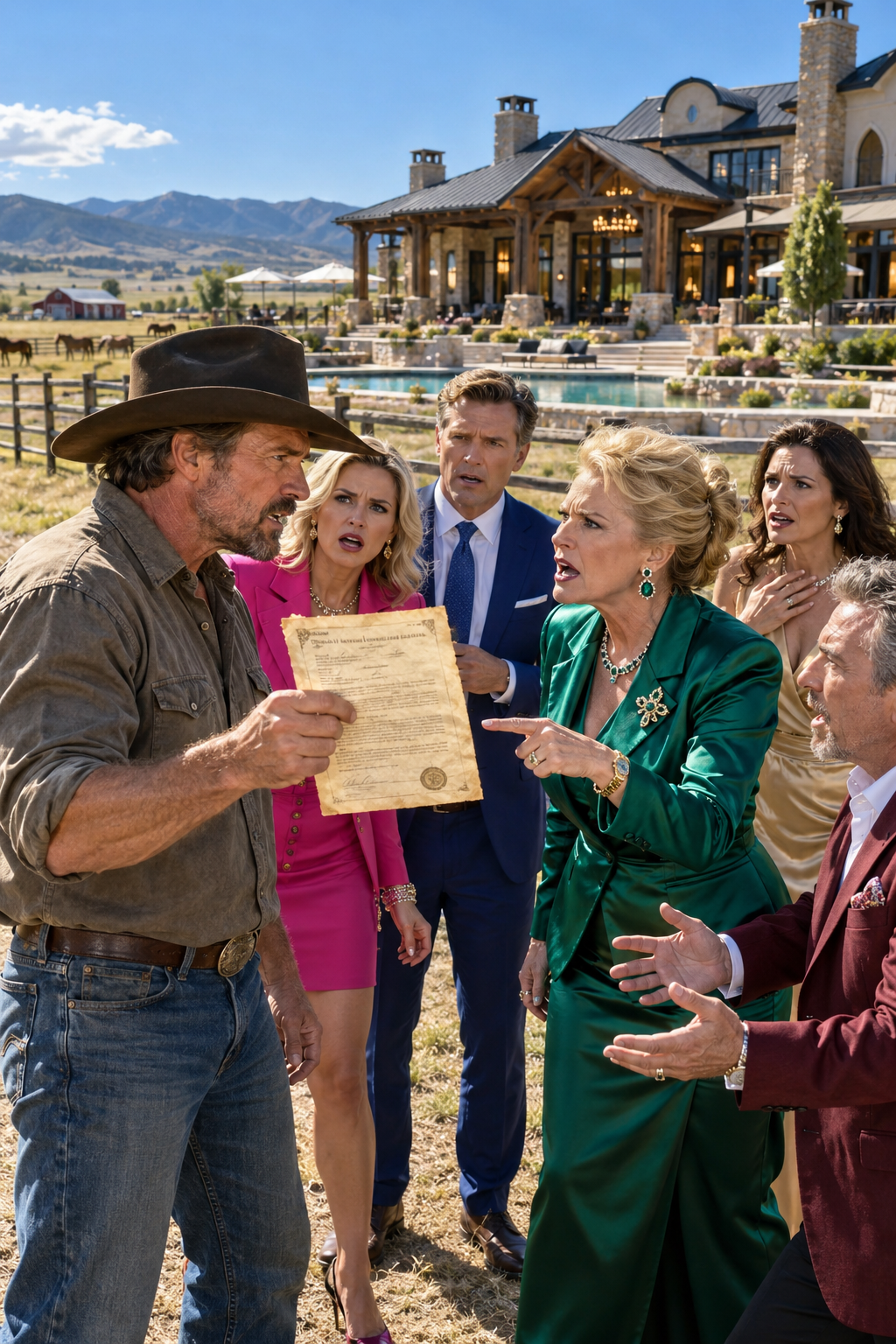
The HOA Built an $18 Million Clubhouse on My Ranch—Then My Grandfather’s Original Deed Turned Their Celebration Into a Crime Scene
The first time I saw the $18 million clubhouse, there were three hundred people drinking champagne on my land.
The second thing I saw was a bronze plaque near the entrance thanking the HOA president for “securing this property for future generations.”
The third thing I saw was a sheriff’s deputy walking toward me with his hand resting on his belt because somebody had reported a trespasser.
The trespasser was me.
I stood beside my dusty Ford F-350 and looked past him at the building rising above the cottonwoods.
Three stories.
Montana stone.
Black steel beams.
Glass walls overlooking the Gallatin foothills.
An infinity pool curved along the western terrace. A private restaurant glowed behind floor-to-ceiling windows. Landscapers had planted mature blue spruce around a circular driveway where valets were parking Mercedes, Range Rovers, and one Bentley.
There was even a stone bridge crossing the irrigation creek my grandfather had dug by hand in 1967.
The deputy stopped ten feet away.
“Sir, this is a private event.”
“You with the construction company?”
“Catering?”
He glanced at my work boots, faded jeans, and canvas ranch jacket.
“Then I need you to leave.”
I looked at his nameplate.
Deputy Aaron Mills.
Young. Maybe thirty.
Not arrogant.
Just working with the information somebody had given him.
So I didn’t argue.
Instead, I pointed toward the giant clubhouse.
“Who owns that?”
His expression tightened.
“Cedar Ridge Estates.”
“No,” I said. “Who owns the dirt underneath it?”
That made him pause.
Behind him, the celebration continued.
A jazz quartet played under white tents.
Waiters carried champagne.
A photographer posed board members beneath a banner reading GRAND OPENING GALA.
And standing at the top of the clubhouse steps was Vanessa Caldwell.
President of the Cedar Ridge Estates Homeowners Association.
Sixty-one years old.
Silver-blonde hair.
White designer pantsuit.
Diamond earrings.
The kind of smile people practiced in mirrors before charity luncheons.
She saw me.
Her smile disappeared.
Then she handed her champagne glass to somebody and came down the steps.
Not quickly.
Vanessa never hurried when other people could watch.
She approached with two board members and a man I recognized from county commission meetings.
Grant Hollis.
Contractor.
Political donor.
Professional hand shaker.
Vanessa stopped beside Deputy Mills.
“Mr. Mercer.”
She looked at the truck behind me.
“You were notified months ago that this parcel belongs to Cedar Ridge.”
“I was notified months ago that you believed it belonged to Cedar Ridge.”
Her smile returned, but only around the mouth.
“There is no difference.”
“There’s a fairly expensive difference behind you.”
One of the board members laughed nervously.
Vanessa didn’t.
Grant Hollis stepped forward.
He was broad-shouldered, tan, and wearing a navy suit that probably cost more than my first tractor.
“We have recorded title,” he said. “Permits. Financing. County approvals. Environmental clearance. Everything.”
He blinked.
Apparently he expected shouting.
I reached into my truck.
Deputy Mills moved slightly.
I held up one hand.
“Just paper.”
I pulled out a manila envelope.
Vanessa folded her arms.
“If this is another copy of your grandfather’s ranch map, our attorney has already reviewed it.”
“It isn’t.”
I removed one folded document.
Heavy paper.
Cream-colored.
Edges browned with age.
Blue recording stamp.
Raised county seal.
Vanessa’s eyes dropped to it.
She didn’t recognize it yet.
But Grant Hollis did.
His face changed.
Only for half a second.
That was enough.
I handed the document to Deputy Mills.
“Original warranty deed,” I said. “Recorded June 14, 1963. Book 118, page 442. My grandfather purchased 2,306 acres from the Brennan family.”
Mills studied it.
Vanessa gave a small laugh.
“We know about the original ranch acquisition.”
“I’m sure you do.”
I pointed toward a paragraph near the bottom.
“But I’m guessing nobody showed you Schedule B.”
Grant said nothing.
That interested me more than anything Vanessa could have said.
Deputy Mills read silently.
Then he looked toward the clubhouse.
Then back at the deed.
“What does ‘expressly excluded from any future subdivision conveyance’ mean?”
Vanessa answered before I could.
“It means nothing relevant to today.”
“It means,” I said, “that the 82-acre western pasture where your clubhouse is sitting was specifically excluded from every future subdivision sale unless a separate conveyance was executed by a Mercer family owner.”
Mills looked at me.
“Was one executed?”
Vanessa sighed.
“Jack, please. We have spent eighteen months dealing with these claims.”
“And eighteen months avoiding that document.”
“We have a deed.”
“You have a photocopy of a deed.”
“A recorded deed.”
“Recorded in 1998.”
“Signed by my father.”
“My father was in Germany on the day your document says he signed it.”
Nobody laughed this time.
The music continued behind us.
A trumpet climbed through a bright little melody.
Somebody opened another bottle of champagne.
Vanessa’s face stayed composed.
But Grant Hollis looked toward the parking lot.
That was when I knew I hadn’t driven out there for nothing.
I had spent eleven months letting these people think I was losing.
Eleven months letting them send letters.
Eleven months letting their attorneys call me confused.
Eleven months watching concrete trucks cross my northern road.
Eleven months listening to neighbors tell me I should accept whatever settlement Cedar Ridge offered before legal fees buried me.
I had not stopped the first bulldozer.
I had not chained the gate.
I had not threatened the workers.
I had not gone screaming to social media.
I had not given Vanessa Caldwell a single photograph of an angry rancher she could show a judge.
I documented.
I surveyed.
I recorded.
Because my grandfather used to say that if a man was determined to dig his own grave, the smartest thing you could do was hand him a sharper shovel.
Vanessa had arrived with an excavator.
“Jack,” she said quietly, “this isn’t the place.”
I looked at the gala.
The champagne.
The photographers.
The donors.
The county officials.
The giant brass scissors waiting beside a red ribbon.
“I disagree.”
She lowered her voice.
“You’re embarrassing yourself.”
That one almost made me smile.
“What time is the ribbon cutting?”
Grant stepped closer.
“That’s enough.”
I looked at him.
“Three o’clock?”
“Because I’d really hate to miss it.”
Deputy Mills lifted a hand.
“Everybody calm down.”
“I am calm,” I said.
Vanessa studied me.
For the first time, I saw uncertainty.
Vanessa Caldwell did not become HOA president by being afraid of paperwork.
She became president because she understood something most people don’t.
Control rarely arrives wearing a uniform.
Usually it arrives as a committee.
She had moved to Cedar Ridge eleven years earlier after selling a commercial property company in California.
Within fourteen months she was on the architectural review board.
Within three years she was vice president.
Within five she was president.
And once she had the title, Cedar Ridge stopped behaving like a neighborhood association and started behaving like a small government that had misplaced the Constitution.
Mailbox colors.
Fence heights.
Boat storage.
Exterior lighting.
Holiday decorations.
Parking permits.
Landscaping schedules.
Pet restrictions.
Private-road fees.
Vanessa could turn anything into a regulation if it appeared in front of her long enough.
Most residents tolerated it because Cedar Ridge was beautiful.
One hundred and ninety-six homes tucked against the foothills.
Private trails.
Trout ponds.
A guarded entrance.
Mountain views.
Houses worth between $1.2 million and $6 million.
And then Vanessa promised them something bigger.
A clubhouse.
Not a community room.
Not a pool with a snack bar.
Her presentation called it Cedar Ridge Summit Club.
Fitness center.
Fine dining.
Pickleball.
Indoor golf.
Event ballroom.
Wine cellar.
Business suites.
Guest cottages planned for phase two.
When residents asked where it would go, Vanessa pointed to the western pasture beyond their existing subdivision.
My western pasture.
At first, I assumed the proposal would die as soon as somebody checked the parcel map.
Then I received a certified letter informing me that Cedar Ridge intended to begin preliminary soil testing on “HOA-owned recreational parcel 17-B.”
I called the management office.
A twenty-three-year-old receptionist told me the property question had already been resolved.
I asked who resolved it.
She transferred me to legal.
Legal transferred me to a voicemail.
Three days later I received a letter from attorney Charles Voss.
It contained one sentence I still remember exactly.
“Your continued assertion of ownership is unsupported by the recorded chain of title.”
That was interesting.
Because I had the chain of title.
My grandfather had kept everything.
Every deed.
Every easement.
Every cattle lease.
Every tax receipt.
Every survey.
Every mineral reservation.
Every handwritten agreement involving water, fences, access roads, or grazing.
He didn’t trust filing cabinets unless the filing cabinet was his.
After he died, those records went into a steel cabinet in the ranch office.
After my father died, they became mine.
I spent a weekend going through them.
And at first, I thought Cedar Ridge might actually have found something I had missed.
The ranch had been broken up before.
In 1998 my father sold 410 acres to the company that eventually developed Cedar Ridge.
In 2004 he sold another 63 acres for an access corridor and utility easements.
The transactions were legitimate.
The boundaries were surveyed.
Taxes had been paid accordingly for decades.
But the western pasture had never moved.
Eighty-two acres.
Parcel 17-B on the newer county maps.
Original designation: Tract Seven.
My grandfather had excluded it deliberately because it controlled water access to two lower hayfields and contained the only service road wide enough to move equipment between the north and south sections of the ranch.
If Cedar Ridge owned Tract Seven, my ranch was effectively cut in half.
If I owned it, their $18 million clubhouse was about to become the most expensive trespassing structure in Montana.
I hired a title attorney named Rachel Kim.
She was forty-four, wore plain dark suits, and had the deeply unsettling habit of going silent whenever she discovered something important.
The first day she reviewed Cedar Ridge’s claim, she said almost nothing for twenty minutes.
Then she leaned back.
“Where did they get this?”
She was looking at a 1998 deed provided by the HOA.
“County recorder.”
“No. I mean where did this version come from?”
I looked closer.
It was supposedly the deed documenting my father’s original sale to the developer.
Rachel placed my father’s copy beside the HOA copy.
At first glance, they looked identical.
Same buyer.
Same seller.
Same notarization block.
Same page count.
Except the HOA version had an additional line in the property description.
INCLUDING TRACT SEVEN, 82.14 ACRES.
That was all.
Eighty-two acres stolen with five words and one number.
I looked at Rachel.
“Can they amend a recorded deed like that?”
“Not without a correction instrument, signatures, and recording.”
“Was there one?”
“I haven’t found it.”
“So theirs is fake.”
She tapped the paper.
“Never accuse somebody of fraud when incompetence can explain the same evidence.”
I hated how reasonable that sounded.
Then she pointed to something else.
“Your father’s signature is identical.”
“It should be. Same deed.”
She pulled a magnifying lens from her desk.
“I mean identical.”
The signature on both versions wasn’t merely similar.
It was pixel-for-pixel the same.
Same pen hesitation.
Same ink break.
Same angle.
Same tiny hook at the end of the R.
One had been copied.
Then Rachel found the notary.
Or, more precisely, she found the notary’s death certificate.
The HOA version claimed that Margaret Ellen Price notarized an amended deed on October 18, 1998.
Margaret Price had died on September 2.
Forty-six days earlier.
That should have ended it.
Because recording offices don’t decide ownership disputes.
And Cedar Ridge had something enormously valuable on its side.
The financing had closed.
The contractors had mobilized.
The county had issued permits based on submitted title documentation.
The HOA had already collected a special assessment averaging $38,000 per household.
Construction was moving fast.
Stopping it with an emergency injunction would require me to show immediate harm and a high probability of success.
Rachel believed we could.
Then she told me something unexpected.
“Or we could let them build.”
I stared at her.
She stared back.
“You’re joking.”
“That’s my land.”
“They’re pouring concrete.”
“That seems like the opposite of what attorneys usually recommend.”
“If we seek emergency relief now, their lawyers will attack your documents before we’ve completed discovery. They’ll ask for expedited depositions. They’ll say the boundary is disputed. They may stall long enough to create political pressure.”
“And if we wait?”
“They keep spending money on land they may not own.”
I understood.
“You want their exposure to grow.”
“I want their incentive to tell the truth to grow.”
That was the moment the strategy changed.
I sent one formal notice.
Not twenty.
To the HOA.
To Grant Hollis’s development company.
To the construction lender.
To the county.
To the title insurer.
It stated that I claimed ownership of Tract Seven, that construction was unauthorized, and that continued activity occurred at their own risk.
Then I watched.
Vanessa responded with a letter accusing me of harassment.
Grant’s company responded through counsel.
The bank acknowledged receipt.
The title insurer requested documents.
Construction continued.
So I installed cameras on my side of the property line.
Not hidden cameras.
Visible ones.
I photographed every delivery.
Every retaining wall.
Every foundation pour.
Every tree removed.
Every load of gravel.
Every trench.
Every steel beam.
I had surveyors set monuments.
Cedar Ridge pulled two of them.
I had them replaced.
Cedar Ridge removed three fence posts.
I invoiced them.
They ignored the invoice.
A grading contractor accidentally cut an irrigation line feeding my lower pasture.
I photographed it.
Then repaired it.
A subcontractor parked equipment on my hayfield.
I had it professionally towed to the edge of the construction zone.
A superintendent called me furious.
I told him exactly where the machinery was.
No threats.
Just records.
Then the mini-payoffs began.
The title insurer froze a portion of coverage.
The construction lender requested supplemental indemnity.
One subcontractor suspended work for six days after discovering the ownership dispute.
Vanessa held an emergency board meeting and told residents the delay was caused by “a neighboring landowner attempting financial extortion.”
Someone leaked the recording to me.
I listened to it while fixing a hydraulic hose in my barn.
Vanessa’s voice came through my phone speaker.
“Mr. Mercer believes he can use an outdated family document to interfere with community progress.”
I wiped oil from my hands.
Then I replayed one phrase.
Outdated family document.
She might not have known everything.
But she knew there was a document.
A real one.
And she was scared enough to discredit it before residents ever saw it.
Two weeks later, she made her first offer.
I declined.
Then $750,000.
I declined.
Then $1.2 million.
I declined.
Her attorney asked what number would resolve my “nuisance assertion.”
I told him I wasn’t selling.
That was apparently difficult for them to understand.
People like Vanessa thought every no was simply a number waiting to be increased.
By the time Summit Club reached twelve million dollars in construction value, she offered $2.6 million.
I declined again.
That afternoon, she came to the ranch herself.
She arrived in a pearl-white Range Rover.
No attorney.
No board members.
She parked beside the machine shed while I was repairing a gate hinge.
She looked around the ranch.
My grandfather’s red barn.
The hayfields.
The mountains turning purple behind the cottonwoods.
“You really want to preserve all this?”
“That’s generally why people don’t sell.”
She ignored that.
“This area is changing.”
“Property like this will eventually be developed.”
“Not while I own it.”
“You don’t have children.”
I stopped tightening the bolt.
That was the first time she irritated me.
Not because the statement was false.
Because she had researched it.
My wife, Laura, had died eight years earlier.
We never had children.
My younger sister lived in Seattle and had no interest in ranching.
Vanessa knew all of that.
“What happens in twenty years?” she asked.
“Not your problem.”
“It becomes someone’s problem.”
“Still not yours.”
She stepped closer.
“The community is offering you generational money.”
“My grandfather already gave me generational property.”
“That’s sentimental.”
“That’s ownership.”
She stared at me.
Then she changed tactics.
“The clubhouse is happening.”
“I noticed.”
“It will open.”
“We have every approval required.”
“Except mine.”
“We don’t need yours.”
“Then why are you here?”
One point for the rancher.
She looked toward the pasture.
“You’re going to lose, Jack.”
“Then you shouldn’t be worried.”
Two months later, Summit Club was finished.
Cedar Ridge sent engraved invitations to the grand opening.
Mine arrived by FedEx.
I assumed it was a mistake.
Rachel didn’t.
“They want you there.”
“To humiliate you.”
That sounded dramatic until I read the handwritten note inside.
Mr. Mercer,
We hope you will join your neighbors in celebrating a project that proves progress cannot be stopped by unnecessary conflict.
—Vanessa Caldwell
Rachel read it twice.
Then smiled.
I had never seen her smile at a legal threat before.
“Oh,” she said. “We’re going.”
So there I was.
Opening day.
Standing beside Deputy Mills.
Original deed in hand.
While three hundred people celebrated on my ranch.
Vanessa reached for the deed.
I pulled it back.
“Deputy’s reading it.”
Her jaw tightened.
“You cannot disrupt a private event based on a document from 1963.”
“I haven’t disrupted anything.”
Behind her, the jazz quartet finished a song.
People applauded.
I checked my watch.
Eighteen minutes until the ribbon cutting.
Grant Hollis moved closer to Vanessa.
“We should talk privately.”
I heard him.
Vanessa did too.
She ignored him.
“Deputy,” she said, “Mr. Mercer has repeatedly harassed our contractors and board members. We have documentation.”
Mills looked uncomfortable.
“Ma’am, I’m only here on the trespass call.”
“Exactly. Remove him.”
Mills looked at the deed again.
Then toward me.
“Mr. Mercer, is this parcel currently under litigation?”
Vanessa jumped in.
“No court has ruled that he owns this land.”
“That’s true,” I said.
She gave me a triumphant look.
I continued.
“But no court has ruled that Cedar Ridge owns it either.”
Grant muttered something under his breath.
Mills handed the deed back.
“Until ownership is resolved, I’m not arresting anybody for standing on disputed property.”
Vanessa’s face hardened.
“Then I would like your supervisor.”
“Already coming.”
She blinked.
That wasn’t because of me.
Mills pointed toward the road.
A sheriff’s SUV was approaching.
Then another.
Vanessa turned.
Her expression changed.
“Why are there two?”
She didn’t.
That was Rachel’s contribution.
At that morning, she had filed supplemental evidence with the district court.
At 11:17, Judge Eleanor McBride had reviewed it.
At 12:26, she had signed a temporary preservation order.
Not an eviction.
Not a seizure.
Something quieter.
Nobody could transfer, alter, destroy, encumber, or remove evidence associated with Tract Seven until the court held a hearing.
That included property records stored in the clubhouse office.
Deputy Mills’s supervisor stepped out of the first SUV.
Sheriff Daniel Roark stepped out of the second.
Roark was fifty-eight, thick through the shoulders, with gray hair and a face that looked permanently unimpressed.
He walked directly toward me.
“Rachel Kim around?”
“Inside my truck.”
Vanessa frowned.
Rachel opened the passenger door and stepped down with a leather portfolio.
The look on Vanessa’s face was worth eleven months of patience.
“You brought your attorney?”
Rachel approached.
“Mrs. Caldwell.”
“What is this?”
Rachel handed Sheriff Roark a packet.
He looked at the first page.
Then turned toward Vanessa.
“Ma’am, I have a court order requiring preservation of records related to this property.”
Vanessa stared at him.
“You’re serving this now?”
“During our grand opening?”
“This is absurd.”
“Maybe. But Judge McBride signed it.”
Around us, guests were starting to notice.
Phones appeared.
Vanessa saw them.
Her entire posture changed.
Public mode.
She turned toward the nearest guests.
“Just a minor legal formality.”
Sheriff Roark looked at me.
I said nothing.
Let her say it.
Let her tell three hundred people that deputies arriving with a court order at an $18 million grand opening was a minor formality.
Grant pulled out his phone.
Rachel spoke.
“Mr. Hollis.”
He looked at her.
“The order prohibits destruction or alteration of relevant records.”
“I’m calling my lawyer.”
“I hope so.”
“You might also tell him the judge ordered preservation of electronic communications.”
His thumb stopped.
There it was.
Another tiny payoff.
But after eleven months, I had learned to appreciate reactions.
Vanessa stepped toward Rachel.
“What supplemental evidence?”
Rachel looked at me.
She opened her portfolio and removed a plastic sleeve.
Inside was a photograph.
Black and white.
My father in 1998.
Standing beside a military transport aircraft in Ramstein, Germany.
The date had been written on the back in my mother’s handwriting.
October 18, 1998.
The exact day the disputed amendment claimed my father had signed a deed in Montana.
Vanessa barely looked at it.
“Photographs can be misdated.”
Rachel removed another document.
United States Air Force civilian contractor travel records.
My father had been working overseas for an aerospace maintenance company.
His passport entry records matched.
His payroll records matched.
His hotel receipts matched.
His supervisor was still alive.
And we had taken his sworn affidavit three days earlier.
My father had not been in Montana.
He had not signed an amended deed.
Grant Hollis went pale.
Vanessa didn’t.
That told me something.
She was surprised by the evidence.
Grant was afraid of it.
Different reaction.
Different knowledge.
I filed that away.
“Vanessa,” Grant said.
She turned.
“We should postpone the ceremony.”
Her eyes narrowed.
“Until counsel—”
Three hundred residents had paid special assessments.
Local press was there.
A regional lifestyle magazine was there.
Bank representatives were there.
County officials were there.
Vanessa Caldwell had spent two years promising this moment.
She was not going to let me take it away.
That was her motive.
Not just money.
Not even mostly money.
Vanessa had attached her identity to Summit Club.
Every newsletter called it her vision.
Every donor dinner praised her leadership.
Every board presentation carried her signature.
The clubhouse was proof that she could command people, contractors, banks, and county departments into making something enormous appear.
If the clubhouse failed, it wasn’t merely a bad project.
It was Vanessa Caldwell being publicly wrong.
And people who build their identity around never being wrong will risk almost anything to avoid one sentence.
I made a mistake.
She turned toward the steps.
“The ribbon cutting will proceed.”
Grant grabbed her arm.
Not violently.
But urgently.
She looked down at his hand until he released her.
“Take your hand off me.”
“Call counsel.”
“I know exactly what I’m doing.”
I believed half of that.
The event coordinator whispered into a radio.
Music resumed.
Guests gathered near the entrance.
Sheriff Roark sighed.
“Wonderful.”
Rachel murmured, “Let her.”
We stood at the edge of the crowd.
Vanessa climbed the steps.
Grant followed reluctantly.
Board members lined up beside a red ribbon.
Someone handed Vanessa giant brass scissors.
Camera shutters clicked.
She stepped to a podium.
“Friends, neighbors, and members of the Cedar Ridge family.”
I leaned against the hood of my truck.
She talked about community.
Shared investment.
Future generations.
Exactly the kind of words people use when they want ownership to sound like an emotion instead of a legal fact.
Then she said something I didn’t expect.
“This project was built in the face of obstruction.”
Several people turned toward me.
Vanessa continued.
“There will always be individuals who fear progress.”
Rachel whispered, “She’s doing it.”
“Doing what?”
“Making this better.”
“For discovery.”
Vanessa smiled at the crowd.
“We had the courage to rely on facts.”
I almost admired it.
Then she cut the ribbon.
Applause exploded.
Champagne fired.
The photographer stepped backward to capture the board members cheering.
And at that exact moment, a white county SUV turned into the driveway.
Then another.
Then a third.
The applause faded.
County vehicles stopped beside the sheriff’s units.
A woman stepped out of the first.
Marissa Cole.
Gallatin County chief building official.
I knew her because she had refused to speak with me without counsel two months earlier.
She walked toward Sheriff Roark holding a red folder.
Vanessa lowered the scissors.
Grant whispered something that I couldn’t hear.
Marissa stopped at the bottom of the steps.
“Who is the responsible project representative?”
Vanessa descended.
Marissa handed her a document.
“Effective immediately, occupancy authorization for Summit Club is suspended pending verification of title representations contained in the permit application.”
Nobody spoke.
Then somebody near the pool said, “What?”
Vanessa stared at the notice.
“You can’t do this.”
Marissa’s voice stayed flat.
“We can suspend a certificate issued based on materially disputed application information.”
“The title was verified.”
“Then this should be resolved quickly.”
“We have three hundred guests.”
“I’m aware.”
“This is a private facility.”
“I’m aware.”
“We have catering contracts, media, residents—”
“Mrs. Caldwell, everyone must exit the structure.”
That was the moment the party died.
Not when I arrived.
Not when the sheriff arrived.
Not when Rachel produced my father’s travel records.
It died when the county official said exit.
People who had been drinking champagne ten seconds earlier began looking at exits, attorneys, spouses, and each other.
A man in a tan blazer approached Vanessa.
“I paid forty-two thousand dollars for this.”
Another voice.
“My assessment was fifty-one.”
Then another.
“You said the lawsuit had been cleared.”
Vanessa raised both hands.
“Everyone, please.”
Grant started walking toward the parking lot.
I noticed immediately.
So did Rachel.
“Sheriff,” she said.
Roark turned.
Rachel pointed.
“Mr. Hollis may have records subject to the preservation order in his possession.”
Grant stopped.
“I have my phone.”
Roark nodded.
“Then don’t delete anything.”
“I wasn’t.”
“Good. Makes my afternoon easier.”
Grant’s mouth tightened.
Guests began filing out.
Some angry.
Some confused.
Some filming everything.
One elderly man stopped beside me.
“You Mercer?”
He looked back at the clubhouse.
“My wife told me this land dispute was nonsense.”
“I’m sorry.”
“Vanessa told us you were trying to extort the association.”
He studied me for a second.
Then held out his hand.
“Robert Keene.”
I shook it.
“How much did they assess you, Robert?”
“Thirty-eight thousand five hundred.”
“That hurt?”
He looked toward his wife.
“We postponed replacing her car.”
That hit harder than I expected.
Because until then, Cedar Ridge had been easy to think of as Vanessa.
Vanessa’s project.
Vanessa’s board.
Vanessa’s lawyers.
But communities don’t spend eighteen million dollars.
Retired couples.
Business owners.
Some wealthy.
Some stretched thin because they had purchased expensive houses during better years.
A bad HOA decision wasn’t abstract.
It came out of somebody’s savings account.
Robert lowered his voice.
“If you own this land, what happens to the clubhouse?”
“I don’t know yet.”
Then walked away.
Rachel had overheard.
“You do know.”
“You have options.”
“That’s not knowing.”
She gave me a look.
I knew what the law allowed.
If the building had been constructed in bad faith on my land, the remedies could become brutal.
Forced purchase negotiations.
In some circumstances, ownership of improvements could attach to the land depending on the final ruling and equitable findings.
Eighteen million dollars of glass, stone, steel, tile, kitchen equipment, furniture, and mechanical systems.
Sitting on dirt my family had owned since 1963.
But I wasn’t thinking about owning a luxury clubhouse.
I was thinking about my grandfather.
He would have hated the infinity pool.
Probably liked the restaurant.
Absolutely stolen the towels.
By , Summit Club was empty.
Yellow county notices covered the entrances.
The giant red ribbon lay on the stone steps.
Champagne glasses remained on tables inside.
A half-cut wedding cake-sized grand-opening dessert sat abandoned in the ballroom.
The jazz quartet packed up.
The valets went home.
Sheriff’s deputies supervised retrieval of personal belongings.
Vanessa stood near the entrance speaking rapidly to three attorneys.
Grant Hollis sat alone inside his SUV.
And I finally walked onto the terrace.
My terrace, maybe.
The view was spectacular.
They had oriented the building west toward the mountains.
The pool reflected the orange sky.
I stood beside the stone wall and listened to water move over the infinity edge.
Rachel joined me.
“Eighteen million dollars.”
“That’s what they claim.”
“Probably more.”
“Doesn’t make me feel better.”
“It shouldn’t.”
We watched Vanessa below.
“She’ll fight,” Rachel said.
“She’ll claim good-faith reliance on recorded title.”
“She’ll blame Hollis.”
“She may blame the county.”
“Probably.”
Rachel leaned against the railing.
“You’re enjoying this less than I expected.”
“Robert Keene postponed buying his wife a car.”
“That’s not your fault.”
“I didn’t say it was.”
Below us, Vanessa looked up.
Our eyes met.
She started toward the terrace.
Rachel straightened.
“Here we go.”
Vanessa climbed the steps alone.
No attorneys.
No board members.
She stopped several feet away.
“You got what you wanted.”
“You shut down the building.”
“The county shut down the building.”
“Because of you.”
“Because somebody submitted questionable title documents.”
Her eyes flashed.
“You think you’ve won.”
That was true.
And my answer seemed to bother her more than arrogance would have.
She looked at Rachel.
“I want five minutes with Jack.”
Rachel looked at me.
She walked toward the stairs but didn’t go far.
Vanessa waited until Rachel was out of earshot.
Then she spoke.
“What do you want?”
“The same thing I wanted eleven months ago.”
“It’s eighty-two acres.”
“It’s my eighty-two acres.”
“You cannot use it.”
“I was using it before you built a spa on it.”
“For cattle?”
“For whatever I choose.”
“You would destroy eighteen million dollars in community investment for cattle.”
“No. You spent eighteen million dollars on disputed land. Those are different sentences.”
She stared at me.
Then she stepped closer.
“Five million.”
Her nostrils flared.
“Eight million dollars.”
That was more than the land was worth.
She expected me to hesitate.
“Everyone has a number.”
“You keep saying things like that.”
“Ten million.”
“You’d walk away from ten million dollars?”
I looked toward the irrigation creek.
“Because if you can steal land and keep it by offering enough money after you’re caught, you didn’t buy anything. You paid a fine.”
Her face went still.
Then she said something strange.
“You don’t understand what happens if the 1998 deed fails.”
At first I thought she meant the clubhouse.
“The building sits on my ranch.”
“Not the building.”
She looked toward Rachel.
Then back at me.
“The deed.”
My pulse changed.
Only slightly.
“What about it?”
Vanessa realized she had said too much.
The control returned to her face.
“Doesn’t sound like nothing.”
“You should take the ten million.”
“Because this gets ugly.”
“It’s already ugly.”
“No, Jack.”
Her voice dropped.
“You have absolutely no idea.”
She walked away.
That was the first warning.
The second arrived an hour later.
Rachel and I were back at the ranch office when Sheriff Roark called.
I put him on speaker.
“Jack, you sitting down?”
I remained standing.
“Close enough.”
He exhaled.
“Our evidence tech found a storage room inside the clubhouse administration wing.”
“There were six banker boxes marked historical association records.”
Rachel grabbed a pen.
“Were they within the preservation order?”
“What’s in them?”
“That’s why I’m calling.”
Paper moved on his end.
“There are title copies. Surveys. Development agreements. Old correspondence.”
Rachel asked, “Anything from 1998?”
I looked at her.
Roark continued.
“One box contains draft property descriptions for the original Cedar Ridge acquisition.”
“Does it include Tract Seven?” I asked.
That was good.
Then he added, “But there’s another version.”
Rachel froze.
“What version?”
“A draft marked revised.”
“October 1998.”
“Who prepared it?”
“Looks like Hollis Development’s predecessor company.”
Grant’s father had run that company.
I walked toward the window.
Outside, evening settled over the ranch.
“What changed?”
Roark paused.
“Tract Seven was added.”
No surprise.
Not anymore.
Rachel said, “Anything showing authorization from Mercer?”
“Not that we’ve found.”
Then his voice changed.
“Jack, there’s something else.”
I turned around.
“The revised description didn’t just add Tract Seven.”
Roark said, “It added four other parcels.”
Rachel’s pen stopped.
“What parcels?”
“Working on that.”
“How much acreage?”
“About six hundred and twelve acres total.”
My first reaction was confusion.
Cedar Ridge didn’t contain six hundred extra acres.
At least not that I knew of.
“Different directions. Some north. Some east. One south of your ranch.”
Rachel went pale.
I had never seen Rachel Kim go pale.
“Sheriff,” she said, “who owns those parcels now?”
“That’s the problem.”
“What problem?”
“Three of them appear to be part of Cedar Ridge.”
I stared at the speaker.
“That’s impossible.”
“The subdivision is four hundred-something acres.”
“The homes are.”
I understood before Rachel said it.
“Common areas,” she whispered.
Roark confirmed.
“Trails. Greenbelt. Water features. Part of the north access road.”
I sat down.
For years Cedar Ridge residents had walked trails they believed belonged to their HOA.
Jogged through greenbelts.
Paid fees to maintain ponds.
Drove over access roads.
If those parcels had been added by the same forged 1998 amendment…
The clubhouse wasn’t the beginning.
It was a repeat.
Rachel stood.
“We need the entire chain.”
“I know,” Roark said. “And there’s more.”
Of course there was.
“There’s an envelope in the same box. Sealed. Handwritten note on the front.”
“What does it say?”
“Do not record until Mercer signs.”
My skin went cold.
“Who wrote it?”
“We don’t know.”
“What’s inside?”
“Copy of the altered deed.”
Rachel closed her eyes.
I felt something between vindication and dread.
Because that sentence destroyed the incompetence theory.
Somebody knew my father’s signature was required.
Somebody prepared a deed before obtaining it.
Then, somehow, a version appeared in the county records anyway.
“Any letters?” Rachel asked.
“Several. We’re inventorying.”
“From whom?”
“Hollis Development. Cedar Ridge counsel. Survey firm.”
Roark hesitated.
“One you’re going to recognize.”
I already knew.
That surprised me.
Then Roark said, “Charles Voss.”
The HOA attorney.
The man who had told me my claim was unsupported by the recorded chain of title.
Rachel wrote his name.
“Anyone else?”
“Someone named Henry Mercer.”
I stopped breathing for a second.
My father was David Mercer.
My grandfather was Samuel Mercer.
Henry Mercer was my uncle.
My father’s older brother.
He had disappeared from family photographs after 1996.
I remembered him mostly as a voice.
Always smelling faintly of cigarettes and saddle leather.
He and my grandfather had fought bitterly over the ranch.
Henry wanted to sell.
Granddad refused.
Then Henry moved to Arizona.
At least that was the story I grew up hearing.
He died in 2011.
“What does Henry have to do with Cedar Ridge?”
Roark said, “There’s a letter.”
Paper moved.
Roark cleared his throat.
“Dated August 9, 1998. Addressed to Grant Hollis Sr.”
Grant’s father.
The original developer.
Roark read slowly.
“‘The western acreage cannot be conveyed through David without Dad’s restriction becoming an issue. I may have another way to establish the development boundary, provided the payment arrangement remains private.’”
Nobody spoke.
The ranch office suddenly felt very small.
Rachel looked at me carefully.
“You knew nothing about this?”
Roark continued.
“There are references to a payment schedule.”
“How much?”
“First number I saw was two hundred thousand.”
In 1998, that was serious money.
“What for?”
“Doesn’t say.”
My grandfather had died in 1997.
One year before the disputed deed.
If Henry believed he had a claim…
The will had been clear.
My father received the ranch.
Henry received investment accounts and property in Arizona.
He had no authority to transfer ranch land.
Unless somebody convinced a title company otherwise.
Rachel asked the question I was thinking.
“Was Henry ever granted power of attorney?”
“I don’t know,” I said.
Then I remembered something.
My father’s stroke.
Not the major one that killed him years later.
A smaller stroke in 1998.
He recovered.
But for several months my uncle Henry had returned to Montana to “help with paperwork.”
I stood so fast the chair rolled backward.
Rachel watched me.
“There may have been a power of attorney.”
Her face tightened.
“For what?”
“My father’s medical recovery.”
“I don’t know.”
“If Henry had valid authority—”
“He still couldn’t sign as my father.”
“No. But it complicates motive.”
Roark said, “You two should come down tomorrow.”
The call ended.
For a while neither Rachel nor I spoke.
The ranch office was full of things my family had never thrown away.
An old branding iron.
My grandfather’s saddle.
A photograph of my parents at their wedding.
A cracked barometer.
Stacks of ledgers.
Sixty years of ordinary life.
Suddenly every piece of paper felt capable of lying.
Rachel broke the silence.
“Vanessa knew this was bigger.”
“She said the 1998 deed failing would cause problems.”
“She may know about the other parcels.”
“Or she found out recently.”
“Doesn’t matter yet.”
It mattered to me.
Because Vanessa had built the clubhouse.
Grant Hollis had built Cedar Ridge.
But Henry Mercer had been my family.
That night I barely slept.
Not because I was angry.
Anger is easy.
It gives you somewhere to put energy.
I was rearranging history.
Every memory involving Uncle Henry.
Every argument I had overheard.
Every time my father changed the subject when Henry’s name came up.
My grandfather once called him a man who could sell tomorrow to pay for tonight.
I thought he meant gambling.
Maybe he meant land.
At the next morning, I walked into the ranch office and opened the old steel file cabinet.
Rachel wasn’t coming until eight.
Sheriff Roark expected us at nine.
I had three hours.
I started with 1998.
Tax documents.
Cattle records.
Equipment receipts.
Medical bills.
My father’s travel paperwork.
Then I found a folder labeled DAVID—MEDICAL AUTHORIZATION.
Inside was exactly what Rachel feared.
A power of attorney.
Executed March 12, 1998.
Henry Mercer appointed agent for limited financial and ranch operations while my father recovered.
I read every line.
Bank transactions.
Utility accounts.
Property management.
Then the limitation clause.
My hands stopped.
Henry was explicitly prohibited from selling, mortgaging, gifting, or conveying real estate.
My father had anticipated the risk.
I almost laughed.
Instead, I photographed every page.
Then I turned the final sheet over.
There was handwriting on the back.
My father’s.
Three lines.
Henry asked again about Brennan west tract.
Told him no.
Dad protected that ground for a reason.
Underneath, another sentence.
Ask Walter about second map.
I read it twice.
Second map.
I had no idea who Walter was.
I searched the cabinet.
Then the barn.
My grandfather had built a workbench along the back wall with sixteen small drawers for bolts, washers, nails, fencing staples, and things no hardware store had manufactured since the Reagan administration.
One drawer still had his handwriting.
I checked underneath.
Then I noticed scratches around the wooden label plate.
Two screws.
Newer than the others.
I removed them.
Behind the label was a narrow cavity.
Inside was a brass key.
I called Rachel.
She answered immediately.
“What happened?”
“How do you know something happened?”
“You called before seven.”
“I found a key.”
“Don’t start opening random boxes until I get there.”
I looked around.
“Too late.”
“I’ll call you.”
I ended the call.
The key didn’t fit the desk.
Or the steel cabinet.
Or my grandfather’s old gun safe.
Then I remembered the trunk.
It was in the loft above the tack room.
A heavy cedar travel trunk my grandfather brought from Wyoming before he bought the ranch.
I had never opened it.
I climbed the ladder.
Dust filled the loft.
The trunk sat beneath an old horse blanket.
The brass key slid into the lock.
Inside were clothes.
A broken pocket watch.
My grandmother’s Christmas cards.
A stack of newspapers.
And beneath them, a leather survey case.
I carried it into the light.
Inside were rolled maps.
Original surveys.
Some hand-drawn.
Some professionally stamped.
The first showed the 1963 ranch.
The second showed water lines.
The third showed grazing divisions.
Then I found one labeled:
BRENNAN RESERVATION—PRIVATE.
My grandfather’s handwriting ran across the bottom.
Walter confirmed 11/4/72.
Second map.
I spread it across the floor.
It showed Tract Seven.
But it also showed something I had never seen.
A boundary line continuing far beyond Tract Seven.
Across what was now Cedar Ridge.
East toward the highway.
South along the creek.
Several parcels were shaded.
At the center was a notation.
LAND HELD UNDER BRENNAN REVERSION CLAUSE.
I stared at it.
Reversion clause?
Then I read the smaller handwriting.
If transferred as part of subdivision without consent, title returns to original retained estate.
My mouth went dry.
The map referenced the 1963 deed.
Schedule B.
Paragraph 14.
I knew Schedule B.
I had read it dozens of times.
But not every cross-reference.
I ran back to the office.
Pulled the original deed.
Found paragraph 14.
Then paragraph 14(c).
Dense legal language.
Typical old real estate drafting.
I read it once.
Then again.
Then a third time.
And finally I understood why my grandfather had protected Tract Seven.
It wasn’t merely an 82-acre pasture.
It was an anchor parcel.
Under the original Brennan transaction, several adjoining tracts could later be developed only under specific conveyance conditions.
If someone attempted to bundle the protected parcels into a subdivision through an unauthorized transfer, a reversion provision could activate.
Not just on Tract Seven.
On every linked tract in the schedule.
I counted the shaded parcels on the map.
The same number Sheriff Roark had mentioned.
My phone rang.
I answered.
“Please tell me you didn’t discover anything catastrophic without me.”
“I discovered something catastrophic.”
“Of course you did.”
“How fast can you get here?”
“Twenty minutes.”
“Make it ten.”
Then something outside moved.
I walked to the window.
Not Rachel.
It stopped in front of the ranch office.
The driver’s door opened.
Vanessa Caldwell stepped out.
She was wearing jeans this time.
No designer white suit.
No diamonds.
No audience.
She looked exhausted.
I folded the survey map before she reached the porch.
Then I stepped outside.
“You’re up early.”
“So are you.”
“What do you want?”
“We need to talk before your attorney arrives.”
“She’s already on her way.”
Vanessa looked toward the county road.
“Then listen quickly.”
“I’m listening.”
She held an envelope.
“I found this last night.”
“My home office.”
“What is it?”
“Something I should have given you months ago.”
I didn’t take it.
“Why didn’t you?”
“Because I wanted the clubhouse built.”
There it was.
Not a full confession.
Not the entire scheme.
Just enough truth to cost her something.
“What’s inside?”
“A copy of an internal title memo.”
“The HOA’s insurer.”
“Fourteen months ago.”
Before foundations were poured.
Before steel.
Before windows.
Before the special assessment was fully collected.
I looked at her.
“What does it say?”
“It identifies a defect.”
“Tract Seven?”
“And you built anyway.”
She looked past me toward the mountains.
“Hollis told us it was curable.”
“Did you believe him?”
“I wanted to.”
Better answer than yes.
Worse answer than no.
I took the envelope.
Inside was a six-page memo.
The third page contained the sentence that mattered.
Significant risk exists that the 1998 amended legal description was recorded without valid grantor authorization.
I looked up.
“You had this.”
“You told residents my claim was extortion.”
“You collected assessments.”
“You kept building.”
Each answer came quieter.
I should have enjoyed it.
“Why are you giving me this now?”
Her eyes met mine.
“Because Grant Hollis came to my house at midnight.”
That got my attention.
“What did he want?”
“The boxes.”
“What boxes?”
“The historical records.”
“The sheriff has them.”
“He didn’t know that yet.”
“What did Grant say?”
“He told me we had to recover certain documents before discovery began.”
“Which documents?”
“He wouldn’t tell me.”
“Then why come to you?”
“Because he thought I had moved the boxes.”
I watched her carefully.
“Why would he think that?”
“Because I moved them once before.”
There it was.
Another piece.
“During construction.”
“Hollis told me old records stored at the management office were subject to water damage.”
“And you believed that?”
“At the time.”
“Where did you move them?”
“The clubhouse administration room.”
Convenient.
Maybe both.
Vanessa stepped closer.
“Jack, Grant was terrified last night.”
“I have known him for nine years. I’ve seen lawsuits. Cost overruns. Contractor disputes. A federal tax audit. I have never seen him scared.”
I thought about his face when I produced the original deed.
“What is he scared of?”
“I don’t know.”
“You know more than you’re saying.”
At least she had stopped pretending.
Vanessa looked toward the road again.
“Grant told me the clubhouse was never the real exposure.”
I said nothing.
“He said if your deed survives, Cedar Ridge has a boundary problem.”
“He wouldn’t answer.”
My grip tightened on the envelope.
Then Vanessa said the words I would remember for a long time.
“He said people could lose their homes.”
Rachel’s SUV appeared at the end of the road.
Vanessa stepped backward.
“You need to find Walter.”
“Who is Walter?”
Her face changed.
“You know that name?”
“How do you know it?”
Before she could answer, tires screamed on the county road.
Not Rachel.
Another vehicle.
A gray pickup shot past the ranch entrance.
Then braked hard.
Vanessa went white.
“Who is that?”
“I don’t know.”
The truck stopped fifty yards away.
A man stepped out.
Late seventies, maybe eighty.
Tall but stooped.
Brown jacket.
White hair.
He carried a battered metal document tube.
Rachel pulled in behind him.
She got out and looked from the stranger to me.
The old man walked slowly toward the porch.
“You Jack Mercer?”
He nodded once.
“Samuel’s grandson.”
He looked at Vanessa.
His expression hardened.
“You with Cedar Ridge?”
She hesitated.
“I’m the HOA president.”
“Then you’re going to want to hear this too.”
He set the metal tube on the porch railing.
My heartbeat picked up.
“Who are you?”
“Walter Brennan.”
Everything around me seemed to go quiet.
The family that had sold my grandfather the ranch in 1963.
The name on the deed.
The name on the hidden survey.
Walter confirmed 11/4/72.
Rachel slowly approached.
“You’re the Walter referenced in Samuel Mercer’s notes?”
“I’d imagine.”
I unfolded the old map.
Walter looked at it.
His face changed.
“Where’d you find that?”
“My grandfather’s trunk.”
He touched one corner carefully.
“I drew this with your grandfather.”
Vanessa stared at him.
Rachel was already taking out her phone to photograph the document.
I pointed at the shaded parcels.
“What does the reversion clause mean?”
Walter looked toward Cedar Ridge in the distance.
Then back at me.
“It means Samuel knew somebody might eventually try exactly what they tried.”
“Which was?”
“Take the protected ground without getting the signatures.”
Vanessa folded her arms.
“Whose signatures?”
Walter looked at her.
“Both families.”
My stomach tightened.
“The Brennan family retained approval rights?”
“On five tracts.”
In the West, it was always water.
Walter unscrewed the metal tube.
“My father sold Samuel the ranch cheap because they agreed neither family would let a developer break the watershed into a residential subdivision without joint approval.”
Rachel asked, “Was that restriction ever released?”
“Could it expire?”
“Not the way it was written.”
Vanessa spoke.
“Cedar Ridge has existed for almost thirty years.”
Walter looked at her without sympathy.
“Doesn’t change ink.”
Rachel knelt beside the porch railing.
“Mr. Brennan, do you have a copy of the controlling instrument?”
Walter pulled a rolled document from the tube.
He unrolled it.
Signatures.
County recording stamp.
My grandfather.
Walter’s father.
And a legal description that matched the shaded parcels on my map.
Rachel read for several minutes.
Nobody interrupted.
Then she sat back on her heels.
“Oh, my God.”
Vanessa whispered, “What?”
Rachel looked at me.
“This isn’t just a restriction.”
“No. You don’t.”
Her finger moved along the paragraph.
“If an unauthorized subdivision conveyance occurred, title to the protected tracts did not automatically transfer to the developer.”
“That’s what I thought.”
She looked at Walter.
“Who does it revert to?”
Walter pointed at me.
“Mercer retained estate.”
Vanessa shook her head.
Rachel continued reading.
Her face had lost all color.
“Subject to surviving Brennan confirmation.”
Walter nodded.
“That’s why I came.”
Vanessa stepped toward the document.
“How much land?”
Nobody answered.
She raised her voice.
“How much?”
Rachel looked at the survey.
Then at me.
Then toward the distant rooftops of Cedar Ridge.
“Potentially six hundred and twelve acres.”
Vanessa laughed once.
A short, disbelieving sound.
“That’s impossible.”
Walter rolled the document halfway closed.
“It gets worse.”
I looked at him.
“The 1972 map wasn’t the last map.”
My chest tightened.
“What last map?”
Walter looked toward the ranch road.
“My father and Samuel amended the protected watershed after the county approved the reservoir project.”
Rachel stood slowly.
“How much additional land?”
Walter did not answer immediately.
Instead, he opened the metal tube again.
He reached deep inside.
And pulled out another rolled survey.
Newer than the first.
Red boundary markings.
Official stamps.
My grandfather’s signature.
Walter’s father’s signature.
And across the top, typed in block letters:
SUPPLEMENTAL BRENNAN-MERCER CONSERVATION AND REVERSION AREA.
I unrolled it across the hood of my truck.
The red boundary did not stop at Cedar Ridge.
It crossed the subdivision.
Crossed the access road.
Crossed the golf community to the east.
Crossed the commercial strip near Highway 191.
Then continued north around land worth hundreds of millions of dollars.
Rachel whispered, “How many acres?”
Walter pointed to the total in the lower corner.
Vanessa grabbed the truck hood to steady herself.
I stared at the number.
Four thousand eight hundred seventeen acres.
My ranch was only part of it.
Cedar Ridge was only part of it.
The clubhouse suddenly looked tiny.
Rachel looked at Walter.
“Was this recorded?”
Walter’s face became grim.
“It was supposed to be.”
“My father delivered it personally to the county recorder in 1973.”
I searched the document for a stamp.
There wasn’t one.
No recording number.
No book and page.
Rachel saw it too.
“This copy was never stamped.”
Walter nodded.
“That’s why I started looking when I saw your clubhouse story online last night.”
Vanessa stared at him.
“Looking for what?”
Walter reached into his jacket.
Pulled out an old photograph.
A county records office.
Three men standing beside file cabinets.
One was Walter’s father.
One was my grandfather.
I didn’t recognize the third.
Walter turned the photograph over.
A name had been written on the back.
Franklin Hollis.
Grant Hollis’s grandfather.
My mouth went dry.
Walter said, “Frank Hollis was deputy county recorder.”
Rachel went completely still.
Vanessa whispered, “Jesus.”
Then my phone rang.
Sheriff Roark.
I answered.
“Jack, where are you?”
“Is Rachel with you?”
“Put me on speaker.”
Roark’s voice filled the morning air.
“We finished cataloging the final box.”
Rachel looked at me.
“What did you find?”
“A ledger.”
“What kind?”
“Payments.”
Vanessa closed her eyes.
Roark continued.
“Hollis Development. Multiple county officials. Survey consultants. Title people.”
Rachel asked, “Dates?”
“Starts in 1972.”
Walter’s face hardened.
“Ends when?”
Nobody moved.
“What do you mean, doesn’t?” I asked.
“The latest entry is three months old.”
I looked toward Vanessa.
She looked as shocked as I felt.
Rachel’s voice sharpened.
“Who received the latest payment?”
Roark hesitated.
That hesitation frightened me more than the answer.
“Jack, I’m sending deputies to you.”
“Because the ledger has a note beside the payment.”
“What note?”
I heard paper shifting.
Then Sheriff Roark read it.
“Mercer original located. Clubhouse forces final resolution. If he produces Schedule B, activate phase two.”
The world narrowed.
Rachel took the phone from my hand.
“What is phase two?”
“We don’t know.”
A metallic crash came from the barn.
All four of us turned.
Another crash.
Glass breaking.
Rachel whispered, “Jack.”
Smoke appeared behind the barn window.
Flames rolled up the interior wall near the old records room.
Someone had entered from the rear.
The steel cabinet door stood open.
Files were scattered across the floor.
The folder containing my father’s limited power of attorney was gone.
So was the original 1963 deed.
I turned toward the back exit.
The door swung in the wind.
Fresh tire tracks cut through the grass toward the service road.
Rachel reached me seconds later.
“Call 911.”
“Already doing it.”
Vanessa stopped outside the smoke.
Walter stood beside her holding the second survey against his chest.
My phone buzzed.
Unknown number.
One photograph.
My original deed lying on the passenger seat of a vehicle.
Under it were three words.
YOU FOUND ONE.
A second message appeared.
Then a third.
The final photograph showed a metal archive drawer.
Inside were dozens of old deeds.
Dozens of maps.
Dozens of signatures.
Across the top folder, in faded black ink, was a name I knew better than my own.
And beneath the photograph was one sentence.
Ask your father why Henry wasn’t the first Mercer who sold us land.
I stared at the screen.
My father had been dead for six years.
Then Walter Brennan looked over my shoulder, saw the photograph, and made a sound like the air had been punched out of him.
“No,” he whispered.
I turned to him.
Walter pointed at the metal archive drawer in the photograph.
“You need to get the sheriff here now.”
“He’s coming.”
“No, Jack.”
Walter’s hand started shaking.
“That cabinet isn’t from Hollis Development.”
Rachel looked closer.
“How can you tell?”
Walter swallowed.
“Because I installed it.”
Nobody spoke.
“Where?” I asked.
His eyes lifted to mine.
“In the basement of the old county courthouse.”
My phone buzzed again.
This time there was no photograph.
Only an address.
And below it:
COME ALONE IF YOU WANT TO KNOW WHO REALLY OWNS CEDAR RIDGE.
Then one final message appeared.
DON’T TELL THE SHERIFF.
HE’S ALREADY IN THE LEDGER.
✓ Lynn R. Adams
The HOA Built an $18 Million Clubhouse on My Ranch—Then My Grandfather’s Original Deed Turned Their Celebration Into a Crime Scene The first time I saw the $18 million clubhouse, there were three hun…