The HOA Built a $200,000 Garage Across My Private Driveway—So I Locked Both Entrances Before Their Grand Opening
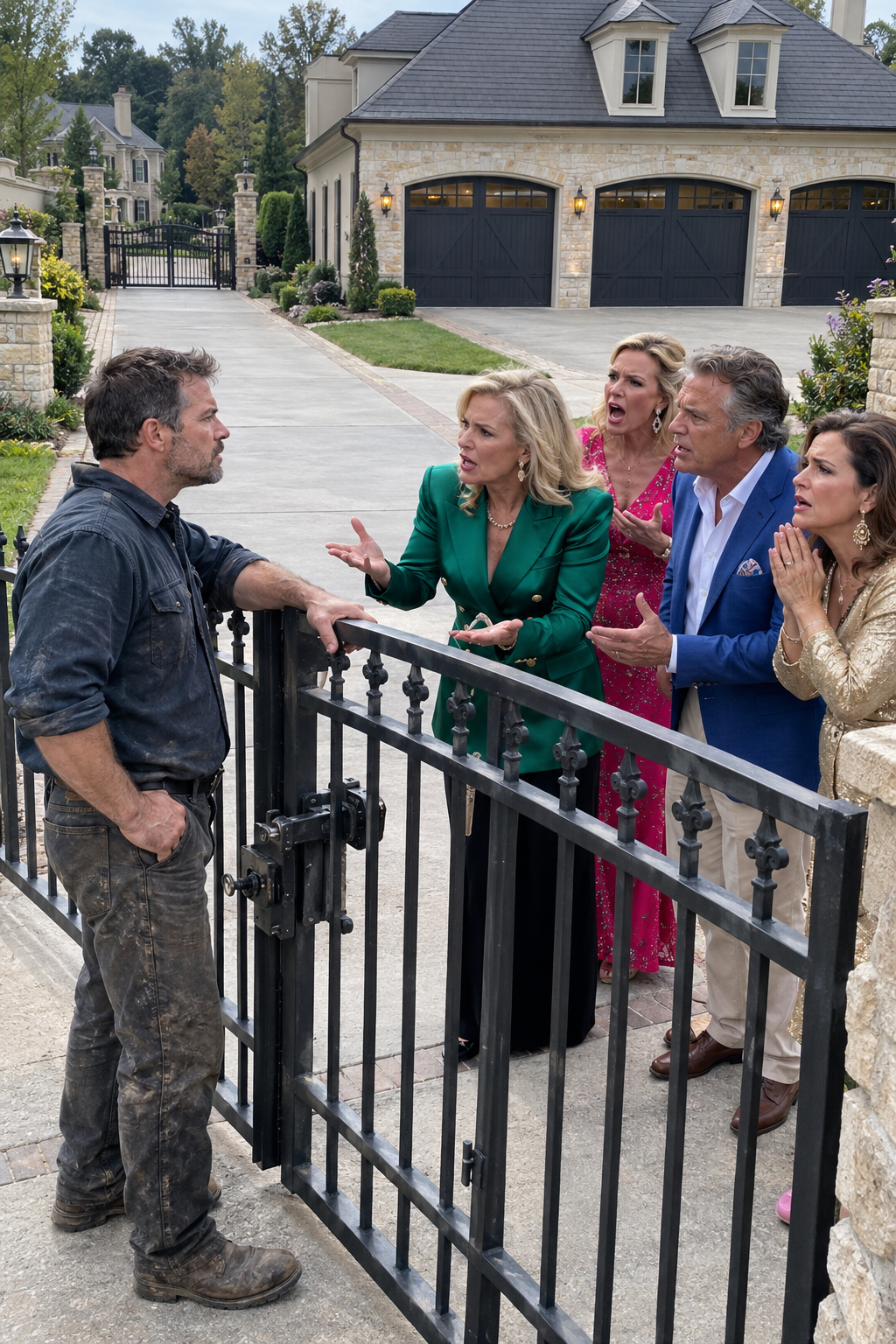
The HOA Built a $200,000 Garage Across My Private Driveway—So I Locked Both Entrances Before Their Grand Opening
The first thing the HOA president said when I found a two-story garage sitting across my driveway was, “You should be thanking us.”
The second thing she said was worse.
“If you interfere with HOA property, Daniel, we’ll have you arrested.”
I stood beside my truck with a paper cup of coffee cooling between my fingers and stared at the building that had not existed when I left town nine days earlier.
Forty feet wide.
Fresh gray siding.
Three oversized garage doors.
A second-floor office with black-framed windows.
Concrete still pale from the pour.
And directly beneath the center bay was the crushed gravel lane my family had used for fifty-three years to reach County Road 18.
My driveway.
Not beside it.
Not near it.
The building literally straddled the only practical route from my house, workshop, and twelve-acre property to the public road.
A brand-new sign had been mounted beside the entrance.
BROOKSTONE RIDGE COMMUNITY OPERATIONS CENTER.
Estimated cost, according to the permit packet I would later obtain:
The woman smiling at me as if she had personally improved my life was HOA president Cynthia Vale.
Cynthia was fifty-six, silver-blonde, always perfectly dressed, and possessed the rare talent of making a threat sound like an invitation to brunch.
That morning she wore a cream blazer, dark green slacks, oversized sunglasses, and a gold HOA board pin.
Behind her stood board treasurer Mark Bell and two contractors.
All four of them looked amused.
I looked past Cynthia toward the new building.
“Where’s my driveway?”
She smiled.
“You’re looking at it.”
“I’m looking at a garage.”
“A community operations facility.”
“Built across my driveway.”
She removed her sunglasses.
“Built over a section of roadway the association has maintained for years.”
That was my first clue.
Not what she said.
How carefully she said it.
I had spent twenty-two years working as a civil engineer. Most of that time had involved municipal infrastructure, easements, boundary disputes, access roads, drainage corridors, and contractors who occasionally developed selective amnesia when property lines became inconvenient.
People think engineers obsess over concrete.
Good engineers obsess over paperwork.
Concrete tells you what someone built.
Paper tells you whether they had the right to build it.
I took another sip of coffee.
“Who owns the land under this building?”
Cynthia’s smile tightened.
“The association has lawful access rights.”
“That wasn’t my question.”
Mark shifted his weight.
One contractor suddenly became fascinated by his boots.
Cynthia folded her arms.
“Daniel, I understand this feels personal because your family used this road before Brookstone Ridge existed. But communities grow. Infrastructure changes. You can’t expect forty-eight homeowners to organize themselves around sentimental attachments.”
Sentimental attachments.
I nearly laughed.
The driveway ran across land my grandfather bought in 1973.
The county parcel map showed it.
My deed showed it.
My survey showed it.
And the reason Cynthia thought she could get away with what she had done was simple.
For the past sixteen years, Brookstone Ridge had used part of that lane too.
Their subdivision sat east of my acreage.
When developers built Brookstone in 2010, the main entrance had been placed on Willow Creek Parkway.
But during construction, the developer negotiated a temporary access agreement with my father allowing construction vehicles to use twelve hundred feet of our private driveway.
Sixteen months.
Revocable after construction.
My father had been generous.
Too generous.
After construction ended, residents occasionally kept using the road because it saved them four minutes driving around to Willow Creek Parkway.
Dad complained.
The HOA apologized.
Then people kept doing it.
Years passed.
Dad got sick.
I moved back to help him.
After he died, I inherited the property.
And three months later, I received the first letter from Cynthia Vale.
She called the lane a “shared community access corridor.”
I sent her the deed.
She sent me a smiley-face email thanking me for my “perspective.”
Then the HOA installed two decorative lanterns beside my road.
I removed them.
Then they spread gravel on six hundred feet of the lane.
I invoiced them for unauthorized work.
Then they put up directional signs.
I removed those too.
Each time, Cynthia acted shocked.
Each time, I sent documentation.
Each time, she backed off just enough to avoid a real fight.
Until nine days before I came home and discovered a $200,000 garage sitting across my driveway.
Cynthia stepped closer.
“You were notified.”
“No, I wasn’t.”
“The project appeared in the community newsletter.”
“I’m not part of your community.”
“You receive the newsletter.”
“Because you keep mailing it to me.”
She ignored that.
“We also posted notice at the clubhouse.”
“I don’t belong to your HOA.”
Mark finally spoke.
“The board relied on counsel.”
I turned toward him.
“What did counsel tell you?”
Cynthia answered before he could.
“That the HOA possesses an established access easement.”
I looked at the contractor.
“Can I see your site plan?”
Cynthia’s voice sharpened.
“You can request records through proper channels.”
The contractor glanced at her.
Then at me.
Then back at her.
His discomfort told me more than any answer could have.
I nodded once.
That seemed to surprise Cynthia.
She had expected anger.
People like Cynthia often do.
They prepare for shouting because shouting is useful.
An angry man can be described as unstable.
An angry neighbor can be called threatening.
An angry property owner can be made to look unreasonable in a board meeting.
So I didn’t raise my voice.
I didn’t touch the garage.
I didn’t threaten anyone.
I took out my phone and photographed everything.
Every corner.
Every foundation edge.
Every utility trench.
Every tire track.
Every new drainage pipe.
Every survey stake I could find.
Then I walked sixty yards south and photographed something even more interesting.
A wooden stake painted orange.
My surveyor had placed it the previous spring.
PROPERTY LINE.
The garage foundation extended eleven feet west of it.
Onto my parcel.
I photographed that too.
Cynthia followed me.
I kept walking.
“Daniel, I need you to understand that disrupting HOA operations could expose you to liability.”
“So could building on somebody else’s land.”
Her jaw moved slightly.
That was the moment I knew she understood exactly what she had done.
They knew the driveway wasn’t theirs.
They knew the construction agreement had expired.
They knew I had never signed an easement.
They knew the garage crossed my parcel line.
They knew I was supposed to discover it only after the concrete hardened.
Cynthia stared at me for several seconds.
Then she put her sunglasses back on.
“You should speak to an attorney before doing anything impulsive.”
“I intend to.”
I got into my truck.
The center garage door remained open.
Inside were two zero-turn mowers, a utility cart, a compact tractor, several snowplow attachments, and shelves still wrapped in plastic.
Probably another hundred thousand dollars in association equipment.
I backed away.
Cynthia smiled again.
She thought the building itself had settled the argument.
That was her mistake.
Concrete feels permanent.
Deeds are more permanent.
I drove around the southern edge of my property using an old livestock trail and reached the highway through my neighbor’s farm.
It took thirty-two extra minutes.
By noon, I was sitting in the office of attorney Rebecca Sloan.
Rebecca was forty-eight, sharp-eyed, calm, and had represented my father years earlier during a county drainage dispute.
I laid the deed, subdivision plat, temporary construction agreement, surveys, and photographs across her conference table.
She spent fifteen minutes reading.
Then she leaned back.
“How friendly do you want to be?”
“Define friendly.”
“Giving them a chance to remove it voluntarily.”
I looked at the photograph of the garage.
“How long would that take?”
“Depends how unreasonable they are.”
“They built a two-story structure across my road while I was out of town.”
Rebecca nodded.
“So not very friendly.”
She opened the temporary access agreement.
“Here’s the important part.”
She pointed to paragraph seven.
“The developer’s right of access terminated automatically upon issuance of the subdivision’s final certificate of occupancy.”
“That happened in 2011.”
“Any chance they acquired rights afterward?”
“Potentially they’ll argue prescriptive easement.”
I had expected that.
“How strong?”
“Not strong enough for what they built.”
“Because use has to meet specific requirements, and they repeatedly acknowledged your ownership. These letters matter.”
She tapped the folder containing six years of correspondence.
Cynthia had accidentally documented my ownership herself.
Letters asking permission to grade the road.
Emails promising residents would stop using it.
A 2019 request to install temporary holiday decorations.
A 2022 proposal asking whether I would consider selling the HOA a permanent easement.
Rebecca smiled slightly.
“You don’t ask someone to sell you something you already legally possess.”
There it was.
Mini-payoff number one.
Cynthia’s own paper trail undermined Cynthia’s argument.
Rebecca continued.
“Now let’s look at the permit.”
“I don’t have it yet.”
She turned to her computer.
County building records were available online.
Three minutes later, we were looking at the permit application.
Brookstone Ridge Homeowners Association.
Detached maintenance structure.
Site address:
17 Brookstone Lane.
“That’s not where the building is.”
Rebecca checked the county GIS map.
17 Brookstone Lane belonged to the HOA.
It was a narrow strip of common property eighty yards east of my driveway.
The garage wasn’t built there.
Not entirely.
According to the approved plan, the western wall was supposed to sit three feet inside the HOA boundary.
Instead, the entire building had been shifted west.
Almost fourteen feet.
Enough to place a substantial portion on my land.
Rebecca stared at the screen.
“They may have a bigger problem than you.”
The county had approved one location.
They had built somewhere else.
I pointed toward the plan.
“Why shift it?”
Rebecca enlarged the drainage map.
Then we saw it.
A stormwater retention swale ran through the approved building location.
The garage design overlapped the swale by nearly eight feet.
“That shouldn’t have been permitted there either,” I said.
“Maybe somebody discovered that after approval.”
“And moved the building onto my land.”
“Looks possible.”
I leaned back.
Now the motive made sense.
The HOA had wanted a garage near the rear entrance of the subdivision.
They had budgeted it.
Announced it.
Signed a construction contract.
Then somebody realized the approved location conflicted with drainage infrastructure.
Moving the building east would have put it too close to two expensive homes.
Moving it north would interfere with utilities.
Moving it south would require clearing mature trees and probably trigger additional review.
Moving it west solved everything.
Except west belonged to me.
Rebecca printed the permit.
“What do you want?”
“My driveway back.”
“That’s reasonable.”
“And I want them to stop treating my property like backup HOA land.”
“Also reasonable.”
She picked up a yellow legal pad.
“We send a cease-and-desist today. Demand no further construction, no occupancy, no use, and immediate restoration of access.”
“Can I gate my property?”
She looked up.
I showed her the survey.
My driveway entered from County Road 18 on the west, crossed my parcel, ran past the new garage, then continued to a second older entrance near the northern fence.
Both entrances were entirely on my property.
Brookstone residents had been using both as unofficial shortcuts.
Rebecca studied the documents.
“Your deed shows no public right-of-way.”
“No recorded HOA easement.”
“County access?”
“Only along the first twenty feet from the road.”
She tapped her pen.
“You can generally secure private property, but I’d make sure there are no utility easements or emergency-access complications at the exact gate locations.”
“I already have surveys.”
“Get them verified.”
“And Daniel?”
“If you install gates, don’t physically trap people.”
“I’m not planning to.”
“Don’t block an occupied vehicle.”
“Don’t touch HOA property.”
She watched me.
“You’re being suspiciously agreeable.”
“I’m an engineer, Rebecca.”
“That’s exactly why I’m suspicious.”
By three o’clock, her formal notice had been emailed and hand-delivered.
At four sixteen, Cynthia called me.
I let it go to voicemail.
Her message lasted forty-seven seconds.
“Daniel, this escalation is unnecessary and frankly disappointing. The board has acted in good faith based on legal advice, and your attorney’s characterization of the situation is highly inaccurate. I strongly encourage you not to take any unilateral action that could inconvenience residents or interfere with association assets. We are prepared to discuss a reasonable accommodation.”
Reasonable accommodation.
They built over my driveway.
I was supposed to negotiate permission to use my own driveway.
I saved the voicemail.
At five thirty, the contractor called.
His name was Travis Mullen.
Unlike Cynthia, he sounded nervous.
“Mr. Mercer, I think we should talk.”
“Go ahead.”
“I received something from the HOA saying your attorney is disputing the property line.”
“My attorney isn’t disputing it.”
“She’s enforcing it.”
Another silence.
Travis exhaled.
“Can I come by tomorrow?”
The next morning, he arrived alone.
No Cynthia.
No board members.
He carried a rolled set of plans under one arm.
That told me plenty.
We met beside the garage.
Travis opened the drawings on the hood of his truck.
“I’m going to tell you what I know.”
“I’m listening.”
“This is the layout we bid.”
The drawing matched the county plan.
Garage east of my property line.
“What changed?”
“A revised staking layout.”
“From whom?”
“HOA project manager.”
“Who was that?”
He hesitated.
“Did you get a revised survey?”
“Revised permit?”
“Written change order?”
He looked embarrassed.
“Not exactly.”
“What does ‘not exactly’ mean?”
“She told us the original staking was wrong.”
“Who told her?”
“She said their engineer.”
“She never gave me one.”
I looked at the garage.
“How far did you move it?”
“Twelve to fourteen feet.”
“Across my boundary.”
“I didn’t know that at the time.”
I believed him.
Not because he looked honest.
Because contractors protect themselves.
And right now Travis was standing beside a six-figure building explaining why he wanted his fingerprints removed from the decision.
“Why didn’t you verify?”
“Because the HOA president signed the field directive.”
He pulled out a sheet.
There it was.
FIELD LOCATION ADJUSTMENT.
Authorized by Cynthia Vale.
The wording was carefully vague.
Shift structure approximately 12 feet west to accommodate drainage requirements.
Drainage requirements.
Not survey correction.
Not engineering discrepancy.
They had discovered the swale.
Then moved the building onto my land.
I photographed the document.
Travis didn’t stop me.
“Do you have a copy?”
He stared toward the garage.
“I probably shouldn’t give it to you.”
“That’s fair.”
He rolled the plans back up.
Then he said, “Your lawyer can subpoena it.”
Mini-payoff number two.
“Thanks, Travis.”
He climbed into his truck.
Before leaving, he lowered the window.
“One more thing.”
“The project isn’t really two hundred grand.”
“What is it?”
“Closer to three.”
“Office build-out upstairs. Security system. Heated slab. Backup generator. Equipment charging stations.”
I looked at the garage again.
“Why would a forty-eight-home HOA need all that?”
He shook his head.
“Ask your neighbors.”
Then he drove away.
That sentence bothered me.
Not because it answered anything.
Because it didn’t.
At ten that morning, a county survey crew arrived.
By noon, fresh stakes confirmed what my older survey already showed.
The garage crossed my property line.
Not eleven feet.
Thirteen feet, four inches at the southwest corner.
Twelve feet, nine inches at the northwest corner.
Worse, the center vehicle bay had been positioned directly over my established driveway surface.
The county surveyor, Luis Ortega, walked the line twice.
Then he said, “That’s not subtle.”
“You’ve got photographs from before construction?”
“Years of them.”
At one thirty, Rebecca forwarded an email from the HOA’s attorney.
His name was Stephen Hale.
The message began politely and deteriorated quickly.
The HOA denied trespassing.
Claimed an implied easement.
Claimed historical maintenance rights.
Claimed reliance on long-standing community use.
Then came the sentence Rebecca highlighted.
“Any obstruction of the association’s customary access may result in emergency injunctive relief.”
I called her.
“So they’re threatening to sue me if I block access to the building they put on my property.”
“That’s my reading.”
“Can I install my gates now?”
“Survey clear?”
“Utility clear?”
“Emergency access?”
“The fire marshal confirmed neither entrance is designated subdivision emergency access. Brookstone has two compliant entrances from Willow Creek Parkway.”
She paused.
“Then secure your property.”
That afternoon, I called a steel fabricator named Owen Price.
Owen had built ranch gates, industrial security barriers, and equipment enclosures all over the county.
I showed him the entrances.
“I need two gates.”
“How serious?”
He grinned.
“My favorite kind.”
We designed them simply.
No theatrics.
Just two heavy galvanized steel swing gates mounted on concrete-set posts, fully inside my property.
Each had reflective markers, a keypad, camera coverage, and a mechanical lock backup.
Boring is underrated.
People expect revenge to look dramatic.
The best revenge often looks like infrastructure.
Owen could install them Saturday.
That was two days away.
Friday morning, Cynthia held an emergency HOA meeting.
I knew because three residents sent me screenshots of the announcement.
COMMUNITY ACCESS THREAT.
PRIVATE LANDOWNER ATTEMPTING TO DISRUPT HOA SERVICES.
The notice urged homeowners to attend.
I wasn’t invited.
So naturally, I went.
Brookstone’s clubhouse looked like every upscale suburban clubhouse built in the last fifteen years.
Stone veneer.
High ceilings.
Gas fireplace.
Decorative beams that held up absolutely nothing.
About forty residents filled the room.
Cynthia stood at the front beside Mark Bell and Stephen Hale, the HOA attorney.
The second I entered, conversations stopped.
Cynthia’s expression changed.
“Daniel, this is a members-only board session.”
“I’m here because I understand I’m the subject.”
“You’re not a member.”
Several people laughed.
Cynthia didn’t.
Stephen leaned toward her and whispered something.
She inhaled.
“Fine. You may observe.”
I sat in the back.
Cynthia began with a slide presentation.
The first slide showed the new garage.
BROOKSTONE RIDGE OPERATIONS CENTER.
The next showed a map.
But the map was wrong.
My driveway had been drawn as a yellow road labeled NORTH ACCESS.
No parcel boundary.
No private-property notation.
No expired temporary agreement.
Just a yellow road leading neatly from County Road 18 into Brookstone.
Cynthia explained that the new facility would allow faster snow removal, landscaping response, emergency maintenance, and storage.
Then she switched slides.
Daniel Mercer has challenged Brookstone Ridge’s historical access.
Not ownership.
Careful language.
Residents began murmuring.
One man raised his hand.
“Did we build the garage on his land?”
Cynthia smiled.
“There are competing interpretations of the boundary and access rights.”
“No, there aren’t.”
Every head turned.
Stephen Hale frowned.
Cynthia said, “Daniel, please respect the meeting format.”
I held up the certified survey.
“County survey completed yesterday. The garage crosses thirteen feet four inches onto my parcel.”
The room went silent.
Cynthia’s face lost color for half a second.
Then recovered.
Stephen spoke.
“A survey does not resolve all questions of easement law.”
I looked around the room.
“But the permit might interest everyone.”
That got them.
I held up the approved site plan.
“The county approved your garage on HOA land. Someone ordered the contractor to shift it twelve feet west after discovering the approved location conflicted with your drainage swale.”
A woman near the front turned toward Cynthia.
“Is that true?”
Cynthia didn’t answer directly.
“Construction projects frequently require field adjustments.”
“Across somebody else’s property?” the woman asked.
Stephen raised a hand.
“I strongly recommend residents avoid drawing conclusions before legal review.”
Another man stood.
“How much did this thing cost?”
Mark Bell cleared his throat.
“The approved capital allocation was two hundred five thousand.”
“Is that the final cost?”
Mark looked at Cynthia.
Wrong move.
Everyone saw it.
The resident repeated, “What’s the final cost?”
Cynthia stepped in.
“The project remains within authorized contingency parameters.”
That meant no.
“How much?”
Nobody answered.
Someone near me muttered, “Jesus.”
I had come hoping to correct the record.
Instead, Cynthia was destroying her own credibility.
Mini-payoff number three.
Then an older resident named Carol Jensen raised her hand.
Carol lived near the southern Brookstone entrance.
“I have a different question.”
Cynthia forced a smile.
“Yes, Carol?”
“Why did we need the garage there at all?”
“To support community operations.”
“We already have maintenance storage behind the clubhouse.”
“That facility is inadequate.”
“It has three bays.”
“The board reviewed operational requirements.”
Carol shook her head.
“That’s not what I’m asking.”
She turned toward the room.
“I’m asking why the board needed a new building beside Daniel’s road.”
Cynthia’s eyes narrowed.
Carol continued.
“Because six months ago you proposed buying his access road.”
The room changed.
I felt it physically.
I stared at Carol.
She looked at me.
“You didn’t know?”
Cynthia cut in.
“That proposal never advanced.”
Carol ignored her.
“There was a closed-session discussion. Cynthia said acquiring the Mercer road would increase property values by creating a direct western entrance.”
Stephen stood.
“Carol, privileged executive-session discussions—”
“I’m seventy-two years old, Stephen. Sue me.”
Someone laughed.
Then several people started talking at once.
I looked at Cynthia.
Now I understood the garage differently.
It wasn’t just a maintenance building.
It was leverage.
If the HOA established a permanent facility dependent on my driveway, they could later argue the road had become essential infrastructure.
Then they could pressure me to grant access.
Maybe sue for it.
Maybe claim necessity.
Maybe offer to purchase it at a price favorable to them.
The garage wasn’t sitting across my driveway by accident.
Its location created the problem Cynthia needed.
That was twist number one.
And judging by her face, Carol had just exposed more than Cynthia intended.
The meeting unraveled.
Residents demanded financial records.
Someone asked for the field directive.
Another asked why the board had discussed acquiring my road without notifying homeowners.
A younger man in a navy polo shouted from the back, “Are we getting sued because Cynthia wanted a second entrance?”
Cynthia banged a small wooden gavel.
“This meeting is adjourned.”
Nobody moved.
She banged again.
“Adjourned!”
I walked outside.
Carol followed me.
We stood beneath the clubhouse portico.
Rain had begun tapping the pavement.
“I’m sorry,” she said.
“For what?”
“For not telling you sooner.”
“You didn’t owe me anything.”
“I think I did.”
She looked back through the glass doors.
“The board has been getting stranger for about a year.”
“Closed meetings. Special assessments. Consultants nobody remembers approving.”
“For what?”
“I don’t know.”
“What was the road acquisition proposal?”
Carol lowered her voice.
“Cynthia presented it as phase one of a connectivity plan.”
“Connectivity to what?”
“She never said.”
That bothered me.
“Who else was in that meeting?”
“Full board. Stephen. And some man I didn’t recognize.”
“What man?”
“Tall. Gray suit. Maybe early sixties. Cynthia introduced him as a development consultant.”
Carol thought.
“Whitaker. Maybe Whitmore.”
“Do you remember anything else?”
She nodded slowly.
“He had maps.”
“What kind?”
“Not just Brookstone.”
Her eyes met mine.
“Your whole property was on them.”
Rain ran from the edge of the roof.
“Did you see what they showed?”
“Only briefly.”
She closed her eyes.
“There were colored blocks.”
“Development parcels?”
“Anything labeled?”
“One thing.”
She opened her eyes.
“Phase Three.”
I almost asked what Phase One and Phase Two were.
Then Cynthia came outside.
The older woman turned.
Cynthia stood behind us with Stephen Hale.
“You should be careful discussing confidential board matters.”
Carol smiled sweetly.
“You should be careful building garages on Daniel’s land.”
Then she walked away.
I liked Carol.
Cynthia watched her leave.
Then faced me.
“You’re enjoying this.”
“Don’t lie.”
“I’d enjoy having my driveway back.”
“You’re creating unnecessary hostility.”
“You poured sixty cubic yards of concrete across my driveway.”
“Because you refused every reasonable access proposal.”
That was new.
“What proposals?”
“Your father understood this community depended on cooperation.”
“My father told you to stop using the road.”
“He was difficult toward the end.”
I took one step closer.
Not aggressive.
Just enough that she had to look directly at me.
“Don’t talk about my father.”
For the first time since I had known Cynthia, she stopped smiling.
Stephen stepped between us verbally.
“Mr. Mercer, no one wants escalation.”
I looked at him.
“Then move the building.”
“That is not a practical resolution.”
“It’s the only resolution I’m offering.”
Cynthia laughed softly.
“You think you can force a two-hundred-thousand-dollar building to move?”
I looked toward the west.
“I think I can force you to stop crossing my property.”
Saturday morning at seven, Owen arrived with a flatbed truck.
By seven thirty, Cynthia arrived too.
She pulled up in a white Mercedes SUV and parked near the northern entrance.
When she saw the steel gate sections chained to Owen’s trailer, she marched toward us.
“You cannot be serious.”
Owen looked at me.
I said, “Morning, Cynthia.”
“What are you doing?”
“Installing gates.”
“You were specifically warned not to obstruct HOA access.”
“I’m securing private entrances.”
“This is retaliation.”
“No. This is a fence project.”
“You’re blocking the operations center.”
“The operations center doesn’t have permission to access my property.”
She pulled out her phone.
“I’m calling the sheriff.”
That response irritated her more than resistance would have.
The sheriff’s deputy arrived twenty-eight minutes later.
Deputy Lauren Webb.
Mid-thirties.
She listened to Cynthia first.
Cynthia spoke rapidly about historical rights, interference with community property, emergency services, and possible criminal obstruction.
Then Lauren came to me.
I handed her a folder.
Attorney letter.
Fire marshal email.
Photographs.
Utility clearance.
Gate site plan.
Lauren read quietly for several minutes.
Then she looked toward Owen.
“You’re keeping the gate entirely inside these stakes?”
“Yes, ma’am.”
“Any public right-of-way?”
She turned to Cynthia.
“This appears civil.”
Cynthia stared at her.
“He is intentionally preventing access to HOA property.”
Lauren looked toward the garage.
“Is the garage on his property?”
“That is disputed.”
I said nothing.
Lauren looked at the survey stakes.
Then back at Cynthia.
“Again, civil.”
Cynthia lowered her voice.
“Deputy, forty-eight families depend on these facilities.”
“For what?”
“Maintenance.”
“Is anybody trapped?”
“Any emergency vehicles blocked?”
“Any occupied homes losing access?”
“Then I don’t have a criminal matter.”
Cynthia’s face hardened.
“What if he locks the gates?”
Lauren shrugged slightly.
“Then I suggest you speak with your attorney.”
She handed me the folder.
“Don’t block the county shoulder.”
“Wasn’t planning to.”
She nodded.
“Have a good morning.”
Mini-payoff number four.
By noon, the first gate stood finished.
Twenty-four feet wide.
Six-inch steel posts.
Cross-braced frame.
Heavy hinges.
It wasn’t flashy.
It looked like something designed to remain exactly where it was for thirty years.
At one fifteen, Owen finished the northern entrance.
At one twenty-two, Cynthia returned with Stephen.
At one twenty-five, I closed both gates.
That was it.
No cheering.
No dramatic confrontation.
Just two ordinary sounds.
But everything changed.
Brookstone residents could still enter and exit their subdivision through Willow Creek Parkway, exactly as their approved subdivision plans intended.
They could reach every house.
The clubhouse remained accessible.
Emergency vehicles remained unrestricted.
Nothing essential was blocked.
Except the HOA’s shiny new garage.
The garage had three vehicle bays.
All three opened west.
Onto my driveway.
With both ends of my private lane gated, their equipment had nowhere lawful to go.
They had built a $300,000 box with doors facing land they didn’t control.
Stephen stared through the steel bars.
“This will be addressed Monday.”
“Probably.”
“You may be liable for damages.”
“Send Rebecca your theory.”
Cynthia stood beside him.
“You’ve made your point.”
I looked at the garage.
“You made my point.”
Sunday was quiet.
I spent the morning repairing fence along my eastern pasture.
Around noon, I noticed three Brookstone residents standing outside the northern gate.
They weren’t angry.
They were taking pictures.
One gave me a thumbs-up.
By evening, screenshots from the Brookstone neighborhood forum began arriving.
People were furious.
Not with me.
With the board.
WHERE ARE THE ORIGINAL GARAGE PLANS?
WHY DID THE LOCATION CHANGE?
WHY DIDN’T HOMEOWNERS VOTE ON THE ADDITIONAL COSTS?
WHY WAS DANIEL’S PROPERTY SHOWN AS HOA ACCESS?
WHO APPROVED THIS?
Then someone uploaded the HOA’s latest financial statement.
A line caught my attention.
Strategic infrastructure reserve: $418,000.
That sounded ordinary until I compared it with the previous year.
Previous balance:
Nearly two hundred thousand dollars had moved.
Not to the garage.
That appeared under capital improvements.
This money was separate.
Rebecca called me at nine Monday morning.
“They filed.”
“Injunction?”
“They want an emergency order forcing you to reopen both gates.”
“On what grounds?”
“Historical access, safety, operational necessity, irreparable financial harm.”
“Irreparable financial harm because they can’t use the garage they built on my land.”
“Pretty much.”
“When’s the hearing?”
“Wednesday.”
She paused.
“You’re taking this suspiciously well.”
“I have something.”
I told her about Carol.
The closed meeting.
The road acquisition plan.
The unknown development consultant.
Phase Three.
Rebecca became quiet.
“Get me everything Carol remembers.”
“And Daniel?”
“If they were planning development involving your property, I want to know whether anyone approached the county.”
That afternoon, we found it.
Not a permit.
Not an application.
A pre-development meeting request filed four months earlier.
Vanguard Communities LLC.
Project name:
Brookstone West Expansion.
I stared at the screen.
Rebecca opened the attached conceptual map.
My twelve acres sat directly in the center.
Not beside it.
Colored yellow.
A proposed road entered from County Road 18 using my driveway.
It crossed my property.
Passed the location where the new HOA garage now stood.
Then continued east into forty-two proposed residential lots.
At the bottom of the page was a note.
PRIMARY WESTERN ACCESS SUBJECT TO ACQUISITION.
I read it twice.
Then a third time.
“This isn’t an HOA project.”
“No,” Rebecca said.
“Vanguard Communities.”
“Who owns Vanguard?”
“We’re checking.”
I zoomed into the map.
The garage had already been drawn.
Not as a garage.
As an entry-services facility.
That meant the conceptual plan existed before the garage permit.
The building had not been moved onto my driveway because of a last-minute drainage problem.
Or at least, not only because of that.
Someone had planned for it to sit there months earlier.
Twist number two.
Rebecca leaned toward the screen.
“Cynthia didn’t improvise.”
“She positioned the building where this development plan needed it.”
“But why would the HOA spend homeowner money helping a private developer?”
That was the question.
Wednesday morning, the courtroom was full.
Half of Brookstone seemed to have shown up.
Cynthia sat beside Stephen Hale.
She wore navy.
No HOA pin.
Mark Bell sat behind them, pale and miserable.
Rebecca and I sat opposite.
The judge entered at nine.
Judge Marian Cole.
Sixty-something.
No patience for theatrics.
Stephen went first.
He described my gates as a sudden unilateral obstruction of a long-established community access route.
He emphasized years of use.
HOA maintenance.
Operational reliance.
Financial investment.
He avoided saying the garage sat on my property until Judge Cole asked directly.
“Counsel, is any part of this structure physically located on Mr. Mercer’s titled parcel?”
Stephen paused.
“A recent survey suggests overlap.”
“How much overlap?”
“Approximately thirteen feet.”
The judge looked over her glasses.
“That’s a substantial overlap.”
“We contend the association holds access rights—”
“That wasn’t my question.”
Stephen stopped.
“Yes, Your Honor.”
Mini-payoff number five.
Then Rebecca stood.
She began quietly.
That was her style.
No outrage.
No speeches.
She entered my deed.
Certified survey.
Expired construction agreement.
Prior HOA correspondence acknowledging my ownership.
County-approved garage site plan.
Cynthia’s field directive shifting the building west.
The fire marshal’s confirmation that my road was not required emergency access.
Then she showed the conceptual Vanguard plan.
Stephen objected immediately.
“Relevance.”
Rebecca looked at the judge.
“The HOA claims Mr. Mercer’s gates created an unforeseen emergency. This document suggests the location and desired use of his private driveway may have been planned months before construction.”
Judge Cole allowed it for limited purposes.
Rebecca placed the map on the screen.
The courtroom murmured.
Cynthia leaned toward Stephen.
Her face changed.
That reaction mattered.
The judge noticed it.
Rebecca continued.
“The association asks this court to force a landowner to provide access to a building the association knowingly positioned across his boundary, despite having an approved site plan locating that building elsewhere.”
Stephen stood.
“Knowingly is not established.”
Rebecca held up the field directive.
“Then perhaps Ms. Vale can explain why she personally authorized a twelve-foot westward shift.”
Stephen objected again.
Judge Cole looked annoyed.
“I have the document, counsel.”
By eleven fifteen, the hearing was over.
Judge Cole denied the emergency injunction.
Not permanently.
But completely enough.
The HOA had failed to demonstrate immediate irreparable harm.
Residents retained full access through public subdivision entrances.
Emergency services remained unrestricted.
And the court had serious concerns regarding the structure’s location.
The gates stayed closed.
Outside the courthouse, reporters would have been excessive.
We didn’t have reporters.
We had fifteen Brookstone residents with phones.
That was worse for Cynthia.
Someone asked her if she would resign.
She ignored them.
Someone asked Mark where the money came from.
He walked faster.
Carol hugged me.
“I haven’t had this much fun in years.”
Rebecca didn’t.
She was looking at her phone.
She handed it to me.
An email had arrived from county planning.
She had requested the complete pre-development file.
They had just sent it.
Thirty-seven pages.
We went back to her office.
Vanguard Communities LLC.
Concept plan.
Page eight.
Traffic estimate.
Page twelve.
Utility extension proposal.
Page seventeen.
Projected forty-two single-family homes.
Page twenty-one.
Proposed HOA integration agreement.
“Integration?”
Rebecca read.
The new subdivision would potentially be incorporated into Brookstone Ridge’s existing HOA structure.
That meant more dues.
More homes.
More control.
Maybe Cynthia’s motivation was partly power.
But it still didn’t explain why she would risk everything.
Then we reached page twenty-nine.
Preliminary acquisition schedule.
Three parcels.
Parcel A belonged to an elderly farmer west of me.
Parcel B was a narrow commercial strip.
Parcel C was mine.
Status beside mine:
OWNER UNWILLING.
Establish necessity of corridor access prior to formal acquisition.
Neither Rebecca nor I spoke.
There it was.
Fourteen words.
The entire garage scheme reduced to fourteen words.
Establish necessity of corridor access prior to formal acquisition.
They hadn’t built the garage despite my ownership.
They built it because of my ownership.
The building was designed to manufacture dependency.
Once the HOA could claim hundreds of thousands of dollars of infrastructure required my road, the pressure to force an easement would increase.
Maybe through negotiation.
Maybe litigation.
Maybe eminent-domain lobbying if they could involve public infrastructure.
It was clever.
Aggressive.
And almost invisible.
Rebecca kept reading.
I heard something in her voice.
“You need to see page thirty-two.”
Vanguard ownership disclosure.
Registered manager:
CV Development Holdings.
Rebecca nodded.
“Keep going.”
CV Development Holdings registered agent:
Vale Strategic Services.
I felt cold.
“Looks like it.”
The HOA president had an undisclosed connection to the company benefiting from the expansion.
Now the garage made perfect sense.
If Brookstone West succeeded, Vanguard could build forty-two houses.
If those houses sold for the $650,000 to $900,000 range common in our county, the project could generate tens of millions.
And the western access corridor was crucial.
My land was the bottleneck.
Cynthia hadn’t been protecting forty-eight homeowners.
She had been positioning them to subsidize infrastructure for a development deal.
Rebecca immediately requested corporate filings.
Then financial records.
Then county correspondence.
Meanwhile, Brookstone exploded.
By Thursday afternoon, nineteen homeowners had signed a petition for a special meeting.
By Friday, thirty-one had signed.
Mark Bell resigned as treasurer Friday night.
His resignation letter was only three paragraphs.
But one line stood out.
“I was not fully informed regarding the president’s external business interests related to the operations center.”
That was devastating.
Cynthia responded with an email calling the accusations “false, malicious, and based on incomplete documents.”
Then something unexpected happened.
She came to my house.
Six thirty in the evening.
No attorney.
No Mercedes.
She arrived in Mark’s old pickup truck.
I watched from the porch as she walked toward the house.
She looked different.
No sunglasses.
Jeans and a gray sweater.
For the first time, she looked tired.
I stayed on the porch.
“We need to talk privately.”
“Rebecca told me not to.”
“This isn’t about the lawsuit.”
“That makes me even less interested.”
She looked toward the security camera above my garage.
“Are you recording?”
She almost smiled.
“Of course you are.”
“What do you want?”
She walked closer but stopped at the bottom step.
“I can make the garage problem disappear.”
“It already disappeared. It’s behind a locked gate.”
“I mean legally.”
“The HOA will relocate the structure.”
“That’s what I asked for on day one.”
“You’ll get it.”
“And you withdraw your counterclaims.”
“You haven’t even heard the offer.”
“I don’t need to.”
She looked toward the pasture.
Sunlight cut through the oak trees.
For a moment neither of us spoke.
Then she said, “Vanguard will offer you two million dollars for the twelve acres.”
I nearly laughed.
My land was worth maybe nine hundred thousand on a generous day.
But with access value?
Apparently much more.
“Two point five.”
I studied her.
“You came here prepared to climb.”
Her face hardened.
“Everyone has a number.”
“What’s yours?”
“I’m not selling.”
“You don’t understand what’s coming.”
That sentence changed everything.
“What’s coming?”
She realized she had said too much.
She stepped back.
“Development.”
“No, Cynthia.”
I pointed toward her.
“That wasn’t a real estate pitch. You said I don’t understand what’s coming.”
She stared at me.
Then did something surprising.
She looked scared.
Not embarrassed.
“Sell the land.”
“Because you are making this harder than it needs to be.”
She looked toward the road.
Then back at me.
“Three million. Final.”
She closed her eyes briefly.
When she opened them, the fear was gone.
The old Cynthia had returned.
“Then don’t say nobody warned you.”
She walked away.
I saved the camera footage.
Monday morning, the HOA special meeting drew forty-four of forty-eight homeowners.
Cynthia attempted to chair it.
The residents voted to replace her as presiding officer.
Thirty-seven to six.
Carol Jensen was chosen instead.
Then came the recall vote.
Cynthia spoke for nine minutes.
She denied financial misconduct.
Denied concealing information.
Denied intentionally locating the garage on my property.
Claimed developers had approached multiple community leaders.
Claimed her consulting company had never profited from HOA decisions.
Then Carol asked one question.
“Did you disclose your relationship with Vanguard before voting on the garage?”
Cynthia stared at her.
Stephen Hale, sitting beside the wall, looked down.
“Did you?” Carol repeated.
Cynthia answered, “My relationship with outside entities was not relevant to the board’s maintenance decision.”
People started shouting.
Carol lifted the gavel.
“Then the answer is no.”
The recall passed.
Thirty-nine to five.
Cynthia Vale was no longer president of Brookstone Ridge HOA.
She stood slowly.
Gathered her papers.
And walked out without saying a word.
That should have felt like the ending.
The garage still stood.
The development company still existed.
My driveway was still shown on Vanguard’s plan.
And Cynthia’s warning kept repeating in my head.
You don’t understand what’s coming.
Three days later, the county issued a stop-use order on the garage.
Wrong site location.
Boundary encroachment.
Drainage discrepancies.
The HOA’s new board voted unanimously to negotiate removal.
Travis Mullen estimated it would cost almost ninety thousand dollars to dismantle and rebuild the structure east of the property line.
Nobody was happy.
But at least they were finally arguing over their own land.
I thought the crisis had peaked.
Then Mark Bell called me.
It was 10:42 p.m. on a Thursday.
His voice shook.
“What happened?”
“I need to show you something.”
I sat upright.
“Where are you?”
“My house.”
“Are you safe?”
A long pause.
“I don’t know.”
That got me moving.
I called Rebecca while pulling on my boots.
Then drove to Brookstone.
Mark lived in a brick house near the northern cul-de-sac.
His porch light was off.
Inside, almost every light was on.
He opened the door before I knocked.
He looked terrible.
White T-shirt.
Hands trembling.
“What’s going on?”
He locked the door behind me.
“Cynthia didn’t run the whole thing.”
“I figured Vanguard had other people.”
He shook his head.
“You don’t understand.”
That sentence again.
“What don’t I understand?”
Mark led me into his dining room.
A black laptop sat on the table.
Beside it were three banker boxes.
He pulled out a chair.
“When I became treasurer, I got access to archived financial files.”
“Most of the old records were normal.”
He swallowed.
“But six months ago Cynthia asked me to authorize payments from the strategic infrastructure reserve.”
“A consulting firm.”
“Vanguard?”
He opened the laptop.
“Larkspur Municipal Strategies.”
I had never heard of it.
“What did they do?”
“She said entitlement consulting.”
“For the expansion?”
“She wouldn’t tell me.”
“How much?”
“One hundred ninety-four thousand.”
That matched the missing reserve money.
“Why did you approve it?”
His face twisted.
“Because I trusted her.”
I didn’t say anything.
He didn’t need punishment from me.
He was already doing a good job himself.
Mark opened a folder.
“I started digging after the courthouse hearing.”
Inside were invoices.
Consulting.
Land-use analysis.
Transportation coordination.
Municipal outreach.
Then one invoice caught my eye.
Corridor feasibility and public-benefit conversion strategy.
Thirty-eight thousand dollars.
“What does public-benefit conversion mean?”
“That’s what scared me.”
He clicked another file.
A PDF opened.
Twenty-two pages.
Larkspur letterhead.
CONFIDENTIAL STRATEGIC ACCESS MEMORANDUM.
Prepared for Vanguard Communities.
I started reading.
The first pages discussed traffic projections.
Then road classification.
Then utility corridors.
Then development phasing.
Page eleven changed everything.
If voluntary acquisition of Parcel C cannot be achieved, project sponsors should evaluate mechanisms by which the western corridor may qualify for public-purpose designation.
My mouth went dry.
“Public-purpose designation?”
Mark nodded.
“Keep reading.”
Possible strategies included emergency-service connectivity.
Utility access.
Regional traffic relief.
And partnership with county entities.
The garage had been step one.
Not the end goal.
Proof of infrastructure dependency could support a broader argument that my private driveway served public or quasi-public needs.
Maybe not enough to take the property immediately.
But enough to start political pressure.
Enough to manufacture reasons.
Enough to make my ownership inconvenient.
I looked at Mark.
“Who is Larkspur?”
“I don’t know.”
“You said Cynthia wasn’t running this.”
He turned the laptop toward me.
Another file.
From Cynthia.
Western Corridor Funding.
Authorize the invoice from Larkspur. This has already been approved above my level. Do not circulate outside executive session.
Approved above my level.
Cynthia had a level above her.
That explained the fear on my porch.
Rebecca arrived twenty minutes later.
I had sent her Mark’s address.
She read the email twice.
Then looked at him.
“Where did you get this?”
“HOA archive.”
“Are these original files?”
“Do not alter anything.”
“I haven’t.”
“Do you have backups?”
Mark nodded toward the banker boxes.
Rebecca exhaled.
She turned to me.
“Daniel, this is no longer primarily an HOA dispute.”
“No, I mean legally. There may be corporate conflicts, undisclosed financial interests, possibly misappropriation. Maybe more.”
Mark rubbed his forehead.
“There is more.”
Rebecca and I looked at him.
He pulled a sealed envelope from the bottom of the box.
“I found this behind old insurance records.”
He opened it.
Inside was a copy of a letter dated seven months earlier.
County Transportation Planning Division.
The first paragraph thanked Vanguard Communities for preliminary discussions regarding western connectivity.
The second discussed potential benefits of a secondary route between County Road 18 and Willow Creek Parkway.
The third included a sentence that made my stomach tighten.
The county would be open to evaluating corridor dedication should participating landowners demonstrate sufficient public benefit.
“Participating landowners,” Rebecca said.
“I’m not participating.”
Mark nodded.
“That’s what I thought.”
He reached back into the envelope.
“There was another attachment.”
He slid a map across the table.
I had seen versions of the development map before.
But not this one.
This one had signature blocks.
Brookstone Ridge HOA.
And beneath them—
Mercer Property Holdings.
“What the hell is Mercer Property Holdings?”
Mark’s voice dropped.
“I hoped you knew.”
The signature above it was handwritten.
Daniel Mercer.
Not my signature.
Rebecca leaned over the page.
“Do you own any company called Mercer Property Holdings?”
“Have you ever authorized anybody to negotiate with the county?”
“Signed a development participation letter?”
She took out her phone.
“Don’t touch this page.”
My pulse had accelerated for the first time since the garage appeared.
Someone had created an entity using my name.
Or close enough to suggest authority.
Someone had signed my name.
Someone had represented to county planners that I was participating.
Suddenly the garage wasn’t just trespass.
It was supporting evidence for a story somebody had already told the government.
A story in which I had agreed.
A story in which my road might eventually become public infrastructure.
I looked at Mark.
“Who submitted this?”
“I don’t know.”
“Where did Cynthia get it?”
“I don’t know.”
“Who was above her level?”
His eyes moved toward the laptop.
“There’s one more email.”
He opened it.
No body text.
Just a forwarded message Cynthia had sent herself.
The sender’s address belonged to someone named R. Kessler.
The subject line read:
Mercer will fold after vertical construction.
Rebecca whispered, “Vertical construction.”
“The garage,” I said.
Mark nodded.
The email contained only one sentence.
Once the building is in place, deny boundary error, establish reliance, and proceed to corridor conversion if he refuses acquisition.
I read it twice.
Then the lights went out.
Not dimmed.
Not flickered.
Mark froze.
Rebecca immediately turned on her phone flashlight.
“Power failure?”
Mark shook his head.
“The neighbors still have lights.”
Through the front window, the house across the street glowed normally.
My phone buzzed.
Security alert.
Both cameras at my property had gone offline.
I stared at the screen.
Then another alert appeared.
SOUTH GATE MOTION DETECTED.
Image unavailable.
Rebecca looked at me.
“Call the sheriff.”
I already was.
While the dispatcher answered, Mark moved toward the window.
I grabbed his arm.
“Stay away from the glass.”
Headlights appeared at the end of the cul-de-sac.
A dark SUV rolled slowly past the house.
No plates visible from where we stood.
It didn’t stop.
It didn’t need to.
Mark whispered, “That’s the same SUV.”
“What same SUV?”
He looked at me.
“The one Cynthia’s development consultant drove.”
My phone rang.
Unknown number.
I almost ignored it.
Then answered.
No greeting.
No background noise.
Just a man’s voice.
“You should have taken the three million, Mr. Mercer.”
The call ended.
For a second, nobody moved.
Rebecca stared at me.
Mark’s face had gone gray.
Then my phone buzzed again.
This time, one of my cameras had reconnected.
A still image loaded.
South gate.
Timestamp: 11:31 p.m.
The steel gate stood open.
Not broken.
The keypad housing had been removed cleanly.
And beyond it, on my driveway, sat a white survey truck I had never seen before.
Two men stood beside my gate.
One held a tripod.
The other was hammering a bright orange stake into my ground.
I zoomed in.
There was writing on the stake.
Even through the grainy night image, I could read it.
COUNTY PROJECT LIMIT.
My mouth went dry.
The sheriff’s dispatcher was still talking in my ear when a second image loaded.
Farther up the driveway.
Near the $300,000 garage.
Three more stakes.
Then another.
Then another.
A line running straight across my property.
Not toward Brookstone.
Toward the highway.
Rebecca saw the screen.
“What is that?”
I didn’t answer.
Because at that exact moment, Mark opened one final document on the laptop.
A county transportation concept sheet dated six weeks before Cynthia built the garage.
The project title was printed across the top.
WESTERN RELIEF CONNECTOR.
Estimated budget:
$18.7 million.
My driveway was only the first twelve hundred feet.
The proposed road continued another four miles.
Through farms.
Through woodland.
Through seventeen privately owned parcels.
And at the bottom of the map, beneath a red line that started at my steel gate, someone had written four words.
PHASE ONE ACQUISITION BEGINS HERE.
✓ Lynn R. Adams
The HOA Built a $200,000 Garage Across My Private Driveway—So I Locked Both Entrances Before Their Grand Opening The first thing the HOA president said when I found a two-story garage sitting across …