The HOA Built a $20 Million School on My Ranch—Then One Survey Stake Exposed the Deed They Thought I’d Never Find
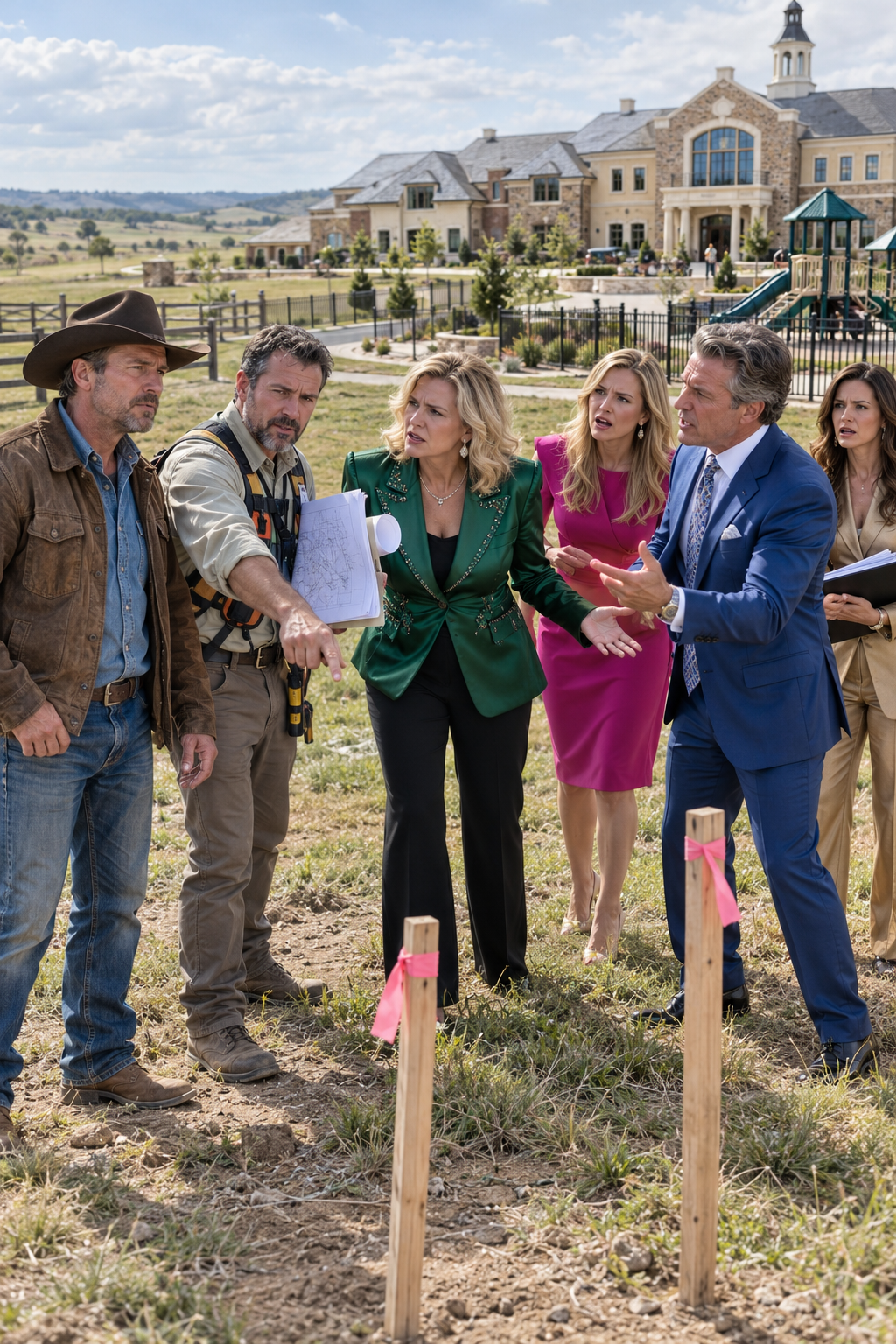
The HOA Built a $20 Million School on My Ranch—Then One Survey Stake Exposed the Deed They Thought I’d Never Find
The first time I realized someone had built a twenty-million-dollar school on land I still owned, I was standing beside a survey stake while an HOA president told me I could be arrested for trespassing.
On my own ranch.
She smiled when she said it.
Then the surveyor looked at her, looked at the new brick school behind us, and said six words that wiped the smile clean off her face.
“Ma’am, this building is on his parcel.”
For a few seconds, nobody moved.
Not the construction superintendent.
Not the county inspector.
Not the two men wearing Cedar Hollow Academy jackets.
Not even Patricia Caldwell, president of the Cedar Hollow Estates Homeowners Association and the woman who had spent the past three years acting as if half of northern Colorado belonged to her because she had a laminated badge that said BOARD PRESIDENT.
I stared past them at the building.
Three stories.
Cream limestone entrance.
Glass science wing.
A gymnasium big enough to hold every graduating class in the county.
Two playgrounds.
A football practice field.
A circular bus lane.
Fresh landscaping.
A bronze sign near the entrance covered by a blue tarp for the grand opening ceremony scheduled twelve days later.
Cedar Hollow Academy.
Eight hundred students.
Twenty million dollars in construction costs.
Thirty-seven acres of what everyone had been calling “the education parcel.”
Except according to the brass-capped survey marker sticking out of the dirt beside my boot, the education parcel wasn’t theirs.
It was mine.
Patricia recovered first.
“That is impossible.”
Surveyor Daniel Reese didn’t react.
Daniel was fifty-eight, narrow-faced, permanently sunburned, and had the personality of a courthouse clock.
He did not care about money.
He did not care about titles.
He did not care whether you screamed at him.
If a piece of dirt sat twelve inches east of a legal boundary, Daniel would tell the governor it sat twelve inches east of a legal boundary.
He crouched beside the marker and brushed away loose soil.
“I’m not giving you an opinion,” he said. “I’m showing you a monument.”
Patricia crossed her arms.
Her white SUV was parked behind her, polished so brightly that the clouds reflected in its doors.
She wore cream slacks, expensive boots, and an emerald jacket that looked more appropriate for a fundraiser than a construction site.
“This property was purchased from his father in 2008.”
Daniel looked at me.
That part was true.
Or at least I had always believed it was.
My father, Henry Walker, had sold land to the original developer seventeen years earlier.
Forty-one point six acres.
Everyone in my family knew about it.
Dad had hated selling even that much of Walker Ranch, but cattle prices had been terrible, my mother needed surgery, and Cedar Ridge Development had offered enough money to solve several problems at once.
I was twenty-four at the time.
I remembered sitting at our kitchen table while Dad complained about lawyers turning simple transactions into eighty-page closing packets.
He had pointed at the east window with his coffee mug.
“They can have that scrub ground past the old cottonwoods,” he’d said. “Nothing good grows there anyway.”
That was how I remembered it.
That was how the family remembered it.
And for seventeen years, nobody had questioned it.
Cedar Ridge eventually became Cedar Hollow Estates.
Four hundred upscale houses followed.
Then a clubhouse.
Then tennis courts.
Then private walking trails.
Then Patricia Caldwell.
Patricia arrived about six years ago and transformed a quiet HOA into something resembling a suburban government with better landscaping and worse constitutional limits.
She loved rules.
Mailbox colors.
Roof shingles.
Fence heights.
Driveway basketball hoops.
Boat storage.
Trash cans visible after p.m.
Holiday lights left up after January 15.
She once sent me a violation notice because my cattle trailer could be seen from a road inside Cedar Hollow.
I wasn’t even a member of the HOA.
My ranch predated the subdivision by eighty-seven years.
When I mailed the notice back with NO JURISDICTION written across the front, Patricia sent another notice informing me that my “failure to cooperate would be documented.”
I framed it.
But until that morning beside Daniel Reese’s survey marker, Patricia had always been an annoyance.
A loud one.
An arrogant one.
Still, an annoyance.
Now she was standing in front of a twenty-million-dollar school that might have been built on my property.
And suddenly she wasn’t annoying anymore.
She was dangerous.
Patricia pointed at Daniel.
“You need to check your equipment.”
Daniel slowly stood.
“My equipment is fine.”
“The fence is over there.”
She pointed toward an old barbed-wire fence nearly six hundred feet behind the school.
Daniel followed her finger.
Then he looked back at her.
“Fences aren’t automatically boundaries.”
“That fence has been there for decades.”
“No,” I said.
Everyone looked at me.
I had been quiet until then.
That was intentional.
When people are frightened, they fill silence.
Patricia especially.
I pointed toward the south corner of the school property.
“The original fence used to run from that cottonwood grove to County Road 14.”
Patricia blinked.
I could almost see her calculating whether I actually remembered.
I had repaired that fence with my father when I was fourteen.
The summer heat had been brutal.
Dad let me drive the old Ford flatbed even though I didn’t have a license.
We stretched wire until sunset.
I still had the scar on my left thumb where a staple slipped.
The fence Patricia had pointed toward was newer.
Built after the subdivision went in.
I had assumed the developer moved it because Dad’s sale changed the property line.
I had never had a reason to question that assumption.
Until Daniel called me three days earlier.
He had been surveying a utility easement for a water pipeline I wanted to run toward my northern pasture.
He couldn’t reconcile the recorded deed with the county GIS map.
So he kept digging.
Then he called me.
“Ethan,” he had said, “you need to come out here.”
Not good morning.
When a surveyor who has been doing boundary work for thirty-four years tells you to come out immediately, you go.
Now Patricia stepped closer to Daniel.
“I have personally reviewed the academy closing documents. Cedar Hollow Education Foundation owns this property.”
“Then your closing documents and the land records disagree,” Daniel said.
Her eyes hardened.
“That’s defamatory.”
Daniel actually laughed.
A dry little sound.
“Coordinates can’t defame you.”
I almost smiled.
But then I noticed something behind Patricia.
County inspector Mark Ellis had stopped taking notes.
The construction superintendent, a heavyset man named Rick Nolan, had pulled out his phone.
One of the Cedar Hollow Academy representatives was whispering urgently to the other.
They understood the problem before Patricia did.
A boundary dispute involving an empty meadow was one thing.
A boundary dispute involving a twenty-million-dollar building financed through municipal bonds was something else entirely.
Patricia turned to me.
“You knew we were building this school.”
“I knew you were building a school.”
“You watched construction for eighteen months.”
“From my ranch.”
“And you never objected.”
“Why would I object to you building on property I believed your developer purchased?”
Her chin lifted.
“No,” I said. “Not exactly.”
She stared at me.
“I believed you owned it because my father sold you land. That doesn’t mean I agreed you could build on whatever land you wanted.”
Patricia gave me the smile she used at HOA meetings when she wanted everyone to understand that the discussion was over.
“Well, fortunately, belief doesn’t determine legal ownership.”
Daniel bent down, lifted his equipment case, and snapped it shut.
“That,” he said, “is the first correct thing anybody has said in five minutes.”
Rick Nolan turned away to hide a smile.
Patricia heard him.
Her face tightened.
Then she looked at me again.
“What do you want?”
There it was.
Not What happened?
Not How do we verify this?
Not Could there be a mistake?
What do you want?
That question told me more than anything else she had said.
Maybe Patricia didn’t know exactly what had happened.
But she knew enough to be afraid.
I didn’t raise my voice.
I didn’t threaten her.
I didn’t block the road.
I didn’t demand twenty million dollars.
I didn’t touch a single brick of that school.
I simply looked at the survey stake beside my boot and said, “I want to see the deed.”
Patricia answered too quickly.
“You’ve seen it.”
“Your family executed it.”
“My father executed something seventeen years ago. I want the recorded document your foundation relied on before spending twenty million dollars.”
“You can obtain public records yourself.”
“I already did.”
That stopped her.
Daniel glanced at me.
I hadn’t told him that part yet.
The previous night, after his phone call, I had driven into town and pulled every deed, plat, easement, subdivision filing, parcel map, and boundary adjustment connected to Walker Ranch and Cedar Hollow.
My dining table disappeared under paper.
At in the morning, I found the problem.
At , I found something worse.
But I wasn’t ready to tell Patricia about the second thing.
I reached into my truck and pulled out a yellow folder.
Patricia’s eyes followed it.
“The deed my father signed in 2008 describes forty-one point six acres,” I said.
“Beginning at the northeast quarter corner of Section Twenty-Two.”
“Then running south eight hundred forty-two feet.”
She hesitated.
For the first time all morning, uncertainty crossed her face.
Daniel noticed it too.
I continued.
“Then east to the drainage channel. Then north along the county right-of-way.”
Patricia said nothing.
I opened the folder.
“The school isn’t on that tract.”
Rick Nolan walked closer.
The academy representatives stopped whispering.
Patricia’s mouth tightened.
“That is your interpretation.”
“No,” Daniel said. “That is geometry.”
I handed him the deed.
Daniel unfolded the legal description.
He had already seen it electronically, but he played along.
He pointed south, toward a wide stretch of weeds on the opposite side of a drainage basin.
“The land described in this deed starts approximately two thousand one hundred feet southeast of the academy.”
One of the academy men swore quietly.
Patricia snapped her head toward him.
He pretended he hadn’t spoken.
I pointed toward the distant scrub ground.
“My father sold Cedar Ridge Development that land.”
Then I pointed at the school.
“He did not sell you this land.”
Patricia’s face had gone pale.
Only slightly.
Most people wouldn’t have noticed.
“So what?” she said. “There was obviously a drafting error.”
“It happens constantly.”
Daniel shook his head.
“Not like this.”
She turned on him.
“What does that mean?”
“The description isn’t off by twenty feet. It isn’t reversed. It isn’t missing a call. It describes a completely different tract.”
Patricia took one step toward him.
“The intent of the parties controls.”
“Sometimes,” Daniel said.
“My attorney will explain it to you.”
“I’m a surveyor. Your attorney can explain it to a judge.”
That sentence changed the atmosphere.
Until then, Patricia had been trying to win an argument.
Now she understood there might actually be a case.
She pulled out her phone.
“I think we’re done here.”
“I agree,” I said.
She looked surprised.
Maybe she expected me to fight.
Instead, I closed my folder.
“I’ll have my attorney contact the foundation.”
“You don’t need an attorney.”
“I probably do.”
It was the first time she used my first name all morning.
That was when I knew she was scared.
She lowered her voice.
“There are hundreds of families involved in this project.”
“Teachers have contracts.”
“Children are enrolled.”
“The dedication is in twelve days.”
I looked at the school again.
Workers were installing banners on the entrance columns.
A landscaper was kneeling beside rows of fresh flowers.
Two guys in fluorescent shirts were painting parking stripes.
Everybody was preparing for a celebration.
Nobody had any idea the ground beneath them was suddenly uncertain.
“That sounds important,” I said.
Patricia stared at me.
I climbed into my truck.
She grabbed the top of the open door.
“You need to understand something.”
I looked at her hand.
Then at her.
She removed it.
Her voice softened.
“This development contributes millions of dollars to this county. Cedar Hollow Academy has support from the commissioners, the school board, local businesses, everyone. Whatever technical issue your surveyor thinks he found can be corrected.”
“Then correct it.”
I started the engine.
She stepped back.
Then she said something that stayed with me.
“Don’t turn this into something bigger than it needs to be.”
I looked through the windshield at twenty million dollars of brick and steel.
“I’m not the one who made it big.”
Then I drove away.
By noon, Cedar Hollow’s attorney had called me three times.
I didn’t answer.
By one, Patricia called twice.
I didn’t answer her either.
At , I received an email titled FORMAL NOTICE OF INTERFERENCE WITH EDUCATIONAL OPERATIONS.
That made me laugh.
I was standing in my equipment barn changing hydraulic fluid in a tractor that had been older than me when Dad bought it.
Apparently, changing hydraulic fluid twenty-five hundred feet from the school constituted interference.
The email accused me of making “unsubstantiated ownership assertions,” intimidating contractors, disrupting school preparations, and threatening community resources.
I hadn’t threatened anyone.
I forwarded it to my attorney, Rachel Bennett.
Rachel called eleven minutes later.
“What did you do?”
“Changed hydraulic fluid.”
“I’m serious.”
She sighed.
I could hear keyboard keys clicking.
Rachel had handled ranch issues for my family for twelve years.
Water rights.
Grazing leases.
Mineral agreements.
An ugly dispute with a utility company that wanted to run transmission poles through our calving pasture.
She did not panic easily.
But after reading Patricia’s email and the deed, Rachel stopped typing.
“Who surveyed this?”
“Daniel Reese.”
Another silence.
“That’s good.”
“I thought so.”
“Did he put his opinion in writing?”
“He will tomorrow.”
More typing.
Then she asked, “Do you have your father’s closing file?”
I looked toward the house.
“I’ve got his filing cabinets.”
“Find everything from 2008.”
That was the beginning.
My father never trusted computers.
He trusted metal cabinets, handwritten labels, and the belief that no document worth keeping should depend on electricity.
When he died, I inherited forty-three years of ranch paperwork.
Most of it sat in the basement.
At that evening, I pulled out a gray box labeled CEDAR RIDGE SALE.
Inside were copies of bank checks.
Tax documents.
A purchase agreement.
A title commitment.
Three maps.
Dad’s notes.
Correspondence with a Denver law firm.
And a photograph.
The photograph stopped me.
It showed Dad standing beside developer Martin Caldwell.
Patricia’s late father-in-law.
Martin had founded Cedar Ridge Development.
He was shorter than Dad, heavy around the middle, always wore western boots with suits, and had a reputation for buying land that other developers considered useless.
In the photo, both men stood beside the old cottonwood grove.
Behind them was the original barbed-wire fence.
And behind that fence, in the distance, was the ridge where Cedar Hollow Academy stood today.
Dad had written something on the back.
SOLD PARCEL IS EAST OF DRAINAGE.
NOT SCHOOL MEADOW.
DO NOT MOVE LINE WITHOUT NEW DEED.
I read it twice.
Then a third time.
Dad had been dead four years.
But suddenly I could hear his voice.
Almost irritated that anyone would need reminding.
I called Rachel.
“I found something.”
Twenty minutes later, I sent her photographs of the entire file.
She called me back at .
“This is better than I expected.”
“How much better?”
“The purchase agreement includes an exhibit.”
“I saw that.”
“Look at Paragraph Nine.”
I found it.
The language was boring enough to put a person to sleep.
PROPERTY TO REMAIN WITH SELLER.
I kept reading.
“The meadow west of drainage channel shall remain part of seller’s retained ranch property,” I said.
Rachel was quiet.
“That’s where the school is.”
I sat down.
“Then how did anybody issue title insurance?”
“That’s my next question.”
“Could they have amended the deal later?”
“Absolutely.”
“Did they?”
“I don’t know.”
I looked at Dad’s filing cabinet.
“If he signed something later, wouldn’t he keep it?”
“Probably.”
“But not definitely.”
I hated that answer.
Certainty is expensive.
Anybody who has ever fought over land knows that.
People think deeds are simple.
Your property.
My property.
A courthouse record.
But land carries decades of paper behind it.
Reservations.
Exceptions.
Rights-of-way.
Old surveys.
Corrective instruments.
Affidavits.
Plat revisions.
A single notarized page can move millions of dollars.
Rachel said, “There’s another issue.”
“The academy issued bonds.”
“Twenty-one point eight million total. Construction plus financing costs.”
“Bondholders require valid collateral.”
I leaned back.
“If the school sits on my property…”
“Then someone has a very uncomfortable phone call to make.”
That phone call happened the next morning.
To every contractor on the project.
At , Rachel sent Cedar Hollow Education Foundation a formal notice disputing title to the academy property.
She attached Daniel’s preliminary survey.
Dad’s purchase agreement.
The 2008 recorded deed.
The county plat.
And the photograph.
She copied the foundation’s law firm, title insurer, bond trustee, county planning department, construction lender, and general contractor.
At 10:23, Rick Nolan called me.
“This is Rick from the school.”
“I remember.”
There was noise behind him.
Men talking.
A reversing truck.
Then it stopped.
One by one.
“What’s going on?” I asked.
“The title company issued a hold.”
I didn’t respond.
“They’re telling us no more permanent improvements until ownership is resolved.”
“Sounds reasonable.”
“We’ve got seventy-two workers here.”
“I’m sorry.”
Rick lowered his voice.
“I’ve been doing commercial construction twenty-seven years. I’ve never seen this.”
“Neither have I.”
“They’ve frozen the final draw too.”
That was the first mini-payoff.
I didn’t ask anyone to stop construction.
I didn’t chain a gate.
I didn’t stand in front of a bulldozer.
A survey stake did what anger couldn’t.
By lunch, every machine at Cedar Hollow Academy was parked.
By evening, the landscaping company had removed its crew.
The next morning, a temporary certificate inspection was postponed.
Patricia called at a.m.
I answered this time.
“You need to withdraw your claim.”
“This is costing us tens of thousands of dollars a day.”
“You should speak to your attorney.”
“I’m speaking to you.”
“I noticed.”
“This is not funny.”
“I didn’t say it was.”
She took a breath.
“We have documentation establishing ownership.”
“Send it to Rachel.”
“Then she’ll review it.”
“Ethan, you’re making a mistake.”
“Possibly.”
“You could be liable for the delay.”
“Then sue me.”
That silenced her.
People like Patricia love legal threats when they expect the other person to fear them.
They like them much less when you calmly invite them to put the threat in front of a judge.
She changed tactics.
“Would you meet with me?”
“With lawyers.”
“Privately.”
“I think we can resolve this.”
“With lawyers.”
Another pause.
“What do you want for the parcel?”
That was the second time she asked that question.
This time, the meaning was different.
I looked out my kitchen window.
Morning fog sat low over the cattle pond.
My father’s barn stood beyond it.
The roof needed paint.
The north wall leaned slightly because Dad had built half of it himself in 1979 and believed level was mostly a suggestion.
“What are you offering?” I asked.
“Five hundred thousand.”
I almost thought I misheard.
“For thirty-seven acres with a twenty-million-dollar school on it?”
“For land your family already intended to sell.”
“Seven hundred fifty.”
“One million.”
She became quiet.
Then colder.
“You’re trying to extort us.”
“You called me.”
“We built in good faith.”
“Then show me the deed.”
“We have a corrective instrument.”
There it was.
The thing I had been waiting to hear.
“What corrective instrument?”
She hesitated.
Only a fraction of a second.
But enough.
“Our legal team will provide it.”
“When was it recorded?”
“You can discuss that with counsel.”
“Patricia.”
“When was it recorded?”
She hung up.
I called Rachel immediately.
“She says there’s a corrective instrument.”
“You know?”
“It arrived six minutes ago.”
“What does it say?”
Rachel didn’t answer immediately.
That worried me.
“It’s titled Affidavit of Scrivener’s Error.”
My grip tightened on the phone.
A scrivener’s affidavit can correct certain clerical mistakes in recorded documents.
A misspelled name.
A mistaken reference.
It is not supposed to become a magic wand for transferring land somebody never sold.
“Who signed it?”
“Martin Caldwell.”
“He’s dead.”
“He signed it in 2020.”
“That was before he died.”
“Then what’s the problem?”
“The affidavit says your father and Martin mutually intended the 2008 deed to include the school meadow.”
I stared through the window.
Dad’s handwriting flashed through my mind.
NOT SCHOOL MEADOW.
DO NOT MOVE LINE WITHOUT NEW DEED.
Rachel continued.
“It says the legal description attached to the original deed was wrong due to drafting error.”
“Dad never signed that.”
“Was he notified?”
“Not according to the document.”
“When was it recorded?”
“Dad died in 2022.”
“So he was alive.”
“And nobody asked him?”
“Apparently not.”
A cold feeling settled into my stomach.
“Who notarized it?”
“Someone named Linda Merrick.”
“Should I know her?”
“I’m working on that.”
Rachel’s voice changed.
That meant she was reading something else.
I heard rapid typing.
Then silence.
Longer this time.
“Linda Merrick’s notary commission wasn’t active in Colorado in 2020.”
I said nothing.
“She had a commission,” Rachel continued, “but it expired in 2018.”
“That could be a database mistake.”
“Could be.”
Another pause.
“Except there’s something else.”
“The affidavit was supposedly notarized in Larimer County on September 14, 2020.”
“I just found Martin Caldwell’s obituary.”
I felt my chest tighten.
“What does that have to do with it?”
“He spent most of 2020 in Arizona undergoing cancer treatment.”
“That doesn’t prove anything.”
I heard her keyboard again.
“But his company filed a corporate report stating he participated remotely in all meetings from Scottsdale between August and November.”
I looked toward the basement door.
Toward Dad’s filing cabinet.
Toward the yellowing paperwork that had suddenly become more valuable than cattle, equipment, and maybe the ranch itself.
“You think the affidavit is fake.”
“I think we should not say that yet.”
That was Rachel’s lawyer answer.
Which meant yes.
By afternoon, Cedar Hollow’s attorney requested mediation.
Rachel declined until title evidence was complete.
The next day, Patricia announced an emergency HOA meeting.
I learned about it because thirty-seven Cedar Hollow residents emailed me.
Apparently, Patricia told homeowners that “an adjacent ranch owner was attempting to seize the community school through an opportunistic boundary claim.”
That sentence spread through the neighborhood faster than grass fire.
So did the map.
Some residents hated me instantly.
Others started asking uncomfortable questions.
One man named Greg Marshall called.
He had bought his house two years earlier.
“Are you seriously trying to take the school?”
“Patricia says you are.”
“Patricia also says she owns the land.”
Greg lowered his voice.
“According to the current recorded deed and survey, yes.”
“You should attend the meeting.”
“You coming?”
“I wasn’t invited.”
Greg laughed.
“Come anyway.”
The HOA clubhouse was packed that Thursday.
Two hundred people in folding chairs.
Another seventy standing against the walls.
Board members.
Local reporters.
Patricia stood at a podium beneath a giant Cedar Hollow logo.
I stayed near the back beside Rachel.
The room changed when people noticed me.
Whispers spread row by row.
Patricia noticed too.
Her jaw tightened.
Then she smiled for the crowd.
“We are aware that Mr. Walker has chosen to attend.”
As if I had wandered into her living room.
“We welcome transparency,” she continued.
Rachel whispered, “That’s promising.”
I almost laughed.
Patricia spent fifteen minutes explaining that the school project was secure, professionally managed, fully financed, and properly approved.
Then she displayed a slide showing the 2020 corrective affidavit.
“There has never been any genuine uncertainty regarding ownership,” she said.
Rachel leaned toward me.
“She really shouldn’t be doing this.”
“Because now she’s relying on that document publicly.”
Patricia continued.
“The Walker family sold this tract to Cedar Ridge Development seventeen years ago. A technical drafting error in the original legal description was corrected through standard procedures.”
Several residents nodded.
The room relaxed slightly.
Then a woman in the third row raised her hand.
“Did Ethan Walker’s father sign the correction?”
Patricia’s smile tightened.
“The original transaction reflects the intent of both parties.”
“That wasn’t my question.”
People turned toward the woman.
She crossed her arms.
“Did his father sign it?”
Patricia shuffled papers.
“The correcting affidavit was executed by the original developer.”
“Our counsel has determined—”
A murmur traveled through the room.
I recognized the woman.
Lisa Moreno.
She owned a house on Aspen Court and had fought Patricia the previous year over a fence color.
Patricia had fined her eleven hundred dollars.
Apparently Lisa had not forgotten.
Another man stood.
“Was Henry Walker alive when the correction was filed?”
Patricia’s eyes moved toward me.
The room got louder.
Somebody behind us said, “Why didn’t they have him sign?”
Good question.
Patricia raised one hand.
“Please. These issues have already been reviewed by professionals.”
Rachel finally stepped forward.
“Then perhaps those professionals can explain why the notary commission appears to have expired two years before the affidavit was executed.”
The room went dead.
Patricia’s eyes locked onto her.
Rachel introduced herself.
Then she waited.
It was one of the things I admired about her.
Rachel never rushed to fill silence.
She let other people drown in it.
Patricia glanced toward the HOA attorney sitting at a table near the wall.
He leaned toward another board member.
A reporter lifted a camera.
Patricia said, “I’m not going to comment on speculative claims.”
Rachel nodded.
That answer somehow made Patricia look worse.
Then another resident stood.
“If the academy doesn’t own the land, what happens to the bonds?”
The room exploded.
Now we were talking about money.
Parents cared about the school.
Homeowners cared about their property values.
Investors cared about bonds.
But everybody cared when the words lien, default, assessment, or special fee entered the conversation.
Patricia struck the podium lightly.
“There is no bond default.”
A man shouted, “Could there be?”
“Then why is construction stopped?”
“It’s temporary.”
“Why did the title company freeze funding?”
Patricia’s head snapped toward him.
“How do you know that?”
He pointed toward Rick Nolan.
The construction superintendent was standing near the side wall.
Rick shrugged.
“I told my subcontractors.”
That earned a few laughs.
Patricia didn’t laugh.
For the next forty minutes, she lost control of the room one question at a time.
Not dramatically.
Not with shouting.
That would have been easier for her.
Instead, residents asked calm, specific questions.
Who ordered the 2020 affidavit?
Why was the deed never amended while Henry Walker was alive?
Why had the school site been moved from the original development plan?
When did the HOA board first learn of the description problem?
Had bond counsel been told?
Had the title insurer been told?
Who authorized construction before resolving title?
Patricia answered almost none of them.
At , she abruptly adjourned the meeting.
I was halfway toward the exit when she intercepted me.
“Are you enjoying this?”
“Don’t lie.”
“You humiliated me.”
“I didn’t say a word.”
“You brought your lawyer.”
“You brought yours.”
Her eyes flashed.
“This school matters to people.”
“You don’t have children.”
That one landed harder than she intended.
My wife, Sarah, and I had tried for years before she died.
Patricia didn’t know that.
Most people didn’t.
I let the silence sit.
Then I said, “That doesn’t change where the boundary is.”
She realized she had touched something.
For half a second, something almost human appeared in her expression.
Then it disappeared.
“Sell us the land.”
“Two million.”
Rachel looked at me.
Patricia noticed.
“Three million dollars for thirty-seven acres.”
“Why are you offering three million dollars for land you claim you already own?”
That question hit her like a slap.
Two reporters were standing ten feet away.
Both heard it.
Patricia lowered her voice.
“Because litigation benefits nobody.”
“Then show us a valid deed.”
She walked away.
The following morning, somebody cut the chain on my east gate.
Not the gate near the school.
A different one.
A ranch gate almost a mile north.
Nothing was stolen.
No cattle escaped.
Whoever did it simply cut the lock, opened the gate, and left it that way.
I found it at a.m.
I didn’t call Patricia.
I called the sheriff.
Deputy Aaron Mills photographed the chain.
“Could be kids,” he said.
“Could be.”
“You got cameras?”
“Not here.”
“Get some.”
By lunchtime, I had twelve cellular trail cameras covering every major access point.
That afternoon, somebody from Cedar Hollow called county code enforcement and reported “unsafe agricultural chemical storage” on my property.
Inspector came out.
Found nothing.
The next day, someone reported my barn apartment as an illegal rental.
It wasn’t a rental.
The day after that, animal control received a complaint that my cattle lacked water.
They had two automatic tanks and a pond.
The officer apologized.
I kept records of everything.
I did not accuse Patricia.
I did not post angry messages.
I did not threaten retaliation.
I let the pattern create its own shape.
Then Daniel Reese finished the full boundary survey.
And the problem got worse.
Much worse.
Rachel, Daniel, and I met at my kitchen table Sunday afternoon.
Daniel spread a thirty-six-inch survey map across the wood.
He placed four coffee mugs on the corners.
“The academy footprint is entirely inside Walker Ranch,” he said.
“How entirely?”
“All of it.”
“The parking lot?”
“Football field?”
“Bus lane?”
“Stormwater pond?”
He tapped the paper.
Rachel pointed at the western line.
“What about the access road?”
Daniel gave her a look.
That was my first warning.
“What?” I asked.
“The school’s primary access road crosses your property for eight hundred seventy-three feet.”
I rubbed my jaw.
“Do they have an easement?”
“I can’t find one.”
Rachel sat back.
“That’s a problem.”
Daniel nodded.
“But that’s not the big problem.”
I stared at him.
Twenty million dollars sitting on land I owned.
No valid deed.
Questionable affidavit.
No access easement.
And somehow Daniel had found a bigger problem.
He moved his finger north.
“See this line?”
“This is the legal description from the original subdivision plat.”
He moved his finger again.
“This is the occupation line.”
I studied the map.
They weren’t the same.
Not even close.
The difference widened toward the northwest corner.
“What am I looking at?”
Daniel removed his glasses.
“Someone shifted the subdivision control line.”
Rachel leaned closer.
“I don’t know.”
“At the widest point, six hundred twelve feet.”
My throat went dry.
“What’s inside that gap?”
Daniel didn’t answer.
He didn’t need to.
I could see rectangles on the map.
Rachel counted quietly.
“Twenty-three… twenty-four…”
Daniel said, “Thirty-one residential lots intersect the disputed strip.”
I stood so fast my chair scraped backward.
“You’re telling me thirty-one houses might be on my ranch?”
Daniel put his glasses back on.
“I’m telling you thirty-one houses need additional title research.”
“That’s lawyer language.”
“I’m a surveyor.”
“That was surveyor language.”
For the first time since this started, Daniel smiled.
Rachel looked serious.
“Do not discuss this publicly.”
“I wasn’t planning to.”
“Not with residents. Not with media. Not with Patricia.”
“Because if this is what it looks like, the school isn’t the real story.”
She was right.
We spent the next two days digging.
The final Cedar Hollow subdivision plat had been recorded in phases.
Phase One was clean.
Phase Two was clean.
Phase Three had something strange.
A boundary adjustment note referenced a survey performed by a company called Front Range Land Services.
Daniel knew the name.
“They shut down about fifteen years ago.”
“Can we get their records?” I asked.
The county archive had one surviving field-book scan.
Daniel requested it.
When it arrived, he called me.
“Come to my office.”
Same tone as before.
No explanation.
The field notes showed the survey crew had originally placed the subdivision line where Dad’s records said it should be.
Then, three weeks later, somebody ordered them to use a different control monument.
That shifted the line west.
Onto Walker Ranch.
A handwritten notation sat in the margin.
REVISED PER CLIENT INSTRUCTION.
I asked Daniel, “Who was the client?”
“Cedar Ridge Development.”
Martin Caldwell.
Patricia’s father-in-law.
Rachel stared at the scan.
“Does changing the monument change ownership?”
“No,” Daniel said. “Not by itself.”
“Then how did houses get permitted?”
“That’s what I want to know.”
The answer came from a retired county planner named Charles Whitaker.
He was seventy-three and lived outside Loveland.
Daniel knew him from years ago.
Charles agreed to meet us at a diner.
He remembered Cedar Hollow immediately.
“Biggest headache of my career.”
He stirred sugar into black coffee.
“Martin Caldwell wanted everything yesterday.”
“Do you remember a boundary problem?” Rachel asked.
Charles looked at her.
Then at Daniel.
Then at me.
“I remember Martin wanting the school moved.”
My pulse jumped.
“Moved from where?”
Charles pointed vaguely east.
“The purchased tract had drainage issues. County engineering didn’t like the original site.”
Rachel leaned forward.
“So they relocated it west.”
“Eventually.”
“Onto my ranch?”
Charles stopped stirring.
“You’re Henry’s boy?”
He stared at me.
Then leaned back.
“Well, hell.”
“Henry wouldn’t sell that meadow.”
Every hair on my arms rose.
“You talked to him?”
“2009. Maybe 2010.”
I exchanged a look with Rachel.
Charles continued.
“Martin wanted more land after the drainage report. Henry refused.”
“Did Martin know he didn’t own the meadow?”
Charles gave me a tired smile.
“Son, Martin knew where every square foot he owned was. That man could smell a half-acre variance from three counties away.”
That was the first real twist.
This wasn’t a drafting mistake.
At least not originally.
The developer knew.
“He asked the county to approve the school there anyway?”
“No. The school wasn’t built then. Market crashed. Project stalled. The education parcel sat empty.”
“What happened to the boundary?”
Charles frowned.
“That part always bothered me.”
Rachel placed a copy of the revised plat in front of him.
His eyes narrowed.
“Where’d you get this?”
“County archive.”
He studied it.
Then shook his head.
“That is not the version I reviewed.”
The diner suddenly felt very quiet.
Daniel pointed at the control monument.
“Recognize this revision?”
“Your initials are beside it.”
Charles stared.
There they were.
Blue ink on the original scanned document.
Charles’s face changed.
“I didn’t initial that.”
Rachel said nothing.
Charles leaned closer.
“I used full initials.”
He pulled out a pen.
Three letters.
He pushed the document away.
“That isn’t mine.”
I felt something cold settle behind my ribs.
The old man looked at me.
“You need to get this to the district attorney.”
Rachel said, “Not yet.”
I turned toward her.
“Because we need originals. We need chain of custody. We need to know whether this is fraud, sloppy recordkeeping, or something else.”
Charles laughed without humor.
“Lady, somebody put my initials on a plat I never approved.”
“I understand.”
“No. You don’t.”
His hand trembled slightly around the coffee mug.
“If that line moved where I think it moved, every permit issued afterward may have relied on it.”
Nobody spoke for several seconds.
Then Charles asked a question.
“Who runs Cedar Hollow now?”
“Patricia Caldwell.”
His eyes narrowed.
“Martin’s daughter-in-law?”
He stared down at the table.
“Be careful.”
“Because Martin never did anything alone.”
That sentence followed me home.
By Wednesday, the title insurer had hired outside counsel.
By Thursday, the bond trustee demanded documentation.
By Friday, Cedar Hollow Academy announced that its grand opening ceremony was “postponed due to administrative matters.”
Patricia blamed me publicly.
She gave an interview on local television.
I watched from my kitchen.
She stood in front of the school wearing a royal-blue blazer, talking about children, community investment, and “one rancher exploiting an antiquated paperwork discrepancy.”
Then the reporter asked whether the school had a valid deed.
Patricia said, “Absolutely.”
The reporter asked why the title insurer had frozen the project.
Patricia said, “Out of an abundance of caution.”
The reporter asked whether she had offered me three million dollars to purchase the property.
Her face changed.
Only for a second.
But television cameras are cruel.
They catch seconds.
“I’m not going to discuss confidential settlement conversations.”
The clip went online.
Within an hour, the comments were brutal.
If they own it, why offer $3 million?
Show the deed.
Who notarized the correction?
Why didn’t Henry Walker sign?
Patricia stopped giving interviews.
That afternoon, my trail camera sent me an alert.
East pasture.
I opened the live image.
She had driven through a ranch access gate marked PRIVATE PROPERTY.
A man sat beside her.
I recognized him.
Gerald Price.
Cedar Hollow’s attorney.
I called Deputy Mills.
Then I drove toward them.
I didn’t block the road.
I parked fifty yards away and waited.
Patricia got out first.
“What are you doing?”
“Watching.”
“This road serves the academy.”
“This road is on my ranch.”
“We have implied access rights.”
“Rachel disagrees.”
Gerald stepped out.
“Ethan, there’s no reason to escalate.”
I looked toward the sheriff’s vehicle approaching behind them.
Patricia saw it.
Her eyes widened.
“You called law enforcement?”
“You drove past a no-trespassing sign.”
“This is ridiculous.”
Deputy Mills parked.
He spoke to everyone calmly.
Gerald claimed they were inspecting access related to the school.
I showed him the survey.
Mills looked at Patricia.
“Until this is resolved, you need permission to enter Mr. Walker’s undisputed ranch property.”
“This is not undisputed.”
“This gate is.”
Patricia turned red.
For the first time, someone had told her no in front of witnesses and had the authority to make it stick.
She climbed back into her SUV.
Before leaving, Gerald walked toward me.
“Three million was generous.”
“So I’ve heard.”
“You should take it.”
He glanced toward Patricia.
Then lowered his voice.
“Because if this becomes what your attorney seems determined to make it, nobody wins.”
“Somebody already won.”
He frowned.
“My father.”
Gerald’s expression tightened.
“He said no.”
Then I walked away.
That evening, Rachel called.
Her voice was different.
“Did Gerald Price speak to you privately today?”
“What did he say?”
I told her.
She became quiet.
Then she said, “Do not speak to him again without me.”
“Because I found out who prepared the 2020 scrivener’s affidavit.”
I already knew the answer before she said it.
The second twist.
Patricia’s current attorney had prepared the document now being used to claim my land.
Not some retired lawyer.
Not Martin Caldwell’s old counsel.
Gerald Price.
The same man telling me to take three million dollars and walk away.
Rachel continued.
“And there’s more.”
“Of course there is.”
“The notary, Linda Merrick, worked for his law firm.”
I closed my eyes.
“Expired commission?”
“Did she actually notarize it?”
“We don’t know.”
“Can we ask her?”
Rachel was silent.
“She died last year.”
That was convenient.
Too convenient.
But I didn’t say it.
Rachel didn’t either.
Good lawyers know when a fact is suspicious and when a fact is proof.
Those are not the same thing.
The next morning, Rachel filed suit.
Not for twenty million dollars.
Not for possession of the school.
Not for damages.
Quiet title.
Declaratory judgment.
We asked the court to determine who owned the ground.
That was all.
Simple questions are terrifying when someone has spent years hiding complicated answers.
The filing attached Dad’s deed.
Dad’s contract.
Daniel’s survey.
The recorded affidavit.
The notary records.
Within six hours, the title insurer formally reserved rights.
Within nine, the bond trustee requested an emergency legal opinion.
Within eleven, Cedar Hollow’s foundation board scheduled a closed meeting.
At that night, Lisa Moreno called me.
“You need to know what Patricia is doing.”
“She wants an emergency assessment.”
“For what?”
“Legal expenses.”
I almost laughed.
“How much?”
“Five thousand per household.”
“That’s two million dollars.”
“Can she do that?”
“She thinks she can.”
Lisa’s voice dropped.
“But that’s not why I called.”
“She told the board the HOA has to control this before homeowners start checking their own titles.”
“Repeat that.”
“She said if people start ordering independent surveys, the entire development could be destabilized.”
The thirty-one lots.
I looked toward the map on my kitchen table.
“Was that recorded?”
My heart started beating faster.
“Send it to Rachel.”
“Already did.”
The emergency assessment never passed.
Three board members refused to vote.
One resigned.
Another demanded an independent investigation.
Patricia’s control over Cedar Hollow began cracking in places nobody could patch with landscaping rules.
But the most important call came Monday morning.
County Clerk Susan Bell.
“I understand you’re researching instruments involving Cedar Ridge Development.”
There was a pause.
“Mr. Walker, I probably shouldn’t be calling you directly.”
“But your attorney submitted a request for the original recording packet tied to the 2020 affidavit.”
“We found it.”
My fingers tightened around the phone.
“Is that unusual?”
Another pause.
“But we found something attached behind it that wasn’t scanned into the public index.”
“A cover letter.”
“From who?”
“Gerald Price’s firm.”
I stopped breathing for a second.
“What does it say?”
“I’d rather provide it through your attorney.”
Then she exhaled.
“It references multiple corrective instruments.”
“How many?”
“I don’t know.”
“What does multiple mean?”
“Mr. Walker, your attorney needs to see this.”
Rachel saw it forty-three minutes later.
Then she called me.
“Get to my office.”
I drove eighty miles an hour.
Rachel had the letter on her desk when I arrived.
Daniel was already there.
So was a private title examiner I had never met.
Nobody smiled.
I sat down.
Rachel slid a copy toward me.
The letter was dated September 18, 2020.
Gerald Price’s firm.
Addressed to the county recorder.
RE: CEDAR HOLLOW LEGACY BOUNDARY CORRECTIONS.
My stomach tightened.
The letter requested expedited recording of “corrective affidavits necessary to conform legacy legal descriptions with long-established occupation and development boundaries.”
I kept reading.
Then I reached the sentence Rachel had highlighted.
THIS PACKAGE INCLUDES SIXTY-FOUR INSTRUMENTS AFFECTING THE CEDAR HOLLOW MASTER DEVELOPMENT AREA.
I looked up.
“Sixty-four?”
Nobody answered.
I read it again.
Sixty-four.
The title examiner placed a stack of parcel maps on the desk.
“We’ve identified eleven so far.”
“Eleven what?”
“Similar affidavits.”
My mouth went dry.
“All prepared by Gerald?”
“All changing boundaries?”
“Some boundaries. Some easements. Some parcel descriptions.”
Daniel pointed at the maps.
“Several appear to convert occupation lines into claimed legal boundaries.”
I looked at Rachel.
“Without deeds?”
“In the ones we’ve reviewed, yes.”
My pulse hammered.
“How much land?”
“We don’t know.”
“Who owns it?”
“We don’t know.”
“How many houses?”
“We don’t know.”
That answer scared me more than any number.
Rachel pulled another document from the stack.
“There’s one instrument we need to discuss.”
She placed it in front of me.
A legal description.
Walker Ranch.
My name appeared in the chain.
But this wasn’t the school.
I traced the description with my finger.
“What parcel is this?”
Daniel turned the survey map around.
Then pointed.
Northwest pasture.
The high ground.
Almost four hundred acres.
My best grazing land.
The part of the ranch Dad had always said never to sell.
“What does the affidavit do?”
Daniel looked at Rachel.
Rachel looked at me.
“It claims the tract was transferred into the Cedar Hollow master development area through a 2009 boundary settlement.”
“I’ve never seen a boundary settlement.”
“Neither have we.”
“My father never mentioned one.”
I looked at the recording date.
October 2, 2020.
Same law firm.
Same expired notary.
My hands went cold.
“What’s on that land?”
“Mostly your cattle right now,” Daniel said.
“Then why would they claim it?”
Nobody answered.
I looked at the plat.
Then something clicked.
The old preliminary drawings I had seen years ago.
Dad complaining about Martin Caldwell wanting another phase of houses.
Rachel’s face told me she had reached the same conclusion.
“They planned to develop it.”
“Possibly.”
“Four hundred acres?”
“Possibly.”
“That’s not a correction.”
“That’s theft.”
Rachel held up one hand.
“What else do you call it?”
“Something we prove before we name it.”
I turned toward the window.
Cars moved along the street below.
Normal Monday morning.
People carrying coffee.
Delivery vans.
A woman walking a golden retriever.
And eighty miles away, a twenty-million-dollar school sat frozen on my ranch because somebody had decided seventeen years earlier that paper could be made to say anything if enough people stopped checking.
My phone rang.
Unknown number.
I almost ignored it.
Rachel said, “Answer.”
I put it on speaker.
“Ethan Walker?”
“This is Special Investigator Thomas Vance with the Colorado Attorney General’s office.”
Everyone in the room stopped moving.
“We’ve received information regarding property filings connected to Cedar Hollow Development.”
I looked at Rachel.
She slowly sat down.
Vance continued.
“I need to speak with you about your father.”
“My father is dead.”
“We recovered records last night from a former Cedar Ridge executive.”
My mouth went dry.
“What records?”
“Correspondence.”
“About the school?”
“About the ranch.”
I gripped the phone.
“What does it say?”
Another pause.
Long enough that I could hear papers moving on his end.
“Mr. Walker, before I answer, I need to ask you something.”
“Did your father ever tell you why he suddenly changed his will in November of 2020?”
Rachel looked at me.
Daniel looked confused.
My father had changed his will in 2020.
I knew that.
He had removed a distant cousin as backup executor and made me sole trustee of the ranch.
I had never thought much about it.
“He said he was cleaning things up.”
Vance was silent.
Then he said, “That’s not why.”
Every muscle in my body tightened.
“What do you mean?”
“We found an email your father sent three days before he changed the will.”
I could barely hear my own voice.
“Martin Caldwell.”
Nobody in Rachel’s office moved.
“What did it say?”
Vance inhaled slowly.
Then read one sentence.
“If you record one more false boundary against my ranch, I will release everything I have on Cedar Hollow.”
My heart stopped.
Rachel’s eyes widened.
I stared at the four-hundred-acre map.
“What did my father have?”
“We don’t know yet.”
“What does ‘everything’ mean?”
“That’s what we’re trying to determine.”
I walked toward the desk.
“Then why call me?”
“Because Caldwell replied.”
Vance’s voice became quieter.
“His response was only seven words.”
“What seven words?”
He read them.
“Henry, you know who else goes down.”
The room felt suddenly too small.
I thought of Dad’s filing cabinets.
His careful labels.
His distrust of computers.
His habit of keeping every receipt, every contract, every letter.
I thought of something else too.
A cabinet I had never opened.
An old green fireproof cabinet bolted to the concrete wall behind his workbench.
Dad kept it locked.
After he died, I couldn’t find the key.
I had forgotten about it.
Until that exact moment.
“Investigator Vance.”
“I think my father left something.”
Rachel stood.
I was already heading for the door.
“The basement.”
We drove to the ranch in three vehicles.
I didn’t wait for a locksmith.
I used an angle grinder.
The fireproof cabinet had two steel locking bolts.
It took sixteen minutes to cut through them.
Daniel stood behind me.
Rachel held a flashlight.
Investigator Vance stayed on the phone while a local deputy watched the doorway.
The cabinet finally opened with a metallic groan.
Inside were four shelves.
Old cattle records.
Water-right documents.
A revolver Dad had owned since the seventies.
And on the bottom shelf, a black binder.
I pulled it out.
Dust covered the plastic.
Rachel said, “Don’t open it yet.”
She photographed everything.
Then we carried the binder upstairs.
We put it on the kitchen table.
The same table where Dad had signed ranch checks.
The same table where he had complained about selling forty-one acres in 2008.
The same table where I had spread Cedar Hollow’s maps two weeks earlier.
Rachel opened the binder.
First page.
A handwritten note.
IF YOU’RE READING THIS, THEY FINALLY GOT GREEDY ENOUGH TO COME BACK FOR THE REST.
My throat closed.
Nobody spoke.
I turned the page.
There was a map.
Not just Walker Ranch.
All of Cedar Hollow.
Hundreds of lots.
Common areas.
The school.
The clubhouse.
And dozens of parcels outlined in red.
At the bottom, Dad had written:
LAND MARTIN NEVER BOUGHT.
Daniel leaned over my shoulder.
His face slowly changed.
“How many?”
Rachel whispered.
He started counting.
Then stopped.
He looked at me.
“This isn’t thirty-one houses.”
My heart pounded.
“How many?”
Daniel stared at the map.
“More than a hundred.”
Rachel turned another page.
Copies of checks.
Survey notes.
Internal Cedar Ridge memoranda.
Then a spreadsheet.
Parcel numbers.
County officials.
Consultants.
Beside several entries was one word.
Rachel went completely still.
“This is not a property dispute anymore.”
The kitchen suddenly felt cold.
I turned one final page.
There was a sealed envelope taped inside the binder.
My name was written across it in Dad’s handwriting.
ETHAN ONLY.
I pulled it free.
Rachel said, “We may need to document—”
I photographed the envelope.
Then I opened it.
Inside was one sheet of paper.
A letter from my father.
The first paragraph explained the boundary fraud.
The second explained why he stayed quiet.
The third made my hands shake.
Because Dad said Martin Caldwell hadn’t created Cedar Hollow’s land scheme.
He had inherited it.
And according to my father, the first false deed had been filed twenty-three years before Martin ever bought a single acre.
By someone still alive.
Someone currently serving in county government.
Someone who had personally signed Cedar Hollow Academy’s final occupancy approval just six weeks earlier.
At the bottom of the page, Dad had written a final warning.
I read it aloud.
“If Patricia starts building on the meadow, don’t fight the school first.”
Rachel looked at me.
Daniel leaned closer.
I continued.
“Follow the money behind the school.”
Then I reached the final line.
My hands stopped.
Investigator Vance’s voice came through the phone.
“Mr. Walker?”
I didn’t answer.
Rachel stepped beside me.
“What does it say?”
I handed her the page.
She read it.
Her face drained of color.
Because my father’s last sentence wasn’t about a deed.
It wasn’t about Patricia.
It wasn’t even about Cedar Hollow.
“Ethan, if they ever build that school, it means they finally found the place where we buried the original records—and if they found those records, they know you have the other half.”
✓ Lynn R. Adams
The HOA Built a $20 Million School on My Ranch—Then One Survey Stake Exposed the Deed They Thought I’d Never Find The first time I realized someone had built a twenty-million-dollar school on land I …