The HOA Built a $2 Million Marina on My Private Lake—So I Drained It and Exposed What They Buried Beneath
🔥HERE’S THE NEXT PART OF THE STORY, ENJOY !! The explosive twist and the final ending of this story ! ⬇️💬 Thank you ❤
Three-bedroom homes.
Retired teachers.
Contractors.
Families grilling on decks.
But over the last decade, larger houses had appeared along the ridge.
Investment groups bought older properties.
Short-term rentals multiplied.
The HOA raised dues.
Installed stone monuments at both entrances.
Built a clubhouse with a fitness center.
Linda transformed every board meeting into a presentation about “property positioning.”
She wanted Cedar Point to stop being a neighborhood.
She wanted it to become a destination.
And destinations, according to Linda, needed amenities.
The marina was the crown jewel.
Seventy-two slips.
Fuel pumps.
A restaurant pavilion.
Rental pontoons.
A private events dock.
A gated parking lot.
An estimated construction cost of nearly two million dollars.
Evan’s company had brokered the financing arrangement.
Of course it had.
“How much are they paying you?” I asked.
His jaw flexed.
“Enough to finally stop living like Dad expected us to apologize for succeeding.”
That hurt more than I let him see.
Dad had loaned Evan ninety thousand dollars when his business collapsed in 2014.
He had never asked for repayment.
Dad had cosigned Evan’s first office lease.
Dad had sold twenty acres of timber after Evan’s divorce so his son could keep his house.
But resentment has a selective memory.
Then I asked, “Did you ever see Dad sign that agreement?”
Evan’s expression changed.
Only slightly.
But I saw it.
“Did Linda?”
“I don’t know.”
“Did Gregory?”
“You’re reaching.”
I stepped closer.
There are answers people give with words.
And there are answers people give when they suddenly become fascinated by the horizon.
Evan walked away.
That night I packed.
Not because they had won.
Because Dad had taught me something important when I was thirteen and furious after losing an argument with a teacher.
Never fight for the ground your opponent expects you to defend.
Make them wonder why you gave it up.
I took clothes.
Family photographs.
Mom’s recipe box.
Dad’s old fly-fishing rod.
And the red metal survey box.
I had found it six days after the funeral.
Dad had hidden it behind a false plywood panel inside the workshop where he stored survey equipment.
There was a note taped to the lid.
ONLY IF THEY COME FOR THE WATER.
Inside were original deeds.
Survey maps.
Dam permits.
A brass key.
An engineering report.
A bound copy of the Cedar Point easement agreement.
And one sealed envelope written in Dad’s shaky handwriting.
I had not opened that envelope yet.
I don’t know why.
Maybe grief makes you superstitious.
Maybe I wanted one last thing from my father that hadn’t already become evidence.
I moved into a small rental cabin twelve miles away.
Four days later, workers erected fencing around the property where I had lived for twenty-seven years.
A week after that, Linda announced the marina project.
She did it at an HOA meeting held in the Cedar Point clubhouse.
I attended.
Of course I attended.
The ballroom was packed.
Linda stood beneath a projection of a glossy architectural rendering.
Blue water.
White docks.
Smiling families.
Boats lined up under striped canopies.
CEDAR POINT MARINA & SOCIAL CLUB.
THE FUTURE STARTS HERE.
Linda spoke for twenty minutes.
She talked about property values.
Community prestige.
Economic growth.
“Unlocking the lake.”
That phrase nearly made me laugh.
Then she saw me.
She could have ignored me.
Instead she pointed.
“Our former neighboring landowner is here tonight.”
A few heads turned.
Linda smiled.
“There has been confusion concerning private claims to the lake. Our attorneys have confirmed that Cedar Point possesses all access rights necessary for the project.”
I stood in the back with my hands inside my jacket pockets.
One resident, Mr. Ellison, raised his hand.
“Does Claire own any part of the lake itself?”
Linda answered immediately.
“Does her family?”
Wrong again.
“Then why did we need their permission all these years to repair the boat ramp?”
Linda’s eyes narrowed.
“Historical courtesy.”
That one almost impressed me.
It takes confidence to rename a recorded easement as courtesy in front of eighty witnesses.
Then she looked directly at me.
“Claire, if you intend to disrupt this meeting, I’ll have you removed.”
“I haven’t said anything.”
A few people chuckled.
Linda’s cheeks colored.
She gripped the microphone.
“Then perhaps you should keep it that way.”
There it was.
The public humiliation she wanted.
A victory lap.
A message to anyone questioning her authority.
I nodded once.
Then I left.
Behind me, applause began.
Outside, Evan was smoking beside his SUV.
He quit cigarettes six years earlier.
Apparently betrayal was stressful.
“You enjoy that?” I asked.
“Watching her do that.”
He exhaled toward the parking lot.
“She’s protecting the project.”
“From what?”
That made him angry.
“Why are you acting like this?”
“Like what?”
“Would screaming help?”
“At least it would be normal.”
“Maybe normal isn’t useful anymore.”
He dropped the cigarette and crushed it.
“Claire, take the settlement.”
“What settlement?”
His face froze.
He had just told me something I wasn’t supposed to know.
Finally, he said, “Gregory will contact you.”
“Your nuisance claims. Whatever.”
“I haven’t filed any nuisance claims.”
“It’s coming.”
He opened his SUV door.
I asked quietly, “Evan, how much money did you borrow against the marina?”
His head snapped toward me.
That was the second answer he gave without words.
He drove away.
The following morning, I opened Dad’s envelope.
Inside was one page.
That was all.
No sentimental goodbye.
No apology.
No speech about family.
Just instructions.
If you are reading this, somebody has decided the lake is worth more than the promise attached to it.
Remember three things.
The HOA owns access, not water.
The developer owns lots, not the lakebed.
And nobody owns the dam but a Whitmore.
If commercial construction begins, read Paragraph 17 before you argue with anyone.
Then call Daniel Ruiz.
Do not warn them twice.
At the bottom, in smaller handwriting, he had added:
Your brother knows enough to be dangerous and not enough to be afraid.
I sat alone for almost five minutes.
Then I laughed.
Not because anything was funny.
Because it sounded exactly like him.
Daniel Ruiz turned out to be a property attorney in Knoxville.
Seventy years old.
Semi-retired.
Sharp enough to make Gregory Shaw look like a man selling extended warranties at a shopping mall kiosk.
When I called, Daniel knew my name before I finished introducing myself.
“Your father said this day would come.”
“You talked about Cedar Point?”
“For twenty-nine years.”
“I wish somebody had mentioned that to me.”
“Thomas assumed you knew.”
“That was Dad’s favorite method of communication.”
Daniel laughed.
Then his voice became serious.
“Has construction started?”
“Because once they start, they trigger Paragraph 17.”
I had the agreement on my kitchen table.
I turned pages.
Paragraph 17 was titled COMMERCIALIZATION AND AUTOMATIC TERMINATION.
The recreational easement granted to Cedar Point remained valid only while the lake was used for private, noncommercial recreation.
If the HOA itself authorized commercial development, permanent marina infrastructure, paid public access or fuel sales, the entire waterfront easement terminated automatically thirty days after written notice from the lake owner.
Not suspended.
Terminated.
Permanently.
I read it twice.
“They can’t be this stupid.”
“They aren’t,” Daniel said.
“They believe they own enough of the underlying property to make Paragraph 17 irrelevant.”
“Because of Dad’s supposed sale.”
“You think it’s fraudulent?”
“I think your father called me nine days before he died because someone had asked him to sign an amendment allowing a marina.”
My fingers tightened around the phone.
“He wouldn’t say.”
“Did he sign?”
“You’re certain?”
“I drafted the rejection.”
That afternoon, Daniel ordered title records from three counties and the state archives.
What came back was better than anger.
It was leverage.
My family’s ownership had been split deliberately decades earlier.
The house and surrounding acreage were one parcel.
The dam was another.
The lakebed was another.
The western shoreline belonged to a family conservation trust.
And the water impoundment rights were attached to the dam parcel, not the house.
Even if Dad had legitimately sold the home property—which Daniel doubted—the buyer still would not own the lake.
Or the lakebed.
Or the dam.
Or the right to permanently maintain the lake at any particular elevation.
That was the secret asset.
Not two million dollars.
Not twenty million.
Dad had spent his life being treated like an old man guarding a pond.
What he had actually protected was the legal mechanism controlling every waterfront dollar Cedar Point could ever create.
The HOA didn’t know that.
Evan didn’t know that.
Linda definitely didn’t know that.
So I said nothing.
Construction began six weeks later.
They moved fast.
Pile drivers arrived before sunrise.
Excavators carved away part of the eastern shoreline.
Concrete trucks rolled through Cedar Point.
Workers drove steel supports into the shallows.
Residents posted drone videos online.
Linda gave interviews to a local lifestyle magazine.
She wore a white blazer and hard hat in one picture.
The caption called her “the visionary transforming Cedar Point.”
I printed it.
Daniel asked why.
“I like souvenirs.”
Every time the HOA crossed another legal line, we documented it.
Permanent dock installation.
Commercial electrical service.
Fuel infrastructure.
Restaurant foundation.
Advertising marina memberships to nonresidents.
Preselling slips.
Each one tightened the rope.
The strangest part was watching people celebrate something they did not own.
Linda hosted champagne nights on the unfinished dock.
Evan began driving a new Range Rover.
Gregory sent me letters demanding I stop “interfering with construction operations.”
I had never interfered once.
In fact, when residents asked whether I planned to sue, I said the same thing every time.
That answer spread.
Linda interpreted it as surrender.
So did Evan.
Three months after construction started, Gregory finally sent the settlement Evan had accidentally mentioned.
They offered me $185,000.
In exchange, I would waive any claim involving the house, shoreline, lake access, marina or prior family easements.
The letter described the payment as “generous consideration designed to eliminate uncertainty.”
Daniel read it and grinned.
“They’re scared.”
“They look pretty happy.”
“Happy people don’t pay nearly two hundred thousand dollars to eliminate uncertainty.”
I declined.
No counteroffer.
No explanation.
Two weeks later they raised it to $300,000.
I declined again.
Then Linda came to see me.
She arrived at my rental cabin without calling.
Her Mercedes looked absurd beside my gravel driveway.
She stepped out wearing cream trousers and oversized sunglasses.
“You’ve made your point.”
“I didn’t know I had one.”
“Don’t do that.”
She removed her glasses.
“You want more money.”
“Everyone wants more money.”
“That may be where you keep making mistakes.”
Her mouth tightened.
“Cedar Point has invested almost two million dollars.”
“Families bought homes based on this project.”
“Businesses have contracts.”
“And you’re sitting out here acting like none of that matters.”
“It matters.”
“Then sell whatever meaningless sliver of rights you think you still have.”
I studied her.
For the first time, Linda looked tired.
Not defeated.
But pressured.
That mattered.
“Who told you my rights were meaningless?”
“Did you verify it?”
“He’s our attorney.”
“That wasn’t my question.”
Her expression changed.
Just a fraction.
Then recovered.
“We have title insurance.”
“We have county approvals.”
“We have financing.”
Her eyes sharpened.
Linda left without answering.
The next morning, Daniel sent formal notice under Paragraph 17.
Commercial activity had triggered automatic termination of Cedar Point’s recreational easement.
Thirty days.
At the end of the notice period, Cedar Point would have no legal right to use Whitmore Lake without a new agreement.
Linda called an emergency HOA meeting.
I attended that one too.
This time, no microphone joke.
The room was furious.
Some residents blamed Linda.
Others blamed me.
A man near the front shouted that I was holding the neighborhood hostage.
Linda let him speak for nearly a minute before pretending to restore order.
Then she addressed me.
“Claire, are you willing to explain why you’re attempting to destroy the community your father helped create?”
“I’m not destroying anything.”
“You’re threatening hundreds of families.”
“No. I’m enforcing the agreement your association signed.”
“That agreement is obsolete.”
“Then why did your attorney cite it in your marina permit package?”
Gregory’s face went pale.
A murmur moved through the room.
Linda turned toward him.
He stared down at his papers.
Mini-payoff number one.
I continued.
“Your board told residents the Whitmore agreement did not matter. But when you needed county approval, you submitted that same agreement as proof you possessed lake access.”
Gregory stood.
“This is not the appropriate venue for legal argument.”
Daniel, seated beside me, spoke for the first time.
“Then I imagine court will be.”
Linda looked at him.
“And you are?”
“Daniel Ruiz.”
Gregory knew the name.
I could tell because he stopped moving.
Linda didn’t.
“Should I know you?”
Daniel smiled.
“No. But your lawyer does.”
Mini-payoff number two.
We left before the meeting ended.
Three days later, the HOA sued me.
They asked a judge for an emergency injunction preventing me from restricting access to the lake.
Their filing argued that Cedar Point had relied on decades of continuous use.
That the marina represented substantial investment.
That altering the arrangement would cause irreparable harm.
They also attached Dad’s alleged sale documents.
That was what Daniel wanted.
Because once those documents entered the case, we could attack them directly.
The notary was real.
The signature wasn’t.
A forensic document examiner found inconsistencies.
But the better evidence came from Dad himself.
The date on the supposed agreement was November 14.
According to the document, Dad had signed it at p.m. in Gregory Shaw’s downtown office.
At p.m. on November 14, my father was undergoing a cardiac procedure at St. Thomas Hospital in Nashville.
I had been sitting twelve feet away when they wheeled him into recovery.
Hospital records confirmed it.
Security footage confirmed it.
His cardiologist confirmed it.
Even Evan had texted me that afternoon.
I sent back:
Still asleep. Doctor says everything went well.
Daniel placed a copy of Evan’s text on the conference room table during deposition preparation.
I stared at it.
“He knew Dad couldn’t have signed.”
“Then why would he let them use it?”
Daniel didn’t answer.
He didn’t need to.
Money makes complicated lies surprisingly simple.
The judge denied the HOA’s request for immediate relief and ordered expedited discovery.
Linda’s public confidence began to crack.
Marina construction still continued.
That surprised me.
Daniel said it shouldn’t.
“They’ve borrowed too much.”
“How much?”
“More than the marina costs.”
He showed me financial disclosures obtained during discovery.
Cedar Point Recreation Holdings had borrowed $3.8 million.
The marina was budgeted at $1.95 million.
“Where did the rest go?”
“Excellent question.”
Evan’s brokerage company had received $240,000 in consulting and transaction fees.
Gregory’s firm received nearly $170,000.
A construction management company owned by Linda’s nephew received $410,000.
The HOA had pledged future marina revenue as collateral.
And buried inside the financing documents was an assumption that Cedar Point controlled permanent access to the lake.
They weren’t just building a marina.
They had mortgaged the neighborhood’s future against my father’s water.
Now I understood why Linda needed me to disappear.
And why Evan had helped.
I confronted him once.
He came to the cabin late on a Sunday evening.
No suit this time.
No Range Rover either.
He drove Dad’s old pickup, which somehow made me angrier.
He stood on my porch looking exhausted.
“Can I come in?”
He looked past me into the cabin.
“You always have to make things difficult.”
“I learned from Dad.”
“Please don’t.”
“Don’t what?”
“Turn him into some saint.”
“I didn’t.”
“He controlled everything.”
“He protected everything.”
“Same difference.”
His jaw tightened.
“You got the house.”
“They stole the house.”
“You got Dad’s trust.”
I went still.
There it was.
Not the marina.
Not the money.
The wound underneath all of it.
“He trusted you too.”
“Not like you.”
“You left.”
“I built a life.”
“And I stayed.”
The word came out bitter.
“You got to be the good daughter because you never went anywhere.”
I stared at him.
For years, I had wondered what he thought when he skipped hospital visits.
When he missed Mom’s worst days.
When he arrived for Christmas with expensive wine and left before dishes.
Now I knew.
He had turned absence into ambition.
He had turned my staying into failure.
“You think I wanted this life?”
He said nothing.
“I wanted Nashville. I wanted the job. I wanted weekends where nobody called because Dad fell in the bathroom or Mom wandered outside at two in the morning.”
He looked down.
“I wanted to sleep without listening for the medical alert.”
“But somebody had to stay.”
“I never asked you to.”
“No, Evan. You just benefited from it.”
His face hardened again.
“I came here to help you.”
“With what?”
“Take the money.”
“You don’t understand what happens if this project collapses.”
“I understand perfectly.”
“No, you don’t.”
He stepped closer.
“The financing is tied everywhere.”
“Everywhere where?”
He realized too late.
I had asked softly.
Not accusing.
Not demanding.
Just curious enough to make him answer.
He rubbed both hands over his face.
Then said, “The clubhouse. Reserve accounts. Some common property.”
The HOA had pledged community assets.
Linda had risked property owned collectively by hundreds of families.
That was the moment my anger changed shape.
Until then, I wanted justice.
After that, I wanted to protect innocent people from the board they had trusted.
That became my moral line.
I could have crushed Cedar Point financially.
Daniel told me so.
We could demand enormous compensation.
Push for receivership.
Force years of litigation.
Maybe even threaten the HOA itself.
I didn’t want that.
Mrs. Hanley lived there.
She was seventy-eight.
Her husband had died the previous summer.
Mr. Ellison lived there.
So did the family who brought Dad peach cobbler every Fourth of July.
Most residents had never forged anything.
Never lied.
Never stolen.
They had believed a board that told them the paperwork was clean.
My fight was with the system that betrayed them.
Not the people trapped underneath it.
So Daniel and I drafted an offer.
Cedar Point could preserve limited recreational access if the HOA removed the commercial marina infrastructure, disclosed all financing, replaced the board and permanently prohibited commercial use of the lake.
We gave them ten days.
Linda rejected it in eleven minutes.
Her email contained one sentence.
WE WILL NOT BE EXTORTED ON OUR OWN WATERFRONT.
Those two words settled everything.
The marina grand opening was scheduled for Saturday, August 17.
Linda spent weeks promoting it.
There would be live music.
Food trucks.
Boat demonstrations.
A ribbon cutting.
Local officials.
A fireworks barge that evening.
The marina slips were nearly sold out.
Evan called me four days before the event.
“You’re not planning something stupid, are you?”
“That answer doesn’t help.”
“You asked a yes-or-no question.”
He was quiet.
Then he said, “Linda thinks you’re bluffing.”
“Gregory says you can’t interfere with the marina while litigation is pending.”
“Why do you keep saying that?”
“Because you never ask useful questions.”
He hung up.
The useful question was simple.
Who controls the water level?
The answer was inside Dad’s red metal box.
The dam parcel belonged to the Whitmore Lake Conservation Trust.
I was the successor trustee.
The state operating permit allowed seasonal water-level reductions for inspection, maintenance, vegetation management and structural evaluation.
Dad had done smaller drawdowns many times.
The spillway gates and low-level outlet were private infrastructure.
The HOA had no control over them.
But I wasn’t stupid enough to simply pull a lever and hope for the best.
Three weeks earlier, I had hired a licensed dam engineer.
We notified the appropriate state office.
We inspected downstream capacity.
We established a gradual drawdown schedule.
We coordinated environmental safeguards.
We made sure no downstream property would flood.
We made sure fish habitat was handled appropriately.
Everything was slow.
Documented.
Which is exactly how you want revenge when the other side has three lawyers.
The lake began dropping on Thursday.
Six inches.
Then twelve.
Most residents barely noticed.
By Friday evening, docks sat lower against exposed banks.
Linda noticed.
She called me nine times.
I answered the tenth.
“What are you doing?”
“Dam inspection.”
“You’re lowering the lake.”
“You can’t.”
“The opening is tomorrow.”
“You did this deliberately.”
“I scheduled required maintenance.”
“You lying—”
I ended the call.
Saturday morning arrived bright and humid.
By sunrise, Whitmore Lake had fallen more than six feet.
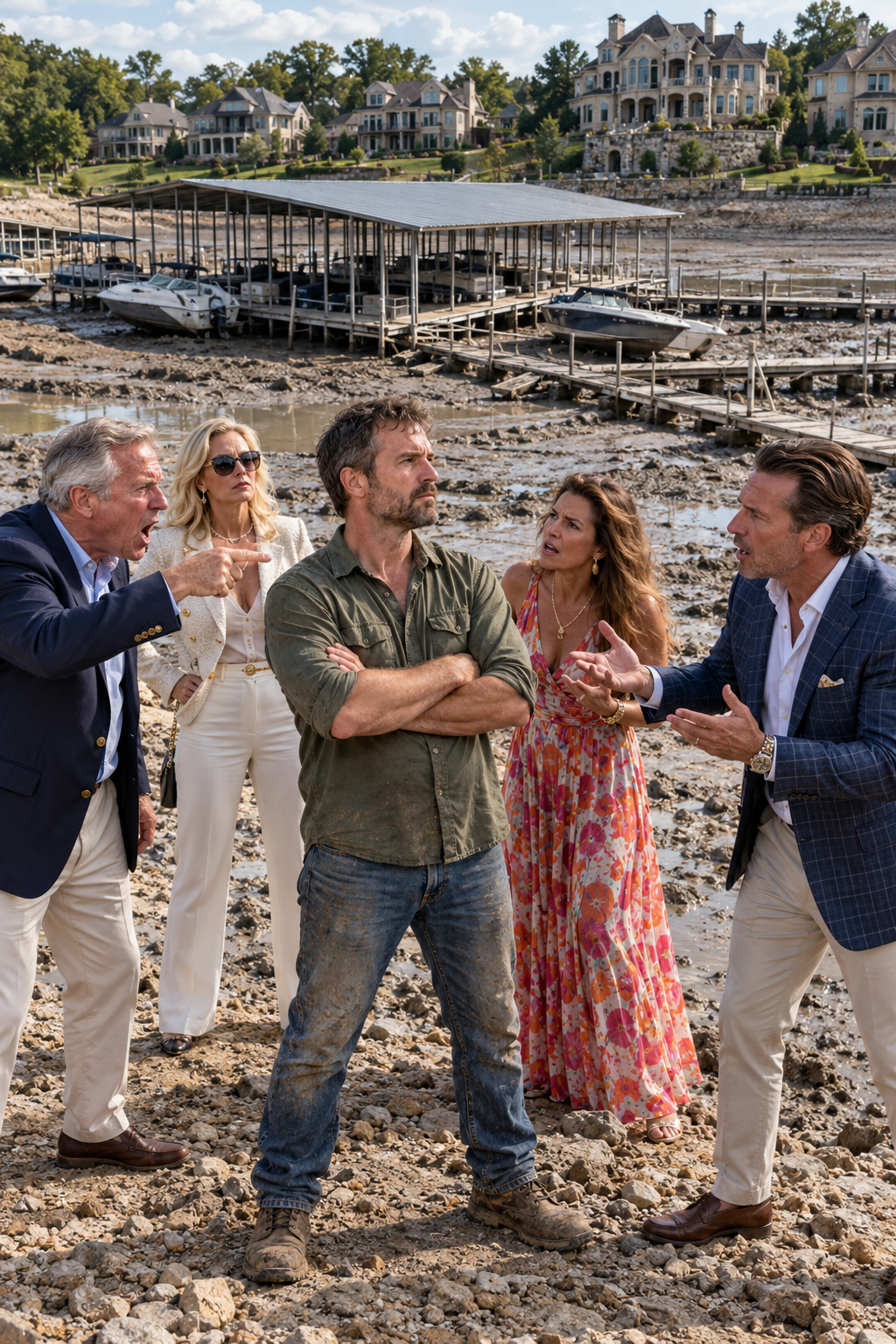
The waterline had pulled hundreds of feet away from the shallow eastern cove where Cedar Point had built its marina.
The polished floating docks were no longer floating.
They rested crookedly on mud.
Rental pontoons sat tilted at absurd angles.
The fuel dock leaned toward a shrinking ribbon of water.
The ceremonial ribbon stretched across an entrance leading to nowhere.
At a.m., Linda arrived.
I was standing on the western ridge with Daniel and the dam engineer.
Even from across the lake, I heard her scream.
Not words at first.
Just sound.
Then trucks started arriving.
A local television crew.
People walked down the new stone pathway and stopped.
Imagine spending two million dollars on a marina and discovering the lake had quietly left.
Mud stretched beneath the docks like wet gray concrete.
The main channel shimmered far beyond them.
A pontoon boat had settled nose-first.
A banner sagged between two posts.
Linda stood in white pants and expensive shoes at the edge of the mud.
She looked very small.
Evan arrived fifteen minutes later.
He called me.
I watched him from across the exposed lakebed.
“Put the water back.”
“You have to.”
“People are here.”
“I can see them.”
“This is insane.”
“The marina—”
“Was built in a shallow cove.”
“You knew.”
“You knew this would happen.”
“Dad knew.”
“What does that mean?”
“He warned you not to build permanent structures.”
“He never said the lake could disappear.”
“It didn’t disappear.”
I looked at the narrow blue channel.
“It moved.”
Evan said something I couldn’t understand.
Then the line went dead.
By noon, the story was everywhere.
HOA MARINA GRAND OPENING SINKS INTO MUD AFTER PRIVATE LAKE OWNER LOWERS WATER.
The photographs were brutal.
Linda pointing angrily.
Guests standing around in summer clothes.
Boats stranded.
Workers trying to stabilize gangways.
I didn’t enjoy seeing ordinary residents embarrassed.
But I did enjoy one image.
Linda stood beneath the giant THE FUTURE STARTS HERE banner.
Behind her was half a mile of mud.
That photograph is still framed in Daniel’s office.
The board called an emergency session that afternoon.
For the first time, residents demanded financial records.
Linda refused.
That was her final mistake.
Because the bank was already demanding answers too.
The marina loan required continuous legal access to navigable water.
Without it, Cedar Point Recreation Holdings was potentially in default.
The lender sent inspectors.
The title insurer opened an investigation.
The county suspended the marina’s operating approval pending clarification of water rights.
Boat-slip buyers demanded refunds.
Gregory stopped returning Linda’s calls.
And Evan disappeared for two days.
When he finally resurfaced, he came to Daniel’s office with his own lawyer.
That told me everything.
He wanted a deal.
He gave us emails.
Lots of emails.
Linda had approached him nearly a year before Dad died.
She wanted Dad’s signature on an expanded easement.
Dad refused.
Repeatedly.
Gregory then proposed acquiring the home parcel and characterizing its sale as including “appurtenant water rights.”
Evan knew that language was questionable.
But Linda promised him brokerage fees, future development contracts and a minority interest in the marina operating company.
Still, Dad wouldn’t sign.
Then Dad went into the hospital.
Three weeks later, the forged agreement appeared.
Evan swore he did not forge Dad’s signature.
I believed him.
Not because I trusted him.
Because he lacked the nerve.
Gregory claimed the signature came from a document packet provided by Linda.
Linda claimed it came through Evan.
Evan claimed Gregory handled execution.
The three of them had built a circle.
Each person held enough responsibility to implicate the others.
Nobody held enough courage to admit where the pen had actually touched paper.
The system began eating itself.
Residents recalled the entire HOA board.
Linda lost by eighty-seven percent.
A temporary board appointed an independent accountant.
The audit found hundreds of thousands of dollars in questionable payments.
Not every payment was criminal.
Some were merely reckless.
Some were self-dealing.
Some were hidden behind consulting contracts.
The marina company collapsed.
The bank agreed not to pursue Cedar Point’s common properties after the new board negotiated a restructuring and transferred claims against the former directors and contractors.
That was where Daniel earned every dollar I paid him.
We reached a settlement preserving the neighborhood.
Cedar Point kept limited residential lake access.
The original community boat ramp remained.
No fuel sales.
No commercial rentals.
No paid marina memberships.
No permanent expansion without written approval from the Whitmore Conservation Trust.
The useless marina structures were dismantled.
Materials were sold.
A portion of the proceeds went back to residents through reduced assessments.
The shoreline was restored.
And the lake stayed lowered for six weeks while we inspected the dam.
Dad had been right about that too.
We found erosion near an old drainage structure that needed repair.
Had the lake remained full for several more severe storm seasons, the damage might have become serious.
What began as a legal weapon ended up protecting the valley.
Linda sold her house that winter.
I saw her once before she left.
She was loading boxes into an SUV.
I had gone to Cedar Point to sign final access documents with the new board.
She noticed me.
For several seconds neither of us spoke.
Then she said, “You destroyed everything I built.”
I shook my head.
“You humiliated me.”
“You built a marina on somebody else’s lake.”
“We were improving this place.”
“You were monetizing something you didn’t own.”
“Same thing, according to half this country.”
I almost smiled.
Then her voice softened.
“Do you know what Cedar Point was before I became president? Average.”
That was it.
Her motive.
Not greed alone.
She could not stand ordinary.
A quiet lake was ordinary.
Neighbors fishing from an old ramp were ordinary.
She wanted gates.
Memberships.
Launch parties.
A glossy brochure.
Something people could point at and envy.
I said, “Average isn’t a crime.”
She closed the rear hatch.
“But nobody remembers average.”
I looked toward the lake.
Dad’s old dock was visible between the trees.
“You’d be surprised.”
She drove away.
Gregory Shaw surrendered his license after the state bar investigation.
The forged document case was referred to prosecutors.
He eventually pleaded guilty to charges related to falsified notarization records and financial misconduct.
Linda entered a civil settlement and was barred from serving on an HOA board in connection with the case.
The criminal evidence against her on the signature itself was never as clean as people wanted.
Real life is like that.
Sometimes a villain does not stand in court and confess everything while everyone applauds.
Sometimes justice arrives as depositions.
Asset freezes.
Settlement agreements.
Insurance claims.
And a woman who once controlled a ballroom packing boxes alone.
Evan’s consequences were different.
He cooperated early.
That helped him legally.
It didn’t help him with me.
His real estate license survived after disciplinary review, though he paid substantial penalties and lost almost every important client he had.
The marina investment disappeared.
So did the Range Rover.
One afternoon in March, almost a year after Dad died, Evan came to the old house.
My house again.
The forged sale had been declared void.
I had moved back after repairs.
He stood on the porch holding a cardboard box.
“What’s that?”
“Dad’s stuff.”
Inside were things he had taken after the funeral.
A pocketknife.
Three watches.
Old tax records.
A photograph of Dad holding both of us beside the lake in 1979.
I was seven.
Evan was four.
We were sunburned and skinny.
Dad had one arm around each of us.
Evan stared at the picture.
“I don’t remember that day.”
“What happened?”
“You fell off the dock.”
He laughed softly.
“Seriously?”
“Dad jumped in wearing his boots.”
“That sounds like him.”
He looked toward the water.
The lake had been refilled gradually after repairs.
Spring rain restored it faster than expected.
The surface was smooth.
No fuel dock.
No giant restaurant pavilion.
Just trees reflected in blue water.
“I’m sorry,” he said.
I didn’t rescue him from the silence.
For once, he had to stand inside it.
“I was angry at him,” Evan continued.
“I thought he looked down on me.”
“He worried about you.”
“Same thing sometimes.”
Then he looked at me.
“And I was angry at you.”
“Because you stayed.”
“And because he trusted you.”
He swallowed.
“I told myself you manipulated him.”
“But you didn’t.”
“I told myself you were waiting for the inheritance.”
“I wasn’t.”
He rubbed the back of his neck.
“You could have taken everything from me.”
“You didn’t.”
That was the easiest question he had asked in a year.
“Because Dad didn’t protect this lake so his children could destroy each other over it.”
Evan’s eyes filled.
Mine didn’t.
That does not mean I felt less.
It means grief had already taken everything it needed from me.
I had nothing left to prove with tears.
We did not hug.
Not that day.
Some betrayals should not be repaired in a single cinematic moment.
Some apologies deserve time.
Months passed.
Then something strange happened.
Cedar Point became quieter.
Without the marina debt, residents pushed for lower dues.
The new board restored hiking trails instead of building amenities.
Kids started fishing from the community ramp again.
A group of retirees formed a volunteer shoreline cleanup crew.
Mr. Ellison asked whether we could install two benches near the western trail.
I said yes.
Mrs. Hanley donated one in memory of her husband.
Evan came by occasionally.
At first, always with an excuse.
He brought lumber.
Then tools.
Then one Saturday he simply showed up and helped repair Dad’s dock.
We worked for four hours.
Barely spoke.
At sunset he opened two beers and handed me one.
That was the closest we came to forgiveness.
It was enough.
The asset everyone had fought over turned out to be worth far more than the lake itself.
Not financially.
Dad had spent decades protecting a place where people could still see stars after sunset.
A place where kids learned to fish.
A place where my mother once sat wrapped in a blanket during her final healthy autumn and said she could hear geese landing before she could see them.
Linda saw unused revenue.
Evan saw recognition.
Gregory saw paperwork that could be bent.
Dad saw responsibility.
It took me too long to understand that inheritance.
Ownership is temporary.
Stewardship lasts.
By the following summer, I created the Thomas and Margaret Whitmore Lake Trust.
The lake could never be commercially developed.
The land could not be sold to a resort company.
The original Cedar Point residents retained recreational access.
A conservation group received monitoring rights.
Local schools could use part of the western shore for environmental programs.
I named him successor trustee after me.
Daniel nearly fell out of his chair.
“You sure about that?”
“Then why do it?”
“Because somebody once trusted me before I had earned it.”
Daniel studied me.
“You think he’s changed?”
“I think he knows what losing everything feels like.”
“That’s not the same thing.”
I signed anyway.
“But it’s a start.”
I thought that was the end.
For almost six months, I truly believed it was.
Then, on the first cold morning of November, a package arrived.
No return address.
Inside was another envelope.
My name was written across the front.
Not in Dad’s handwriting.
My grandfather’s.
Claire Whitmore.
To be opened only after Thomas is gone and Paragraph 17 has been enforced.
I stood in my kitchen for a long time.
The lake outside was dark under the winter sky.
Evan was repairing a fence near the lower pasture.
Everything was peaceful.
That should have made me feel safe.
Instead, I felt the same cold pressure I had felt the day Gregory placed the forged sale agreement on my kitchen table.
I opened the envelope.
Inside was a survey map dated 1959.
Another deed.
And a photograph.
The photograph showed my grandfather standing beside three men near the original dam construction site.
On the back were four names.
Samuel Whitmore.
Henry Mercer.
Charles Shaw.
Richard Vale.
I read those names again.
Linda Mercer.
Gregory Shaw.
Coincidence was possible.
But then I unfolded the deed.
It referenced sixty-four acres beneath what was now the deepest section of Whitmore Lake.
Land supposedly purchased by my grandfather before the dam was built.
Supposedly.
Because attached to the deed was a handwritten note.
If they ever try to take the lake through Cedar Point, understand this: the marina will only be the surface problem.
Do not let them discover what was buried before the water rose.
I felt my heartbeat change.
Under the note was a faded county engineering sketch.
A quarry entrance.
Three storage buildings.
And one rectangular area marked with a red X.
I called Daniel.
He answered on the fourth ring.
“I found something.”
“At my age, I hate sentences that begin that way.”
“Did Dad ever mention Henry Mercer?”
“Where did you hear that name?”
I sat down.
Outside, Evan looked toward the house as if he could somehow feel the air change.
“Granddad left me another deed.”
Daniel stopped breathing for a second.
Then he said something I had never heard from him before.
“Don’t show it to anyone.”
“Because Thomas asked me the same question thirty years ago.”
My hand tightened around the phone.
“What did you tell him?”
“That some property disputes are not really about property.”
I looked at the red X.
“Daniel, what was under the lake before Dad flooded it?”
Another silence.
Longer this time.
Then someone knocked on my front door.
Three slow knocks.
He was still in the pasture.
The envelope remained open on the kitchen table.
The faded photograph stared up at me.
Three family names tied together before Cedar Point existed.
Before Linda.
Before Gregory.
Before the marina.
I walked toward the door.
And before I opened it, I asked Daniel the smallest question I could think of.
The question that sounded almost foolish.
The question my father had spent his whole life making sure I would eventually know enough to ask.
“Daniel… did my grandfather build this lake to hold water—
or to hide something underneath it?”
✓ Lynn R. Adams
🔥HERE’S THE NEXT PART OF THE STORY, ENJOY !! The explosive twist and the final ending of this story ! ⬇️💬 Thank you ❤ Three-bedroom homes. Retired teachers. Contractors. Families grilling on dec…