The HOA Blocked My Only Road and Ordered Me to Join—They Forgot My Dead Husband Owned the Ground Beneath Them
🔥HERE’S THE NEXT PART OF THE STORY, ENJOY !! The explosive twist and the final ending of this story ! ⬇️💬 Thank you ❤
My gate, though I didn’t understand that yet.
Behind it, Carter Road curved through maples toward my farm.
I could see the distant roof of our barn.
I could almost see Thomas standing there.
“What happens if I don’t pay?”
Daniel folded his arms.
“Then the association can pursue collection remedies.”
He hesitated.
Marlene didn’t.
“Foreclosure, if necessary.”
There it was.
Not a dispute about landscaping.
Not a misunderstanding about dues.
They wanted Cedar Hollow.
I understood that before I understood how.
Sixty-two acres surrounded by a luxury subdivision.
Views of the mountains.
Access to utilities.
Close to the interstate.
Thomas had turned down developers for years.
The last offer I knew about had been $3.2 million.
That was four years earlier.
Suddenly Daniel’s board position made much more sense.
I opened my truck door.
The security guard moved closer.
I stepped onto the pavement.
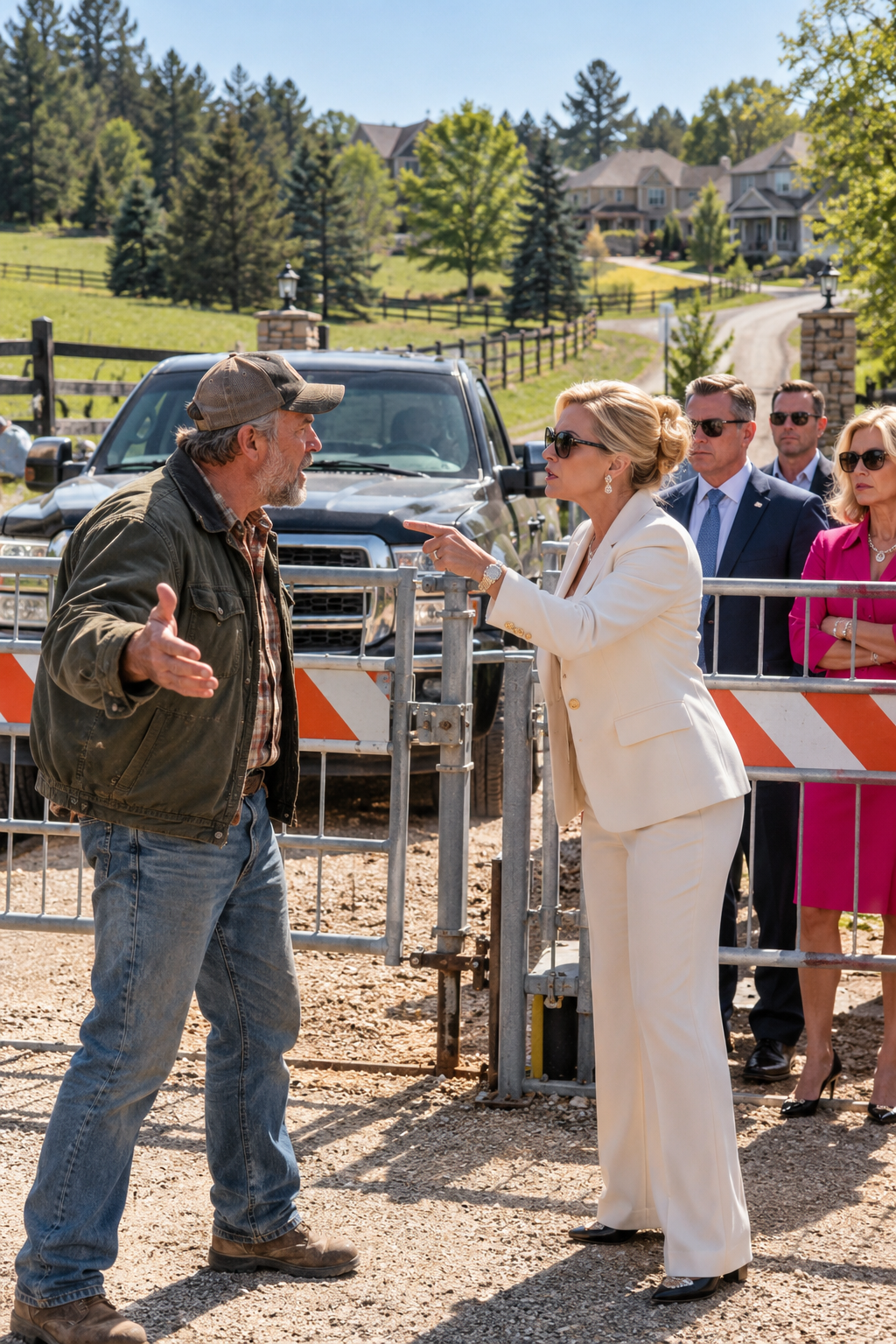
“You’re blocking the only road to my house.”
Marlene gave me a smile that almost looked sympathetic.
“You have access once you complete the membership documents.”
“My animals are down there.”
“Then I suggest you sign quickly.”
“My husband was buried three days ago.”
Her expression didn’t change.
“We’re aware.”
Something inside me became very still.
There is a difference.
Calm is peace.
Stillness is what happens when anger becomes too heavy to move.
I had given Daniel a bedroom when his own father was too drunk to remember whether he had come home.
I had given Daniel Christmas gifts when my brother couldn’t afford them.
I had given Daniel money for college when Thomas and I were still paying medical bills from Emily’s funeral.
I had given Daniel a place at our table after everyone else got tired of rescuing him.
I had given Daniel the benefit of the doubt long after he had stopped earning it.
And now Daniel was standing at a gate erected on the road to my home, telling me I could buy permission to enter my own life.
I touched the brass key.
“Who authorized the gate?”
Daniel grinned.
“Whose contractor?”
“Association contractor.”
Marlene’s smile thinned.
“That’s an administrative issue.”
“So you have one?”
“Our legal counsel reviewed everything.”
I nodded once.
Daniel frowned.
I climbed back into my truck.
He looked almost disappointed.
“Aunt Claire, where are you going?”
“To find somewhere to sleep.”
He laughed.
I saw the relief on his face.
That hurt more than the gate.
He thought I had surrendered.
Marlene thought so too.
Behind them, the security guard was already lowering his hand as though the problem had solved itself.
I reversed carefully.
Then I drove away.
I spent that night at the Pine Crest Motor Lodge twelve miles outside town.
The carpet smelled like old cigarettes even though a plastic sign on the dresser said NO SMOKING.
I had two blouses, one pair of jeans, my prescription, a toothbrush from the front desk, and the black dress I had worn to my husband’s funeral.
Everything else I owned was behind a gate controlled by people who wanted to take my land.
At that evening, Daniel texted me.
Aunt Claire, please don’t make this ugly. We’re trying to help you transition. Thomas handled everything. You don’t need the burden now.
Transition.
That word sat on the screen like grease.
At , another message arrived.
Marlene can waive some late fees if you sign tomorrow.
There are buyers interested in Cedar Hollow. You could walk away with enough to be comfortable forever.
Now I understood.
Not all of it.
I set the phone down.
Then I took off the brass key.
Thomas had kept an old rolltop desk in our bedroom.
The key didn’t look like one of those keys.
It was too small.
I thought about his workshop.
His gun cabinet.
The safety deposit box at First Federal.
Then I remembered the old green survey cabinet.
It stood in the corner of the barn office.
Heavy steel.
Four drawers.
Thomas had bought it at a county auction thirty years earlier.
The bottom drawer was always locked.
I had once asked what he kept inside.
“Things nobody cares about until suddenly everybody does,” he said.
At the time, I rolled my eyes.
At p.m., I called my neighbor, Frank Mercer.
Frank’s property touched ours on the western side and had its own farm lane connected to Route 614.
It wasn’t a legal access route to Cedar Hollow.
But there was an old cattle path between our properties.
“I need a favor.”
“Can you get me onto my land without using Carter Road?”
There was silence.
“Those sons of bitches actually locked you out?”
News travels fast in rural counties.
“I need to get into Thomas’s barn.”
“I’ll be there in fifteen minutes.”
Frank picked me up behind the motel in his mud-covered Jeep.
We used his western pasture, crossed a shallow creek, opened two cattle gates, and bounced across a field road that hadn’t been maintained since the Clinton administration.
When my farmhouse finally appeared beyond the trees, I nearly lost my composure.
The porch light was still on.
I had left it on the morning of the funeral.
Thomas always hated coming home to a dark house.
For three days, I had kept turning the porch light on out of habit.
Now it glowed in the distance while I entered my own property like a trespasser.
Frank stayed outside the barn.
“Call me if you need anything.”
I unlocked the office.
The green survey cabinet stood beneath the window.
The brass key fit the bottom drawer.
My hand shook once.
Then I turned it.
Inside were six file folders, a rolled survey tied with a faded red ribbon, an envelope with my name on it, and a blue leather binder.
On top of everything was a handwritten note.
If anyone ever blocks Carter Road, do not argue with them.
Do not sign anything.
Do not threaten them.
Ask who authorized the obstruction.
Then call Rebecca Shaw.
Tell her to open File 17.
Love you always.
I sat down.
For the first time since the funeral, I cried.
Not loudly.
I pressed one hand to my mouth and let tears fall onto Thomas’s desk.
The message was dated eleven months earlier.
Thomas had known.
Maybe not exactly what would happen.
But enough.
I wiped my face.
Under the note was a business card.
REBECCA SHAW
SHAW & HOLLIS PROPERTY LAW
CHARLOTTESVILLE, VIRGINIA
A cell phone number had been written on the back.
It was 10:06 at night.
I called anyway.
A woman answered on the fourth ring.
“Rebecca Shaw.”
“My name is Claire Carter.”
Then her voice changed.
“You knew my husband?”
“He left your card.”
Another pause.
“Did someone block the road?”
I looked at Frank through the barn window.
Rebecca exhaled slowly.
“Did you sign anything?”
“Did you threaten anyone?”
“Did you ask who authorized it?”
“What did they say?”
I looked at Thomas’s note again.
“They said the HOA did.”
That word again.
I was beginning to hate it.
“What is File 17?”
“Something Thomas hoped we would never need.”
“What is it?”
“Evidence.”
“Claire, I’m going to ask you to do something difficult.”
“I’ve had a difficult week.”
“Then ask.”
“Go back to the motel. Do nothing. Tomorrow morning, let them think they won.”
I stared at the blue binder.
“I’m tired of people telling me to leave my own land.”
“I understand.”
“No, you don’t.”
Rebecca was quiet.
Then she said, “Thomas told me you would say that.”
That stopped me.
“What else did he tell you?”
“That you would want to fight immediately.”
“He knew me.”
“And he told me to remind you about chess.”
I closed my eyes.
Thomas and I played chess every Sunday night for thirty-five years.
He was better than I was.
He hated when I moved too quickly.
The board, Claire, he would say.
Don’t look at the piece they want you to see.
Look at the board.
I looked again at the survey cabinet.
“What’s on the board?”
Rebecca answered with four words.
“They don’t own the road.”
The next morning, I returned to Stonegate Ridge.
Not to get home.
To attend the emergency board meeting Daniel had helpfully texted me about.
The meeting was held in the Stonegate Ridge clubhouse, a massive stone building with a swimming pool, gym, tennis courts, and a ballroom larger than the church where Thomas’s funeral had taken place.
I arrived in the same black dress.
Marlene noticed.
So did Daniel.
Homeowners filled most of the chairs.
Someone had posted about “the Carter property situation” on the neighborhood Facebook group, and apparently half the subdivision wanted entertainment.
Marlene sat behind a long table with four board members, Daniel, the property manager, and an attorney named Seth Mallory.
Seth looked about fifty.
Expensive suit.
Quiet eyes.
Unlike Marlene, he didn’t look happy to see me.
That interested me.
Marlene tapped the microphone.
“Mrs. Carter, we appreciate you attending.”
“I wasn’t invited.”
“This meeting is open to association members.”
“I’m not a member.”
A few people laughed.
Marlene did not.
“That issue is exactly why we’re here.”
Seth Mallory opened a folder.
“Mrs. Carter, Stonegate Ridge maintains that your parcel was annexed into the association pursuant to Section 14 of the master declaration.”
“By the property owner.”
“March seventeenth.”
Thomas had been in the hospital on March seventeenth.
I had spent that entire day beside him.
“Do you have my signature?”
Seth looked at Daniel.
Daniel passed him a document.
The attorney slid it across the table.
I picked it up.
There it was.
CLAIRE M. CARTER.
My signature.
It looked like my signature from ten years earlier, when my handwriting was slightly wider.
I knew exactly where they had gotten it.
A durable medical power of attorney I had signed for Thomas when he had heart surgery in 2015.
Daniel had helped us scan some records after the surgery.
He had access to the file.
My stomach turned.
But my voice stayed level.
“I didn’t sign this.”
Marlene crossed her arms.
“That’s a serious accusation.”
“No. It’s a simple statement.”
Daniel leaned toward the microphone.
“Aunt Claire, you were under enormous stress.”
There were murmurs in the room.
He was going to make me confused.
Of course he was.
“You’re saying I forgot?”
“I’m saying Uncle Thomas was dying. You signed dozens of documents.”
That part was true.
Insurance forms.
Hospital releases.
Medication authorizations.
Hospice paperwork.
Maybe hundreds.
Daniel knew exactly how believable his lie could sound.
I looked at Seth.
“Did you witness this?”
“Did you notarize it?”
He turned the page.
A notary stamp appeared beneath my signature.
Karen Bell.
I knew the name.
She worked for the Stonegate Ridge management company.
Not independent.
Not random.
Part of the system.
“All right.”
Daniel blinked.
“All right?”
Marlene seemed pleased.
“We can have the membership package prepared today.”
“I didn’t say I was joining.”
Her smile vanished.
“Then why are you saying all right?”
“Because I wanted to know what document you were relying on.”
Seth Mallory stopped writing.
For the first time, he looked directly at me.
I asked, “Mr. Mallory, did you examine the title to Carter Road before advising the board to install that gate?”
Daniel’s eyes moved toward Marlene.
Marlene answered for him.
“The road is association property.”
“That wasn’t my question.”
“It has been maintained by the association for years.”
“Still not my question.”
She leaned forward.
“What exactly are you suggesting?”
I looked at Seth.
He didn’t answer.
So I asked again.
“Did you examine the title?”
The attorney closed his folder.
“We’ll respond through appropriate channels.”
There it was.
The smallest crack.
Most people in the room probably missed it.
Neither did Rebecca Shaw, sitting quietly in the back row.
Marlene had not noticed her come in.
Rebecca stood.
“Then let’s use the appropriate channels.”
She walked forward and placed a thick envelope on the table.
Seth looked at her.
His face changed instantly.
Marlene looked between them.
“You know each other?”
“Property bar’s small,” Rebecca said.
Then she pushed the envelope toward him.
“Notice of disputed annexation. Notice of unauthorized obstruction. Preservation demand. Notice of potential title claim.”
Daniel laughed nervously.
“Title claim to what?”
Rebecca turned toward him.
“The ground under your gate.”
Nobody laughed after that.
The original Carter Road had been created in 1949.
Thomas’s grandfather gave neighboring farmers the right to use it.
Not ownership.
The road remained legally part of the Carter parcel.
When Stonegate Ridge was developed, the developer needed Carter Road widened because its property did not have enough frontage on the state highway for the main entrance it wanted.
Thomas negotiated an easement.
The developer received a permanent right of passage over a forty-two-foot corridor.
But the agreement contained conditions.
The Carter family retained ownership of the land beneath the road.
The developer and any successor association could maintain the roadway.
They could landscape beside it.
They could install utilities beneath portions of it.
But they could not impede access to Cedar Hollow.
They could not install a controlled gate without written permission from the Carter landowner.
They could not annex Cedar Hollow into the association without a separately executed consent.
And most importantly, any intentional obstruction of Cedar Hollow access after written notice would trigger an expedited right to injunctive relief, attorney’s fees, survey costs, and restoration.
Thomas had negotiated every line.
Marlene’s contractor had installed the gate fourteen feet inside our property boundary.
Not beside Carter Road.
On Carter land.
The stone entrance pillars too.
So was half their decorative fountain.
A fountain I suddenly liked much more than I had the day before.
Daniel stood.
“That’s impossible.”
Rebecca unrolled the survey.
A red boundary line ran directly through the entrance.
She pointed to the county recording numbers.
“Volume 822. Page 417. Recorded August twenty-sixth, 2016.”
Daniel looked at Seth.
“You said the HOA owned the entrance.”
Seth’s face hardened.
“I said I was provided documents indicating association control of the entrance.”
Nobody asked.
They didn’t need to.
Everyone looked at Daniel.
His face went pale.
Marlene recovered first.
“This is ridiculous. The association has used that road openly for almost a decade.”
Rebecca nodded.
“Under an easement.”
“Which means we have rights.”
“Absolutely.”
That seemed to restore Marlene’s confidence.
Then Rebecca finished.
“You have the right to cross Mrs. Carter’s land. Not the right to stop Mrs. Carter from crossing Mrs. Carter’s land.”
One homeowner actually clapped.
Marlene slammed a palm against the table.
“This meeting is adjourned.”
I raised my hand.
Not because I needed permission.
Because I wanted everyone looking.
“Just one question.”
Marlene glared at me.
I held up the alleged annexation agreement.
“If I signed this in March, why does the PDF metadata say it was created two days after Thomas died?”
Silence hit the room like something physical.
Daniel looked at the paper.
Then at me.
For the first time since I had seen him at the gate, he stopped smiling.
That afternoon, the gate opened.
Not voluntarily.
A circuit judge signed a temporary emergency order requiring Stonegate Ridge to provide immediate, unrestricted access to Cedar Hollow until the title dispute could be heard.
At p.m., I drove home.
The security guard stood beside the raised gate.
He wouldn’t look at me.
I didn’t blame him.
He was just earning a paycheck.
As I passed Daniel’s house, I saw him standing in his driveway with his phone pressed to his ear.
He watched me.
I lifted two fingers from the steering wheel.
Not a wave.
Just acknowledgment.
I wanted him to understand something.
When I reached Cedar Hollow, Frank Mercer was waiting on the porch.
So were two of my dogs, furious that I had apparently abandoned civilization.
I sat on the porch steps until sunset.
For one evening, I allowed myself to think the worst might be over.
At the next morning, a certified letter arrived.
Stonegate Ridge fined me $1,000 for “unauthorized livestock visible from common roadways.”
At noon, another violation was emailed.
My barn roof was “nonconforming.”
At , they cited my mailbox.
At , they alleged my pickup truck was a prohibited commercial vehicle because it had farm plates.
By Friday, I had seventeen violations.
Total fines: $9,500.
Rebecca called them harassment.
Marlene called them enforcement.
I called them useful.
Every notice created another piece of evidence.
I printed each one.
Thomas taught me that too.
Never interrupt someone who is creating your exhibits for you.
The following Monday, surveyors arrived at Cedar Hollow.
Not HOA surveyors.
I hired Cole & Barrett, the same firm Thomas had used in 2016.
They placed bright orange stakes along the actual boundaries of the Carter Road corridor.
By noon, sixty-three orange flags ran from the highway entrance through the center of Stonegate Ridge.
Several lawns had tiny corners inside the easement.
The gatehouse sat almost entirely on my land.
So did the visitor kiosk.
So did the monument sign.
And then the survey crew reached the clubhouse.
That was when Rebecca called me.
I recognized the tone.
“We found something.”
“Good or bad?”
“I’m not sure yet.”
I drove down.
Rebecca stood behind the clubhouse beside surveyor Matthew Cole.
An orange stake had been placed near the pool fence.
Another near the tennis courts.
Another near the rear parking lot.
“What am I looking at?”
Matthew handed me a copy of the original development plat.
“Stonegate Ridge Parcel C.”
“What about it?”
“Parcel C contains the clubhouse, pool, courts, maintenance building, and approximately seventeen-point-eight acres of common space.”
He pointed to a deed reference.
“Except it was never conveyed to the HOA.”
“Who owns it?”
He looked at me.
Rebecca answered.
Not because it was funny.
Because sometimes the truth is so large your mind rejects it.
“The developer didn’t purchase this parcel outright from Thomas.”
I stared at the buildings.
“They built all that on leased land?”
“Ground lease. Thirty years. One dollar annually for the first ten years, then a payment formula tied to association dues.”
“I’ve never received money.”
“Because Thomas deferred the payments.”
Rebecca hesitated.
“Because the developer financed the widening of Carter Road, new bridge drainage, utility extensions, and replacement of your western well.”
I remembered.
Eight years earlier, Thomas told me he had worked out a “good trade” with the developer.
That was all he said.
I hadn’t asked.
There were crops to harvest.
Bills to pay.
Doctors to visit.
Life kept happening.
Rebecca opened the blue leather binder I had found in the survey cabinet.
Inside was the ground lease.
I read the first page.
Then the second.
Then the clause Thomas had highlighted.
Section 18.
Material Default.
If the lessee, association, or successor entity intentionally asserted title over any retained Carter parcel, attempted unauthorized annexation of Cedar Hollow, or knowingly obstructed the reserved access corridor, the lessor could declare a material default.
If uncured within thirty days, the lease could be terminated.
Everything built on Parcel C would remain subject to separate legal determination.
The clause didn’t mean I could walk into the clubhouse and start changing locks.
Courts don’t work that way.
Rebecca made that very clear.
But it meant the HOA had a much bigger problem than a gate.
Seventeen acres bigger.
When I told Frank, he stared at me for several seconds.
Then he started laughing so hard he had to sit down.
“The pool?”
“Apparently.”
“The fancy gym?”
“Apparently.”
“The tennis courts?”
“I’m just asking.”
“Apparently.”
He wiped tears from his eyes.
“Thomas was a sneaky old man.”
Then my smile disappeared.
Because the file contained something else.
A handwritten letter from Thomas.
If you are reading this, somebody has decided your kindness means weakness.
Don’t let them turn this into revenge.
Most of the people in Stonegate Ridge are just families. They bought homes. They didn’t negotiate these documents.
Protect them if you can.
But protect Cedar Hollow first.
I promised Emily we would.
That last sentence nearly broke me.
Our daughter.
When she was seventeen, before the accident, she had fought us over a developer who wanted to buy the north pasture.
She loved that field.
There was an old oak near the creek where she used to read.
“You’re never selling this place, right?” she once asked Thomas.
He laughed.
“Not while I’m breathing.”
“What about after?”
He looked at her.
“Then you’ll have to stop your mother.”
Emily smiled at me.
Two years later, we buried her on the hill overlooking that oak.
Cedar Hollow wasn’t an investment.
It was the last place on earth where our family was still whole.
That was why Thomas kept refusing the developers.
That was why I would too.
And suddenly I understood what Daniel had never understood.
He thought the secret was that I owned valuable land.
The secret was why I would never sell it.
Three days later, Daniel came to the farmhouse alone.
I watched him walk up the porch steps.
He looked exhausted.
“Aunt Claire.”
I didn’t invite him inside.
“What do you want?”
“To fix this.”
“You had three days after the funeral to fix it.”
“Marlene pushed too hard.”
I almost admired the speed with which he tried to move responsibility away from himself.
“You forged my signature.”
His eyes flickered.
“I didn’t forge anything.”
“Then who did?”
“You probably signed something and don’t remember.”
“I’m serious.”
“March seventeenth.”
“The date on the document.”
I continued.
“I was at University Hospital from that morning until after midnight. There are security cameras. Parking records. Nurses. Doctors. Credit card receipts. Thomas had surgery at p.m.”
He swallowed.
“You could have signed electronically.”
“From Thomas’s hospital room?”
“Then why does your annexation document list the signing location as the Stonegate Ridge management office?”
“Why does the notary log say I presented a Virginia driver’s license in person?”
“Why did Karen Bell take an unscheduled vacation the morning after Rebecca requested her notary journal?”
His jaw tightened.
“Be careful.”
There it was.
Not an apology.
From the boy I once drove to Little League practice.
I stepped closer.
“You’re standing on my porch, Daniel.”
“I’m trying to save you from making a huge mistake.”
“No. You’re trying to save yourself.”
He looked toward the road.
Then back at me.
“Do you know what Cedar Hollow is worth?”
“No, you don’t. Not anymore.”
He lowered his voice.
“Eight million. Maybe nine.”
That was more than double the last offer.
“Because Stonegate Ridge is basically built out. Cedar Hollow is the only direction left.”
There it was.
The motive.
Not all of it.
“Who’s the buyer?”
He hesitated.
“Blue Ridge Residential.”
The original developer.
“Why are you involved?”
“I know people.”
“That wasn’t the question.”
He rubbed his face.
“My business has debt.”
“How much?”
“Does it matter?”
“It matters if you tried to sell my land to pay it.”
His eyes hardened.
“You always do that.”
“Make me sound like some kind of criminal.”
I almost laughed.
“You forged my signature.”
“I helped create a solution.”
“To a problem I didn’t have.”
“You’re seventy-one years old, Aunt Claire.”
“Sixty-eight.”
He blinked.
That almost made me smile.
“You’re alone,” he said. “What are you going to do with sixty-two acres?”
There are sentences you remember forever because they change the shape of a relationship.
That was one.
I looked at him.
Really looked.
And I saw not my nephew.
Not the boy sleeping in our spare room.
Not the nineteen-year-old Thomas drove to court.
Not family.
I saw a man who had taken every sacrifice we made for him and converted it into an assumption.
He assumed I would forgive him.
He assumed I was too old to fight.
He assumed grief made me weak.
He assumed blood gave him permission.
Most of all, he assumed I existed only in relation to men.
Thomas’s wife.
Emily’s mother.
A widow now.
Available now.
I folded my arms.
“You asked what I’m going to do with sixty-two acres?”
“I’m going to keep it.”
His face tightened.
“You can’t stop development forever.”
“I don’t need forever.”
“What does that mean?”
“You’ll find out.”
He stared at me.
Then his voice dropped.
“You’re going to ruin a lot of people over your pride.”
That angered me more than anything Marlene had said.
“Two hundred fourteen families bought houses from people who promised them things they didn’t own.”
I pointed toward Cedar Hollow.
“I didn’t make that promise.”
He said nothing.
“I didn’t forge a document.”
“I didn’t block a widow from her home three days after she buried her husband.”
“I didn’t threaten foreclosure on land I had no authority over.”
“So don’t come onto my porch and hand me responsibility for what happens next.”
He turned to leave.
I let him reach the steps.
Then I asked the question.
The one Thomas’s note had told me to save.
He stopped.
“If the HOA is so certain it owns everything…”
He slowly turned.
“…why are you trying this hard to make me sell before the judge looks at the deeds?”
His face answered before his mouth could.
That was the moment I knew the land wasn’t the only thing they were hiding.
Two days later, Rebecca discovered why.
Blue Ridge Residential had a pending financing agreement for “Stonegate Ridge Phase Four.”
Phase Four was Cedar Hollow.
The company had already spent nearly $600,000 on engineering, utility planning, environmental studies, and preliminary road design.
Plans existed for ninety-six houses.
A second pool.
A playground.
A commercial-style daycare building.
And a new road directly across Emily’s grave.
They hadn’t purchased my land.
They hadn’t obtained an option.
They didn’t have my signature.
But someone had represented to investors that control of Cedar Hollow was “substantially secured.”
Daniel had been paid $74,000 in “consulting fees.”
Marlene’s husband’s company held a preliminary landscaping contract worth $1.3 million.
Property manager Kevin Rourke’s brother owned the excavation company expected to clear the land.
Karen Bell, the notary, received a $12,000 “retention bonus.”
It wasn’t one greedy HOA president.
It was a machine.
A small machine.
A stupid machine.
But a machine nonetheless.
Everyone got a piece.
Except the woman whose land they planned to take.
The court hearing was scheduled for October 18.
By then, the story had spread across the county.
I hated that.
People I hadn’t spoken to in fifteen years called pretending to check on me.
Local reporters parked near the entrance.
Someone started selling shirts online that said ASK CLAIRE WHO OWNS THE ROAD.
Frank bought three.
I told him he was an idiot.
He gave me one.
Marlene refused interviews.
Daniel stopped attending board meetings.
Seth Mallory withdrew as HOA counsel, citing conflicts caused by “material facts not previously disclosed by association representatives.”
That sentence was lawyer language for:
They lied to me too.
The board hired a Richmond firm.
They filed eighty-three pages of motions.
They argued adverse possession.
Implied dedication.
Prescriptive rights.
Every legal phrase money could buy.
Rebecca read all of it.
Then she smiled.
“Are they right?”
“About some peripheral issues? Maybe enough to argue.”
“And the road?”
“The annexation?”
“The ground lease?”
Her smile disappeared.
“That’s where it gets interesting.”
The HOA had one argument I hadn’t expected.
Thomas had signed an amendment two years before he died.
An amendment extending the ground lease.
Marlene’s lawyers claimed that amendment eliminated the default provision.
If true, I still owned Parcel C.
But I couldn’t terminate the lease over their misconduct.
That would take away my biggest leverage.
They filed a copy.
Thomas’s signature looked real.
Rebecca stared at it for an hour.
Then she asked me, “Did Thomas ever sign documents with blue ink?”
The copy was black and white.
“That doesn’t help.”
She kept reading.
Page four contained a notary block.
The amendment had supposedly been signed on June 11, 2024.
“Where were you that day?” Rebecca asked.
Then remembered.
“Baltimore.”
“Both of you?”
“Yes. Johns Hopkins. Thomas had an oncology consultation.”
“Can you prove it?”
“Probably.”
But the document said Thomas signed in Virginia.
For a moment, I thought we had caught them again.
Then Rebecca frowned.
“Claire, a person can sign while traveling if the notarization occurs properly later. It depends on execution details.”
She called Thomas’s oncologist.
Records confirmed we were in Baltimore.
But the HOA produced an affidavit from the notary stating Thomas had signed the document earlier and acknowledged it later.
Suspicious.
Not impossible.
For the first time, I felt fear.
What if Thomas had changed his mind?
What if illness had made him agree to something he never explained to me?
What if the secret protection he thought he left me wasn’t protection at all?
That evening, I sat at the kitchen table with the blue binder.
Thomas’s chair was empty.
His coffee cup still sat in the cabinet.
I had not moved his boots from beside the back door.
Grief is strange.
You can stand in court fighting over millions of dollars and feel strong.
Then you see a pair of worn work boots and become twenty years old inside.
I opened the binder again.
Page by page.
Road easement.
Ground lease.
Developer correspondence.
Environmental maps.
Then I found something tucked inside the rear cover.
A yellow envelope.
On the front, Thomas had written:
FOR WHEN THEY SHOW YOU THE AMENDMENT.
I laughed and cried at the same time.
“Thomas, you impossible man.”
Inside was a letter.
If they are desperate enough, they may produce an amended lease dated June 11, 2024.
I did not sign it.
I saw a draft.
Rebecca has the original rejection letter.
The important part is not my signature.
Ask them where they got the parcel number.
I called Rebecca.
She answered immediately.
“What happened?”
“I found another note.”
Then Rebecca said, “Parcel number.”
We looked at the alleged amendment.
Parcel C was identified as:
Tax Map 17-4-23B.
Rebecca pulled the original lease.
Because Parcel 17-4-23B did not exist until August 2024, when the county subdivided a drainage easement from the larger tract.
The alleged amendment was dated June.
Two months before the parcel number existed.
The document wasn’t merely suspicious.
It was impossible.
Someone had created it later and backdated it.
On October 18, Stonegate Ridge’s lawyers walked into court carrying sixteen banker boxes.
Rebecca carried one leather binder.
I carried Thomas’s brass key.
The courtroom was packed.
Marlene sat in the first row.
Daniel sat behind her.
He looked ten years older than he had at the gate.
The judge was Eleanor Whitcomb, sixty-four, sharp-eyed and unimpressed by theatrics.
She spent the first hour on the road.
The HOA argued it had operated and maintained Carter Road for years.
Rebecca agreed.
They argued homeowners depended on it.
Rebecca agreed.
They argued shutting the road would cause catastrophic harm.
Rebecca agreed again.
The HOA lawyer seemed confused.
Then Judge Whitcomb asked Rebecca what relief I wanted.
Rebecca stood.
“Mrs. Carter does not seek to close the road.”
A wave of whispers moved through the room.
Marlene turned.
Daniel looked at me.
The HOA lawyer paused.
Judge Whitcomb asked, “She does not?”
“No, Your Honor.”
“What does she seek?”
“Permanent recognition of her title, permanent unrestricted access to Cedar Hollow, removal or modification of any controlled gate interfering with that access, nullification of the fraudulent annexation, damages, attorney’s fees, and enforcement of her rights regarding Parcel C.”
The judge looked at me.
“Mrs. Carter is willing to continue allowing over two hundred homeowners to use a roadway crossing her property?”
I stood when Rebecca motioned.
“Yes, ma’am.”
I looked toward the people sitting behind the HOA board.
A young couple with a baby.
An older man wearing a Veterans of Foreign Wars cap.
They weren’t my enemies.
“Because they bought homes,” I said. “They didn’t steal my road.”
Nobody spoke.
I continued.
“My husband told me not to confuse the board with the neighborhood.”
Judge Whitcomb nodded once.
That decision changed everything.
The HOA had spent weeks telling residents I wanted to shut down their entrance.
That I was vindictive.
That I was willing to destroy their property values.
Now they couldn’t use families as shields.
The fight narrowed.
Me against the people who had actually done it.
Then came the forged annexation agreement.
The notary, Karen Bell, had been subpoenaed.
Under oath, she denied knowingly notarizing a false signature.
Rebecca asked whether I had appeared before her on March seventeenth.
Karen said she believed I had.
Rebecca displayed hospital security footage.
At p.m., the exact time Karen’s notary journal claimed I had been standing inside the Stonegate Ridge management office, a camera at University Hospital showed me pushing Thomas in a wheelchair toward radiology.
Karen began crying.
She asked for a recess.
When court resumed, she had a lawyer.
Then she invoked her right against self-incrimination.
Daniel stared at the floor.
Marlene stared straight ahead.
Next came the lease amendment.
The HOA’s lawyer introduced it confidently.
Rebecca barely reacted.
She waited until their title expert confirmed the document’s date.
June 11, 2024.
Then she displayed the tax map.
“When was parcel 17-4-23B created?”
The expert adjusted his glasses.
“August twenty-second, 2024.”
“So on June eleventh?”
“It did not yet exist as a separately designated parcel.”
“Yet this document signed in June identifies it by an August parcel number?”
The expert looked toward the HOA attorneys.
“I can’t explain that.”
Rebecca nodded.
“I have no further questions.”
You could feel the entire case change direction.
Not dramatically.
Not with shouting.
Just quietly.
Like a lock turning.
During the lunch recess, Daniel approached me in the hallway.
His lawyer tried to stop him.
He ignored her.
“Aunt Claire.”
I kept walking.
That word stopped me.
Not because I felt sorry for him.
Because I had never heard him use it with me before.
His eyes were wet.
“Marlene told me it was legal.”
I said nothing.
“She said Blue Ridge’s lawyers had reviewed everything.”
“I didn’t create the lease amendment.”
“What did you create?”
His face collapsed slightly.
“What did you create, Daniel?”
He looked toward his lawyer.
Then whispered, “The annexation form.”
There it was.
Not enough for court.
Not formally.
But enough for me.
“I was drowning.”
“My company was finished. I owed vendors. Taxes. Everything. Blue Ridge said if I could help secure the property, they’d pay a consulting fee.”
“So you stole my signature.”
“I thought you’d sell anyway.”
“You didn’t ask.”
“You would have said no.”
His voice rose.
“That’s the problem! You and Uncle Thomas always acted like Cedar Hollow was some sacred place. It’s dirt, Claire.”
The hallway went silent.
His lawyer closed her eyes.
Daniel realized what he had said.
I looked at him.
Behind my eyes I saw Emily under the oak tree.
Thomas in the barn.
Our children barefoot in the creek.
Christmas mornings.
Hospital bills on the kitchen table.
Forty years of work.
A funeral three days before the gate went up.
“It was dirt when you needed somewhere to live,” I said.
He looked down.
“It was dirt when Thomas taught you to drive.”
“It was dirt when we mortgaged part of it to pay your college tuition after your father disappeared.”
His eyes lifted.
“You never told me that.”
“Because Thomas didn’t want you carrying shame that belonged to your father.”
His mouth opened.
Nothing came out.
“That’s what you tried to steal, Daniel.”
I stepped closer.
“Not sixty-two acres.”
I touched his chest with one finger.
“The part of your life someone else sacrificed to give you.”
Then I walked back into court.
By sunset, Judge Whitcomb had ruled on the emergency title questions.
Cedar Hollow was not part of Stonegate Ridge.
The annexation document was invalid pending further fraud proceedings.
The HOA had no authority to fine me.
Every fine was void.
Carter Road remained my property, burdened by the association’s legitimate access easement.
The HOA could maintain its entrance, but any gate had to provide me, my guests, emergency services, farm vehicles, and successors unrestricted passage.
The court also found substantial evidence that the ground lease amendment had been fabricated.
The Parcel C dispute would continue.
The judge referred the suspected forged documents to the Commonwealth’s Attorney.
Marlene left through a side door.
Daniel didn’t leave.
He sat alone on the courtroom bench after almost everyone else had gone.
I didn’t speak to him.
Some people believe forgiveness means removing consequences.
Thomas never believed that.
Neither do I.
The rest took almost a year.
Marlene resigned as HOA president eleven days later.
Two other board members resigned that same week.
An independent audit found more than $310,000 in questionable contracts involving relatives of board members and management employees.
Property manager Kevin Rourke was fired.
His management company lost the Stonegate Ridge contract.
Karen Bell surrendered her notary commission while the investigation proceeded.
Blue Ridge Residential canceled its Phase Four proposal.
The company later settled civil claims without admitting wrongdoing.
Daniel was charged with forgery, uttering a forged document, and conspiracy related to the annexation paperwork.
He eventually accepted a plea agreement.
No dramatic handcuffs in court.
No screaming.
No movie scene.
Just a man in a gray suit standing before a judge, admitting that the signature on the document was not mine and that he knew it.
He received probation, community service, restitution obligations, and a suspended sentence conditioned on compliance.
Some people thought that wasn’t enough.
Maybe they were right.
But I didn’t need Daniel in prison to know he had lost something larger.
His business collapsed.
His wife left him.
He sold his Stonegate Ridge home.
And for the first time in his adult life, nobody in the family rescued him.
Parcel C was settled differently.
The HOA couldn’t afford years of litigation.
I didn’t want to own their swimming pool.
Thomas’s letter kept returning to me.
Don’t turn this into revenge.
So Rebecca negotiated.
The association purchased the seventeen-point-eight acres from the Carter trust.
The price was $2.4 million.
Far below what we probably could have demanded under pressure.
But the agreement came with conditions.
The HOA paid my legal expenses.
Every claim against Cedar Hollow was permanently released.
The association recorded a covenant acknowledging Cedar Hollow would never become part of Stonegate Ridge without the written consent of its owner.
The gate was redesigned.
The ridiculous monument sign was moved six feet.
The fountain stayed.
Frank remained disappointed about that.
And Carter Road?
I gave it away.
That part shocked everyone.
After the lawsuits ended, I conveyed the road corridor to the county for one dollar, subject to permanent public-access protections and a requirement that Cedar Hollow retain unrestricted agricultural and residential access.
I never again wanted a private board to control who could reach my home.
Then I took most of the Parcel C settlement money and did something Daniel would never have predicted.
I didn’t buy a beach house.
I didn’t move to Florida.
I didn’t buy a luxury car.
I created the Thomas and Emily Carter Land Trust.
Forty-eight acres of Cedar Hollow went into permanent conservation protection.
No subdivision.
No ninety-six houses.
No road through Emily’s grave.
Twelve acres near the highway were reserved for a different purpose.
Four small cottages were built there.
Then four more.
Affordable long-term housing for widows and widowers over sixty-five who had been displaced by foreclosure, medical debt, or sudden housing loss.
Rebecca helped build the legal structure.
Frank helped build the first porch.
The older man from Stonegate Ridge wearing the VFW hat donated kitchen cabinets.
A group of neighbors organized landscaping.
People who had once watched me fight their HOA showed up carrying hammers, casseroles, folding chairs, and checks.
We called the place Hollow House.
Not Cedar Hollow Estates.
Not Carter Village.
Nothing fancy.
Just Hollow House.
The first resident was a seventy-three-year-old woman named Nora whose husband died after forty-nine years of marriage.
Her landlord sold her apartment building two months later.
She arrived with four boxes, a sewing machine, and a photograph of her husband.
When I handed her the key, she cried.
I understood that kind of crying.
She kept apologizing.
I told her to stop.
“This is your home now.”
She looked at me and asked, “How long can I stay?”
“As long as you need.”
That was the moment the money finally felt clean.
Not because it was a lot.
Because it had become something the people who tried to take Cedar Hollow never understood.
Justice isn’t always making someone suffer.
Sometimes justice is taking the weapon they aimed at you and melting it down into a key for somebody else.
Marlene moved away the following spring.
I saw her once before she left.
At the grocery store.
We reached for the same carton of eggs.
She recognized me.
For a second neither of us spoke.
Then she said, “You destroyed that community.”
I looked at her.
Her lips tightened.
“You humiliated people.”
“You cost homeowners millions.”
“No, Marlene.”
She waited.
“You built a system where telling you no became a punishable offense. I just survived it.”
She pushed her cart away.
I never saw her again.
Daniel was different.
He came back two years later.
Not to ask for money.
Not exactly.
It was October.
The leaves had turned red along Carter Road.
I was sitting on the porch when an old sedan pulled into the driveway.
Daniel got out.
He looked thinner.
No expensive watch.
No polished shoes.
He carried a cardboard box.
I stayed seated.
He climbed the steps.
“I found some things.”
He placed the box beside my chair.
Inside were photographs.
Emily and Daniel as children.
Thomas teaching him to fish.
Christmas mornings.
A Little League trophy.
A photograph of me standing beside a birthday cake while Daniel, maybe thirteen, grinned at the camera.
“I forgot you had these,” I said.
“Dad gave them to me before he died.”
My brother had died eight months earlier.
Daniel looked toward the cemetery hill.
“Can I visit Uncle Thomas?”
“That’s not something you need my permission for.”
Then he stood there awkwardly.
“I’m sorry.”
I said nothing.
“I know that doesn’t fix it.”
“I know you probably don’t forgive me.”
“I don’t know yet.”
He looked surprised.
That was the truth.
Forgiveness is not a switch.
Sometimes it’s a road.
Sometimes it has gates.
Sometimes you’re not ready to open them.
Daniel rubbed his hands together.
“I kept thinking about what you said in the courthouse.”
“That the farm was part of my life because you and Thomas sacrificed for me.”
He swallowed.
“I didn’t know.”
“You weren’t supposed to.”
“I should have.”
“No. You should have known enough without knowing the price.”
His eyes filled.
This time, I let him have his tears.
“I thought if I got rich enough,” he said, “everything before that wouldn’t matter.”
I looked at Cedar Hollow.
“At some point, Daniel, a person has to decide whether every kindness they received becomes gratitude or entitlement.”
“I chose wrong.”
Another silence.
Then he asked quietly, “Do you think I can ever make it right?”
I could have told him no.
Part of me wanted to.
Instead I looked toward Hollow House.
Two of the cottages still needed exterior repairs.
Daniel followed my gaze.
I said, “Do you know how to replace siding?”
He gave a small, embarrassed laugh.
“Frank does.”
That was all I gave him.
Not forgiveness.
A place to start.
He walked toward Thomas’s grave.
I carried the cardboard box inside.
At the bottom was an envelope I hadn’t noticed.
It wasn’t from Daniel.
The paper was yellowed.
My name was written across the front in Thomas’s handwriting.
CLAIRE — ONLY AFTER EVERYTHING IS OVER.
I sat at the kitchen table.
For a full minute, I just stared at it.
Then I laughed.
“Seriously, Thomas?”
The dead man apparently had one more move.
Inside was a key.
Not brass this time.
Attached to it was a small metal tag.
FIRST FEDERAL
There was also a note.
If you won, leave this sealed unless Daniel comes back on his own.
If he does, then maybe there is still enough Carter left in him to help you with what comes next.
Blue Ridge was never the whole problem.
Marlene wasn’t either.
Follow the money behind Phase Four.
Start with County Acquisition File 88-C.
And Claire—
Trust Rebecca.
Don’t trust the judge.
My hands went cold.
Judge Whitcomb?
The woman who had ruled in my favor?
I read the line again.
Don’t trust the judge.
At the bottom Thomas had drawn a small arrow.
I turned the page over.
One sentence was written on the back.
They tried Cedar Hollow because they had already done it successfully to eleven other families.
I stood so fast the chair scraped across the floor.
Outside, Daniel was still walking back from the cemetery.
I stepped onto the porch.
He looked up.
There must have been something in my face, because he started toward me immediately.
“What happened?”
I held up Thomas’s letter.
“When you worked for Blue Ridge, did you ever hear of County Acquisition File 88-C?”
Daniel stopped walking.
All the color disappeared from his face.
For several seconds he said nothing.
Then he looked toward the road as if checking whether anyone had followed him.
“Aunt Claire…”
He came closer.
His voice dropped to a whisper.
“That file doesn’t exist.”
I stared at him.
“Thomas said it does.”
Daniel shook his head.
“No. I mean officially, it doesn’t exist.”
My fingers tightened around the silver key.
“What’s in it?”
He looked at the farmhouse.
At the road.
At Hollow House.
Then back at me.
And for the first time since the morning he blocked me from my own home, my nephew looked genuinely afraid.
“You remember asking why they were willing to risk everything for sixty-two acres?”
Daniel swallowed.
“It was never about your sixty-two acres.”
The wind moved through the oak trees above Emily’s grave.
I heard Thomas’s voice in my memory.
Don’t look at the piece they want you to see.
Look at the board.
I slipped the silver key into my pocket.
Then I asked the quietest question I had asked through the entire fight.
“All right, Daniel.”
I opened the porch door.
“Who else’s land did they steal?”
✓ Lynn R. Adams
🔥HERE’S THE NEXT PART OF THE STORY, ENJOY !! The explosive twist and the final ending of this story ! ⬇️💬 Thank you ❤ My gate, though I didn’t understand that yet. Behind it, Carter Road curved th…