The Five Words That Made Callaway Believe in Home Again _064
## Part 2 – The Woman Whose Name Still Lived in His House
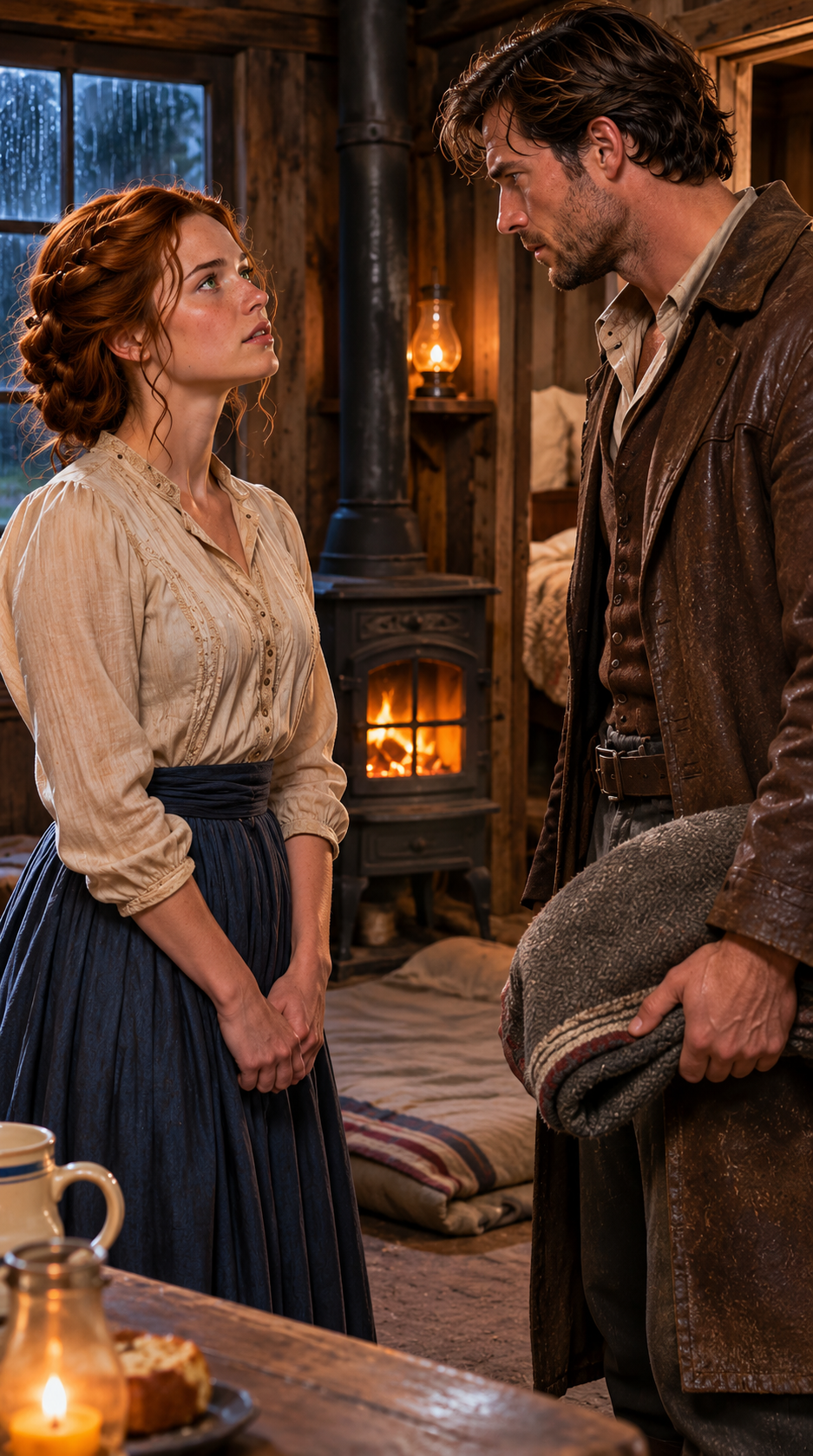
Callaway’s hand remained near my cheek, but the warmth had gone from his expression.
A moment earlier, he had been about to kiss me.
Now he looked as though he had heard a door close somewhere far behind him.
“There’s something about my past you deserve to know before giving me your heart.”
The rain beat against the farmhouse roof.
I waited.
Callaway lowered his hand.
For several seconds, he stared at the floorboards between us.
Then he said, “I was married once.”
I had expected many things.
That was not one of them.
“Oh.”
It was a foolish little word, but it was all I had.
His mouth tightened.
“She died six years ago.”
The disappointment that had flashed through me turned instantly to shame.
“I’m sorry.”
“Thank you.”
He looked toward the bedroom.
Suddenly the single bed, the folded quilts, the worn bureau—everything in that small room seemed different.
“Was that her room?”
Callaway nodded.
“This was her house too.”
I drew my hand away from his sleeve.
“You should have told me.”
“Yes.”
The answer came without defense.
That surprised me.
“Why didn’t you?”
“Because you came here to work.”
“And?”
“And I thought it wasn’t your burden.”
I looked at him.
“You were just about to kiss me.”
“I know.”
“And now you think it becomes my burden.”
His eyes lifted.
“Yes.”
At least he was honest.
“What was her name?”
“Maeve.”
An Irish name.
I blinked.
“She was Irish?”
“Born in County Clare.”
I almost laughed from disbelief.
“So you hired an Irish cook to live in the house where your Irish wife died?”
Callaway looked stricken.
“That sounds terrible when you say it.”
“It sounds strange when anyone says it.”
“I didn’t choose you because you were Irish.”
“Are you certain?”
“Yes.”
“How many applications did you receive?”
“Five.”
“And mine?”
“You wrote that a cook who cannot make bread should be imprisoned.”
Heat rose to my face.
“That was humor.”
“I hoped so.”
“And that decided you?”
“You also listed every meal you could prepare from flour, onions, beans, salt pork, and one stubborn chicken.”
I tried not to smile.
“I was being practical.”
“You were.”
The sadness in his face eased for half a second.
Then returned.
“Maeve hated cooking.”
That did make me smile.
“Did she?”
“Burned water.”
“That is difficult.”
“She managed.”
I leaned against the table.
“Tell me about her.”
Callaway looked almost afraid of the invitation.
“We don’t have to do this tonight.”
“You said I deserved to know.”
“You do.”
“Then tell me enough that I’m not sleeping in a dead woman’s bed wondering what everyone forgot to mention.”
He flinched.
Too sharp.
I regretted it instantly.
“Callaway—”
“No. You’re right.”
He moved toward the stove and sat.
I took the other chair.
For a while, the only sound was rain.
“Maeve and I met in Cheyenne,” he began. “She worked in a laundry.”
“How old were you?”
“Twenty-seven.”
“And her?”
“Twenty-four.”
“My age.”
“Yes.”
That seemed to trouble him.
“Did you love her immediately?”
He almost smiled.
“No.”
“Good.”
“Why good?”
“I mistrust immediate love.”
“You asked me to sleep beside you on the second night.”
“That was warmth.”
“Of course.”
“I also said just stay beside me.”
“Yes, ma’am.”
There was the faintest humor again.
Then he looked at the fire.
“Maeve and I argued for nearly a year before we married.”
“What about?”
“Everything.”
“Specific.”
“She thought Wyoming was too cold.”
“Correct.”
“She wanted curtains.”
“Reasonable.”
“She thought cattle smelled.”
“They do.”
“She disliked my coffee.”
“Then she was unquestionably wise.”
Callaway laughed.
It was the first full laugh I had heard from him.
I smiled.
Then he quieted.
“She made this place less empty.”
The words settled heavily.
“Like today,” I said.
He looked at me.
“When you came through the door.”
I remembered his face.
Warm lamplight.
Two plates.
Welcome home, Callaway.
His eyes had changed then.
Now I understood why.
“Did I remind you of her?”
“No.”
That answer came quickly.
“Not at all?”
“You both have accents.”
“Callaway.”
“No.”
He leaned forward.
“Maeve was bold where you are careful. Impatient where you watch. She talked to everyone.”
“I talk.”
“You observe first.”
“That sounds like a polite way of calling me suspicious.”
“Maybe.”
I accepted that.
“How did she die?”
His face closed again.
“Winter fever.”
I waited.
He said nothing more.
Too simple.
I could hear it.
“There’s more.”
“Yes.”
“What?”
His hands tightened.
“She died after I left her alone.”
My chest hurt.
“Why did you leave?”
“Cattle.”
One word.
Full of self-hatred.
“A storm had broken the east fence. We had stock scattered.”
“And Maeve was ill.”
“She had a cough.”
“How bad?”
“Not bad enough.”
“That is not an answer.”
“It became one.”
He swallowed.
“She told me to go.”
“Then why blame yourself?”
“Because she also asked me to come back before dark.”
“And?”
“I didn’t.”
The rain hammered the roof.
“Why?”
“Found twenty head near the creek. Then another fence was down. I told myself another hour wouldn’t matter.”
“When did you return?”
“Next morning.”
My heart sank.
“Was she…”
“Alive.”
His voice broke.
“For one day.”
I closed my eyes.
Callaway continued.
“Doctor said pneumonia.”
“That can happen quickly.”
“I know.”
“You weren’t responsible for the weather.”
“I was responsible for leaving.”
“She asked you to go.”
“And asked me to return.”
I leaned toward him.
“Those two things can both be true.”
He stared at me.
“You think I don’t know that?”
“No.”
His tone sharpened.
Then he stopped.
“I’m sorry.”
“You don’t need to apologize for being hurt.”
“Yes, I do, if I turn it into harm.”
That answer touched me.
I sat back.
“So you’ve been alone six years because you think loving someone gives you the opportunity to fail them.”
His eyes narrowed slightly.
“You are very direct.”
“I crossed an ocean alone.”
“Fair.”
He looked toward the bedroom.
“I stopped hiring housekeepers after two quit.”
“Why?”
“They said I barely spoke.”
“I can see the problem.”
“One said the house felt haunted.”
“Was it?”
“I was.”
That silenced me.
Then I asked, “Why hire again now?”
“The ranch grew.”
“That is practical.”
“Yes.”
“Only practical?”
His gaze came to mine.
“No.”
My heart began beating faster.
“What else?”
“I was tired.”
“Of cooking?”
“Of eating alone.”
There.
Not romance.
Not yet.
Something more honest.
I looked at the bed through the open doorway.
“Did Maeve sleep there?”
“Yes.”
“And you?”
“Yes.”
“After she died?”
“For two months.”
“Then?”
“Barn loft.”
I stared.
“For six years?”
“Mostly.”
“Callaway.”
He looked embarrassed.
“I sleep better around horses.”
“No. You punish yourself better around horses.”
That struck.
He looked away.
I softened my voice.
“She is not going to disappear if you sleep in the house again.”
His jaw tightened.
“I know.”
“And I am not taking her place.”
“I know.”
“Do you?”
He looked at me.
“Yes.”
I believed him.
Mostly.
Then he stood.
“I’ll sleep by the stove.”
I almost laughed.
“No.”
He frowned.
“The barn is too cold.”
“That is not what I meant.”
I pointed toward the bedroom.
“The bed really is big enough.”
His breathing changed.
“Kathleen.”
“You told me the truth.”
“Some of it.”
I caught that immediately.
“Some?”
He closed his eyes.
I folded my arms.
“Callaway.”
“There is something else.”
“Of course there is.”
He gave me a tired smile.
“Maeve did not simply die here.”
“What does that mean?”
He returned to the table.
Opened a drawer.
Removed a folded sheet of paper.
Old.
Creased.
He handed it to me.
It was a letter.
Maeve’s handwriting, perhaps.
Callaway,
If I do not improve, you must promise me something.
Do not sell the north pasture.
Do not let Hal Brennan buy it.
He knows what Patrick found.
I looked up.
“Who is Patrick?”
“Maeve’s brother.”
“Her brother was here?”
“Years before she died.”
“And Hal Brennan?”
Callaway’s face hardened.
“A cattle buyer.”
“That sounds harmless.”
“He isn’t.”
“What did Patrick find?”
“I don’t know.”
I stared.
“You kept this letter six years and never found out?”
“I tried.”
“How?”
“Patrick disappeared.”
My stomach tightened.
“Before Maeve died?”
“Two months before.”
“Disappeared how?”
“Rode toward Rawlins. Never arrived.”
“Was he harmed?”
“No proof.”
“And Brennan?”
“Offered to buy the north pasture three days later.”
I looked at the letter again.
“What is there?”
“Nothing.”
“Water?”
“A seasonal creek.”
“Minerals?”
“None we know of.”
“Railroad?”
“No proposed line.”
“Then what did Patrick find?”
Callaway shook his head.
“That question has been sitting in this house longer than you have.”
I read the note again.
Do not sell the north pasture.
Do not let Hal Brennan buy it.
He knows what Patrick found.
Then I noticed something written faintly along the edge.
Numbers.
Columns.
Not random.
“Callaway.”
“What?”
“This isn’t only a letter.”
He leaned over.
I pointed.
12 – 6 – 41
9 – 3 – 18
7 – 2 – 11
“What is that?”
“I don’t know.”
“You said Maeve hated cooking.”
“Yes.”
“Did she keep accounts?”
“Sometimes.”
“Did Patrick?”
“He worked for the railroad survey office for a year.”
My pulse quickened.
“Surveyor?”
“Assistant.”
I studied the numbers.
Could be measurements.
Section coordinates.
Land records.
“Do you have a map?”
Callaway brought one.
Wyoming survey grid.
Sections.
Townships.
Ranges.
We worked for an hour.
Nothing.
Then I saw it.
The numbers were not land coordinates.
They matched ledger pages.
“Do you have cattle books from that year?”
He found them in a locked cabinet.
Dust covered the spine.
Page twelve.
Line six.
Entry forty-one.
Brennan Freight Company.
Page nine.
Line three.
Entry eighteen.
Brennan again.
Page seven.
Line two.
Entry eleven.
A freight payment.
“What does it mean?” Callaway asked.
I compared the entries.
Three different payments.
All recorded as feed transport.
All unusually large.
“Someone paid Brennan nearly nine hundred dollars in two months.”
“I didn’t.”
“Your name is on the ledger.”
“I didn’t keep these books then.”
“Who did?”
“Maeve.”
I stared.
“Then she knew.”
Callaway’s face changed.
“About what?”
“Something hidden inside normal expenses.”
I checked neighboring entries.
Different handwriting.
Callaway’s, perhaps.
Maeve’s entries were neat.
But these three lines were overwritten.
“Look.”
The ink beneath one entry showed through.
I held it toward the lamp.
Not FEED.
DEED.
Callaway went still.
“Deed transport?”
“No.”
I rubbed the page lightly.
Another word emerged.
COPY.
“Deed copy.”
My heartbeat quickened.
“Patrick found a property deed.”
Callaway stared toward the dark north pasture beyond the window.
Then something knocked against the porch.
Once.
Twice.
We both froze.
He crossed to the door.
I followed.
He opened it.
No man.
No horse.
Only wind.
And a small parcel wrapped in oilcloth.
Callaway picked it up.
Inside was an old brass survey compass.
Engraved:
P. O’CONNOR.
Patrick.
Beneath it was a note.
HARTWELL STATION. LOCKER 17.
I stared at Callaway.
“Who left this?”
He looked into the rain.
No one visible.
Then he noticed a hoofprint beyond the porch.
Fresh.
Large.
And beside it, stamped into the mud, a brand mark shaped like a broken B.
Brennan’s cattle brand.
For six years, Callaway had believed the old secret was dead.
Someone had just reminded us it was not.
**–END OF PART 2– CLICK “NEXT” AT THE BOTTOM OF THE PAGE TO CONTINUE READING**
✓ Lynn R. Adams
## Part 2 – The Woman Whose Name Still Lived in His House Callaway’s hand remained near my cheek, but the warmth had gone from his expression. A moment earlier, he had been about to kiss me. Now he…