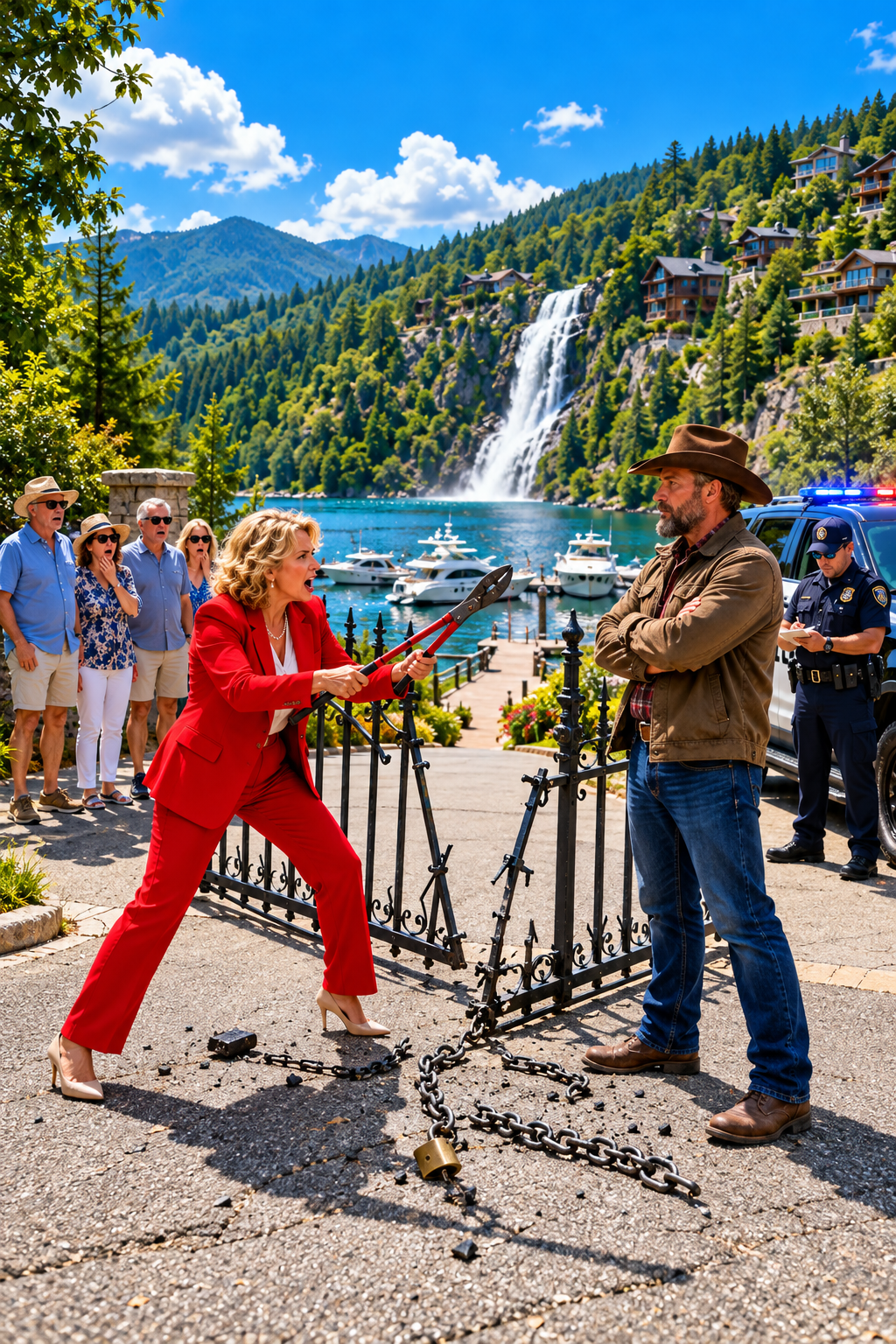
The first time my HOA president cut the chain on my private lake gate, she smiled like s
Part 2: A forgotten legal agreement concealed the price of arrogance
Nine years before Karen arrived at my gate with bolt cutters, I purchased a modest lakeside property in Willow Creek, a quiet residential development outside Charlotte, North Carolina. My house wasn’t the largest in the neighborhood, and it certainly wasn’t the fanciest, but I paid a substantial premium for one feature that made it different from every other lot. Along its western boundary ran a narrow private pathway leading to a wooden dock and a peaceful stretch of shoreline where the water remained shallow enough for swimming. The deed and accompanying recorded documents gave my property exclusive rights to use and control that access route, subject to specific maintenance obligations and restrictions. My real estate attorney, Michael Grant, emphasized the importance of those rights during closing, warning me that waterfront access could become a source of conflict whenever people confused shared scenery with shared ownership.
The lake itself was not mine, and I never claimed otherwise. Residents could reach it from a public area near the northern shoreline, where a gravel trail led to a fishing platform and a small launch suitable for kayaks. My private path simply offered a more convenient route to a different section of the waterfront, including the dock I maintained at my own expense. For the first two years, nobody complained, and most neighbors respected the gate without giving it a second thought. Then the original developer, Charles Benton, decided that selling luxury weekend lake experiences might solve his company’s growing financial problems.
Charles began advertising premium recreational packages to buyers outside Willow Creek, promising exclusive dock access, waterfront gatherings, and private fishing experiences. Unfortunately, the route he intended to use ran directly through my protected easement, and his promotional materials even included photographs of my dock. When I confronted him, he dismissed my concerns and claimed that his company had retained broad development rights throughout the subdivision. My attorney disagreed, and within days we were preparing legal action to stop the unauthorized commercial operation. The dispute lasted months, involved expensive property appraisals, and eventually ended in a negotiated settlement that Charles desperately wanted to keep out of a prolonged courtroom battle.
The settlement reaffirmed my exclusive access rights and prohibited the developer, the HOA, and their covered successors from authorizing unauthorized traffic through the protected route. Because the proposed commercial operation threatened the value and exclusivity of the property, the parties negotiated an unusually large liquidated-damages provision intended to address future violations. Section 4.2B identified $480,000 for each qualifying unauthorized use, a figure supported in the agreement by valuation materials and accepted by the signing parties. Whether a court would ultimately enforce every dollar of such an extraordinary provision was a separate legal question, but the recorded agreement created a serious contractual exposure that no responsible board could safely ignore. The settlement was signed, recorded with the county, and placed in the HOA’s permanent legal files.
Three members of the association’s previous leadership had participated in those negotiations. They understood why the agreement existed, and they knew the restrictions were supposed to protect the community from future disputes. One former board member, a retired accountant named Thomas, mentioned the settlement to me shortly after Karen became president. He said the document was stored in the association’s legal binder under Tab 7, alongside the subdivision plat and the governing covenants. I assumed any incoming president would review those materials before making decisions involving private property, especially decisions that could expose sixty households to litigation.
Karen apparently considered reading old documents a waste of time. She had built her reputation on decisive action, aggressive enforcement, and a belief that homeowners who challenged her authority were enemies of neighborhood harmony. During her first two years, she transformed minor architectural disputes into expensive disciplinary campaigns, often issuing fines before residents had meaningful opportunities to respond. The Henderson family paid $1,200 after repainting their mailbox a beige shade Karen considered insufficiently neutral. Another couple received repeated violation notices because a flowerpot extended several inches beyond a boundary nobody could clearly identify.
I watched those incidents with growing discomfort, but I had little interest in becoming the center of another neighborhood argument. I worked long hours, enjoyed quiet weekends, and preferred solving engineering problems to attending HOA meetings filled with petty accusations. Still, I kept copies of my deed, settlement, and plat map in a fireproof cabinet beside my desk. Those documents represented more than paperwork; they represented years of savings, legal expense, and the right to enjoy the home I had purchased. When Karen destroyed my chain, she forced me to retrieve them, and the forgotten agreement suddenly became the most important document in Willow Creek.
Part 3: Karen transformed my private property into her personal playground
Three days after the gate incident, my phone vibrated with a notification from the HOA’s neighborhood application. The announcement featured cheerful graphics, cartoon sunshine, and a photograph of the lake taken from my dock. “COMMUNITY LAKE DAY THIS SATURDAY,” the headline declared, followed by instructions directing all residents to enter through the newly designated western access point. Karen encouraged families to bring children, picnic baskets, fishing rods, and guests, promising that Willow Creek was entering a new era of shared recreation. I read the announcement twice, printed a copy, and placed it inside a folder labeled “Unauthorized Access.”
That Saturday morning, I positioned a folding chair near the edge of my driveway with a thermos of coffee, a legal pad, and my phone. The first visitors arrived shortly after nine, a young couple dragging a cooler between them while their little boy carried an inflatable dinosaur nearly as large as himself. They smiled politely and thanked me for allowing the neighborhood to use the path, which immediately told me how Karen had presented the situation. I didn’t argue with them or frighten their child, because ordinary residents were not the people who had decided to override my recorded rights. Instead, I documented the activity from my property, recording times and observable details while avoiding unnecessary confrontation.
By lunchtime, the private trail resembled the entrance to a summer campground. Families came and went, children hurried back for forgotten towels, and several people made repeated trips to retrieve food from their cars. Someone placed a portable speaker on my dock, while another visitor tied a fishing boat to a railing I had repaired the previous spring. I felt anger rising whenever I heard footsteps passing my windows, but I reminded myself that the association had created this situation. By the end of the day, I had recorded twenty-three qualifying entries under the method my attorney and I were using to evaluate the contractual claim.
On Monday, I mailed formal notices to every board member by certified mail. Each letter identified the recorded settlement, referenced Section 4.2B, described the unauthorized activity, and demanded that the association stop directing people through my property. I included the county recording information so nobody could reasonably claim the document was impossible to locate. Seven envelopes went out, and within days I received seven signed delivery confirmations. The board had been given a clear opportunity to stop, investigate, and seek legal advice before causing additional harm.
Karen called that evening, sounding more irritated than concerned. “Daniel, I received your ridiculous letter,” she announced, without bothering to say hello. “You cannot threaten an entire neighborhood because you don’t like sharing.” I asked whether she had personally read Section 4.2B, and she responded that the board would not be intimidated by legal technicalities. When I suggested she consult an independent property attorney, she laughed and told me the association already had excellent representation.
Three days later, I found an official HOA violation notice in my mailbox demanding $3,500 for obstructing a community recreational pathway. The alleged obstruction was my privately owned gate, the same gate Karen had forcibly opened less than two weeks earlier. I stared at the notice in disbelief, then photographed it and called Michael. He listened carefully as I explained the chronology, particularly the fact that the fine had been issued after every board member received written notice of the recorded agreement. His response was calm but unmistakably serious.
“Keep the original,” he instructed. “That notice may become evidence of intentional interference, and we need to preserve everything.”
The following Saturday, Karen organized another lake day, drawing an even larger crowd. I documented thirty-one additional qualifying passages, bringing my running total to fifty-four. Rather than celebrate, I sat alone at my kitchen table and looked at the photographs of families enjoying a place they believed had been legitimately opened to them. I wondered how many would still be smiling if they understood the potential liability their association was accumulating. Karen had promised them a summer of freedom, but every announcement she published made it harder for her to claim that the violations were accidental.
Part 4: Frightened neighbors revealed the cruelty behind Karen’s authority
The first neighbor to approach me privately was Eleanor Mitchell, a seventy-four-year-old retired elementary school teacher who lived two houses down. She arrived on a Wednesday afternoon carrying a thick stack of envelopes secured with a faded rubber band, and her hands trembled as she asked whether we could speak inside. Eleanor had lived in Willow Creek longer than almost anyone, and I had always known her as the woman who delivered homemade cookies to new families. Seeing her frightened on my doorstep disturbed me more than Karen’s latest threatening letter. When she placed the envelopes on my kitchen table, I understood why.
Every envelope contained an HOA violation notice, and together they represented eighteen months of relentless financial pressure. Karen had fined Eleanor for a vehicle leaving a faint stain on her driveway, for an exterior light allegedly exceeding brightness limits, and for allowing her grandson to park beside her garage during a Sunday visit. Several notices included additional administrative fees that had grown when Eleanor requested explanations or appealed the original charges. She had paid approximately $3,200 because she feared the association might eventually place a lien against her home. Her monthly retirement income barely covered ordinary living expenses, and the fines had forced her to postpone dental treatment.
“I taught children for thirty-eight years,” she told me, staring at her folded hands. “I never imagined I would be afraid of checking my own mailbox.”
I asked whether she had challenged the notices, and she showed me carefully organized copies of letters, product specifications, and photographs she had submitted to the board. In one case, the association’s written lighting standard appeared to contradict the violation Karen had issued. Eleanor had presented that information at a meeting, only to be interrupted and told she was wasting everyone’s time. Two weeks later, another fine arrived for an unrelated issue, leaving her convinced that questioning the president would only make matters worse.
I advised Eleanor to preserve her records and seek appropriate advice before paying or ignoring additional notices. Then I asked permission to share copies with Michael, explaining that her experience might demonstrate a broader pattern of retaliatory enforcement. She agreed, though she looked genuinely terrified that Karen would discover our conversation. Before leaving, she squeezed my hand and whispered that she hoped somebody would finally make the neighborhood safe again. I promised only that I would take her concerns seriously, because I had learned that making dramatic promises was easy and delivering meaningful change required evidence.
Over the next week, three more residents contacted me with remarkably similar stories. Dave Patterson described receiving landscaping violations shortly after questioning the board’s financial reports, while the Hendersons showed me correspondence revealing that their mailbox color had never been clearly prohibited by the governing documents. Another homeowner, a single father named Luis, said he had stopped attending meetings because every disagreement seemed to produce a new inspection of his property. I collected written statements, photographs, dates, and copies of notices, keeping the information separate from the lake-access dispute so the two matters could be evaluated responsibly.
Meanwhile, Michael requested certified copies of the subdivision plat, recorded bylaws, and settlement agreement from the county. The plat confirmed that my access route lay within the protected portion of my property and was not designated as an HOA common area. The governing documents also limited the board’s authority and did not give it unilateral power to rewrite recorded property rights. Those records were devastating to Karen’s central argument, because a board resolution could not simply transform private land into community property. The association needed legitimate legal authority, not a confident speech and a laminated sign.
By the third organized lake event, my documented count had reached seventy-one qualifying passages. Michael reviewed the growing evidence and warned me that the situation was becoming too serious to leave unresolved indefinitely. We discussed emergency relief, further notices, and the practical challenges of enforcing such an unusually large contractual damages provision. I understood that waiting carried risks, especially if someone was injured on the path or the board escalated its conduct. Yet Karen was still assuring residents that she possessed unquestionable authority, and her next announcement suggested that she intended to go far beyond a few weekend gatherings.
Part 5: A summer festival pushed the association toward financial catastrophe
Karen unveiled her grandest project on a Tuesday evening in July, sending an HOA announcement titled “WILLOW CREEK SUMMER LAKE FESTIVAL.” The invitation promised music, lawn games, food vendors, family activities, and an afternoon of community celebration beside the water. Unlike the earlier lake days, this event explicitly welcomed relatives, friends, and guests who did not live in the subdivision. The included a colorful map identifying my gate as the official festival entrance, complete with arrows directing visitors along the private pathway. I forwarded the announcement to Michael before I finished reading it.
He called within minutes and asked whether I wanted to seek an immediate court order. I told him I wanted the association formally warned again, and he prepared another written demand emphasizing that outside guests were not authorized to use the route. We also discussed safety concerns, insurance questions, and the possibility that a court might view continued unrestricted access as something I should have attempted to prevent sooner. Michael insisted that the accumulating contractual claim did not eliminate my responsibility to act reasonably. I agreed, and we prepared to document the scheduled event while taking steps to prevent a dangerous confrontation.
Festival morning arrived with cloudless skies and the kind of humid Southern heat that makes everything smell like freshly cut grass. By ten o’clock, families were streaming toward the lake carrying coolers, beach umbrellas, and oversized bags of food. Several visitors asked whether they needed tickets, while others assumed my driveway was an overflow parking area. I directed vehicles away from blocking emergency access and recorded the organized use of the pathway without physically interfering with families. The crowd grew steadily, and by noon I could hear music from the dock through the closed windows of my house.
Then, shortly after two, Karen’s husband arrived with another board member carrying concrete mix, a shovel, and a heavy metal signpost. They began digging inside my property boundary, apparently intending to replace the temporary sign with something permanent. I approached from a safe distance and informed them that I did not consent to construction on my property. Karen’s husband shrugged and claimed the association had already approved the installation. When I asked him to stop, he told me to take my complaints to the board and continued pouring concrete into the hole.
I photographed the installation from beginning to end, documenting the materials, location, workers, and completed structure. The finished sign declared, “PERMANENT COMMUNITY LAKE ACCESS,” with the word “PERMANENT” printed in oversized letters. I remember staring at that word and wondering how someone could believe that concrete and capital letters were substitutes for a deed. The installation also demonstrated that the board’s interference was no longer a temporary misunderstanding. It had become a deliberate attempt to create the appearance of public ownership on land the recorded documents identified otherwise.
By evening, the festival had generated sixty-one additional qualifying passages, bringing the cumulative documented count to 132. At the contractual rate stated in Section 4.2B, the resulting demand calculation was $63,360,000. I entered the numbers into a spreadsheet and stared at the result, aware that the actual legal recovery would depend on interpretation, enforceability, and any eventual settlement. Even so, the figure represented a terrifying exposure for an association whose annual budget was only a tiny fraction of that amount. Karen had organized what she considered a neighborhood triumph, but the paperwork told a very different story.
A week later, the association delivered another letter announcing its intention to petition the city to designate the private access route as a public right-of-way. Karen claimed historical use, community benefit, and safety concerns justified the request, despite the absence of supporting language in the recorded plat. Michael immediately notified the planning department of the existing easement and settlement, and the city placed the petition on administrative hold while the property dispute was reviewed. Karen nevertheless continued telling residents that public access was inevitable. Her confidence was becoming less like leadership and more like a refusal to acknowledge reality.
Part 6: Karen’s public victory speech became evidence against her
The Willow Creek annual homeowners meeting took place in a community center with beige walls, fluorescent lights, and rows of folding chairs that squeaked whenever someone shifted position. Karen had promoted the gathering for weeks, promising an important announcement about the future of neighborhood recreation. I arrived early with a folder containing copies of the settlement, correspondence, plat map, violation log, and HOA notices. Eleanor sat near the front beside Dave Patterson, while several residents who had previously avoided meetings quietly filled the back rows. By the time Karen called the gathering to order, the room was packed.
Karen stood behind a podium wearing a navy blazer and an expression of absolute satisfaction. She began by praising the board’s courage in confronting what she described as years of unfair restrictions on community resources. Then she dimmed the lights and projected a presentation titled “PROJECT OPEN LAKE: RESTORING ACCESS FOR EVERY FAMILY.” Photographs of smiling children, fishing rods, picnic tables, and festival decorations appeared across the screen. She spoke warmly about neighborhood unity, never once acknowledging that every photograph had been taken during events conducted through a disputed private access route.
As the presentation continued, I noticed something extraordinary about her slides. Karen had included dates, estimated attendance figures, and descriptions of each organized gathering, apparently hoping to demonstrate the success of her leadership. Several images showed people walking directly through my gate, while others depicted equipment being carried along the protected pathway. Her own records independently corroborated thirty-one of the qualifying passages documented in my log. I photographed the slides from my seat, making sure to capture the captions and surrounding context.
Halfway through the presentation, Dave raised his hand and asked whether the board had reviewed the recorded settlement governing the lake-access easement. Karen’s smile tightened, but she answered without hesitation. “That agreement is outdated,” she said, dismissing it as an old development dispute that supposedly had no relevance to current community needs. Dave asked whether the association’s attorney had specifically reviewed the liquidated-damages provision. Karen responded that professional counsel had examined the situation and that the board was standing on solid legal ground.
I watched one board member, Marcus Hale, lower his eyes toward the table. Marcus had always seemed quieter than the others, and I wondered whether he knew more than he was willing to say publicly. Karen moved quickly to the next slide, announcing that the city right-of-way petition was progressing and that permanent access would soon be secured. That statement was especially troubling because the planning department had already placed the petition on hold. Several residents applauded, but Eleanor remained motionless, and Dave shook his head.
When Karen finished, she invited questions, though her tone made clear that she expected congratulations. I stood and asked whether the board would provide homeowners with a complete copy of the legal opinion supporting its actions. Karen said privileged legal communications could not be distributed and suggested that I was attempting to create unnecessary fear. I replied that homeowners deserved to understand any financial risks created in their names. The room became uncomfortably quiet, and for the first time that evening, Karen looked uncertain about how her audience was responding.
After the meeting adjourned, I approached the front table and placed a sealed envelope beside Karen’s presentation notes. Inside were copies of the relevant settlement section, the county recording information, and a final request that she immediately suspend unauthorized access. “Please read this before tomorrow morning,” I told her. She glanced at the envelope, gave a dismissive laugh, and returned to speaking with a supporter. I walked outside, called Michael from the parking lot, and authorized him to deliver the formal demand package.
The next morning, a process server arrived at Karen’s home with documents describing 132 alleged violations and a contractual damages demand of $63,360,000. Copies went to the association, its registered agent, and the board members, accompanied by photographs, notices, certified-mail receipts, and supporting records. For months, Karen had treated my objections as the complaints of one stubborn homeowner. Now the dispute had become a formal legal crisis with consequences that every household in Willow Creek might eventually feel. And the first person to understand just how serious it was would not be Karen, but the attorney she had repeatedly claimed was protecting her.
Part 7: A sixty-three-million-dollar demand shattered Karen’s carefully constructed empire
Marcus called me late that evening, sounding like a man who had witnessed an accident and was still trying to understand how everyone had survived. He said Karen had summoned several board members to an emergency meeting after receiving the demand package, and the association’s attorney had joined by telephone. According to Marcus, the attorney began by asking for the county recording number and a complete copy of the original settlement. There was a long silence while he reviewed the relevant documents, followed by questions about prior notices, board authorizations, and the number of organized events. Karen reportedly interrupted several times, insisting that the amount was absurd and that no homeowner could possibly demand such a sum.
The attorney explained that the agreement appeared properly executed and recorded, and that the association could not dismiss it simply because the current board had not reviewed it. He also cautioned that the extraordinary liquidated-damages amount might face substantial judicial scrutiny, including arguments about whether it operated as an unenforceable penalty. That uncertainty offered no comfort, because even a fraction of the demand could overwhelm the association’s finances. The board’s available reserves were approximately $340,000, and its insurance coverage raised difficult questions about intentional interference with known property rights. For the first time, Karen had to confront the possibility that her decisions might cost the community far more than any neighborhood improvement could justify.
Marcus said the room became silent when Karen admitted she had never seen Section 4.2B. She claimed the previous leadership had failed to explain the agreement during her transition into office. Thomas, the former treasurer who had remained involved as an adviser, was present and quietly retrieved a thick legal binder from a cabinet. He placed it on the table, opened it to a yellow divider marked “TAB 7,” and showed her the recorded settlement and the transfer checklist she had signed when assuming office. Nobody needed to raise their voice, because the documents answered the question more effectively than any accusation could.
Karen reportedly stared at the binder for several seconds before asking why nobody had warned her. Marcus told me that Thomas responded with a simple observation: the documents had been available to her from the beginning. She had received the files, possessed authority to consult counsel, and had been notified repeatedly after the gate was cut. The problem was not that the information had been hidden. The problem was that Karen had considered herself too powerful to need it.
I didn’t celebrate when Marcus finished his account. The homeowners association wasn’t a faceless corporation with unlimited resources; it represented sixty families, including Eleanor, Dave, and people who had never supported Karen’s actions. A catastrophic judgment could have forced special assessments, damaged property values, and punished residents who had simply trusted their elected board. I told Michael that I wanted the interference stopped, my rights permanently protected, my costs covered, and the association’s abusive enforcement practices addressed. I had no desire to bankrupt innocent neighbors for the sake of watching Karen suffer.
Negotiations began the following week, with the HOA’s attorney acknowledging that the association needed an immediate resolution. Our initial discussions were difficult because the board wanted the damages demand withdrawn before committing to meaningful changes. Michael refused to surrender our leverage without enforceable protections, while the association argued that the extraordinary contractual figure would likely be reduced or rejected in litigation. Both sides understood that a trial would be expensive, unpredictable, and potentially devastating to the community. After several rounds of negotiation, the focus shifted from the headline demand toward a comprehensive settlement that would prevent future interference.
The final agreement reaffirmed my exclusive easement rights in a new recorded instrument, required removal of the unauthorized signs, and prohibited the HOA from directing traffic through my property without lawful permission. The association agreed to rescind my $3,500 fine, reimburse documented legal expenses, pay for a reinforced replacement gate, and establish a funded mechanism for future enforcement. The $63.36 million demand was resolved through the negotiated settlement rather than paid as a judgment or cash award. Karen also accepted a personal financial contribution toward the association’s legal costs as part of the arrangement, although the amount remained confidential.
Her resignation appeared in the HOA application on a Tuesday morning, written in three short sentences that contained neither an explanation nor an apology. Eleanor called me before breakfast, her voice shaking with relief as she asked whether the announcement was real. I confirmed what I had seen and told her that the new interim board had already agreed to review disputed fines. She began crying quietly, not because she hated Karen, but because she had spent nearly two years feeling powerless inside her own home. That was when I understood that the greatest victory had never been the enormous number printed on the demand letter.
Part 8: The final settlement restored justice and changed our neighborhood forever
The first morning after the settlement became effective, I drove to the lake and found a small construction crew removing Karen’s permanent access sign. The workers broke apart the concrete foundation, lifted the steel post from the ground, and loaded the pieces into a truck while I watched from my driveway. Nobody made a speech, and nobody argued about community rights or neighborhood unity. The crew simply restored the property boundary to the condition it should have remained in all along. When they finished, the only visible evidence of Karen’s grand project was a square patch of disturbed soil beside my newly installed gate.
The replacement gate was stronger than the original, with reinforced hinges, a heavier chain, and a lock designed to withstand ordinary tampering. I had chosen a simple black finish rather than anything decorative, because I wanted the entrance to look like what it was: a private boundary, not a monument to a neighborhood war. Michael helped ensure that the new recorded agreement clearly described the protected route and the association’s continuing obligations. The HOA also adopted procedures requiring independent legal review before any future board attempted to alter recorded property rights. Those safeguards mattered more to me than the appearance of the gate.
Within two weeks, the interim board announced a comprehensive review of fines issued during Karen’s presidency. Eleanor attended the first public hearing carrying the same carefully organized stack of documents she had brought to my kitchen months earlier. This time, board members listened as she explained each disputed charge, and an independent reviewer compared the notices with the actual governing standards. Several fines were reversed, and she received refunds totaling a little over $2,000. When the treasurer handed her the written confirmation, Eleanor smiled with the unmistakable relief of someone who had finally been heard.
Other families received partial refunds or cancellation of outstanding penalties. Dave’s mailbox citation was withdrawn, the Hendersons obtained relief from their disputed architectural fine, and Luis received written clarification of the rules that had been repeatedly used against him. The new board introduced a transparent appeals process, required documented evidence for violations, and prohibited retaliatory enforcement. Meetings became longer because homeowners were finally allowed to ask questions, but the atmosphere changed almost immediately. People who had spent years sitting silently began participating in decisions affecting their homes.
The lake-access issue required a separate solution, because some residents genuinely missed the convenient shoreline and the gatherings Karen had organized. I understood their disappointment, but convenience could not justify taking control of someone else’s property. Fortunately, a homeowner on the northern edge of Willow Creek had previously expressed interest in negotiating a properly compensated access agreement. The new board approached him respectfully, commissioned a survey, and worked with counsel to establish a lawful route. Within three months, the association had secured an additional pathway through a recorded agreement approved by the affected owner.
The first legitimate community lake celebration took place on a Saturday in early autumn. Eleanor invited me, and although I initially hesitated, I decided to attend for an hour. Families gathered near the new northern entrance, children played on the grass, and volunteers served lemonade beneath a white canopy. There were no threatening notices, unauthorized signs, or board members claiming powers they didn’t possess. The atmosphere felt ordinary, which was exactly what made it wonderful.
Dave found me standing near the water and asked whether I regretted pursuing the dispute so aggressively. I considered the question before answering, remembering the broken chain, the certified letters, the enormous demand, and the anxiety that had followed. I told him I regretted that the conflict had become necessary, and that I wished Karen had simply read the agreement before making her first decision. But I did not regret defending my property or helping neighbors challenge unfair treatment. He nodded and said the neighborhood had needed someone willing to insist that the rules applied to the people enforcing them.
Months passed, and Willow Creek gradually became the peaceful community I remembered from my first years there. The new board published financial reports, encouraged attendance at meetings, and treated homeowners as neighbors rather than subjects. Eleanor resumed hosting holiday cookie exchanges, while the Hendersons repainted their mailbox without requesting permission for every subtle variation of beige. I returned to my engineering work and spent quiet weekends fishing from my dock. The entire episode began to feel like an extraordinary storm that had finally moved beyond the horizon.
One Saturday morning, almost a year after Karen destroyed my chain, I unlocked the new gate just before sunrise and walked toward the water. Mist hovered above the lake, and the wooden dock creaked beneath my feet as I settled into an old folding chair. Somewhere across the shoreline, a bird called from the trees, and small ripples spread through the pale reflection of the sky. I thought about how close the neighborhood had come to financial disaster because one person believed authority meant never having to admit a mistake. Then I remembered Eleanor’s smile when she received her refund, and I realized that the ending was bigger than my property line.
When I returned to the gate, I noticed fresh grass growing over the patch where Karen’s concrete sign had once stood. The soil had settled, the evidence of the installation was fading, and soon nobody passing by would know that anything unusual had happened there. I closed the gate, threaded the chain through its steel brackets, and clicked the padlock into place. For a moment, I rested my hand against the cool metal and remembered Karen standing in the gravel with her bolt cutters, absolutely certain that she had won. She had believed the chain was the only thing standing between her and the lake, but she never understood what it represented.
It represented a deed, a settlement, years of sacrifice, and the simple principle that nobody becomes more important than the law merely because they win an election to a neighborhood board. Karen had tried to teach sixty families that the loudest person in the room could decide what belonged to everyone. Instead, her downfall taught them that authority comes with responsibility, and that ignoring a document does not make its obligations disappear. The $63.36 million demand had never become a giant check deposited into my bank account, but it had forced a reckoning that restored boundaries, accountability, and dignity throughout Willow Creek. As I walked back toward my house, I knew I had finally received something more valuable than revenge: the freedom to enjoy my home without fear, and the satisfaction of knowing that my neighbors could do the same.
✓ Lynn R. Adams
Part 2: A forgotten legal agreement concealed the price of arrogance Nine years before Karen arrived at my gate with bolt cutters, I purchased a modest lakeside property in Willow Creek, a quiet resi…