The first time Karen demanded access to my pool, I thought she was joking. She stood
Part 2: The bylaws gave me the answer Karen never expected
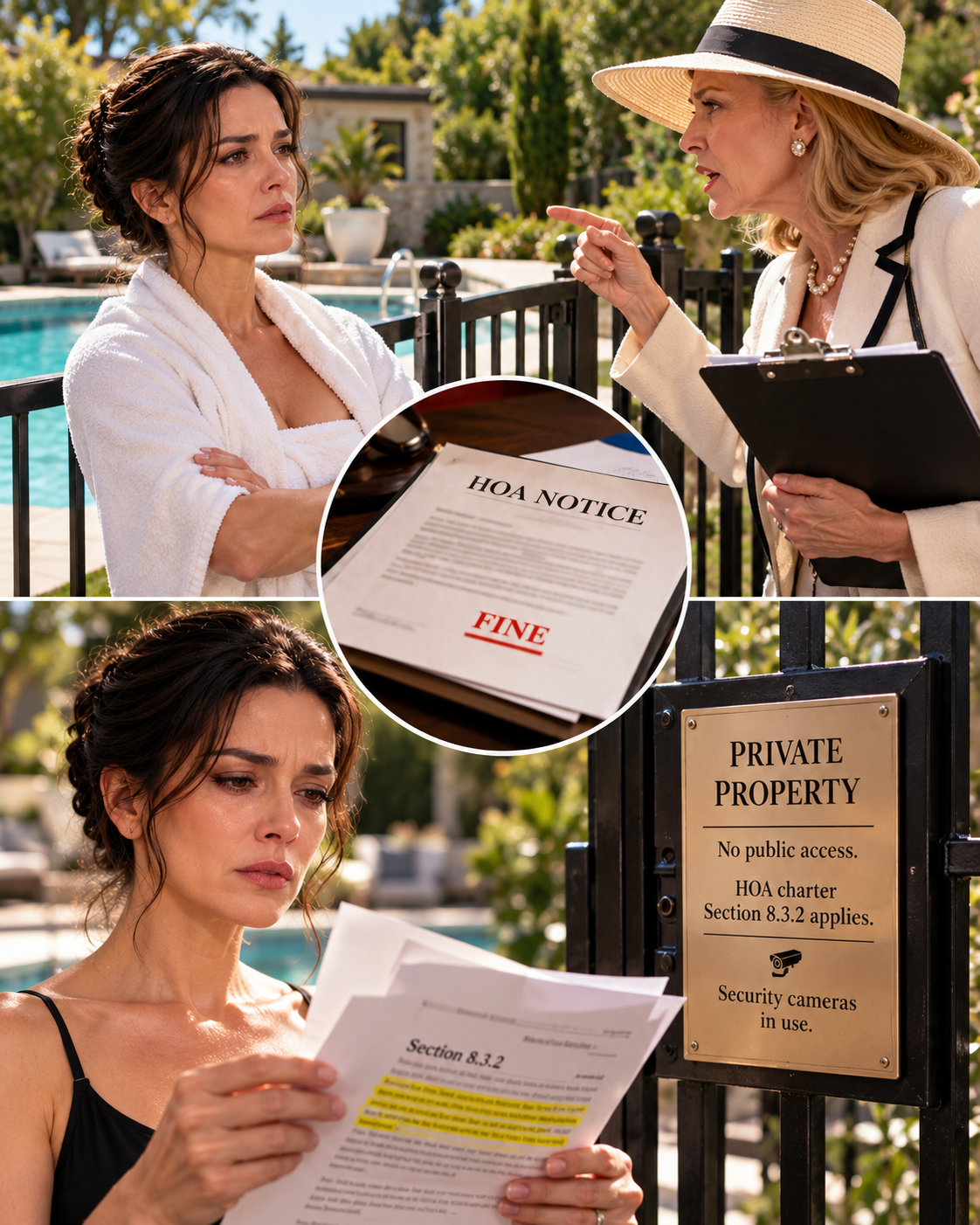
I spent the next morning reading the HOA charter as if it were a mystery novel whose villain had left fingerprints on every page. Section 8.3.2 was short, clear, and almost comically specific: the association could not regulate a private recreational structure unless association funds had paid for it or the owner had agreed to shared use. Neither condition applied to my pool. The board could enforce safety rules for common property, but the pool was behind my fence, on my land, and maintained with my money. I printed the section again and placed a yellow tab beside the sentence that Karen had apparently hoped nobody would read.
I called the HOA’s management company, not to argue, but to ask whether it had a copy of my original construction approval. The representative found it in the association’s digital archive within minutes and emailed it to me with a polite note confirming the pool had been approved as a private improvement. That gave me something better than my own memory: the board’s records showed exactly what Karen had chosen to ignore. I asked the representative to confirm that no HOA funds had ever been used for construction or maintenance. She checked the budget history and confirmed there were no such payments. I saved both messages and made a new folder labeled Pool—HOA Correspondence.
Then I hired a local sign company to make a durable aluminum plaque for the gate. I kept the wording plain and factual: “Private property. No public access. HOA charter Section 8.3.2 applies. Security cameras in use.” I did not add threats or insults, because the sign was meant to communicate a boundary, not start a neighborhood war. The company engraved the letters in black and mounted the plaque beside the latch, level with the gate frame. When the installer drove away, the sign looked less like a challenge than a small, permanent reminder that the pool belonged to the person paying to keep it running.
Karen saw it before lunch. She marched up the sidewalk, stopped just beyond the fence, and stared at the sign with an expression that suggested it had personally offended her. “You’re making this divisive,” she said. I was watering the flowers beside the patio and did not look up right away. “No,” I said, turning the hose off. “I’m making the rules visible.” She said the board would review my conduct, and I asked whether she meant the board that had approved the pool in the first place. Her cheeks colored, and she turned sharply enough that the brim of her hat nearly struck the gate.
I could have left it there, but the next letter made clear that Karen had no intention of letting the matter die quietly. It demanded that I remove the sign, reconsider my “elitist attitude,” and attend an emergency hearing about the pool’s “impact on neighborhood cohesion.” I made a copy of the letter, framed it, and hung it inside the side entrance near the pool gate. Beneath it, I added a small laminated card reading, “For educational purposes: please review Section 8.3.2.” The joke made me smile, but the folders on my desk kept growing. Karen had turned a private pool into a board issue, and I was beginning to suspect she had been waiting for an excuse.
Part 3: I answered her threats with paperwork and neighbors
I sent the association a certified response with copies of the construction approval, the charter, and the management company’s confirmation that no common funds had been spent on the pool. I asked the board to withdraw the demand, correct its records, and confirm in writing that it would not impose fines for exercising a permitted use of my property. I also requested the minutes from every meeting where the pool had been discussed. The letter was professional, specific, and a little longer than the notice Karen had sent. I kept a signed copy and filed the postal receipt beside the original threat.
The reply arrived a week later, with Karen’s name at the bottom and a paragraph accusing me of “undermining community spirit.” It did not address the bylaw, the permit, or the invoices. Instead, it warned me that continued resistance might lead to “additional review of exterior features.” I read it once, then forwarded it to the management company and every board member. I asked a simple question: “Which provision of the charter authorizes this action?” Nobody answered for three days. On the fourth, a board member named Denise called me privately and admitted she had not known the notice had been sent.
That was when I learned the pool was not Karen’s only target. Neighbors told me she had fined one family over the species of tulips in their flower bed, even though the approved landscaping list included those same tulips. She had ordered another homeowner to remove a birthday bounce house because it was “too visually disruptive.” A retired couple had received a warning because their American flag hung an inch below the measurement Karen preferred. People had treated each incident as an annoyance they could survive alone. The moment I told them about the pool letter, they started sharing their own stories.
I met Mark three houses down on a Friday evening, after a neighbor suggested he might understand how the board worked. Mark had served on the HOA board several years earlier, before Karen won a contentious vote and pushed him out of the leadership group. He had solar panels, immaculate hedges, and a calm manner that made him seem difficult to provoke. I showed him the pool notice and the bylaw. He read both pages, looked over his glasses, and said, “She’s overplayed her hand.” I asked whether he would run for the board again. He laughed once, then said he would think about it.
The election was two months away, and Karen’s seat was on the ballot. Mark eventually agreed to run, but he did not want a campaign built on gossip or revenge. We talked about open financial records, clear approval procedures, and equal enforcement of the rules. I helped him build a simple website and prepare a one-page statement for homeowners. A few neighbors volunteered to deliver flyers, while others offered to host small meetings in their homes. Nobody had to invent a villain for the campaign. Karen had sent enough letters, issued enough warnings, and ignored enough questions that the record spoke for itself.
Part 4: Her own neighbors turned the backyard into a campaign
We organized a “Private Property Appreciation Day” on a Saturday afternoon, with invitations sent to neighbors who had been warned about their gardens, sheds, saunas, chicken coops, or backyard gatherings. The event was not an official campaign rally; it was a chance to meet without feeling like every conversation might be written down and cited later. People brought snacks, folding chairs, and stories they had held in for years. Mark came with his wife and kids, and I set out lemonade beside the pool. We did not invite Karen, because she had made it clear she viewed the property as a public resource whenever it suited her.
At first, everyone spoke cautiously, checking whether the others had experienced the same pattern. Then the stories came faster. One neighbor had been fined for a mailbox color that appeared on the HOA’s own approved palette. Another had been warned about a garden hose left visible for less than an hour. A family with a toddler described being told their plastic playhouse looked “too commercial.” With every story, the mood shifted from private frustration to recognition. Karen had made people feel isolated, but the moment they compared notes, her authority looked much smaller.
She watched the gathering from across the street, arms folded, her face fixed in a tight line. I noticed her taking photographs near my fence later that afternoon, leaning in toward the gate as if the sign might change if she studied it long enough. The red light on the security camera blinked above her, and she hurried away when she spotted it. I saved the footage and sent it to the management company with a factual note asking that board members refrain from approaching private property without permission. I did not accuse her of a crime or threaten to have her arrested. I wanted the record to be accurate, because accuracy was already doing more work than anger.
The next day, I sent Karen and the board a formal notice asking her to stop entering my yard and photographing the pool through the gate. I included the time-stamped image and reminded them that the property was private and the gate was marked. I copied the management company and asked that the communication be included in the association’s official file. Karen replied with a furious message about my “aggressive attitude,” but she did not deny being there. Mark’s campaign continued quietly, with short conversations at doorsteps and a clear promise to publish the budget and meeting minutes.
By the week before the election, the neighborhood had changed. People who once lowered their voices when Karen walked by now asked her direct questions at public meetings. One homeowner asked why the pool was being treated as a community issue when the charter excluded privately funded structures. Another asked why similar rules seemed to be enforced differently from street to street. Karen responded with long speeches about cohesion and fairness, but she still would not explain the missing authority in the pool notice. Her clipboard stayed in her hands, yet it no longer made everyone else feel small. Election day was approaching, and the residents had begun to understand that a board seat was not a crown.
Part 5: The election made the neighborhood choose its own rules
Election night arrived with the subdued tension of a school board meeting and the nervous energy of a courtroom hallway. Residents filed into the clubhouse carrying envelopes and pens, greeting one another with tight smiles. Karen had arrived early in a red blazer, surrounded by flyers and a group of supporters who looked more uncertain than enthusiastic. She thanked people for attending and spoke about preserving standards, protecting property values, and keeping the neighborhood unified. The words sounded familiar, but this time people listened with their arms folded and their questions ready.
Mark walked in carrying a binder labeled “Financial Reform and Transparency.” He did not make a grand entrance or hand out glossy brochures. He greeted the volunteers, sat down, and waited for the election coordinator to explain the process. From the back of the room, I watched people cast their ballots and wondered how many had decided only after years of small frustrations. There were no speeches during the count, only the scrape of chairs and the quiet movement of envelopes from one table to another. Karen kept looking toward the counters, smiling whenever someone glanced her way.
When the results were announced, Mark had seventy-nine votes. Karen had nine. One ballot had written “Anyone but Karen,” and the coordinator counted it as invalid, though nobody in the room needed the official tally to understand the message. Mark thanked the residents and promised to make the association easier to question, not harder. Karen gathered her flyers and left before he finished speaking. The door swung shut behind her, and for the first time in years, the clubhouse felt like a place that belonged to everyone who lived there.
The newly elected board met the following week and began by reviewing the pool dispute. They asked the management company to confirm the bylaw, checked the original permit, and reviewed the letter Karen had sent without a full board vote. The board formally withdrew the demand for shared access and confirmed that no fine would be issued. They also adopted a personal property noninterference policy: officers could not demand access to a homeowner’s privately funded amenity or threaten consequences without citing an applicable rule. The policy was not named after me, but I knew exactly why it existed.
The board did not stop there. Mark asked the management company to publish meeting minutes promptly, provide residents with a clear process for appealing violations, and review whether past fines had been applied consistently. They did not erase every old penalty automatically; each one had to be checked against the documents and the homeowner’s appeal. Some warnings were withdrawn, and several fines were refunded after the board found the cited rules did not apply. The work took months, and it was less dramatic than the election. But it mattered more than a victory speech, because the neighborhood was replacing one person’s whims with procedures everyone could read.
Part 6: The new board found more than a pool dispute
I expected the election to end the conflict, but the review of old violations revealed how much damage one unchecked board member could cause. The association’s records were inconsistent: some homeowners had received detailed explanations, while others had been fined based on vague phrases like “community appearance” or “reasonable standards.” In several cases, the board could not find proof that a notice had been delivered before the penalty was added. Mark asked an independent manager to review the files and report back at an open meeting. No one was accused of a crime, and no one was publicly shamed; the board simply began correcting the record.
One of the homeowners whose fine was overturned was the family with the bounce house. They had kept the warning letter for two years, not because they expected to use the bounce house again, but because they had been angry that their child’s birthday had become a violation. Another resident received a refund for the tulip fine after the landscaping list confirmed the plants were permitted. A few other penalties remained in place because they were supported by clear rules and proper notices. The difference was important: Mark’s board was not promising that homeowners could ignore every standard. It was promising that standards would be written, fairly applied, and open to appeal.
Karen did not attend those meetings, but she sent emails to the board accusing Mark of dismantling the community. She also circulated a letter saying the new policy would cause property values to collapse. Mark replied with a short statement explaining that the board would continue enforcing legitimate rules while respecting the charter’s limits. The management company shared the documents with every homeowner, and people could see the policy for themselves. For once, no one had to rely on rumor or guesswork. The official record was available to everyone who wanted to read it.
My pool remained private, exactly as the permits and bylaws had always said it was. I kept the gate locked and continued paying for the water, chemicals, repairs, and insurance. When neighbors asked whether the board could now demand access, I showed them the written policy and the charter section. Some still came over for a swim when I invited them, but nobody treated an invitation as an entitlement. That distinction made every gathering feel lighter. A shared afternoon by choice was different from a demand backed by a clipboard.
A few months later, Mark told me the board had received a complaint from a homeowner who believed Karen had retained copies of association records at her house. The board requested the files back through the management company, and Karen returned them without incident. There was no dramatic confrontation, no police at her door, and no courtroom showdown. The new board simply documented the exchange and updated its recordkeeping procedure so future officers would not control the only copies of essential documents. It was an unglamorous safeguard, but it prevented the next person from confusing access to paperwork with ownership of the neighborhood.
Part 7: The neighborhood learned that accountability could be ordinary
The next season, the association held its first public budget meeting in years. Mark projected each line item onto the clubhouse screen and explained what the dues paid for, what reserves remained, and which repairs would need attention. Residents asked questions without being told they were divisive. A homeowner requested a copy of the landscaping contract, and the management company sent it the next day. Another asked why the clubhouse roof had been delayed, and Mark showed the bids and explained the timeline. Transparency did not make every decision popular, but it made the decisions understandable.
I attended the meeting with my pool folder tucked under my arm, though I no longer needed it to defend the gate. At the end, Denise thanked the residents who had spoken up during the election. She said the board had learned that people were more willing to follow rules when the rules were clear and the board treated them with respect. The room applauded—not wildly, but with the relieved sound of people who had stopped bracing for the next threat. I looked at the old framed letter near the clubhouse entrance, where the board had posted examples of past notices alongside the corrected policies. The pool demand was not displayed; the association had kept private disputes private.
Karen eventually ran for secretary of the neighborhood garden club. I heard about it from a neighbor who was on the committee, not from any official announcement. She was not selected. One member reportedly said they wanted the club to remain about gardening, not “rules and inspections.” I did not celebrate her rejection or send her a message about it. The point was not to make Karen suffer; the point was to stop letting her turn every shared space into a stage for control. She was free to volunteer, speak, and run for positions, just as anyone else was.
The landscaping company reshaped the shrubs along my front walk that summer. I asked them for a clean, simple design that fit the yard and left the sidewalk clear. The result was a row of tidy green hedges, nothing more. A neighbor joked that I should have had them spell “Private Means Private,” and I laughed, but I never ordered the letters. The sign at the pool gate already said what needed saying. I had no interest in turning my property into a billboard for a fight that was over.
Mark’s children came over for a swim on a warm Saturday, and we sat on the patio while they splashed in the shallow end. Their parents brought food, we talked about the garden and the roof repairs, and nobody checked whether the visit complied with an imagined community access rule. It was an invitation, freely given and freely accepted. When the kids left, Mark thanked me for having them over and said the pool had become a neighborhood landmark. I told him it always had been—just not a public facility. We laughed, and the distinction no longer needed defending.
Part 8: My pool stayed private and the neighborhood belonged to everyone
A year after Karen first approached my gate, the HOA held its annual meeting in the clubhouse. Mark announced that the association had completed the policy review, returned improperly assessed fines, and created an online archive for budgets, minutes, and approved rules. The board still had disagreements to resolve, including maintenance costs and landscaping requests, but residents could now see how decisions were made. There was no applause for every line item. There was something better: people asking questions, receiving answers, and going home knowing what the rules actually said.
I stood near the back with a cup of coffee and listened as one homeowner thanked the board for explaining an exterior improvement denial instead of simply issuing a fine. Another asked for clarification about holiday decorations, and the manager pointed to the new written guideline. Nobody called the question divisive. Nobody threatened a “structural compliance review” because someone wanted an explanation. The meeting was ordinary, and that was the success. A community should not need a crisis to remember that its residents are people, not subjects.
Afterward, Denise came over and asked whether I still had the original pool approval. I said I did, though it was also in the management company’s archive now. She smiled and said the association had updated its records so future boards would not have to guess what had been approved. I thought about the first letter, with its strange threats and confident tone, and how quickly it might have frightened someone who lacked the time or money to push back. The experience had taught me that boundaries are strongest when they are written down and shared. A rule no one can find is not much protection.
That evening, I went through the side gate and lowered myself into the pool. The water was cool, the sun was slipping behind the rooftops, and the neighborhood was quiet except for a dog barking down the block. The aluminum sign caught the last light beside the latch. It no longer felt like a challenge; it was simply accurate. My pool belonged to my household, and I could choose to invite anyone I wanted. That freedom was never the same as being selfish, no matter how many times Karen had tried to frame it that way.
I still see Karen from time to time, usually across a street or near the mailbox. We exchange the small, distant nod people give when they share a neighborhood but not a friendship. I do not know whether she regrets what she did, and I have stopped trying to guess. What I know is that she no longer has the power to make the rules by herself. The board has procedures, residents have access to records, and the pool gate stays locked unless I open it. She came to claim a piece of my backyard in the name of fairness; in the end, the neighborhood learned that fairness begins with respecting the line between what is shared and what belongs to someone else.
✓ Lynn R. Adams
Part 2: The bylaws gave me the answer Karen never expected I spent the next morning reading the HOA charter as if it were a mystery novel whose villain had left fingerprints on every page. Section 8….