The End – When Love Becomes Silence, Two Hearts Must Learn to Choose Again _065
## Part 6 – The House We Thought We Owned
I stared at Nathan.
“What do you mean the house doesn’t belong entirely to us?”
He held up one hand.
“Daniel said not to panic.”
“That sentence has never once made anyone less likely to panic.”
“I know.”
“Who owns our house?”
“Technically? We do.”
“That is not reassuring.”
Nathan sat again.
“When your grandmother helped us with the down payment, she apparently structured part of it differently than we thought.”
I remembered the money.
We had believed Grandma gave us a gift.
Twenty-five thousand dollars toward the down payment.
“She owned part of it?”
“Not exactly.”
“Then what?”
“She created a lien.”
My eyebrows rose.
“A lien?”
“A private one.”
“Why?”
“Daniel doesn’t know.”
Of course he didn’t.
Because apparently my grandmother had spent her retirement creating legal puzzles for descendants who hadn’t asked for them.
“When do we find out?”
“Tomorrow.”
I covered my face.
Nathan laughed quietly.
I looked through my fingers.
“You think this is funny?”
“Not funny.”
“You’re laughing.”
“I was thinking about your grandmother.”
“What about her?”
“She would be delighted by this.”
Despite myself, I laughed too.
He was right.
Grandma believed paperwork was a form of immortality.
The next afternoon, we sat in Daniel Mercer’s office together.
Six months earlier, Nathan had entered the same room alone to discuss ending our marriage.
Now our hands rested beside each other on the conference table, wedding rings back where they belonged.
Daniel placed a folder before us.
“I should begin by saying that nothing is wrong with your mortgage.”
“Good,” I said.
“You aren’t losing the house.”
“Better.”
“And there’s no unknown third-party owner.”
I leaned back.
“Excellent.”
Daniel smiled.
“The issue is your grandmother’s contribution.”
He opened the file.
“When you bought the house, Eleanor Bellweather provided twenty-five thousand dollars.”
“Yes.”
“You understood it as a gift.”
“Yes.”
“It largely was.”
“Largely?”
Nathan squeezed my hand.
Daniel continued.
“She structured ten thousand dollars as a private deferred lien.”
“Why?”
“According to this letter, because she wanted that portion preserved for you in the event of divorce.”
I stared.
Nathan raised his eyebrows.
“What?”
Daniel handed me the letter.
I recognized Grandma’s handwriting immediately.
Claire,
Marriage is an act of hope, but paperwork should not depend on hope alone.
I nearly laughed.
Of course.
Daniel explained.
“If the marriage ended and the house were sold, the ten thousand plus a small indexed adjustment would return to you separately before remaining equity was divided.”
I looked at Nathan.
He looked more amused than offended.
“Your grandmother really trusted me,” he said.
“She liked you.”
“Apparently not ten-thousand-dollars’ worth.”
I laughed.
Daniel smiled.
“There is another provision.”
“Of course there is.”
“If the marriage remains intact for ten years after the home purchase, the lien automatically dissolves.”
“How long has it been?” Nathan asked.
Daniel checked.
“Nine years and seven months.”
I blinked.
“So in five months?”
“It disappears.”
Nathan leaned toward me.
“I feel like we’re being tested by a dead woman.”
Daniel tried not to laugh.
I read the rest of Grandma’s note.
Near the end was a sentence that sobered me.
If the two of you remain together, I hope it is because staying continues to be a choice, not because leaving seems impossible.
I stopped.
Nathan saw my expression.
“What?”
I handed him the letter.
He read.
Then read the sentence again.
Neither of us spoke for a moment.
Daniel closed the file.
“Legally, there’s nothing you need to do.”
Nathan nodded.
“Thank you.”
As we left the office, we passed the conference room where Nathan had first met Daniel.
He stopped.
“That was the room.”
I followed his gaze.
“Where you decided not to divorce me?”
“No.”
He looked at me.
“Where I realized I didn’t actually know what I wanted.”
I thought about that.
“Are you glad you came?”
“Yes.”
The answer surprised me.
“Really?”
“If I hadn’t, I might still be waiting for things to become unbearable enough to force a decision.”
We stepped into the elevator.
“I hated that you called him.”
“I know.”
“I still kind of hate it.”
“I know.”
“But I think I understand.”
The elevator doors closed.
Nathan leaned against the wall.
“I wasn’t trying to punish you.”
“I know that now.”
“I was trying to stop disappearing.”
I reached for his hand.
“I know that too.”
Life did not become perfect after that.
That would have been easier to write about.
It would also have been a lie.
There were evenings when I became withdrawn again.
There were days Nathan interpreted my exhaustion as rejection before catching himself.
There were counseling sessions where we argued.
Once, we spent forty minutes debating whether Nathan’s habit of “helpfully” reorganizing the dishwasher was generosity or a hostile takeover.
Mara refused to take sides.
This disappointed both of us.
But things were different.
Not easier.
Clearer.
When I needed space, I said it.
When Nathan needed reassurance, he asked.
Not always gracefully.
But directly.
One evening, months later, I came home after a brutal day at work.
Nathan was in the kitchen.
He glanced at me.
“You look exhausted.”
“I am.”
“Want to talk?”
“No.”
A shadow crossed his expression.
Old reflex.
I saw it.
He saw me seeing it.
I walked over and kissed his cheek.
“I don’t want to talk because my brain is soup.”
His shoulders relaxed.
“Soup?”
“Bad soup.”
“What kind?”
“Airport soup.”
He laughed.
“I love you. I just want forty minutes alone.”
“Okay.”
“And then maybe we can watch something?”
“Deal.”
That conversation lasted twenty seconds.
A year earlier, the same evening might have ended with both of us silently resentful.
That was what progress looked like.
Not speeches.
Translations.
A year after the argument that changed everything, Nathan and I returned to the restaurant where we’d celebrated our fifth anniversary.
We were seated near the window.
He ordered salmon.
I ordered pasta.
Halfway through dinner, I noticed him looking at me.
“What?”
“Nothing.”
“That’s suspicious.”
He smiled.
“You seem happy.”
The observation caught me off guard.
“I think I am.”
“How’s your energy?”
“Better.”
“Headaches?”
“Rare.”
“Sleep?”
“Still terrible when you steal the blankets.”
“I reject this accusation.”
“There is evidence.”
“No jury would convict me.”
I laughed.
Then his expression softened.
“I’m glad you’re feeling better.”
“So am I.”
I looked at him.
“And us?”
“What about us?”
“Are you glad we’re better?”
Nathan considered the question.
“We’re different.”
“That sounded ominous.”
“No.”
He reached across the table.
“I think we’re more real.”
That was exactly right.
The marriage we’d had before had been loving.
But somewhere along the way, we had started protecting its image instead of protecting its honesty.
Nathan didn’t want to admit how lonely he’d become because he feared pressuring me.
I didn’t want to admit how overwhelmed I’d become because I feared disappointing him.
We both believed silence was kinder.
Silence almost ended us.
After dinner, we walked along the river.
The night was cool.
Nathan held my hand.
Our rings occasionally clicked together.
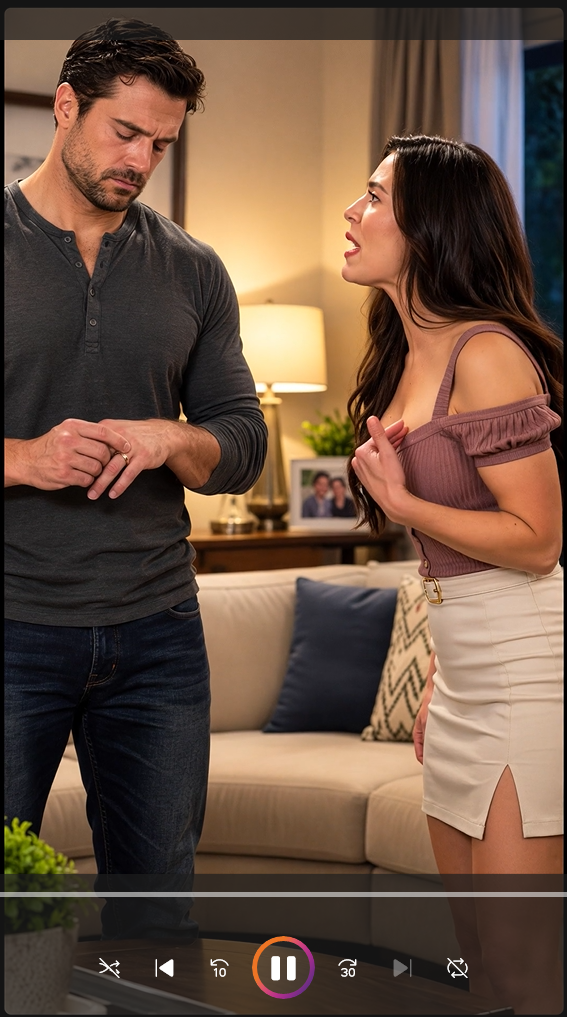
That tiny metallic sound reminded me of the night his ring struck the coffee table.
Back then, the sound had seemed like an ending.
Now I understood it differently.
It had been a boundary.
Not one meant to frighten me.
A boundary around his own emotional survival.
I had been right when I screamed that my body belonged to me.
Nathan had been right when he said he was allowed to decide whether he wanted to remain in the marriage.
Both truths could exist simultaneously.
Love did not erase autonomy.
Autonomy did not erase commitment.
Marriage wasn’t ownership.
It was participation.
And participation required two people.
As we reached the pedestrian bridge, Nathan stopped.
“What?”
“I forgot something.”
“What?”
“Today.”
I frowned.
“What about today?”
He pulled out his phone.
“It’s the lien date.”
I stared.
“You remembered?”
“Your grandmother’s ten-year clause.”
I laughed.
“Oh my goodness.”
He opened the calendar.
Exactly ten years earlier, we had closed on our house.
Which meant Grandma’s private lien had officially expired.
“I guess the house is completely ours now,” I said.
Nathan smiled.
“Should we celebrate?”
“How?”
“Paint the kitchen.”
I stared at him.
“That is not a celebration.”
“You’ve complained about that color for nine years.”
“It looks like mustard having an identity crisis.”
“Then we’ll repaint.”
“We?”
“Yes.”
“You hate painting.”
“I hate the kitchen more.”
I laughed.
“Fine.”
That weekend, we bought paint.
Soft cream.
Nothing dramatic.
We moved furniture.
Covered the counters.
Argued mildly about painter’s tape.
Then spent Saturday transforming the room where so many important things had happened.
The kitchen where we had danced as newlyweds.
The kitchen where we had barely spoken.
The kitchen where I’d discovered the attorney’s message.
The kitchen where we’d learned about the hidden account.
The kitchen where Nathan confessed he had met Thomas.
The kitchen where we’d begun learning how to speak again.
At sunset, we stood covered in paint flecks, admiring the finished walls.
Nathan put an arm around my waist.
I leaned against him.
Then my eyes moved toward the counter.
The same counter where his phone had lit up that Saturday morning.
I smiled.
“What?”
“I was thinking about Daniel’s message.”
Nathan groaned.
“Romantic.”
“Everything you requested is ready.”
“Please stop.”
“We can review the documents Monday.”
“Claire.”
I laughed.
“You scared me half to death.”
“I scared myself.”
I turned toward him.
“Did you think you’d really leave?”
Nathan considered the question seriously.
“Yes.”
The answer no longer frightened me.
“Do you think you would have?”
“Yes.”
I nodded.
“I’m glad you didn’t.”
“So am I.”
Then he surprised me.
“But I’m also glad I knew I could.”
I looked at him.
He searched my face.
“That sounds worse than I mean it.”
“No.”
I understood.
Staying meant more when staying wasn’t imprisonment.
“I knew I could leave too,” I said.
Nathan nodded.
“And?”
“And I stayed.”
He smiled.
“So did I.”
We kissed.
Not as proof.
Not because either of us owed the other affection.
Because in that particular moment, we both wanted to.
Months later, on our ninth wedding anniversary, Nathan gave me a small box.
I narrowed my eyes.
“We agreed no expensive gifts.”
“It’s not expensive.”
Inside was a key.
I frowned.
“What is this?”
“The attic.”
“We don’t have an attic key.”
“Exactly.”
“What?”
Nathan laughed.
“I installed a lock.”
“Why?”
“You’ll see.”
He led me upstairs.
Behind the door was a small finished room.
A desk.
Bookshelves.
A reading chair beside the window.
I stared.
“What is this?”
“Your room.”
“My room?”
“You always say you need somewhere quiet.”
My throat tightened.
“So I thought you should have somewhere you can close the door.”
I walked inside.
On the desk was a small wooden plaque.
CLOSED DOESN’T MEAN GONE.
I turned.
Nathan looked suddenly nervous.
“Too much?”
I shook my head.
“No.”
Then I laughed.
“Possibly a little.”
“Fair.”
I ran my fingers across the desk.
A year earlier, closed doors had terrified him.
Now he’d built me one.
Not because he wanted distance.
Because he’d finally learned that space and abandonment were not the same thing.
I looked at him.
“Thank you.”
“You’re welcome.”
“And you know I’m going to lock you out when you’re annoying?”
“I assumed.”
“You’re comfortable with that?”
“I have a garage.”
“True.”
He started to leave.
“Nathan?”
He turned.
“I love you.”
His expression softened.
“I love you too.”
That night, I found myself thinking about the woman I’d been when all this began.
Angry.
Exhausted.
Defensive.
Certain that Nathan’s needs were accusations.
Certain my boundaries should end every conversation instead of helping define how the conversation could continue.
I also thought about Nathan.
The husband who believed patience meant enduring indefinitely.
Who confused persistence with communication.
Who stayed silent about his deepest loneliness because he thought admitting it might make him selfish.
Neither of us had been monsters.
Neither had been entirely innocent.
We were simply two people who loved each other and had become frighteningly bad at letting the other person see what that love looked like.
That was the lesson I carried forward.
Not that a wife must provide affection to keep a husband.
Not that a husband should threaten to leave when he hears no.
Those would have been simple lessons.
Our truth was more complicated.
No one was entitled to my body.
But Nathan was entitled to decide what kind of relationship he could remain in.
I was entitled to space.
He was entitled to emotional connection.
Neither of us was entitled to have our needs automatically met.
But both of us were responsible for speaking honestly about what those needs were.
And when needs conflict, love doesn’t always solve the conflict.
Sometimes love means staying.
Sometimes it means leaving.
Sometimes it means admitting that both people have changed and asking whether they still want to choose each other.
We did.
Not forever in one heroic promise.
Today.
Then tomorrow.
Then the day after that.
Some mornings the choice was easy.
Other mornings it required effort.
But it remained a choice.
One evening years later, I found the old letter Nathan had written before he contacted Daniel.
I don’t know how to tell you that I am disappearing inside our marriage without making you feel responsible for saving me.
I read all four pages.
Then carried them downstairs.
Nathan was washing dishes.
“I found this.”
He dried his hands.
“Oh.”
“Do you still feel like you’re disappearing?”
He looked surprised.
“No.”
“Ever?”
“Sometimes I feel ignored when you’re reading.”
“That is because you interrupt during good chapters.”
“Cruel.”
I smiled.
Then I became serious.
“Tell me if it ever starts happening again.”
“I will.”
“Promise?”
He shook his head.
“No.”
I blinked.
“No?”
He walked toward me.
“We agreed not to make impossible promises.”
I smiled.
“Right.”
“So I’ll tell you today.”
“And tomorrow?”
“If tomorrow comes, I’ll choose again.”
I rested my forehead against his.
Outside, rain tapped softly against the windows.
The kitchen walls were still cream.
The chipped blue mug still sat in the cabinet.
Our wedding rings remained on our hands.
Not because they imprisoned us there.
Because that day, once again, we had chosen to wear them.
And perhaps that was what marriage had always been.
Not possession.
Not certainty.
Not one person surrendering themselves so the other would stay.
Just two imperfect people learning that love survives best when neither is taken for granted.
The ring Nathan removed that Thursday night had terrified me.
For a long time, I thought that moment nearly destroyed our marriage.
Eventually, I understood the truth.
Our marriage had been disappearing quietly long before the ring ever came off.
The sound of metal against the coffee table wasn’t the sound of our ending.
It was the first thing loud enough to make both of us finally listen.
**–THE END– PLEASE
Share your thoughts or feedback to motivate us to create more stories ♥️
✓ Lynn R. Adams
## Part 6 – The House We Thought We Owned I stared at Nathan. “What do you mean the house doesn’t belong entirely to us?” He held up one hand. “Daniel said not to panic.” “That sentence has never…