The End – The Wedding Feast That Revealed the Widow Everyone Had Misjudged _064
## **Part 6 – The Kitchen Anna Built and the Life No One Could Claim Credit For**
Anna Bell Caldwell lived a long life.
Not an easy one.
Long.
Full.
That mattered more.
Bell’s Kitchen lasted.
Not because Anna became a famous celebrity cook.
There were no celebrity cooks in Sweetwater Bend.
It lasted because the bread was good.
The accounts were careful.
Employees were paid.
Customers returned.
And Anna understood something many business owners did not:
People who make useful things are not automatically obligated to sacrifice themselves for everyone else.
She had learned that the hard way.
Sadi became equal partner at forty.
Anna insisted on legal documents.
Sadi groaned.
“You don’t trust me?”
“I trust you enough to put it in writing.”
Good.
The ranch kitchen remained part of the business.
Caldwell Ranch paid invoices.
Even after Henry joked they had been married long enough to merge accounts.
Anna replied:
“Romance has limits.”
He loved her for it.
Their children grew.
Thomas became a lawyer in Cheyenne.
Not grand politician.
Just a careful lawyer who specialized in land, probate, and small business agreements.
He credited his mother.
Of course.
Mary trained with a veterinarian in Denver and returned west to work with ranch animals.
Not as Caldwell Ranch heiress.
As professional.
She charged her father.
Anna laughed for a week.
Henry did not.
Then admitted:
“Apparently this family invoices me for love.”
Mary answered:
“No. For work.”
Exactly.
Henry gradually sold a minority share of ranch operations to two longtime foremen, **Luis Ortega** and **Matthew Crane**, who had worked there for decades.
Employee ownership.
Practical succession.
Mary consulted.
Thomas handled contracts.
No child trapped.
Vivian remained part of Anna’s life in a distant way.
Letters.
Occasional visits.
Hospital fundraiser cakes.
When Vivian’s second husband died after twenty years, she wrote Anna:
**I finally understand that a quiet marriage can be the most alive thing in a house.**
Anna replied:
**Quiet is only good if people are still speaking.**
Vivian wrote back:
**Fair.**
They never became sisters.
No need.
Respect was enough.
In later years, Vivian visited Sweetwater Bend and finally ate in Bell’s Kitchen as an ordinary customer.
She saw the blue-flowered staff aprons.
Her face changed.
“That pattern.”
Anna nodded.
“My mother’s.”
Vivian looked down.
“I once called it hideous.”
“Yes.”
“I was an idiot.”
“Yes.”
Vivian laughed.
Good.
No elaborate forgiveness.
History acknowledged.
Then lunch.
Henry aged.
His hair silvered.
Shoulders narrowed.
The wealthy rancher who once seemed untouchable developed arthritis in both hands.
Anna mocked him gently.
He complained more dramatically than childbirth, according to her.
He denied that.
Marriage remained.
At sixty-eight, Henry suffered a mild stroke.
Recovered.
But ranch work ended for him.
He struggled.
One evening he said:
“I don’t know who I am if I’m not running the ranch.”
Anna looked at him.
Interesting.
The question mirrored her younger life.
Who was she if not cooking for survival?
Who was he if not useful?
She asked:
“Who were you before ranch work?”
“A boy.”
“Unhelpful.”
He smiled.
Then thought.
He liked woodworking.
Reading agricultural journals.
Teaching young ranch hands.
So he did more of those.
Identity widened.
Anna’s knees worsened around the same time.
She reduced kitchen shifts.
Hated it.
Sadi told her:
“You are not required for breakfast to exist.”
Anna glared.
Sadi smiled.
“Learn what you taught everyone else.”
Cruel.
Correct.
Anna retired from daily cooking at seventy.
Not from the business entirely.
She reviewed books once a month.
Then quarterly.
Eventually not at all.
Bell’s Kitchen continued without her.
That was success.
The first year she no longer worked Christmas baking, Anna felt useless.
Henry found her in the pantry pretending to reorganize jars.
“You’re hovering.”
“I live here.”
“You are alphabetizing beans.”
“I like order.”
He took her hand.
“Come sit.”
She looked toward shelves.
Then went.
Growth.
They spent more time together.
Not constantly.
Henry still visited ranch offices.
Anna joined a reading circle.
They traveled once to Denver.
Hated the noise.
Returned early.
Good.
At seventy-five, Anna finally opened the cedar box containing her original apron.
The fabric had faded further.
Blue flowers almost gray.
She held it to her chest.
Henry watched.
“Want to wear it?”
“No.”
“Why?”
Anna smiled.
“I don’t need armor in my own kitchen anymore.”
That sentence surprised her.
The apron had carried her through grief.
Work.
Humiliation.
Independence.
But her mother’s note had been right.
Cloth should serve the living.
Anna donated the original apron to Bell’s Kitchen’s small office archive, not public display.
Staff could see it if interested.
No shrine in dining room.
Customers came for food, not tragedy.
Good.
Then Henry became ill more seriously.
Heart.
Age.
Nothing sudden.
They had time.
Months.
He organized ranch papers.
Thomas helped.
Mary managed medical care without becoming controlling.
Anna sat with him.
One evening he said:
“I’ve been thinking about the wedding.”
“Which one?”
He smiled weakly.
“First.”
“Oh.”
“Do you ever think I stood because I was already in love with you?”
Anna looked toward him.
“No.”
He laughed.
“Correct.”
“You barely knew me.”
“Yes.”
“What were you?”
“Angry.”
“At Vivian?”
“At myself.”
She frowned.
Henry continued:
“I had watched the way she treated you all week.”
“And did nothing.”
“Not enough.”
Yes.
“I kept telling myself the kitchen wasn’t my business.”
“It was your house.”
“Yes.”
“I thought keeping peace was kindness.”
Anna understood that better than he knew.
Then:
“When she humiliated you in front of everyone, I realized my silence had become participation.”
Anna squeezed his hand.
“That’s why you stood.”
“Yes.”
“Not romance.”
“No.”
Good.
No rewritten history.
Then Henry smiled.
“Romance came later.”
“Much later.”
“Cruel woman.”
“Accurate.”
He died at seventy-seven.
At home.
Anna beside him.
His last clear words came the day before.
“Nothing simple.”
She knew.
“When done properly.”
He smiled.
His father’s sentence.
Their sentence.
Then he slept.
After his death, Anna did not return full-time to Bell’s Kitchen.
Important.
Grief did not reverse retirement.
She visited.
Ate lunch.
Complained about pie crust occasionally.
Sadi ignored her.
Their friendship lasted into old age.
When Sadi died at seventy-nine, her daughter **Ruth Sadi Morgan** inherited Sadi’s business share under a purchase arrangement.
Anna’s own share gradually transferred into an employee trust.
Not entirely gift.
Part purchase.
Part estate planning.
By eighty, Anna owned only a small minority interest.
Enough income.
No control.
She liked that.
Bell’s Kitchen belonged increasingly to the people working there.
At eighty-two, Vivian died in Denver.
Her niece sent Anna a box.
Inside was one item Vivian had kept for decades.
A copy of the first wedding menu.
Vivian had written on the back:
**Anna made every dish. I spent too many years believing admitting another woman’s excellence would make me smaller. It did not. Refusing to admit it did.**
Anna cried.
Then she placed the menu with the business archive.
Not because Vivian needed sainthood.
Because growth deserved accurate record too.
Anna’s children wanted her to move to Cheyenne or the ranch house.
She refused.
She stayed in Sweetwater Bend.
Small cottage near Bell’s Kitchen.
Her choice.
Mary visited often.
Thomas less often but wrote every week.
Grandchildren filled holidays.
One granddaughter, **Eliza**, loved baking.
Everyone assumed she would inherit Bell’s Kitchen.
Anna stopped that immediately.
“Do you want it?”
Eliza shrugged.
“I like baking.”
“That wasn’t my question.”
Eliza thought.
“I want to study medicine.”
“Then study medicine.”
“Who will run the kitchen?”
“Someone who wants to.”
Good.
No inheritance as obligation.
At eighty-five, Anna attended Bell’s Kitchen’s fiftieth anniversary.
The dining room had expanded.
Still modest.
Six original tables remained along one wall.
The blue-flowered apron pattern had changed slightly over generations.
A younger cook named **Mara Jensen** asked Anna to say something.
Anna refused.
Then was persuaded.
She stood slowly.
No grand speech.
She looked around.
“I started with six tables because that was what fit.”
Laughter.
“I cooked because I needed money.”
Silence softened.
“People like to tell stories afterward and make necessity sound noble.”
She smiled.
“It was necessity.”
Then:
“But work gave me choices.”
She looked toward the kitchen.
“And choices gave me dignity people could not take as easily.”
Someone asked:
“Was Mr. Caldwell the one who changed your life?”
Anna thought.
“Yes.”
Then:
“So was Sadi.”
She looked toward old photographs.
“Rebecca Hale.”
“Thomas.”
“Samuel Bell.”
“Martha.”
“Vivian, eventually.”
People smiled.
“And my mother most of all.”
Then Anna corrected herself.
“No.”
She paused.
“My mother gave me tools.”
She looked around the room.
“I changed my life.”
That was the truth.
No false modesty.
No dependency.
Anna died at eighty-seven.
Peacefully.
In her cottage.
Mary beside her.
Thomas arrived hours earlier.
Eliza too.
No secret inheritance surfaced.
No final villain confessed.
No hidden fortune.
Anna’s estate was clear.
Cottage to be sold, proceeds divided between children.
Remaining Bell’s Kitchen shares transferred to employee trust.
Personal savings divided among family and a small scholarship for culinary apprentices.
Mother’s apron to remain with business archive, but never required for display.
One sentence in the will:
**Do not turn my work clothes into a saint’s relic. Feed people instead.**
Thomas laughed through tears.
Exactly Anna.
Her memorial was held at Bell’s Kitchen after hours.
Not the Caldwell dining hall.
Not the church where she married.
Her place.
The tables filled with food cooked from recipes that had changed over decades.
Not preserved exactly.
Anna believed recipes should improve.
Sadi’s daughter spoke.
Mary spoke.
Thomas spoke.
Then, surprisingly, Vivian’s niece read the note from the old wedding menu.
No one pretended Vivian’s cruelty had not happened.
No one made it the whole story either.
Mary ended with something Henry once told her:
“Your mother was never remarkable because someone rich defended her.”
Anna would have liked that.
“She was remarkable because when someone finally gave her room, she built something larger than the room.”
The kitchen was silent.
Then people ate.
Good.
That was how Anna would have wanted it.
Years later, the story of the Caldwell wedding became local legend.
As legends do, it changed.
Some versions claimed Henry stopped the ceremony itself.
False.
Some claimed Vivian was banished immediately.
False.
Some claimed Anna became Henry’s bride the next morning.
Ridiculous.
Some claimed the cake was six tiers.
It was three.
The archive kept the facts.
Anna Bell cooked a wedding feast.
Vivian Ashford publicly belittled her and falsely implied credit.
Henry Caldwell corrected the record.
Later Henry and Vivian separated because their marriage had been built on incompatible expectations.
Anna left Caldwell Ranch before any courtship began.
She established Bell’s Kitchen independently.
Years later, after Henry was legally free and both had built separate lives, they chose each other.
The truth was slower.
Better.
Because Anna’s story was never about a wealthy man rescuing a poor widow from humiliation.
Henry’s defense mattered.
But it was not enough to build her life.
Forty dollars mattered.
The bank refund mattered.
Samuel’s letter mattered.
Red Creek mattered.
Her mother’s apron mattered.
Sadi mattered.
The courage to leave Caldwell Ranch when her feelings became dangerous mattered.
The willingness to build six tables in a repaired kitchen mattered.
The ability to say yes to Henry only after she could safely say no mattered most of all.
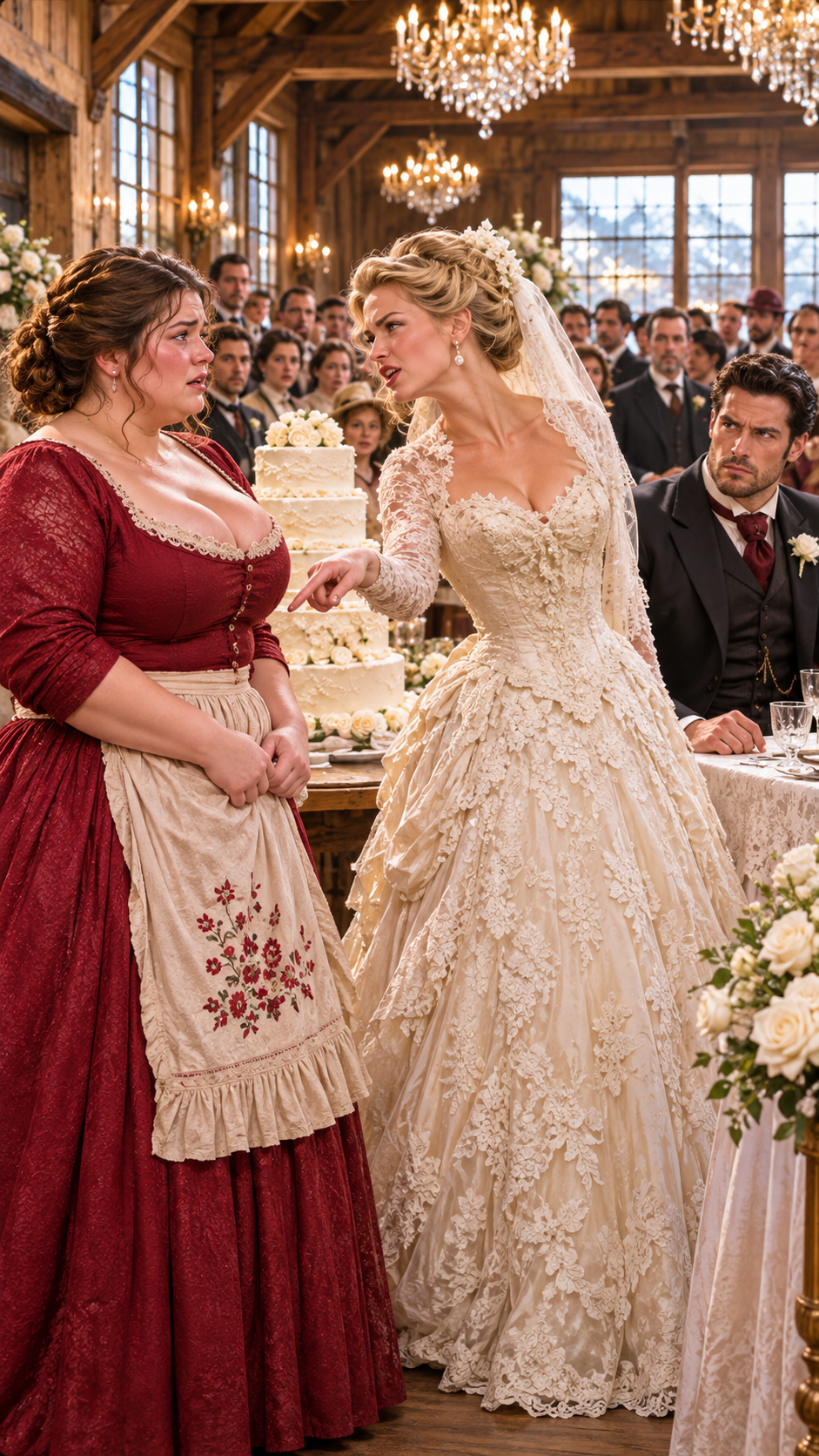
Anna had once stood in a servant’s kitchen wearing the only thing she had left of her mother while a wealthy bride laughed at her before two hundred guests.
Decades later, people still remembered Henry standing.
But the people who knew Anna best remembered what happened after everyone sat back down.
She kept working.
She got paid.
She learned the truth about her debts.
She built her own business.
She chose love without surrendering independence.
She taught employees that work deserved wages.
She taught children that inheritance should create options, not obligations.
And she taught everyone around her one quiet lesson that no wedding speech could have carried by itself:
Dignity is not something another person grants when they finally decide to defend you.
Sometimes dignity begins when you realize it was yours before anyone in the room knew your name.
**–THE END– PLEASE
Share your thoughts or feedback to motivate us to create more stories ♥️
✓ Lynn R. Adams
## **Part 6 – The Kitchen Anna Built and the Life No One Could Claim Credit For** Anna Bell Caldwell lived a long life. Not an easy one. Long. Full. That mattered more. Bell’s Kitchen lasted. N…