The End – The Secret Caleb Mercer Carried Into His Marriage in the Snow _065
Part 6 – The Name He Chose to Keep
Judge Warren lived above the general store in Pine Crossing.
He was seventy-three, nearly deaf in his left ear, and suspicious of any document written in ink he described as “too blue to be respectable.”
He examined Thomas Whitmore’s papers for three hours.
Eleanor waited beside Caleb.
Jonathan joined them shortly after noon.
Finally the judge removed his spectacles.
“Well.”
Eleanor leaned forward.
“Well?”
“You own almost nothing.”
She blinked.
Caleb coughed to disguise a laugh.
Judge Warren pointed at her.
“That is good news.”
“I’m delighted.”
“The corrective deeds are valid in intent but most were never recorded. Fortunately, possession and tax records support the current occupants.”
“So the families keep their homes?”
“Yes.”
Relief swept through her.
“What do we need to do?”
“Sign confirmatory deeds. File them. Pay a modest recording fee.”
“That’s all?”
“That’s enough paperwork to ruin a pleasant afternoon.”
Eleanor smiled.
“And Caleb’s parcel?”
Judge Warren picked up the northern basin deed.
“Valid once recorded.”
Caleb shook his head.
“I don’t need it.”
The judge squinted.
“Need has very little to do with land.”
Caleb looked at Eleanor.
She understood the question.
“What do you want it to become?”
He thought for a long moment.
“My mother’s cabin is there.”
“Yes.”
“Or what’s left of it.”
Jonathan spoke quietly.
“You could rebuild.”
Caleb’s expression remained uncertain.
“Not as a house.”
Eleanor waited.
Then he looked at her.
“School.”
“A school?”
“Children from the north homesteads travel nearly seven miles.”
Judge Warren grunted.
“Closer to eight.”
Caleb nodded.
“Then a school.”
Eleanor smiled.
“That sounds right.”
The judge gathered the papers.
“Good. Now stop creating mysteries and sign things.”
Over the following week, Eleanor and Caleb visited every affected family.
They did not announce grand gifts.
They simply explained that old records had been confused and that the titles would be corrected.
Some people cried.
Some laughed.
One elderly farmer insisted he had always known his deed was perfectly sound and then spent twenty minutes searching for spectacles already resting on his forehead.
Caleb became increasingly uncomfortable whenever anyone thanked Eleanor.
On the fifth such occasion, she elbowed him.
“What?”
“You’re frowning.”
“I’m not.”
“You look as though gratitude causes indigestion.”
“It does.”
“Then we’re well matched.”
Word spread.
So did another story.
Caleb Mercer had married a woman from Baltimore.
She had discovered she might technically own half the ridge.
Instead of demanding land, she was giving everyone proper titles.
By the time the story reached the far end of the valley, Eleanor had apparently inherited three mountains, a railroad and a gold mine.
“People exaggerate,” Caleb said.
“You’re telling me?”
“I have never crushed a man with one hand.”
“Only because they run away first.”
His eyes narrowed.
She smiled sweetly.
Marriage, Eleanor discovered, improved considerably once teasing became possible.
Still, one mystery remained.
Mercer.
They searched Thomas Whitmore’s documents.
Nothing.
Jonathan checked Samuel’s papers.
Nothing.
Finally, Eleanor remembered her father’s letter.
Tell Caleb why Margaret chose the name Mercer.
Not discover.
Tell.
That suggested Thomas had written the explanation somewhere.
They returned to the northern cabin.
Snow had begun melting from the roof.
Inside, sunlight entered through gaps in the boards.
Eleanor stood where Margaret’s table had once been.
“If I were hiding something from a child…”
Caleb raised an eyebrow.
“What?”
“I wouldn’t hide it where the child might accidentally find it.”
“So not under the floor.”
“No.”
She looked upward.
“The loft.”
The old sleeping loft had partially collapsed.
Caleb climbed carefully.
Near one roof beam he found a narrow wooden compartment.
Inside was a small book.
A Bible.
On the first page:
Daniel Mercer, 1862.
Caleb sat back.
“Daniel Mercer.”
Eleanor climbed high enough to see.
Another inscription lay beneath it.
To Margaret, from your grandfather Daniel.
Caleb looked at her.
“Her grandfather.”
“Mercer was a family name.”
They searched the Bible.
Near the back, Thomas had inserted a letter.
Caleb,
If you have learned enough to wonder about your surname, you deserve the simple answer.
Margaret chose Mercer because it belonged to the grandfather who raised us after our parents died.
Daniel Mercer was not wealthy.
He owned no important property.
He repaired wagons, sang badly, and believed every child should know how to swim whether the child wished to or not.
He gave Margaret the happiest years of her childhood.
When she began again in the West, she chose his name for you because she wanted your life to begin with something given in love rather than hidden in shame.
That is all.
Do with the name what you wish.
Thomas
Caleb sat motionless.
Eleanor expected disappointment.
Instead, he smiled.
Not broadly.
Not dramatically.
Just enough.
“Daniel Mercer.”
“Your great-grandfather.”
“Repaired wagons.”
“And sang badly.”
“I can do that.”
“You certainly can.”
He looked offended.
“You’ve never heard me sing.”
“I heard you yesterday.”
“That was humming.”
“It was distressing.”
Caleb laughed.
The sound filled the ruined cabin.
He looked around.
At the broken walls.
The loft.
The place where his mother had tried to build a life beyond the reach of old mistakes.
“I think I’ll keep it.”
“The name?”
“Yes.”
Eleanor sat beside him.
“I hoped you would.”
Caleb glanced at her.
“Why?”
“Because it sounds like you.”
He looked down at the letter.
“For most of my life, I thought a name told you where a man came from.”
“And now?”
“Maybe it tells you what he decides to carry forward.”
Eleanor leaned her shoulder lightly against his.
Caleb did not move away.
Spring came slowly to the mountain.
Snow retreated into the shadows beneath pine trees.
Streams filled.
Wildflowers appeared along slopes that had seemed permanently white.
The cabin changed too.
Eleanor hung curtains.
Caleb built shelves.
She organized his accounts and discovered the sawmill had been losing money because Caleb charged widows and struggling farmers less than cost and never recorded the difference.
“You are an appalling businessman.”
“They needed lumber.”
“You still have to write it down.”
“Why?”
“So we know how appalling you are.”
He gave her the ledger.
“You do it.”
She did.
Jonathan remained in their lives.
At first through letters.
Then visits.
His daughters arrived in June.
Nine-year-old Beatrice stared at Caleb for approximately thirty seconds before asking if he could truly lift a barrel.
Caleb made the mistake of saying yes.
For the next week, he was required to demonstrate strength on command.
Six-year-old Lucy discovered his beard was useful for persuasion.
She would grasp it gently and announce her demands.
“Uncle Caleb, swing.”
“Uncle Caleb, story.”
“Uncle Caleb, another biscuit.”
He surrendered every time.
Eleanor showed no mercy.
“The feared man of the mountain.”
Caleb sat at the kitchen table while Lucy braided a ribbon into his beard.
“Say one more word.”
“What will you do?”
He considered.
“Nothing.”
“Exactly.”
At the northern basin, construction began on a small schoolhouse.
Caleb insisted Margaret’s remaining cabin wall be incorporated into one side.
Above the door, a wooden sign read:
MERCER SCHOOL.
Not for Caleb.
For Daniel.
For Margaret.
For a name chosen because it represented kindness without debt.
Eleanor began teaching three mornings a week until a permanent teacher could be found.
She loved it more than expected.
By autumn, she and Caleb had settled into something neither had anticipated.
Not dramatic romance.
Something sturdier.
Morning coffee.
Shared jokes.
Arguments over blankets.
The way Caleb always warmed her boots near the stove before snowy walks.
The way Eleanor left a lamp burning when he worked late.
His nightmares did not disappear.
But they became less frequent.
The first time Caleb woke confused, Eleanor spoke until he knew where he was.
The first time she woke from a dream about Baltimore—about unpaid bills, empty rooms, and the terrible sensation of having nowhere left to go—Caleb did the same for her.
“You’re here,” he told her.
She understood then why those two words mattered.
Not trapped here.
Not indebted here.
Simply here.
By choice.
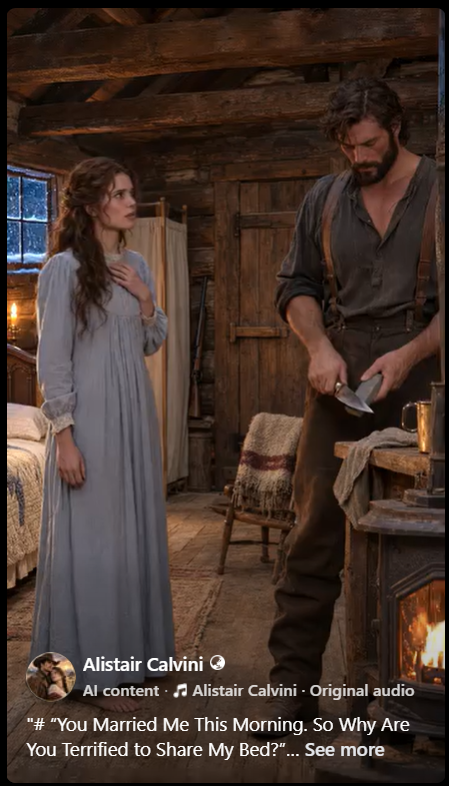
On the anniversary of their wedding, the first heavy snow arrived.
Caleb entered the cabin carrying firewood.
He stopped.
Eleanor stood behind the canvas screen.
“Eleanor?”
“Yes?”
“Why are you laughing?”
“I’m remembering something.”
“What?”
She emerged wearing the same pale-blue nightgown.
Caleb froze.
A year had changed many things.
Apparently not that.
His ears turned red.
Eleanor folded her arms.
“Caleb Mercer.”
“Yes, ma’am.”
“You married me one year ago today.”
“I remember.”
“And on our wedding night, you sharpened a knife for twenty minutes because you were terrified to share my bed.”
“I was not terrified.”
“You inspected the chimney twice.”
“It needed inspection.”
“The hinges?”
“Preventive maintenance.”
“The rifle?”
“Responsible ownership.”
“The knife?”
He paused.
“Coincidence.”
Eleanor laughed.
Caleb set down the firewood.
Then he looked at her with a softness that still surprised her.
“I was scared.”
“I know.”
“Not of you.”
“I know that too.”
“I thought there were things inside me I had to keep away from everyone.”
Eleanor’s smile faded into tenderness.
“And now?”
“Now I think fear gets louder when you lock it in a room alone.”
She crossed the cabin.
“And secrets?”
“Same.”
“Regret?”
“Usually.”
“Turnips?”
“Those should remain isolated.”
She laughed.
He reached for her hands.
For a moment they simply stood there.
Outside, snow settled softly on the mountain.
Not a blizzard this time.
No howling wind.
No hidden letters waiting behind walls.
Their first year had not solved every question.
It had not healed every memory.
It had not transformed Caleb into a man who never woke afraid or Eleanor into a woman who never wondered whether security might disappear.
But that was not what love had done.
Love had given fear somewhere to speak.
It had given uncertainty a chair at the table instead of a locked room.
It had taught two people who had entered marriage expecting duty that companionship could be built from a thousand ordinary acts of trust.
Caleb touched his forehead to hers.
“I should tell you something.”
Eleanor pulled back.
“Oh, no.”
“What?”
“The last time you said that, we discovered seventeen disputed properties, two secret relatives, a hidden brother and a school.”
“This is smaller.”
“How much smaller?”
“Considerably.”
She narrowed her eyes.
“Go on.”
Caleb reached into his pocket.
He placed a folded paper in her hand.
Eleanor opened it.
A deed.
The cabin and forty acres.
Ownership:
Caleb Mercer and Eleanor Whitmore Mercer, jointly.
She looked up.
“Caleb.”
“I filed it this morning.”
“You didn’t have to do this.”
“I know.”
“That land was yours before we married.”
“I know.”
“And if anything happened—”
“I know.”
She stopped.
Caleb smiled.
“That’s why I did it.”
Her eyes filled.
“I didn’t marry you for land.”
“I know that too.”
“Then why?”
“Because this is your home.”
The words reached a place inside Eleanor that no deed could.
She had come west because she believed she had nowhere else to go.
She had entered a stranger’s cabin prepared to negotiate every inch of safety.
A year later, the same man was standing before her, giving her not protection, not charity, not permission—
but belonging.
Eleanor folded the deed carefully.
“I have something for you too.”
Caleb looked suspicious.
“No hidden relatives?”
“Probably not.”
“Property disputes?”
“None.”
“Goats?”
She stared.
“How did you know?”
His eyes widened.
Eleanor burst out laughing.
“There is no goat.”
“That wasn’t funny.”
“It was extremely funny.”
She crossed to the bookshelf.
From behind a row of ledgers she removed a narrow parcel.
Caleb opened it.
Inside was a framed copy of the old photograph.
Thomas Whitmore.
Margaret.
Young Caleb.
But Eleanor had placed another photograph beside it.
Taken that summer.
Caleb and Eleanor stood outside Mercer School.
Jonathan stood beside them.
Beatrice and Lucy were in front.
Judge Warren appeared accidentally in the background, scowling at the photographer.
Caleb studied both images.
The family that had been hidden.
And the family rebuilt from what remained.
On the back, Eleanor had written:
What came before us explains many things.
It does not choose what comes after.
Caleb read the words twice.
Then he wrapped his arms around her carefully.
Eleanor leaned against his chest.
“You know,” she said, “the townspeople still think you’re frightening.”
“They should.”
“Mrs. Bell says you carried three sacks of flour at once.”
“I did.”
“Mr. Daley says you stared down a black bear.”
“It was a small bear.”
“Lucy says you cried when she gave you that painted rock.”
Caleb became very still.
“That child cannot be trusted.”
Eleanor laughed into his shirt.
Later, the lamps were extinguished.
The stove dimmed.
They climbed into bed while snow covered the familiar trail outside.
Caleb lay beside her.
No careful gulf remained between them now.
Eleanor rested her head against his shoulder.
He took her hand.
Neither spoke for a while.
Then Caleb whispered, “Eleanor?”
“Yes?”
“Are you afraid?”
She thought about Baltimore.
The stagecoach west.
The whispers in Pine Crossing.
The enormous stranger waiting at the station.
The knife.
The storm.
The hidden key.
The letters.
Margaret.
Thomas.
Samuel.
Jonathan.
Everything that had seemed so alarming because she did not yet understand it.
“Yes,” she said.
Caleb turned toward her.
“Of what?”
“The usual things.”
“Such as?”
“Losing people.”
His thumb moved over her hand.
“Changing.”
Another pause.
“Wanting too much.”
Caleb nodded.
“Me too.”
Eleanor smiled in the darkness.
“But I’m not afraid of you.”
His answer took a moment.
“I know.”
Outside, snow continued falling.
Inside the cabin, nothing extraordinary happened.
No secret compartment opened.
No stranger knocked.
No forgotten document appeared.
And perhaps that was the finest surprise of all.
Caleb Mercer slept beside his wife.
Eleanor slept beside her husband.
Two people carrying imperfect histories.
Two people no longer mistaking fear for fate.
And between them, where distance had once been carefully measured, there remained no empty space at all.
**–THE END– PLEASE
Share your thoughts or feedback to motivate us to create more stories ♥️
✓ Lynn R. Adams
Part 6 – The Name He Chose to Keep Judge Warren lived above the general store in Pine Crossing. He was seventy-three, nearly deaf in his left ear, and suspicious of any document written in ink he de…