The End – The Ring She Left Behind and the Marriage We Almost Lost _065
Part 6 – The Promise We Chose Again
We drove to the hospital the next morning.
Six hours.
Lola sat in the back seat with headphones and a book.
Clara barely spoke.
Her relationship with her father had always existed as a collection of carefully avoided subjects.
Thomas had left when Clara was eleven.
He remarried.
Moved away.
Sent birthday cards.
Called occasionally.
Clara grew up believing there were only two facts that mattered.
Her father had left.
Her mother had stayed.
By adulthood, she had reduced the pain into something manageable.
“We’re not close.”
That sentence covered everything.
Halfway through the drive, she said, “What could he possibly have to tell me now?”
“I don’t know.”
“What if I don’t want to hear it?”
“Then don’t.”
She looked at me.
“You mean that?”
“Yes.”
“He’s sick.”
“That doesn’t create an obligation to hear something you’re not ready for.”
She stared out the window.
“You’ve changed.”
“So have you.”
“No, I mean that.”
I waited.
“You used to solve everything.”
“I’ve been informed that’s occasionally annoying.”
She smiled.
“Occasionally?”
“I’m improving.”
Thomas was sitting upright when we entered his hospital room.
He looked older than I remembered.
Smaller.
His illness turned out to be serious but not immediately life-threatening.
A cardiac episode.
Enough to frighten him.
Not enough to make the meeting feel like a final goodbye.
Clara stood near the door.
“Hi, Dad.”
Thomas looked at her for several seconds.
“Hi, sweetheart.”
Clara stiffened slightly at the word.
I squeezed her shoulder.
“I’ll take Lola for something to eat.”
Clara looked almost frightened.
“You don’t have to.”
“I know.”
She nodded.
Lola and I went downstairs.
We ate terrible vending-machine crackers.
Forty minutes passed.
Then an hour.
Finally, Clara appeared.
Her face was pale.
She sat beside me.
“What happened?”
She looked at Lola.
“Can Dad and I talk alone for a minute?”
Lola nodded.
We found a quiet hallway.
Clara leaned against the wall.
“My father didn’t leave us.”
I waited.
“What do you mean?”
“My mother asked him to go.”
I said nothing.
“He had an affair.”
I closed my eyes briefly.
Clara laughed once, bitterly.
“Of course.”
“I’m sorry.”
“He says it lasted three months. My mother found out. She told him to leave.”
“That sounds like leaving.”
“I know.”
She shook her head.
“That’s not the part.”
“What is?”
“He wanted to come back.”
I watched her.
“My mother wouldn’t let him.”
Clara wiped her eyes.
“She told him she’d rather raise me alone than let me grow up watching them hate each other.”
“That was her choice.”
“Yes.”
“But why keep it from you?”
“Because she didn’t want me to hate him for cheating.”
I frowned.
“So you hated him for leaving instead.”
“Yes.”
The irony was brutal.
Clara slid down against the wall until she was sitting on a bench.
“My mother spent thirty years protecting me from the truth and accidentally gave me another lie.”
I sat beside her.
“Did your father blame her?”
“No.”
That seemed important.
“He said he agreed to let me believe he chose to leave because he thought I deserved to trust at least one parent completely.”
Clara stared ahead.
“He thought being the villain was some kind of gift.”
I understood that kind of thinking.
Taking pain silently.
Controlling information.
Protecting someone by deciding what truth they could handle.
It was painfully familiar.
“What are you feeling?” I asked.
“Angry.”
“At him?”
“Yes.”
“At your mother?”
“Yes.”
“At yourself?”
She looked at me.
“Yes.”
“Why?”
“Because I built so much of my life around something I didn’t understand.”
She took a shaky breath.
“When I saw that Seattle email, do you know what I thought?”
“What?”
“Of course he’s leaving.”
The words chilled me.
“Elliot, I didn’t think it because of you. Not entirely.”
She began crying.
“I thought it because every man leaves.”
I put my arm around her.
“And then Logan came along.”
She nodded.
“I think part of me wanted to leave first.”
The entire year rearranged itself in my mind.
Not excused.
Understood.
There was a difference.
Clara hadn’t nearly gone out with Logan because her father had cheated thirty years earlier.
Human beings were not equations.
But old wounds shaped the stories we were quickest to believe.
My story had been different.
My father had never left.
He had worked.
Constantly.
He was proud of never missing a paycheck.
He had missed almost everything else.
And I had become him while telling myself I was becoming the opposite.
Perhaps most of adulthood was discovering which parts of our parents lived inside us unnoticed.
Clara leaned into me.
“I thought I was over all this.”
“Maybe you were over the version you knew.”
She looked at me.
“That sounds annoyingly like Dr. Patel.”
“I’ve been taking notes.”
She laughed through tears.
Thomas remained in the hospital for three days.
During that time, Clara spoke with him more than she had in the previous three years.
Not all at once.
Not dramatically.
She asked questions.
He answered them.
Sometimes the answers hurt.
Sometimes they disappointed her.
But they were real.
Then she called her mother.
That conversation was harder.
I wasn’t in the room.
When Clara returned, she looked exhausted.
“How’d it go?”
“She cried.”
“And?”
“I cried.”
“And?”
“She said she thought she was doing the right thing.”
“Do you believe her?”
“Yes.”
“Does that make it okay?”
“No.”
She sat beside me.
“But I’m starting to understand that people can love you and still make decisions that hurt you.”
I raised an eyebrow.
“That’s becoming a theme.”
“Apparently.”
When Thomas was discharged, we returned home.
Life resumed.
School.
Work.
Laundry.
Bills.
But something in Clara had shifted.
She began seeing an individual therapist in addition to our occasional check-ins with Dr. Patel.
I did too.
Not because our marriage was failing.
Because I had finally understood that marriage could not be the only place we examined ourselves.
Summer arrived.
Then the anniversary of the night Logan came to our door.
I remembered the date before Clara mentioned it.
Tuesday.
Exactly one year.
I came home at six.
The house was unusually quiet.
“Hello?”
“In here,” Clara called.
She was in the living room.
On the hallway table sat the ceramic dish.
Inside were our old wedding rings.
Beside it lay the cream blouse she’d worn that night.
Folded.
I stopped.
“What is this?”
“A question.”
I looked at her.
She wore jeans and a plain white shirt.
No dramatic curls.
No anniversary earrings.
Just Clara.
“What question?”
“Do you want to remember tonight?”
I frowned.
“I already do.”
“I mean intentionally.”
She sat.
“I almost threw that blouse away last month.”
“Why?”
“Because every time I saw it, I remembered who I was that night.”
“Who were you?”
“Confused. Angry. Desperate to be chosen.”
She touched the fabric.
“And ashamed.”
I sat beside her.
“I don’t want you to be ashamed forever.”
“I know.”
“I was angry that night too.”
“You had reason.”
“So did you.”
She looked at me.
“Not for Logan.”
“No.”
That mattered.
We had learned to hold two truths at once.
I had failed Clara emotionally.
Clara had crossed boundaries that threatened our marriage.
Neither truth erased the other.
She picked up the blouse.
“I kept thinking that if I threw this away, I’d be closing the chapter.”
“And?”
“I don’t want to close it.”
That surprised me.
“Why?”
“Because I learned more about us in the year after that night than I did in the five years before it.”
She looked toward the hallway table.
“That ring hitting the wood was the worst sound I’d ever heard.”
I remembered.
The metallic click.
Tiny.
Final.
“I thought you hated me.”
“I didn’t.”
“I thought you were letting me go.”
“I was.”
She stared at me.
I continued.
“I loved you enough to let your choice be real.”
Her eyes filled.
“I hated you for that for about thirty seconds.”
“Only thirty?”
“Maybe forty-five.”
I smiled.
She held out her hand.
The new ring gleamed.
“I think that’s why I came back inside.”
“Because I let you go?”
“Because you made me understand I could actually leave.”
I considered that.
She continued.
“Before that, Logan was an idea. Divorce was paperwork. Leaving was a fantasy where you suddenly realized how much I mattered.”
Her voice softened.
“But when you said the ring stayed, leaving became real.”
I reached for her hand.
“And you stayed.”
“Yes.”
“Do you regret it?”
She smiled through tears.
“No.”
The front door opened.
Lola walked in with Rachel.
“Are we doing the thing?”
Clara laughed.
“Yes.”
“What thing?” I asked.
Lola looked alarmed.
“You didn’t tell him?”
“Surprise.”
I groaned.
“My old enemy.”
Rachel handed me a small bag.
“Get dressed.”
“For what?”
“Dinner.”
I looked at Clara.
She smiled.
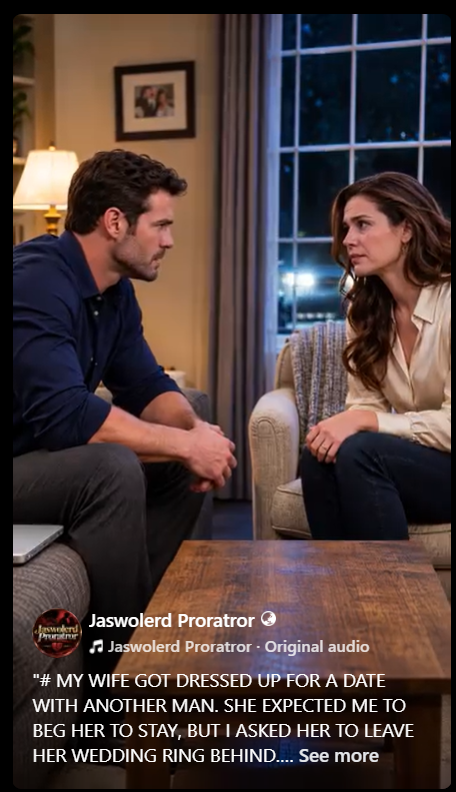
A year earlier, she had dressed for dinner with another man and waited for me to beg her to stay.
Now, apparently, my entire family was kidnapping me for a restaurant reservation.
I could live with that.
We went to a small Italian place downtown.
Lola told embarrassing stories about both of us.
Rachel ordered too much dessert.
No one discussed Logan.
No one discussed Diane.
No one discussed divorce.
Because healing did not require turning every good moment into a ceremony about surviving bad ones.
Eventually Rachel took Lola home with her.
Clara and I drove back alone.
When we entered the house, she walked toward the hallway table.
The ceramic dish still held our old rings.
“What should we do with these?” I asked.
She picked hers up.
“I’ve wondered.”
“Sell them?”
“No.”
“Hide them?”
“No.”
“Throw them into a volcano?”
She laughed.
“Very practical.”
“I watched documentaries.”
She turned the ring between her fingers.
“Maybe Lola should have them someday.”
I was surprised.
“Why?”
“Not as some romantic heirloom.”
She smiled.
“As a story.”
“What story?”
“That marriage isn’t a ring.”
I looked at the bands.
“No?”
“No.”
She held up hers.
“This didn’t keep me faithful to you emotionally.”
Then she touched the new ring on her hand.
“And this doesn’t guarantee anything either.”
“What does?”
“Nothing.”
I looked at her.
She continued.
“That’s what I finally understand. There isn’t a guarantee.”
The idea would have frightened me a year earlier.
Now it felt strangely peaceful.
“We choose,” she said.
“Every day?”
“That’s annoyingly sentimental.”
“Very.”
She smiled.
“But yes.”
We put the old rings back in the dish.
Then we went upstairs.
Years later, I would sometimes think about that Tuesday evening.
Not because it was the night my wife nearly went on a date with another man.
Because it was the night both of us discovered how many unspoken stories had accumulated inside our marriage.
Clara believed I was leaving.
I believed we were fine.
She believed jealousy would prove love.
I believed providing was the same thing as being present.
She believed her father’s departure explained something about men.
I believed my father’s constant work explained something about responsibility.
We were surrounded by assumptions.
About each other.
About ourselves.
About marriage.
And almost every dangerous moment began when we trusted those assumptions more than we trusted a conversation.
North Bridge eventually became Clara’s full-time business.
It never became enormous.
That wasn’t her goal.
She built a small team and found work she enjoyed.
I stayed with my company another three years before moving into consulting myself.
I never became the executive I once imagined.
Strangely, I never missed it.
Lola grew older.
At thirteen, she discovered the ceramic dish.
At fifteen, she asked what the rings meant.
Clara and I looked at each other.
Then we told her.
Not every detail.
Not Logan’s private messages.
Not the lawyer’s notes.
But enough.
We told her there had been a year when we almost lost each other.
She listened carefully.
Then she asked, “Who fixed it?”
I smiled.
“No one.”
She frowned.
Clara answered.
“We worked on it.”
“That’s not very romantic.”
“Most real things aren’t,” I said.
Lola rolled her eyes.
“Dad.”
“What?”
“You ruin everything.”
Some traditions survive.
On our twentieth anniversary, Clara and I returned to Vermont.
The lake looked almost exactly as it had in the photograph.
We stood in nearly the same place.
Older.
Gray beginning at my temples.
Lines around Clara’s eyes that I loved more than I expected.
A tourist offered to take our picture.
We stood together.
Clara leaned into me.
The camera clicked.
Afterward, she looked at the old honeymoon photo on her phone.
“We look different.”
“Devastatingly.”
She bumped my shoulder.
“Do you miss them?”
“Who?”
“The people we were.”
I thought about it.
“No.”
“Not at all?”
“I like them.”
I looked across the lake.
“But they thought love was something you found and then kept.”
Clara waited.
“What do we think?”
“That it’s something you keep finding.”
She smiled.
“That was almost good.”
“Almost?”
“Still needs editing.”
“You married a spreadsheet person.”
“Twice, apparently.”
I looked at her hand.
The ring caught the afternoon light.
“Would you?”
“Would I what?”
“Choose again?”
She didn’t answer immediately.
Years earlier, that pause might have terrified me.
Now I knew pauses were not rejection.
Sometimes people were simply thinking.
Finally she said, “Yes.”
Then she looked at me.
“Would you?”
“Yes.”
“Even knowing everything?”
“Especially knowing everything.”
She rested her head against my shoulder.
We stood there quietly.
No dramatic music.
No audience.
No perfect ending.
Just two people beside a lake.
Two people who had hurt each other.
Misunderstood each other.
Frightened each other.
Forgiven slowly.
Changed imperfectly.
Stayed intentionally.
Years earlier, when Clara had asked whether I would still be there if she opened the door, I hadn’t answered.
For a long time, I regretted that.
I thought perhaps I should have said yes.
Perhaps I should have reassured her.
Perhaps I should have fought differently.
Eventually I understood why I couldn’t answer.
Because the real question had never been whether I would still be there.
It was whether we would still be us.
And the answer turned out to be no.
We didn’t save the marriage we had.
That marriage had been built partly on silence, routine, fear, and assumptions.
We built another one.
Not from the beginning.
From the wreckage.
From uncomfortable conversations.
From apologies that didn’t demand immediate forgiveness.
From boundaries that made choices real.
From counseling rooms.
From ordinary dinners.
From saying, “I’m scared,” instead of, “Nothing’s wrong.”
From asking, “What did you mean?” instead of deciding we already knew.
From learning that staying wasn’t something one person could force and leaving wasn’t something one person could prevent.
Most of all, we learned that being chosen once was never the point.
Marriage asked us to keep choosing.
Not blindly.
Not desperately.
Not because a ring required it.
Because we knew the truth.
Because the door was always there.
And because, after everything, we kept choosing to come home.
Share your thoughts or feedback to motivate us to create more stories ♥️
**–THE END– PLEASE
✓ Lynn R. Adams
Part 6 – The Promise We Chose Again We drove to the hospital the next morning. Six hours. Lola sat in the back seat with headphones and a book. Clara barely spoke. Her relationship with her fathe…