The End – The Night Our Perfect Marriage Finally Told Everyone the Truth _065
## Part 6 – The Life Beyond the Sterling Name
Graham Pike resigned as Bennett’s attorney the following morning.
He cited a conflict of interest.
That phrase told Amelia almost everything she needed to know.
Within hours, the independent audit committee requested records from Graham’s former firm.
He retained his own counsel.
And, through that attorney, he offered an explanation.
Not a confession.
An explanation.
Years earlier, Charles Sterling had asked Graham to help restructure the obligations connected to Westbridge.
After Charles died, Graham continued administering parts of the arrangement.
Some transactions had been authorized.
Others had been improvised.
Then Bennett’s investment losses deepened.
The structure became increasingly unstable.
According to Graham, he believed he was carrying out Charles’s intention to protect Sterling Group until liabilities could be resolved.
“That’s an extraordinary interpretation of responsibility,” Amelia said.
We sat in her office reading the statement.
“Did he forge my signature?”
“He admits authorizing the use of a prior signature image.”
I stared at her.
“So yes.”
“Essentially, yes.”
“Did Bennett ask him to?”
“Graham says no.”
“Did Bennett know?”
“Graham says Bennett knew spousal acknowledgments were being handled but did not know the signature itself had been copied.”
I closed my eyes.
The answer wasn’t clean.
It rarely was.
Bennett was not innocent.
He had knowingly allowed financial documents to move forward in my name without confirming I had signed them.
But he may not have been the person who forged anything.
“What about Madison?”
“The Renshaw issue is separate.”
Of course it was.
One mystery solved.
Another waiting.
Madison’s attorney produced the original emails three days later.
The messages Bennett had shown me were real.
Madison had sent banking instructions for Renshaw.
But the context changed everything.
Months earlier, Bennett had told her Sterling Group intended to settle an old obligation owed to her father’s estate.
He asked her to obtain payment instructions from her mother.
Madison did.
She claimed she believed the payment was a one-time legal settlement.
Then recurring transfers began.
She processed them because they had already been approved through finance.
“Who approved them?” I asked Nathan.
“Graham’s office.”
I almost laughed from exhaustion.
“Again?”
“Again.”
“Did Graham owe Thomas money?”
“Not personally.”
“Then why keep paying?”
Nathan closed the file.
“Because Charles apparently left written instructions to resolve the dispute privately.”
“So Bennett thought he was honoring his father.”
“Yes.”
“Madison thought her father’s estate was receiving a settlement.”
“Yes.”
“Graham thought he was administering Charles’s wishes.”
“Possibly.”
“And no one thought to speak openly?”
Nathan smiled sadly.
“That appears to be the central theme.”
Secrets had multiplied not because everyone was conspiring together.
Because everyone was protecting a different version of the past.
Charles protected the company.
Eleanor protected the family.
Julian protected his freedom.
Bennett protected his reputation.
Madison protected a relationship she wanted to believe was real.
Graham protected a dead man’s instructions.
And I?
I had protected the appearance of a happy marriage.
The Sterling empire had not nearly collapsed because one villain sat in a dark room planning everything.
It had become fragile because too many intelligent people believed silence was safer than discomfort.
The audit lasted four months.
Sterling Group eventually issued a public statement acknowledging significant internal-control failures, undisclosed related-party transactions, and improperly executed spousal acknowledgments.
The company restated several financial disclosures.
No charitable donations had been diverted.
That mattered most to me.
The Sterling Foundation commissioned its own independent audit and adopted governance reforms that separated it more clearly from the family business.
Eleanor stepped down as honorary chair.
Bennett resigned as chief executive.
Not because the board concluded he had personally forged documents.
Because they concluded he had concealed material financial problems and tolerated internal practices that should never have been tolerated.
Julian declined an invitation to return.
He went back to Colorado.
Madison cooperated with the review and eventually left Atlanta.
Graham surrendered his role as outside counsel and faced professional disciplinary proceedings.
The rest belonged to lawyers and regulators.
For once, I allowed it to.
I had spent months believing I needed to know every answer before I could move forward.
I didn’t.
My divorce from Bennett was finalized eleven months after the anniversary party.
There were no cameras outside the courthouse.
No dramatic confrontation.
No cheering crowd.
Just paperwork.
Amelia sat beside me while I signed the final page.
“That’s it?” I asked.
“That’s it.”
I stared at my signature.
My real signature.
I had begun recognizing its shape differently.
Once, it was simply something I placed at the bottom of documents.
Now it felt like a declaration.
This is my name.
This is my consent.
This is my decision.
Outside the courthouse, rain covered Atlanta in a silver haze.
Amelia opened an umbrella.
“What are you going to do?”
“Today?”
“With your life.”
I laughed.
“That’s a slightly larger question.”
“You’ll figure it out.”
I looked toward the city.
For the first time in six years, I did not know exactly what came next.
And I liked that.
I kept working with the Sterling Foundation.
Some people expected me to leave.
I didn’t.
The foundation had never belonged only to Bennett.
It belonged to the families we served.
The nurses who worked overnight shifts.
The children who decorated hospital walls with drawings.
The donors who gave twenty dollars and the donors who gave twenty thousand.
We changed the name.
That was Eleanor’s suggestion.
No family name.
No legacy branding.
It became the Bright Harbor Children’s Fund.
At the first board meeting under the new name, I sat beside people who had once treated me mainly as Bennett Sterling’s wife.
Now they asked my opinion.
The first few times, I answered cautiously.
Then I stopped apologizing before speaking.
An odd habit emerged.
Whenever I laughed too loudly, I noticed it.
And then I laughed louder.
Eleanor and I rebuilt something.
Not the relationship we once had.
Something more honest.
We met for lunch every few weeks.
Sometimes we spoke about Bennett.
Usually we didn’t.
One afternoon she brought me Charles’s old crossword book.
“He would have wanted you to have it.”
I smiled.
“Why me?”
“You were the only person who ever beat him.”
“Once.”
“He complained about it for months.”
We laughed.
Then Eleanor’s expression softened.
“I should have given you that letter.”
“Yes.”
“I thought preserving the family meant preventing fracture.”
“And now?”
“Sometimes fracture is how pressure escapes.”
It sounded like something she’d learned painfully.
So had I.
I saw Madison once more.
Nearly two years after the anniversary.
She emailed first.
I almost deleted the message.
Instead, I agreed to coffee.
She had moved to North Carolina and was working for a small architecture firm.
No private jets.
No yachts.
No billionaire employer.
She looked peaceful.
“I got married,” she said.
I blinked.
“You did?”
“Last month.”
She showed me a photograph.
A small outdoor wedding.
Her husband had kind eyes.
“He knows everything?”
“Yes.”
“Everything?”
“Everything.”
I smiled.
“That must have been difficult.”
“It was.”
She stirred her coffee.
“But hiding things was harder.”
We sat quietly.
Then she said, “I’ve wanted to ask you something.”
“What?”
“Why didn’t you destroy me that night?”
I frowned.
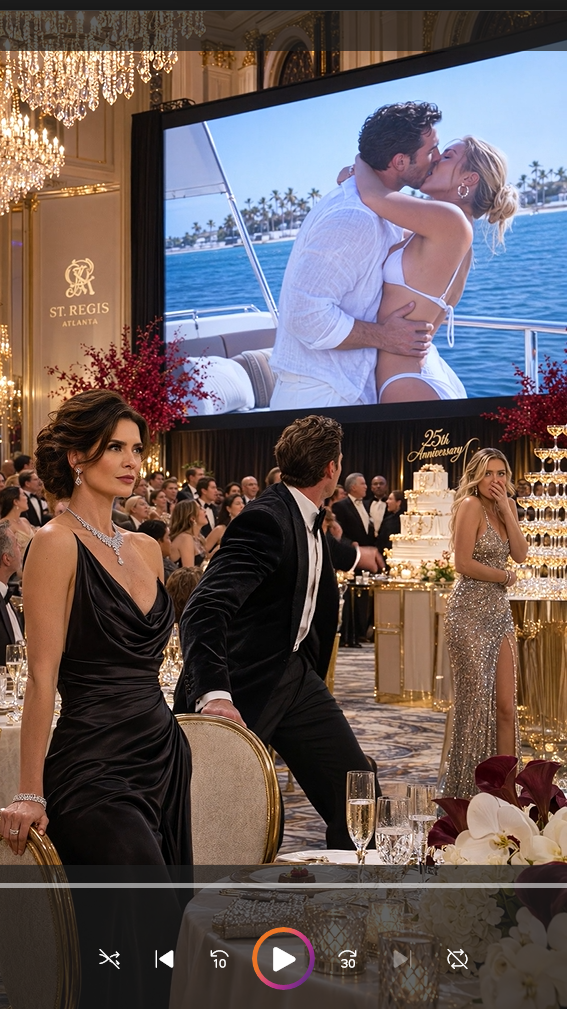
“I played a video of you kissing my husband in front of three hundred people.”
“Yes.”
“That’s not exactly mercy.”
“No.”
She smiled faintly.
“But afterward. You could have told everyone things you thought were true about me. You didn’t.”
I considered the question.
“Because I realized I didn’t actually know your story.”
Madison’s eyes filled.
“Neither did I.”
Before we left, she hugged me.
I wasn’t sure I wanted the hug.
Then I accepted it.
Forgiveness, I discovered, was not the declaration that something had been acceptable.
It was sometimes nothing more than releasing your obligation to keep carrying it.
Bennett and I did not become friends.
That would have been dishonest.
But we eventually became something less dramatic than enemies.
People who had once loved each other.
People who had hurt each other.
People who no longer needed to continue doing either.
Three years after our divorce, I received a letter from him.
Not an email.
A letter.
_Celeste,_
_I used to believe losing everything would be the worst thing that could happen to me._
_It wasn’t._
_The worst thing was realizing how much of my life I spent pretending nothing could be lost._
He wrote that he had started teaching occasional seminars at a business school.
Corporate governance.
I laughed aloud when I read that.
He anticipated the reaction.
_Yes, I understand the irony._
He said Julian had visited him.
They were trying.
Slowly.
He said Eleanor had stopped mediating between them.
Probably the healthiest thing she’d ever done.
Then came the line that stayed with me.
_I spent years asking whether people respected me when I should have been asking whether they could be honest with me._
At the bottom, he wrote:
_I hope you’re happy._
I folded the letter.
I didn’t answer.
Not because I was angry.
Because no answer was required.
On the fourth anniversary of the night everything changed, I attended a Bright Harbor fundraising dinner.
The event was smaller than Bennett’s spectacle had been.
One hundred guests.
No champagne towers.
No luxury slideshow.
No declarations about perfect marriages.
A pediatric surgeon spoke about a new family-support program.
A mother described what it meant to have housing near the hospital while her daughter underwent treatment.
At the end of the evening, someone asked me to say a few words.
Years earlier, microphones frightened me unless I knew exactly what Bennett expected me to say.
Now I walked onto the stage without notes.
The room quieted.
I looked around.
“Four years ago,” I began, “I learned something important about appearances.”
A few people who knew the history smiled.
“Beautiful rooms can contain painful truths. Complicated families can contain genuine love. People can fail us without being entirely monsters, and people can disappoint us without defining the rest of our lives.”
I paused.
“The most important thing I learned was simpler.”
The room waited.
“Your voice does not become valuable when everyone agrees with you.”
I thought of the woman I’d been.
Careful.
Quiet.
Always adjusting herself to fit someone else’s comfort.
“It was valuable before anyone listened.”
Afterward, applause rose gently through the ballroom.
Not explosive.
Not theatrical.
Warm.
Real.
I stepped down.
Outside, Atlanta glowed beneath a clear autumn sky.
I walked alone toward my car.
Not lonely.
Alone.
There is a difference.
My phone buzzed.
A message from Amelia.
**You were good tonight.**
I smiled.
**I know.**
Then I laughed.
Loud enough that a couple crossing the parking lot turned around.
For years, I would have lowered my voice.
Instead, I kept laughing.
That night, at home, I opened the drawer where I kept a few objects from my marriage.
A wedding photograph.
Charles’s letter.
My old anniversary invitation.
And the ring.
I hadn’t looked at it in nearly a year.
I held it beneath the lamp.
The diamond still caught the light beautifully.
Objects do not become ugly simply because their meaning changes.
Neither do memories.
There had been good mornings with Bennett.
There had been laughter.
There had been love.
There had also been deception, silence, and a slow shrinking of myself.
Both could be true.
That was perhaps the hardest lesson.
Life rarely divides itself into heroes and villains as neatly as stories do.
People carry fear into love.
Pride into marriage.
Grief into business.
Secrets into families.
And sometimes the bravest decision is not exposing another person’s worst moment.
It is refusing to disappear inside it.
I placed the ring back in the drawer.
Then I reconsidered.
I picked it up again.
The next morning, I took it to a jeweler.
Not to sell it.
To remake it.
Months later, the diamond returned in a small pendant.
No wedding band.
No promise from anyone else.
Just a piece of my past transformed into something I had chosen.
At the next Bright Harbor gala, I wore it.
Eleanor noticed.
Her fingers touched the pendant lightly.
“Is that—”
“Yes.”
She smiled.
“That suits you better.”
I looked around the room.
At the donors.
The doctors.
The families.
At a life I once thought would end when my marriage did.
Instead, it had widened.
Somewhere in Atlanta, Bennett was building whatever came next for him.
Somewhere in North Carolina, Madison was building a marriage founded, I hoped, on fewer secrets than ours had contained.
Julian was building a life that did not need the Sterling name to validate it.
Eleanor was learning that loving her sons did not require protecting them from consequences.
And I was learning something too.
There had never been one video that ruined everything.
That was simply the dramatic version people remembered.
The marriage had not ended because a screen lit up inside a ballroom.
It had ended gradually, through a thousand small silences.
And my new life had begun the same way.
Not with applause.
Not with revenge.
Not even with the truth appearing on an enormous screen.
It began in quieter moments.
The first time I said no without explaining.
The first document I read before signing.
The first room I entered alone.
The first opinion I refused to soften.
The first laugh I did not silence.
Those were the moments that gave me my life back.
And this time, every part of it carried my own signature.
**–THE END– PLEASE
Share your thoughts or feedback to motivate us to create more stories ♥️
✓ Lynn R. Adams
## Part 6 – The Life Beyond the Sterling Name Graham Pike resigned as Bennett’s attorney the following morning. He cited a conflict of interest. That phrase told Amelia almost everything she needed…