The End – The Night One Tent Broke a Marriage and Exposed Two Friendships _064
## **Part 6 – The Life They Built After Winning Stopped Mattering More Than Understanding**
Graham and I stayed married for fifty-one years.
That sentence would have shocked the woman I was on the morning after the camping trip.
She thought marriage could be broken in one night and repaired with one apology.
She was wrong about both.
A marriage can be injured quickly.
Repair is slower.
And sometimes repair never comes.
Ours did.
Not because I deserved another chance more than anyone else.
Not because Graham was obligated to forgive.
Not because nothing physical happened between Wyatt and me.
That phrase—_nothing happened_—became one of the first things I had to unlearn.
A great deal happened.
I humiliated my husband.
I deliberately replaced him in a shared space.
I chose another man as emotional ally against him.
I sent messages imagining I had married the wrong person.
I enjoyed attention that made my husband uncomfortable and called his discomfort insecurity.
I used anger as permission to punish.
Those things happened.
No affair label was required to make them serious.
Graham had his own work too.
He had to stop treating calmness as the only respectable emotion.
He had to learn that withdrawing could wound as deeply as shouting when used as punishment.
He had to speak before resentment became distance.
He had to build friendships beyond Wyatt instead of making one man carry twenty years of social history.
Different responsibility.
Not equal blame.
Still growth.
We learned that distinction.
That may have saved us more than anything.
In our later years, younger couples sometimes asked why we lasted.
I never gave them the campsite story unless it was relevant.
Usually I said:
“We stopped trying to win arguments we actually needed to understand.”
That was simpler.
At sixty-five, Graham retired.
Hated it.
He lasted three months before consulting part-time.
I laughed.
He said:
“I need purpose.”
I said:
“You need emails.”
Both true.
I retired later.
Our mornings became dangerously long.
So we developed separate routines.
He walked.
I read.
Coffee together at ten.
Independence remained important.
Not secrecy.
There is a difference.
We had learned it thoroughly.
At seventy, my knees worsened.
Camping became cabins.
Then hotels.
Then staying home.
No tragedy.
Every season does not need to imitate youth.
Graham still hiked short trails.
He always told me where he was going.
Not because I demanded tracking.
Because safety was considerate.
I did the same.
At seventy-two, he received a Christmas card.
No return address at first.
Then he turned it over.
Wyatt.
My stomach tightened even after all those years.
Graham read silently.
Then handed it to me.
A family photo.
Wyatt.
His wife.
Two grown daughters.
Grandchild.
On back:
**Hope you’re well. No expectation of response. I’m grateful for the years we were friends and sorry for the way I failed that friendship.**
Graham stared toward the window.
“What do you want to do?”
He thought.
Then wrote a card.
**I’m well. I hope you are too. I remember the good years too. Take care.**
That was all.
No restored friendship.
No dinner.
No dramatic forgiveness.
But two older men allowed their shared history to contain more than its worst ending.
That seemed right.
Wyatt died several years later after an illness.
Graham attended the memorial.
I offered to go.
He said:
“Yes.”
That surprised me.
At the service, I stayed beside him but did not approach Wyatt’s family except to offer condolences.
His wife knew vaguely who we were.
No details required.
One of Wyatt’s daughters spoke about how her father taught her to apologize specifically.
My throat tightened.
People can grow after doing harm.
Their growth does not require access to the people they hurt.
That matters.
Driving home, Graham cried.
“I loved him once.”
“I know.”
He looked toward me.
“Not like you.”
“I know.”
“Different.”
“Yes.”
Grief needs no competition.
Then age came faster.
At seventy-eight, Graham had a heart attack.
He survived.
Recovery took months.
For the first time in our marriage, he depended on me physically.
He hated it.
I remembered the younger man walking alone into dark trees because he would rather endure discomfort than beg for dignity.
Now I asked before helping.
“Want the stairs?”
“No.”
“Want my arm?”
“No.”
Wait.
Then:
“Fine.”
He took it.
We laughed.
Care without ownership.
That lesson had followed us everywhere.
At eighty-one, I developed breast cancer.
Early.
Treatable.
I told Graham the same afternoon.
No hiding while waiting for a perfect explanation.
He listened.
Then started asking medical questions.
I raised one eyebrow.
He stopped.
“Sorry.”
I smiled.
“You may plan tomorrow.”
“Deal.”
We had come far.
Treatment worked.
I lived.
Graham celebrated by buying a terrible cake.
I ate it anyway.
At eighty-three, we moved into a smaller house near my niece.
While packing, we found the old camping photographs.
Before the disaster.
Campfire.
Lake.
Me laughing.
Wyatt standing behind us.
Graham smiling.
I stared for a long time.
“Keep?”
Graham asked.
I thought.
“Yes.”
Not all.
One.
Why?
Because the picture was true too.
There had been friendship.
There had been good days.
History becomes dishonest if we keep only evidence supporting the ending.
We placed it in a box.
Not on display.
Still part of our life.
Then we found something else.
A copy of our first counseling exercise.
Melissa had asked each of us:
**What are you afraid marriage will take from you?**
My answer then:
**Freedom.**
Graham’s:
**Peace.**
We laughed.
How predictable.
Then underneath, years later, we had written revisions.
Mine:
**I’m afraid I’ll confuse freedom with never having to consider another person.**
His:
**I’m afraid I’ll confuse peace with never having to confront anything.**
That was us.
The tent night had been exactly those fears colliding.
I demanded freedom without responsibility.
He sought peace through withdrawal.
Wyatt entered the gap.
No mystery after all.
Just patterns.
At eighty-five, Graham’s heart weakened again.
This time doctors were clear.
No crisis.
Gradual.
Months.
Maybe a year.
We talked.
No pretending.
No heroic interventions beyond what he wanted.
One night, he asked:
“Do you remember the keys?”
I smiled.
“The house key?”
“Yes.”
“You left it on picnic table.”
“I did.”
“Why?”
He thought.
“I wanted you to understand I was serious.”
“It worked.”
“Too dramatic?”
“Somewhat.”
He laughed.
Then:
“I wasn’t actually sure I wanted divorce.”
“I know.”
“I just knew I couldn’t go home and act normal.”
“That was right.”
He looked toward me.
“Were you afraid I’d never come back?”
“Yes.”
“Good.”
I stared.
He grinned.
“Little revenge.”
I laughed.
After fifty years, he was allowed one.
Then he became serious.
“Did you ever forgive yourself?”
That question hurt.
“Mostly.”
“Mostly?”
“I still hate who I was in that moment.”
He took my hand.
“You don’t have to like her.”
I waited.
“But she isn’t the only version of you.”
My eyes filled.
“I know.”
“Do you?”
“Yes.”
Finally.
Responsibility without permanent identity.
That was another lesson.
Graham died at eighty-six.
At home.
I was beside him.
My sister’s daughter nearby.
His brother on the phone earlier that morning.
No last-minute revelation.
No hidden message from Wyatt.
No perfect final speech.
His last clear words were:
“Don’t sleep outside.”
I stared.
Then realized he was joking.
I laughed so hard I cried.
“Idiot.”
He smiled.
Then slept.
He died several hours later.
Perfectly Graham.
Quiet even at the end.
I lived another five years.
The first year was hard.
Not because I could not function.
Because ordinary companionship leaves enormous silence.
I missed his coffee.
His early arrivals.
His folding clothes too neatly.
His refusal to admit guitar lessons had never improved him.
I missed being annoyed.
That surprised me.
Grief is full of strange absences.
I kept living.
Friends.
Family.
Books.
Short trips.
No second great romance.
No need.
At eighty-nine, my niece asked me to speak with her daughter, who had a problem with her boyfriend and his female best friend.
I almost laughed at the universe.
The young woman said:
“I don’t want to be controlling.”
I answered:
“Then don’t control.”
She frowned.
“What do I do?”
“Describe what behavior hurts.”
“Ask what it means.”
“Decide what you will participate in.”
Then:
“And don’t make another person prove love by humiliating themselves.”
She stared.
“Specific.”
“Yes.”
I never told her the whole camping story.
She did not need it.
Advice should fit the listener, not serve the speaker’s confession.
At ninety-one, my health declined.
Not dramatically.
Age.
I organized papers.
No hidden letters.
Graham and I had agreed.
Nothing important left unexplained after death.
Still, I wrote one note for family history.
Not confession.
Context.
**If anyone tells the story about the night I made Graham sleep outside, do not say he stayed because he was weak.**
Then:
**He left because he had boundaries. He returned because he had choices.**
And:
**Do not say I changed because I was afraid to lose him. Fear started the process. Responsibility sustained it.**
That mattered.
Then the final line:
**And please do not make Wyatt the villain who almost stole a marriage. He betrayed a friendship, and I betrayed trust, but Graham and I had already created distance before Wyatt stepped into it. Tell the whole truth or tell less.**
I signed it.
No drama.
When I died later that year, my niece found the note.
She kept it with the old camping photograph.
The one where all three of us still looked happy.
Because we had been, in that moment.
Human lives can contain contradictory truths.
Wyatt had loved Graham as a friend and still betrayed him.
He had cared about me and still encouraged something unhealthy.
I had loved my husband and still deliberately humiliated him.
Graham had loved me and still sometimes disappeared emotionally when I needed him.
Love does not automatically make people behave well.
Character is what they do when love and fear pull in different directions.
The tent never mattered as much as we thought.
Not really.
It was canvas.
Zippers.
Sleeping bags.
The real story was what each of us brought inside it.
Resentment.
Jealousy.
Pride.
Unspoken attraction.
The need to win.
The fear of being unimportant.
By morning, there was nowhere left to hide those things.
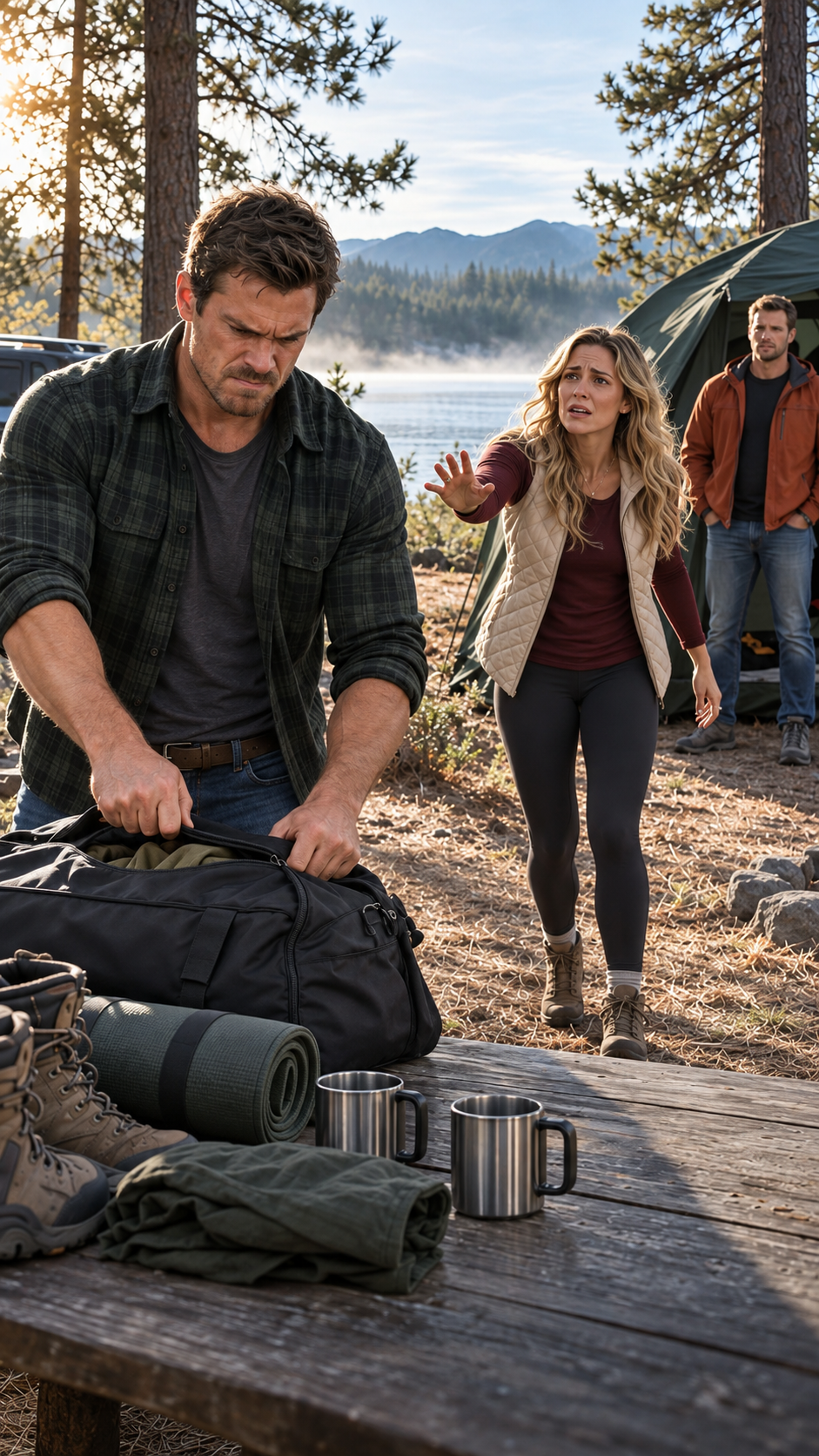
Graham packed his duffel because he finally understood that staying without consequence would teach me nothing.
I watched him leave because I finally understood that love did not guarantee continued access to someone I had hurt.
And the years afterward mattered because neither of us confused reconciliation with pretending the boundary had never been necessary.
The marriage lasted.
Not because Graham came back.
Because when he did, we stopped asking who had won that terrible night.
We started asking what kind of people we wanted to be the next morning.
Then the morning after that.
And the one after that.
Again and again.
Until eventually the night in Bend became what every wound hopes to become—
not erased,
not excused,
but small enough inside a much larger life that it no longer determined where we slept, whom we trusted, or how we chose each other.
**–THE END– PLEASE
Share your thoughts or feedback to motivate us to create more stories ♥️
✓ Lynn R. Adams
## **Part 6 – The Life They Built After Winning Stopped Mattering More Than Understanding** Graham and I stayed married for fifty-one years. That sentence would have shocked the woman I was on the m…