The End – The Bride Who Learned Why the Beast Chose Mercy Over Possession _064
## Part 6 – The Home No Bargain Could Ever Own
We married for the second time beneath a pine tree.
Samuel complained that this created unnecessary paperwork.
I reminded him it created none.
He complained anyway.
The ceremony was small.
Mrs. Hale from the lower settlement brought flowers.
Miriam Stone arrived late because she stopped to inspect a creek crossing.
Three ranch hands washed their shirts.
Silas wore a black coat that made his scar look sharper than ever.
I wore blue again.
Not the soaked wedding gown from Boston.
A new dress.
Loose at the waist.
Comfortable.
Mine.
No corset.
No Beatrice.
No father deciding how tightly another woman should lace me.
When Silas saw me, he forgot whatever he had planned to say.
That pleased me.
Samuel stood beside him.
“You may breathe, Kane.”
Silas glared.
Everyone laughed.
Then the minister asked why we had gathered when the couple was already legally married.
Silas answered first.
“Because the first time she didn’t know enough.”
The valley became quiet.
He looked at me.
“I did not give Elara the truth before asking her to share my name.”
My eyes filled.
“I thought I was protecting her.”
He glanced toward Samuel.
“We have discovered this family has a poor history with that phrase.”
More laughter.
Then he became serious.
“This time, she knows.”
He looked at the north ridge.
“The land is hers.”
Then at the meadow.
“The water belongs to both of us under the trust.”
Back to me.
“And her life belongs to her.”
My throat tightened.
“I am here because I hope she will keep choosing to share part of it with me.”
That was Silas.
No grand speech.
No claim.
Hope.
My vows came easier.
“I came to Blackthorn believing I had been traded.”
Silas’s face tightened.
“I believed marriage meant surrender because that was how it had been explained to me.”
I looked toward the cabin.
“Then my husband put a key in my hand.”
A few people who knew the story smiled.
“He gave me a door I could lock against him.”
Silas looked down.
“And somehow that made it possible, eventually, for me to open it.”
His eyes lifted.
“I do not choose Silas because my father bargained.”
My voice strengthened.
“I do not choose him because my mother trusted him.”
I smiled.
“I certainly do not choose him because of thirty silver dollars.”
Samuel said, “Reasonable.”
More laughter.
“I choose him because he learned that protecting me cannot mean deciding for me.”
Silas’s eyes shone.
“And because I learned that trusting someone does not mean surrendering myself.”
We exchanged simple rings.
Mine contained a small piece of silver.
Not mined from Blackthorn.
Silas was very clear about that.
Afterward, we ate beneath the pines.
No ballroom.
No Boston society.
No whispered jokes about my body.
I ate two pieces of cake.
Then a third because Beatrice was not there to stop me.
Silas saw.
“Good?”
“Excellent.”
“You have icing there.”
“Where?”
He kissed the corner of my mouth.
Samuel groaned.
“Newlyweds.”
“We’ve been married nine months,” I said.
“Apparently not according to you.”
Fair.
We settled into married life gradually.
Real life.
Less dramatic than secrets.
More demanding.
Silas snored when exhausted.
I stole blankets.
He left muddy boots near the door.
I reorganized the pantry so thoroughly that he could not find salt for three days.
We argued.
Then learned to argue better.
He sometimes went silent when afraid.
I learned to ask whether he needed time or company.
I sometimes interpreted disagreement as rejection.
He learned to say, “I disagree, but I am not leaving.”
That sentence healed more than he knew.
Blackthorn Ranch changed too.
The meadow trust allowed controlled grazing during dry summers.
The spring network was mapped and protected through local agreements.
We created written water access rules for families downstream.
No single ranch controlled everything.
That had been my condition.
Silas agreed immediately.
“You own enough land already,” I told him.
“You own more.”
“I am aware.”
“Rich woman.”
“I arrived with one valise.”
“And a dangerous understanding of property law.”
“I learned quickly.”
The silver remained underground.
Morrow’s company tried once more with a better offer.
I read it.
Then declined.
Not because we swore never to mine.
Because the environmental risk remained too high.
Miriam approved.
Silas pretended his opinion had no importance.
It did.
Just not more than mine.
Samuel eventually retired.
By retired, I mean he stopped accepting new clients and spent more time visiting us than anyone requested.
He played chess badly.
Silas played worse.
I beat both.
Father wrote every few months.
Our correspondence remained cautious.
Then, two years after my second wedding, he came west.
He wrote first.
I will come only if invited.
That mattered.
I invited him.
Silas asked, “Are you sure?”
“No.”
“Do you want me here?”
“Yes.”
“Then I’m here.”
Father arrived in spring.
Older.
Thinner.
No Boston grandeur.
His coat was good but worn.
He carried one case.
For a moment, standing at the station, I saw him not as the architect of my childhood pain.
Just a man.
A flawed one.
That did not erase anything.
But it made conversation possible.
He saw Silas.
They stared.
Father touched the gap where his broken tooth had once been repaired.
Silas cleared his throat.
“I regret the chair.”
Father looked surprised.
Then laughed.
An actual laugh.
“So do I.”
That helped.
At the ranch, Father asked permission before entering the office.
I noticed.
Silas noticed me noticing.
We said nothing.
Father spent three weeks.
He never asked about ownership.
Never mentioned silver.
Instead he helped with school accounts.
Yes.
School.
The lower valley schoolhouse had grown.
Children came from ranches and mountain settlements.
We added evening lessons for adults.
Father volunteered.
Arithmetic.
Bookkeeping.
He had always been good with numbers.
Watching him teach a ranch hand’s fourteen-year-old daughter how to calculate interest nearly broke my heart.
Not because it redeemed him completely.
Because people can become better after causing harm.
But the harm still existed.
Both truths fit.
On his final evening, Father asked to speak privately.
We sat on the porch.
“I owe you an apology.”
I waited.
He did not say, But.
Good beginning.
“I treated you as something I was responsible for arranging.”
My eyes burned.
“I told myself a father must secure his daughter’s future.”
He looked toward the valley.
“Really, I was frightened of what would happen if I lost control of anything else.”
I listened.
“I lost Arthur.”
“Mother.”
“Money.”
“My reputation.”
He smiled sadly.
“I kept responding to loss by tightening my grip.”
He looked at me.
“And eventually I nearly lost you because of it.”
I said nothing.
He did not ask forgiveness.
Instead he asked, “Would you tell me about Rosalie?”
That was the question I had never expected.
So I did.
Her letters.
Her seamstress work.
Her friendship with Mae.
Her hatred of fitted sleeves.
Father cried when I showed him the portrait.
Not loudly.
He touched the painted edge.
“She hated that day.”
“You knew?”
“I knew afterward.”
“Why keep it?”
“I thought someday I would look at it and understand why she left.”
“Did you?”
“No.”
He looked at me.
“Now I do.”
When he left, we embraced.
Not fully repaired.
But real.
Three years later, he died quietly in Providence.
He left no fortune.
Only books.
A small savings account.
And a note.
For Elara:
I spent much of my life confusing possession with security.
You taught me the difference.
I cried for the father he had become.
And for the father I had needed earlier.
Both deserved tears.
Silas held me through them.
Years passed.
His scar faded slightly.
Not much.
Mine were invisible.
Those take longer.
We never had children.
For a while that saddened me.
Then life widened around us.
The school.
The ranch workers’ families.
Samuel’s endless visits.
Miriam’s surveys.
Young women from the valley who came to ask me how deeds worked because they had heard Mrs. Kane read contracts “like a banker.”
I taught them.
Especially the women.
Perhaps because my mother had spent half her life trying to build legal doors for me.
I wanted fewer daughters to need secret doors.
One autumn afternoon, a young woman named Hattie came to me.
Her father wanted her to sign over inherited acreage to her fiancé.
“Why?” I asked.
“He says a husband should manage land.”
“What do you think?”
She hesitated.
“I don’t know.”
“Good.”
She looked confused.
“Not knowing is allowed.”
I handed the deed back.
“Read first. Ask questions. Get your own lawyer. Decide afterward.”
“What if he is offended?”
“Then you will have learned something useful before marriage.”
Silas heard from the hallway.
Later he said, “You’re terrifying.”
“I learned from the Beast of Blackthorn Valley.”
He frowned.
“I hate that name.”
“I find it charming now.”
“No.”
“Beast.”
“Elara.”
I laughed.
People still told stories about him.
The scarred mountain rancher.
The man wolves supposedly followed.
The man who killed three men.
I corrected people when it mattered.
Not always.
Once a traveling salesman heard the rumor and became extraordinarily polite.
I let Silas enjoy that.
Years after our marriage, we finally discovered how the wolf story began.
A winter pack had followed him for three miles because he was dragging a dead deer.
That was all.
I laughed for an hour.
Silas refused to discuss it.
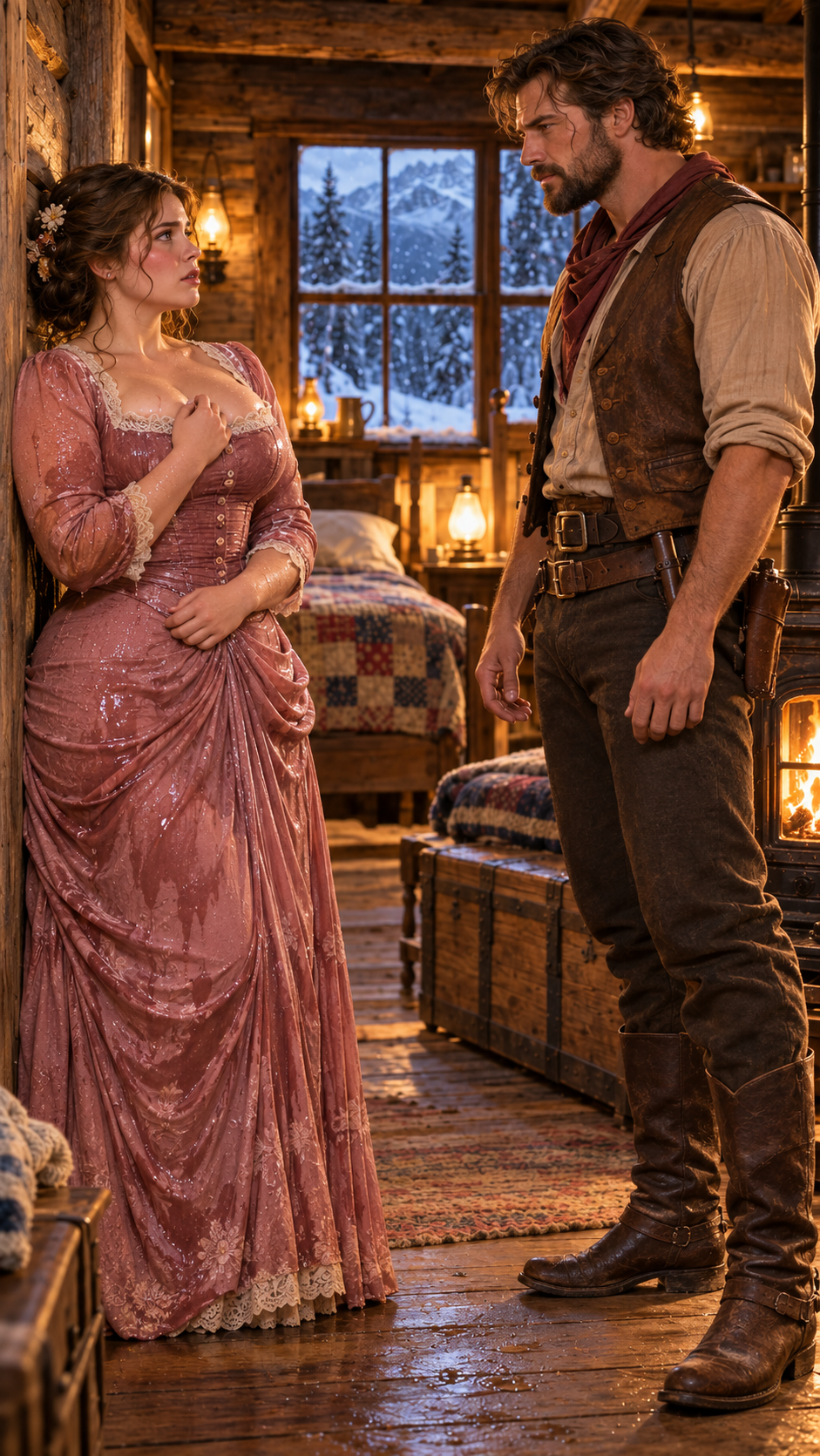
One cold evening, almost fifteen years after the night I first entered his cabin, snow began falling.
We sat beside the same iron stove.
The chest still stood near the hearth.
“Open it,” Silas said.
“Why?”
“Go on.”
I used the brass key.
Inside lay the blue wedding gown.
Clean.
Preserved.
I stared.
“You kept it.”
“Yes.”
“Why?”
“I thought you might want to burn it someday.”
I touched the fabric.
The dress represented almost everything I hated.
Father’s bargain.
Fear.
Wet snow.
A marriage I had not freely understood.
But also the road to everything after.
“No.”
Silas looked surprised.
“Keep it.”
“Why?”
“Because I don’t want the beginning rewritten merely because the ending improved.”
He smiled softly.
“That sounds like Samuel.”
“Horrifying.”
I lifted the pale silk nightgown beneath it.
My mother’s gift.
The garment had been repaired several times.
Soft with age.
I held it against my chest.
“That first night…”
Silas groaned.
“I know.”
“You ordered me to remove my dress.”
“I explained immediately.”
“Eventually.”
“Within seconds.”
“You terrified me.”
“You were already terrified.”
“True.”
He touched the nightgown.
“I was terrified too.”
I looked at him.
“You?”
“Yes.”
“Of me?”
“Of doing one thing that would make every rumor you’d heard become true.”
That humbled me.
“You went into a blizzard.”
“I had a barn.”
“You could have frozen.”
“I had blankets.”
“You are impossible.”
“You married me twice.”
“Poor judgment.”
He smiled.
Then became thoughtful.
“Would you still?”
“Still what?”
“Choose me.”
The question never stopped mattering to him.
Perhaps that was why the marriage remained alive.
He never assumed yesterday’s yes made today irrelevant.
I took his scarred face between my hands.
“Yes.”
He kissed my palm.
“Why?”
“Because you ask.”
Simple.
True.
We stood near the window.
Outside, Blackthorn Valley disappeared beneath snow.
The north ridge.
The meadow.
The hidden silver.
The spring.
All the land our parents had fought over, feared, protected, manipulated, inherited, and misunderstood.
For years I had believed property created security.
Then I believed Silas did.
Later I understood neither was enough.
Security came from something less dramatic.
Knowing where the keys were.
Knowing what the papers said.
Knowing I could say no.
Knowing I could leave.
Knowing staying meant something because leaving remained possible.
Silas wrapped a blanket around my shoulders.
“Cold?”
“A little.”
“You want more wood?”
“No.”
He sat.
I sat beside him.
My body had changed with age.
Softer.
Heavier in places.
Silver beginning in my hair.
No corset.
No shame.
Silas still looked at me as if beauty was something discovered rather than measured.
I rested my head against his shoulder.
“My mother was right.”
“About?”
“You.”
“That is vague.”
“She said you protect people through silence.”
He sighed.
“I improved.”
“Somewhat.”
“You?”
“I lecture strangers about contracts.”
“Constantly.”
“We are both difficult.”
“Yes.”
Outside, wind moved through the pines.
The same sound I had heard the first night.
Back then I thought I had been carried to the end of the world with a monster.
Instead I had arrived at a locked door.
Silas put the key in my hand.
That was how everything began.
Not with love.
Not even with trust.
With choice.
Then honesty.
Then anger.
Then forgiveness where it was earned.
Then love.
Slowly enough that I could believe it belonged to me.
I looked at the man beside me.
The feared cowboy.
The supposed beast.
The husband who had once ordered his bride out of a wet dress and then stepped into a blizzard so she could change without fear.
People would always prefer the dramatic version.
The scar.
The bargain.
The mountain.
The rumors.
But the truth was quieter.
Silas Kane changed my life because when everyone else tried to decide what was best for me, he eventually learned to ask what I wanted.
And I changed his because I never let him confuse silence with kindness again.
The fire settled lower.
He reached for another log.
I stopped him.
“Stay.”
He looked at me.
“Cold?”
“No.”
“Then?”
I slipped my hand into his.
“Just stay.”
He smiled.
And he did.
**–THE END– PLEASE
**Share your thoughts or feedback to motivate us to create more stories ♥️**
✓ Lynn R. Adams
## Part 6 – The Home No Bargain Could Ever Own We married for the second time beneath a pine tree. Samuel complained that this created unnecessary paperwork. I reminded him it created none. He com…