The Emerald Pool That Revealed a Queen No Prince Could Claim _064
## **Part 2 – The Prince’s Silence, the Hidden Birth Record, and Isabella’s First Refusal**
Prince Adrian kept his hand extended.
Isabella looked at it.
Then at him.
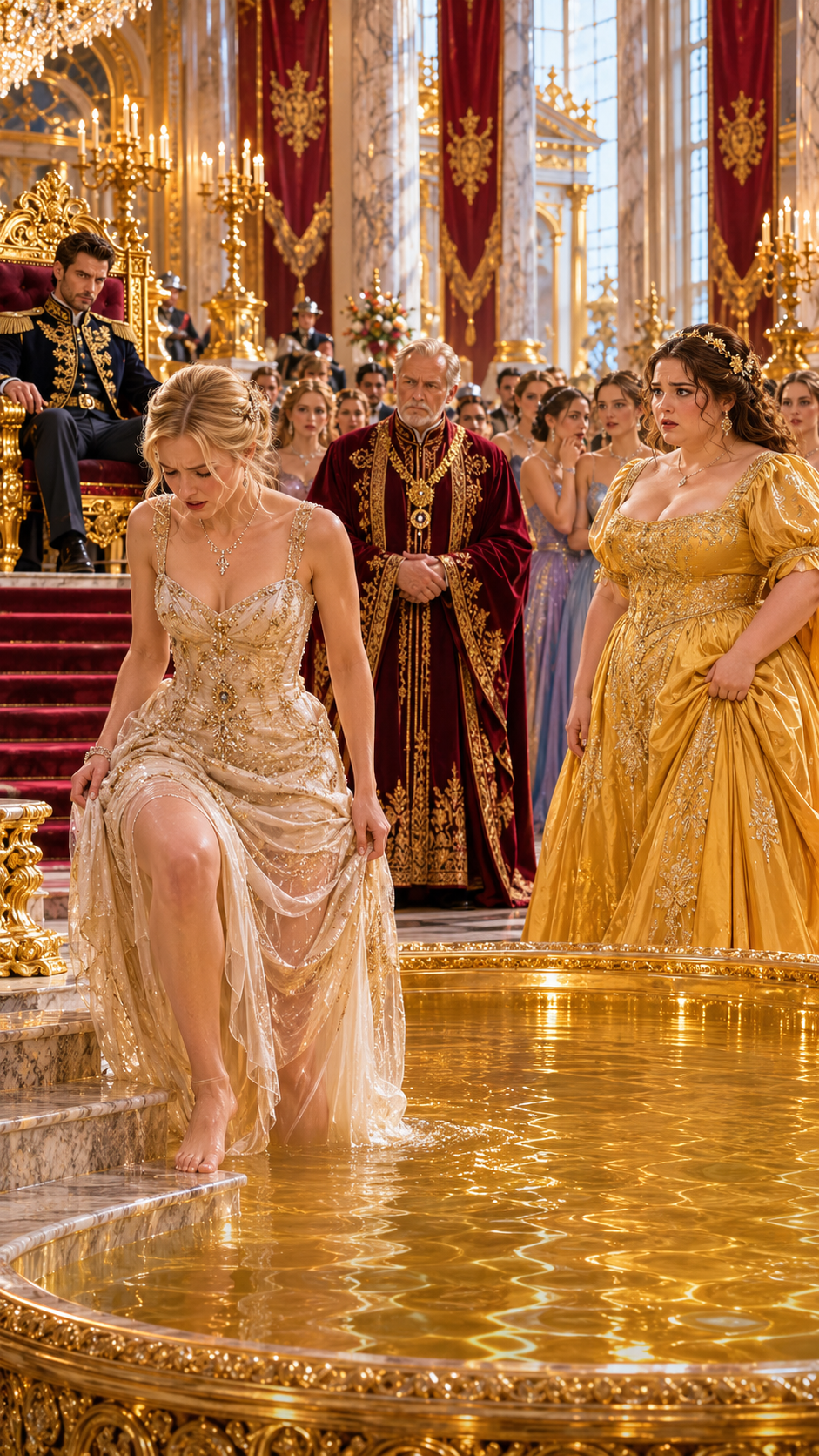
The emerald water shimmered around her waist, casting green reflections across the marble pillars of the palace courtyard.
No one laughed now.
That was almost worse.
A few moments earlier, the nobles had treated her as entertainment.
Now they watched her as though she had become a sacred object.
Isabella disliked both versions.
She gathered the skirt of her yellow dress and walked toward the steps without taking Adrian’s hand.
A murmur moved through the courtyard.
The prince lowered his arm.
Isabella climbed out by herself.
Water streamed from her sleeves.
The elderly advisor, Lord Severin, stepped forward with a velvet robe.
“Lady Isabella—”
“No.”
He stopped.
She looked directly at him.
“My name was Isabella Maren five minutes ago.”
“Yes, but—”
“And I presume it remains Isabella Maren now.”
The old man blinked.
Adrian almost smiled.
Isabella noticed.
That irritated her more.
“Something amusing, Your Highness?”
“No.”
“Good.”
He bowed his head slightly.
No prince had bowed to her before.
The court noticed.
Isabella did too.
She accepted the robe from Severin only after taking it from his hands herself.
No servants wrapping it around her.
No ritual.
No sudden transformation into whatever the court wanted her to become.
Then she turned toward Adrian.
“You looked away.”
The prince’s expression sobered.
“I did.”
“Why?”
The courtyard became so quiet that Isabella could hear water dripping from her hem onto stone.
Adrian could have lied.
He could have claimed he was distracted.
Could have blamed ceremony.
Could have said she misunderstood.
Instead:
“Because I was uncomfortable.”
Isabella’s throat tightened.
“With me.”
“With what I assumed about you.”
“That sounds very polished.”
“It isn’t.”
He looked almost embarrassed.
“I saw you walking toward the pool and thought the court would laugh.”
“They did.”
“Yes.”
“And you decided not to be seen watching.”
Adrian closed his eyes briefly.
“Yes.”
There it was.
No rescue.
No excuse.
He had not mocked her.
But he had protected himself from association with her humiliation.
For Isabella, that distinction mattered.
It also did not erase the hurt.
“You were ashamed to look interested.”
Adrian met her gaze.
“I was afraid the court would decide I was.”
“That is not better.”
“No.”
Lord Severin shifted uneasily.
“Your Highness, perhaps this conversation should continue in private.”
Isabella turned to him.
“Why?”
“Because the court—”
“The court laughed in public.”
Severin stopped.
Fair.
Adrian said quietly:
“She is right.”
Several nobles exchanged looks.
That pleased Isabella less than she expected.
She had not wanted to teach a prince courage.
She had wanted him to possess some before her bloodline became interesting.
Then Severin lifted one hand.
“The pool must be examined.”
“Examined?”
Isabella frowned.
“To confirm the reaction.”
Adrian looked at him sharply.
“You just declared her ancient royal blood before half the kingdom.”
“I declared what the water traditionally signifies.”
“Then why confirm it?”
“Because tradition is not the same as proof.”
That, at least, was sensible.
Isabella looked back toward the pool.
The water remained emerald.
Not pale green.
Not tinted.
Emerald.
A color so deep it looked as though forest light had been poured into gold.
“What could cause it?”
She asked.
Severin hesitated.
“There are several possibilities.”
“Name them.”
“Minerals.”
Someone laughed nervously.
Severin ignored it.
“Chemical agents. Residues in the stone channels. Or the old explanation.”
“Blood.”
“Lineage.”
Isabella folded her arms.
“Those are not the same thing.”
Severin’s eyes sharpened.
Interesting.
“Perhaps not.”
Adrian stepped closer, stopping a respectful distance away.
“My mother made it turn green.”
“You were there?”
“I was six.”
“Do you remember?”
“Very clearly.”
His expression softened.
“She stood in the pool during the midsummer rite. The water changed around her feet.”
“What happened afterward?”
Silence.
Isabella saw it.
The same shadow that crossed people’s faces whenever Queen Elara was mentioned.
Adrian’s mother had died when he was ten.
Everyone knew that.
Few seemed willing to say more.
“She became ill four years later,” Adrian said.
“And?”
“She died.”
“Of what?”
Severin interrupted.
“A fever.”
Adrian looked at him.
That look contained disagreement.
Isabella noticed.
“So which one of you is lying?”
Severin stiffened.
Adrian answered.
“Neither, perhaps.”
That was not reassuring.
“She did have fever.”
“And?”
Adrian hesitated.
Then:
“No one agreed why.”
The courtyard suddenly felt colder.
Isabella looked at the emerald water.
A lost royal line.
A dead queen.
An old ritual.
And an advisor who had turned pale before anyone else.
She said:
“I want to leave.”
Severin nearly dropped his walking stick.
“Leave?”
“Yes.”
“You cannot simply—”
“I arrived this morning with no title.”
“You may now possess a claim recognized by one of the oldest institutions in the kingdom.”
“That sounds like your problem.”
A few younger nobles tried not to smile.
Adrian did not.
He looked concerned.
“Isabella.”
She turned.
“What?”
“If you walk out alone, every household represented here will know your name before sunset.”
“They know it already.”
“They know a story.”
“And what story would you prefer?”
He considered.
“I would prefer you have guards.”
She almost laughed.
“I had no guards before the water changed.”
“No.”
“Then I am suddenly valuable.”
Adrian flinched.
Good.
He needed to hear it.
“I am saying visible.”
“That is not better either.”
He nodded.
“Fair.”
Severin stepped forward.
“Lady Isabella, whatever you think of the prince, please understand this is not merely a marriage custom.”
“Then stop calling it a bridal pool.”
Severin went silent.
The court had called it that for generations.
The royal pool.
The queen’s choosing.
The place where women entered hoping to become the prince’s bride.
But now Severin had admitted its deeper function.
It recognized lineage.
If that was true, then generations of women had been publicly judged under a false interpretation.
Isabella looked toward the twelve candidates still waiting beside the colonnade.
Some were humiliated.
Some furious.
One, a tall woman in blue named Celia Arden, met Isabella’s gaze and gave a tiny nod.
Not friendship.
Recognition.
The whole ceremony had become absurd.
Isabella asked:
“Was this pool originally used to choose brides?”
Severin hesitated.
“Not exactly.”
The court erupted.
“What?”
“Then what is it?”
“My daughter was promised a fair trial!”
Severin raised both hands.
“Silence.”
The crowd settled reluctantly.
He looked older suddenly.
“The earliest records describe the pool as a recognition basin for the royal household.”
“Recognition of what?”
Isabella asked.
“Kinship.”
“Not suitability for marriage?”
“No.”
A wave of anger passed through the candidates’ families.
Adrian looked stunned.
“You knew?”
Severin stared at the marble floor.
“I knew the earliest wording.”
“And allowed this ceremony?”
“For three centuries, the tradition changed.”
“Tradition changed,” Isabella repeated. “Convenient phrase.”
Severin looked ashamed.
Good.
This day was apparently collecting confessions.
Then a voice came from behind the court.
“Because kings preferred brides to cousins.”
Everyone turned.
An elderly woman stood beneath the archway.
Not dressed like nobility.
Dark green traveling coat.
Silver hair in a loose braid.
Two guards moved toward her.
Adrian lifted a hand.
“Wait.”
The woman walked forward without bowing.
Severin’s face went white.
“Helena.”
Isabella looked between them.
“You know her?”
Severin whispered:
“Unfortunately.”
The woman smiled.
“Mutual.”
Adrian stepped down from the dais.
“Who are you?”
“Helena Maren.”
Isabella’s heart stopped.
Maren.
Her name.
The woman turned toward her.
“You have your grandmother’s eyes.”
Isabella could not move.
“My grandmother died before I was born.”
“Yes.”
“You knew her?”
Helena’s smile faded.
“She was my sister.”
The courtyard disappeared around Isabella.
She had grown up with no extended family.
Her mother, Miriam Maren, died when Isabella was sixteen.
Her father, Tomas, had died earlier.
No grandparents.
No aunts.
No cousins.
At least none she knew.
“You’re my great-aunt?”
“Aunt will do.”
Isabella stared.
“Where have you been?”
Helena looked toward Severin.
“Hiding from people who thought blood was more useful than a person.”
That sentence landed hard.
Adrian’s face changed.
Severin gripped his cane.
“Helena, this is not the place.”
“It is exactly the place.”
She looked at the pool.
“Still turning green, I see.”
“You’ve seen it before?”
Isabella asked.
Helena smiled sadly.
“Many times.”
Severin whispered:
“You swore never to return.”
“I swore many foolish things.”
Adrian’s patience broke.
“What does Isabella’s bloodline mean?”
Helena looked at him.
“It means your mother was not the last descendant of the House of Aurelian.”
The court gasped.
Ancient Aurelian.
The dynasty that ruled before Adrian’s family.
The line believed ended after a succession war two centuries earlier.
Adrian said:
“My mother was Aurelian?”
“Through her grandmother.”
Severin closed his eyes.
So that secret had been known.
Isabella looked at him.
“You knew.”
“Yes.”
“How much?”
“Enough.”
“That answer is becoming irritating.”
Helena laughed.
“I like her.”
Severin did not.
Then Isabella asked:
“How am I related to Queen Elara?”
Helena’s expression softened.
“Your grandmother and Elara’s grandmother were sisters.”
Silence.
That made Isabella and Adrian distant cousins through the old line.
Not close enough to be socially unusual among royal families.
Close enough to explain the pool.
More important:
It meant Isabella’s claim did not come from Adrian.
She belonged to the lineage independently.
“Why was my family poor?”
The question came out before she intended.
If royal blood mattered so much, why had her mother sewn dresses for merchants?
Why had Isabella grown up above a bakery?
Helena answered gently.
“Because blood does not pay rent.”
That almost made Isabella laugh.
Good answer.
Then:
“Your branch deliberately disappeared from court.”
“Why?”
“Because after the Aurelian collapse, being known was dangerous.”
“And two hundred years later?”
“Habit becomes family law when enough frightened people inherit it.”
Isabella understood that better than she wanted.
Helena continued.
“Your grandmother refused every invitation to return. Your mother did too.”
“My mother knew?”
“Yes.”
The betrayal was different from Adrian’s.
Quieter.
Still sharp.
“My mother knew I descended from royalty and never told me.”
“She knew a story.”
“Not proof?”
“Some proof.”
“Why hide it?”
Helena looked at the crowd surrounding them.
“Look around.”
Fair.
But not enough.
“She should have told me.”
“Yes.”
Isabella turned toward Helena.
The immediate agreement surprised her.
“You think she was wrong?”
“I loved your mother. She was still wrong.”
That softened something.
No one defending secrecy simply because it came from love.
Good.
Adrian said:
“What happens now?”
Helena turned.
“To whom?”
“To Isabella.”
Isabella interrupted.
“I happen to myself.”
Adrian’s expression changed.
Then he bowed his head.
“Yes.”
Helena smiled faintly.
“That may be the first intelligent thing a Valerian prince has said in this courtyard.”
Adrian looked almost offended.
Good.
Then Severin said:
“The Council of Lineage must convene.”
Isabella frowned.
“There is such a council?”
“Rarely used.”
“Convenient.”
Helena grinned.
Severin ignored her.
“If Isabella’s descent can be documented, the old constitutional provisions may recognize her as a royal dynast in her own right.”
“Meaning?”
Adrian asked.
Severin hesitated.
“Meaning she may hold a hereditary seat in the High Council.”
The nobles erupted again.
Isabella felt dizzy.
Not queen.
Not automatically.
But political standing.
Land rights, perhaps.
Legal status.
Everything changing because water changed color.
She hated how quickly the court had transformed her body from something to mock into something to calculate.
She looked at Adrian.
“You still haven’t answered one thing.”
“What?”
“If the water had stayed gold, would you have spoken to me?”
He looked stricken.
Good question.
He took time.
“I don’t know.”
That answer hurt.
But she trusted it more than a beautiful lie.
Then:
“I hope I would have.”
“That is not the same.”
“No.”
“And now?”
“Now I want to know you.”
She stared.
“Because of the water?”
“At first? Partly.”
He said it with shame.
Then:
“But because you refused my hand in front of the whole court, more.”
Isabella almost smiled.
Almost.
“You admire rejection?”
“I admire that you did not become agreeable when everyone suddenly valued you.”
That was better.
Still insufficient.
She turned toward Helena.
“I’m leaving.”
Helena nodded.
“Good.”
Severin nearly shouted.
“Again?”
“I need dry clothes.”
Adrian said:
“You may use the eastern guest wing.”
“No.”
“Why?”
“Because I entered this palace as a candidate for your hand. I am not staying tonight under the same roof while everyone decides whether I’m valuable enough to become political property.”
Adrian absorbed that.
“Where will you go?”
“My inn.”
Severin looked horrified.
“The Crown Swan?”
“You know it?”
“Everyone knows it. Their roof leaks.”
“Only over room six.”
Helena laughed.
Isabella looked toward her.
“You’re coming.”
“I hoped.”
Adrian stepped closer.
“Please take guards.”
Isabella opened her mouth.
Then reconsidered.
Visibility had changed.
She could reject palace control without rejecting practical safety.
“Two.”
“Four.”
“Two.”
“Three.”
She stared.
Adrian sighed.
“Two.”
“Good.”
That was their first negotiation.
She left the palace in her yellow dress beneath a borrowed cloak, followed by Helena and two guards who looked deeply confused about taking orders from a woman who might be royal but refused to acknowledge a title.
At the Crown Swan, Isabella changed clothes.
A simple green gown.
Helena watched her from the bed.
“You resemble your mother more when you’re angry.”
“That is unfortunate.”
“She was spectacular angry.”
“Why did she never tell me?”
Helena’s smile disappeared.
“She was afraid the palace would find you.”
“Would that have been dangerous?”
“Possibly.”
“From Adrian?”
“No.”
“His father?”
Helena looked away.
There.
Another secret.
“King Edmund?”
“Yes.”
Adrian’s father had died six years earlier.
Respected king.
Strict but stable.
“What did he do?”
“Nothing we could prove.”
Isabella sat.
“What did he want?”
“The Aurelian line gone from politics.”
“Why?”
“Because Elara’s blood made her popular.”
The queen.
Adrian’s mother.
“She could claim the throne separately?”
“Not exactly. But she carried legitimacy older than Edmund’s family.”
“And?”
“Some nobles wanted constitutional reform.”
Isabella frowned.
“What kind?”
“To reduce the king’s authority and strengthen the council.”
“And Elara supported it?”
“Yes.”
“What happened?”
Helena was silent.
Then:
“She died.”
The room turned cold.
“You think King Edmund killed her.”
“No.”
Helena answered quickly.
“I think people around him benefited from her silence.”
That was different.
More careful.
“Do you have proof?”
“No.”
“Then don’t build a murder out of suspicion.”
Helena stared.
Then nodded slowly.
“You truly are Miriam’s daughter.”
“Good.”
Then Helena reached into her traveling case.
Removed a bundle of documents.
Birth records.
Marriage certificates.
Letters.
A genealogy.
Isabella’s family.
Proof.
Enough, perhaps.
But beneath them was something else.
A diary page.
Queen Elara’s handwriting.
Helena placed it in Isabella’s hands.
The final entry read:
**The pool does not choose queens. It recognizes those descended from Aurelian women because of the mineral seal placed in the old rites. Severin knows this. Edmund knows too. If they continue using it to parade brides before Adrian when he comes of age, they will turn recognition into spectacle.**
Isabella’s heart pounded.
The pool was not magic.
Not exactly.
An ancient mineral compound, perhaps activated by something inherited?
Or ceremonial substances?
She did not know.
But Elara knew the ritual had been manipulated.
Then the next line:
**If another Aurelian woman appears, she must be given the truth before anyone offers her a crown.**
Isabella looked up.
Helena’s face had gone pale.
“What?”
Helena whispered:
“That page was not there when I last saw the diary.”
“Who had it?”
“Severin.”
The royal advisor.
Isabella stared at the paper.
The man who had declared her royal in front of the court had also known the pool did not choose brides at all.
And Queen Elara had specifically instructed him to tell the next woman the truth before the crown turned her into a symbol.
Instead, Severin had let twelve women be judged publicly.
Then let Isabella walk into the water unaware.
The pool had revealed her bloodline.
But the court’s oldest advisor had apparently concealed the meaning on purpose.
And now Isabella wanted to know why.
**–END OF PART 2– CLICK “NEXT” AT THE BOTTOM OF THE PAGE TO CONTINUE READING**
✓ Lynn R. Adams
## **Part 2 – The Prince’s Silence, the Hidden Birth Record, and Isabella’s First Refusal** Prince Adrian kept his hand extended. Isabella looked at it. Then at him. The emerald water shimmered ar…