THE DIAMOND AT HER FEET: MY HUSBAND GAVE HIS MISTRESS MY MOTHER’S JEWELS
I met Everett Whitmore eleven years before the anniversary dinner, when I was twenty-six and working as an assistant curator at a Boston museum. He arrived for a fundraising reception wearing a charcoal suit, expensive watch, and the easy confidence of someone accustomed to being welcomed into every important room. I was examining a small nineteenth-century portrait when he approached and described the woman in the painting as sorrowful. I disagreed, explaining that the subject appeared watchful rather than defeated because her eyes were fixed directly on the viewer. Everett laughed, asked my name, and spent the rest of the evening making me feel more interesting than anyone else in the museum.
At the time, I knew little about the private challenges facing his family’s property company. Whitmore & Lane owned historic buildings, luxury residences, and commercial developments throughout the Northeast, but its reputation was considerably stronger than its balance sheet. Everett rarely mentioned debt, failed acquisitions, or the legal disputes that occasionally threatened his family’s holdings. Instead, he spoke passionately about preserving New York’s architectural history and restoring neglected landmarks. Those interests appealed to the part of me that had grown up surrounded by art, old buildings, and stories about protecting valuable things.
My grandfather founded Hart Meridian after building a reputation for recovering and authenticating valuable property. Over the decades, the business developed into a sophisticated network of security operations, provenance research, asset management, and private investment structures. My mother inherited responsibility after his death and became known for recognizing dangerous transactions long before their consequences became visible. She believed wealth could provide comfort but never replace good judgment, and she repeated that lesson whenever I became distracted by beautiful appearances. “If someone begins by taking something small,” she told me once, “pay attention to what they are preparing to take next.”
Everett and I married three years after our first meeting at the New York Public Library. His mother, Lenora, wore diamonds that seemed designed to announce generations of status, while Conrad congratulated me on joining a family with such an exceptional history. My mother smiled politely through the ceremony but privately advised me to retain independent counsel and preserve the legal separation between family assets and marital property. I followed her guidance because I respected her experience, though I secretly believed it was unnecessary. Everett seemed devoted to me, and I could not imagine a future in which our financial interests would become opposing forces.
For the first several years, our marriage appeared genuinely happy. We traveled through Europe, restored a summer home overlooking the Atlantic, and discussed children we hoped to raise between New York and Connecticut. Everett surprised me with thoughtful gifts, remembered anniversaries, and occasionally abandoned business dinners to spend an evening reading beside me. On our fifth anniversary, he presented a diamond necklace arranged in a delicate crescent with a larger central stone shaped like a falling tear. He claimed to have commissioned it from a Geneva jeweler and said he wanted me to possess something as extraordinary as the woman he had married.
I believed him because I had no reason then to imagine the necklace belonged to my mother’s collection. Vivian kept valuable jewelry inside a professionally secured vault, and I rarely examined individual pieces because she considered them private family history rather than objects meant for regular display. She had allowed certain pieces to be borrowed for special occasions, but detailed inventories remained in the custody of Hart Meridian’s asset team. When Everett presented the necklace, I assumed its resemblance to older family jewelry reflected his awareness of my taste. I never thought to compare its engraving with my mother’s records.
Everything changed during the years that followed my father’s death and my mother’s gradual withdrawal from public life. Everett became increasingly occupied with expensive development projects, extended business travel, and meetings that seemed to require his attention at inconvenient hours. He began dismissing my museum work as an indulgence, even though I had continued overseeing trust responsibilities and investment reports throughout our marriage. Whenever I asked about an unfamiliar expense or unexplained absence, he accused me of behaving like a suspicious accountant instead of a loving wife. I tried to preserve the peace, believing his irritability reflected business pressure rather than deliberate deception.
My mother died eleven months before the dinner at The Marlowe Room, leaving me with grief I had barely begun to understand. Everett stood beside me at her funeral, held my hand, and spoke beautifully about her intelligence and generosity. He promised he would help preserve everything she had built, even though he had never shown much interest in understanding her business. I wanted to believe his tenderness represented genuine support during the most difficult period of my adult life. Later, I would discover that he had already begun examining ways to use assets connected to her trust.
The necklace disappeared three months after Vivian’s death. We were returning from Palm Beach when I opened its velvet case and discovered it empty, despite remembering clearly that I had placed the piece inside before our departure. Everett became furious with hotel employees and insisted the incident would be handled privately through insurance. His insistence that I avoid a formal report troubled me because my mother had spent her career teaching me the importance of documentation. I contacted Hart Meridian’s security director, reviewed the travel records, and learned that a private courier had collected a package on Everett’s instructions.
That discovery led to the Miami jeweler and the receipt describing a necklace alteration. When I examined the appraisal records, I discovered the original piece was registered as VH-17 in my mother’s collection. The necklace my husband claimed to have purchased had actually been removed from a vault containing property belonging to my family trust. I did not know whether Everett had personally accessed the vault, instructed someone else to retrieve it, or relied on an authorization that had been improperly issued. But I knew one thing with certainty: the disappearance was no longer an unfortunate travel accident.
Detective Marisol Vega listened carefully when I reported the missing necklace at an Upper East Side precinct. I provided photographs, inventory information, travel details, the custom jewelry receipt, and the courier records, explaining which facts I knew directly and which required investigation. She asked whether Everett understood I intended to pursue the matter formally, and I told her he had repeatedly discouraged me from contacting the police. Vega explained that identifying the piece would require more than my recollection because valuable jewelry could be altered or replicated. I appreciated her caution because I wanted the truth established through evidence rather than through my certainty about my husband’s motives.
Hart Meridian’s records helped investigators understand the necklace’s history. The original diamonds had been acquired by my grandfather decades earlier and arranged into a crescent by a jeweler who worked closely with my mother. Each significant piece in the collection was photographed, appraised, and associated with a discreet identifier known only to the family and its professional custodians. The necklace had remained in storage until shortly before Everett presented it to me as an anniversary gift. A review of its access history revealed irregular documentation that raised questions about who authorized its removal.
I contacted Naomi Pierce, an attorney whose practice included complex asset disputes and corporate governance. She reviewed the necklace’s ownership records and recommended examining certain financial arrangements involving Whitmore & Lane. My family trust had provided substantial financing to Everett’s company over several years, including emergency support following a failed Denver development and assistance during a major property dispute in Brooklyn. Those transactions were documented through formal agreements, but Naomi wanted to know whether any assets had been used beyond their authorized purposes. I agreed because my mother’s warning about small thefts suddenly seemed far more relevant than I wanted to believe.
The financial review revealed that Whitmore & Lane owed Hart Meridian-controlled entities approximately $280 million under several secured financing arrangements. Those obligations did not mean I personally owned the Whitmore company, but they gave the trust important contractual rights and required the borrower to comply with specified restrictions. Several recent reports suggested that collateral associated with the trust had been referenced in transactions connected to a proposed Aspen resort development. The project involved complex financing, aggressive projections, and outside investors whose identities remained unclear in the preliminary records. Naomi explained that the documents warranted closer examination before anyone could determine whether improper representations had occurred.
The more we investigated, the more troubling Everett’s behavior became. He had recently increased his involvement in family financial discussions, despite previously insisting that accounting details bored him. Conrad appeared to be negotiating with lenders and investment advisers while offering reassurances that important collateral remained available. A proposed transfer structure included property interests associated with the Hart trust, although the relevant authorizations had not been documented. I asked Naomi to identify the exact restrictions under our financing agreements and preserve all available communications through proper channels.
Then came the messages.
Through lawful document requests and corporate records provided by authorized custodians, investigators obtained communications indicating that Everett had been discussing strategies to weaken my influence over certain assets. One message referred to completing financial arrangements before any divorce proceedings began, while another suggested I would remain unaware because I supposedly preferred charity luncheons to reviewing contracts. Reading those words hurt more than discovering the affair because they revealed deliberate contempt for the judgment my mother had spent years developing in me. Everett had mistaken my preference for privacy for ignorance, and he had apparently encouraged his father to do the same.
Naomi warned me that the financial issues would need to be investigated separately from the necklace. Unauthorized use of collateral, misleading representations, and questionable corporate transfers could carry substantial civil consequences, while criminal allegations would require independent proof of intent. I agreed that we should avoid announcing conclusions before the records supported them. The business employed hundreds of people who deserved stability, and my family’s trust had obligations beyond satisfying my anger. I wanted the suspected scheme stopped without causing unnecessary harm to employees or innocent investors.
During the following weeks, Everett became unusually attentive. He sent flowers, suggested a romantic weekend away, and repeatedly asked whether I had forgotten about the necklace. I told him the insurance matter remained unresolved and that I preferred to let the appropriate professionals handle it. He seemed relieved whenever I avoided an argument, perhaps believing I had accepted the disappearance as another unfortunate inconvenience. Meanwhile, Naomi continued reviewing the financing arrangements, and Detective Vega pursued the jewelry evidence independently.
The invitation to our anniversary dinner arrived on a rainy November afternoon. Everett had reserved The Marlowe Room for trustees, donors, investors, and friends, presenting the event as a celebration of our marriage and the Whitmore family’s charitable arts initiative. I opened the elegant envelope and found the name Sienna Vale printed beneath the title guest curator. I recognized her from a thank-you card I had once discovered among Everett’s belongings, along with photographs showing them together at events he had claimed to attend alone. The invitation confirmed that my husband intended to bring his mistress into the center of our public life while expecting me to remain gracious.
I could have refused to attend and allowed Naomi to proceed entirely through legal channels. Instead, I decided to appear because I wanted to observe the people involved without warning them about everything we knew. I told Detective Vega about the invitation and followed her advice concerning any potential identification of the missing jewelry. Nobody promised an arrest, and I understood that investigative decisions belonged to law enforcement rather than to my wishes. Still, I prepared a small folder of records and placed it in my evening bag.
I chose a simple black gown without a necklace. Everett complimented my appearance before leaving for the restaurant, apparently unaware that I had already reviewed the history of the diamonds he once placed against my throat. I looked at his handsome face and remembered how deeply I had loved him. Then I asked whether he had invited anyone from his recent business travels. He smiled and told me not to worry about details because the evening was supposed to celebrate us.
The Marlowe Room occupied the upper floor of a discreet Manhattan building, hidden behind dark doors and an elevator reserved for private guests. Its dining room glowed with amber light, polished brass, velvet chairs, and windows overlooking the city. Everett greeted me beside the central table wearing a midnight tuxedo, his expression warm enough to make strangers believe we were still deeply in love. He kissed my cheek, introduced me to several guests, and guided me toward the place reserved beside him. Then I noticed Sienna sitting on his other side, wearing the ivory silk dress and the diamonds that would change the evening.
For nearly an hour, I allowed the dinner to proceed without confrontation. Guests discussed museum acquisitions, charitable projects, luxury developments, and the newest restaurants in Manhattan, while Sienna contributed anecdotes designed to demonstrate her growing influence. She touched Everett’s sleeve whenever she laughed and addressed him by a private nickname that made several guests glance toward me. I remained courteous because I wanted to understand how openly they intended to display their relationship. Each small gesture confirmed that Everett no longer feared I would challenge him in front of people whose approval mattered.
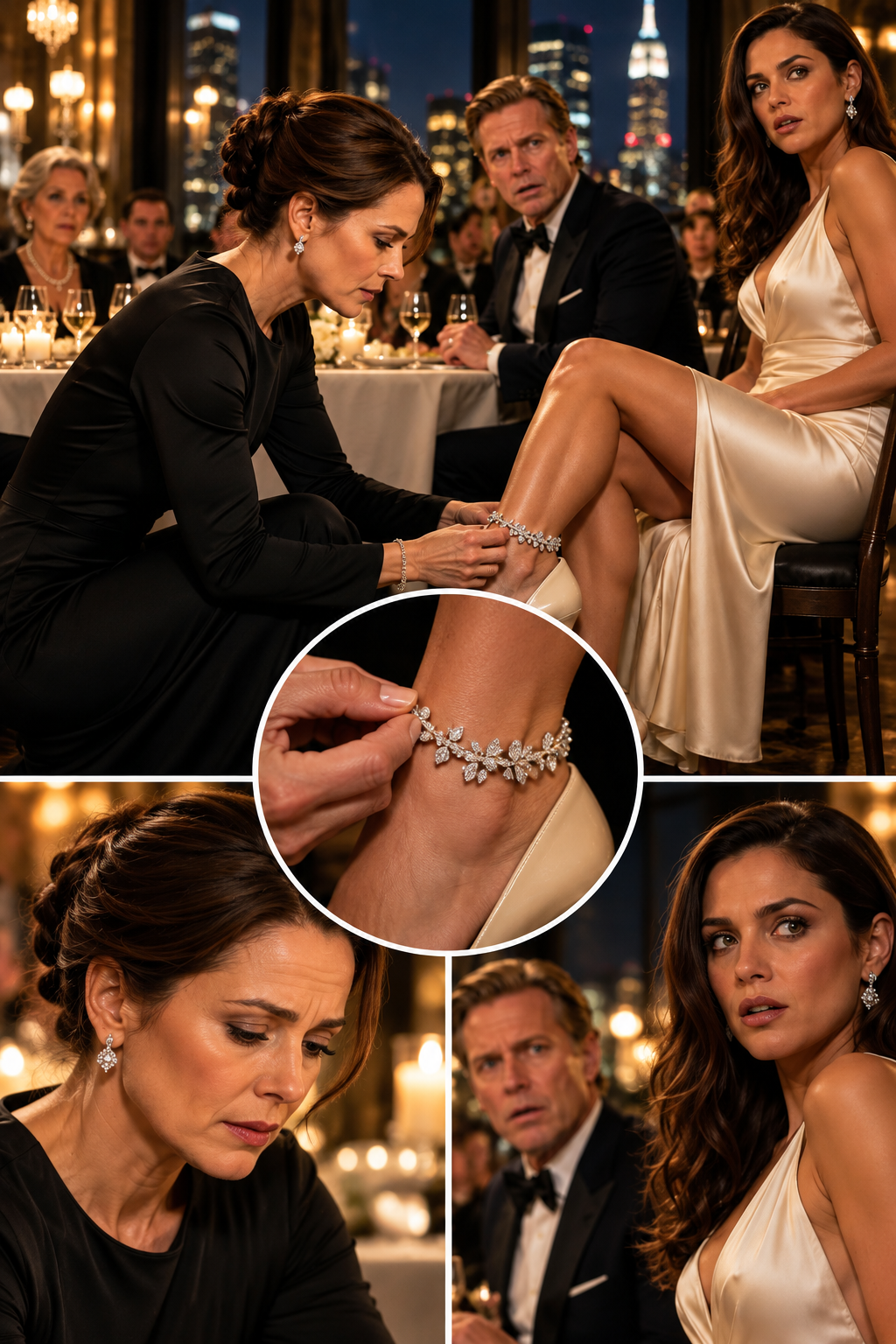
The first opportunity arrived when Meredith Blaine, a society columnist with sharp eyes and an instinct for expensive gossip, complimented Sienna’s anklet. Sienna stretched one leg forward and described the diamonds as a spontaneous gift from someone who understood her taste. Everett quickly praised her appreciation for unusual jewelry, apparently hoping the subject would end there. I told Meredith that the piece looked familiar and asked Sienna whether it had come from a European jeweler. She replied that Everett had commissioned it privately and that she considered it one of her most treasured possessions.
I asked to inspect the clasp.
Sienna hesitated for only a moment before allowing me to look, apparently deciding that displaying the jewelry mattered more than whatever discomfort my request created. Beneath the table, the engraved identifier remained visible, and I recognized the arrangement of the diamonds from the appraisal photographs. I sat upright and explained that the piece appeared to match jewelry previously reported missing from my collection. Everett immediately described my concern as emotional confusion and told the guests the necklace had been misplaced during travel. I placed the report and photographs on the table so everyone could see that the question had been documented long before dinner.
Sienna stared at the papers, then at Everett. She asked whether the diamonds had belonged to me, and he replied that the necklace had been an old family gift whose history was complicated. I corrected him, explaining that the piece originated in my mother’s private collection and had been removed without an authorization I could verify. The Miami jeweler’s receipt showed an alteration consistent with turning the necklace into an anklet. A courier record connected the timing of the work to Everett’s travel arrangements.
The table fell silent.
Sienna insisted she had not known anything about the necklace’s original ownership. I believed that possibility because Everett had told me so many confident lies that I understood how easily he could have misled her as well. Yet she had knowingly participated in an affair with a married man and seemed to have enjoyed displaying the jewelry before me. I told her those personal choices were separate from the question of whether she possessed property taken without authorization. The distinction mattered because evidence could establish one wrongdoing without proving every suspicion I held about another.
Everett’s father rose from his chair and demanded that we handle the matter privately. Conrad Whitmore had spent decades using his family’s reputation to influence banks, investors, and public officials, and he considered any visible family disagreement an unacceptable failure of discipline. I told him the missing jewelry had already become a formal investigation and that publicity had not been my objective. He accused me of embarrassing the Whitmore name, and I reminded him that his son had invited Sienna to wear the disputed piece at a dinner celebrating our marriage. Conrad’s expression hardened, but he did not answer.
Detective Vega arrived later that evening with another investigator, acting on information concerning the location of property relevant to the open report. She spoke privately with restaurant management before approaching our table and identifying herself. Sienna appeared frightened when Vega explained that investigators needed to document and examine the jewelry. After consulting the circumstances and agreeing to cooperate, Sienna removed the anklet and provided it for examination under the investigators’ procedures. The diamonds disappeared into an evidence container while the restaurant’s remaining guests watched in astonished silence.
Everett insisted the entire situation was a misunderstanding and promised that his attorneys would resolve it immediately. Sienna turned toward him with tears in her eyes and asked whether he had lied about the diamonds. He told her she was overreacting and attempted to direct her back to her seat. I watched the confidence leave her face as she realized the man who had presented himself as her protector was more interested in controlling the situation than explaining the truth. For the first time, she appeared to see Everett without the glamour surrounding his surname.
Before leaving, Detective Vega confirmed that the jewelry would be examined and that the investigation remained ongoing. Naomi arrived separately to accompany me home and ensure the relevant records were preserved. Everett attempted to speak with me privately, promising to explain everything if I stopped involving other people. I told him that explanations could be provided to the investigators and attorneys who had already spent months trying to establish what happened. Then I walked away from the anniversary dinner without waiting for dessert.
I expected to feel triumphant as I entered the elevator. Instead, I remembered my mother fastening simple earrings before museum dinners and telling me never to confuse beautiful objects with the people who wore them. The necklace had once represented Everett’s affection, then my inheritance, and finally evidence that he was willing to take what belonged to my family. Yet the jewelry itself had done nothing wrong. The betrayal belonged to the man who handled it.
The following morning, Naomi and I attended a specially convened meeting at Whitmore & Lane’s Manhattan headquarters. Independent directors, corporate counsel, and senior finance officers were present because concerns involving the Aspen development and trust collateral had reached a point requiring formal review. Everett arrived looking exhausted, while Conrad entered through a private elevator with the expression of someone determined to dismiss the entire situation as a family misunderstanding. I took a seat beside Naomi and waited for the independent chair, Elaine Porter, to open the meeting. The room was quiet enough that every turning page seemed unusually loud.
Conrad began by complaining that the previous evening’s jewelry incident had damaged the family’s reputation. Elaine reminded him that the board’s responsibility was to examine financial records and corporate conduct, not to determine whether a private dinner had been embarrassing. Naomi presented the trust’s financing agreements and explained that certain collateral protections required approvals not reflected in the available documents. She also identified inconsistencies between representations made to outside financing parties and the ownership rights held by Hart Meridian. The directors asked questions while Conrad repeatedly insisted the arrangements were ordinary business practices.
Everett claimed he had relied on advisers and did not understand the significance of the trust restrictions. I found that explanation difficult to accept because he had spent years presenting himself as a sophisticated real estate executive. Still, I allowed the professional reviewers to examine the evidence rather than interrupting whenever his statements sounded implausible. Naomi explained that the trust was entitled to demand information, protect its collateral, and pursue remedies if contractual breaches were established. Those rights did not permit arbitrary seizure of an entire company, but they created serious obligations that Whitmore & Lane could not ignore.
Then Sienna arrived.
She had contacted Naomi that morning after leaving The Marlowe Room and said she possessed messages relevant to the financial review. Elaine allowed counsel to arrange an appropriate meeting with her, and Sienna agreed to provide information voluntarily through the company’s investigative procedures. She appeared without makeup, wearing a simple coat and carrying a phone she held with both hands. Everett’s expression changed when he recognized the device. Conrad immediately demanded that she leave, but Elaine instructed everyone to remain professional.
Sienna explained that Everett had described the Aspen resort as their shared future. He promised her a creative leadership role and said the financing would become secure once certain Hart-connected assets were reorganized. She had not understood the legal mechanics, but she remembered repeated references to completing transfers before I discovered the full structure. When she questioned the arrangement, Everett reassured her that I rarely examined financial documents and would prefer a private divorce settlement. Sienna said she had believed him because he always spoke as though everything was already decided.
Her phone contained messages and voice recordings that required authentication before they could be treated as reliable evidence. Independent counsel preserved the material and arranged for forensic examination rather than allowing an improvised presentation to determine the board’s conclusions. Still, the information was serious enough to justify immediate safeguards against further transfers involving the disputed development. Elaine proposed restricting relevant authorizations while the audit continued. The directors approved protective measures under the company’s governance procedures.
Everett reacted angrily, accusing Sienna of betraying him and attempting to invent financial crimes to protect herself. She looked toward him with a mixture of humiliation and disbelief, then admitted that he had instructed her to describe the anklet as a European jewelry commission if anyone questioned its origin. Conrad remained silent, his hands resting flat on the table as though he could force the discussion to stop by refusing to participate. I recognized the expression because I had seen powerful men adopt it whenever facts became more dangerous than anger. Their confidence had depended on everyone else accepting incomplete explanations.
Naomi then described the potential consequences of the financing concerns. The Hart trust could issue formal default notices where supported by the agreements, demand corrective action, and pursue remedies if the identified breaches were not resolved. Calling secured obligations immediately would require careful consideration of contractual requirements and the impact on legitimate operations. I instructed our advisers to protect the trust’s rights while avoiding unnecessary damage to employees or innocent investors. The objective was accountability and asset protection, not destroying hundreds of livelihoods to punish my husband.
The board voted to suspend Everett from certain executive responsibilities pending completion of the financial investigation. Conrad was removed from committees handling the disputed development, and outside professionals were appointed to examine the relevant transactions. Sienna’s information became part of that review, subject to authentication and legal safeguards. No criminal conclusion was announced at the meeting, but the company’s leadership understood that the concerns extended far beyond missing jewelry. The Whitmore family’s most dangerous problem was no longer its damaged reputation.
Afterward, Everett approached me in the corridor and asked whether I wanted to ruin him. I told him I had wanted a husband who respected my family, honored our marriage, and treated valuable property as something other than an opportunity. He accused me of using the trust’s money as a weapon, and I reminded him that its agreements existed long before our personal conflict. I had spent eleven years defending his family against criticism because I believed we belonged to the same future. Now I was defending the assets my mother entrusted to me because he had made that future impossible.
For the first time, Everett seemed unable to imagine a response that would restore his authority. He looked toward the boardroom doors, where directors were continuing their discussions without him. Then he asked whether we could still save our marriage. I thought about the diamonds around Sienna’s ankle and the messages suggesting he intended to move assets beyond my reach. I told him the marriage could not survive another promise made only after the evidence became impossible to deny.
The weeks following the board meeting were filled with legal correspondence, accounting reviews, and public speculation about Whitmore & Lane’s future. Everett withdrew from active leadership while independent investigators examined the company’s financial arrangements, and Conrad gradually lost influence over decisions involving the contested Aspen project. Lenders demanded additional information, certain transactions were suspended, and the company began negotiating measures intended to stabilize its finances. None of those developments happened with the speed predicted by gossip, but they changed the balance of power. The trust’s rights were finally being treated as obligations that could not be ignored.
The jewelry investigation continued separately. Forensic examination confirmed that the anklet incorporated stones and identifiers matching my mother’s documented necklace, and the Miami atelier provided records concerning the alteration. Investigators also examined how the original piece left the private collection and whether the relevant insurance representations were accurate. Everett’s attorneys offered explanations that required further review, while Sienna cooperated in describing the circumstances under which she received the gift. I avoided predicting the outcome because recovering property and establishing criminal responsibility required different kinds of proof.
My marriage ended through a divorce process that was both emotionally exhausting and legally complicated. Our attorneys examined marital property, trust assets, and financial obligations, making sure the settlement reflected enforceable agreements rather than the assumptions Everett had repeated throughout our marriage. He initially demanded terms that would have preserved his access to certain Hart-controlled assets, but those claims were evaluated against the relevant documents. Eventually we reached a resolution that allowed each of us to move forward while leaving corporate and investigative matters subject to their separate processes. I did not feel victorious when I signed the final papers.
I moved out of our Fifth Avenue apartment soon afterward. The property had been beautiful, with high ceilings, a marble foyer, and views that once made me feel fortunate beyond description. But its rooms had become crowded with memories of dinners during which Everett ignored my questions, gifts that concealed dishonesty, and family gatherings where I was expected to behave as though nothing mattered more than the Whitmore name. I wanted a home where silence felt restful rather than compulsory. I found a smaller residence with large windows, bookshelves, and enough space to work without surrounding myself with objects chosen to impress visitors.
One cold morning, Detective Vega contacted me to explain that the recovered jewelry could be released under the applicable procedures. I arrived at the precinct wearing a camel coat and found the anklet resting inside an evidence container. Without restaurant lighting and Sienna’s deliberate performance, the diamonds looked strangely ordinary. They were still valuable, still beautiful, and still associated with my mother’s collection, but they no longer seemed capable of determining how I felt about myself. I realized that the power I had assigned them came from the memories attached to their changing owners.
After the necessary documentation was completed, I carried the recovered piece to Boston. My mother had trusted a jeweler named Aaron Feld for decades, and his small workshop near Beacon Hill remained one of the few places where I could remember her without thinking about the inheritance she left behind. Aaron examined the diamonds through a magnifying lens and recognized the engraving immediately. He shook his head when I explained that the necklace had been transformed into an anklet. Then he asked whether I wanted him to restore its original design.
For months, I had imagined doing exactly that. I pictured the crescent resting against my throat again, repaired so perfectly that nobody could tell Everett had ever taken it apart. But standing in Aaron’s workshop, surrounded by tools, sketches, and the quiet smell of polished metal, I understood that restoring the original arrangement would not undo my marriage. The necklace had already represented too many conflicting things. I wanted the stones to become something new without pretending their history had disappeared.
I asked Aaron whether he could create a bracelet using the diamonds and preserve my mother’s engraving. He suggested combining platinum with a narrow line of gold and placing the largest stone sideways so its falling-tear shape resembled a small compass. I loved the idea because a compass symbolized direction rather than sorrow. We reviewed the design together, and he promised to make something my mother would recognize without copying the past. For the first time, discussing the diamonds gave me pleasure instead of pain.
When the finished bracelet arrived, I opened its velvet box beside a window overlooking the city. The stones formed a delicate line of light around my wrist, and the engraved identifier remained protected inside the clasp. I fastened it without calling anyone to witness the moment. It felt neither like Everett’s gift nor Sienna’s humiliation. It felt like a piece of family history I had chosen to carry forward on my own terms.
That evening, I placed the empty evidence folder inside a locked cabinet and called my mother’s oldest friend. We spoke about Vivian’s love of old theaters, her habit of wearing simple jewelry, and her belief that preserving beautiful things could provide opportunities for people who might otherwise be forgotten. The conversation reminded me that my inheritance included responsibilities far more meaningful than any single necklace. I began considering a project my mother had supported shortly before her death. It involved restoring a historic theater in Charleston that had served generations of Black performers and community organizations.
The theater stood on a narrow Charleston street, its brick walls weathered by storms and decades of neglect. My mother had first visited it as a young woman while researching the history of cultural institutions threatened by redevelopment. She admired the building because it had survived periods when performers were denied access to many larger venues, creating a place where artists and audiences could gather on their own terms. Before her death, she asked Hart Meridian to explore whether the property could be restored without erasing the people who gave it meaning. The project had been delayed by competing priorities, but I now wanted to complete what she began.
Our team worked with preservation specialists, community historians, architects, and local arts organizations to establish a restoration plan. The objective was not simply to create another elegant venue suitable for wealthy donors, but to preserve the building’s archives and make performance space accessible to local artists. We developed apprenticeships for young technicians, musicians, and theater professionals while creating financial arrangements intended to support long-term operations. The work required patience because historic buildings often conceal problems behind beautiful surfaces. I found that complexity strangely comforting after months spent examining financial deceptions created by people who claimed to value heritage.
I traveled frequently to Charleston during the restoration. Each visit brought new discoveries, from original decorative details hidden beneath later renovations to photographs documenting performances held decades earlier. I met older residents who remembered attending concerts and community gatherings inside the theater, and their stories shaped decisions about what should be preserved. One woman showed me a photograph of her grandmother standing outside the entrance in the 1950s, wearing a handmade dress and smiling as though the building belonged to her entire neighborhood. I realized the theater’s value could never be measured solely through its appraised property price.
Naomi continued managing the trust’s financial concerns while I focused on the restoration. Whitmore & Lane underwent restructuring discussions, and its board pursued remedies where the investigations supported them. Everett resigned from his executive position, while Conrad stepped away from several responsibilities following scrutiny of the Aspen transaction. The company’s future depended on negotiations among creditors, investors, and management rather than on the Whitmore family’s desire to preserve appearances. I had no interest in turning the collapse of their authority into a public celebration.
Sienna sent a handwritten note several months after the anniversary dinner. She apologized for deliberately displaying the anklet and admitted that she had enjoyed believing she possessed something another woman valued. She also explained that Everett had repeatedly described our marriage as an empty arrangement maintained for money and reputation. I did not respond immediately because an apology could acknowledge harm without requiring the injured person to resume contact. Eventually I sent a brief message thanking her for cooperating with the investigation and wishing her well.
The distinction mattered to me. Sienna had behaved cruelly, but she had also provided information that helped investigators understand Everett’s conduct. I could recognize both facts without pretending we were friends or treating her later cooperation as proof that earlier choices did not matter. My mother’s lessons had always emphasized judgment rather than theatrical punishment. Accountability required acknowledging the truth even when it complicated the story I preferred to tell.
The theater reopened the following spring. Its restored interior featured warm lighting, carefully preserved ornamentation, modern accessibility improvements, and a stage designed to support community performances alongside professional productions. On opening night, I stood backstage wearing a deep-blue gown and the bracelet Aaron had created from my mother’s diamonds. Naomi was beside me, along with the theater director, Ruth Ann Bell, who had guided the project through countless difficult decisions. Ruth Ann squeezed my hand and asked whether I was ready to speak.
I walked onto the stage and looked out at an audience filled with local artists, preservation advocates, community members, donors, and families who had waited years to see the building restored. I spoke about my mother’s belief that historic spaces held memories that deserved care rather than ownership for its own sake. I thanked the people who protected the theater long before Hart Meridian became involved and acknowledged that our contribution represented only one chapter in its history. Then I announced the first group of apprenticeship recipients, young people who would receive training in stage production, conservation, and arts administration. The applause belonged to them.
After the ceremony, a young woman approached me in the lobby. She said she recognized me from the news surrounding The Marlowe Room and had been hesitant to mention it. Then she explained that a former partner had taken money from her savings, and seeing me pursue documentation had encouraged her to seek advice about recovering it. Her situation had not involved diamonds or wealthy families, but the uncertainty and shame felt painfully familiar. I told her I was glad she had found support and that careful documentation could help people understand their options.
She looked at my bracelet and asked whether it was made from the recovered diamonds. I said yes, and she smiled because she thought the design was beautiful. I told her the stones had belonged to my mother long before Everett entered my life, and that I had chosen to make something new rather than recreate the necklace exactly. She said that sounded like a good way to remember where something came from without allowing it to remain unchanged forever. Her words stayed with me long after the guests departed.
Two years after the anniversary dinner, people still occasionally recognized me as the woman whose husband’s mistress wore a stolen diamond necklace around her ankle. Strangers sometimes asked whether I had planned the confrontation or whether the public embarrassment made the divorce easier to survive. I usually answered that the investigation had begun months before the dinner and that legal evidence mattered more than anything dramatic I said at the table. The truth was less satisfying to people hoping for a simple revenge story, but it was more important to me. My life had never truly changed because of one memorable sentence.
The financial investigations reached their own conclusions through a mixture of negotiated remedies, corporate restructuring, and proceedings appropriate to the evidence. Hart Meridian protected its secured interests while working with responsible parties to avoid unnecessary disruption to legitimate operations. The Whitmore family lost much of the influence it once exercised over the company, and Everett’s ability to represent himself as its unquestioned future disappeared. I no longer followed every development because Naomi and the relevant professionals handled matters requiring my involvement. My former husband’s career was no longer a measure of my happiness.
Conrad eventually retreated from public business life. Lenora occasionally appeared at charitable gatherings, maintaining the impeccable manners that had once made me feel unwelcome inside her family. I did not attempt to determine whether she privately regretted the way Everett treated me because the answer would not change what happened. We exchanged polite greetings when circumstances required it, but our lives had separated. I was no longer responsible for protecting the Whitmore family’s image.
Hart Meridian expanded its cultural preservation work, creating partnerships that supported historic buildings, archive conservation, and training programs for young professionals. The Charleston theater became a thriving venue, hosting performances, educational activities, and community celebrations. Its success brought me more satisfaction than the expensive dinners where I once accepted praise for being Everett’s graceful wife. I enjoyed seeing artists enter the building with instruments, costumes, and ideas that had nothing to do with my marriage. The theater belonged to a future larger than my personal history.
My own home changed as well. I moved into a restored townhouse with tall windows, a small library, and a garden where I could sit without hearing anyone discuss investments or public appearances. The rooms were filled with paintings I loved, books from my museum years, photographs of my parents, and objects I collected because they meant something rather than because they carried impressive prices. I began hosting simple dinners for friends who did not expect expensive entertainment. Sometimes we stayed at the table for hours discussing travel, politics, art, and memories of people we missed.
I also returned to the work I loved before marriage. Museum curators invited me to advise on provenance questions, and Hart Meridian supported initiatives designed to help institutions document collections responsibly. My professional life no longer revolved around defending financial structures from people who wanted to misuse them. I still reviewed major decisions and honored my responsibilities as trustee, but I gave qualified colleagues the authority to manage work that did not require me personally. Learning to delegate gave me time to become interested in the world again.
Occasionally I thought about Everett with a tenderness that surprised me. There had been happy years, and I refused to rewrite every memory as deception simply because our marriage ended badly. I remembered the first evening at the Boston museum, the way he laughed when I challenged his interpretation of a painting, and the mornings when he prepared breakfast before business became the center of his life. Those memories remained real even though they could not excuse what followed. I had loved someone who eventually betrayed my trust, and both truths could exist without canceling each other.
The bracelet rested on my wrist during important occasions. Sometimes it caught sunlight and scattered little reflections across a table, reminding me of my mother’s collection and Aaron’s careful work. Other days, I left it in its velvet case because I no longer needed jewelry to remind myself that I possessed courage or judgment. The stones were beautiful, but their value had nothing to do with my worth. They were objects that people had used for affection, deception, vanity, and evidence before I chose to give them a different meaning.
One afternoon, I visited my mother’s grave in Connecticut. I brought white flowers and spent a long time sitting beside the stone, telling her about the theater, the people it served, and the younger professionals who had received training through our programs. I admitted that I had sometimes been frightened of failing her because Everett’s schemes exposed weaknesses in the safeguards she trusted me to manage. Then I realized she would not have wanted me to measure my life only by the mistakes other people made. She would have wanted me to recognize what I did after discovering them.
I remembered her telling me, when I was a child, that someone who steals a small thing may be testing whether anyone is paying attention. For years, I understood that lesson as a warning about property, money, and valuable objects. Now I realized it applied just as strongly to relationships. Everett had gradually taken my time, patience, confidence, and willingness to overlook uncomfortable truths, each time assuming I would continue protecting him. The necklace was only the first loss I could document clearly enough to challenge.
After leaving the cemetery, I drove to a small restaurant near the coast and ordered lunch alone. The waitress complimented my bracelet, and I thanked her without explaining its history. She had no reason to know the diamonds once hung around another woman’s ankle or that they had become evidence in a complicated family dispute. To her, they were simply beautiful stones arranged in an unusual design. I appreciated being able to accept a compliment without turning my life into a story.
Years later, I would receive invitations to speak at events concerning family businesses, ethical stewardship, and the preservation of valuable assets. Some organizers wanted me to discuss the scandal because they believed it would attract an audience, but I preferred conversations about governance and responsibility. I explained how proper inventories, independent reviews, and accurate documentation could protect organizations from mistakes and misconduct. I also emphasized that wealth did not eliminate vulnerability or guarantee good judgment. The people trusted with important resources still needed clear rules, accountability, and the courage to challenge those who misused authority.
At one such event, a young professional asked whether I had felt powerful when I confronted Sienna at The Marlowe Room. I considered the question before explaining that I had actually felt frightened, heartbroken, and deeply uncertain about what would happen next. The evidence gave me a way to act responsibly despite those emotions, but it did not make them disappear. Real confidence, I told her, was not a flawless expression or a clever remark delivered before wealthy strangers. It was the ability to protect yourself without allowing anger to become the only force guiding your decisions.
That evening, I returned home and placed the bracelet beside a photograph of my mother. I looked at her face and remembered how often she appeared calm while managing problems that would have overwhelmed other people. She had never claimed courage meant avoiding fear, and she rarely treated financial victories as reasons for public celebration. Instead, she believed success involved preserving something valuable long enough for others to benefit from it. I hoped the theater, the trust, and the life I had rebuilt would honor that belief.
The next morning, sunlight entered my bedroom and reflected from the diamonds onto the pale wall. For a moment, the tiny points of light resembled stars scattered across the room. I remembered seeing those stones at Sienna’s ankle and feeling that Everett had deliberately lowered something precious to humiliate me. But jewelry had never possessed the power to reduce my worth. Only my willingness to accept his version of the story could have done that.
I thought about the woman I had been before the dinner. She believed keeping a marriage intact required endless patience, even when trust had begun disappearing. She feared that challenging a wealthy husband’s family might make her seem ungrateful or vindictive. She had become so accustomed to being described as graceful that she sometimes hesitated to speak whenever the truth might make others uncomfortable. I wished I could tell her that dignity and silence were not the same thing.
The real ending to my marriage did not happen when Detective Vega recovered the anklet or when the board restricted Everett’s authority. It happened gradually, as I stopped arranging my thoughts around whether he would finally acknowledge what he had done. I no longer needed his apology to validate the evidence or his regret to justify my decision to leave. The facts had been established as far as the investigations and legal proceedings allowed, and the future required my attention more than the past. That recognition felt quieter than revenge but far more lasting.
On the third anniversary of the dinner, I returned to the Charleston theater for a performance by young artists supported through the apprenticeship program. The building glowed against the evening sky, its entrance crowded with families, musicians, and people who had never heard of Everett Whitmore. Inside, the audience gathered beneath restored lights while performers prepared backstage. I sat near the center of the room and felt an overwhelming gratitude that this place existed because people chose to protect it. My mother’s legacy had become something alive.
As the performance began, I glanced down at the bracelet on my wrist. The diamonds shone gently beneath the theater lights, no longer arranged as the necklace Everett claimed to have commissioned or the anklet Sienna once displayed. Their shape had changed, but their history remained. I understood that my own life had followed a similar path. I had not returned to the woman I was before my marriage; I had become someone new through everything I learned afterward.
Everett once believed taking my jewelry and undermining my inheritance would leave me frightened enough to accept whatever future he chose. Sienna believed wearing the diamonds would prove she had replaced me. Conrad believed the Hart family’s wealth could continue supporting Whitmore ambitions without requiring honesty in return. Each of them mistook my willingness to remain polite for an inability to defend myself. Their mistakes became visible only when the records they ignored began speaking for me.
I never needed the diamonds to prove I was valuable. I needed the truth to understand what had happened, the law to help establish accountability, and the courage to choose a life no longer organized around someone else’s deception. The bracelet remained a beautiful reminder of my mother, but the woman wearing it was responsible for everything she became afterward. I had survived the humiliation, protected what mattered, and discovered that my future could contain purpose without being defined by revenge.
When the final song ended, the theater filled with applause. I stood with the audience, watching young performers bow beneath lights that had once been dark for years. The sound moved through the restored building, warm and powerful, and I imagined my mother sitting beside me with the small approving smile she rarely offered in public. For the first time, I did not think about what Everett had taken. I thought about everything that remained.
And when I stepped outside into the Charleston night, the diamonds rested against my wrist like a line of small stars.
They had belonged to my mother.
They had been stolen, altered, displayed, and recovered.
Now they belonged to a future I had chosen for myself.
Everett thought he had placed my worth at another woman’s feet.
Instead, he led me back to the truth.
The jewels were always mine.
And so was my life.
✓ Lynn R. Adams
I met Everett Whitmore eleven years before the anniversary dinner, when I was twenty-six and working as an assistant curator at a Boston museum. He arrived for a fundraising reception wearing a charco…