The day my grandmother was buried, my parents abandoned me at her funeral to catch a luxury Caribbean
Part 2: A rushed funeral revealed exactly how little my parents cared.
The week before Grandma Rose’s funeral, our dining room became a planning center filled with travel brochures, printed airline tickets, and arguments about departure times. My mother had placed the funeral schedule beside the cruise itinerary, circling the church service in red and drawing an arrow toward the airport. When I asked why she was treating Grandma’s burial like an appointment squeezed between business meetings, she answered without looking up from her phone. “We paid a fortune for this vacation, Emma, and your grandmother wouldn’t want us wasting money.” I remember staring at her, wondering how someone could speak so confidently about the wishes of a woman she had barely bothered to visit while she was dying.
The cruise had cost almost eight thousand dollars, an amount my father repeated whenever I questioned their decision. He explained that canceling would mean losing deposits, airline fees, and reservations, as though financial inconvenience justified abandoning a grieving child. I suggested postponing the trip, contacting the cruise company, or simply accepting that sometimes families had responsibilities more important than vacations. Dad slammed his laptop shut and warned me that another disrespectful word would result in punishment. My mother added that I was becoming overly emotional and needed to learn that life didn’t stop whenever someone died.
The morning of the funeral, I wore a black dress Margaret had helped me choose, along with Grandma’s pearl earrings, which she had given me during her final week. Sacred Heart Church looked enormous and strangely empty, its stained-glass windows throwing pale colors across rows of vacant wooden pews. Several elderly neighbors attended, along with distant relatives who had traveled through freezing rain to pay their respects. My parents stood near the entrance, greeting everyone with polished smiles that disappeared whenever they checked the time. Amber remained beside them, scrolling through her phone, apparently more interested in messages from her friends than the coffin holding our grandmother.
The priest had never known Grandma personally, and halfway through the service, he mistakenly called her Ruth. I felt something inside me snap when nobody corrected him, not even my father, who had spent forty-five years calling that woman Mom. When the priest invited family members to share memories, my father shook his head and glanced toward the exit. I stood before I could lose my courage, walked to the lectern, and began speaking about Grandma’s life. I told everyone how she had worked until her fingers bled, how she secretly paid for groceries when struggling neighbors couldn’t afford them, and how she made a lonely little girl believe she mattered.
My voice trembled at first, but the longer I spoke, the more clearly I could hear Grandma encouraging me to stand tall. I described the Christmas she had sewn winter coats for three children whose father had lost his job, and the summer she taught me to bake bread because she believed everyone should know how to feed themselves. People began crying, including relatives I had never seen show much emotion. When I finished, Margaret was standing near the back of the church, her hand pressed against her heart. My mother leaned toward me as I returned to my seat and whispered, “That speech was completely unnecessary, and now we’re running late.”
At the cemetery, cold wind swept through the bare trees while Grandma’s coffin descended beside the grave of the husband she had lost decades earlier. I wanted to remain there until everyone left, but my father kept urging the family toward the reception. Less than two hours later, my parents were carrying their luggage toward the parking lot, dressed in travel clothes beneath their winter coats. I followed them outside, tears freezing against my cheeks, and asked one final time whether they could stay. Dad turned around, visibly irritated, and said, “You’re old enough to understand priorities, Emma.”
I watched their car disappear down the street, feeling as though something inside me had been buried alongside Grandma. Amber eventually offered to drive me to Margaret’s house, but she barely spoke during the journey. Just before I stepped out, she surprised me by admitting that our parents had behaved terribly. It was the closest she had ever come to defending me, and for one brief moment, I thought we might finally become sisters in more than name. But Amber drove away before I could answer, leaving me on Margaret’s porch with a suitcase, a broken heart, and no idea that my real childhood was about to begin.
Part 3: Grandma’s closest friend became the mother my family refused to be.
Margaret Hansen opened her front door before I could knock, as though she had been watching the street and waiting for me to arrive. She was seventy-one, with silver hair pinned into a loose bun and gentle brown eyes that reminded me of the warmth I had just lost. Without asking questions, she took my suitcase, guided me inside, and placed a steaming mug of hot chocolate between my shaking hands. Her house smelled of lavender, polished wood, and the chicken soup simmering in the kitchen. For the first time since Grandma’s death, I felt that someone cared whether I had eaten, slept, or survived the day.
Margaret had known Grandma Rose for more than forty years, beginning when they were young mothers living on the same street. She knew stories about my grandmother that nobody else remembered, including the winter Grandma secretly sold her wedding jewelry to pay for my father’s medical treatment. She told me about the years when Rose went without new shoes so her children could attend school looking respectable. She remembered how Grandma cried privately whenever one of her children dismissed her sacrifices as embarrassing signs of poverty. And she revealed that Grandma had worried deeply about the way my parents treated me.
“She saw how they favored Amber,” Margaret explained one evening while we folded laundry together. “She noticed how often you apologized for things that weren’t your responsibility, and she knew you were afraid of disappointing people who were rarely satisfied.” I asked why Grandma hadn’t confronted my parents, and Margaret sighed. She said Rose had tried many times, but Martin became defensive whenever anyone questioned his parenting. Eventually, Grandma decided that being a dependable presence in my life mattered more than winning arguments she couldn’t change.
During that first week, Margaret never pressured me to recover quickly from my grief. Some mornings I cried before breakfast, and other nights I sat on the guest-room floor surrounded by photographs of Grandma. Margaret would sit beside me, sometimes speaking and sometimes simply remaining there until I was ready to stand. She showed me how grief could exist alongside ordinary life, how we could laugh at an old memory without betraying the person we missed. On Sunday, she made Grandma’s favorite roast chicken and placed a small vase of yellow roses in the center of the table.
My parents returned from their cruise looking sunburned and cheerful, carrying souvenirs they had purchased for Amber but nothing for me. My father spent dinner describing a snorkeling excursion, while Mom complained that the ship’s premium restaurant hadn’t met her expectations. Neither asked how I had managed during the week or whether I wanted to talk about Grandma. When I mentioned that Margaret had helped me organize Grandma’s photographs, my mother rolled her eyes and accused me of dwelling on the past. That evening, I realized that the distance between my parents and me was no longer something I could pretend not to see.
Over the following months, I spent almost every weekend at Margaret’s house, where I helped with gardening, learned bookkeeping, and completed homework at her kitchen table. Margaret was a retired accountant who occasionally advised small businesses, and she approached money with a calm discipline that fascinated me. She explained compound interest, emergency savings, and why people who appeared wealthy were sometimes drowning in debt. Unlike my parents, who equated financial success with expensive possessions, Margaret believed money was valuable because it created security and choices. “A beautiful house means nothing,” she told me, “if the people inside it feel unwanted.”
Six months after Grandma’s funeral, my parents summoned me to the living room for what Dad called a serious family discussion. Their finances had deteriorated after months of overspending, and Amber’s upcoming college expenses had become the center of every conversation. Dad explained that they needed to reduce household costs, while Mom described how much money they spent on my clothes, food, transportation, and school activities. I listened in disbelief as they discussed my existence like an unnecessary subscription they wanted to cancel. Then my father announced that Margaret had agreed to become my legal guardian if I wanted to live with her permanently.
I looked from one parent to the other, waiting for someone to say they would miss me or that the arrangement was temporary. Instead, Mom told me that Margaret had plenty of room and that everyone would be happier if I moved. Dad promised occasional visits, although his tone suggested he considered those visits another obligation. I should have felt unwanted, and part of me did, but beneath the hurt was a powerful sense of relief. When I asked whether I could begin packing, both parents looked almost offended that I hadn’t begged them to keep me.
Part 4: My parents discarded their daughter while another woman rebuilt her life.
Moving into Margaret’s house was easier than I expected because I had already begun thinking of it as home. My parents signed the necessary guardianship documents after Margaret consulted an attorney, and they showed little interest in the details beyond confirming their financial obligations. I packed my clothes, schoolbooks, photographs, and the small wooden sewing box Grandma had given me. Amber watched from her bedroom doorway as I carried the last suitcase downstairs, then offered a quiet goodbye without stepping forward to hug me. Dad remained in his office, and Mom reminded me not to forget my winter coat because she didn’t want another reason to drive across town.
Margaret helped me decorate my bedroom with pale green curtains, secondhand bookshelves, and a quilt Grandma had sewn years earlier. She encouraged me to invite friends over, join school activities, and make decisions without constantly worrying about whether I was inconveniencing someone. At first, ordinary kindness made me suspicious because I had grown accustomed to affection being conditional. When I accidentally broke one of her favorite ceramic bowls, I began crying before she even entered the kitchen. Margaret looked at the broken pieces, checked whether I was injured, and said, “Emma, sweetheart, people are always more important than things.”
That sentence stayed with me because it represented everything my parents had never understood. In their home, a scratched table or expensive carpet stain could provoke hours of anger, while my sadness was dismissed as childish drama. At Margaret’s, mistakes became opportunities to learn rather than evidence that I was a disappointment. She attended parent-teacher conferences, celebrated my report cards, and listened when I struggled with friendships. She also encouraged counseling, helping me understand that my parents’ choices were reflections of their priorities rather than proof that I lacked value.
My grades improved steadily, and by my junior year of high school, I had discovered a passion for working with vulnerable children. I volunteered at a community center, helped younger students with homework, and participated in a holiday program for families experiencing homelessness. Seeing children who carried adult worries reminded me of the girl I had been when Grandma died. I began considering a career in social work, although I worried that the education required would be too expensive. Margaret listened carefully and told me that helping people build safer lives was one of the most meaningful careers she could imagine.
One evening, she surprised me by revealing that Grandma Rose had once dreamed of becoming a nurse. Rose had abandoned that dream when her mother became ill, choosing employment over education because her family needed the income. Margaret showed me an old notebook containing anatomy sketches, medical terminology, and handwritten notes Grandma had saved from a correspondence course. I cried as I turned the pages, realizing that the woman who had taught me to pursue my dreams had sacrificed so many of her own. Margaret placed her hand over mine and said, “Your grandmother wanted you to have choices she never had.”
With Margaret’s encouragement, I applied to several universities and received an offer from Boston University, along with a partial scholarship. When the financial aid package arrived, I worried about covering the remaining tuition and living expenses. Margaret calmly explained that Grandma had left a small educational fund for me and that she had saved additional money to help with college. I protested because I knew she had already done more for me than anyone else. She smiled and replied, “Love isn’t a ledger, Emma, and I’m not keeping score.”
My parents never attended my high school graduation, although I mailed them invitations weeks in advance. Dad sent a brief message claiming he had an unavoidable business commitment, while Mom said Amber needed help preparing for an internship. Margaret sat in the front row with a bouquet of sunflowers and cried when I crossed the stage. Afterward, she took photographs outside the auditorium and insisted we celebrate at my favorite restaurant. That night, as we drove home beneath the summer stars, I realized that the empty seats my parents had left behind no longer defined the day.
College brought challenges I hadn’t anticipated, including demanding coursework, financial anxiety, and the loneliness of living far from home. Margaret called every Sunday evening, sent care packages before exams, and visited whenever she could. My biological parents never asked about my classes, internships, or plans after graduation. When I earned my bachelor’s degree and later completed a master’s program in social work, Margaret was there for both ceremonies, cheering with the enthusiasm of an entire family. I thought about Grandma Rose each time I accepted a diploma, wishing she could see the future she had helped make possible.
Part 5: A sudden death reunited me with the family that abandoned me.
By twenty-seven, I was working for a nonprofit organization in Portland that supported teenagers transitioning out of foster care. My days involved arranging housing, helping young adults enroll in college, and advocating for children whose circumstances often resembled my own. The work could be emotionally exhausting, but I loved knowing that a conversation, scholarship, or safe place to sleep might change someone’s future. Margaret remained my closest confidante, and every Sunday evening we shared dinner at her kitchen table. We continued setting a place for Grandma Rose in our memories, telling stories about her whenever something reminded us of her kindness.
Margaret was eighty-three, and although she moved more slowly, her mind remained sharp and her humor wonderfully unpredictable. She still balanced her checkbook by hand, complained about overpriced groceries, and insisted on growing tomatoes despite the physical effort required. I frequently offered to hire someone to help around the house, but she refused to surrender the independence she treasured. One Sunday, she asked whether I was happy with the life I had built. When I told her I was, she smiled and said, “Then your grandmother and I accomplished exactly what we hoped.”
Two days later, my phone rang while I was reviewing a case file at work. The caller introduced himself as James Chin, an attorney who had handled Margaret’s financial and estate planning for many years. His voice was gentle but unusually formal, and I immediately felt a terrible tightening in my chest. He explained that Margaret had suffered a fatal heart attack during the night and had passed away peacefully at home. I remember gripping the edge of my desk, unable to understand how someone who had been laughing over Sunday dinner could suddenly disappear from the world.
The days that followed blurred into funeral arrangements, paperwork, and moments of grief so intense that ordinary tasks became difficult. I chose Sacred Heart Church for Margaret’s service because she had loved its quiet beauty and because Grandma Rose had been honored there years earlier. This time, I refused to allow the ceremony to become rushed or impersonal. Friends, former foster children, neighbors, and colleagues filled the pews, sharing stories about the countless ways Margaret had helped them. When I stood to deliver the eulogy, I described her as the woman who had chosen to become my mother when the people responsible for raising me decided I was too inconvenient.
My parents did not attend Margaret’s funeral, and neither did Amber. Their absence hurt less than I expected because I had long since stopped measuring my worth through their attention. What surprised me was the phone call I received afterward from James Chin, informing me that Margaret’s will specifically mentioned my parents and sister. He explained that they had been invited to a formal meeting at his office the following Tuesday. I couldn’t imagine why Margaret would include people who had barely acknowledged her existence for more than a decade.
The morning of the meeting, I dressed in a simple black dress and drove through downtown Portland beneath a gray autumn sky. I had no expectations beyond receiving a few personal belongings, perhaps Margaret’s sewing machine or the recipe box she had inherited from Grandma. When I entered the conference room, I stopped so abruptly that the receptionist nearly collided with me. My parents were already seated at the polished wooden table, looking older, wealthier in appearance, and just as emotionally distant as I remembered. Amber sat beside them wearing an expensive suit and an expression of open curiosity.
Dad stood when he saw me, smiling awkwardly as though we had simply lost touch after a minor disagreement. Mom examined my clothes before offering condolences, and Amber asked whether Margaret had been ill for long. Their questions felt rehearsed, but I answered politely because I had no interest in reopening old wounds. Then Dad leaned forward and asked whether I knew anything about Margaret’s finances. Before I could respond, James Chin entered carrying a thick leather folder, and the atmosphere in the room changed immediately.
James explained that Margaret had carefully organized her estate and left detailed instructions regarding every beneficiary. My father straightened in his chair, my mother opened a notebook, and Amber placed her phone facedown on the table. I remained quiet, thinking about the woman whose absence had created this strange gathering. James looked directly at my parents and announced that Margaret had left them something she believed they had avoided confronting for far too long. Then he opened the folder and began reading.
Part 6: An attorney exposed decades of selfishness before revealing an astonishing fortune.
James Chin began with a letter addressed to Martin and Christine Morrison, written in Margaret’s unmistakably elegant handwriting. My father smiled slightly when he heard his name, apparently assuming that the letter accompanied a generous financial gift. Instead, James explained that Margaret had compiled records documenting decades of financial assistance Grandma Rose had provided to her adult son. The documents included canceled checks, loan agreements, handwritten receipts, and bank statements showing repeated transfers that Martin had promised to repay. According to Margaret’s calculations, my father had borrowed approximately $127,000 from his mother without fulfilling those promises.
Dad immediately protested that private family arrangements were nobody else’s business, but James continued reading without raising his voice. The records showed additional expenses Grandma had covered for Amber and me, including medical bills, school supplies, childcare, and emergency household costs totaling roughly $43,000. I stared at the documents, remembering my father’s repeated complaints that Grandma had never helped him become successful. Apparently, she had quietly sacrificed her savings to support him while he criticized her modest lifestyle. My mother shifted uncomfortably as James described the payments, and for the first time, I saw uncertainty replace her usual confidence.
Then James read Margaret’s personal message, and the room became painfully silent. She wrote that my parents had mistaken financial assistance for entitlement and confused family loyalty with an obligation that applied only to other people. She described the funeral they had rushed to accommodate their cruise and the frightened child they had left behind. She reminded them that Grandma Rose had spent her life protecting her children, only to have one of them dismiss her death as inconvenient timing. Finally, Margaret wrote that their decision to surrender responsibility for me had revealed more about their character than any amount of money ever could.
My mother interrupted, accusing Margaret of being judgmental and vindictive, but James calmly explained that the letter represented Margaret’s personal wishes rather than a legal claim for repayment. He added that she had established a separate $50,000 counseling trust that could help fund family therapy if I ever voluntarily chose to pursue reconciliation. The trust would remain available for five years, after which any unused funds would pass to me. Dad scoffed at the idea of therapy, declaring that our family had never needed outsiders interfering in private matters. I almost laughed at the irony of a man who hadn’t spoken to his daughter in years insisting that the family was functioning perfectly.
James then turned to Amber and informed her that Margaret had left her a collection of valuable first-edition books. Their estimated worth was fifteen thousand dollars, although Margaret had expressed hope that Amber would appreciate their literary significance rather than immediately sell them. Amber looked disappointed and asked whether there were additional accounts or property interests attached to the gift. When James explained that there were none, she folded her arms and muttered that the entire situation was ridiculous. I watched her reaction with sadness because she seemed unable to recognize generosity unless it arrived in the form she preferred.
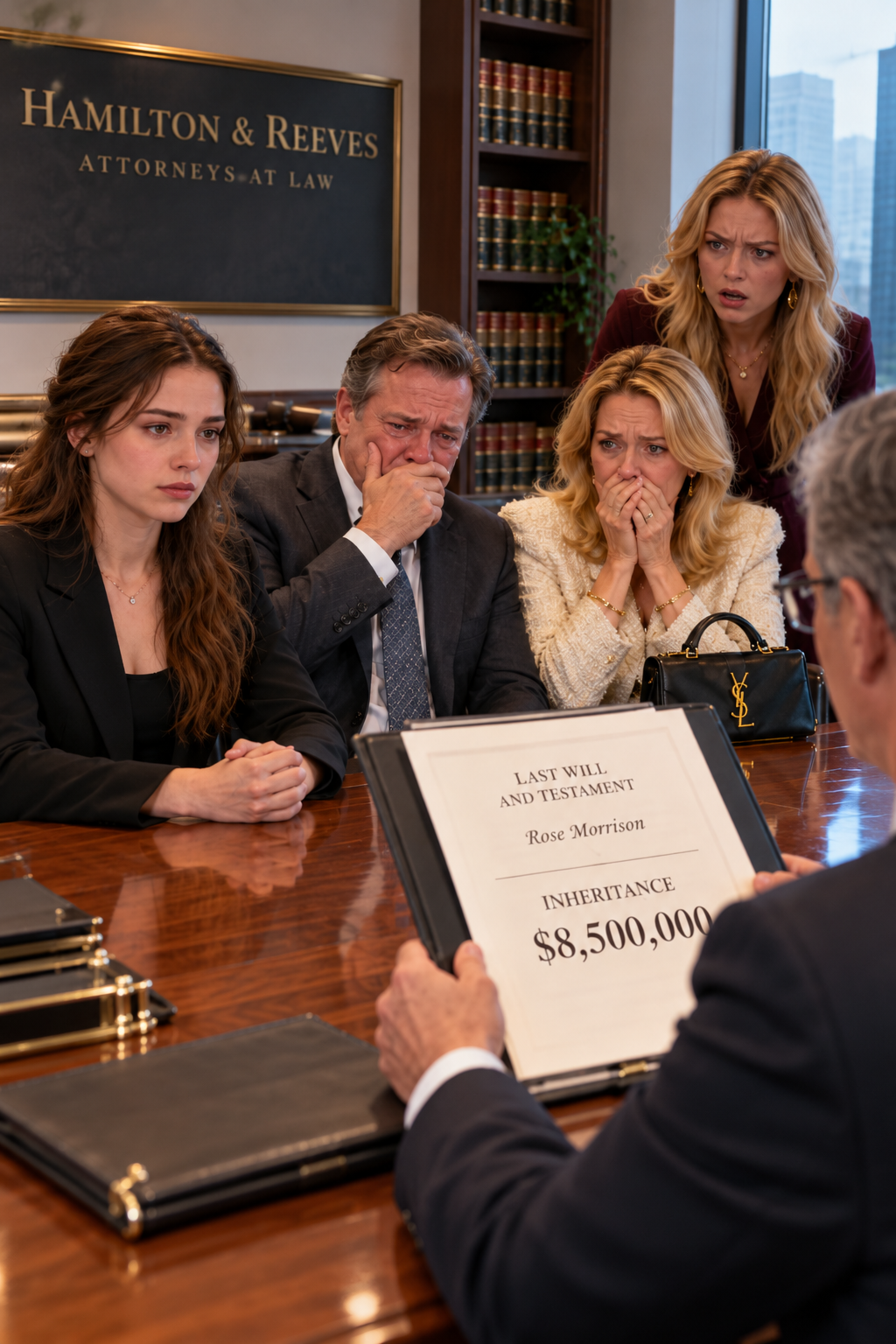
Finally, James looked toward me, and his expression softened. He explained that Margaret had regarded me as her daughter for thirteen years and had made me the principal beneficiary of her estate. He listed her house, valued at approximately $680,000, followed by investment accounts worth $3.2 million and savings totaling another $1.4 million. There were retirement assets estimated at $2.8 million, along with vehicles, jewelry, and other personal property worth approximately $420,000. The combined estimated value was $8.5 million, subject to final accounting, taxes, and administration.
I heard the numbers, but they seemed disconnected from reality, as though James were discussing someone else’s life. Margaret had lived simply, driven an aging sedan, and reused wrapping paper at Christmas, so I had never imagined she possessed extraordinary wealth. James explained that she had invested carefully for decades, inherited a modest portfolio from a relative, and benefited from years of patient financial growth. She had never considered luxury important enough to justify spending what she could use to help others. Her wealth had remained largely invisible because she had never needed strangers to admire it.
My father suddenly pushed back his chair, his face turning crimson as he demanded to know how Margaret could leave everything to me. Mom insisted that they had known Margaret for years and deserved consideration as members of Rose’s family. Amber asked whether the will could be challenged, while Dad repeated the total inheritance aloud as though each repetition made the situation more offensive. James explained that Margaret had executed her documents with appropriate legal safeguards and that biological relationships to a deceased person’s friend did not create automatic inheritance rights. Then my father turned toward me and said the words I would remember for the rest of my life: “We gave away a daughter who was worth eight and a half million dollars.”
Part 7: My parents demanded a fortune, but I finally found my voice.
For several seconds, I couldn’t speak because my father’s words seemed to erase every painful year between us. He hadn’t said he regretted missing my childhood or that he wished he had treated me differently. He regretted losing access to money that had never belonged to him. My mother placed a hand on his arm and began explaining that parents deserved financial support from successful children, especially when they had sacrificed so much. I looked at her and wondered which sacrifices she meant, because my clearest memories involved being treated as an expense that needed to be eliminated.
James attempted to continue the meeting, but Dad interrupted with questions about Margaret’s mental capacity and whether she had been manipulated. He suggested that I must have known about her wealth and deliberately isolated her from my biological family. The accusation stunned me because I had spent thirteen years loving Margaret without ever knowing the size of her investments. I reminded him that he had been free to visit me, call me, or develop a relationship with Margaret whenever he wished. Instead, he had chosen to disappear until an inheritance gave him a reason to return.
My mother began crying, but her tears were accompanied by demands rather than apologies. She claimed that Amber deserved an equal share because both of us were Rose Morrison’s granddaughters, even though the estate belonged to Margaret. Amber quickly agreed, arguing that family wealth should be divided fairly regardless of personal relationships. I asked her when she had last visited Margaret or sent her a birthday card. She stared at me for a moment before admitting that she couldn’t remember, then accused me of making everything unnecessarily personal.
“Everything about this is personal,” I replied, surprised by the steadiness of my own voice. “Margaret wasn’t a bank account waiting to be distributed among people who ignored her.” I told them about the nights she had stayed awake helping me study, the college visits she had made, and the hospital appointments where I had sat beside her when she needed support. I described how she had encouraged my career, celebrated my achievements, and loved me without demanding anything in return. Then I asked my parents to name one meaningful thing they had done for either of us during those thirteen years.
Neither answered, and the silence exposed more than any argument could have accomplished. Dad finally muttered that he had been busy building a business, while Mom claimed that children eventually needed to become independent. I reminded them that I had been fourteen when they abandoned me at Grandma’s funeral and fifteen when they arranged for someone else to raise me. Independence wasn’t something they had taught me through loving guidance. It was something I had been forced to develop because they considered my needs inconvenient.
James handed me a sealed envelope containing a final letter from Margaret, and I opened it with trembling fingers. She wrote that she had deliberately kept her wealth private because she wanted our relationship to remain untouched by expectations or obligation. She said she had watched me grow from a frightened teenager into a compassionate woman who gave her time to children other people overlooked. She hoped the inheritance would provide financial security, but she also hoped I would use part of it to create opportunities for young people who lacked dependable families. At the bottom, she had written, “You were never a burden, Emma, and loving you was never a sacrifice.”
I pressed the letter against my chest and cried, not because I had suddenly become wealthy, but because Margaret had understood the wound my parents had left behind. She knew that some part of me still feared being unwanted, no matter how successful or independent I became. Her final words answered a question I had carried since childhood. I had not been too difficult, too expensive, or too unimportant to deserve love. I had simply been born to people who valued the wrong things.
When I stood to leave, Dad moved toward the doorway and insisted that we needed to discuss a reasonable family settlement. Mom suggested that I could give them a million dollars without affecting my lifestyle, while Amber argued that sharing the inheritance would prove I was a better person than they had been. I looked at all three of them and understood that no amount of explanation would transform entitlement into remorse. I told James to communicate with me directly regarding the estate and asked my family not to contact me about money again. Then I walked out of the conference room, carrying Margaret’s letter and feeling freer than I had in years.
Part 8: I transformed an unwanted inheritance into the legacy my mothers deserved.
The months following the estate meeting were more difficult than the dramatic confrontation itself. My parents called repeatedly, sent lengthy emails, and attempted to contact me through relatives who suddenly became interested in rebuilding family connections. Their messages alternated between apologies, accusations, financial requests, and warnings that I would regret refusing to help them. Dad claimed his business was struggling and suggested that a small investment from me could preserve the family name. Mom insisted that Grandma Rose would have wanted me to forgive them, although she seemed unwilling to acknowledge how they had treated Grandma while she was alive.
I consulted James and established clear boundaries, directing all financial and legal communications through his office. He helped me work with an independent financial adviser, an accountant, and estate professionals to understand the inheritance before making major decisions. I learned that the headline figure represented estimated asset values rather than an immediate deposit of $8.5 million into my checking account. There were administrative expenses, tax considerations, and long-term planning decisions that required careful attention. Margaret had spent decades building financial security, and I refused to dishonor her work through impulsive spending or emotional pressure.
I eventually sold Margaret’s house because living there without her felt unbearably painful. Before the sale, I spent one final afternoon walking through its familiar rooms, remembering the frightened teenager who had arrived carrying a suitcase after Grandma’s funeral. I kept Margaret’s sewing machine, her recipe collection, several pieces of furniture, and the quilt that had covered my bed throughout high school. I also saved the old kitchen table where she had taught me to manage money and encouraged me to pursue college. When the moving truck arrived, I cried harder than I had expected, but I knew memories could survive without ownership of the building that held them.
I purchased a modest home near my workplace and continued my career rather than resigning to enjoy an extravagant lifestyle. My colleagues knew I had received an inheritance, but most had no idea how substantial it was. I still attended difficult meetings, helped teenagers prepare job applications, and advocated for housing resources that were never sufficient to meet demand. The money changed my personal financial security, but it didn’t erase the experiences that had shaped my purpose. If anything, I felt a stronger responsibility to create opportunities for young people who had never experienced the protection Margaret gave me.
After months of planning, I established the Rose Morrison and Margaret Hansen Foundation, an organization dedicated to educational support, mentoring, and emergency assistance for foster youth. I committed a significant portion of my inheritance to its initial funding and worked with experienced nonprofit professionals to create a sustainable structure. Our first programs provided college application assistance, vocational training grants, tutoring, and emergency housing support. We partnered with local organizations rather than attempting to replace services that already existed. My goal wasn’t to become famous for generosity; it was to make sure children who felt forgotten could find practical help when they needed it.
At the foundation’s opening celebration, nearly two hundred guests gathered in a community center decorated with photographs of Grandma Rose and Margaret. Former foster children spoke about the importance of having someone attend their school events, remember their birthdays, or answer the phone during a crisis. I stood before the audience and described how two extraordinary women had taught me that love was demonstrated through consistent action. I explained that Grandma had given me my first understanding of compassion and Margaret had turned that understanding into a life I could build upon. When I finished, the audience stood applauding, and I wished desperately that both women could have witnessed what their kindness had created.
A local newspaper published a feature about the foundation, including a brief account of my childhood and the inheritance that helped launch the organization. Within days, my parents resumed contacting me, this time insisting that the article had unfairly damaged their reputation. Dad accused me of humiliating the family, while Mom claimed that private matters should never have been discussed publicly. I reminded them through my attorney that I had not named them in my speech or invited anyone to investigate their personal lives. The story centered on two women who had helped vulnerable children, not on the people who had failed to do so.
Amber eventually sent a message that differed from the angry demands I had received earlier. She admitted that she had often followed our parents’ example because questioning them would have meant risking their approval. She acknowledged that she should have defended me when I was younger and that Margaret had shown me more loyalty than our biological family. I appreciated the honesty, but I didn’t pretend it erased years of indifference. I replied that rebuilding trust would require time, consistency, and a relationship that had nothing to do with inheritance money.
Part 9: Years later, I discovered that the greatest inheritance was being loved.
A year after Margaret’s death, my life had settled into a rhythm that would have seemed impossible to the fourteen-year-old girl abandoned in a church basement. The foundation was supporting nearly two hundred young people through scholarships, mentoring, and partnerships with community organizations. I remained involved in direct social work because I never wanted financial administration to separate me from the people we served. My home was comfortable but ordinary, with books stacked beside the sofa, flowers on the kitchen windowsill, and Grandma’s embroidered handkerchief framed near the front door. Every Sunday, I prepared dinner using recipes from the two women who had taught me what home should feel like.
I also fell in love with Daniel Parker, a public school counselor whose quiet patience reminded me of the best parts of Margaret’s character. We met through a youth mentoring program, and our relationship developed slowly through shared work, long conversations, and an understanding that trust was something built rather than demanded. Daniel never treated my inheritance as an achievement or my family history as entertainment. He respected my boundaries, listened when old memories surfaced, and celebrated the foundation’s progress without trying to claim any part of it. When he proposed during a weekend trip along the Maine coast, I said yes beneath a sky filled with the soft colors of sunset.
Planning our wedding forced me to confront questions I had avoided for years, particularly whether my biological parents should be invited. Several relatives argued that weddings were opportunities for reconciliation and that excluding them would create unnecessary conflict. I considered their opinions, but I also remembered the funeral where my parents had prioritized a cruise over their grieving daughter. I had no desire to turn another meaningful ceremony into a performance centered on their comfort. Daniel supported my decision to invite people who had consistently treated us with love and respect.
Amber attended our small wedding after months of careful conversations and a few tentative visits. She arrived without demands, helped arrange flowers, and quietly apologized for the years she had spent ignoring my pain. Our relationship remained cautious, but I began to believe that something healthier might eventually grow between us. My parents did not attend, although they sent a card containing a brief congratulations followed by another request to discuss family finances. I placed it in a drawer and refused to let it overshadow the happiest day of my life.
During the reception, Daniel and I displayed photographs of Grandma Rose and Margaret beside a small arrangement of yellow roses. I wore Grandma’s pearl earrings and carried a piece of Margaret’s wedding lace sewn discreetly into my dress. When I spoke to our guests, I thanked the people who had shown me that family could be created through loyalty, kindness, and everyday acts of care. I didn’t mention my parents or the money that had once made them furious. That day belonged to love, and I wanted nothing from my past to diminish it.
Several months later, I learned through a distant relative that my father’s business had closed and my parents were living in a smaller apartment. The news stirred complicated emotions, including sadness for the opportunities they had wasted and relief that their financial problems were no longer mine to solve. I didn’t celebrate their difficulties, but I also didn’t interpret them as a debt I was obligated to repay. Their circumstances were the result of decisions made over many years, just as my present life reflected the choices Grandma and Margaret had encouraged me to make. I wished them stability without inviting them back into a relationship defined by entitlement.
One afternoon, a sixteen-year-old girl named Lily visited the foundation after being placed with a new foster family. She was intelligent, guarded, and convinced that needing help made her a burden to everyone around her. As we talked, she admitted that she had stopped asking adults for anything because disappointment hurt less when she expected nothing. I recognized the fear in her voice immediately because I had once spoken the same way. I told her about a woman who welcomed me into her home after the worst day of my childhood and never made me feel guilty for needing love.
Lily asked whether that woman had been related to me, and I smiled through unexpected tears. I explained that Margaret had been my grandmother’s closest friend, but she became my mother in every way that mattered. Lily considered that for a long moment before asking whether people could really choose to become family. I told her they could, although trust should be earned through dependable actions rather than promises alone. As she left with information about our mentoring program, I realized that Grandma and Margaret’s legacy was continuing in ways no inheritance document could ever fully measure.
Sometimes I still think about the conference room where my father discovered that I had inherited $8.5 million. I remember his disbelief, my mother’s anger, and the desperate way they tried to convert biological relationships into financial claims. But those memories have lost their power because the money was never the most important part of the story. The true inheritance began years earlier, when Grandma taught me that kindness mattered more than status and Margaret proved that a child could be loved without conditions. Their generosity gave me an education, a purpose, a family, and the courage to build a future that didn’t depend on anyone else’s approval.
On the anniversary of Grandma Rose’s death, I visited the cemetery with Daniel and placed yellow roses beside her headstone. Margaret rested nearby, beneath a marker engraved with words I had chosen from one of her favorite letters: “Love is what we give, and what we leave behind.” I sat between their graves for a long time, remembering the frightened girl who had believed her parents’ abandonment meant she wasn’t worth keeping. I wished I could reach backward through time, hold that girl’s hand, and show her the life waiting beyond her grief. Most of all, I wanted her to know that the people who walked away had never possessed the authority to determine her worth.
My parents once believed they had saved money by giving me away, and years later, they believed they had lost millions because of that decision. They were wrong about both things, because children aren’t financial assets and love isn’t a transaction. Margaret didn’t become my mother because she expected an inheritance, and I didn’t care for her because I imagined she had a fortune hidden away. We chose each other when there was nothing to gain except companionship, trust, and the ordinary happiness of belonging. That was the legacy Grandma Rose began, Margaret protected, and I intend to carry forward for the rest of my life.
✓ Lynn R. Adams
Part 2: A rushed funeral revealed exactly how little my parents cared. The week before Grandma Rose’s funeral, our dining room became a planning center filled with travel brochures, printed airline t…