“The costume rental is $800, but you can always wear your dry-cleaning smock. It’ll be cute.” A wealthy mother said that in front of my daughter when I told her we’d be attending the school’s Christmas ball. Then she warned me to stay away from Nathan Hayes, a wealthy widower on the school board. Three weeks later, Ella and I arrived wearing two dresses I’d sewn myself from designs my late mother had left behind. And the woman who’d humiliated us was standing right there.
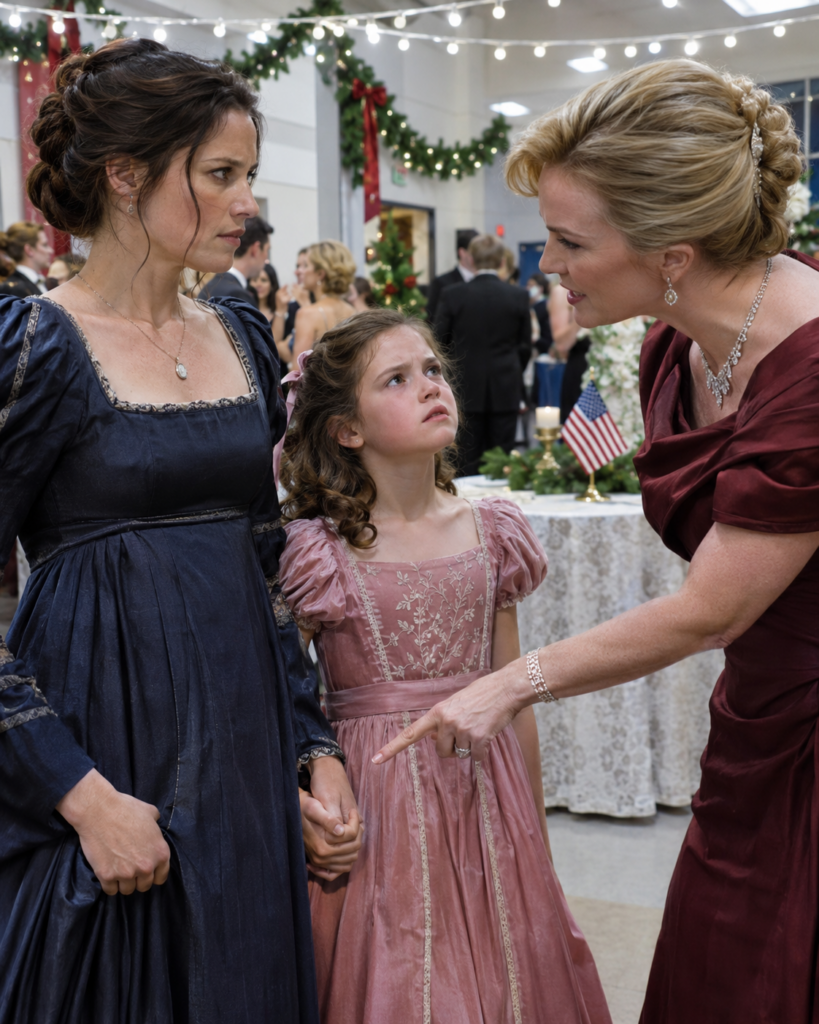
A Wealthy Mother Told Me to Wear My Dry-Cleaning Smock to the Christmas Ball. Then She Saw the Dresses My Mother Had Drawn.
“Let’s go home, princess,” I whispered, taking my daughter’s hand.
Ella didn’t move.
She stood beneath the Christmas lights in a dress I’d spent three weeks sewing, staring at the woman who had just humiliated us in front of half the school.
“Mommy,” she said quietly, “did we do something wrong?”
I felt her fingers tightening around mine.
“No, sweetheart.”
“Then why do we have to leave?”
That question stopped me.
Across from us, Vanessa adjusted the diamond bracelet on her wrist. She wore a burgundy gown that probably cost more than I earned in a month, and she looked perfectly satisfied with herself.
A moment earlier, she’d announced to the other parents that I pressed clothes at Lexington Cleaners. Then she’d suggested that the two beautiful dresses Ella and I were wearing had probably been made from old curtains.
She’d looked directly at my daughter and reminded her that wealthy families like Vanessa’s had paid for the evening.
Ella was only eight.
She shouldn’t have had to stand there while a grown woman explained why she didn’t belong at her own school’s Christmas ball.
“It’s probably best if you go,” Vanessa said, smiling as though she were offering friendly advice. “These events can be overwhelming when you’re not accustomed to them.”
I turned toward her.
“Vanessa, you’ve said enough.”
Her eyebrows rose.
“I was only trying to save you some embarrassment.”
Behind her, several parents exchanged uncomfortable looks. Nobody laughed.
I could hear the music continuing at the other end of the decorated auditorium. Children were dancing beneath strings of white lights, their costumes sweeping across the polished floor.
Ella had been looking forward to this evening for months.
I’d nearly talked myself out of bringing her because I couldn’t afford the elaborate rental costumes some families had ordered.
Then I’d found two drawings my late mother had left behind.
One was a dress for me.
The other was for a granddaughter she had never lived to meet.
I’d spent night after night bringing those drawings to life.
Now, standing in the auditorium, I was about to take Ella home because one woman had decided we weren’t good enough to stay.
Ella looked down at the delicate embroidery on her sleeve.
“Grandma drew this for me,” she said.
“She wanted me to wear it?”
“I think she would have loved seeing you in it.”
Ella looked toward the dance floor.
“Then I want to stay.”
I stared at her.
She wasn’t asking me to confront Vanessa. She wasn’t asking for revenge.
She simply wanted the Christmas evening I’d promised her.
I crouched until we were eye to eye.
“Are you sure, honey?”
She nodded.
“I haven’t finished dancing.”
I took a breath.
“All right.”
When I stood again, Vanessa was watching us.
“Well?” she asked.
I released Ella’s hand long enough to straighten the embroidered cuff of her dress.
“We’re staying.”
Vanessa’s expression changed.
Before she could answer, someone spoke behind me.
“I’m glad to hear that.”
Nathan Hayes was standing a few feet away with his son, Logan.
Nathan had already asked me to dance earlier that evening. He’d been kind to Ella, complimented our dresses, and treated us as though we belonged there without question.
Now his expression was serious.
He looked at Vanessa.
“What exactly is going on?”
For the first time all evening, she seemed uncertain of herself.
My name is Grace Bennett, and I worked at Lexington Cleaners pressing other people’s expensive clothing.
Most mornings, I arrived before the first customers. I checked the garments waiting for finishing, tested the steam equipment, and worked through racks of dresses, suits, coats, and delicate blouses.
Some pieces cost more than my monthly rent.
I handled them carefully anyway.
A dress didn’t matter less because it belonged to someone I didn’t know, and it didn’t matter more because its owner had money.
I was good at my job.
My supervisor trusted me with the most difficult fabrics, and customers sometimes requested me by name when they brought in formalwear.
But pressing beautiful clothing wasn’t the career I’d once imagined.
My mother had been a wedding-dress maker.
She worked from a small sewing room in our home, where fabric hung from hooks and a wide wooden table was almost always covered with patterns.
I grew up beneath that table, gathering fallen scraps and making dresses for my dolls.
By the time I was twelve, I could thread a machine, replace a zipper, and sew a reasonably straight seam.
By sixteen, I was helping my mother alter wedding gowns.
She used to say that a well-made dress should make a woman forget she was wearing it.
“If she’s worried about the hem or the neckline all evening,” Mom would tell me, “you haven’t finished your job.”
I loved watching her work.
She could take a plain length of fabric and make something that seemed to belong to the person wearing it.
When I was accepted into fashion school, she was more excited than I was.
She helped me pack, sharpened my pencils, and tucked a small sewing kit into my suitcase.
During my first year, I won a student design competition.
By the second year, I was at the top of my class.
Then my mother died.
The bills that followed were more than I could manage while attending school.
I left before completing my degree and found work.
At first, I told myself I’d return the following semester.
Then the following year.
Eventually, life moved forward without waiting for me to finish what I’d started.
When Ella came along, providing a stable home mattered more than returning to school.
I took every extra shift I could get.
I learned to stretch a grocery budget, repair a broken appliance, and make children’s clothing last another season.
Designing dresses became something I remembered doing.
I still kept my mother’s old sewing machine, but most days it sat covered in the corner of my bedroom.
The idea of using it professionally again seemed as distant as my student years.
Until Vanessa made that remark about my work uniform.
It happened three weeks before the Christmas ball.
The school had organized a holiday fundraiser where children and their parents could dress as dukes and duchesses.
The costumes were optional, but many families had ordered elaborate rentals. Some were spending hundreds of dollars to create the perfect evening.
Ella had been talking about the ball since the announcement came home in her school folder.
She wanted to wear a long dress and dance beneath the Christmas decorations.
She didn’t ask for an expensive costume.
She only asked whether I could go with her.
I promised I would.
We’d already had one close call that semester.
A customer brought an expensive silk dress to Lexington Cleaners and insisted she needed it pressed immediately.
The job took longer than expected, and I nearly missed Ella’s school performance.
I ran from the cleaner’s to the auditorium and slipped inside just as she began speaking.
She stood onstage with the other children and said she was thankful for her mother.
“She can fix anything with a needle.”
I remember holding the program against my chest because I didn’t know what else to do with my hands.
For a moment, I could hear my own mother’s voice.
Then Ella spotted me in the audience and smiled.
That smile stayed with me for weeks.
I wanted her Christmas ball to be another happy memory.
Instead, Vanessa turned it into a problem.
She was one of the wealthiest mothers at the school and a prominent volunteer in its fundraising activities.
Her daughter, Harper, attended classes with Ella and Logan.
Vanessa had become particularly interested in Nathan Hayes, a wealthy widower who served on the school board.
Nathan’s son, Logan, was friends with Ella.
I had met Nathan through the children. He was friendly without being familiar, and he never made me feel uncomfortable about my job or the difference between our finances.
Vanessa noticed every conversation we had.
When she learned Ella and I planned to attend the ball, she approached me near the school entrance.
“Grace, is it true you work at Lexington Cleaners?”
“You personally press the clothes?”
She looked at my coat and shoes.
Then she smiled.
“The costume rental is eight hundred dollars. But you can always wear your dry-cleaning smock. It’ll be cute.”
Ella was standing beside me.
I remember looking down at her face.
She understood enough to know the woman was making fun of us.
Before I could respond, Vanessa stepped closer.
“And please don’t get any ideas about Nathan. He’s a very successful man. He needs someone who understands his world.”
I told her Nathan and I were friends.
She didn’t seem interested in that answer.
“He’s on the school board,” she said. “People will notice if you start behaving as though you’re close to him.”
I took Ella home without arguing.
That evening, she asked whether the other children would laugh at us if we didn’t have expensive dresses.
I told her no.
But I wasn’t as certain as I wanted to sound.
The next day, I visited my old friend Naomi.
We’d attended fashion school together. She’d finished her degree and eventually built a career working with a bridal studio.
Unlike some people from that part of my life, Naomi never treated me as though leaving school had erased everything I’d accomplished there.
We stayed in touch, although I often felt embarrassed talking about design while spending most of my days pressing garments at the cleaner’s.
When I told Naomi what had happened, she became quiet.
Then she asked, “Do you still have your sewing machine?”
“Does it work?”
“I think so.”
“Then why are you considering renting a costume?”
I laughed without much humor.
“Because I haven’t made a formal dress in years.”
Naomi leaned back in her chair.
“Grace, you were the strongest designer in our class.”
“That was a long time ago.”
“You didn’t forget how to sew.”
“I have a job and a child. I can’t spend hundreds of dollars on fabric.”
“I didn’t ask you to.”
She offered to let me use the fabric, thread, and equipment at her studio.
At first, I refused.
I didn’t want charity.
Naomi wouldn’t let me hide behind that word.
“I have material left from completed jobs,” she said. “Good material. I can give you the remnants and access to a machine. You can do the work.”
“What about your time?”
“I’m offering you a place to sew, not a business partnership.”
I looked at her.
She smiled.
“Unless you want one someday.”
I wasn’t ready to answer that.
But I went home and opened the old trunk containing my mother’s belongings.
Inside were neatly folded pieces of lace, several measuring tapes, and a worn envelope filled with drawings.
Most were designs I’d seen before.
Then I found two I didn’t recognize.
One showed an elegant gown for a grown woman, with a fitted bodice, graceful sleeves, and a skirt that fell in soft folds.
The second was smaller.
A child’s dress.
My mother’s handwriting appeared along the edge of the paper.
For Grace, and someday, perhaps, for a little granddaughter.
I sat on the floor with both drawings in my lap.
Mom had never met Ella.
She’d died years before my daughter was born.
Yet she’d imagined the possibility of her.
When Ella came into the room, I showed her the pictures.
She studied the smaller dress.
“Grandma drew that?”
“She didn’t know you yet. But she hoped one day there might be a little girl who could wear it.”
Ella traced the edge of the paper with one finger.
“Grandma never even met me.”
“No, sweetheart.”
She looked at the drawing again.
“But she thought about me.”
I had to turn my face away for a moment.
That night, I uncovered my mother’s sewing machine.
Making the dresses was harder than I’d expected.
Not because I’d forgotten how to sew, but because my mother hadn’t left finished patterns.
She’d left sketches, measurements, and handwritten construction notes.
I had to interpret the designs, adjust the proportions, and build the patterns myself.
Naomi helped me find suitable fabric among the materials in her studio.
We chose soft ivory and pale blue for Ella, with delicate embroidery around the sleeves and hem.
For my gown, we used a deeper shade of blue with a subtle silver sheen.
Neither dress required an enormous quantity of expensive material.
But both demanded careful construction.
I worked after my shifts at Lexington Cleaners.
Sometimes I sewed until midnight.
Other evenings, I stayed at Naomi’s studio while she finished her own orders.
She would look over from her workbench and tell me when a seam wasn’t lying properly.
I did the same for her.
It felt like being back in school, except that we were older and had bills waiting at home.
Ella helped where she could.
She sorted buttons, cut thread, and learned how to sew a straight line on scraps.
When I fitted the first version of her bodice, she stood very still while I pinned the fabric.
“Does it look like Grandma’s picture?” she asked.
“If you stop wiggling.”
For about ten seconds.
Then she giggled, and I had to start pinning again.
Those evenings became some of my favorite memories.
For years, I’d come home from the cleaner’s too tired to do much beyond making dinner and checking homework.
Now Ella sat beside me while I worked.
She saw me doing something I loved.
One night, she asked why I didn’t design dresses for my job.
I told her life hadn’t worked out that way.
She frowned.
“But you’re really good.”
Children can make complicated things sound simple.
I kissed the top of her head.
“Thank you, honey.”
Nathan and I grew closer during those weeks.
His son, Logan, injured his ankle at school, and I helped him while we waited for Nathan to arrive.
It wasn’t a dramatic injury, but Logan was upset and embarrassed about needing assistance.
I kept him company, found a place where he could sit comfortably, and helped him gather his belongings.
Nathan thanked me afterward.
A few days later, he invited Ella and me to join him and Logan for Sunday pancakes.
I hesitated.
Our friendship had already attracted Vanessa’s attention.
I didn’t want to make things worse for Ella.
Nathan noticed my uncertainty.
“It’s breakfast,” he said. “Logan has been asking when Ella can come over. You don’t have to make it more complicated than that.”
So we went.
Nathan lived in a beautiful house, but the kitchen was surprisingly ordinary.
There were school notices on the refrigerator, a crooked drawing above the breakfast table, and a stack of newspapers beside the window.
Logan had left a pair of sneakers in the hallway.
Nathan apologized for the mess.
I told him he should see my house on a Monday morning.
We made pancakes while the children played.
Nathan’s first batch came out unevenly cooked.
I teased him about it.
He said he was better at reading financial reports than judging when a pancake needed turning.
I believed him.
Over breakfast, we talked about work, parenting, and the strange adjustments that come with raising children.
He spoke gently about Logan’s mother.
Her death had changed their lives in ways he was still learning to navigate.
I didn’t ask him for details he wasn’t ready to share.
And he didn’t ask me to explain every difficult decision I’d made while raising Ella.
That was one reason I enjoyed his company.
He listened.
When we left, Nathan walked us to the car.
“Would you like to do this again sometime?” he asked.
I looked toward the children, who were arguing cheerfully about a board game.
“I think they’d like that.”
“I was asking you.”
I felt myself blush.
“Then yes.”
Vanessa learned about the breakfast.
I never discovered who told her.
Perhaps someone had seen my car outside Nathan’s house. Perhaps one of the children mentioned it at school.
Whatever the reason, she appeared at Lexington Cleaners several days later.
I was pressing a customer’s blouse when my coworker told me someone wanted to speak with me.
Vanessa stood near the counter holding her handbag.
She looked around the shop with an expression that made me wish I’d kept working in the back.
“Grace,” she said. “I was hoping we could settle something.”
I asked whether she had clothing to collect.
“No. This is personal.”
I stepped away from the counter so we wouldn’t disturb the customers.
Vanessa opened her handbag and took out an envelope.
She placed it on a nearby table.
“Five thousand dollars,” she said.
I stared at it.
“For what?”
“For you and Ella to make other plans on the night of the Christmas ball.”
I thought I’d misheard her.
“You want me to keep my daughter home from a school event?”
“I’m offering you a very generous arrangement.”
She hesitated, then lifted her chin.
“Harper is supposed to dance with Logan. And Nathan and I have been discussing our involvement in the school for some time.”
That wasn’t an answer.
“Has Nathan asked you to attend the ball with him?”
Her expression tightened.
“We don’t need to discuss my private relationship with Nathan.”
I looked at the envelope.
“You’re paying me to stay away from him.”
“I’m helping you avoid an uncomfortable situation.”
“Ella wants to go.”
“Children get disappointed. They survive.”
I picked up the envelope and handed it back.
Vanessa didn’t move.
“Grace, think about what five thousand dollars could do for you.”
I had thought about it.
Five thousand dollars could cover months of household expenses. It could repair my car, replace the aging refrigerator, and give me breathing room I hadn’t had in years.
For a moment, the amount frightened me because I understood exactly how useful it would be.
But Ella had already been hurt by Vanessa’s comments.
I wasn’t going to teach her that a wealthy person could pay us to disappear.
“Please take your money,” I said.
Vanessa returned the envelope to her handbag.
“You’ll regret making this difficult.”
Then she left.
I stood there for several minutes before returning to the pressing room.
My hands were shaking.
I didn’t tell Ella about the offer.
She was a child.
She didn’t need to carry that part of the conflict.
The dresses were nearly finished when I ran out of money for the last details.
Naomi had provided fabric and access to her machines, but I still needed some specialized materials for Ella’s dress.
I had a small set of pearls that had belonged to my mother.
They weren’t large or particularly valuable by luxury-jewelry standards.
But Mom had worn them on special occasions, and I treasured them.
I took them to a pawnshop and received two hundred dollars.
I told myself I’d redeem them as soon as I could.
I used the money carefully.
Every bit of trim had to matter.
When Naomi found out, she looked upset.
“Grace, you should have told me.”
“You’ve already helped enough.”
“I know what those pearls mean to you.”
She didn’t argue.
A few days later, she came to my house carrying a small box.
Inside were my mother’s pearls.
I stared at them.
“I knew where you’d taken them. I paid the amount needed to redeem them.”
“You shouldn’t have.”
“Probably not.”
I looked up.
She was smiling.
“You can pay me back when you’re able. But I couldn’t stand the thought of you wearing your mother’s dress without her pearls.”
I hugged her so tightly she laughed.
Then we helped Ella put on her finished gown.
For a moment, she stood in front of the mirror without speaking.
The dress followed my mother’s drawing so closely that I felt a strange ache in my chest.
The soft blue skirt moved gently when Ella turned.
The embroidered sleeves fitted perfectly.
Naomi took a pair of shoes from her bag.
“I found these for our duchess.”
Ella gasped.
Then she looked at me.
“Can I really wear all of this?”
“Yes, sweetheart.”
She stood very straight.
“Grandma would’ve liked it.”
I looked at the drawings spread on the table.
“I think she would have loved it.”
That was how we arrived at the Christmas ball wearing two dresses my mother had imagined years before.
And that was why Vanessa’s remarks hurt so deeply.
She wasn’t merely mocking my clothes.
She was mocking the work my mother had taught me, the skill I’d spent years developing, and the little girl who believed her grandmother had somehow left her a gift.
Now Nathan stood beside us, asking what had happened.
Vanessa recovered quickly.
“It’s nothing serious,” she said. “Grace has misunderstood a harmless joke.”
“A joke?” I repeated.
She looked irritated.
“About the dresses. Surely you don’t expect everyone to treat them like museum pieces.”
Nathan’s expression remained calm.
“I heard what you said to Ella.”
Vanessa glanced toward the parents standing nearby.
“I was simply pointing out that many families have contributed substantially to the event.”
“And all the children are invited,” Nathan said.
“Of course they are.”
“Then their parents shouldn’t be made to feel unwelcome.”
Vanessa’s cheeks colored.
“I’m on the fundraising committee, Nathan. I’ve spent months organizing this evening.”
“I know you have.”
“Someone has to pay for these events.”
“That doesn’t give anyone the right to embarrass a child.”
For a moment, Vanessa seemed unable to decide whether to be angry or offended.
Then she looked at me.
“You’ve certainly made a great deal out of a little teasing.”
I felt Ella move closer.
I could have let Nathan handle the rest.
He was wealthy, respected, and a member of the school board. His words carried weight in that room.
Mine didn’t carry the same social authority.
But Ella was holding my hand.
And I didn’t want her to remember that her mother needed a wealthy man to explain why she deserved respect.
I stepped forward slightly.
“Vanessa, I do work at Lexington Cleaners,” I said. “I press your clothes. I also made these two dresses.”
She gave a small shrug.
“That’s very resourceful.”
“My mother designed them before she died. She was a wedding-dress maker, and she taught me how to sew. The drawings were among the things she left me.”
Vanessa’s eyes shifted toward Ella.
I continued.
“You don’t have to like our dresses. But you don’t get to make my daughter feel ashamed of them.”
The parents around us had gone quiet.
I wasn’t speaking loudly.
I didn’t need to.
Then Ella surprised me.
She stepped forward.
“My grandma drew this dress before I was born,” she said.
Vanessa looked down at her.
Ella touched the embroidery on her sleeve.
“And my mommy made it. She did every little flower herself.”
I felt tears gathering in my eyes.
Nathan crouched beside her.
“Well, I think it’s beautiful.”
Ella smiled at him.
Logan, who had been standing quietly beside his father, nodded.
He held out his hand.
“Ella, do you still want to dance?”
She looked at me.
I squeezed her hand.
“Go ahead, honey.”
Logan was still being careful with his ankle, so they moved slowly toward the edge of the dance floor.
Ella lifted her skirt slightly to keep it from dragging.
I watched them go.
Behind me, Vanessa said nothing.
Nathan turned back to me.
“Would you like to finish our dance?”
I almost laughed.
“I think we’ve caused enough excitement.”
“We haven’t caused anything.”
I looked toward Vanessa.
She was standing near the refreshments, speaking quietly with another parent.
Her daughter, Harper, stood beside her looking miserable.
I felt sorry for the child.
Whatever Vanessa had imagined for the evening, Harper hadn’t deserved to be placed in the middle of it.
Nathan followed my gaze.
“Harper’s a good kid,” he said.
“Logan likes her, too. But I don’t think the children should have their friendships arranged for them.”
I looked at him.
“Vanessa wanted Harper to dance with Logan.”
“Logan told me she kept bringing it up.”
“And she wanted you to dance with her.”
Nathan sighed.
“She and I have worked on several school projects. I thought we were on friendly terms.”
“You didn’t know what she was expecting?”
He seemed uncomfortable.
“I should probably have been clearer with her.”
I appreciated that he didn’t pretend the situation had nothing to do with him.
“That’s between the two of you,” I said.
He offered his hand.
“But I’d still like to dance with you.”
This time, I accepted.
We moved onto the floor while the band played an old holiday song.
The dress felt wonderful.
I’d adjusted the lining several times to make sure it sat comfortably at the shoulders, and the skirt moved exactly as I’d intended.
For the first time that evening, I stopped worrying about whether the other parents were staring.
Nathan wasn’t an especially graceful dancer.
He admitted as much after nearly stepping on my hem.
“Careful. I spent three weeks making this.”
“I’d hate to ruin it.”
“You’d have to try harder than that.”
There was no dramatic applause or sudden public declaration.
People continued dancing.
Children ran between tables.
Someone dropped a cup near the refreshments, and a volunteer hurried over with towels.
The evening went on.
That ordinary continuation was a relief.
Ella was still at the ball.
She was laughing with Logan and another friend.
And the dress my mother had imagined for her was moving beneath the Christmas lights.
Near the end of the evening, an older woman approached me beside the refreshment table.
She introduced herself as Margaret Pierce. Her granddaughter attended the school.
“I hope you don’t mind my asking,” she said, “but did you truly make that dress?”
“Both of them.”
She studied the embroidery on my sleeve.
“It’s beautiful workmanship. I used to sew for my children, but nothing quite like this.”
“Thank you.”
“Do you take commissions?”
I hesitated.
“I haven’t been doing much custom work lately.”
“My daughter is planning a small anniversary celebration in the spring. She’s been looking for someone who can make a dress that doesn’t look like something from a department store.”
I explained that I worked at Lexington Cleaners and couldn’t promise anything without discussing the details.
Margaret didn’t seem put off.
“Of course. Would you mind giving me your number?”
I wrote it down.
After she left, I stood holding my empty cup.
It had been years since someone had asked me to design something from the beginning.
Not alter an existing garment.
Not press a customer’s dress.
Nathan came over a few minutes later.
“Everything all right?”
“You look surprised.”
“I think someone just asked me about making a dress for her daughter.”
“I’m not surprised.”
But his confidence felt kind rather than patronizing.
As we prepared to leave, Ella came running toward me.
Her cheeks were pink from dancing.
“Mommy, can we come again next year?”
I crouched to straighten her hair.
“If the school has another ball, of course.”
She glanced at my gown.
“Will we wear Grandma’s dresses?”
“I hope so.”
Then she leaned close and whispered, “Can you make me another one someday?”
“We’ll see.”
The trouble with Vanessa didn’t end that night.
The following Monday, my supervisor at Lexington Cleaners called me into the office.
Her name was Mrs. Patel. She’d owned the business for years and knew most of our regular customers personally.
She was a practical woman who disliked unnecessary drama.
“Grace, I received a complaint about you.”
I felt my stomach tighten.
“From whom?”
Mrs. Patel folded her hands.
“She said you behaved unprofessionally at a school event and embarrassed her in front of other parents.”
I stared at her.
“Did she say what happened?”
“She said you argued with her.”
I took a breath.
“Mrs. Patel, may I explain?”
She nodded.
I told her about the Christmas ball.
I didn’t embellish anything.
I explained that Vanessa had mocked my job and the dresses I’d made, then spoken to Ella about how wealthy parents had paid for the event.
I told her I’d asked Vanessa to stop.
Mrs. Patel listened.
When I finished, she looked thoughtful.
“Was this at work?”
“Were you representing Lexington Cleaners?”
“No. I was attending my daughter’s school function.”
“Did you disclose any private customer information?”
“Absolutely not.”
She nodded.
“Then I don’t see a work-related problem.”
I felt my shoulders relax.
Mrs. Patel continued.
“Vanessa is a customer. She’s welcome to bring us clothes or take them somewhere else. But she doesn’t get to manage my employees’ personal lives.”
I thanked her.
She waved that away.
“Your work is excellent, Grace. If there were a genuine problem with how you handled a customer’s garments, we’d address it. This is something else.”
I went back to the pressing room.
For the first time since the ball, I realized how frightened I’d been.
I couldn’t afford to lose my job.
Vanessa knew that.
She’d used the possibility of losing my income as another way to pressure me.
Now that threat had failed.
Nathan called later that week.
He asked whether Ella was doing all right after the ball.
“She seems fine,” I said. “She talked about dancing with Logan all weekend.”
“Logan enjoyed himself.”
“Even with his ankle?”
“He complained the next morning, but he said it was worth it.”
Then Nathan became more serious.
“The principal asked to speak with me about what happened.”
I sat down.
“Several parents reported Vanessa’s comments. The school wants to understand what occurred.”
I felt uneasy.
“I don’t want Ella dragged into a dispute.”
“Neither do I.”
“Vanessa contributes a lot of money to the school.”
“And you’re on the board.”
I hesitated.
“Nathan, I don’t want anyone thinking you’re using your position to defend me.”
He answered carefully.
“That’s fair. I’ve told the principal what I witnessed, and I’ll stay out of any committee decision about Vanessa.”
I was relieved.
“Thank you.”
“The principal may want to speak with you directly.”
“I’ll talk to her.”
Nathan paused.
“Grace, I’m sorry you had to deal with this.”
“You didn’t make Vanessa say those things.”
“No. But I should have realized sooner that she was treating you badly.”
I thought about the warning outside the school and the envelope at Lexington Cleaners.
“I didn’t tell you everything,” I admitted.
“What do you mean?”
I described Vanessa’s offer of five thousand dollars.
He was quiet for several seconds.
“She offered you money to keep Ella home?”
“Because she wanted Harper to dance with Logan?”
“And because she wanted you to dance with her.”
Nathan sounded stunned.
“I had no idea.”
“Why didn’t you tell me?”
I considered the question.
“Because I didn’t want our friendship to become something I had to defend by asking you to intervene.”
He was quiet.
Then he said, “I understand.”
I wasn’t sure he did completely.
But he didn’t press me.
The principal invited me to meet her the following week.
Her name was Dr. Linden, and she’d been at the school for several years.
I’d always found her approachable, although we rarely spoke beyond parent conferences and school events.
She greeted me warmly and offered me a seat.
“I want to make sure Ella feels comfortable at school,” she said.
“She does.”
“Has anyone said anything to her about the ball?”
“Not that she’s told me.”
Dr. Linden nodded.
“We’ve received several accounts of the exchange between you and Vanessa. They were consistent about the remarks directed at your work and your daughter.”
I looked down at my hands.
“I didn’t intend to make a scene.”
“You weren’t the person making those remarks.”
She opened a folder.
“The school depends on parent volunteers and donations. But contributing money doesn’t give anyone authority over another family’s participation.”
I appreciated hearing that.
She asked me to describe the conversation from my perspective.
When I mentioned the five-thousand-dollar offer, she looked surprised.
“Did anyone else witness that?”
“Then I can’t determine exactly what was said from your account alone.”
“I understand.”
“But the remarks at the ball were witnessed by several people. We can address those.”
Dr. Linden explained that the school’s volunteer committee would review Vanessa’s conduct and whether she should continue in her event-organizing role.
No decision had been made.
The school wasn’t going to punish Harper for her mother’s behavior, and I was glad to hear that.
Before I left, Dr. Linden asked whether I wanted Ella to speak with the school counselor.
I thought about it.
“Can I discuss it with her first?”
“Of course.”
At home, I asked Ella how she felt about what had happened.
She considered the question.
“I didn’t like when Mrs. Vanessa talked about your job.”
“Harper said she was sorry.”
I looked at her.
“At school. She said her mom shouldn’t have been mean.”
I sat beside Ella.
“That was kind of Harper.”
Ella nodded.
“She didn’t want to dance with Logan all night anyway.”
“She wanted to dance with everybody.”
I laughed softly.
Leave it to children to make a problem smaller than the adults had made it.
A few days later, Harper came to our house with her mother for a school-related visit.
I hadn’t expected Vanessa.
The children had been invited to work on a class project together, and Harper had asked whether she could join Ella and Logan.
Vanessa stood on my porch wearing a tailored coat and holding her car keys.
For a moment, we simply looked at one another.
Then Harper stepped forward.
“Hi, Ella.”
Ella smiled and invited her inside.
Vanessa remained on the porch.
“Harper has been talking about this project,” she said.
“So has Ella.”
There was an awkward silence.
Vanessa looked past me into the house.
It wasn’t large.
The living room furniture was mismatched, and the sewing machine stood near the window beneath a small lamp.
I could almost see her taking everything in.
Then she said, “I understand you spoke with Dr. Linden.”
“About the ball.”
She pressed her lips together.
“I didn’t expect things to go this far.”
I thought about the envelope of money and the complaint she’d made to my employer.
“Neither did I.”
Vanessa shifted her weight.
“I’ve volunteered at that school for years.”
“I helped raise the money for the decorations, the music, and the refreshments.”
“I know that, too.”
She looked frustrated.
“People are acting as though none of that matters.”
“It matters,” I said. “But it doesn’t change what you said to Ella.”
She looked away.
For a moment, I wondered whether she might apologize.
Instead, she said, “I suppose everyone sees things differently.”
It wasn’t an apology.
I wasn’t going to pretend it was.
“Harper is welcome here,” I told her. “The children shouldn’t have to carry this.”
Vanessa looked relieved.
“Thank you.”
Then she left.
I closed the door and went to help the children with their project.
The school eventually removed Vanessa from her event-organizing role.
The decision came through the volunteer committee after it reviewed the reports from parents who had witnessed the exchange.
She remained a parent at the school, and Harper continued attending classes with Ella and Logan.
There was no public announcement designed to humiliate her.
I didn’t receive a dramatic apology letter.
I wasn’t interested in one.
What mattered was that the school had made clear that donors and volunteers were expected to treat other families respectfully.
The principal also reminded families that school events were intended for all students, regardless of what their parents could afford.
I kept taking Ella to school.
Vanessa and I occasionally passed one another in the hallway.
We didn’t become friends.
We didn’t need to.
Harper and Ella continued playing together.
That was enough.
Meanwhile, Margaret Pierce called about the dress for her daughter’s anniversary celebration.
She wanted something elegant but comfortable.
Her daughter had trouble finding formal clothing that suited her figure without requiring constant alterations.
I invited them to meet Naomi and me at the bridal studio.
Margaret’s daughter, Allison, arrived carrying a folder of photographs.
She was a little older than I was and had a friendly, straightforward manner.
“I saw the dresses at the Christmas ball,” she told me. “My mother wouldn’t stop talking about them.”
“I’m glad she liked them.”
Allison opened the folder.
“I don’t want a wedding gown. I’ve already had one of those. I want something I can wear to dinner, dance in, and still feel comfortable after four hours.”
I asked questions.
What colors did she like? Did she prefer fitted sleeves or something looser? What kind of shoes would she wear? Would she need pockets?
She laughed at the last question.
“Please tell me you can put pockets in it.”
“I can try.”
We spent an hour discussing the design.
I made quick sketches while she described what she wanted.
When I showed her the first idea, she leaned forward.
“That’s it.”
I felt a rush of happiness I hadn’t experienced professionally in years.
We discussed the budget carefully.
I didn’t want to undercharge simply because I was grateful for the opportunity.
Naomi helped me calculate the material, labor, fitting time, and alterations.
Allison agreed to the estimate and paid a deposit.
I went home holding a copy of the signed agreement.
It wasn’t a fortune.
But it was my first substantial design commission in years.
I placed it beside my mother’s sketchbook.
Then I made dinner for Ella.
Working on Allison’s dress taught me how much I still had to learn about running a design business.
I knew how to sew.
I knew how to fit a garment, select materials, and solve construction problems.
What I didn’t know was how to manage invoices, estimate realistic deadlines, or make sure a client understood the difference between a design change and a fitting adjustment.
Naomi helped.
She reminded me to record every hour and keep receipts for every purchase.
When I spent too long worrying over a neckline that the client already loved, Naomi told me to stop trying to improve something that didn’t need improving.
“You’ve got a deadline,” she said. “And a customer who wants to wear the dress, not watch you remake it forever.”
She was right.
The first fitting went well.
Allison loved the color and the movement of the skirt.
The sleeves needed adjustment, and the waist required a small correction.
Those were ordinary problems.
I fixed them.
At the final fitting, Allison turned in front of the mirror and smiled.
“I feel like myself,” she said.
That sentence meant more to me than she knew.
It was exactly what my mother had always wanted her dresses to do.
When the commission was paid in full, I sat at my kitchen table and reviewed the numbers.
After materials and expenses, I’d earned a reasonable amount for the work.
It wasn’t enough to quit Lexington Cleaners.
But it was enough to prove that designing could become part of my working life again.
I also had enough to repay Naomi for redeeming my mother’s pearls.
I brought her the money in an envelope.
She tried to refuse.
I insisted.
“You said I could pay you back when I was able.”
She looked at the envelope.
Then she took it.
“All right.”
“Thank you.”
She smiled.
“Now stop thanking me and come look at this fabric.”
More commissions followed gradually.
A mother wanted a dress for her daughter’s graduation.
Another woman asked whether I could redesign a gown she’d kept for years but no longer wore.
A customer at Lexington Cleaners noticed a sketch I was working on during my lunch break and asked whether I could make something for a family wedding.
I didn’t accept every job.
Some clients wanted complicated designs on impossible deadlines.
Others expected custom work at bargain prices.
Naomi encouraged me to be honest about what I could deliver.
At first, turning down work frightened me.
I’d spent so many years needing extra income that saying no felt almost irresponsible.
But I learned that one poorly planned commission could consume more time and money than it earned.
I kept working at Lexington Cleaners while building my design work.
Mrs. Patel allowed me to adjust my schedule when I had fittings, provided I arranged coverage and continued meeting my responsibilities.
She didn’t treat my second career as a threat.
One afternoon, she watched me finish pressing a complicated silk gown.
“You know, Grace,” she said, “you handle these garments like someone who understands how they’re made.”
She nodded toward the dress.
“Maybe that’s why you’re so good at this.”
It was a small compliment.
But I carried it home with me.
Nathan remained part of our lives.
We continued meeting for breakfast, attending school events, and spending time together with the children.
As the months passed, our friendship became something more.
I was careful.
Not because I thought Nathan was unkind, but because the difference between our circumstances was real.
He had money, connections, and a reputation that opened doors.
I had a job at the cleaner’s, a growing collection of design commissions, and a daughter who depended on me.
I didn’t want to become someone whose life was organized around a wealthy man’s generosity.
One evening, Nathan asked whether I’d like him to help pay for equipment for my sewing business.
We were sitting on my porch after the children had finished dinner.
I appreciated the offer.
But I declined.
“Grace, I’m not trying to interfere,” he said.
“Then why won’t you let me help?”
“Because I need to know I can build this myself.”
He considered that.
“Is there anything I can do?”
“You could carry the old cutting table out of Naomi’s storage room next Saturday.”
He laughed.
“That sounds manageable.”
“And you can bring Logan. Ella wants to show him the machine.”
The next Saturday, Nathan arrived in jeans and an old sweater.
He carried the heavy table with Naomi’s husband helping at the other end.
There was no grand gesture.
Just two men moving furniture while the children tried to stay out of the way.
Afterward, I made sandwiches.
Nathan sat at the kitchen table with Ella and Logan while they argued over which fabric scraps would make the best costumes for a school play.
I watched them for a moment.
Then I went back to work.
Nathan and I eventually spoke more openly about what we wanted.
He told me how difficult the years after his wife’s death had been.
He’d spent a long time focusing on Logan and his responsibilities, unsure whether he had room in his life for another relationship.
I understood more than he expected.
My life had been organized around Ella for so long that making space for someone else felt unfamiliar.
We didn’t rush.
The children were friends before Nathan and I became close, and we wanted to preserve that friendship regardless of what happened between us.
There were awkward moments.
Logan sometimes missed his mother during holidays and birthdays.
Ella occasionally asked questions about whether Nathan would always come to breakfast.
We answered as honestly as we could.
We didn’t make promises we weren’t ready to keep.
Nathan never asked me to stop working.
He didn’t suggest that my sewing business was unnecessary because he could afford to support us.
He listened when I talked about clients and fittings.
Sometimes he offered practical advice about contracts or scheduling, but he didn’t act as though his experience in business made him an expert on dressmaking.
That mattered.
I had spent years being made to feel that my work was less important than other people’s.
I wasn’t willing to build a relationship around that feeling again.
Nathan seemed to understand.
By the following summer, I was spending fewer hours at Lexington Cleaners and more time on custom design work.
I hadn’t become a famous designer.
I didn’t have an expensive showroom or a line of dresses in department stores.
What I had was a small, growing business.
I rented space in Naomi’s studio several days a week and continued taking carefully chosen commissions.
We kept our finances separate and our responsibilities clear.
Some months were better than others.
There were slow weeks when I worried about bookings, and busy weeks when I had to remind myself to stop working before midnight.
But the work was mine.
I could show a customer a sketch and watch her imagine herself wearing the finished dress.
I could choose fabrics, adjust patterns, and solve the problems that came with making something beautiful and wearable.
Most importantly, Ella could see me doing it.
One afternoon, she came into the studio carrying a school notebook.
She’d drawn a dress on the back page.
It had an enormous skirt, sleeves covered in stars, and a train so long that it extended across two sheets of paper.
I studied it carefully.
“That’s quite a design.”
She looked proud.
“Can we make it?”
“Perhaps a smaller version.”
“Because the train alone would take every curtain in the neighborhood.”
Ella burst out laughing.
Then she looked at me.
“Not old curtains, though.”
She was smiling, but I knew what she meant.
For a moment, I could see Vanessa standing in the school auditorium, speaking loudly about the dresses we’d made.
I set down my pencil.
“Ella, there’s nothing wrong with making something beautiful from old curtains, either.”
She thought about that.
“Really. It depends on the fabric and what you do with it.”
She nodded slowly.
“Grandma could’ve done that.”
“She certainly could.”
Near the end of the year, the school announced another Christmas ball.
Ella brought the invitation home and placed it on the kitchen table.
“Can we go?”
I looked at her.
“Of course.”
She grinned.
“Can I wear Grandma’s dress again?”
“If it still fits.”
We took it out of its garment bag that evening.
The blue fabric had held up beautifully.
Ella had grown, and the hem needed adjusting.
I placed it on the dress form and examined the seams.
She stood beside me.
“Will you have to change a lot?”
“Not much. Your grandma left a little room in the design.”
Ella smiled.
“It’s like she knew I’d grow.”
I ran my fingers over the embroidery.
I thought about my mother sitting at her worktable years before Ella was born, drawing a dress for a little girl she could only imagine.
I wondered whether she’d have believed how much that drawing would come to mean to us.
Then Ella asked whether she could help with the hem.
I handed her a small pair of scissors and showed her where to cut the thread.
She worked carefully, her tongue pressed against her lip in concentration.
I recognized the expression.
I’d worn it myself when I was her age, sitting beside my mother at the sewing machine.
We attended the second Christmas ball without worrying about what anyone else would say.
Ella wore the same blue dress, adjusted to fit her.
I wore my mother’s other design again, with her pearls resting against the neckline.
Nathan and Logan met us near the entrance.
Logan was taller than the year before, and his ankle had fully recovered.
Ella immediately asked whether he wanted to dance.
He looked at his father.
Nathan smiled.
“Go ahead.”
The children disappeared into the crowd.
Nathan offered me his arm.
“Would you like to dance?”
I looked around the room.
The decorations were different, but the music and excitement felt familiar.
Families were gathered around tables. Children showed off their costumes, and volunteers hurried between the refreshments and the dance floor.
I spotted Vanessa near the far wall.
She was speaking with another parent.
Our eyes met briefly.
She looked away.
That was all.
I didn’t feel the need to confront her.
I didn’t need to know whether she regretted what she’d said.
Ella was happy.
My work was growing.
And I was standing in a dress I’d made with my own hands from a drawing my mother had left behind.
I turned back to Nathan.
“Yes,” I said. “I’d love to.”
We joined the other parents on the dance floor.
A few months later, I received a photograph from Allison, the woman whose anniversary dress had been my first major commission.
She was standing beside her husband, smiling in the gown I’d designed.
In her note, she said she’d felt comfortable and beautiful throughout the celebration.
I printed the photograph and pinned it above my workbench.
Beside it, I placed a copy of my mother’s sketches.
I didn’t put them there as proof that I’d finally become successful.
They reminded me where I’d started.
Some mornings, before clients arrived, I’d sit at the workbench with a cup of coffee and study the lines my mother had drawn.
I could still imagine her leaning over my shoulder, pointing out a seam that needed adjusting or reminding me to leave room for movement.
I missed her.
That hadn’t changed.
But I no longer felt that losing her had meant losing the part of myself she’d helped create.
One Saturday, Ella came into the studio while I was finishing a dress.
She carried a small piece of blue fabric.
“Mommy, can you teach me how to make a flower?”
I put down my work.
“An embroidered flower?”
She nodded.
“Like the ones on Grandma’s dress.”
I brought out a needle, thread, and a small embroidery hoop.
We sat together beside the window.
I showed her how to make the first stitch.
She tried it.
The thread tangled.
I helped her straighten it.
She tried again.
This time, the stitch held.
Ella looked pleased.
“Do you think Grandma would like it?”
I studied the small blue flower beginning to form beneath her fingers.
Then I smiled.
“She’d tell you to make another one.”
Ella laughed.
She bent over the fabric and pulled the needle through again.
I sat beside her, holding the hoop steady while she worked.
✓ Lynn R. Adams
A Wealthy Mother Told Me to Wear My Dry-Cleaning Smock to the Christmas Ball. Then She Saw the Dresses My Mother Had Drawn. “Let’s go home, princess,” I whispered, taking my daughter’s hand. Ella di…