The Bride Who Learned Why the Beast Chose Mercy Over Possession _064
## Part 2 – The Portrait Her Father Never Meant Her to See
The second face was my father’s.
For several seconds, I could not breathe.
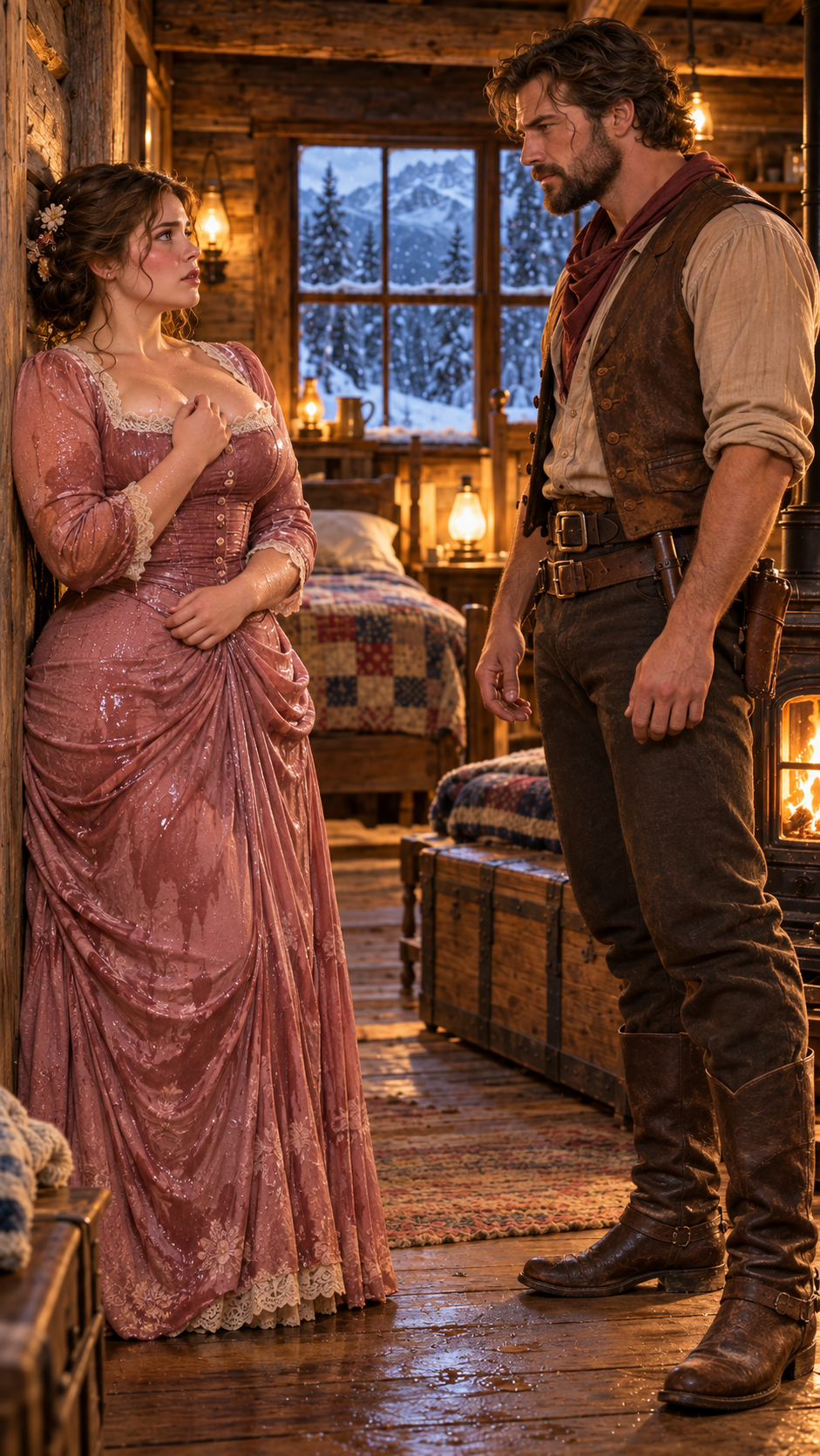
The blizzard screamed against the cabin walls. Snow hissed across the windowpanes. The stove snapped and settled behind Silas, but those sounds seemed to come from another world.
I stared at the painted miniature in his hand.
My mother, Rosalie Whitmore, was seated beneath a flowering apple tree.
Beside her stood Edwin Whitmore.
My father.
Younger, certainly.
But unmistakable.
Same narrow mouth.
Same high forehead.
Same silver-gray eyes I had learned to fear whenever money was short and his temper shorter.
I stumbled backward.
“No.”
Silas did not move toward me.
That mattered.
Even now, while my thoughts scattered, he left the distance between us mine to cross or keep.
“Elara.”
“No.”
I pointed at the portrait.
“My mother died when I was six.”
Silas looked at the painting.
“So you were told.”
The words struck harder than if he had shouted.
I shook my head.
“No. There was a funeral.”
“A closed coffin.”
I stared.
“How could you know that?”
“Because Rosalie told me.”
My knees weakened.
I caught the edge of the table.
Silas started forward instinctively.
I flinched.
He stopped at once.
That small act—stopping—kept me from running.
“You knew my mother?”
“Yes.”
“When?”
“Eight years ago.”
The room tilted.
Eight years.
I had been sixteen.
My mother had supposedly been dead for ten years.
“You are lying.”
“I wish I were.”
“Why?”
He swallowed.
“Because the truth won’t be kind to you.”
I laughed once.
It sounded terrible.
“You bought me from my father for thirty dollars and a horse, brought me twenty miles into the mountains, and now you tell me my dead mother was alive ten years after her burial.”
Silas’s scar pulled slightly as his jaw tightened.
“I did not buy you.”
“You paid him.”
“Yes.”
“That is what purchase means.”
“No.”
His voice remained quiet.
“I paid a debt to get you out of his house.”
I stared.
“What debt?”
“Not yours.”
“My father said you demanded me.”
“I did.”
The honesty hurt.
Silas continued before I could interrupt.
“But not because I wanted a wife who couldn’t refuse me.”
“Then why?”
He looked toward the portrait.
“Because Rosalie asked me to find you.”
My throat closed.
“When?”
“Before she died.”
The word died landed differently now.
I whispered, “She is dead?”
“Yes.”
“When?”
“Seven years ago.”
I gripped the chair harder.
Seven.
Not eighteen.
Seven.
My mother had lived somewhere while I grew up believing she was beneath a stone in Boston.
“Where?”
“Wyoming Territory.”
“Why?”
Silas took a slow breath.
“Sit down.”
“No.”
“All right.”
“Tell me standing.”
He nodded.
“Your mother left Boston because she believed staying would put you in greater danger.”
“From whom?”
He hesitated.
My stomach twisted.
“Silas.”
“Your father.”
The word made everything inside me go cold.
“No.”
“Elara—”
“My father was selfish. Cruel with words. Reckless with money. But my mother adored me. If she were alive, she would never have left me with him.”
Silas’s expression changed.
“That is exactly what she spent years blaming herself for.”
I wanted to hate him for saying it.
Instead I hated how gently he said it.
He walked to the iron chest and removed a packet of letters tied with the same faded ribbon.
He placed them on the table.
Did not hand them to me.
Did not insist.
“They’re hers.”
I stared.
“How many?”
“Twenty-three.”
“To you?”
“Some.”
“And the others?”
“To you.”
My heart stopped.
“What?”
“She wrote them over the years.”
I stepped toward the table.
My hands hovered over the packet.
“Why didn’t I receive them?”
“Because she never sent them.”
“Why?”
“She was afraid Edwin would find them.”
“Then why write?”
Silas looked at me.
“Because sometimes writing to someone is the only way a person survives missing them.”
That broke something.
I sat.
Not gracefully.
Just collapsed into the chair.
Silas remained near the stove.
I untied the ribbon.
The first envelope said:
For Elara, age seven.
The next:
For Elara, on her tenth birthday.
Then twelve.
Fourteen.
Sixteen.
My vision blurred.
I opened the oldest.
My darling girl,
Today you are seven, and I have spent the entire morning remembering how you used to insist that roses smelled better after rain.
I do not know whether you still believe that.
I do not know what books you read now, or whether your hair still curls when the weather turns damp.
I do not know if you remember the song I sang at bedtime.
There are many things I do not know because I made a choice that separated me from you.
I pray someday you will understand why.
I stopped.
My hands shook so violently the paper rattled.
“She remembered.”
Silas’s voice came quietly.
“Every day.”
I read the next lines.
Your father believes I died because I allowed him to believe it.
I thought if I vanished, he would stop using you to force me back.
I was wrong.
I should have returned sooner.
I should have trusted that fear was not the same as wisdom.
If this letter reaches you one day, please know one thing before all others:
I did not leave because I loved you too little.
I left because I was frightened and believed love made me capable of choosing for you.
That was my mistake.
I pressed my fingers to my mouth.
For years, I had imagined my mother’s death as the great sadness of my childhood.
Now I had something worse.
A living woman missing me.
A woman writing birthday letters in secret.
A woman who had chosen absence and regretted it.
“Why did she leave him?”
Silas looked toward the fire.
“Your father gambled before you were born.”
“I know.”
“More than you know.”
Of course.
Every answer had another locked door behind it.
“He began borrowing against property that belonged partly to Rosalie.”
“My grandmother’s money.”
“Yes.”
“She told me it was gone.”
“It wasn’t.”
I looked up.
“What?”
“Not then.”
Silas came to the table and placed another paper beside the letters.
A legal document.
Rosalie Vale Whitmore.
My mother’s maiden name.
I read.
A trust.
Three thousand dollars.
A small house.
And mineral rights to a parcel in Wyoming.
I frowned.
“She owned land?”
“Yes.”
“What happened to it?”
“Edwin tried to borrow against it.”
“Could he?”
“Only with her signature.”
I understood.
“She refused.”
“Yes.”
“And?”
“He forged it.”
I stared.
Silas did not dramatize the answer.
That made it believable.
“Mother discovered?”
“Yes.”
“She confronted him?”
“Yes.”
“What did he do?”
“He begged her not to expose him. Said prison would destroy you.”
The old pattern.
Fear disguised as protection.
Even before I understood that pattern, I hated it.
“So she disappeared.”
“After arranging evidence with an attorney.”
“Why not take me?”
Silas’s expression tightened.
“Because Edwin threatened to accuse her of kidnapping you and claim she was unstable.”
“Would anyone believe him?”
“In Boston society?”
I looked away.
A beautiful married woman accusing her respectable husband of fraud.
A husband insisting she was hysterical.
Yes.
People might have believed him.
Especially if he had money.
Especially if he had friends.
Especially if he could produce doctors willing to say what he paid them to say.
The room suddenly felt less distant from the drawing rooms I had hated.
People had laughed at my body there.
Whispered about my dresses.
Treated humiliation as amusement.
Why had I ever assumed they would have protected my mother?
“What happened after she left?”
“She reached Wyoming.”
“With whom?”
“An attorney named Samuel Crowe helped her.”
“Then?”
“She worked.”
“Doing what?”
“Seamstress. Bookkeeper. Cook when she had to.”
My chest tightened.
My mother, raised with servants.
Working.
Surviving.
“Did my father know?”
“Not at first.”
“And later?”
“Yes.”
“How?”
Silas looked at the portrait.
“That was painted after he found her.”
I stared at the miniature again.
Now I saw something I had missed.
Mother was not smiling.
Father was.
“Why would she sit for a portrait with him?”
“She didn’t know he would be there.”
My stomach sank.
“Someone arranged it?”
“Edwin.”
“Why?”
“To prove he knew where she was.”
A quiet threat.
Not violence.
Something colder.
Possession of knowledge.
“He wanted the Wyoming property?”
“Yes.”
“What did she do?”
“Moved again.”
“To Blackthorn Valley?”
“No.”
Silas looked toward the mountain.
“To my mother’s house.”
I blinked.
“Your mother?”
“Mae Kane.”
“Why would she know Rosalie?”
“They were cousins.”
I stared.
That possibility had not occurred to me.
Silas’s mother.
My mother.
Family.
Distant perhaps, but connected.
“Then you and I—”
“Not blood.”
He answered immediately.
“My mother was Rosalie’s cousin through marriage. Mae’s husband—my father—was related to the Vales. Mae herself was not.”
Relief came so unexpectedly that I almost laughed.
Then embarrassment followed.
Silas almost smiled.
“You were concerned.”
“I have had an unusual evening.”
“Fair.”
I looked at his scar.
“How did you meet her?”
“My mother died when I was twenty-six. Rosalie stayed several months afterward helping settle her things.”
“And you?”
“I lived on this ranch.”
“She told you about me.”
“Yes.”
“Everything?”
“Enough.”
“What did she say?”
Silas looked uncomfortable.
That surprised me.
“She said you were bright.”
I waited.
“Kind.”
Another pause.
“And?”
He rubbed the back of his neck.
“Stubborn.”
I almost laughed.
“My mother said that?”
“Frequently.”
“What else?”
“She said you hid books beneath your mattress because Edwin thought women who read too much became dissatisfied.”
I stared.
“How could she know?”
“She remembered you doing the same with sweets when you were five. She said habits probably continued.”
A laugh escaped me.
Then became a sob.
I covered my face.
Silas did not touch me.
He simply stood nearby.
After a while I asked, “How did she die?”
“Pneumonia.”
“Were you there?”
“Yes.”
“Was she alone?”
“No.”
That mattered.
I looked up.
“Did she ask about me?”
“Every day.”
My eyes burned.
Silas continued.
“She made me promise something.”
“To find me.”
“Yes.”
“Then why wait seven years?”
His face changed.
There.
Guilt.
“I tried.”
“What does that mean?”
“I wrote twice.”
“I never received letters.”
“I know.”
“I went to Boston once.”
My breath caught.
“When?”
“Five years ago.”
“I was nineteen.”
“Yes.”
“Why didn’t you find me?”
“I did.”
Silence.
I stared.
“You saw me?”
“Yes.”
“Where?”
“Outside Trinity Church.”
I remembered that winter.
Beatrice had made me wear a dress two sizes too small.
I had stood outside after services pretending not to cry because three young men nearby had laughed about my figure.
“You watched me?”
“For less than a minute.”
“And left?”
Silas’s scar seemed harsher when pain tightened his face.
“Yes.”
“Why?”
“I heard Edwin speaking with a man.”
“What man?”
“An attorney.”
“And?”
“He said if Rosalie’s ‘mountain relatives’ ever came for you, he would declare them frauds after your inheritance.”
I frowned.
“What inheritance?”
Silas went very still.
“You don’t know?”
I almost laughed.
“I have forty-three questions and no inheritance.”
He went back to the iron chest.
Removed a folded deed.
Placed it on the table.
“This ranch.”
I stared.
“No.”
“Not all of it.”
“Silas.”
“The north valley.”
I looked toward the dark mountain beyond the window.
“Blackthorn Valley?”
“Part of it.”
“How?”
“Rosalie’s Wyoming land connected to an old mining claim. She sold it and used the money to purchase fifteen hundred acres here under her maiden name.”
I could barely follow.
“Why?”
“She wanted somewhere you could come someday that Edwin could not touch.”
“And you?”
“I manage it.”
“For whom?”
He looked directly at me.
“For you.”
The cabin seemed to vanish.
“My father traded me into marriage with a man managing land I already owned?”
“Yes.”
“Did he know?”
“No.”
That almost made me smile despite everything.
“But why marry me?”
There it was.
The question beneath all others.
Silas looked toward the door.
Snow blew through a crack around the frame.
“For the same reason I put the cabin key beside your hand.”
“That is not an answer.”
“No.”
He faced me fully.
“Your father’s creditors were closing in. Edwin had discovered Rosalie left property somewhere in the West. He began asking questions.”
“You feared he would find it.”
“Yes.”
“So you offered to marry me.”
“I offered to settle one of his old debts if he allowed you to leave Boston with me.”
“You used his greed.”
“Yes.”
“That still sounds like a purchase.”
His face tightened.
“I know.”
“Then why marriage?”
“Because Edwin could challenge a transfer to you if he claimed you were mentally unfit, under improper influence, or abducted.”
My skin crawled.
“But as your wife?”
“You would have legal complications of another kind.”
“Another man controlling property.”
“Yes.”
He looked ashamed.
“That is why Rosalie’s deed includes separate-property protections drafted under Wyoming law and confirmed through a Montana attorney. Marriage could get you physically away from Edwin while the deed was recognized.”
“And you would control it?”
“No.”
“Are you sure?”
“Yes.”
He pulled out another paper.
I read.
Upon Elara Whitmore reaching twenty-four years of age, all Blackthorn North property passes directly to her sole beneficial ownership.
My birthday had been three weeks earlier.
The land was already mine.
Silas had married a woman who owned part of the valley he worked.
And had not told me before the ceremony.
Anger returned.
“You should have told me.”
“Yes.”
“Before I married you.”
“Yes.”
“Why didn’t you?”
He looked toward the storm.
“Because I thought if I wrote everything, Edwin would intercept the letter.”
“And this morning?”
“No excuse.”
That stopped me.
“No excuse?”
“I was afraid.”
“Of what?”
“You refusing to come.”
I stared.
“Then you did manipulate me.”
“Yes.”
The answer was immediate.
“I told myself I was protecting Rosalie’s plan. Protecting your land. Protecting you from Edwin.”
His voice lowered.
“But I still removed information you had a right to know.”
Silas looked at me with no defense in his face.
“I was wrong.”
The beast of Blackthorn Valley, supposedly feared by half the territory, stood before me and admitted wrongdoing more easily than any polished Boston gentleman I had ever known.
I hated how much that mattered.
He reached for his coat.
“I’ll still sleep in the barn.”
I looked at the blizzard.
“You could freeze.”
“I won’t.”
“How do you know?”
“I’ve slept there before.”
“For what possible reason?”
“Cow with a difficult calf.”
I stared.
Despite myself, I smiled.
He opened the door.
Wind burst inside.
“Silas.”
He stopped.
“Stay.”
His expression changed.
“Inside,” I added quickly. “Not… not as a husband. Not that way.”
“I understand.”
“You can sleep near the stove.”
“Yes.”
“And the revolver stays on the table.”
“Yes.”
“And the cabin key.”
“Yes.”
I nodded.
He closed the door.
For the first time since Boston, I made a decision no one had arranged for me.
It was small.
But mine.
That night, I changed behind the blanket curtain into the silk nightgown my mother had sewn.
The fabric settled loosely around my body.
No corset.
No pinching stays.
No hands yanking laces until I could not breathe.
I looked down and began to cry.
Not because the gown made me beautiful.
Because someone had made it expecting my body to deserve comfort.
When I stepped out, Silas sat on the floor near the stove with his back turned.
“You may look.”
He turned.
His face softened.
“She guessed the size well.”
I touched the sleeve.
“How?”
“She remembered your shape at sixteen. Left extra fabric.”
I laughed through tears.
“Mother always hated fitted sleeves.”
Silas smiled.
Then something outside struck the side of the cabin.
We both froze.
Not a branch.
Too heavy.
Silas stood.
The next sound came from the door.
Three knocks.
Slow.
Measured.
No one should have been twenty miles up Blackthorn Mountain in that blizzard.
Silas reached for neither revolver nor rifle.
He approached the door.
“Who is it?”
A man’s voice came through the wind.
“Open up, Kane. I’ve brought something that belongs to your wife.”
Silas’s face went pale.
I whispered, “Who?”
He looked at me.
“Samuel Crowe.”
My mother’s old attorney.
Silas opened the door.
An elderly man stumbled inside, snow covering his coat.
He carried a leather case chained to his wrist.
After catching his breath, he looked directly at me.
“Elara Whitmore.”
“Yes.”
He removed his hat.
“Your mother made me promise I would not deliver this until you were married and outside your father’s reach.”
He opened the case.
Inside lay a sealed packet.
Across the front, in my mother’s handwriting:
FOR MY DAUGHTER—THE TRUTH ABOUT SILAS KANE.
I looked at Silas.
His expression changed.
Whatever was inside, he had never seen it.
And suddenly I understood that my mother had kept secrets from him too.
**–END OF PART 2– CLICK “NEXT” AT THE BOTTOM OF THE PAGE TO CONTINUE READING**
✓ Lynn R. Adams
## Part 2 – The Portrait Her Father Never Meant Her to See The second face was my father’s. For several seconds, I could not breathe. The blizzard screamed against the cabin walls. Snow hissed acro…