The bride disappeared ten minutes before the ceremony, leaving technology millionaire Everett Callaway
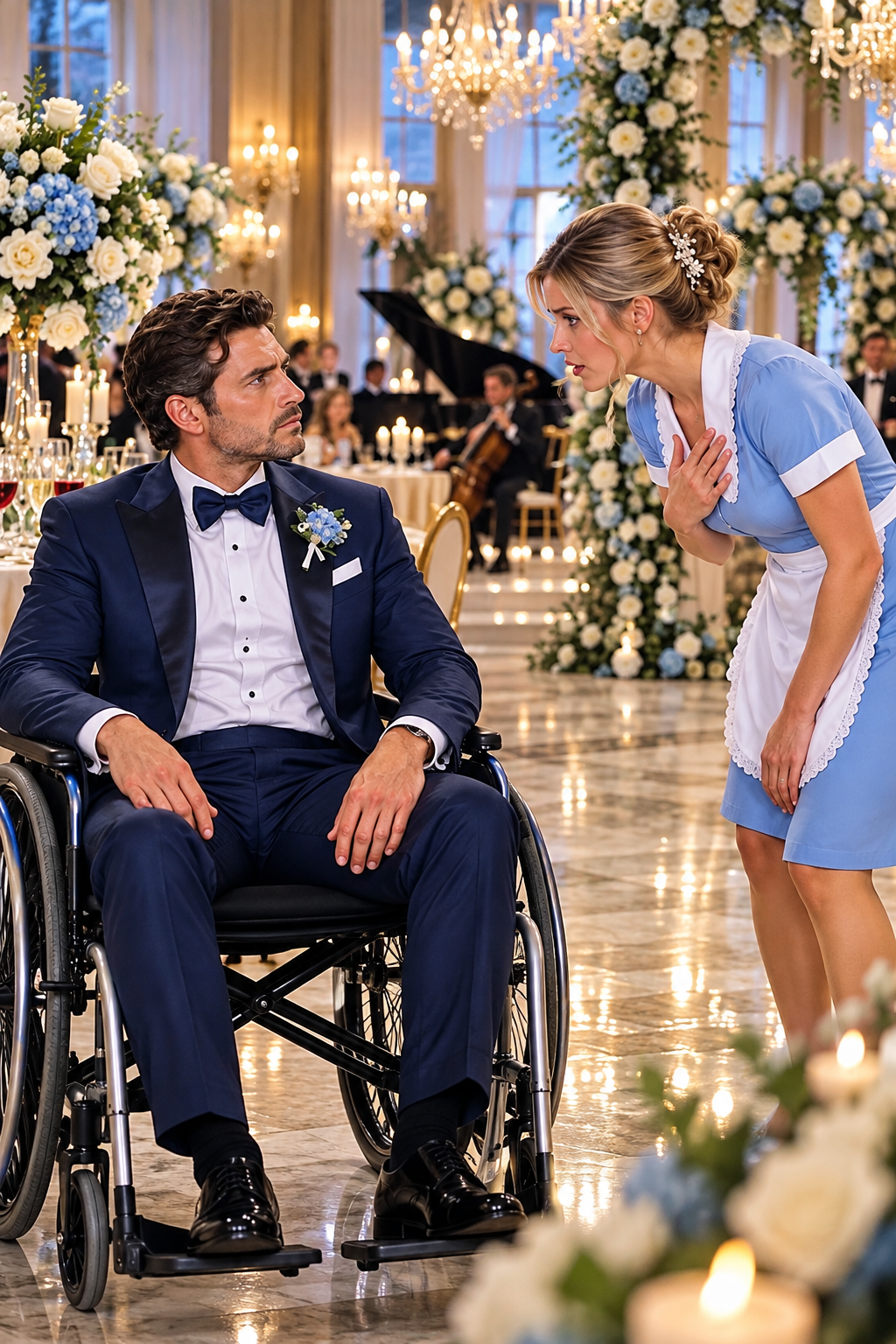
Part 2: Clara sits beside Everett when the wedding hall turns cold
The wedding hall changed in the space of a minute. Guests lowered their voices, musicians stopped playing, and several people looked toward the doors as if Celeste might still come back. Others looked at Everett with the careful sympathy people use when they are afraid of saying the wrong thing. A few were already sending messages to friends who had not attended. The man who owned the company, the estate, and the expensive suit suddenly wanted nothing more than to disappear.
Clara Whitmore entered carrying a tray of empty glasses. She was twenty-nine, had worked at the estate for eight months, and lived in a small apartment with her younger brother, Nathan. Her paycheck helped cover his college tuition, so she had learned to accept long shifts without complaint. Her job was to clear tables, polish serving trays, and stay out of the guests’ way. She was supposed to take the tray to the kitchen and keep moving.
Instead, she set it down. She walked toward Everett slowly, giving him enough time to tell her to leave. He looked up and tried to force a smile, but his eyes were wet and his fingers were trembling. Clara pulled a chair beside his wheelchair and sat down without asking the room for permission. She did not look at the expensive suit, the custom chair, or the empty place where Celeste should have stood. She looked directly at his face.
“The wedding is over,” Everett said, his voice barely audible. Clara nodded. She did not tell him everything happened for a reason or promise he would find someone better. “Being abandoned does not mean you are unworthy of being loved,” she said. The words reached a place he had been trying to hide from himself. For eighteen months, he had watched executives become nervous around him, friends become busy, and even relatives speak as though he were a child.
Clara stayed while the guests began to leave. She stayed when Everett asked the planner to cancel the reception and when his attorney called about the contracts. She stayed when he folded Celeste’s note and put it inside his jacket as if hiding it might lessen its meaning. After an hour, he asked why she had sat with him. Clara said she knew what loneliness looked like because she had watched it change people she loved. She did not explain further until he noticed the silver bracelet on her wrist.
Part 3: A silver bracelet reconnects a lonely man to his mother
The bracelet was old, with a small blue stone set between two narrow bands of silver. Everett recognized it immediately. His mother, Eleanor Callaway, had owned one almost exactly like it and wore it whenever she visited the local shelters and community centers she supported. He asked Clara where she had found it. She said she bought it years ago at a charity shop after a woman donated a box of jewelry.
The woman’s name had not been listed. Clara had only chosen the bracelet because the blue stone reminded her of her grandmother’s eyes. Everett told her his mother had died six years earlier. Eleanor had been deeply involved in charities around Chicago, often giving away personal belongings to raise money for families in need. She believed the greatest test of character was how someone treated a person who could give them nothing in return. Clara had unknowingly carried a piece of Eleanor’s kindness into the room where Everett felt least valuable.
He asked Clara to stay with him until the remaining guests had left. She did not hesitate. By evening, the wedding hall was empty except for a few staff members clearing flowers and folding chairs. Everett remained at the altar, not because he wanted to remember Celeste, but because he could not yet imagine moving forward. Clara sat beside him, telling him about her grandmother, who had once helped raise her after her mother died.
She also told him about Nathan, her younger brother, whose tuition bills had become a constant source of worry. Clara had wanted to study physical therapy, but when their father became unable to work, she took whatever jobs she could find. She had been saving money for night classes, though each time the savings grew, another bill arrived. Everett listened without interrupting. He had spent years surrounded by people who wanted something from him, and Clara was the first person in a long time who seemed to want nothing.
The next morning, Everett returned to the city, but the wedding note followed him. It sat beside the reports in his office and seemed to appear whenever he tried to focus. His chief financial officer, Marcus Bellamy, called a board meeting and suggested Everett’s personal crisis had become a business liability. Several investors, he said, were asking whether a paralyzed CEO could still lead the company. Everett listened through the discussion without reacting, then asked for the latest financial reports. He would not let Celeste’s decision become Marcus’s excuse to remove him.
Part 4: Clara refuses charity, forcing Everett to confront what respect means
In the weeks after the wedding, Clara returned to her shifts at the estate. Everett began asking for her help navigating the property when his regular caregiver had the afternoon off. At first, the requests were practical. Clara knew which paths were smooth, which doors were too narrow for his chair, and which staff members could help without making him feel helpless. Their conversations gradually became longer. Everett learned that Clara had been raised in a modest Pennsylvania town and had assumed responsibility for Nathan after their father’s health declined.
He offered to pay for her physical therapy education. Clara refused. He offered her a management position at one of his companies, and she refused that too. She told him she wanted a chance to earn a place she could keep, not an opportunity people would call charity. Everett was irritated by her stubbornness, though part of him admired it. He asked how she expected to afford school, and she said she was figuring it out.
The answer followed him into his next board meeting. Marcus had encouraged the directors to consider replacing Everett as chief executive, arguing that the accident had left him unable to make rapid decisions. Everett asked Marcus to present evidence rather than assumptions. The CFO produced a list of delayed projects but avoided mentioning that several delays had begun before Everett’s accident. Everett recognized the maneuver. Marcus was trying to make sympathy look like a business case.
Clara did not tell Everett to fight or promise he would win. She reminded him that a wheelchair did not take away his ability to think, evaluate, or lead. If he wanted the company, she said, he had to show the board what he could still do instead of asking them to believe in him out of kindness. Her words were direct enough to sting. Everett went back through the project reports, attended meetings remotely, and began rebuilding his confidence one decision at a time.
He also began looking at how people treated those around him. When a staff member spoke over Clara, Everett corrected him. When a meeting assistant offered to move a document without asking, Everett asked whether Clara wanted help. He realized he had spent years confusing assistance with control. His own injury had made him dependent in ways he could not hide, and Clara’s refusal to be managed forced him to rethink what respect meant. She did not want him to rescue her; she wanted him to see her clearly.
Part 5: A threatened company reveals betrayal hidden inside its financial records
The first sign of trouble came from an audit Everett had ordered after noticing inconsistencies in the company’s vendor payments. Several invoices had been approved for consulting work that no department could explain. The amounts were not large enough to trigger immediate alarms, but the same billing patterns appeared month after month. Everett asked the audit team to examine the accounts connected to the company’s private development subsidiaries. Marcus called the request unnecessary and said it would distract employees from their work.
Everett refused to cancel it. The review uncovered money moving from the engineering company into accounts connected to a private business Marcus controlled. The transfers had been disguised as market research, technology licensing, and project advisory services. Together, they amounted to millions of dollars. Marcus had used the months after Everett’s accident to gain control over approvals, hoping the board would remove the CEO before anyone noticed the pattern. The public story about Everett’s weakness had been useful cover.
When the audit team presented its findings, the boardroom fell silent. Marcus claimed the transfers were legitimate and accused Everett of using the investigation to retaliate against a colleague who had challenged his leadership. Everett asked him to identify the work performed for each invoice. Marcus could not. The company’s lawyers froze the accounts and began preserving records. Everett’s hands trembled beneath the table, but his voice remained steady as he ordered an independent review.
The board members who had questioned whether he could still lead now watched him manage a crisis they had not even noticed. He did not pretend the company was safe or use his title to avoid scrutiny. He accepted questions from the directors, shared the audit findings with the appropriate authorities, and made sure employees would be paid while the accounts were reviewed. Marcus was suspended pending investigation. The company’s share price dropped, but the immediate threat of further losses was stopped.
Everett visited Clara’s apartment that afternoon. He did not bring flowers or a luxury gift. He brought a sealed envelope with the details of an education scholarship established in her name. Clara opened it, read the first page, and pushed it back toward him. Everett told her it was not payment for sitting beside him at the wedding. It was an investment in a future she had worked for long before he knew her name. She said she would accept only if the scholarship had clear rules and was open to other students, too.
Part 6: Everett offers education only after Clara insists on earning it
They reviewed the scholarship terms together at her kitchen table. It would pay tuition directly to an accredited program, require ordinary application materials, and be administered by an independent education committee. Clara would have to meet the same academic expectations as other students. There would be no obligation to work for Everett or the company after graduation. Only after those conditions were written into the agreement did she accept. She wanted help, but she would not let anyone turn help into ownership.
Clara enrolled in a physical therapy assistant program while continuing to work part-time. The first semester was harder than she expected. She had to relearn how to study after years away from a classroom, balance lab work with shifts, and manage her responsibilities at home. Nathan helped with groceries and appointments whenever his schedule allowed. Everett never asked for a report on her grades, though she sometimes told him how exams had gone. He understood that support did not require surveillance.
The company’s crisis continued in parallel. Marcus’s attorneys challenged the audit, and several executives worried that Everett’s response would damage the company’s reputation. Everett shared the records with the board and refused to settle quietly just to protect appearances. The investigation confirmed that Marcus had diverted funds through the consulting contracts and had planned to transfer additional assets before the audit could finish. He was removed from his position and later faced civil and criminal proceedings.
Everett’s performance during the investigation changed the board’s view of him. They saw him question the audit team closely, negotiate with lenders, and explain the company’s response to employees without hiding behind prepared statements. He still delegated tasks when needed, but he did not apologize for using adaptive technology or accepting assistance. The accident had changed the way he moved through the world; it had not erased his judgment. The directors withdrew the proposal to replace him and approved a revised governance policy to prevent one executive from controlling both payments and audits.
Clara did not celebrate Everett’s victory as if it were her own. She had encouraged him, but he had made the decisions and carried the consequences. Everett, in turn, did not present her as the person who had saved his company. He thanked her for speaking honestly when he needed to hear something other than pity. Their friendship deepened through ordinary moments: sharing coffee after her classes, discussing difficult cases from her coursework, and trading stories about their mothers. Neither rushed to call it love.
Part 7: Celeste returns seeking forgiveness, but Clara changes Everett’s future forever
Nearly a year after the wedding disaster, the estate hosted a charity event organized by a foundation Everett had established in his mother’s memory. The event funded rehabilitation services, adaptive equipment, and scholarships for students pursuing care-related professions. Clara had completed the first stage of her training and volunteered at the event between classes. Everett wanted the foundation to reflect Eleanor’s values, not simply carry her name on a plaque. He had learned from Clara that a person could offer help without making the recipient feel small.
Celeste appeared near the garden entrance shortly before the speeches began. She had heard about Everett’s company recovery and the foundation’s work. She approached him nervously and apologized for leaving him at the altar. She said she had been ashamed of his disability and terrified of the life she imagined it would require. She had called it a normal future because she could not admit she was afraid. Everett listened without interrupting, the wedding note still folded inside his jacket.
Celeste asked whether he could ever forgive her. Everett considered the question carefully. He remembered the hall, the whispers, and the moment her final sentence made him believe the accident had taken away his right to be loved. He could have humiliated her in front of the same guests who had watched her leave. Instead, he told her he forgave her, but forgiveness did not restore their relationship or erase what she had done. He wished her well, then returned his attention to the event.
Clara had watched from several yards away. When Everett reached her, he said the woman who walked away had taught him something painful, but the woman who stayed had taught him something priceless. Clara reminded him she had not stayed because she expected a future with him. She had stayed because she could not watch someone be abandoned and pretend it was not happening. Everett said that was precisely why he trusted her. He asked whether she would consider building a life with him, slowly and without pretending his money could solve every difficulty.
Clara did not answer right away. She had her own fears, her own plans, and a future she had only recently begun to reclaim. She told him she would not be a symbol in a story about a rich man finding a kind woman. She wanted to finish school, work as a physical therapy assistant, and make decisions as an equal. Everett said he wanted those things for her whether or not she chose him. Clara took his hand and said they could begin with dinner, no cameras, no audience, and no promises they were not ready to keep.
Part 8: A private wedding replaces the spectacle that once destroyed him
Their relationship grew through small, deliberate choices. Everett learned to ask before helping, and Clara learned that accepting support did not mean giving up her independence. She continued her training and passed each clinical assessment on her own work. Everett attended her program’s recognition ceremony, sitting in the front row with Nathan and Claire, Clara’s mother. When Clara’s name was called, he applauded with the same enthusiasm as everyone else, but he did not stand or make the moment about himself.
They faced difficult days together. Everett’s medical appointments continued, and some weeks brought pain, fatigue, or discouraging news from his rehabilitation team. Clara’s studies demanded more time as she entered clinical placements. There were missed dinners and hard conversations about what either of them could realistically promise. They did not confuse love with a guarantee that life would become easy. They learned to talk about what each needed, then adjusted when the answer changed.
Two years after the abandoned ceremony, Everett and Clara returned to the same estate. It no longer hosted extravagant weddings. The foundation had renovated part of the property into a rehabilitation center with accessible rooms, therapy spaces, and a scholarship office. Their wedding was small, with close friends, family, several former employees, and students Clara had encouraged. There were no press cameras and no crowd of wealthy strangers waiting to see whether the day would succeed.
Everett arrived in his wheelchair beneath afternoon sunlight. Clara walked toward him wearing a simple ivory dress, then knelt beside him before taking his hand. She kissed his forehead and told him she was there because she chose to be. This time, the guests were not waiting for a bride who might disappear. They were watching two people make a promise without pretending that either one could rescue the other from every hardship. Everett felt the old note in his jacket pocket and realized it no longer controlled the story.
After the ceremony, he told Clara that the empty altar had once felt like proof that his life was over. Clara said the altar had only shown him who could not stay. It had also made room for the people who saw him as a whole person. Everett did not call his accident a gift or pretend that pain had been worth the betrayal. He simply knew he had built a life that still mattered, even when his body did not work the way it used to. Clara squeezed his hand as they rolled together toward the garden reception.
Part 9: Their foundation restores dignity to people overlooked by everyone else
Clara became a licensed physical therapy assistant and later helped lead the foundation’s rehabilitation and scholarship programs. Everett used his resources to establish centers that provided therapy, adaptive equipment, and job training for people living with disabilities. The foundation also supported caregivers who had postponed their own education to help family members. Clara insisted that its services be designed with input from the people who used them. She knew the difference between offering help and deciding what another person needed without asking.
The company added accessibility reviews to its hiring and office-design processes. Everett asked employees with disabilities to evaluate new policies before they were adopted. He did not claim that one personal experience made him an expert on everyone else’s life. He knew his story was only one story. The company also began funding paid internships for students who needed flexible schedules or adaptive equipment. Several employees who had once been overlooked advanced into technical and leadership roles.
Marcus’s case moved through the courts, and Everett continued cooperating with investigators. The diverted money was recovered in part, and the company used the proceeds to strengthen its employee assistance fund. Everett did not describe the outcome as revenge. He had wanted the truth exposed and the company protected, not a public spectacle. His board later named him CEO for another term, but he viewed the vote as a responsibility rather than proof that he had won an argument about his disability.
Celeste sent a letter months later, apologizing again and wishing them well. Everett read it privately, then placed it in a drawer with the note she had left at the altar. He no longer needed to reread either one to remember what happened. He had forgiven her, but he did not confuse forgiveness with returning to the past. Clara never asked him to erase the memory, and he never asked her to become the reason he believed in himself. They had built something that belonged to both of them.
On the foundation’s main wall hung a line inspired by Eleanor Callaway’s old philosophy: “A person’s value is revealed by what they choose to give when you have nothing to offer in return.” Clara still wore the silver bracelet, its blue stone catching the light when she moved. Everett remembered the day she sat beside him while a roomful of guests looked away. She had not given him a grand speech or promised to fix his life. She had given him the dignity of being seen as a person. The wedding that ended beneath the flowers had not been the end of his story; it had been the moment he learned what kind of love could stay.
✓ Lynn R. Adams
Part 2: Clara sits beside Everett when the wedding hall turns cold The wedding hall changed in the space of a minute. Guests lowered their voices, musicians stopped playing, and several people looked…