The beach-club celebration was meant to be my public ruin.
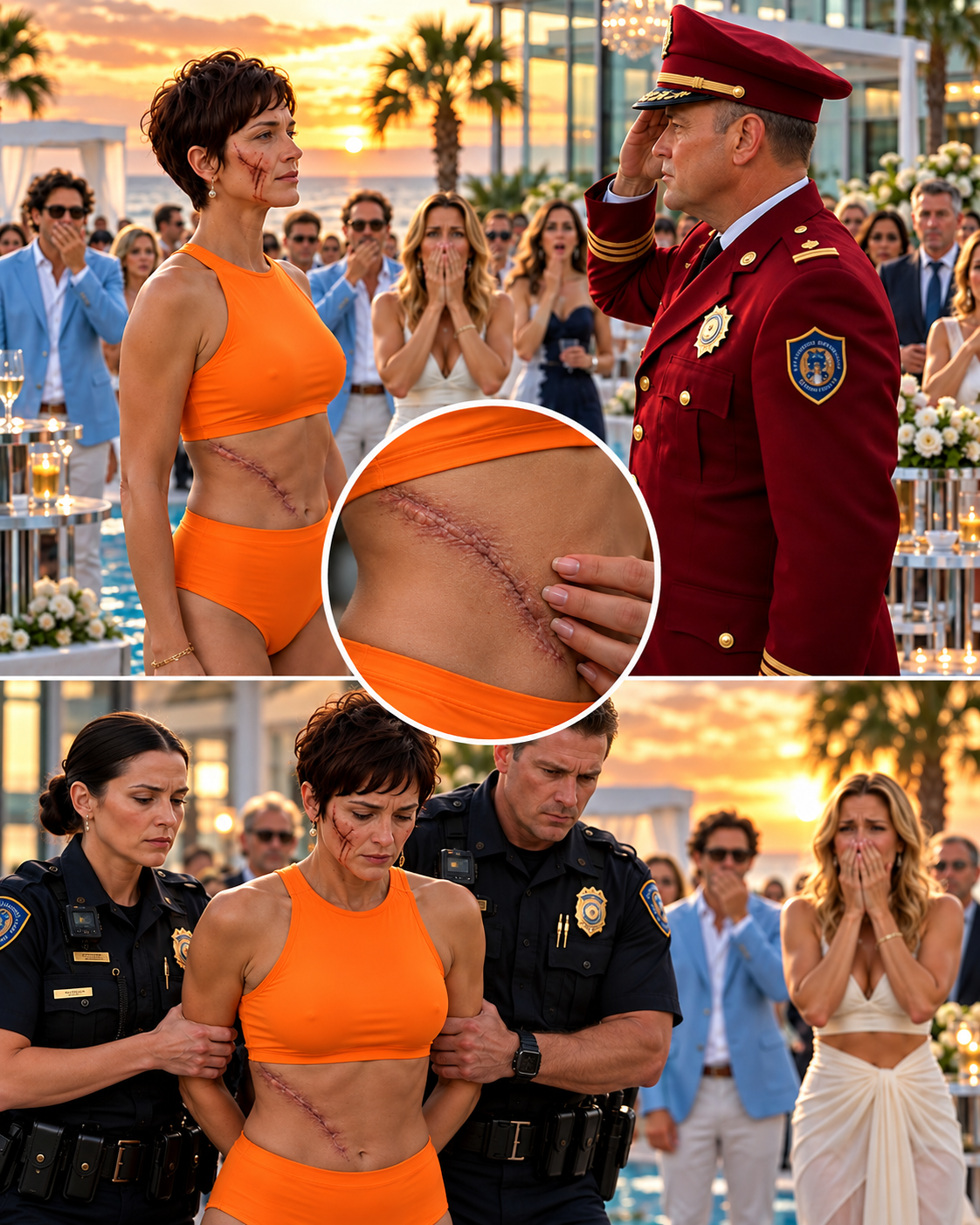
Part 2: Richard Vale’s recording destroys Vanessa’s perfect family story
Vanessa reached for the oldest secret she had. She accused me of causing the Pier Twelve disaster through faulty intelligence and blamed me for the officers’ injuries. Marcus told the crowd my warning had been altered after submission. Investigators displayed proof that the change came from credentials belonging to Vanessa’s late father, Richard Vale. His reputation had once seemed impossible to challenge. Newspapers called him a reformer and civic leader; a bronze statue bearing his name stood outside police headquarters. Vanessa had built her public identity around being the daughter of a man the city treated like a hero.
Adrian connected a recovered drive to the pavilion’s presentation system. Richard’s voice emerged from the speakers, ordering someone to alter my Pier Twelve intelligence because I knew too much and should take the blame if the operation failed. Marcus explained Richard had protected a harbor-smuggling network, redirected seized money into companies later absorbed by Vale interests, and sacrificed the tactical team when investigators approached financial routes he could not allow them to uncover. Vanessa first looked devastated, then calculating. Her shock came not from learning her father was corrupt, but from discovering investigators had a recording she believed hidden.
Marcus arrested her for fraud, obstruction, evidence tampering, conspiracy, and attempted false incrimination. As a detective reached for her wrist, Vanessa pulled a silver phone from her purse and smashed it against the marble. A countdown appeared on the cracked screen. When it reached zero, the pavilion speakers played Daniel’s voice saying that if I discovered the original accounts, “we lose everything.” Vanessa answered, “Elena must never find them.” Guests scattered from Daniel as reporters shouted questions. I stared at my husband, because the recording was dated three years before we met.
Daniel insisted the audio had been fabricated. Adrian confirmed its metadata was authentic. Vanessa smiled from inside the handcuffs and told me the real question was not whether Daniel had spoken those words; it was which Elena he had meant before I entered his life. Daniel admitted Vanessa had recommended the security conference where we met, though he said he believed it concerned general corporate threats. Then he confessed that, early in our relationship, he had entered my office and copied an encrypted drive. I believed the drive had disappeared in a burglary. Daniel said Vanessa had convinced him former Vale associates were hunting it, and he thought a copy might protect me.
Vanessa directed Adrian to a hidden folder labeled CROSS. It held surveillance photographs of me entering grocery stores, police buildings, medical offices, and my apartment over several years. Richard’s network had watched me long after Pier Twelve. Vanessa said an anonymous source had supplied the photographs, guest list, forged banking records, and tip that first pushed me to investigate the Vale Foundation. Before investigators could identify the source, the pavilion lost power. A shot shattered glass above the stage. Guests dropped beneath tables as security teams rushed for the exits. I saw a figure aiming from beyond the palms and tackled Vanessa, saving her from the next shot.
As paramedics arrived, she gripped my wrist. “Daniel’s old recording is real,” she whispered, “but the Elena he meant was somebody else.” A damaged screen behind us flickered back to life, showing Richard Vale at Pier Twelve beside a younger Daniel and a woman whose face looked exactly like mine. I stared at the image long after Vanessa was taken to surgery. The woman had my cheekbones, dark hair, posture, and the small curve in my left eyebrow. Daniel identified her as Eva Cross, someone he had known while still married to Vanessa. He believed Eva had died three days after the ambush, when a burning car was found near the harbor.
Part 3: A woman with Elena’s face reveals the missing sister
Vanessa claimed my mother, Grace, had lied for decades. I had been born with an identical twin, separated soon after birth because of Richard Vale’s influence. Daniel admitted he had loved Eva years earlier. That revelation made every question about our marriage hurt, because I could not tell whether he chose me for myself or because I resembled a ghost he had never stopped mourning. He swore his love for me was real. But truth delivered after exposure sounded different from truth offered freely.
Before police transported her, Vanessa said Richard had found both girls years earlier. Eva had been drawn into his internal-security organization, then discovered evidence of his crimes and disappeared before he could control her. Daniel produced a small brass key Eva had given him the night before Pier Twelve. She had told him that if anything happened, it should someday reach “the other girl.” He had never understood what she meant until I appeared years later. Marcus recognized the number engraved on the key: it belonged to an abandoned evidence locker in the basement of Central Station, beneath Richard’s statue.
Before sunrise, Daniel, Marcus, Adrian, and I opened locker 317. It held two birth certificates, a silver necklace, a photograph of Grace holding two newborn girls, and a memory card sealed inside a protective sleeve. Grace had written on the back that Eva and I were her daughters and begged forgiveness for choosing which child she believed she could save. The video on the card showed Grace explaining that Richard Vale was our biological father. She had worked as a forensic accountant, examining corporate structures tied to his police career. When she discovered him laundering money through seized assets and protected informants, she fled while pregnant.
After giving birth to twins, Grace realized Richard’s influence made hiding two identical babies together nearly impossible. She kept me and placed Eva with a trusted protector, Lillian Ward, believing separation offered both girls a chance to survive. Years later, Richard found Eva and convinced her that Grace had abandoned her. He trained her inside his network before she uncovered enough to understand who her father was. Grace’s final words said Eva had never been my enemy and had spent years trying to come home. Another file showed a woman in dark glasses entering Vale Foundation headquarters two weeks earlier after disabling three cameras. Eva was alive.
The discovery broke Daniel’s certainty. He had believed the car explosion meant Eva died, but the necklace found in the vehicle had apparently been planted. Marcus began a search. Adrian unlocked an encrypted directory with an emergency code Daniel remembered from Eva. It listed judges, police commanders, developers, executives, and politicians linked through Vale’s financial networks. Suspicious transfers carried Marcus’s authorization numbers. He surrendered his badge and admitted he had secretly worked with Eva before Pier Twelve. Their false appearances around Richard were part of an undocumented operation to protect Marcus’s brother and expose the corruption. Marcus said Eva asked him to keep me uninformed, claiming Richard would use one sister to control the other.
The files showed a forty-million-dollar transfer scheduled for midnight into an offshore account. It required biometric approval from someone carrying Richard’s hereditary profile. Vanessa could provide that authorization, but investigators warned Eva might seek me, whose genetics could satisfy part of the system. I refused to accept another round of protective conclusions. At the hospital, Vanessa admitted she had suspected Eva survived. Then she confessed Richard had not died naturally of the stroke described in public. She had altered his medication after learning he planned to kill Eva for betraying him. Vanessa said she had called it self-preservation, then inherited his companies, enemies, and criminal habits.
Part 4: Vanessa confesses while Elena finally meets her twin
Vanessa admitted stealing charity funds, fabricating evidence against me, and building the beach-club humiliation because Daniel’s marriage to a woman with Eva’s face seemed like Richard’s oldest threat returning under another name. Her confession did not erase what she had done, but it made her more than the social villain I had imagined. I asked where Eva would go before midnight. Vanessa finally answered: Pier Twelve. Rain poured through the broken roof of an abandoned waterfront warehouse when I entered shortly before midnight. A woman my height stood beside a computer near the harbor doors.
Eva’s hair was shorter, a thin scar crossed her chin, and her eyes carried an exhaustion I recognized without ever seeing it in my mirror. She admitted sending foundation records, manipulating Vanessa into displaying false information, and arranging events to force investigators to reopen Richard’s archive. She believed I would finish what she could not. I accused her of using me without consent. Eva said she had spent decades knowing I existed but believed direct contact would get us both killed. The computer behind her displayed the forty-million-dollar transfer—not to a personal account, but to restitution funds for families harmed by Vale’s network.
Daniel entered despite being told to remain outside. Eva raised a weapon and warned him he had no right to follow me into another secret. He told her she should have stayed dead. She replied that he should have told me whom he had once served and why he entered my apartment. I demanded the entire truth. Eva said Daniel copied the drive not to protect me from Vanessa, but because someone connected to Richard wanted the Pier Twelve material. Daniel admitted taking it and passing files through one of Richard’s former attorneys while trying to escape the financial and emotional control left by his marriage to Vanessa. I felt my marriage fracture without disappearing entirely; love could remain even after trust stopped supporting it.
Daniel confessed that after our fourth date, he entered my apartment, copied the drive, and gave material to the Vale network. He said fear explained his behavior but did not make it innocent. I asked why he married me after betraying me. He said love became real after the worst thing he had already done, and he grew increasingly afraid that telling the truth would destroy the life he wanted to deserve. I told him “someday” was the favorite hiding place of cowards. I stepped away before anger or tenderness could make the decision for me.
Armed attackers entered the warehouse from several directions. Surviving members of Richard’s network had tracked the transfer and wanted to destroy the evidence. Eva pulled me behind steel containers while Marcus’s officers fought toward the building. Daniel reached a security panel. Eva and I moved through opposite corridors with instincts strangely in sync, though we had spent our lives apart. Daniel opened a south access door for police but was struck before the remaining attackers surrendered or fled toward the docks. I caught him as he fell. Before paramedics reached him, he forced out one more truth: the “original accounts” from his recording were not primarily financial.
Richard’s system had managed stolen identities. At first, it relocated children of murdered informants; later, corrupt officials turned it into a market where wealthy families could erase inconvenient heirs or conceal children behind false birth histories. Grace discovered the system as a forensic accountant. The ledgers documented hundreds of children, parents, payments, judges, physicians, and officials who authorized replacement identities. Eva found clues inside her case. Behind an office wall bearing the Vale crest, Marcus discovered twelve leather-bound books. Some entries belonged to people who had become judges, executives, politicians, and heirs without knowing their identities had been changed. The network explained why Grace fled, why Richard watched his daughters, and why Pier Twelve mattered.
Part 5: Daniel’s betrayal reveals the identity ledger Richard protected
Daniel survived emergency surgery, but my relief did not restore the trust his confession had broken. Vanessa recognized a black crown symbol beside the most valuable identity files. She said Richard used it for the person above everyone else, someone wealthy enough to finance operations but protected enough never to appear openly. She named Grace Cross as the likely financier. Eva and I rejected the possibility; every memory suggested our mother had spent her life running from Richard, not funding him. Yet the ledgers carried Grace’s forensic authorization beside several early transfers. We had to consider that her relationship with the network was more complicated than victimhood.
The recordings showed Grace arguing with Richard that protected relocation could never become a commercial market. Richard insisted wealthy families buying new identities merely guaranteed endangered children safe lives. Grace had designed the accounting structure for moving informant families; Richard corrupted it by accepting money, erasing inheritances, and turning emergency protection into an industry for powerful clients. When Grace tried to end the system, Richard threatened the twins. She escaped and separated Eva from me with help from Lillian Ward. We believed Lillian had died years ago. Then she walked into the hospital alive and announced she had staged her death to disappear from Richard’s network.
Lillian had spent years infiltrating the Black Crown structure under false identities, gathering evidence against the people above Richard. She revealed that Senator Evelyn Shaw, a celebrated champion of child-protection laws and possible presidential candidate, had become the political architect of the identity market. Vanessa thought Evelyn had died when she was five; Richard had told her that story. Lillian said Evelyn had abandoned her original identity and rebuilt herself in public while Richard raised Vanessa as his daughter. Evelyn had turned the crimes of stolen children into the issue that made her famous. She arrived in our city before cameras, condemned the Vale scandal, accused Marcus of manufacturing evidence, and presented federal warrants charging me with fraud, obstruction, murder, and involvement in Richard’s death.
I refused Lillian’s offer of forged travel documents. I had spent too many years living beneath lies other people called protection. Instead, I designed a plan based on public visibility, independent evidence copies, and distribution beyond any one department or prosecutor. Vanessa would approach Evelyn as a daughter seeking reconciliation. Eva would use her inherited biometric access to enter the senator’s private archive. Lillian would send Black Crown files to journalists and victim organizations. I would surrender publicly as bait. At eight that evening, I walked toward police headquarters with empty hands while cameras flashed and Evelyn descended the steps with a rehearsed expression of maternal concern.
Evelyn told me I had caused enough suffering. I answered that I had not yet caused enough truth. Every screen around the plaza went dark, then began uploading the Black Crown archive. Bank transfers, identity ledgers, photographs, recordings, court orders, medical records, and private correspondence copied across independent servers faster than anyone could erase them. Vanessa stepped onto the stage beside Evelyn and called her “Mother” in front of national cameras. The politician who had hidden their relationship for decades called Vanessa unstable. She defended the relocation program as rescue rather than trafficking, saying weak biological families sometimes made wealthy replacement homes morally preferable.
Vanessa accused Evelyn of manipulating her into killing Richard. Evelyn coldly answered that she had merely adjusted the conditions and Vanessa made her own choice. Violence erupted when one of Evelyn’s guards fired toward investigators securing the plaza. Lillian identified a rooftop shooter, and Marcus’s loyal officers prevented compromised agents from seizing the archive servers. Evelyn ran toward an armored vehicle. Vanessa grabbed her before she could enter. The senator struck Vanessa’s injured ribs while reaching for a concealed pistol. I arrived as Evelyn aimed, but Daniel, still weak from surgery and working with investigators, struck Evelyn’s arm from behind.
Part 6: Black Crown collapses while Elena questions her marriage
I disarmed Evelyn while Daniel held her long enough for Marcus to handcuff her before the cameras. By midnight, Black Crown judges had resigned, suspicious accounts were frozen, and victims received notices that identities they trusted might have been fabricated decades earlier. The network had survived through secrecy; it no longer had enough central control to make the evidence disappear. Daniel voluntarily entered federal custody and offered to testify against everyone involved, including himself. I told him I still loved him but no longer trusted him. He removed his wedding ring, placed it in my palm, and said I should decide whether it belonged to us only after I knew who I was without him.
Eva moved into the modest river house where Grace had raised me. Living together was harder than surviving gunfire. Identical faces did not create identical habits, memories, loyalties, or definitions of safety. I checked doors twice while Eva slept with windows open; I wanted quiet mornings while she played music. We sometimes stared too long at each other, as if watching an alternative life move independently. Beneath the floorboards, we found birthday letters Grace had written to Eva every year but never sent. Separation had not meant forgetting, even when fear convinced our mother that contact was too dangerous.
On the anniversary of Pier Twelve, Eva and I read Grace’s final letter beside the harbor. She asked us to live long enough to choose love where she had been forced to choose fear. I cried for the sister I never knew, the mother whose protection had also wounded me, and the life I had spent believing loneliness was simply the shape of being alive. That evening, a package arrived containing Daniel’s wedding ring and notice of his federal hearing. It included one sentence: a final truth remained, and it might end my willingness to see him forever. I thought I was ready for every truth. I was wrong.
Daniel pleaded guilty to evidence theft, conspiracy, and obstruction, but disputed one accusation I had already accepted as fact. He said he had not ultimately delivered my encrypted drive to Richard Vale. Grace had contacted him secretly after he copied it, revealed she was alive, and ordered him to remove a tracking program that could expose Eva if Richard’s people accessed the drive. Daniel gave the cleaned original to Grace. She was poisoned the next day before she could reach me. Daniel had still stolen the drive, entered my apartment, concealed her final contact, and helped dangerous people before changing course.
He handed the court a letter Grace had entrusted to him in case I learned enough to ask the right questions. She wrote that Daniel was not innocent, but he chose to help her when he could have delivered her to Richard. He removed the tracker threatening Eva and stayed near me because Grace asked him to watch without revealing everything. Grace warned me not to forgive him because a dead mother requested it; I should only consider forgiveness if the man he became proved worthy of the pain his secrecy caused. Her letter did not undo the betrayal. It returned the choice to me. Daniel received a five-year sentence, reduced for cooperation and the evidence he supplied, and I visited him once before staying away.
Part 7: Grace’s letter forces Elena to define forgiveness herself
I stayed away long enough to learn whether absence felt like freedom or punishment. The Grace Cross Foundation opened with the goal of helping people whose identities had been changed through illegal adoption, document fraud, state corruption, or inheritance schemes. Vanessa helped investigators trace Vale money from prison. Marcus led a national task force. Lillian testified, then entered witness protection. Thousands of victims learned the truth, from minor document irregularities to family histories stolen before they could form memories. I refused medals and interviews focused on my scar. I preferred building systems for legal aid, counseling, DNA testing, record correction, and financial recovery.
Eva directed field investigations while I trained agencies to preserve evidence without making victims surrender their dignity for help. For the first time, quiet life became possible—not because danger disappeared, but because ordinary mornings deserved attention too. Three years later, Daniel left custody early after helping recover the final Black Crown accounts. He did not contact me, appear at my house, or treat release as permission to resume our marriage. He rented a small apartment, taught ethics and financial-control courses at a community college, and visited the Pier Twelve memorial without posting photographs to prove he had changed. Eva told me, apparently believing sisters had a right to violate each other’s privacy whenever romance was involved.
I laughed harder than I expected. A week later, I found Daniel repairing a damaged memorial plaque near the old warehouse. We spoke cautiously, like people meeting again after surviving different versions of the same disaster. He mentioned receiving unfinished divorce papers. I told him I had withdrawn the petition without promising restoration; I wanted to explore the future rather than let fear decide for me. I gave him back the wedding ring on one condition: nothing hidden again, not even information he believed would protect me. Daniel promised protection would never again mean taking away my right to choose.
He did not immediately reach for me. He let me close the distance myself, and that restraint mattered more than any speech about becoming a better man. Eva appeared behind us, complaining that she expected a more dramatic reunion after waiting three years. Vanessa was with her, newly released in a plain blue dress without the diamonds that once seemed inseparable from her public identity. Vanessa and Daniel traded a cautious joke. Then the four of us walked through the memorial garden, connected by damage none of us could undo and consequences none could redefine as healing. At the center stood Grace’s plaque, beneath which someone had engraved that she chose fear so her daughters might someday be free enough to choose love.
Marcus arrived carrying a wooden box recovered from the final Black Crown vault. It held photographs, letters, hospital papers, and infant bracelets marked ELENA and EVA. Beneath them lay an envelope addressed to all three daughters of Richard Vale. Vanessa sat down before anyone opened it; she had spent her whole life believing Evelyn Shaw was her biological mother. Grace’s letter explained that another infant had been born during the same relocation crisis, and Richard’s network exchanged the child’s identity to preserve a political alliance. Vanessa, too, had been separated from her true origins. A photograph showed Grace outside the hospital holding three newborn girls, with their names written on the back.
Part 8: Three stolen sisters build the family no one planned
Vanessa stared at Eva and me and understood that the hatred driving her had been connected to a family truth hidden beneath lies she inherited before she could speak. I did not offer instant forgiveness. Shared blood could not erase forged evidence, stolen charity funds, public humiliation, or months of attempts to destroy my marriage and reputation. Eva did not suddenly trust her either. Vanessa said she would distrust anyone foolish enough to forgive her that quickly, which became the first genuinely funny thing the three of us shared. We began with supervised meetings, therapy, restitution work, and thousands of pages of records.
Each of us needed room to distinguish what had been done to her from what she later chose to do to others. Vanessa cried hardest while reading Grace’s letters. Eva became angry whenever anyone romanticized sacrifice. I discovered I could love both my sisters without rewriting either as innocent. Family became less like a recovered object and more like an agreement renewed slowly through behavior nobody could force. We learned how to disagree without threatening to disappear, how to ask questions without treating privacy as guilt, and how to leave a conversation without turning distance into punishment. That work took longer than any investigation, and mattered more than any court ruling.
Years later, the Grace Cross Foundation became one of the country’s largest recovery networks for identity-theft and illegal-adoption victims. Eva led field investigations. Vanessa managed restitution controls after completing the professional restrictions placed upon her. I trained agencies that had once failed people like us. Daniel and I renewed our vows in the Pier Twelve memorial garden after years of counseling, financial transparency, separate professional safeguards, and ordinary arguments handled without disappearing behind secrecy. Marcus officiated. Lillian sat quietly in the front row under her restored identity. Vanessa complained that the ceremony lacked champagne until Eva reminded her they were trying not to recreate the beach-club disaster.
There were no television cameras, politicians seeking photographs, giant financial screens, or crowds gathered to decide whether I looked damaged or heroic. Daniel placed the ring on my hand and promised no more secrets. I answered with the only promise I trusted more: no more fear pretending to be love. Afterward, the three sisters walked toward the water as sunlight turned the harbor gold. Vanessa asked whether I still hated the scar she exposed at the beach club. I touched the pale line beneath my ribs and told her I never hated it, only the stories other people placed over it without asking what had really happened.
Eva lifted her sleeve to show scars of her own, and Vanessa touched the healed mark where the beach-club bullet entered her side. We laughed at the strange symmetry of bodies carrying histories no expensive dress could hide. We could not recover childhood birthdays, prevent Grace’s death, bring back the officers lost at Pier Twelve, or restore every stolen identity. We could not make Daniel’s lies harmless simply because he eventually became honest. But when I looked at two women carrying pieces of my face beneath the evening light, I no longer saw rivals, ghosts, or evidence from somebody else’s conspiracy.
I saw sisters who had survived long enough to choose what came next. Our history was still painful, and our trust remained something we had to practice rather than assume. Vanessa would have to live with the harm she caused. Daniel would have to keep earning the chance I gave him. Eva and I would keep learning how to be family after a lifetime apart. None of us could rewrite the past, but we could refuse to let it choose our future. For the first time in my life, the word home described people instead of a place.
✓ Lynn R. Adams
Part 2: Richard Vale’s recording destroys Vanessa’s perfect family story Vanessa reached for the oldest secret she had. She accused me of causing the Pier Twelve disaster through faulty intelligence …