Ten days after giving birth to twin boys, Evelyn Carter is dragged barefoot into a brutal Virginia
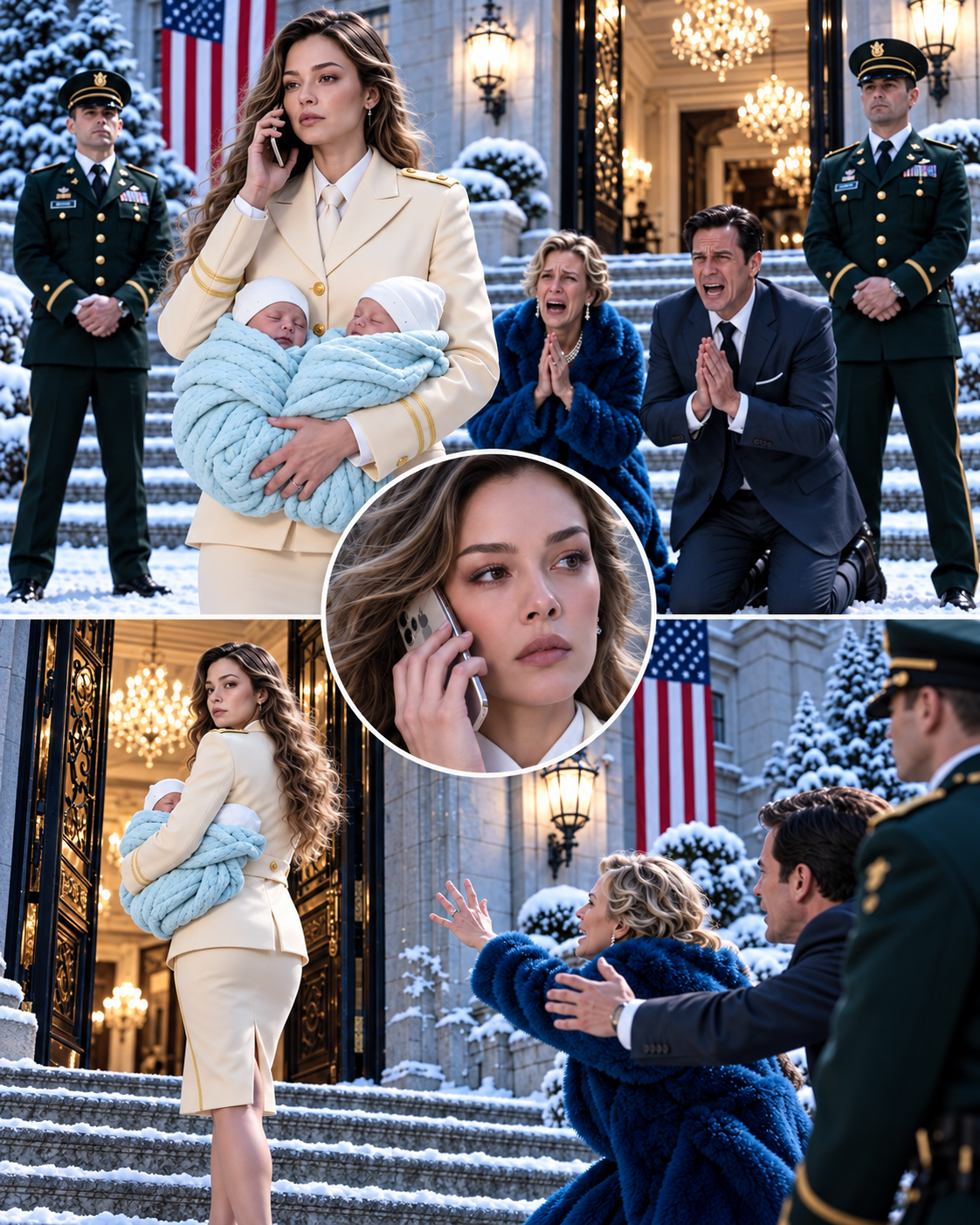
Part 2: The fake DNA test transforms betrayal into a conspiracy
By sunrise, the twins were warm and medically stable, but doctors kept them under observation because newborn babies lose body heat frighteningly fast, and I spent the morning sitting between their bassinets while Major Rebecca Sloan from Army legal services examined the report Victoria had used to destroy my marriage. Rebecca noticed the case number first, because the laboratory named on the document used a different numbering system, and the collection date claimed samples had been obtained from Noah and Luke two days after their birth. I remembered those first exhausted days clearly enough to know I had never authorized genetic testing, and no legitimate physician had discussed one with me. Rebecca contacted Dominion Genomics through proper channels, while my civilian attorney began preparing emergency custody filings. Before lunch, the laboratory confirmed the document was fraudulent.
The signature belonged to a real physician but had been copied from an unrelated record, the case number belonged to a four-year-old test in Maryland, and Dominion Genomics had never received samples from either of my children. Grant called seventeen times that morning, and I finally answered with my attorney present because his explanation mattered more than his apology. He admitted Victoria had arranged for someone to enter my hospital room while I was recovering from an emergency procedure, telling him Harrington heirs required genetic verification before being admitted to the family trust. He had allowed strangers to handle biological samples from our newborn sons because his mother told him it was normal, and he had never asked whether I had consented. When I asked him why, silence became his only answer.
Grant arrived at the medical facility that afternoon demanding to see me, but security kept him away from the neonatal area until I agreed to a controlled meeting. Rebecca placed the laboratory confirmation in front of him, and I watched him read it once, twice, then a third time while the color drained from his face. “My mother wouldn’t fake this,” he whispered, and I reminded him that twenty-four hours earlier he had been equally certain I had cheated. Certainty, I told him, was not evidence, and his willingness to confuse the two had nearly put our children in the hospital with hypothermia. He lowered his eyes and said nothing.
Then a nurse named Claire Donnelly contacted investigators and turned an ugly divorce into something much larger. Claire worked at the hospital where I had delivered, and she had seen a man enter a restricted records area after Victoria persuaded an administrator to provide unauthorized access to my sons’ charts. The Harrington Foundation funded part of the neonatal wing, Victoria sat on the hospital board, and employees had learned that challenging her could end careers, so Claire had originally remained silent. After hearing that two newborns had been thrown into freezing weather because of the supposed test, however, she decided protecting herself was no longer worth protecting a lie. Access logs showed that someone connected to Victoria had viewed not only the twins’ records but years of my private medical history.
That discovery changed everything, because Victoria had begun searching my records long before I became pregnant. She had accessed fertility information, old surgical files, bloodwork, and records transferred from another hospital system, which meant the DNA scheme was not an impulsive reaction to two babies who looked different from her son. She had been investigating me almost from the beginning of my marriage, quietly collecting information while smiling across Thanksgiving tables and criticizing my clothes. Federal investigators issued preservation requests, my attorney obtained temporary custody protections, and Grant stopped demanding that I sign anything. The question was no longer why Victoria hated me; it was what she feared I might discover if I remained a Harrington.
Part 3: My newborn sons unknowingly threaten a hidden financial empire
The first major financial clue came from Grant himself three days later, when he arrived at my attorney’s office carrying a leather folder stolen from his mother’s private study. He had confronted Victoria about the forged report, she had refused to answer him, and desperation finally drove him to search through documents he had spent his entire life being told were none of his concern. Inside the folder were trust agreements created by Grant’s grandfather and later modified by his father, Richard Harrington, before Richard’s death. The language was complicated, but the meaning was explosive: the birth of verified biological grandchildren triggered an independent review of family assets and temporarily transferred significant oversight powers to outside trustees. Noah and Luke had activated that provision simply by being born.
If the twins were declared illegitimate before their parentage was formally entered into the trust, the audit could be delayed and Victoria could continue controlling companies worth hundreds of millions of dollars. Harrington Logistics, Harrington Medical Holdings, and several government-contracting subsidiaries all sat beneath a financial structure Grant had never understood because his mother had always told him she personally owned everything. In reality, she managed assets governed by restrictions she had spent years concealing from her son. Suddenly, calling my babies illegitimate was not merely cruel; it was financially useful. Victoria had millions of reasons to make Grant reject his sons.
Court-authorized financial investigators began examining records and found payments flowing from Harrington companies into consulting firms that appeared to have no genuine employees or operations. Some money eventually reached the hospital administrator who had permitted unauthorized access to my records, while another trail led to a private investigator who had followed me during my pregnancy. Victoria had spent corporate money watching me, which meant her interest went far beyond a controlling mother protecting her spoiled son from an allegedly unsuitable wife. When investigators asked why she might consider me dangerous, I disclosed more of my professional background under the appropriate safeguards. My current work involved procurement integrity and contractor compliance.
I had never investigated a Harrington company and had formally avoided matters that could create a conflict involving my marriage, but Victoria could not have known exactly what I knew or what I might recognize. If the trust audit uncovered suspicious transactions involving government contracts, my experience might allow me to identify patterns Grant would never notice. Grant sat across the table listening, and I watched the realization settle into him with almost physical weight. His mother had spent years teaching him to believe I was financially dependent and professionally insignificant, yet she might have feared me precisely because she knew neither description was true. Then investigators found an invoice that made the room go silent.
Six months before Grant and I married, Victoria had paid a private intelligence company $180,000 for something called Project Winter Rose. The accompanying file contained my father’s name, my military academy history, old photographs, fragments of my service record, and one image of me wearing my uniform years before Grant ever proposed. Victoria had known I was an Army officer long before she mocked me as a struggling designer, and she had deliberately kept that knowledge from her son. At the bottom of one page, four handwritten words had been circled twice in red ink: “Confirm connection to Mercer.” The name belonged to General Thomas Mercer, the man I had called while standing barefoot in the snow.
Part 4: An old photograph connects my mother to the Harrington secret
General Mercer had mentored me for more than a decade, and discovering Victoria had investigated our relationship forced me to request an independent conflict review rather than confront him privately. Mercer cooperated immediately and revealed a chapter of Harrington history I had never heard: twenty-six years earlier, when he was a younger officer, he had worked with a task force examining procurement irregularities involving Harrington Aerospace. The investigation collapsed after a corporate accountant died and crucial records disappeared in a warehouse fire, leaving suspicion but not enough admissible evidence to prosecute anyone. Richard Harrington had cooperated with investigators, while Victoria was never formally charged or publicly identified as a suspect. Shortly afterward, Richard restructured the family fortune into the strange trust now activated by my children.
Grant returned to the mansion and discovered that Victoria had instructed employees to destroy several boxes belonging to his father. The estate manager refused, preserved them, and contacted Grant, who delivered the papers to investigators rather than trying to interpret them himself. Inside was an unsent letter written by Richard describing unauthorized payments hidden through medical charities and warning that someone close to him had been disguising illegal commissions connected to government contracts. One sentence near the end instructed Grant that if anything ever happened to Richard, he should “trust the woman who carries the silver eagle.” Grant looked at me immediately because a colonel wears a silver eagle, but Richard had died seven years before Grant met me.
Mercer recognized the phrase when investigators showed him an old photograph from the original task force. Standing near Richard Harrington was Lieutenant Colonel Margaret Carter, my mother, wearing the same silver eagle insignia I would earn decades later. My mother had died of cancer when I was nineteen, and although I knew she had served in military intelligence, she had never discussed classified investigations with me. Mercer explained that she had been responsible for tracing financial networks connected to the Harrington case. Richard’s message had never been predicting my arrival; he had been referring to her.
My father still had boxes containing my mother’s belongings, and with his permission investigators examined materials she had legally retained. Hidden inside an ordinary notebook were account numbers that initially appeared meaningless, but forensic accountants compared them with newly subpoenaed Harrington records and discovered matches to dormant entities still receiving overseas transfers. My mother had apparently traced part of the financial network decades earlier, and whatever happened after the original case collapsed, she had preserved enough breadcrumbs for another generation to follow. On the notebook’s final page was one handwritten name. Victoria Harrington.
I refused to turn that name into proof of murder, sabotage, or any other dramatic conclusion the evidence did not support, but Victoria made the next move herself. Security footage showed her leaving the mansion through a service entrance with Charles Weller, the family’s longtime chief financial officer, minutes before agents arrived with a warrant. Her phone remained upstairs, her passport was still in the safe, and she carried a hard drive removed from Richard’s private office. The woman who had spent years acting like an untouchable queen was suddenly running from her own house. For Grant, that was the moment defending his mother became impossible.
Part 5: Victoria runs from investigators while Grant faces his own guilt
Victoria remained missing for nine days, and during those nine days Grant stopped asking me to forgive him. He hired independent counsel, surrendered access to corporate accounts and electronic devices, and began supervised visits with Noah and Luke only after my attorney and their pediatrician agreed the arrangement was safe. During his first visit, Noah fell asleep against Grant’s chest, and I watched my husband stare at our son as tears moved silently down his face. “I called him a bastard,” Grant whispered. I did not comfort him.
He admitted he had been drinking that night, admitted that part of him wanted to punish me before learning whether I had actually betrayed him, and admitted that throwing me out had made him feel powerful for several terrible minutes. Most importantly, he did not blame Victoria for his own behavior. “She gave me the lie,” he said, looking down at Noah, “but I chose what kind of man believed it.” That distinction could not repair our marriage, but it was the first thing he had said since the snowstorm that sounded like responsibility rather than regret. I began to believe he might someday become a safe father even if he could never again become my husband.
Investigators eventually located Victoria at a farmhouse outside Winchester owned through one of the shell companies. She surrendered after agents surrounded the property, while Charles Weller was arrested attempting to burn documents in a fireplace. The recovered hard drive contained payment ledgers, private correspondence, hospital transactions, and evidence of a long-running kickback system in which inflated government-contract costs were routed through supposedly charitable medical organizations. My mother’s investigation had approached the same network decades earlier. Victoria had spent years protecting it.
The evidence did not show that Victoria caused my mother’s cancer, nor did it prove she murdered Richard, whose boating death remained consistent with an accident, and I refused to let anger manufacture crimes simply because reality was already ugly. What investigators could establish was serious enough: Victoria had obstructed parts of the old investigation, hidden records through intermediaries, misused corporate funds, and later exploited hospital relationships to investigate me. Her correspondence revealed that she recognized my surname almost immediately when Grant first brought me home. “Margaret Carter’s daughter has entered this family,” she wrote to Weller. “If she discovers what her mother was following, we lose control.”
When I became pregnant, Victoria realized the twins would trigger Richard’s trust provisions and expose records she had controlled for decades. The forged DNA test was designed to make Grant reject his sons before the audit could begin, and she understood her son well enough to know humiliation and jealousy would do most of the work for her. At her preliminary hearing, she asked to speak with me and claimed Grant had secretly participated in the scheme from the beginning. I did not believe Grant, and I did not believe Victoria; I asked investigators to verify the accusation. Records eventually proved Grant had not created the lie, but they could never erase what he had freely chosen to do after believing it.
Part 6: Justice defeats Victoria, but forgiveness cannot restore our marriage
Fourteen months passed before the criminal and civil cases reached meaningful conclusions, because real justice is built from records, testimony, motions, forensic accounting, and tedious verification rather than one perfect courtroom speech. Victoria eventually pleaded guilty to multiple offenses connected to financial fraud, obstruction, unauthorized medical access, and the fraudulent paternity scheme after prosecutors assembled evidence she could no longer explain away. Weller cooperated, hospital administrators faced separate consequences, and several Harrington companies were forced into independent compliance oversight while paying enormous penalties. The family name that Victoria had protected at any cost became permanently associated with the scandal she created while trying to preserve it. Power had protected her for decades until documentation finally became stronger than influence.
A court-supervised laboratory confirmed that Grant was Noah and Luke’s biological father, although by then the result felt almost painfully irrelevant to me. My sons had never needed DNA to deserve warmth, protection, or love, and no percentage printed on paper could make Grant’s actions that winter night less dangerous. He carried a copy of the result in his wallet for months, perhaps because it reminded him how completely confidence can betray a person when evidence is ignored. Victoria was removed from every position of corporate authority, while independent trustees restructured the family businesses. I took no part in controlling their wealth.
After maternity leave, I returned gradually to military duty, and an ethics review confirmed that I had appropriately handled conflicts involving my marriage. Mercer was cleared of wrongdoing, and his connection to my mother gave me photographs and stories I had never known existed. In one photograph, Margaret Carter stood beside Richard Harrington after an investigative meeting, her expression serious but calm, and on the back she had written, “Character is what remains when power can no longer protect you.” I carried a copy of that sentence in my desk. Grant, meanwhile, began discovering exactly what remained of him.
He sold the mansion, stopped drinking, entered therapy, completed parenting courses, and followed every custody requirement without demanding praise. Over time, supervised visits became longer, then eventually became unsupervised daytime visits as he demonstrated consistent responsibility with the twins. He learned bottles, diapers, fevers, bedtime songs, pediatric appointments, and the thousand repetitive tasks that actually create parenthood. Watching him become gentler did not make me angry. It simply could not resurrect the woman who had once felt safe sleeping beside him.
One evening, Grant sat across from me after the twins were asleep and asked whether I still intended to divorce him. I told him I had forgiven him enough that I no longer wanted to spend my future hating him, but forgiveness was not the same thing as reconciliation. He had looked at two ten-day-old babies and decided his rage mattered more than their safety, and no conspiracy created that choice for him. Grant cried, but for once he did not argue, bargain, or ask me to remember our happier years. Six weeks later, our divorce became final, and I walked out of the courthouse holding no trophy except the certainty that home would never again be a place where my children had to earn the right to stay.
Part 7: Years later, the worst night of my life creates hope
Three years later, Noah and Luke believed snow existed for sledding, snowmen, wet mittens, and hot chocolate, and I intended to protect that innocence as long as childhood allowed. Grant lived fifteen minutes away and had become the kind of father who knew which stuffed animal Noah needed after nightmares and which song could calm Luke when he was sick. Our relationship moved from hostile to civil, from civil to cooperative, and eventually into the strange friendship sometimes created when two people finally accept that love can survive in a different form than marriage. I never forgot what he had done. I simply stopped requiring the memory to control every interaction afterward.
My own career continued, and years of service eventually led to my promotion to brigadier general. At the ceremony, my father sat in the front row holding a photograph of my mother while Grant sat farther back with Noah and Luke, who cared much more about the promised cake than the star being pinned to my uniform. Mercer attended near retirement, smiling in the quiet way he always did when he was proud. Looking across the room, I realized there were no longer secrets waiting to detonate beneath my life. Yet the achievement that mattered most to me had nothing to do with rank.
I kept remembering the woman Victoria believed she had thrown into the snow: recently postpartum, financially dependent, frightened, isolated, and carrying newborn children without anyone powerful enough to help. I survived that night partly because Victoria had misunderstood my resources, but thousands of mothers in similar situations had no encrypted phone, no general answering immediately, no attorney already familiar with military protections, and no medical team seven minutes away. That fact stayed with me. Eventually it became an idea, then meetings, then paperwork, then fundraising. We called it Winter House.
Winter House was established through a civilian partnership of veteran organizations, hospitals, family-law advocates, counselors, and domestic-violence specialists, with careful boundaries separating the organization from my official military responsibilities. It provided emergency housing for parents with infants, transportation, legal referrals, medical support, childcare assistance, counseling, and help rebuilding financial independence. Grant anonymously donated during the first year, and although I accepted the money, I refused to put his name on a wall because Winter House was not meant to become anyone’s monument to guilt. Only one sentence was engraved beside the entrance. “No one carrying a child should face the cold alone.”
On the fifth anniversary of the night Grant threw us out, he brought Noah and Luke to Winter House to help volunteers collect Christmas toys. Snow began falling while boxes were being carried through the entrance, and Noah immediately ran into it with his tongue out while Luke followed laughing so hard that he lost a mitten. Grant stood beside me beneath the awning and quietly admitted he still dreamed about the porch. I told him I did too, and when he began saying he wished he could change that night, I stopped him because neither of us could. Looking at our sons playing in the snow, I realized the memory was still mine, but it no longer had teeth.
Part 8: The woman once locked outside builds a door that stays open
Ten years after the snowstorm, I returned to the Harrington estate for the first time since the night my marriage collapsed. Grant had sold the property years earlier, and its new owners were converting part of the grounds into an educational retreat connected with Winter House, but I had resisted visiting until Noah and Luke began asking why the first December snow sometimes made me unusually quiet. They were old enough to deserve the truth, though not every brutal detail. I told them their father had once believed a terrible lie, became angry, and made a dangerous decision. I also told them he had spent years accepting responsibility instead of pretending it never happened.
“Did Dad not want us?” Luke finally asked, and Grant answered before I could. We were standing beneath the same porch where he had once rejected them, and he knelt until he was eye level with both boys. He told them that for one terrible night he had allowed another person’s lie to become more powerful than the love and knowledge he already possessed, and that he had failed their mother and failed them. Noah asked whether that meant Grant had been a bad father. Grant swallowed hard and said, “It means I did something very bad, and then I had to spend years learning how to become better than the man who did it.”
That was the lesson I wanted my sons to carry, because people are more complicated than the labels we use when stories need convenient heroes and villains. Victoria repeatedly chose control and deception until the consequences became impossible to escape, while Grant made a devastating choice and eventually understood that remorse did not purchase reconciliation. I survived them without needing Victoria’s approval, Harrington money, or even my military rank to define my worth. The rank mattered that first night because it gave me access to resources, but the colonel still sat beside two bassinets wondering whether the man she loved had ever truly known her. Strength was never the absence of pain; it was deciding what pain would be allowed to build.
Winter House eventually expanded into several states, and none of the centers carried my name. Families arriving after midnight did not need an inspirational biography about a colonel, a general, a wealthy family, or a spectacular scandal; they needed a warm room, a secure door, clean clothes, a crib, medical help, legal information, and someone willing to believe that one terrible night did not have to become the rest of their lives. Years later, after I retired from the Army, Noah and Luke were teenagers and Grant had become a familiar volunteer during the organization’s winter donation drives. We were no longer husband and wife. Somehow, around the two boys we both loved, we had still learned how to remain a family.
Then, during one brutal December storm, a young woman appeared outside the original Winter House shortly after midnight carrying an infant beneath her coat. She had no suitcase and no shoes, and when the automatic doors opened she remained frozen beneath the entrance light as though she expected someone to tell her she did not belong there. I walked outside, removed my coat, wrapped it around her shoulders, and watched tears appear before either of us spoke. She whispered that she had nowhere else to go, and suddenly I could see myself decades earlier beneath another light, holding two newborn boys while a locked mansion stood behind me. “You have somewhere now,” I told her, and together we stepped inside.
The doors closed behind us, shutting out the wind, and only then did I understand the final meaning of the night the Harringtons believed they had destroyed me. They had not created my strength, because I possessed it before meeting them, and exposing Victoria had never been the victory I once imagined it might become. Victoria had owned a mansion whose doors she could close, while I had spent the rest of my life building doors designed to open; Grant had once used words meant to deny our sons their belonging, while we had raised them to know exactly where they belonged. I once thought the greatest secret about me was that the frightened woman standing barefoot in the snow was actually Colonel Evelyn Carter. I had been wrong, because my greatest victory was that when another frightened mother finally arrived barefoot in the snow, she needed no rank, fortune, powerful friend, or extraordinary secret to be worthy of rescue—she only needed to knock.
✓ Lynn R. Adams
Part 2: The fake DNA test transforms betrayal into a conspiracy By sunrise, the twins were warm and medically stable, but doctors kept them under observation because newborn babies lose body heat fri…