“Six months after the wedding, I’ll divorce him and take the money.” I overheard my fiancée telling her friend that on the day we were supposed to get married. Before I could confront her properly, my two daughters asked why their suitcases were packed. Vanessa had told them I was sending them away to a residential school the next morning, and that I’d already signed the paperwork. I hadn’t. Then my little girl asked, “Daddy, did we make too much noise?” That was when I realized this wasn’t just about my wedding anymore.
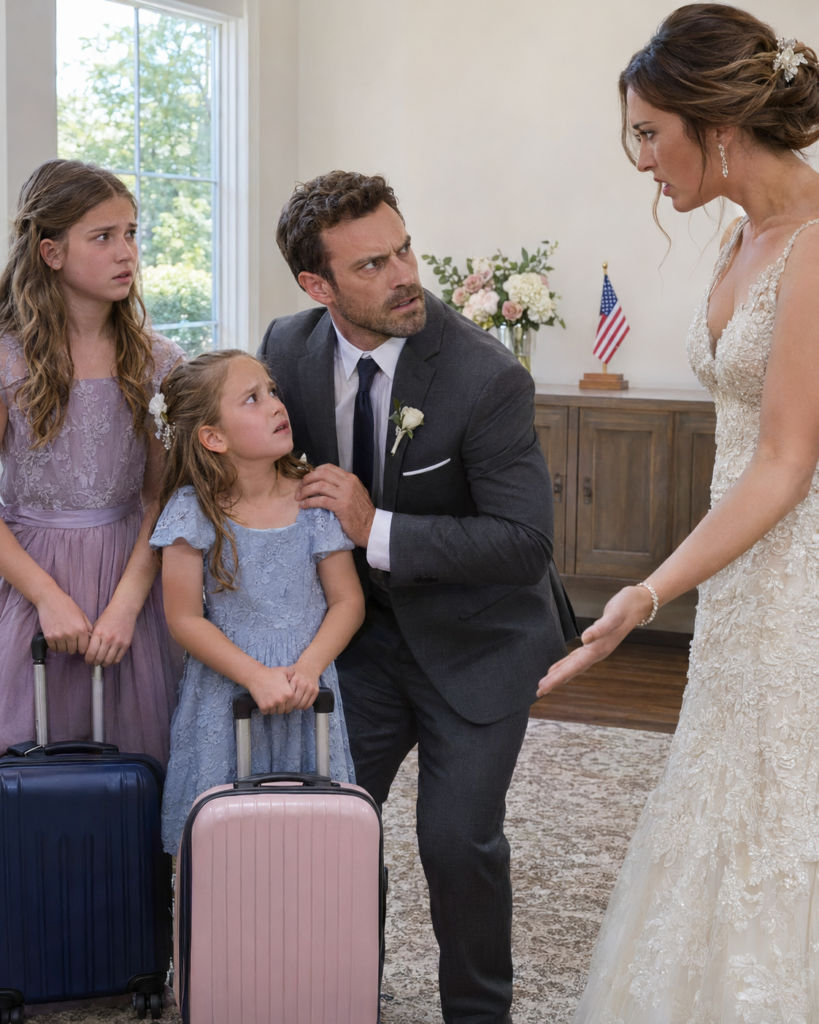
My Fiancée Packed My Daughters’ Suitcases Before Our Wedding—and Told Them I’d Signed the Papers
Claire finished reading the message, but nobody spoke.
“Please arrange the car for both girls. I’ll discuss the details with Daniel after the wedding.”
I looked at my fiancée, Vanessa, who was standing beside the dressing-room window in her wedding gown.
“After the wedding?” I asked. “You planned to send my daughters away tomorrow, but you weren’t going to tell me until after our honeymoon?”
Vanessa’s expression tightened.
“Daniel, we’ve already discussed this.”
“No. We’ve discussed schools. We’ve never agreed that Ava and Susie should live at one.”
Claire was still holding her phone. She looked from Vanessa to me, visibly uncomfortable.
“You told me Daniel had approved the arrangements,” she said.
Vanessa gave her a sharp look. “Claire, please.”
“I need to understand something,” I said. “Claire, were you actually planning to take my daughters tomorrow morning?”
She nodded slowly.
“I was supposed to accompany them in the car. Vanessa told me their father had agreed.”
“And now you know I haven’t.”
“Then I need you to withdraw from that arrangement.”
Claire didn’t hesitate.
“Of course.”
She stepped into the hallway to contact the transportation company.
Vanessa moved toward the door, but I stopped her with a question.
“Did you really believe you could send two children to a residential school without their father knowing?”
She turned back.
“I believed that once we were married, you’d finally understand why it was necessary.”
There were flowers being arranged downstairs, musicians preparing for the ceremony, and guests arriving to celebrate our marriage.
My two daughters were sitting in another room beside suitcases packed for a departure I had never authorized.
And the woman I was supposed to marry was telling me she’d expected to persuade me after it happened.
I took the school papers from my jacket pocket and unfolded them.
The line marked for a parent or guardian’s authorization was blank.
“Then why did you tell the girls I’d signed?”
Vanessa looked away.
For the first time that morning, she seemed to understand that I wasn’t going to let the question disappear.
My name is Daniel. I have two daughters, Ava and her younger sister, Susie.
Their mother was gone from our everyday lives, and I’d spent years trying to give them a home where they felt loved and secure. I knew I couldn’t take away every sadness or solve every problem. Most days, I concentrated on the things I could do: school lunches, bedtime routines, helping with homework, and making sure they knew I would be there when they needed me.
I also wanted companionship. I wanted someone to share the ordinary work of raising a family, someone who could build a future with us.
For a long time, I believed Vanessa was that person.
When we began dating, she was warm with the girls. She listened to Ava talk about school and patiently answered Susie’s endless questions. She understood that their mother would always be part of their lives.
At least I thought she did.
As our wedding approached, Vanessa began speaking more often about fresh starts. She wanted new traditions, new photographs, and a home that felt like ours.
I could understand that. Nobody wants to feel like a visitor in the place where they’re supposed to belong.
But gradually, her idea of a fresh start began to involve fewer and fewer reminders of the life my daughters and I already had.
I didn’t recognize the pattern until the morning we were supposed to marry.
That morning, I’d overheard Vanessa talking to Claire about divorcing me after six months and taking my money.
I confronted her immediately.
She said it was a stupid joke made out of wedding nerves.
I told her there wouldn’t be a wedding.
Then I discovered the suitcases.
Ava and Susie believed they were leaving for a residential school the next morning. Vanessa had told them I’d agreed to everything, including the paperwork.
When I said I hadn’t, Ava looked genuinely confused.
Susie asked whether they were being sent away because they made too much noise.
I promised them they weren’t going anywhere.
Then I discovered the school application, the separate transportation arrangements, and the one-bedroom apartment Vanessa had reserved in her own name.
By the time Claire read the message on her phone, I understood that this wasn’t a misunderstanding between two adults.
My daughters had been made to believe their father wanted them gone.
Vanessa sat down beside the dressing table and crossed her arms.
“You’re making everything sound worse than it was.”
I stayed standing.
“Then explain it.”
She glanced at the paperwork in my hand.
“The program has a wonderful reputation. We’ve discussed how the girls might benefit from a structured environment.”
“We discussed schools. We never agreed they should leave home.”
“I thought you’d be more open to it after the wedding.”
“So you arranged it anyway.”
“I was trying to solve a problem.”
“What problem?”
Vanessa looked toward the door before answering.
“We’ve been planning a marriage, Daniel. A marriage between two adults. Every conversation turns into a discussion about the girls.”
“They’re my children.”
“I know that.”
“Then you know I can’t make a decision about our home as if they don’t exist.”
She pressed her lips together.
I had heard that particular silence before. It usually meant she wanted to stop talking until I was less upset. In the past, I had often agreed. I didn’t like arguments, and I especially disliked having them around the girls.
But waiting until later had become part of the problem.
I laid the school application on the dressing table.
“Who told the school I approved this?”
“Daniel, please.”
“I explained that we were discussing enrollment.”
“Did you tell them I’d signed?”
“Then why did you tell Ava I had?”
Vanessa stared at the papers.
“I was going to get your signature.”
“After we were married.”
“The car was supposed to come tomorrow morning.”
“It wasn’t as if the girls were going to disappear. There would have been an orientation. We could have discussed the final details.”
“Then why does Ava believe she’d only be allowed home after six months if she behaved?”
Vanessa looked startled.
“She told you that?”
“I never said she couldn’t come home.”
“Did you tell her she might return after six months?”
“I told her we could see how the arrangement worked.”
She added, “Children don’t always understand what adults mean.”
That might have been true in some situations.
But Ava had understood enough to pack a suitcase. Susie had understood enough to wonder whether she’d been too noisy for me to keep.
Vanessa knew they were frightened and had allowed them to believe I’d approved the plan.
I folded the paperwork.
“I need to check on the girls.”
“Daniel, we have a wedding in less than an hour.”
“No, Vanessa. We don’t.”
“Don’t do this.”
I looked at her.
“You already knew I was having doubts this morning. You knew what I’d overheard. Why didn’t you tell me about the school then?”
“I was trying to keep us from making a terrible mistake over one argument.”
“By keeping another secret?”
She didn’t answer.
I walked into the hallway.
Claire was speaking quietly into her phone. When she saw me, she raised a finger, asking for another moment.
I waited beside the door.
“Yes,” she said. “I understand. Please note that I will not be acting as the children’s escort. Their father has not authorized the trip.”
She listened, wrote something down, and ended the call.
“The company has noted that I’m withdrawing,” she told me. “I’ll send you the booking information so you can follow up directly.”
“Thank you.”
“Daniel, I really thought you knew.”
“I believe you.”
“I asked Vanessa whether she’d spoken with you. She said you had discussed the school.”
“We had discussed schools. Not this.”
Claire looked back toward the dressing room.
“I’m sorry I didn’t ask you myself.”
“You should have,” I said. “But thank you for showing me the message.”
She nodded.
I didn’t ask her to confront Vanessa again. That wasn’t her responsibility.
My daughters were waiting for me, and I had spent enough of the morning listening to adults explain what they thought was best for them.
When I entered the small sitting room, Ava looked up immediately.
She was wearing the dress Vanessa had chosen for the wedding. Susie was on the carpet, trying to close a small bag.
The two larger suitcases stood against the wall.
Ava had packed neatly. I could see a folded sweater through the partly open zipper. Susie’s case was bulging, with one sleeve caught near the top.
I sat beside them.
“The car isn’t taking you anywhere tomorrow,” I said. “I’ve started canceling the arrangements.”
Susie stopped pulling at the zipper.
“So we’re staying home?”
“With you?”
She crawled onto my lap.
Ava remained on the couch, watching me closely.
“Vanessa said you wanted us to go,” she said.
“She said you’d already made up your mind.”
“I hadn’t.”
“Then why did she tell us that?”
I took a breath.
“I can’t answer that for her. But I should have known what she was telling you. I’m sorry I didn’t.”
Ava looked down at her dress.
“You were so happy about the wedding.”
“I didn’t want to ruin it.”
“You haven’t ruined anything.”
She nodded, but I could tell she wasn’t convinced.
Susie looked at her sister and then at me.
“Is Vanessa still going to be our stepmother?”
“No, sweetheart.”
“Because we’re not going to school?”
Ava looked up.
“Daddy, if we went, would you still marry her?”
The question made me pause.
I realized Ava was still trying to find a way to give me what she thought I wanted.
She had been doing that for weeks without my knowing.
“No,” I said. “I’m not canceling the wedding because you refused to go anywhere. I’m canceling it because Vanessa made plans about your lives without my permission and told you something that wasn’t true.”
Ava rubbed her hands together.
“But she said you needed a new life.”
That was the sentence I had been trying to make sense of since our first conversation that morning.
When Vanessa insisted Ava had written a statement saying she wanted to attend the residential school, I asked my daughter about it.
She admitted writing it.
Then, slowly, she explained that Vanessa had told her I needed to move forward and that reminders of their mother were making that difficult.
Ava believed agreeing to leave would show how much she loved me.
She was afraid that if she refused, I might stop loving her.
I had never imagined my daughter could be carrying that fear while I was busy choosing flowers, confirming meals, and deciding where the wedding photographs would be displayed.
I moved closer to Ava.
“Look at me for a minute.”
She raised her eyes.
“I loved you before Vanessa came into our lives. I love you now. Nothing about that depends on where you go to school or how well you behave.”
She swallowed.
“Even if you don’t get married?”
She looked at Susie, who was resting against my shoulder.
“I told her we should be good about it,” Ava said. “I didn’t want her to be scared.”
“I know you were trying to help. But it wasn’t your job to make this easier for the adults.”
Her eyes filled with tears.
I put an arm around her, and she leaned against me.
For a while, we sat together without saying anything.
Then Susie asked if she could take off her wedding shoes.
I almost laughed at the ordinary request.
“Of course.”
She slipped them off and tucked her feet beneath her.
I told the girls I needed to speak with the wedding coordinator, but I would stay nearby. I asked them to leave the suitcases alone for now.
Ava nodded.
As I got up, she caught my sleeve.
“Are you going to tell everyone about us?”
“No. I’m going to tell them the wedding isn’t happening. You don’t owe anybody an explanation.”
She looked relieved.
That decided something for me.
I would not turn the cancellation into a public accusation, however much I wanted people to understand why I was doing it.
The girls had already been made to feel responsible for my future. I wasn’t going to make them responsible for explaining my decision.
The wedding coordinator was standing near the ceremony room with a clipboard in her hand.
She had the focused expression of someone keeping track of a hundred small details at once.
“Daniel, we’re nearly ready,” she said. “Would you like to check the seating before we begin?”
“The ceremony won’t be going ahead.”
She blinked.
“I’m sorry?”
“Vanessa and I are not getting married.”
Her expression changed immediately.
“Are you all right?”
“Yes. But I need some help.”
She led me to a quieter corner.
I explained that there was a private family situation and that my daughters needed to remain with me. No one was to collect them or their belongings, and any transportation arranged for them was to be referred directly to me.
She wrote down my instructions.
Then we discussed how to inform the guests.
I asked her to give me a few minutes before making any announcement.
“Of course,” she said. “We can hold everything until you’re ready.”
I thanked her.
As I walked back toward the dressing rooms, I passed the display of family photographs.
I’d noticed it earlier and asked Vanessa why Ava and Susie were missing.
She said she’d wanted a few photographs of just the two of us.
There was nothing wrong with having photographs of a couple at their wedding. But the girls had asked for pictures of their family, too, and I had expected those to be included.
Now the display showed one carefully arranged image after another of Vanessa and me.
There was no photograph of my daughters.
I stood in front of it for a moment.
I remembered a conversation we’d had while choosing pictures.
Susie wanted to include one taken at a park. Ava had laughed because none of us looked particularly neat in it.
Vanessa preferred the more formal photographs.
I’d told the girls we’d use their favorite somewhere else.
I hadn’t followed up.
That omission seemed small at the time.
Looking at the finished display, I understood that the girls had been watching their place in our new family become smaller while I kept assuring myself that everything would work out.
I continued down the hall.
Vanessa had changed from her heels into slippers. She was sitting beside the dressing table when I returned.
“Did you tell them?” she asked.
“I told the coordinator the ceremony is canceled.”
Her face went pale.
“Daniel, please. Can’t we just postpone it?”
“You’re making a permanent decision while you’re upset.”
“I’ve had enough time to understand what happened.”
“You heard one conversation with Claire and jumped to conclusions.”
“I found two packed suitcases. I found school paperwork without my signature. I found a transportation arrangement you never told me about.”
She looked away.
“And I found out you’d told my daughters I wanted them gone.”
“I never used those words.”
“You told Ava I needed a new life and that she and Susie reminded me of their mother.”
Vanessa’s eyes filled.
“I didn’t mean it the way she took it.”
“Then what did you mean?”
She sat quietly.
Finally, she said, “Sometimes I feel like there’s no room for me in your family.”
I pulled out the chair across from her.
“Tell me what you mean.”
She looked surprised that I was willing to listen.
“When we started dating, I understood the girls came first,” she said. “I thought that was normal. But as we got closer to the wedding, I began to wonder whether you actually wanted a wife or just someone to help with the children.”
“That isn’t fair.”
“I know you think it isn’t. But every holiday has traditions I didn’t start. Every time I suggest changing something, someone gets upset. There are pictures of their mother everywhere. Sometimes it feels like I’m the only person expected to make room.”
I had never heard her describe it so plainly.
There were parts of it I could understand.
I had been raising the girls on my own, and our home was full of habits that existed before Vanessa. I had asked her to join our lives without always considering how difficult that might feel.
Perhaps I should have asked more questions when she became quiet during family discussions.
Perhaps I should have made more space for the two of us to talk about what marriage would mean.
But none of that explained the suitcases.
“If you felt excluded, we should have talked about it,” I said. “We could have worked on that together.”
“You told me you wanted more time alone. You never told me you were planning to send the girls away.”
“I thought the school might help all of us.”
“Did you ask them whether they wanted to go?”
“They’re children, Daniel. Sometimes adults have to make difficult decisions.”
“Yes. Their parents do.”
She flinched.
I hadn’t intended the words as an insult, but I wasn’t going to take them back.
“You were going to be their stepmother,” I continued. “That meant you needed to earn their trust. It didn’t mean you could make a decision like this without me.”
Vanessa stared at the floor.
“I knew you’d say no.”
“Then you already knew you were crossing a line.”
For a long moment, neither of us spoke.
Then she looked up.
“What about us?”
“What about us?”
“We were supposed to start our marriage today. We were supposed to have a future.”
“I thought that future included my daughters.”
“Then why did you reserve a one-bedroom apartment instead of the family accommodation we’d discussed?”
She rubbed her forehead.
“I needed somewhere I could go if things didn’t work out.”
“You told me that earlier.”
“Because it’s true.”
“Why couldn’t you talk to me about it?”
“I was afraid you’d think I didn’t trust you.”
I looked at her carefully.
It wasn’t unreasonable for someone entering a marriage to worry about financial security. We could have discussed property, savings, and how each of us would protect ourselves.
But Vanessa hadn’t brought those concerns to me.
Instead, she’d told Claire that six months after our wedding she could divorce me and take the money.
When I overheard her, she’d called it a joke.
Now I wasn’t sure which explanation she expected me to believe.
“I heard what you said this morning,” I told her. “I haven’t forgotten it.”
Her shoulders dropped.
“Daniel, I was nervous.”
“You said you planned to divorce me after six months.”
“I was talking nonsense because I was scared.”
“Scared of what?”
“Being left with nothing.”
“Then we should have talked about that before planning a wedding.”
She looked at me as if I had missed the point.
“I didn’t think you’d understand.”
“You didn’t give me a chance.”
She wiped her eyes.
“I love you.”
I believed she felt something for me. There had been years of kindness between us, and I couldn’t pretend those years had never happened.
But I also knew I couldn’t marry someone who had made my daughters believe they needed to leave home so I could be happy.
“I can’t do this,” I said.
Her expression crumpled.
“Please don’t leave me standing here in my wedding dress.”
I looked at the dress, then back at her.
I remembered the day she chose it, the way she’d laughed as we talked about the ceremony, and how certain I’d felt that we were making a good decision.
I didn’t want to hurt her.
But I had already seen what happened when I placed the wish for a peaceful relationship above questions that needed answers.
“I’ll handle the announcement,” I said. “I won’t tell the guests about the girls or the school.”
She looked relieved for a second.
Then I added, “But I won’t marry you.”
I left her sitting there.
The ceremony room had gone quiet by the time I entered.
Guests were seated beneath the flower arrangements we’d chosen together. A few turned toward me with expectant smiles.
I walked to the front.
I had no prepared speech.
“I’m sorry to tell you that the wedding will not take place today.”
A low murmur moved through the room.
I waited until it settled.
“Vanessa and I have reached a point where we can’t go forward with the marriage. I know many of you traveled to be here, and I’m sorry for the disappointment. The venue staff will help with the arrangements.”
Someone near the back raised a hand as if to ask a question.
I continued before they could.
“This is a private family matter. I’m asking everyone to respect that.”
I thanked them and stepped away.
The coordinator took over.
I heard people whispering as I walked down the aisle, but nobody stopped me.
I was grateful.
Part of me wanted to explain everything. I wanted everyone to know I wasn’t abandoning Vanessa over a small disagreement.
But there was no way to tell the story publicly without exposing my daughters’ fears to people who didn’t need to hear them.
I had made enough mistakes by not protecting their feelings.
I wasn’t going to make another one just to defend my reputation.
When I returned to the sitting room, Susie was curled up on the couch without her shoes.
Ava was sitting beside her.
“Is it finished?” Ava asked.
“Did everyone get mad?”
“Some people are probably disappointed.”
“Did you tell them why?”
“I told them Vanessa and I weren’t getting married.”
Ava nodded.
Susie looked up.
“Are we going home now?”
I carried the suitcases downstairs myself.
The coordinator had arranged for our belongings to be collected and brought to the entrance. I thanked her again and told her I’d contact the venue about any outstanding charges.
We left through a side door.
I didn’t want the girls stopped by relatives who might ask questions before I knew how to answer them.
The car was parked nearby.
Susie climbed into the back seat first. Ava followed, carefully arranging her dress so it wouldn’t wrinkle.
I put the suitcases in the trunk.
For a moment, I stood with my hand on the lid.
I’d imagined that the wedding day would end with Vanessa and me beginning our married life.
Instead, I was taking my daughters home in their wedding clothes, carrying luggage meant for a school I had never approved.
I closed the trunk and got behind the wheel.
For the first several minutes, nobody spoke.
Then Susie asked if she would still have to go to school on Monday.
“Yes,” I said.
“Our regular school?”
“With the same teacher?”
“The same teacher.”
She seemed satisfied.
Ava looked out the window.
After a while, she asked, “Are you sad?”
I considered saying no.
It would have been easier.
But she was old enough to recognize when I wasn’t telling the truth.
“Yes,” I said. “I’m sad about some things.”
She folded her hands in her lap.
“I’m sorry.”
“You don’t have anything to apologize for.”
“But you wanted to get married.”
She looked at me in the rearview mirror.
“Then why can’t we just go to the school?”
I pulled into a parking lot and turned off the engine.
I didn’t want to answer that question while watching traffic.
I turned around in my seat.
“Ava, I need you to hear this carefully. I am not choosing between having you at home and being happy.”
She looked down.
“Vanessa said—”
“I know what Vanessa said. But she was wrong. You and Susie are my children. I’m responsible for you, and I want you with me.”
Susie leaned forward.
“Even when we’re loud?”
“Even when Ava gets mad?”
Ava gave her a look.
“Yes,” I said. “Even when Ava gets mad.”
Susie thought about that.
“What if I spill something?”
“Then we clean it up.”
She leaned back.
I waited to see whether Ava wanted to say anything else.
Finally, she asked if we could get something to eat.
We stopped for lunch.
It was a strange meal. The girls were dressed for a wedding that hadn’t happened, and I was still wearing my suit.
Susie ordered what she usually liked. Ava said she wasn’t hungry, then took a few bites from my plate.
We talked about ordinary things.
I didn’t ask them to explain anything else about Vanessa.
They had spent enough of the morning answering difficult questions.
When we got home, I carried the suitcases into the hallway.
Ava stood beside hers.
“Do we have to unpack everything?”
“Not today.”
“What if Vanessa comes back?”
“She won’t be moving in.”
“Are you sure?”
She looked toward the living room.
“Can we keep our rooms the same?”
“Of course.”
That question told me how much uncertainty she’d been living with.
Ava had always liked to keep her room organized. She moved things around occasionally, but she was attached to the photographs on her dresser and the books arranged beside her bed.
Now she was asking whether she was allowed to keep them.
I wanted to reassure her with a hundred promises.
Instead, I carried her suitcase upstairs and set it in her room.
“Everything stays where you want it,” I said.
She watched me place the case beside her dresser.
Then she went to change out of her wedding dress.
Susie followed me into the kitchen.
“Daddy, can I have a snack?”
“Didn’t you just eat lunch?”
I opened the pantry.
She chose crackers and sat at the table.
I poured myself a glass of water and sat opposite her.
She looked around the room.
“It’s quiet.”
“Are we allowed to play music?”
“Of course.”
She ran to turn on the little speaker we’d used for family dinners.
A familiar song began playing.
Susie started singing along.
I sat at the table and listened.
I hadn’t realized how much I needed to hear her making ordinary noise in our house.
That night, after the girls went to bed, I gathered the school papers and the transportation details.
I read through them carefully.
The application contained information about Ava and Susie, notes about the residential program, and a proposed start date.
There was no signature from me.
Vanessa had arranged more than an inquiry, but she hadn’t completed everything required to enroll the girls.
I didn’t know exactly what the school had been told, and I wasn’t going to guess.
I made a list of the people I needed to contact.
The school came first.
Then the transportation company, the venue, and anyone handling the accommodation arrangements.
I also needed to sort out the financial side of the canceled wedding.
Those were practical problems.
I could solve them one at a time.
What frightened me more was the part I couldn’t fix with a phone call.
My daughter had believed that leaving home was a way to prove she loved me.
I thought about the weeks leading up to the wedding.
Ava had become quieter. She still did her homework and helped with Susie, but she’d stopped asking me many of the questions she usually asked.
I told myself she was getting older.
Susie had begun asking whether Vanessa would make the rules after we were married.
I explained that Vanessa and I would work together to take care of the family.
I didn’t ask why Susie sounded worried.
When Vanessa brought up residential schools, I said I wasn’t interested in sending the girls away.
Then I assumed the conversation was finished.
I’d been clear about what I wanted, but I hadn’t checked what my daughters had been told.
I thought I was protecting the peace in our home.
Instead, I’d allowed someone else to create a problem the girls were afraid to bring to me.
The following morning, Vanessa called.
I stepped onto the porch before answering.
“Daniel, can we talk?”
“We can talk about the arrangements.”
“That’s not what I mean.”
She was quiet for a moment.
“Did you really tell everyone the wedding was canceled?”
“People have been calling me all night.”
“I’m sorry they’re asking questions.”
“Do you have any idea how humiliating this is?”
I looked toward the kitchen window.
Inside, Ava was helping Susie find something for breakfast.
“I know it’s painful,” I said. “But I didn’t tell anyone about the school or the girls.”
“I never meant to hurt them.”
“Susie thought I was sending her away because she made too much noise. Ava thought I wouldn’t love her if she refused.”
Vanessa sighed.
“They misunderstood.”
“They believed what you told them.”
“I was trying to make a better future for us.”
“Then we don’t agree on what that future should look like.”
She began crying.
I listened while she told me how overwhelmed she’d been, how frightened she was about money, and how she felt there would never be a place for her in our family.
Some of those feelings were real. I didn’t doubt that.
But she still hadn’t asked how the girls were doing.
When she paused, I told her I’d contact her about collecting her belongings and settling the remaining expenses.
“I don’t want you coming to the house unexpectedly,” I said. “The girls need some time.”
“Are you saying I can’t see them?”
“I’m saying any arrangements will go through me.”
She sounded hurt.
“After everything I’ve done for them?”
I thought about the lunches she’d packed and the evenings she’d helped with homework. I remembered how pleased Susie had been when Vanessa praised a drawing.
Those moments had mattered.
They didn’t erase the others.
“I appreciate the kindness you showed them,” I said. “But they need to feel safe at home.”
Vanessa asked if I would consider postponing the wedding instead of ending the relationship.
I told her I wouldn’t.
We ended the call without another argument.
On the next business day, I contacted the residential school.
I explained that I was the girls’ father and had discovered an application I hadn’t authorized.
The person I spoke with asked questions to verify my identity and then reviewed the information that had been submitted.
The application was preliminary.
The school had received details about the girls and a proposed arrival date, but the necessary parental authorization had not been completed. There was no finalized enrollment.
I asked how to withdraw the application and make sure no further arrangements would be made without direct contact with me.
The staff member explained the process.
I followed it and requested written confirmation.
I didn’t blame the school for what Vanessa had said. The staff had been given information by an adult who presented herself as involved in our family.
But I needed the record corrected.
When the confirmation arrived, I printed it and put it with the other papers.
Then I contacted the transportation company.
Claire had already withdrawn as the designated escort. I confirmed that the planned journey would not go ahead and asked for the cancellation details in writing.
There were still payment questions to resolve with the person who made the booking, but nobody was coming to collect my children.
I checked that carefully.
The apartment Vanessa had reserved was another matter.
It was in her name, not mine, and it wasn’t the family accommodation we’d discussed.
I made clear that I would not be using it. Whatever reservations she’d made for herself were hers to address.
Then came the wedding expenses.
That part was unpleasant.
The venue had prepared meals and hired staff. The florist had delivered arrangements. Other services had done the work they were contracted to do.
Canceling the ceremony didn’t make those costs disappear.
Some deposits were not refundable. Other charges could be reduced or canceled.
Vanessa and I exchanged emails about what we’d agreed to pay and which arrangements had been made separately.
We disagreed on some items.
I didn’t attempt to turn those disagreements into punishment.
I paid the expenses I was responsible for and disputed charges I hadn’t authorized.
It took time.
There was no dramatic financial victory. Nobody handed me a refund for everything I’d lost, and I didn’t suddenly uncover a hidden fortune Vanessa had stolen.
I reviewed my accounts and the arrangements that involved my name. I found no evidence that she’d already taken my money.
What I’d heard her say about divorcing me after six months remained troubling.
But I wasn’t going to accuse her of acts I couldn’t prove.
I had enough reason to end the relationship without inventing another one.
A week after the canceled wedding, Claire called.
I answered while sitting at the kitchen table.
“Daniel, I wanted to check that everything with the transportation was canceled.”
“It was. I have the confirmation.”
She hesitated.
“Vanessa is very angry with me.”
“I imagine she is.”
“She says I betrayed her by showing you the message.”
I looked at the folder beside me.
“You showed me a message about my daughters.”
“I know. I just keep thinking I should have asked more questions.”
“You should have.”
Claire was quiet.
“I thought the girls knew what was happening,” she said. “Vanessa talked about the school as if they were excited to go.”
“They weren’t.”
“I understand that now.”
I thanked her again for providing the booking details.
Then I told her I didn’t want the situation discussed with the wedding guests.
She agreed.
After we hung up, I sat at the table for a while.
Claire had believed Vanessa because Vanessa was her friend.
I had believed Vanessa because I loved her.
My daughters had believed Vanessa because she was an adult who was about to become part of their family.
That trust had given her influence over all of us.
The girls’ trust would take the longest to repair.
For the first several weeks, Susie asked about plans constantly.
If I said I was going to the grocery store, she wanted to know when I’d return.
If I mentioned school, she asked whether I meant her regular school.
When I took a phone call, she sometimes came into the room and stood quietly until I finished.
At first, I answered each question as though it were an ordinary request for information.
Then I realized she was checking whether something might change without her knowing.
I began telling her about plans before she had to ask.
If I was leaving the house, I explained where I was going and who would be with her.
If we had an appointment, I told both girls what it was for.
I didn’t promise that nothing unexpected would ever happen. Life doesn’t work that way.
But I could make sure they weren’t surprised by important decisions adults had made about them.
Ava was harder to read.
She did her homework, helped with chores, and rarely complained.
She seemed determined to make everything easy for me.
One evening, I found her folding laundry that wasn’t hers.
“You can leave that,” I said.
“I don’t mind.”
“I know you don’t. But you have your own homework.”
“I’m almost finished.”
She continued folding.
I sat down across from her.
“Ava, can I ask you something?”
She looked wary.
“Did Vanessa ever tell you that you needed to help more around the house so I’d be happy?”
Ava stopped.
“She said I should be more responsible.”
“There’s nothing wrong with helping. But did she say that was connected to going to the school?”
Ava looked at the towel in her hands.
“She said I should show you I was mature enough to make a sacrifice.”
I felt my throat tighten.
“What sacrifice?”
“Going away.”
“She said you needed a chance to have a new marriage without worrying about us all the time.”
Ava’s voice was steady, but she wouldn’t meet my eyes.
“I thought if I was good about it, you’d be proud of me.”
I moved my chair closer.
“Ava, I’m proud of you for many things. But I would never ask you to prove you love me by leaving home.”
She set the towel down.
“I didn’t want you to think I was selfish.”
“Wanting to stay with your family isn’t selfish.”
Her face crumpled.
“I was scared.”
“I didn’t tell Susie because I didn’t want her to cry.”
I put my arm around her.
“You were trying to protect your sister. That was kind of you. But you shouldn’t have been put in that position.”
She began to cry.
I held her and let her take her time.
When she finally pulled away, she wiped her eyes and gave an embarrassed little laugh.
“I didn’t mean to make such a big deal.”
“It is a big deal.”
She looked at me.
“And you don’t have to apologize for being upset.”
We left the laundry where it was.
Later that evening, we watched a movie together.
Susie fell asleep halfway through, and Ava leaned against the arm of the couch.
For a little while, the house felt like it had before all the wedding preparations began.
The next morning, I contacted the girls’ regular school to ask what support was available if either of them wanted someone to talk to.
I didn’t want to turn every conversation into a serious discussion about Vanessa.
Sometimes they needed to talk about friends, homework, and ordinary frustrations.
But I wanted them to know that other trusted adults were available if talking to me felt difficult.
I also began making time for each girl separately.
With Susie, that often meant listening to elaborate stories about her day.
With Ava, it meant asking questions and then giving her enough time to decide whether she wanted to answer.
I learned that she had been worrying about the wedding for longer than I’d realized.
She had noticed that Vanessa seemed annoyed when the girls wanted to join activities planned for the four of us.
She had heard Vanessa talk about how different life would be once we were married.
She hadn’t known which changes were normal and which she should be worried about.
I asked why she hadn’t told me sooner.
She looked down at her hands.
“Because you looked happy.”
That answer stayed with me.
I had thought I was hiding my own worries from the girls.
Instead, Ava had been hiding hers from me.
I apologized for not noticing.
She told me I hadn’t known.
“That doesn’t mean I couldn’t have asked,” I said.
She thought about that.
Then she asked whether I’d be upset if she told me something I didn’t want to hear in the future.
“No,” I said. “I might be surprised. I might need time to think. But I want you to tell me.”
She nodded.
It wasn’t a promise that would mean much unless I kept it.
So I tried.
A few days later, Ava disagreed with me about a school activity.
She thought I was being too cautious. I thought she hadn’t considered some practical details.
We talked about it, and I changed my mind about one part of the plan.
She looked surprised.
“You can do that?”
“Change my mind?”
“Sometimes. If you give me a good reason.”
She smiled.
It was a small moment, but I could see what it meant to her.
Her opinions didn’t have to be threats to someone else’s happiness.
They could simply be opinions.
Vanessa emailed about collecting her belongings.
She still had clothes, books, and personal items at the house.
I arranged a time when the girls would be elsewhere and asked a friend to be nearby. I wasn’t expecting trouble, but I wanted the visit to remain practical.
Vanessa arrived carrying an empty bag.
She looked tired.
For a moment, seeing her at the front door brought back the familiarity of our ordinary life together.
She used to arrive with groceries, ask about the girls, and tell me about her day.
Now she stood waiting for me to let her inside.
I stepped aside.
“Your things are in the guest room,” I said.
She nodded.
We gathered the remaining items quietly.
When she finished checking the room, she stopped in the hallway.
Her eyes had settled on a photograph of the girls with their mother.
“Are you going to keep that there?” she asked.
I looked at it.
“The girls like it.”
“I always felt like I was living in someone else’s house.”
I leaned against the wall.
“This was their home before you came here.”
“But you wanted to make it yours.”
“I wanted it to feel like ours.”
I thought about the photographs she’d removed from the wedding display.
“You could have belonged here without taking anything away from them.”
She looked at me.
“That’s easy for you to say.”
“Maybe it is. I know I could have listened more carefully when you told me you felt excluded.”
Her expression softened.
“Then you understand?”
“I understand that you were unhappy. I don’t understand why you made my children think I wanted them gone.”
She looked away.
“I thought the school might make everything easier.”
“For whom?”
She didn’t answer.
We carried the bags to her car.
At the door, she took the house key from her purse and handed it to me.
I thanked her.
She stood there for a moment, as if waiting for me to say something more.
Then she asked, “Do the girls hate me?”
“I haven’t asked them to decide how they feel about you.”
“Would you tell them I’m sorry?”
“If you want to apologize, you can write something. I’ll decide whether it’s appropriate to share it with them.”
She nodded slowly.
Then she got into her car and drove away.
I watched until she turned the corner.
I had loved Vanessa, and I couldn’t pretend the years we’d spent together meant nothing.
But the sadness didn’t make me question my decision.
I went inside and closed the door.
The hallway was quiet.
I looked at the photograph of the girls with their mother, then at the empty space beside it.
Ava had once asked me to hang a picture of the three of us there.
I’d said we would get around to it.
I went upstairs to find the photograph.
It had been taken at a park on an afternoon when none of us had expected to be photographed.
Susie was laughing at something outside the frame. Ava had one hand over her face, and I was looking toward them instead of the camera.
It wasn’t elegant.
It looked like us.
I put it on the hallway table to show the girls when they came home.
That evening, Ava noticed it immediately.
“Where did you find that?”
“In the drawer upstairs.”
She picked it up.
“Can we hang it?”
“That’s what I was thinking.”
Susie came running over.
We tried it beside the photograph of their mother.
Ava thought it should be a little higher.
Susie insisted it was crooked.
We moved it twice before everyone was satisfied.
Then we stepped back.
There were now two photographs in the hallway: one from the life the girls had shared with their mother and one from the life we were still building together.
Neither had to replace the other.
A few weeks later, Vanessa asked to meet for coffee.
I considered refusing.
We had settled most of the practical arrangements, and I didn’t want another argument.
But I also knew there were things I hadn’t said clearly.
I agreed to meet her at a quiet café.
She was already seated when I arrived.
We ordered coffee and spoke briefly about the remaining wedding expenses.
Then she set down her cup.
“I’ve been thinking about everything.”
“I handled the school badly.”
“I should have talked to you before making arrangements.”
She looked hurt by the short answers.
“Daniel, I’m trying.”
She folded her hands on the table.
“I never wanted the girls to feel abandoned.”
“Then why did you tell Ava I needed a life without reminders of their mother?”
Her eyes filled.
“I didn’t mean for her to take it that way.”
“But you knew she was writing a statement saying she wanted to leave.”
“I thought she was agreeing to try something that might be good for her.”
“Did you ever ask whether she wanted to stay home?”
Vanessa looked down.
That silence was familiar now.
I didn’t interrupt it.
Eventually, she said, “I wanted us to have some time alone.”
“I understand wanting time as a couple. But you were asking two children to leave their home so you could have it.”
She took a breath.
“I made a mistake.”
“You made several decisions. You had time to reconsider them.”
She wiped her eyes.
“Could we start over? Slowly?”
“Even if I apologize?”
“I think an honest apology would be appropriate. But it wouldn’t make me ready to marry you.”
She looked at me for a long moment.
“You’ve already decided.”
She glanced out the window.
“What about what I said to Claire? Do you really think I planned to divorce you after six months?”
“I don’t know what you would have done. I know what I heard.”
“I was scared about money. I thought if things failed, I’d be left with nothing.”
“We could have discussed that before the wedding.”
“I didn’t think you’d understand.”
“Then we weren’t ready to marry.”
She looked down at her cup.
I didn’t ask her to confess to a plan she might deny forever.
The words I’d overheard were part of why I no longer trusted her.
The arrangements she’d made for my daughters were enough to show me that our marriage couldn’t begin honestly.
When we left the café, Vanessa said she hoped one day I would understand why she’d been afraid.
I told her I understood fear.
I also understood that fear didn’t give anyone permission to make my children feel unwanted.
We said goodbye.
I didn’t contact her again except to finish the remaining practical matters.
The weeks that followed were ordinary in ways I’d once taken for granted.
There were lunches to pack, homework to check, and school activities to attend.
Susie still asked too many questions, especially when our plans changed.
Ava still watched my reactions closely when she disagreed with me.
But gradually, I saw small changes.
One afternoon, Susie spilled juice across the kitchen table.
I reached for a towel.
“It’s all right. Help me wipe it up.”
She looked at me.
“I’m not in trouble?”
“It was an accident.”
She took the towel.
“Vanessa didn’t like spills.”
“Most people don’t. But that doesn’t mean you can’t make a mistake.”
She helped me clean the table and went back to drawing.
A few days later, Ava asked if she could have a friend over.
I said yes.
She looked surprised.
“Even if you have work to do?”
“I can work in the other room.”
“They might be loud.”
“I’ll let you know if I need things quieter.”
She smiled and went to make the arrangements.
I knew then that the girls were beginning to believe our home could be a place where ordinary needs and ordinary mistakes didn’t threaten their security.
It wasn’t a dramatic transformation.
There were still difficult days.
Sometimes Ava became quiet for no reason I could see, and I had to remind myself not to demand an explanation immediately.
Sometimes Susie wanted reassurance about plans we’d already discussed.
I answered her again.
I also made mistakes.
I lost patience on a busy morning when we were running late. Later, I apologized and explained why I’d been frustrated.
Ava looked relieved.
“You’re not still mad?”
“Even though we were late?”
“We were late. That doesn’t change how I feel about you.”
She nodded.
I had to repeat that lesson many times, in different ways.
The girls had spent weeks believing that being inconvenient could cost them their place at home.
A single promise couldn’t undo that.
Time helped.
So did consistency.
One Saturday morning, several months after the canceled wedding, I was cleaning the hall closet when I found the two suitcases.
They were standing behind a stack of blankets.
I’d put them there after the girls unpacked, though neither had wanted to look at them much.
I carried them into the hallway.
Susie appeared at the top of the stairs.
“Why are those out?”
“I’m cleaning the closet.”
She came down slowly.
“Are we going somewhere?”
Ava joined us.
She looked at the luggage, then at me.
“Those are the school suitcases.”
For a moment, nobody moved.
Then Susie walked over and opened hers.
It was empty except for a folded sheet of paper she’d forgotten.
She picked it up.
It was a list of things she’d wanted to take with her.
She looked at the paper for a moment, then handed it to me.
“Can we throw this away?”
“If you want to.”
She nodded.
I put the paper aside.
Ava touched the handle of her suitcase.
“Maybe we should keep them for trips,” she said.
“That’s a good idea.”
Susie looked worried.
“Trips where we all go?”
“Trips where we all go,” I said.
She smiled.
We put the suitcases on a high shelf in the closet.
I thought that might be the last time we’d talk about them.
But the following spring, Ava came home with a permission slip.
Her class was planning an overnight school trip.
She placed the form on the kitchen table and stood beside me while I read it.
“Do you want to go?” I asked.
“Have you looked at the schedule?”
She nodded.
“There’s a museum visit and some activities with our class. We come back the next afternoon.”
I read through the information about supervision, transportation, and emergency contacts.
Then I looked at her.
“Do you have any questions about it?”
“Just one.”
“What is it?”
She hesitated.
“Are you okay with me going?”
“If you want to go and everything is properly arranged, yes.”
She looked at the permission slip.
“So you’re not sending me?”
“No. You’re asking to go.”
She thought about that for a moment.
Then she smiled.
“I really do want to.”
I picked up a pen and signed the parent authorization.
Ava watched me write my name.
Afterward, she took the form and folded it carefully into her school folder.
Susie came into the kitchen and asked what we were doing.
“Ava’s going on a school trip,” I told her.
“Without us?”
“For one night,” Ava said. “And I’m coming home the next day.”
Susie looked at me.
“Are you picking her up?”
“What time?”
I checked the schedule.
“Three o’clock.”
Ava laughed.
“She’s going to ask you that every day until I get back.”
“Probably,” I said.
Susie grinned.
Then Ava asked whether she could use one of the suitcases from the closet.
I looked at her for a moment.
“Of course.”
She went upstairs to get it.
This time, I didn’t pack it for her. I helped her check the list, asked whether she’d remembered what she needed, and let her decide which clothes to take.
On the morning of the trip, she carried the suitcase to the car herself.
Susie followed us outside and reminded her not to forget her toothbrush.
Ava rolled her eyes.
“I packed it.”
At the school, I helped her take the suitcase from the trunk.
She turned to me before joining her classmates.
“You’ll be here tomorrow?”
“At three.”
She smiled.
“Okay, Dad.”
Then she picked up her suitcase and walked toward her friends.
I watched until she reached them.
She turned once to wave.
I waved back.
The next afternoon, I was waiting when the bus arrived.
✓ Lynn R. Adams
My Fiancée Packed My Daughters’ Suitcases Before Our Wedding—and Told Them I’d Signed the Papers Claire finished reading the message, but nobody spoke. “Please arrange the car for both girls. I’ll d…