Six hours after a flash flood swept our commanding officer away in the North Carolina mountains, my SEAL team reported Captain Nathaniel Ashford dead and prepared to
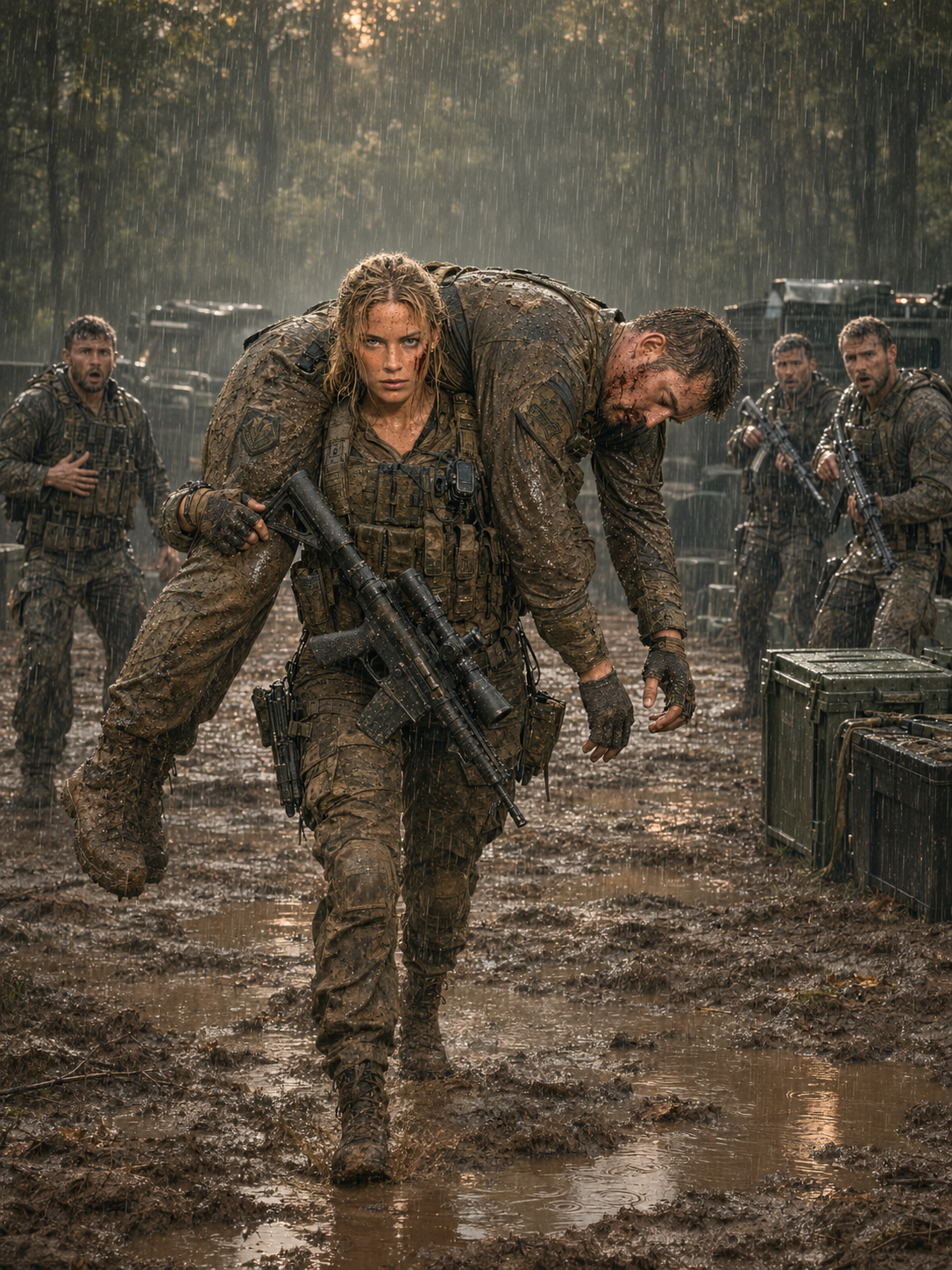
Six hours after a flash flood swept our commanding officer away in the North Carolina mountains, my SEAL team reported Captain Nathaniel Ashford dead and prepared to leave at first light, but I was twenty-six, the smallest operator in that cave, and I had a map showing three places he might still be alive—so I asked for one hour nobody wanted to give me…
The radio hissed in Master Chief Graham Callahan’s hand while rain pounded the mouth of our cave. “Base, this is Bravo Five,” he said. “Captain Nathaniel Ashford is presumed killed in action.” I was sitting against the back wall, cleaning a rifle that hadn’t been fired, and I felt my fingers stop moving.
Six hours earlier, a mudslide had hit while we were crossing a creek in the Blue Ridge Mountains. That creek was normally ten feet across; Hurricane Elena had turned it into a violent brown river. One moment Captain Ashford was with us, and the next the water had taken him beyond anything we could see.
We were on a training exercise in North Carolina, not a combat deployment. We’d planned for bad weather, but not for a storm that strengthened inland until the wind was ripping old trees out by their roots. Our GPS contact with the captain had vanished, the radio carried nothing from him, and the darkness beyond our shelter was almost solid with rain.
“Copy, Bravo Five,” the voice from base answered. They accepted the report and authorized extraction when conditions allowed. Callahan lowered the handset, and nobody spoke for a few seconds. I watched the water run from the sleeves of men who had spent their careers learning what to do when things went wrong.
Senior Chief Marcus Lindren sat with his back to the rock, staring between his boots. “Six hours,” he said finally. “Nobody survives six hours out there.” He wasn’t trying to be cruel. He had seen enough rescues and recoveries to know how often hope turned into another casualty.
Our medic, Petty Officer Jake Sullivan, checked his watch again. “The slide hit at fourteen hundred,” he said. “It’s twenty hundred now. If the captain was injured going into that water…” He let the sentence go unfinished. Tommy O’Connor, our demolitions expert, shook his head and muttered that a man who’d survived Desert Storm and fifteen years in special operations shouldn’t be lost to a hurricane on a training day.
I understood all of them. I also knew Captain Ashford had spent the previous month teaching us how an injured operator thinks: get away from the immediate threat, find elevation, find shelter, and stay as close as possible to the last known team position. I looked from my disassembled rifle to the laminated topographical map inside my pack.
My name is Kira Donovan. I was twenty-six, five feet four inches tall, about 125 pounds, and the youngest member of SEAL Team Five. My teammates called me Ghost because I was good at moving unnoticed through difficult ground. I had earned my place through training and performance, but I could still hear the doubt in certain conversations when people thought I wasn’t listening.
Lindren was usually the most outspoken. His concerns about my size weren’t invented; I couldn’t carry a 195-pound captain through three miles of flooded mountains. But searching wasn’t the same thing as carrying, and the question I couldn’t shake was whether anyone had actually established that Ashford had died. We had lost a signal, not found a body.
I had spent my childhood on the Outer Banks learning that the worst part of a storm wasn’t always where a weather map made it look. My mother, Dr. Patricia Donovan, worked as a senior hurricane researcher for NOAA. She could read a satellite image the way some parents read the morning newspaper, and our kitchen table was often covered with weather information.
My father, Lieutenant Commander Sean Donovan, was a Coast Guard rescue swimmer. During Hurricane Irene in September 2011, when I was eleven, he taught me to listen for shifts in the wind instead of panicking at every gust. “A storm tells you where it’s moving,” he’d say. “You have to pay attention long enough to hear it.”
After Irene passed, I watched him help pull families from flooded homes, including an elderly couple stranded in their attic. That night, exhausted and soaked, he told me, “You don’t leave people behind. If somebody needs help, you help them.” I was young enough to think he’d always come home and old enough to remember the exact way he said it.
A year later, during Hurricane Sandy, his rescue helicopter went down in the Atlantic. His crew had saved five fishermen from a vessel in terrible seas before the aircraft was lost. None of the Coast Guard personnel survived. At his funeral, I held the rescue swimmer badge they gave me and tried to understand how a man could save strangers and still leave his own family grieving.
I kept that badge. I didn’t think carrying it made me brave, and I knew my mother had paid a terrible price for Dad’s devotion to the job. But when somebody said a person was beyond help, I wanted to know whether that conclusion came from evidence or fear. There was a difference, even when the fear was reasonable.
“Donovan.” Callahan had crossed the cave and found me staring at the map. “You’ve been quiet. You okay?” I told him I was, then asked him and Lindren to look at something. I spread the map across a dry patch of stone and marked the place where the creek had swallowed our captain.
“The current was moving northeast,” I said. “If he survived the water and got out, there are only three places within the probable drift area that offer high ground and natural wind protection.” I pointed to each one. Rain was still rattling the cave, but Sullivan and O’Connor moved close enough to see.
Lindren folded his arms. “Donovan, he’s dead.” I didn’t argue about the odds. “He might be,” I answered. “But if he got out, Captain Ashford would do exactly what he taught us to do. We could be looking for a survivor instead of planning a body recovery.”
Callahan studied the contours. “What are you proposing?” My throat tightened because I knew how the next words would sound. “Permission for a solo reconnaissance,” I said. “One hour. I check the three sites, report anything useful, and come back.” For a moment, the cave seemed quieter than the storm had any right to allow.
Lindren gave a short, disbelieving laugh. He reminded me that I was a sniper, not a rescue specialist, that the captain outweighed me by seventy pounds, and that trees were falling outside. He was right about the danger. I told him I wasn’t proposing to carry Ashford out alone; I wanted to locate him, give first aid if necessary, and make an organized rescue possible.
Callahan asked why I believed I could move through weather the rest of the team couldn’t. I told him about my mother, the hurricanes on the Outer Banks, and my father’s work. Then I took the small Coast Guard badge from my pack and set it beside the map. “My father died bringing five people home,” I said. “I’m asking for a chance to find one of ours.”
Callahan asked the medic what waiting might cost us, then asked what I’d do if I encountered unknown armed people; we’d intercepted a fragment of radio traffic earlier. I promised to avoid contact, radio every fifteen minutes, and withdraw if ordered. Lindren warned that we could lose two people instead of one. Callahan looked at the map again before speaking.
“One hour, Donovan,” he said. “Not one minute more. You miss a check-in, you follow an abort order, or you find a situation you can’t handle, you come back.” I checked my radio, GPS, compass, first-aid kit, and waterproofed equipment while Sullivan pressed an extra morphine injector into my hand and O’Connor offered emergency grenades. At the cave entrance, Callahan said quietly, “Your father would be proud.”
I pulled up my hood and looked out into the wall of rain. Behind me Lindren said, “Ghost, you’ll die out there for nothing.” I turned just far enough to answer, “Trying to bring him home isn’t nothing.” Then I stepped out of the cave, and the wind nearly took my feet from under me. Part 2…..
IF FACEBOOK BROUGHT YOU HERE, HERE’S THE CONTINUATION YOU’VE BEEN WAITING FOR. ENJOY! 👇 I stopped beside the rock face until I found my footing. The rain stung my cheeks, and I could see only a few yards ahead, but underneath the roar I heard the same changes in the wind my father had once made me listen for. I kept the compass close, waited through the hardest gust, and moved northeast when the pressure eased.
It wasn’t graceful. I crawled around tangled roots, slipped on stone, and had to keep moving away from trees that creaked above me. At the first fifteen-minute check, I sheltered beside an old oak and told Callahan I was on my route with no contact. Seconds after I moved, a heavy branch crashed where I had been standing.
By twenty-three minutes, I found a scrap of tactical uniform snagged on thorns. It matched what Ashford had been wearing, though I couldn’t prove it was his. I marked the place, held it against my sleeve, and followed the higher ground. Eight minutes later I found the impression of a size-eleven combat boot in mud between two rocks, pointing northeast.
Rain was already softening the print. I couldn’t honestly tell how long it had been there, but its direction and location fit my theory. At the thirty-minute check I reported the fabric and bootprint, saying I had signs that the captain might have been moving after the flood. “Then find out where he went,” Callahan said, his voice suddenly alert.
I pushed on, more frightened now that I had a reason to hope. At about thirty-eight minutes, the wind dropped just enough for voices to carry across a ridge. I crouched in the wet brush and listened. The men below weren’t speaking English, and the tone was businesslike, not the confused shouting of stranded hikers.
Through breaks in the rain I saw four armed men in tactical clothing, moving with the spacing and hand signals of trained operators. They were speaking Russian. One was an older man with a scar on his left cheek, and after a lightning flash showed his face I recognized him from intelligence briefings: Victor Vulov, a former Russian Spetsnaz operator now working as a mercenary.
For a few seconds I couldn’t understand why someone like him would be in these mountains during a hurricane. Then the men shifted, and I saw the makeshift stretcher they were carrying. Under a poncho, with his head moving weakly against the fabric, was Captain Nathaniel Ashford. The man we’d reported dead was alive—and four armed strangers had him.
I flattened myself against the ground and reached for my radio. “Alpha, this is Ghost. Emergency traffic. I have visual on the captain. He’s alive, injured, and being moved northeast by four armed men.” I gave Callahan Vulov’s name and the direction of travel while watching the stretcher disappear behind a stand of battered pines.
Callahan repeated the count, then ordered me to observe without engaging. He wanted a location and updates so the team could organize a response when the conditions allowed. “Acknowledge,” he said. I did, even while my eyes stayed on Ashford’s bent leg and the way his head kept slipping sideways. He didn’t look as though he could wait until morning.
I kept them in sight by taking higher ground and staying well behind. Vulov checked his rear repeatedly, and his men handled the stretcher with practiced coordination. They weren’t lost. They were taking our captain toward a position farther from our team, and every minute made bringing him back more difficult.
At the next check, Callahan told me my hour was nearly up and gave a direct order to break contact and return. I watched a carrier stumble and Ashford’s head fall sideways. “Master Chief,” I said, “if I leave now, they’ll take him out of reach.” Lindren came on the channel and told me to get back immediately.
For the first time that night, I didn’t answer right away. One of the men was scanning the hillside with thermal equipment, and I had to lie still behind a boulder until he turned away. I knew I was crossing a line by staying. I also knew that the captain was alive, and I couldn’t pretend that information hadn’t changed the mission.
I called again with an honest report. The captain was barely conscious; his leg appeared broken; the movement of the stretcher was getting slower. Sullivan told Callahan that serious blood loss could make every hour decisive. I asked for permission to secure Ashford before Vulov’s men could move him beyond our reach.
“What’s your plan, Ghost?” Callahan finally asked. I described the four men, their positions, the rocky shelter they were approaching, and the fact that I could not carry the captain away. I would have to stop the captors, reach Ashford, and hold a position until our team could get to us. Callahan warned that the storm might keep them away for hours.
He asked Lindren for his assessment. Lindren said we would be trading one missing officer for another missing operator, possibly exposing the entire team. I heard the fear beneath his anger, and I respected it, but I still couldn’t look away from the stretcher. Then Callahan asked me one final question: “Can you actually do this?”
I thought of Ashford’s terrain lessons and my father coming home in dripping Coast Guard gear, too tired to eat before checking on me. “Yes, Master Chief,” I said. Callahan authorized me to engage the immediate threats at my discretion, secure the captain, and hold until the team could reach us. He repeated that I had to stay on the radio.
I settled behind a boulder and waited for the men to separate around their shelter. My rifle was not meant to solve every problem I was looking at, especially in that wind. But two guards were out on the perimeter, and the other two were near the stretcher. I had a brief chance to change the balance before they disappeared farther into the rocks.
Part 3 When the first guard went down, the storm swallowed the sound. The second moved toward his unanswered radio call and fell where the others could see him. Shouts rose from the shelter. Vulov pulled Ashford behind a large rock while another guard took cover, and the quiet observation I’d been ordered to maintain had become a fight I couldn’t undo.
I moved to a different position before they could locate me. The remaining guard fired toward a noise off to one side, and in the confusion I stopped him too. Three men were down; Vulov was the only one left from the original group. I could hear his voice through the storm, calm enough to make my skin crawl.
“You came for your captain,” he called in accented English. “Leave, and I let him live.” I could see enough through the rocks to know he was keeping Ashford between us. I couldn’t fire without endangering the man I’d come to save. Vulov began counting aloud and threatened to shoot the captain if I stayed hidden.
I tried an open-channel warning that his position was surrounded. Vulov laughed and said he knew I was alone. When his count reached ten, a shot cracked through the rain. I flinched so hard that my cheek came off the rifle stock, and then I heard Ashford’s exhausted voice: “Missed, you Russian bastard.”
Vulov had fired to frighten and wound him, not finish him. He called out that the next shot would be different. I had no clean line to the captain and no time to wait for a better one, so I used one of O’Connor’s grenades to draw Vulov’s attention away from the opening I was watching. The blast shook loose stones around the shelter.
Vulov shifted, dragging Ashford with him. I fired during the movement and struck rock close to his head, missing him as the wind changed. He pulled Ashford deeper into the stone recess where I could no longer see either of them. I had forced him back, but now I had to reach a man I couldn’t even see.
Then I heard engines, faint at first and growing louder through the rain. Vulov heard them too. “Six more,” he shouted, certain that reinforcements were coming to finish what his first men had started. I told Callahan what I heard; he said our team was beginning to move, but they were still a long way away.
I circled the rock formation until I could see into a deeper opening. Ashford was propped against a wall, almost unconscious, with his damaged left leg out in front of him. There was open ground between us, and Vulov was still somewhere inside. The headlights were getting closer. Waiting would leave me outside when the new men arrived.
I secured my rifle, took my sidearm, and made a dash toward the shelter. Wind drove me sideways; loose stones slid under my boots. I threw my remaining emergency grenade toward Vulov’s position and reached cover as he fired back. Then I moved through the entrance, searching the darkness until I heard a weak voice say, “Ghost? That you?”
“Yes, sir. It’s me.” Ashford tried to lift his head and warn me that Vulov was still inside. I told him to save his strength. He looked so different from the man who’d stood in front of our team explaining survival psychology a month earlier that for one painful moment I had to force myself to concentrate on his injuries instead of his face.
His left lower leg was badly broken, and there were bleeding wounds at his shoulder and side. I used pressure dressings, supported his leg as best I could, and gave the pain medicine Sullivan had supplied. Ashford murmured, “You’re a good doc.” I said, “I’m not Doc, sir. I’m Ghost. But we’re going to make this work.”
I radioed that I had reached the captain and was giving first aid. Callahan’s relief lasted only until I told him Vulov was still somewhere in the formation and the new vehicles had arrived. I could hear doors slam and men calling to one another outside. “Can you move him and hide?” Callahan asked. I looked at the splint and at Ashford’s gray face.
“No, Master Chief. Not quickly enough.” The answer was obvious to both of us. Callahan said his team was roughly forty-five minutes away and ordered me to defend our position until they could reach us. I clicked the radio off for a moment so Ashford wouldn’t hear the distance between us and help.
He heard enough anyway. “Leave me, Ghost,” he said. “That’s an order.” I pulled the loose poncho farther around his shoulders and checked that he was out of the direct wind. “You taught us not to leave someone behind,” I reminded him. He managed a faint smile and said he’d never expected his own lessons to be used against him.
Outside, men were taking positions around the rocks. One voice, different from Vulov’s, called in English that I should surrender and that they would keep us alive because we had value as prisoners. I knew neither of us could rely on that promise. I moved Ashford into a narrow alcove that offered more protection from the entrance.
He gripped my sleeve as I lowered him against the wall. “Kira, listen. I’m not making it out.” I didn’t argue about the seriousness of his condition, because that would have insulted him. I told him the medic was coming, that my job was to keep him safe until then, and that I needed him to stay awake if he could.
The men outside gave me thirty seconds to lay down my weapons. I called Callahan with the situation. He said that if holding became impossible, I was authorized to surrender rather than die for a position we couldn’t defend. I understood why he said it, but I wasn’t ready to hand over our captain to the people who had taken him.
Their assault came through the main entrance and smaller openings among the rocks. I stopped one attacker at the entrance, then another trying to work through a side gap. The shelter filled with shouting, dust, gunfire, and the hard impacts of rounds striking stone. I could no longer keep track of time by my watch; every movement was about protecting the narrow opening to Ashford’s alcove.
Part 4 A flashbang went off inside the shelter and left my ears ringing and my sight blurred. I fired toward movement as trained, then had to switch weapons when someone grabbed my rifle in the confusion. Another man knocked me down, and I fought free at close range. I had never felt less like the quiet Ghost my teammates joked about.
When I finally crawled back toward the alcove, my hands were shaking. Ashford was still breathing, and the bandages had held well enough for the moment. Four of the six men who had arrived in the vehicles had gone down during the defense; two were no longer pressing us. With the three guards outside already dead, only Vulov’s fate remained unknown.
I told Callahan the attack had broken and estimated that a few hostile men might still be nearby. He said the team was coming as fast as the roads and weather allowed. I could have stayed beside the captain, but there was a sound deeper inside the formation, a boot scraping stone, and I needed to know whether Vulov could come back through another opening.
I followed that noise into a passage between the rock chambers. There was a dark trail on the ground, and at the end of it I found Vulov sitting against a wall with his weapon out of reach. He had been wounded during the fighting. He looked at me without reaching for anything and gave a tired, almost incredulous laugh.
“You are the ghost,” he said. I asked where the other two men had gone. He said they had fled when they realized the fight wasn’t worth their pay. Then I asked the question that had been sitting at the back of my mind since I’d recognized his face: “Why did you take our captain?”
“We were hired,” he said. “Take American military personnel in the storm. Use them as leverage.” He didn’t tell me who had paid him, and I wasn’t going to pretend that answer solved the larger question. He spoke as a man who had believed this would be a simple job, until the hurricane put one unexpected person in his path.
His breathing grew weaker. Then he asked me to do something I hadn’t expected. He said there was a photograph of his daughter in his pocket, a young woman in Moscow, and wanted her to receive it. He died before finishing the request. I stood there a moment, looking at a stranger whose decisions had nearly cost my captain his life.
I found the photograph, tucked it away for the authorities to handle, and went back to Ashford. I wasn’t going to make a promise about delivering it myself when I didn’t even know his daughter’s address. But I couldn’t throw it away either. My father had left photographs behind too, and a daughter didn’t stop being someone’s daughter because her father had done terrible things.
I called Callahan and reported Vulov dead, eight hostile men killed in all, and two who had fled. The unexplained mercenary operation would need an investigation; I could only give what I’d seen and what Vulov had said. Callahan reported that the team was about twenty minutes away. That was the first time since leaving the cave I let myself think we might both live.
I returned to the alcove and tightened the poncho around Ashford. He asked if the danger was over. I told him the immediate threat had stopped, but our people still needed to reach us. He closed his eyes for a second and opened them again. “You found me,” he said, as if he were still trying to understand it.
I sat on the stone beside him, listening for footsteps and keeping the radio in my hand. The wind outside was changing; its force had dropped and the thunder had moved farther off. Ashford said I had done something he hadn’t believed anyone could do in that storm. I told him he had taught me where a survivor would try to go, and that had been enough to start looking.
He said he intended to recommend me for the Navy Cross when we got home. I didn’t know what to say to that, so I checked his dressings instead. “You don’t have to do that, sir,” I said. “I do,” he replied. “And I want you to know you saved my life.” I squeezed his hand once and kept listening to the entrance.
Seventeen minutes after the last call, I heard voices through the rain, and this time I knew the American accents. “Ghost! Captain Ashford!” someone shouted. I called back from the rear chamber, and Master Chief Callahan came through first. He stopped when he saw us and let out a long breath that sounded almost like a laugh.
Sullivan came straight to Ashford with his medical kit, taking over the care I’d been trying to provide alone. O’Connor and the others checked the surrounding area and secured weapons while Callahan listened to my brief report. When Lindren entered and saw the evidence of the fight, he stared around him before looking at me. “Donovan,” he said, “what happened?”
“I found the captain,” I answered. It was an incomplete answer, and we both knew it. Callahan had me explain the tracking, the captors, the orders, the decision to engage, and the defense of the shelter. I didn’t leave out the moment I had been ordered to return and kept following the stretcher instead.
When I finished, Callahan said I had disobeyed a direct order. I agreed. He said I’d faced a superior armed force without support and somehow kept Ashford alive until the team could reach us. I agreed with that too. Finally he shook his head and said he wasn’t sure whether I’d been brilliant or reckless. “Could be both,” I told him, and he almost smiled.
Lindren approached while Sullivan worked. The older man who had called my request suicidal looked tired and strangely uncertain. “Ghost, I owe you an apology,” he said. “I questioned whether you could do this. I was wrong.” I told him his concerns had been real, because they had. He nodded, then said I had his trust and he’d never again question whether I belonged on the team.
Final There was no cheering in that shelter. There was too much work left, too many people dead, and a badly injured man still waiting for a hospital. But when Lindren helped carry the captain’s stretcher, I saw something shift between us. He had stopped treating my presence as an exception that needed an explanation.
The storm eased enough for a medevac helicopter to reach us about forty-five minutes later. Ashford was stabilized for transport, and as they lifted him aboard he reached for my hand. “Ghost, your father would be proud,” he said. I couldn’t answer properly with the engines turning overhead, so I nodded and let him hold my fingers for a moment.
I watched the helicopter disappear into the remaining clouds, then joined the others for the long walk back. It took us four hours to get through the fallen trees, mud, and swollen streams. Nobody moved ahead to prove a point, and nobody left anyone to struggle alone. That mattered to me more than I expected.
At the operations center, the questions began. Intelligence personnel wanted every detail of Vulov’s appearance, his men, and his remarks about being hired. Command wanted to know when Callahan had issued orders and why I’d continued after the original time limit. Medical personnel looked at my bruises and scrapes while I answered questions I hadn’t quite sorted out for myself.
I turned over the photograph from Vulov’s pocket as evidence, explaining his request without claiming to know more about his employer or family than I did. After that, I drew the route on a map and went over the account again. There would be an official investigation and a formal record. A rescue didn’t erase the need to account for the choices and deaths involved.
When they finally released me to my quarters, I sat on the bunk without taking off my boots. I had spent so much of the night concentrating on where to put my hands and feet that I hadn’t let myself think about the men who wouldn’t go home. I could feel relief for Ashford and sorrow about the cost of saving him in the same breath.
I took Dad’s rescue swimmer badge from its pocket and rubbed my thumb over its familiar edge. “I got him home,” I whispered. No one answered, and I wasn’t expecting anyone to. What I wanted more than a decoration was another chance to tell my father how much I finally understood about the fear my mother used to live with.
Three days later, I got word that Ashford had improved from critical to stable. The doctors expected him to recover, including the badly broken leg, though it would take time. His first request once he was fully alert was to see me. I walked into the hospital room and found him propped up with a cast on his leg and a bandage at his shoulder.
“Sit down, Ghost,” he said. He told me he’d talked with Callahan and that the recommendation for a Navy Cross was going forward. I tried to explain that I’d only wanted to get him out of the mountains. He nodded. “I know. You weren’t trying to prove something about yourself. You were trying to save somebody else.”
I thanked him for trusting me with the mission, and he reached out his hand. He had twenty-three years of military service behind him, but in that moment he seemed less interested in speeches about courage than in being alive to see another day. “Thank you for bringing me home,” he said. I shook his hand and answered, “Anytime, sir.”
Four months later, at Naval Amphibious Base Coronado, I stood in dress uniform while the citation for my Navy Cross was read. The Secretary of the Navy pinned the medal to my uniform. I could see my mother in the audience holding one of Dad’s Coast Guard medals, and my team stood together nearby, including Lindren, who kept his eyes fixed straight ahead until the ceremony ended.
Mom hugged me afterward with a grip that was stronger than it looked. We didn’t talk much about Dad in front of everyone. There was pride in her face, but also the old worry that had lived there since the day his helicopter failed to come back. I held her a little longer than I normally would and let the cameras move on without us.
When the official photographs and handshakes were over, I walked alone to the beach. The Pacific was calmer than the Atlantic had been in my childhood memories. I took Dad’s badge from my pocket and held it where the afternoon sunlight caught the worn metal. “We brought him home,” I said softly. This time, I let myself stand there until the words felt real.
Six months after the rescue, I was promoted to chief petty officer at twenty-seven, the youngest female chief petty officer in SEAL history. I was assigned to develop advanced weather-operations doctrine, and techniques from the mountains became required training for SEAL candidates. Ashford recovered and returned to duty; he later recommended me for SEAL Team Six selection. Lindren became one of the strongest advocates for bringing capable women into challenging operational roles.
People started calling the hurricane mission a legend, which made me uncomfortable when I thought about the losses in that shelter. There was nothing simple about the night, and I never wanted the story reduced to the idea that you should ignore every warning and rush into danger. Callahan had weighed a terrible decision, Sullivan had kept the captain alive afterward, and the whole team had come for us.
What stayed with me wasn’t the sound of the medal ceremony or the story people told about Ghost. It was the feel of a weathered map beneath my hands, my father’s small badge beside it, and a commander willing to listen when I said we hadn’t found proof that our captain was gone. Dad had taught me to go when someone needed help. That night, against the odds, I also got to come back.
THE END. I’ve shared the complete story, and I truly hope it touched your heart. If this story moved you, please , like, and share the post. Thank you for reading! ❤️
✓ Lynn R. Adams
Six hours after a flash flood swept our commanding officer away in the North Carolina mountains, my SEAL team reported Captain Nathaniel Ashford dead and prepared to leave at first light, but I was tw…