She Was Mocked as a Maid by the Mistress—Until Her Billionaire Father-in-Law Handed Her the Deed
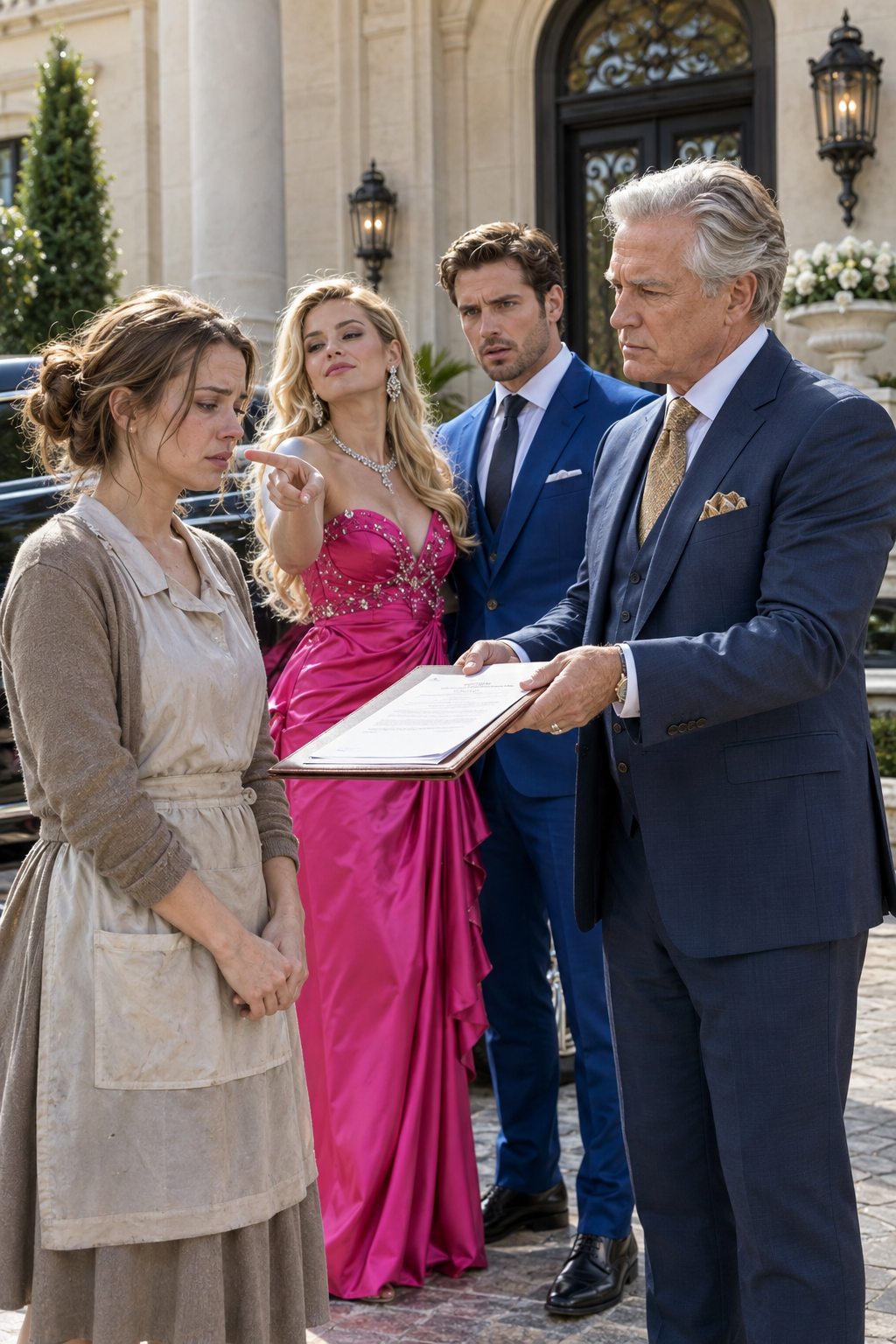
“You missed a spot, sweetheart.”
The woman sleeping with my husband tapped the marble floor with the pointed toe of her red designer heel, then held out an empty champagne glass as if I were supposed to take it from her.
My husband stood six feet away in his father’s mansion and laughed.
Not nervously.
Not because he misunderstood.
He laughed because he wanted me humiliated.
I looked down at the broken crystal scattered beside my knees, then at the linen towel in my hand.
A minute earlier, I had been cleaning up the glass because Walter Bennett—my seventy-two-year-old father-in-law—had nearly stepped on it while walking with his cane.
Vanessa Cole had walked into the room halfway through.
She had seen a woman in black slacks kneeling on the floor with a towel.
She had made an assumption.
My husband, Grant, had decided not to correct her.
“She’s not very quick, is she?” Vanessa asked.
Grant lifted his bourbon.
“You get what you pay for.”
That was when I understood something important.
He wasn’t embarrassed that his mistress had mistaken his wife for a maid.
He was enjoying it.
I rose slowly.
I folded the towel once.
Then twice.
Then I placed it on the antique console table beside Vanessa’s purse.
She was beautiful in the expensive, deliberate way that took appointments, injections, trainers, and an assistant with a calendar.
Long honey-blonde hair.
Cream-colored dress.
Diamond earrings shaped like drops of ice.
She looked to be thirty-two.
I was thirty-eight.
And apparently, in her mind, invisible.
“Careful with that table,” she told me. “It looks old.”
“It is,” I said.
Her eyebrows lifted.
“Oh. She talks.”
Grant took another drink.
His mouth curved.
That smile told me more about my marriage than the last six months of suspicious business dinners, locked phones, unexplained weekends, and sudden criticism ever had.
Vanessa turned toward him.
“I thought your father had better staff.”
“He used to.”
Grant looked directly at me.
“Standards have slipped.”
Something cold settled into place inside me.
I didn’t shout.
I didn’t throw his glass.
I didn’t ask who she was.
I already knew.
Three nights earlier, I had seen her name reflected in the dark screen of Grant’s iPad when a message appeared.
Miss you already. Tell me you’re still serious about after the gala.
I hadn’t confronted him.
Because anger is useful only if you decide where to aim it.
And I had learned years ago that Grant Bennett became careless whenever he believed he had won.
So I let him believe it.
I let Vanessa believe I was staff.
I let Grant believe I was too stunned to speak.
I let both of them enjoy the room.
Because neither of them knew what Walter Bennett had asked me to bring to his study at exactly nine o’clock that evening.
And neither of them knew what was inside the blue folder already waiting on his desk.
“She should take these too.”
Vanessa pointed at two empty glasses near the fireplace.
I looked at her.
It was a small word.
Almost polite.
Her smile froze.
“Excuse me?”
“I said no.”
Grant lowered his bourbon.
The amusement left his face.
There it was.
Vanessa blinked.
She looked at him.
Then at me.
Then back at him.
“Now we’re making progress.”
Grant’s jaw tightened.
Vanessa gave a soft laugh.
“You know the maid?”
I watched Grant.
He could have ended it there.
One sentence.
That’s my wife.
Instead, he looked at Vanessa and said, “It’s complicated.”
That sentence ended our marriage.
Not legally.
But completely.
Vanessa stared at me for another second.
Then understanding spread across her face.
Not embarrassment.
Recognition.
So she already knew my name.
Interesting.
Her expression changed quickly, but not quickly enough.
She hadn’t mistaken me for a maid because she had no idea who I was.
She had mistaken me for a maid because Grant had shown her photographs where I looked different, and she hadn’t bothered learning anything else.
Or maybe she knew exactly who I was and had decided to test how much humiliation I would tolerate.
Either way, she recovered fast.
“Oh,” she said.
She looked me up and down.
“That Elena.”
Grant set his glass down.
“What?” she said lightly. “You told me you two were basically separated.”
I turned to my husband.
“Basically?”
His face hardened.
“We’ll talk later.”
I picked up my clutch from the chair.
“I’ve heard enough.”
Vanessa smiled again.
It was smaller now.
“You know, Elena, Grant speaks very highly of how… practical you’ve been.”
I almost laughed.
That was the word Grant used when he wanted to turn sacrifice into something ordinary.
Practical when I sold my condo in Chicago so he could keep his first company alive.
Practical when I worked sixty-hour weeks while he flew between New York and California telling investors about the business we had built together.
Practical when I sat beside his mother through chemotherapy because Grant was “too slammed.”
Practical when I postponed having children because he said another year would make the company secure.
Then another year.
Then another.
Practical when his father had a stroke eighteen months earlier and Grant somehow became too busy to attend rehabilitation appointments.
I had spent twelve years making myself useful.
Grant had mistaken useful for disposable.
Not anymore.
Vanessa stepped closer.
The scent of her perfume reached me before she did.
“I hope there are no hard feelings.”
I looked at her hand.
She was wearing a bracelet.
White gold.
Emerald clasp.
My bracelet.
Grant had given it to me on our tenth anniversary.
Six months ago, it had disappeared from my jewelry drawer.
He told me I must have misplaced it.
I reached out.
Vanessa instinctively drew back.
I didn’t touch her.
I just pointed.
“That’s mine.”
She looked at the bracelet.
Then at Grant.
He went still.
Vanessa’s smile vanished.
“He gave it to me.”
Grant took one step toward me.
“Elena, don’t do this here.”
I kept my voice calm.
“Is there a better room in your father’s house for discovering your husband stole your anniversary bracelet and put it on his mistress?”
Walter’s mansion had gone quiet around us.
The Bennett Foundation gala was scheduled to begin in less than an hour, but the main ballroom wasn’t open yet.
Staff moved through distant hallways.
A pianist was testing notes beyond the double doors.
Outside, October rain tapped softly against tall windows overlooking the Hudson River.
Grant glanced toward the doorway.
He hated scenes.
More accurately, he hated scenes he couldn’t control.
Vanessa unclasped the bracelet.
For one second I thought she might hand it to me.
Instead, she placed it on the console table.
“I don’t wear secondhand things.”
“Apparently you do.”
Her cheeks colored.
Grant said my name again.
“Stop saying it like a warning.”
His nostrils flared.
“You’re upset.”
That surprised him.
“I’m informed.”
Vanessa crossed her arms.
“Well, since everything’s out in the open—”
“It isn’t.”
Grant cut her off so quickly she actually stepped back.
That interested me too.
Everything wasn’t out in the open.
Good to know.
I looked at my watch.
Walter wanted me upstairs at nine.
Seventeen minutes.
Plenty of time.
“Enjoy the gala,” I said.
Grant stared at me.
“Where are you going?”
“To change.”
Vanessa’s gaze dropped to my black pants and white silk blouse.
“Into what?”
I met her eyes.
“Something you won’t mistake for a uniform.”
I walked out before either of them answered.
Grant followed me into the hallway.
His hand closed around my elbow.
I looked at his hand.
Then at him.
Not because he respected the request.
Because two servers were walking toward us carrying silver trays.
Grant smiled until they passed.
The second they disappeared around the corner, his face changed.
“You’re not going to ruin tonight.”
The sentence was so absurd I studied him for a moment.
“My father’s announcing the foundation expansion. We have investors here. Board members. State officials. I need you to behave like an adult.”
“You brought your girlfriend to your father’s gala.”
“She’s not—”
“Don’t embarrass yourself more than necessary.”
His mouth snapped shut.
I stepped closer.
Grant had always been handsome.
That was part of his armor.
Blue-gray eyes.
Tailored tuxedo.
The easy confidence of a man who had never walked into a room without believing it might eventually belong to him.
But standing there, under the warm light of his father’s hallway, I noticed something I should have noticed years earlier.
Grant didn’t look powerful.
He looked entitled.
There was a difference.
“You told her we were separated,” I said.
His expression tightened.
“We haven’t been happy.”
“That wasn’t my question.”
“We’ve both known things were off.”
“My question was whether you told her we were separated.”
His eyes moved past me.
“We can discuss this tomorrow.”
“That means yes.”
“Did you also tell her you owned this house?”
He looked at me sharply.
Another reaction.
“Why would you ask that?”
“Because when she called me a maid, she said she expected you to have better staff. Not your father. You.”
He recovered.
“She misspoke.”
I watched him.
“Or maybe you’ve been promising her things you don’t own.”
His face changed again.
This time the fear lasted less than a second.
But I saw it.
“You’re tired,” he said.
It was one of Grant’s favorite tricks.
If I disagreed with him, I was tired.
If I remembered something he wished I didn’t, I was confused.
If I objected to being insulted, I was emotional.
If I caught him lying, I was paranoid.
Twelve years of marriage had trained him to believe that naming my reaction gave him control over the facts.
It didn’t anymore.
“I’ll see you downstairs,” I said.
He blocked my path.
“We need to be clear about something.”
“Then be clear.”
“My father’s health is fragile.”
The shift was so sudden I almost smiled.
“You will not upset him tonight.”
“You will not tell him about Vanessa.”
“I don’t have to.”
Grant’s eyes narrowed.
“What does that mean?”
“It means Walter has eyes.”
A muscle moved in his jaw.
“My father likes you. I know that.”
“Does that bother you?”
He lowered his voice.
“But you have a habit of inserting yourself into family matters.”
I stared at him.
Family matters.
I had administered Walter’s medication after his stroke.
I had hired the physical therapist who helped him walk again.
I had reorganized the home office after his accountant retired.
I had spent Christmas Eve in an emergency room with him when Grant flew to Aspen because canceling would have been “awkward.”
But I inserted myself.
“Understood.”
Grant looked relieved.
He thought agreement meant surrender.
It used to.
Then he said the sentence I would remember for the rest of my life.
“And Elena?”
“After tonight, I think you should move out for a while.”
The hallway seemed to become very quiet.
“Move out.”
“Just until we figure out next steps.”
“From our apartment?”
His eyes flickered.
Our Manhattan apartment was partly mine.
I had bought it with him.
He meant the estate.
The mansion we had moved into temporarily after Walter’s stroke.
The mansion where I had spent eighteen months helping his father recover.
The mansion Grant had barely visited until Walter began talking about estate planning.
“You want me to leave your father’s house.”
“I think it would be better.”
“For whom?”
He didn’t answer.
He didn’t have to.
Vanessa appeared at the far end of the hallway.
She had removed my bracelet.
She had also put on a smile that told me she expected to be staying.
I looked at Grant.
“How long have you been planning to ask me this?”
His eyes hardened.
“Don’t turn this into drama.”
There it was.
I almost admired the efficiency.
Betray your wife.
Bring your mistress to a family gala.
Let her mock your wife as domestic staff.
Then accuse your wife of creating drama.
I stepped around him.
Grant caught my arm again.
This time harder.
I looked down.
His fingers loosened.
“Be careful,” I said.
“With what?”
“With touching things you think belong to you.”
His face went blank.
I walked away.
I did not answer when he called my name.
I did not answer when my phone buzzed inside my clutch.
I did not answer when another message came ten seconds later.
I did not answer because for twelve years I had answered every crisis Grant created.
I did not answer because silence was finally worth more than explanation.
I did not answer because, for the first time in my marriage, Grant Bennett had no idea what I knew.
By , I was standing in the guest suite at the east end of the second floor.
My dress hung on the wardrobe door.
Emerald green.
Simple lines.
No sequins.
No dramatic train.
Just silk that fit perfectly and made my eyes look greener than they were.
Walter’s late wife, Margaret, had helped me choose the color years ago.
“Men like the Bennetts wear dark suits and expect women to become the background,” she once told me. “Don’t.”
Margaret had died four years earlier.
I still missed her.
Especially tonight.
I changed quickly.
I pinned my hair back.
Then I opened the safe behind the painting near the dresser.
Inside was a narrow document case.
I removed it.
Checked the contents.
Closed the safe.
When I reached Walter’s study, the door was already open.
He sat behind his desk in a navy tuxedo.
His silver hair was combed back.
A walnut cane rested against his chair.
Walter Bennett had built Bennett Urban Holdings from three rundown apartment buildings in Newark into a real estate and infrastructure empire valued at more than four billion dollars.
People who knew him only from business magazines expected him to be loud.
Walter’s power came from listening longer than other people could tolerate silence.
His attorney, Rebecca Sloan, stood near the fireplace.
So did Marcus Reed, Walter’s longtime CFO.
I stopped inside the doorway.
The blue folder sat on the desk.
Exactly where I expected it.
Walter looked at my dress.
“Margaret’s color.”
“She had good taste.”
“She certainly thought so.”
Then his eyes moved to my face.
The humor disappeared.
“What did Grant do?”
I almost laughed.
“Why assume Grant did something?”
“Because you have that look.”
“What look?”
“The one Margaret had before she fired someone.”
Rebecca covered a smile.
Marcus studied the carpet.
I closed the door.
“Grant brought Vanessa Cole.”
Walter’s expression did not change.
Rebecca’s did.
Marcus exhaled once through his nose.
Interesting.
“You know her?” I asked.
Walter tapped one finger against the desk.
“I know of her.”
“Sit down.”
I remained standing.
Walter looked at Rebecca.
She opened the blue folder.
Inside were photographs.
Grant leaving the Mercer Hotel with Vanessa.
Grant entering a townhouse in Tribeca.
Grant and Vanessa at a restaurant in Miami.
Grant kissing Vanessa beside a black SUV.
Dates printed at the bottom.
Eight months.
My stomach tightened.
Not because I was surprised.
Because betrayal has weight even after suspicion prepares you for it.
Eight months.
Eight months of conference calls.
Eight months of sudden workouts.
Eight months of showers immediately after coming home.
Eight months of asking if I was imagining distance.
I touched the back of the chair.
Then I sat.
Walter said quietly, “I’m sorry.”
“How long have you known?”
“Six weeks.”
“Why didn’t you tell me?”
“I wanted to.”
Rebecca answered.
“We needed to know what else he was doing.”
I looked at her.
“What else?”
She slid another document from the folder.
A loan application.
Forty-eight million dollars.
Borrower: GB Capital Partners.
Collateral description: Bennett House estate, Westchester County, New York.
My eyes stopped on the address.
For a moment, I didn’t understand.
Then I did.
Grant was trying to borrow forty-eight million dollars against his father’s mansion.
I looked at Walter.
“Can he do that?”
“No,” Walter said.
Rebecca added, “Legally? Absolutely not.”
I scanned the page.
A signature appeared at the bottom.
Walter Bennett.
I looked at him.
“You didn’t sign this.”
My skin went cold.
Grant had forged his father’s signature.
“Has the loan funded?”
“Not yet,” Rebecca said. “The lender requested title confirmation. That’s what triggered questions.”
“Why would Grant need forty-eight million dollars?”
Marcus finally spoke.
“His investment fund is in trouble.”
Grant had launched a private investment vehicle two years earlier.
He called it independent.
Walter called it a vanity project.
Grant insisted it was thriving.
Apparently not.
“How much trouble?”
Marcus looked at Walter.
Walter nodded.
“Enough,” Marcus said, “that if two investors demand redemption this quarter, he won’t have the cash.”
“How much is missing?”
“We don’t know that anything is missing.”
The careful phrasing told me plenty.
“How large is the hole?”
Marcus rubbed his thumb against one cuff link.
“Potentially thirty-one to thirty-six million.”
I stared at him.
Grant had told me his fund had just recorded its best quarter.
He had celebrated with a $190,000 Aston Martin.
I had told him it was irresponsible.
He accused me of being jealous of his success.
“When were you going to tell the board?” I asked Walter.
“Tomorrow morning.”
“And tonight?”
Walter leaned back.
“Tonight was supposed to be a foundation gala.”
“Supposed to be?”
He looked toward the blue folder.
“There is something else.”
Rebecca closed it.
Walter placed both hands on the desk.
“Elena, when Margaret got sick, she made me promise something.”
“She said Grant had been raised with too much certainty.”
I almost smiled.
“That sounds like her.”
“She said he had never learned the difference between inheritance and achievement.”
“That also sounds like her.”
Walter’s eyes softened briefly.
“She loved him. But she saw him clearly.”
He reached for another folder.
He placed it in front of me.
“I should have listened sooner.”
I didn’t touch it.
“What is that?”
The first page was legal text.
Property transfer.
Westchester County.
Parcel numbers.
Thirty-two acres.
Main residence.
Guesthouse.
Carriage house.
River frontage.
My eyes moved down.
Grantor: Walter James Bennett.
Grantee: Elena Marie Bennett.
I read it twice.
Then a third time.
I looked up.
Walter was watching me.
“The deed was recorded at yesterday afternoon.”
I pushed the folder slightly away as if distance might make the words more reasonable.
“You transferred the estate to me?”
“Because I wanted to.”
“That is not an answer.”
“It’s the most accurate one.”
“Walter, this property is worth—”
“About thirty-eight million before furniture.”
Rebecca said it in the same tone someone might use to mention parking fees.
I stared at her.
Then at Walter.
“This is insane.”
“No. Insane was leaving Grant in a position to believe he could leverage property he didn’t own.”
“You could have put it into a trust.”
“I have trusts.”
“You could have donated it.”
“I donate plenty.”
“You could have sold it.”
“I like the trees.”
Despite everything, a laugh almost escaped me.
Walter leaned forward.
“When I had the stroke, Grant visited me four times in the first three months.”
I said nothing.
“You were here every day.”
“That doesn’t mean you give me a mansion.”
“When the doctors said I might never walk without assistance, Grant asked my lawyer whether incapacity would accelerate control of the family voting shares.”
I looked at Rebecca.
Her expression confirmed it.
Walter’s mouth became hard.
“You asked the doctor what exercises would help.”
“That was different.”
His voice sharpened.
I looked back at the deed.
“This feels like punishment.”
“It isn’t.”
“For Grant?”
“He’s going to think it is.”
“Grant thinks traffic lights are personal criticism.”
Marcus coughed into his fist.
Rebecca looked away.
Walter continued.
“The house mattered to Margaret. She wanted it kept intact, not carved up for some developer’s vanity subdivision after my death. You understand the property. You know the staff. You know the conservation easement. You helped restore the west gardens. You’re the only person in this family who has ever read the maintenance reports without being forced.”
“That does not make me the right person.”
“It makes you more right than my son.”
I sat back.
The deed seemed impossible.
Then I remembered Grant in the hallway.
After tonight, I think you should move out for a while.
I looked at Walter.
“Does Grant know?”
A strange calm came over me.
“When are you planning to tell him?”
Walter checked his watch.
“Approximately twenty-three minutes.”
Rebecca smiled.
“You said the gala was supposed to be a foundation event.”
“It still is.”
Walter picked up his cane.
“But I also intend to clarify certain family matters.”
“Publicly?”
“Not the affair.”
“Thank God.”
“Margaret would haunt me.”
“She might anyway.”
“I’m counting on it.”
He stood carefully.
Walter steadied himself.
Then he looked at me with a seriousness that erased the joke.
“The deed is not conditional on your marriage.”
I said nothing.
“If you divorce Grant tomorrow, next year, or never, the property remains yours.”
My throat tightened.
“Why are you saying that?”
“Because I know my son.”
Walter shook his head.
“You know the man he was comfortable showing you.”
The words landed harder than I expected.
Walter continued.
“I know the man he becomes when he believes something is being taken from him.”
A pulse of unease moved through me.
“Is that a warning?”
“It’s advice.”
He glanced at Rebecca.
“She has copies of everything. So do I. The original recorded deed is secure.”
I closed the folder.
“What exactly do you think Grant might do?”
Walter’s silence lasted too long.
Then footsteps approached outside.
A knock sounded.
“Mr. Bennett?” a staff member called. “Five minutes until your remarks.”
Walter looked toward the door.
I didn’t like that answer.
But the gala was already moving.
We went downstairs.
The Bennett House ballroom had once been a gallery.
Tonight, it glowed under crystal chandeliers.
White flowers lined the tables.
A string quartet played near the terrace doors.
Three hundred guests filled the room.
Developers.
Hospital executives.
Local officials.
Journalists.
Philanthropists.
People Grant spent his life trying to impress.
I entered beside Walter.
Heads turned.
Not toward me.
Toward him.
That suited me.
Grant stood near the stage speaking to a state senator.
Vanessa was beside him.
She had changed nothing except her posture.
One hand rested lightly on Grant’s arm.
Territorial.
Then Grant saw me.
His sentence stopped.
His eyes moved from my face to the emerald dress.
Then to Walter beside me.
Then to the gray folder Rebecca carried behind us.
For the first time that evening, he looked uncertain.
Vanessa followed his gaze.
Her mouth tightened.
I could almost hear her remembering the champagne glass.
Walter touched my elbow.
“For what?”
“People who feel ready are usually about to say something stupid.”
We walked deeper into the ballroom.
Guests surrounded Walter.
I stepped aside.
Rebecca remained close.
Marcus disappeared toward two board members.
I picked up sparkling water from a passing tray.
Grant reached me less than a minute later.
“What are you doing?”
“Standing.”
“You know what I mean.”
“Then ask a better question.”
His eyes flicked toward Rebecca.
“What were you doing upstairs with my father?”
“Family matters.”
The same phrase he had used on me.
His expression changed.
“Don’t play games.”
He lowered his voice.
“Did you tell him?”
“About which part?”
His face drained slightly.
So there were several parts.
Vanessa approached.
“You clean up well.”
I looked at her.
“So do stolen bracelets.”
She flinched.
Grant stepped between us slightly.
“Vanessa, give us a minute.”
Her response surprised him.
She looked at me.
“I think we should clear the air.”
“That would require honesty.”
“You obviously don’t like me.”
“I don’t know you.”
“You know enough.”
“I know you slept with a married man.”
She tilted her head.
“Grant told me your marriage was over.”
“Did he tell you that before or after giving you my jewelry?”
“Elena,” Grant snapped.
Several people turned.
He immediately lowered his voice.
Vanessa glanced around, then smiled.
“I’m not going to apologize for believing the man I love.”
There it was.
Not affair.
Grant’s eyes closed briefly.
Vanessa noticed.
Her confidence slipped.
I almost felt sorry for her.
“You love him?” I asked.
“Then you should probably know him.”
She stiffened.
“And you think you do?”
The answer surprised all three of us.
I looked at Grant.
“I’m realizing I don’t.”
The lights dimmed slightly.
A staff member tapped the microphone.
Guests began moving toward their tables.
Walter’s remarks were starting.
Grant leaned close to me.
“You will sit with me.”
It wasn’t a request.
I checked the table cards.
Walter Bennett.
Elena Bennett.
Rebecca Sloan.
Marcus Reed.
Two trustees.
Grant was at Table Two.
Vanessa was at Table Seven.
I showed him my card.
“Apparently not.”
He stared at it.
His own card had changed.
I knew because Grant always sat beside his father at these events.
Walter had moved him.
Grant looked toward the stage.
The anger on his face was immediate.
“He did this?”
“I assume the seating chart didn’t become sentient.”
Grant grabbed the card from my hand.
“Elena, what did you say to him?”
“Nothing about the seating chart.”
“Why are you suddenly at his table?”
“I was invited.”
“You’re my wife.”
“An hour ago I was the maid.”
Vanessa heard.
Her face tightened.
The lights dimmed again.
Applause began as Walter stepped onto the stage.
Grant had no choice.
He went to Table Two.
I took my seat beside Walter’s empty chair.
Rebecca sat on my other side.
“Does he always look like that when someone changes his seating assignment?” she murmured.
“What’s different?”
“Usually he thinks he can punish the person later.”
Rebecca looked at me.
“And tonight?”
“I think he’s starting to wonder if he can.”
Walter reached the podium.
The ballroom quieted.
He thanked everyone.
He spoke about the foundation’s scholarship program.
He announced a sixty-million-dollar commitment to expand community medical centers across underserved parts of New York.
Applause rolled through the room.
Grant smiled for the cameras.
He was good at that.
He always looked proud when other people donated family money.
Walter spoke for twelve minutes.
Then he paused.
“Before dinner,” he said, “I want to recognize someone.”
Grant’s shoulders straightened.
I knew why.
For two weeks he had been telling people his father planned to announce his expanded leadership role in Bennett Urban Holdings.
He had ordered new business cards.
He had even shown me one.
Grant Bennett.
Executive Vice Chairman.
He looked toward the stage, ready.
Walter didn’t look at him.
“Eighteen months ago, I had a stroke.”
The room quieted further.
“I was fortunate. I had exceptional physicians. Exceptional therapists. And a family member who refused to let me quit.”
My heart sank.
Walter turned toward our table.
“Elena, stand up.”
I remained seated.
“I own the microphone.”
Rebecca whispered, “You’re not winning this.”
Applause began.
I hated it.
Not because I didn’t appreciate the kindness.
Because Grant’s face told me exactly what it meant.
Walter continued.
“When I could not sign my own name, she handled my household.”
“When I could not walk across this ballroom, she walked beside me.”
More applause.
“When several people advised me to step away from business permanently, she asked whether I wanted advice or whether I wanted my laptop.”
Walter smiled.
“She brought the laptop.”
The room laughed again.
I looked at Grant.
He wasn’t smiling anymore.
Vanessa sat three tables behind him.
Her expression was unreadable.
Walter’s voice changed.
“I have spent most of my life believing businesses survive because of contracts.”
He rested both hands on the podium.
“I was wrong.”
The ballroom became very still.
“They survive because someone notices what others ignore.”
He looked directly at me.
“Elena notices.”
I wanted the floor to open.
Instead, Walter gestured toward Rebecca.
The gray folder was in her hands.
Grant saw it.
He rose halfway from his chair.
Walter continued.
“As part of my estate restructuring, completed and recorded yesterday, Bennett House and its thirty-two acres have been transferred.”
A murmur passed through the room.
Grant stood fully.
Walter ignored him.
Rebecca walked toward me.
Every eye followed her.
She placed the folder in my hands.
Walter finished the sentence.
“To Elena Bennett.”
Pure, impossible silence.
Then someone gasped.
A camera shutter clicked.
Grant’s face became white.
Vanessa stared at me.
Not at my dress.
Not at my face.
At the folder.
At the deed.
At the house around us.
Walter smiled.
“Take care of it.”
I looked up at him.
“You’re enjoying this.”
His microphone was still on.
A wave of laughter spread through the ballroom.
Walter glanced at the microphone.
Applause exploded.
It rose from every table.
People stood.
Not everyone.
Grant didn’t.
Vanessa didn’t.
But most did.
I felt heat crawl up my neck.
I hated public attention.
Walter knew that.
He also knew public facts were difficult to rewrite later.
That was why he had done it.
By the time Walter left the stage, my phone was vibrating nonstop inside my clutch.
Grant reached me before he did.
“What the hell is this?”
The applause was still fading.
Several guests pretended not to listen.
They failed.
Walter stepped between us.
“It’s a deed.”
Grant looked at him.
“You gave her the house?”
“Because it was mine.”
“You know what I mean.”
“I usually do. Tonight I’m less certain.”
Grant pointed at the folder.
“That estate has been in our family for fifty years.”
“Forty-eight.”
“She married into this family.”
Walter’s expression cooled.
“So did your mother.”
Grant’s face changed.
“Then choose your words more carefully.”
Vanessa approached.
Of course she did.
She had no survival instinct when curiosity was involved.
Grant turned on me.
“You knew?”
“I found out twenty minutes before you did.”
“You’re lying.”
Rebecca stepped forward.
“She isn’t.”
Grant looked at her.
“You helped him do this?”
“I’m his attorney.”
“I’m his son.”
“Those are different professions.”
Marcus appeared near Walter’s shoulder.
Two trustees stood several feet behind him.
Grant realized the audience around him was becoming increasingly important.
He lowered his voice.
“This is not the place.”
Walter nodded.
“For once, we agree.”
Grant looked at me.
“Study. Now.”
I didn’t move.
His nostrils flared.
“This is my house,” I said quietly. “You can ask.”
His eyes widened.
It was the first mini-payoff of the night.
A woman at the nearest table covered her mouth.
Grant heard.
His face flushed.
His voice dropped.
“Would you please come to the study?”
“Dinner is being served.”
Vanessa looked stunned.
Walter looked delighted.
Grant leaned closer.
“Do not humiliate me.”
I held his gaze.
“I haven’t.”
That was true.
He was doing an excellent job himself.
Grant remained standing another second.
Then he walked away.
Vanessa followed him.
Walter eased into his chair.
“You may have just killed him.”
“Then move the foundation expansion money to cardiology.”
Rebecca choked on her water.
Dinner continued.
Every guest who passed our table congratulated me as if I had won a raffle.
I thanked them.
I answered no questions about the transfer.
I ignored the phone buzzing in my clutch.
Grant sent eleven messages.
The first three demanded that I meet him.
The next four accused Walter of manipulation.
The next two accused me.
The tenth said:
We need to be united right now.
The eleventh said:
Whatever happens, do NOT speak to press.
That one made me smile.
After the main course, I excused myself and went toward the powder room.
Vanessa intercepted me in the conservatory hallway.
No guests nearby.
No cameras.
Her mask was gone.
“What did you do?”
“I married him.”
“You know what I mean.”
“Apparently nobody tonight knows what they mean.”
Her eyes sharpened.
“You manipulated an old man.”
There was the motivation.
All the things Grant had apparently promised.
“You’ve known Walter for how long?” I asked.
“That doesn’t matter.”
“It matters if you’re diagnosing his mental competence.”
“I didn’t say that.”
“You called him an old man I manipulated.”
She folded her arms.
“Grant told me you’ve been controlling his father since the stroke.”
I almost admired the story.
Of course Grant had prepared one.
Of course I was the calculating wife.
The outsider.
The caregiver with access.
It was predictable enough to be insulting.
“What else did Grant tell you?”
“That the marriage is over.”
“Anything else?”
Her chin lifted.
“He said you were staying here temporarily.”
“He said the house would eventually be his.”
“Apparently false.”
“He said you were refusing to accept reality.”
“What reality?”
“That he doesn’t love you.”
That one should have hurt.
Maybe tomorrow it would.
Tonight, something inside me had gone strangely quiet.
I looked at the woman wearing a dress Grant probably bought with money from an investment fund that might be collapsing.
“You believe him?”
“Then ask him why he needed forty-eight million dollars.”
Her expression changed.
Just a flicker.
But enough.
“You already know.”
She recovered quickly.
“I don’t know what you’re talking about.”
“And now I know you do.”
I walked past her.
She grabbed my wrist.
Looked down.
She released me.
“You think one deed means you won.”
“Won what?”
I almost laughed.
“You can have Grant.”
That hurt her more than I expected.
Her eyes flashed.
“You’re acting very calm for a woman whose husband chose someone else.”
“And you’re acting very confident for a woman whose boyfriend lied about owning the house she expected to move into.”
Her mouth opened.
I continued.
“Take the bracelet when you leave.”
“I don’t want it.”
“You did this afternoon.”
“I said I don’t want it.”
“Then leave it.”
I walked away.
“Why are you not fighting for him?” she called.
I stopped without turning.
“Because marriage isn’t an auction.”
Then I kept walking.
The gala ended shortly after eleven.
Guests departed beneath black umbrellas.
Walter retired upstairs.
Rebecca stayed.
Marcus stayed.
Grant disappeared for nearly forty minutes.
So did Vanessa.
I didn’t wonder what they were doing.
I wondered what documents they were destroying.
At 11:37, I entered the kitchen and found Mrs. Alvarez, the house manager, supervising cleanup.
She had worked for Walter and Margaret for twenty-one years.
She looked at me.
Then toward the ceiling.
Then at me again.
“You own my workplace.”
“Apparently.”
“Should I start being nicer?”
“You’re already terrifyingly nice.”
She nodded.
Then her expression softened.
“Mrs. Bennett.”
She hesitated.
“I heard what happened earlier.”
Of course she had.
Houses that size had better intelligence networks than governments.
“I’m sorry.”
“Thank you.”
“And for what it’s worth, Miss Cole complained the champagne was too cold.”
I stared at her.
Mrs. Alvarez lifted one shoulder.
“I don’t trust people who complain about cold champagne.”
“That’s reasonable.”
She handed me a cup of tea.
“Mr. Grant is in the west library.”
“Thank you.”
“He is angry.”
“He has a broad emotional range.”
She almost smiled.
Then she leaned closer.
“Mr. Walter changed the lock code on his private office last week.”
“Why are you telling me?”
“Because Mr. Grant tried the old code twice tonight.”
That sharpened everything.
“After dinner.”
“Did he get in?”
“How do you know?”
“The security system alerted my phone.”
“Did you tell Walter?”
I set down the tea.
She studied me.
“You have a reason?”
“I’m finding one.”
The west library was empty when I entered.
A fire burned low in the stone fireplace.
Rain streaked the windows.
Grant’s bourbon sat on a side table.
His jacket was thrown across a chair.
I heard voices through the half-open terrace door.
“You said tonight would fix everything.”
“I didn’t know he’d done this.”
“You said the house was basically yours.”
“It should be.”
“Should be?”
“Keep your voice down.”
“You brought me here.”
“You said after tonight we wouldn’t have to hide.”
“You said the financing would close Monday.”
My heartbeat slowed.
Vanessa knew.
Grant said something too quietly for me to hear.
Then Vanessa’s voice rose.
“No. You told me your father had signed.”
I moved closer to the door.
“He was going to.”
“That’s not what you said.”
“He just gave the collateral to your wife!”
“Stop calling it that.”
“What should I call it?”
Grant hissed something.
Vanessa answered, “I put my name on documents because you told me this was clean.”
My stomach tightened.
Her name on documents.
So she wasn’t only the mistress.
She was involved financially.
Maybe knowingly.
Grant said, “You wanted the life too.”
“I wanted what you promised.”
“And you’ll get it.”
A long pause.
Then Grant said, very quietly, “The deed can be challenged.”
I leaned closer.
Vanessa laughed once.
“My father had a stroke.”
“He just gave a fifteen-minute speech without notes.”
“That doesn’t mean he had capacity when he signed.”
My hands went cold.
Vanessa said, “Your lawyer said challenging him would get ugly.”
“I’m not using that lawyer.”
“Then who?”
“I have someone.”
“And Elena?”
Grant didn’t answer.
Vanessa asked again.
“What about Elena?”
His voice dropped.
“She’ll settle.”
“You sure?”
“She didn’t look like she wanted to settle.”
“She doesn’t know how bad this can get.”
That was the moment.
Not the affair.
Not the bracelet.
Not the maid joke.
That sentence.
She doesn’t know how bad this can get.
I stepped away from the terrace door.
I returned to the hall.
Then I called Rebecca.
She answered on the first ring.
“I’m downstairs.”
“Come to the east sitting room.”
“What happened?”
“Bring your laptop.”
Five minutes later, I told her what I had heard.
Rebecca did not interrupt.
When I finished, she opened her computer.
“You need to change your passwords tonight.”
“Already did.”
“Cloud storage?”
“Phone account?”
“Separated it this afternoon.”
Rebecca stared at me.
“After I saw Vanessa’s message three days ago, I started making a list.”
A faint smile touched her mouth.
“I also froze the home equity line on the Manhattan apartment.”
Her eyebrows rose.
“Grant know?”
“What else?”
“Joint accounts?”
“I moved only my personal funds. I left marital funds untouched.”
Rebecca’s smile grew slightly.
“You’ve been busy.”
“I dislike surprises.”
“That makes two of us.”
She turned the laptop toward me.
“This is the recorded deed.”
I scanned the county filing again.
“Can he challenge Walter’s capacity?”
“He can challenge anything. Winning is another matter.”
“Walter was evaluated?”
“By two independent physicians before the transfer.”
“Because Walter anticipated Grant.”
Of course he did.
Rebecca clicked another file.
Walter sat at his desk.
Different suit.
Different day.
A physician beside him.
Walter looked directly into the camera and stated his name, date, location, the property being transferred, the reason, and his understanding of its value.
Then he said:
“My son Grant may claim Elena Bennett pressured me. She did not. In fact, she argued against this transfer twice.”
I looked at Rebecca.
“I argued once.”
“You argued twice.”
“Yesterday on the phone.”
“That counted?”
“Walter insisted.”
On video, Walter continued.
“I am transferring Bennett House because Elena has demonstrated stewardship, judgment, and loyalty to this family independent of her marriage to my son. I am also taking this step because Grant Bennett recently demonstrated willingness to treat family assets as if anticipated inheritance were current ownership.”
Rebecca paused the video.
“He knew about the loan application before he told you.”
“The lender called Bennett Holdings.”
I leaned back.
“So Grant’s capacity argument is dead.”
“Probably.”
“Probably?”
“I never promise outcomes.”
I liked Rebecca more every minute.
“What about Vanessa?”
“That depends what she signed.”
“I want to know.”
She began typing.
Then stopped.
“Elena, there’s something you should consider tonight.”
I looked around.
“This is technically my house.”
“That doesn’t make it safe.”
I thought of Walter’s warning.
The man he becomes when he believes something is being taken from him.
“Do you think Grant would hurt me?”
Rebecca didn’t answer immediately.
“I think a person attempting to pledge forty-eight million dollars of someone else’s property using a signature that may not be genuine is a person under serious pressure.”
“That wasn’t my question.”
Her eyes met mine.
“I don’t know.”
That answer worried me more than reassurance would have.
I went upstairs.
Not to leave.
To prepare.
I photographed every page of the documents Walter had shown me.
I uploaded copies to two secure accounts.
I texted my sister in Boston and told her I might need a place to stay.
I didn’t explain why.
Then I packed one overnight bag.
Not because I intended to surrender the property.
Because smart people can own houses from hotel rooms.
At 12:18 a.m., Grant entered our bedroom without knocking.
He had changed out of his tuxedo jacket.
His bow tie hung loose.
He looked exhausted.
“Why is there a bag on the bed?”
“Because I packed it.”
“For what?”
He closed the door.
“Elena, can we talk like adults?”
“We can try.”
He stood across from me.
For a second, neither of us spoke.
Twelve years.
That is a long time to know where someone keeps his socks.
To know how he takes coffee.
To know which knee hurts after tennis.
To know he secretly hates olives but eats them at business dinners because he once read wealthy Europeans like them.
A long time to build habits around another human being.
A frighteningly short time to discover you never knew what he would do when cornered.
Grant ran a hand through his hair.
“I’m sorry about Vanessa.”
“Which part?”
“All of it.”
“That’s broad.”
“I handled this badly.”
I almost admired the wording.
Cheating for eight months had been a handling problem.
“You lied to her about us.”
“You gave her my bracelet.”
His face tightened.
“That was stupid.”
“You tried to borrow forty-eight million dollars against your father’s house.”
Then every muscle in his body went still.
There it was.
I had hit the center.
“Who told you that?”
“Is it true?”
“Who told you?”
“Your father knows.”
His face changed.
“How much?”
“How much does he know?”
I stared at him.
Wrong question.
Very wrong question.
Grant turned away.
He walked toward the window.
Rain streaked the glass behind him.
“This is a mess.”
“You don’t understand the fund.”
“Then explain it.”
“It’s temporary.”
“The thirty-million-dollar shortfall?”
He turned sharply.
“Marcus told you.”
“It doesn’t matter who told me.”
“That bastard has wanted me out for years.”
“Is the number wrong?”
Grant looked away.
“Investments are illiquid.”
“Is the number wrong?”
The word came out flat.
I sat on the edge of the chair.
“Did you forge Walter’s signature?”
“Then how did it get on the application?”
“He authorized me.”
“In writing?”
“Recorded?”
“Witnessed?”
“Elena, families don’t record every conversation.”
“Families usually don’t collateralize each other’s mansions either.”
He rubbed his face.
“I was protecting the fund.”
“From what?”
“A liquidity event.”
“Meaning investors wanted their money.”
“Some did.”
“And you didn’t have it.”
“We have assets.”
“Then sell them.”
“At distressed prices? No.”
“So your solution was to mortgage your father’s house without telling him.”
“It was going to be mine eventually.”
The sentence was so naked I almost couldn’t believe he said it.
I stared at him.
Grant realized what he had admitted.
He softened his tone.
“You know what I mean.”
“I finally do.”
“No. You believed ownership was a scheduling issue. Your father’s property was yours because you assumed one day he’d die and you’d receive it.”
“That’s not fair.”
“You signed documents based on that assumption.”
“I was fixing a temporary problem.”
“With someone else’s collateral.”
“Our family’s collateral.”
“Not yours.”
His face darkened.
“That distinction suddenly matters to you because he put your name on the deed?”
“It mattered before.”
He laughed bitterly.
“You expect me to believe you don’t enjoy this?”
“Enjoy what?”
“Watching him choose you over me.”
There it was.
The real wound.
Not even the house.
Walter had chosen me.
Grant couldn’t survive that.
“I didn’t ask him to.”
“But you took it.”
“He recorded it before telling me.”
“You could give it back.”
Grant stepped closer.
“You could.”
There it was.
The reason for the conversation.
Not apology.
“If you really believe this is wrong,” he continued, “you can sign it back tomorrow.”
“To Walter?”
His pause answered me.
“We’re married.”
“So this whole thing is ridiculous.”
“Your father disagrees.”
“My father is angry.”
“At the forged loan?”
“I didn’t forge anything.”
“Then show me his authorization.”
He stopped.
I picked up my overnight bag.
Grant looked at it.
“You’re leaving?”
“For tonight.”
His face softened instantly.
Artificially.
“Elena, don’t.”
I studied him.
He approached slowly.
“This is getting out of control.”
“It’s been out of control for eight months.”
“Vanessa was a mistake.”
“She thinks you love her.”
“I told her things.”
“I was unhappy.”
“You were always with Dad.”
I almost laughed.
“He had a stroke.”
“And there was always a reason.”
“A reason for what?”
“For me to come second.”
That was extraordinary.
I set the bag down.
“You cheated on me because I helped your father recover from a stroke?”
“I’m saying we were disconnected.”
“You were in Aspen when he spent Christmas Eve in the ER.”
“I had commitments.”
“You were skiing.”
“It was a business trip.”
“With Vanessa?”
His eyes flickered.
That answered another question.
I nodded once.
“Thank you.”
“For what?”
“For making this easier.”
I picked up the bag again.
He moved toward the door.
Blocked it.
Not aggressively.
But intentionally.
“We need to finish this.”
“You cannot walk out with a thirty-eight-million-dollar property hanging over this family.”
“Watch me.”
His jaw clenched.
“If you leave tonight, people will talk.”
“I hope they use interesting words.”
“I’m serious.”
He didn’t move.
I reached for my phone.
His eyes dropped to it.
Then he stepped aside.
That frightened me more than if he had shouted.
Because for one second, I had seen calculation.
Calculation.
I walked past him.
I stopped at the doorway.
His voice was quiet.
“Whatever my father told you, be careful.”
My hand tightened on the bag.
“Is that concern?”
“It’s advice.”
Same words Walter had used.
Different meaning.
I looked back.
Grant stood beside the bed.
The man I had married.
The man I no longer recognized.
“About what?”
He stared at me.
“People do desperate things when they’re about to lose everything.”
I held his gaze.
“Then I guess you should be careful too.”
I did not drive to Boston.
I went to a hotel twenty minutes away.
Rebecca met me in the lobby.
She had booked rooms on separate floors.
Walter had refused to leave the estate.
That was his choice.
Two private security officers were staying at the house.
Mrs. Alvarez had instructions not to admit Vanessa.
Grant was allowed to remain for the night because removing him dramatically would create more problems than it solved.
At a.m., I finally sat on the hotel bed.
My phone showed thirty-four unread messages.
I ignored most.
One was from Vanessa.
We need to talk without Grant.
I stared at it.
Then another came.
You think I knew everything. I didn’t.
Then a photograph.
A document.
I zoomed in.
GB Capital Partners.
Supplemental guaranty.
Vanessa Cole.
She had guaranteed something.
Below her signature was another.
Grant Bennett.
Then a third.
Elena Bennett.
My own name.
My own supposed signature.
Except I had never seen the document.
I sat upright.
Another message arrived.
He told me you signed this.
I called Rebecca.
She answered immediately.
“I just got something.”
“So did I.”
“Email from the lender’s counsel.”
My pulse quickened.
“What does it say?”
“Grant submitted spousal consent.”
“I never signed anything.”
I looked again at the photograph Vanessa sent.
My signature.
Not perfect.
Close enough to fool someone who didn’t see it every day.
“How many documents have my signature?”
“We’re finding out.”
A knock sounded at my hotel door.
Rebecca heard it through the phone.
“Are you expecting someone?”
“Do not open it.”
Another knock.
Three soft taps.
Then a woman’s voice.
I walked toward the door but didn’t open it.
“What are you doing here?”
“I need to talk to you.”
“How did you find me?”
That was not comforting.
“Grant tracked your phone.”
My stomach dropped.
“You’re on the family account.”
Not anymore.
I had separated it.
But apparently too late.
Rebecca’s voice came through the phone.
“Do not let her in.”
Vanessa spoke through the door.
“I have something you need to see.”
“Because I don’t trust my phone.”
I looked through the peephole.
Vanessa stood alone.
Hair damp from the rain.
No designer composure now.
She looked terrified.
“Rebecca,” I whispered.
“I’m calling hotel security. Keep the door closed.”
Vanessa looked toward the elevator.
Then knocked again.
“What do you have?”
Her face moved closer to the door.
She swallowed.
“That Grant knew the loan documents were fake.”
My skin went cold.
“It isn’t digital.”
“What is it?”
“A copy of a letter.”
“From whom?”
Before she answered, the elevator chimed.
Vanessa looked over her shoulder.
Fear changed her whole face.
Not annoyance.
Not embarrassment.
She stepped away from my door.
“Oh my God.”
She looked directly at the peephole as if she knew I was there.
“Don’t trust him.”
Then she hurried down the hallway.
I heard the stairwell door slam.
A second later, footsteps approached from the elevator.
I stepped back.
Rebecca said, “Elena?”
“I’m here.”
The footsteps stopped outside my door.
I barely breathed.
Ten seconds.
Then the footsteps moved away.
I looked through the peephole.
A man in a dark coat walked toward the elevator.
I had never seen him before.
He didn’t press the button.
He stood beside the elevator for a moment.
Then turned.
Looked directly at my door.
And smiled.
My blood went cold.
Hotel security arrived less than a minute later.
The man was gone.
Vanessa was gone.
Her phone went straight to voicemail.
At a.m., Rebecca came to my room with a hotel manager and one of Walter’s security officers.
We checked the hallway footage.
The man had entered from the parking garage.
Baseball cap.
No clear face.
He had stood outside my room for twenty-eight seconds.
Then left through a service stairwell.
“How did he know the room?” I asked.
No one answered.
Rebecca called Walter.
I expected him to sound sleepy.
When I told him Vanessa had come to the hotel, he swore softly.
When I told him about the man, he became silent.
Then he asked one question.
“Did Vanessa mention a letter?”
I looked at Rebecca.
Walter’s breathing changed.
“What letter?”
“She said she had proof Grant knew the documents were fake.”
Walter’s voice sharpened.
“What did she say exactly?”
I repeated the words.
He said nothing.
“Elena, leave that hotel.”
“We just got security.”
“I’m sending a car.”
“Do not argue with me.”
I had never heard him sound frightened before.
That frightened me.
“Where am I going?”
“Rebecca knows.”
She looked at me.
Apparently she didn’t.
Walter continued.
“Bring nothing you don’t need.”
“What is happening?”
Then he said, “I was hoping I was wrong.”
“About what?”
“The loan isn’t the beginning.”
The room seemed to tilt.
“What does that mean?”
Walter exhaled slowly.
“Three months ago, someone accessed Margaret’s old estate files.”
I looked at Rebecca.
Her expression said this was new to her too.
“We couldn’t determine that.”
“What files?”
“Trust records. Insurance policies. Property transfers.”
“Why didn’t you tell me?”
“Because at the time I thought it was an administrative error.”
“Now Vanessa mentioned a letter.”
I gripped the phone.
“What letter?”
Walter went quiet again.
Then he asked, “Do you remember the night I had the stroke?”
Of course I did.
Dinner at the estate.
Walter collapsed near the library.
Grant was supposedly in Boston.
I found Walter.
Called 911.
Stayed in the ambulance.
Everything after that had been hospitals and fluorescent lights.
“What about it?”
“There was a letter on my desk that night.”
“What kind of letter?”
“An amendment.”
“My family trust.”
Rebecca stood completely still.
Walter continued.
“I had decided to remove Grant as successor trustee.”
I closed my eyes.
“Because I had discovered irregular transfers from a family investment account.”
“I didn’t know.”
“But you suspected him.”
“What happened to the letter?”
“It disappeared.”
My skin prickled.
“After your stroke?”
“Who knew it existed?”
“My attorney at the time.”
“Charles Weller.”
I knew the name.
Walter’s former estate lawyer.
He had retired suddenly two years earlier.
“Anyone else?”
“One person.”
My stomach tightened.
Walter’s voice dropped.
“Margaret.”
I stared at the wall.
“Margaret had already been dead three years.”
“Then how could she know?”
“Because the amendment was based on instructions she left me before she died.”
I sat down.
Rebecca whispered, “Walter, what instructions?”
He was silent long enough that I thought the call had dropped.
Then he said, “Not over the phone.”
The line disconnected.
For ten seconds, nobody moved.
Then Rebecca’s laptop chimed.
An incoming email.
She opened it.
Her face changed.
She didn’t answer.
She turned the screen toward me.
The email was from Vanessa.
No message.
Just one attachment.
A photograph.
A folded paper on a dark wood table.
The top half was visible.
Walter Bennett’s name.
The night of the stroke.
And beneath the title, one sentence had been underlined in black ink.
Rebecca zoomed in.
Then read it again.
Upon my death or incapacity, Grant Alexander Bennett shall have no authority, direct or indirect, over the Bennett Family Trust, Bennett Urban Holdings, or any related property.
My heart pounded.
At the bottom edge of the photograph, another sheet was partly visible.
Only three words could be read.
BENEFICIARY IDENTITY CONFIRMATION.
“What is that?” I whispered.
Rebecca enlarged the image.
The next line came into focus.
A laboratory name.
PATERNITY ANALYSIS.
I stopped breathing.
Rebecca looked at me.
Before either of us could say another word, my phone rang.
I answered immediately.
“Where are you?”
She was crying.
Not dramatic tears.
I could hear her trying not to breathe too loudly.
“I made a mistake.”
“Where are you?”
“I thought Grant was trying to save his company.”
“Vanessa, tell me where you are.”
“He told me the old man was confused.”
“What did you find?”
“I found the letter months ago.”
My grip tightened.
“In Grant’s safe.”
Rebecca moved closer.
Vanessa continued.
“He said it was fake. He said his father’s lawyers created it to scare him.”
“And the paternity test?”
“I never saw the full report.”
“What did you see?”
A noise sounded on her end.
A car door?
Vanessa gasped.
“Listen to me.”
“I’m listening.”
“If anything happens to me, go to the house.”
“What house?”
“Not Bennett House.”
“Then where?”
“Margaret’s.”
I looked at Rebecca.
“Margaret is dead.”
“What are you talking about?”
“The cottage.”
I remembered it.
A small stone cottage in Connecticut that Margaret had inherited from her sister.
Walter rarely mentioned it.
It had supposedly been sold after Margaret died.
Vanessa’s breathing became faster.
“Grant went there three weeks ago.”
“I followed him.”
“To Margaret’s cottage?”
“What did he do?”
“He met someone.”
“I don’t know his name.”
“What did he look like?”
Another sound.
Vanessa whispered, “Oh God.”
“Grant lied about everything.”
Then the line filled with movement.
A muffled impact.
Her phone struck something.
I heard a man’s voice in the distance.
Too faint to understand.
Then Vanessa spoke again, but she wasn’t speaking to me.
A second voice.
“Give me the phone.”
My blood turned to ice.
Rebecca was already calling 911 from her own phone.
I shouted, “Vanessa, run!”
The line crackled.
A sharp sound.
Then silence.
The call ended.
I stared at the screen.
Rebecca gave the emergency operator Vanessa’s number and every detail we had.
The security officer moved toward the door.
Then my phone buzzed.
One final message from Vanessa.
A location pin.
Connecticut.
Rebecca looked at it.
Her face went pale.
“That’s Margaret’s cottage.”
I looked up.
“How do you know?”
“I handled the sale.”
My pulse hammered.
“You said it was sold.”
Rebecca stared at the location.
Then opened her laptop.
Her fingers moved quickly.
Corporate names.
A property database.
She stopped.
“Oh my God.”
“The buyer was an LLC.”
“I know the LLC.”
She turned the screen toward me.
Weller Holdings 14.
I recognized the surname immediately.
“Charles Weller?”
“His family company.”
Walter’s former estate attorney.
The man who had known about the missing trust amendment.
The man who had retired after Walter’s stroke.
The man nobody had mentioned until tonight.
Rebecca’s phone rang.
She answered.
“We got the photograph.”
Then she put him on speaker.
Walter’s voice came through.
“Elena, do not go to Connecticut.”
I looked at the location pin.
“Because if that report is what I think it is, the deed to Bennett House is the least important document you received tonight.”
My mouth went dry.
“What report?”
Walter didn’t answer.
His voice broke slightly.
For the first time since I had known him, Walter Bennett sounded old.
“I should have told you years ago.”
“Told me what?”
Rebecca stared at the screen.
Walter whispered my name.
Then another call appeared on my phone.
Unknown number.
Connecticut area code.
I looked at Rebecca.
She shook her head.
Walter heard the silence.
The unknown number called again.
Then a voicemail arrived.
Twelve seconds.
I pressed play.
At first, there was only static.
Then a man’s voice.
A voice I had never heard before.
“Mrs. Bennett, Vanessa Cole left something here for you.”
Then paper rustled close to the microphone.
“You should come see it before your husband does.”
The message should have ended there.
The man took a breath.
And added six words that made Walter shout through the speaker for me to hang up.
“Ask Walter who Grant’s father is.”
✓ Lynn R. Adams
“You missed a spot, sweetheart.” The woman sleeping with my husband tapped the marble floor with the pointed toe of her red designer heel, then held out an empty champagne glass as if I were supposed…