She Rode the Prairie Train to Marry a Stranger, but One Terrifying Night Revealed Why Her Future Husband Had Begged Her Never to Turn Back
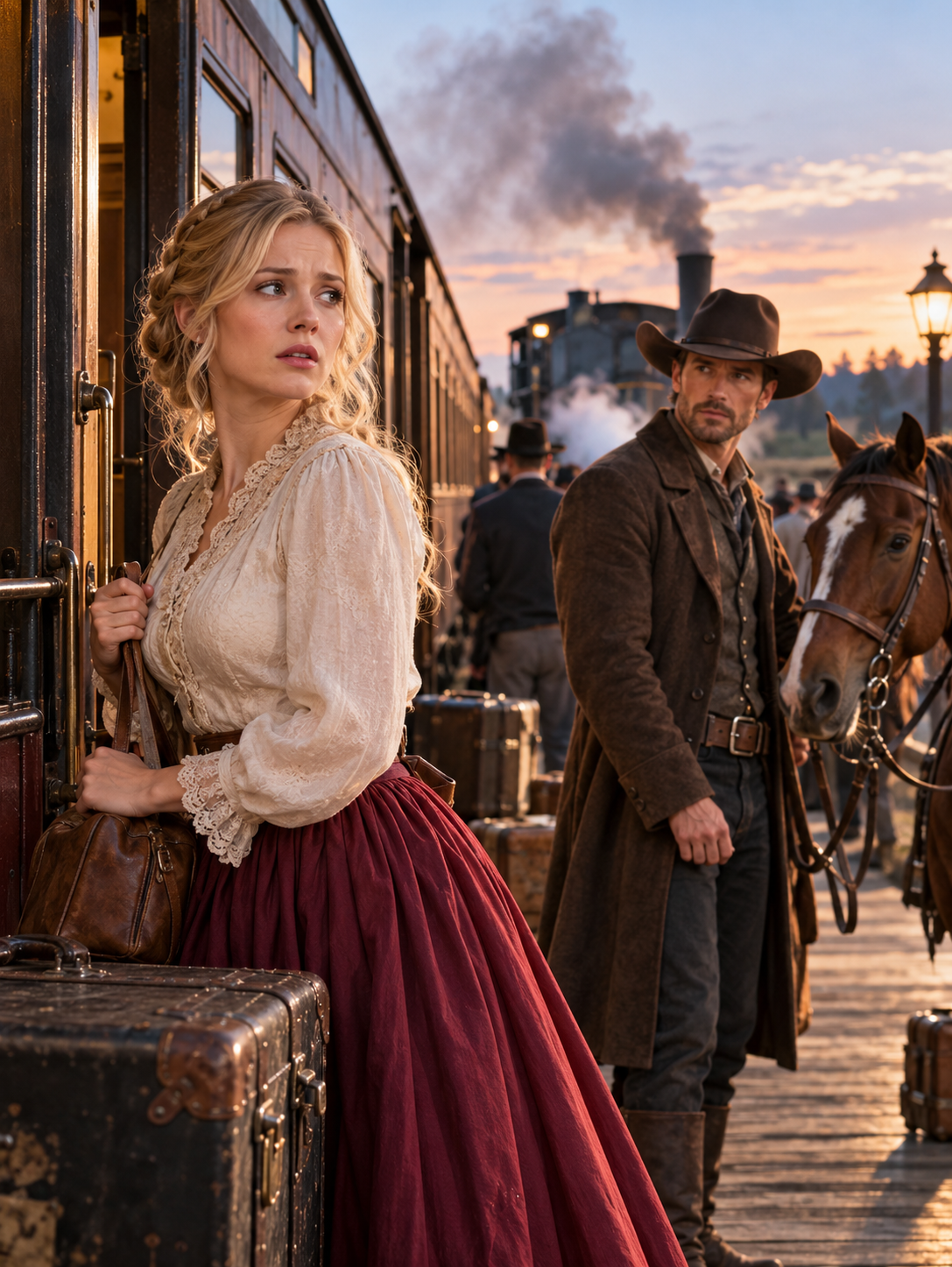
She Rode the Prairie Train to Marry a Stranger, but One Terrifying Night Revealed Why Her Future Husband Had Begged Her Never to Turn Back “Your future husband buried his first bride beneath the cottonwood tree,” the stranger whispered. “And if you step off this train in Blackwater, you’ll be next.” The woman sitting across from me had delivered those words without raising her voice. Then she placed a small silver locket on my lap, stood up, and walked toward the rear of the train as though she had merely asked me to pass the salt. Inside the locket was a photograph of a young woman. She looked almost exactly like me. Same dark hair. Same high cheekbones. Same slightly crooked smile. On the back, scratched into the silver, were four words. DON’T TRUST THE LETTERS. I had traveled eleven hundred miles to marry a man I had never met. And with only seventy-three miles remaining, I was beginning to wonder whether I was riding toward my wedding or my grave. Should I step off at the next station and disappear, or continue toward a stranger whose letters had promised me everything I had ever wanted? My name was Eleanor Whitcomb. I was twenty-six years old, unmarried, nearly penniless, and riding west through the Nebraska prairie in the autumn of 1887. Until that night, I had believed the most dangerous thing about becoming a mail-order bride was discovering that my future husband had exaggerated his appearance. I was wrong. I was wrong about the letters. I was wrong about the woman in the photograph. I was wrong about the reason a wealthy rancher would offer marriage to a woman he had never met. I was wrong about the strange kindness of the railroad conductor. And I was terribly wrong about what waited at the end of the tracks. The train rocked beneath my feet as I stood in the narrow aisle, clutching the locket. Outside, the prairie stretched into darkness. Inside, the carriage smelled of coal smoke, damp wool, and the boiled coffee being carried down the aisle by a tired attendant. The woman who had warned me was gone. I hurried toward the rear door. A large man in a black traveling coat stepped into my path. “Something wrong, miss?” He had a broad face, pale eyes, and a neatly trimmed beard. A silver railroad watch chain crossed his waistcoat. “I’m looking for a woman,” I said. He smiled. “Aren’t we all looking for somebody?” “She was sitting across from me. Gray dress. Brown hat. Perhaps forty years old.” His expression remained pleasant. But his eyes changed. “Plenty of ladies dressed that way.” “She gave me something.” His gaze dropped to the silver locket in my hand. The smile vanished. “Best get back to your seat, Miss Whitcomb.” I had not told him my name. That was the first moment I understood that someone on the train had been expecting me. I did not argue. I did not scream. I lowered my eyes, stepped aside, and returned to my seat. Then I slipped the locket into the lining of my carpetbag, where I had already sewn a small hidden pocket for the sixty dollars I refused to surrender to any husband. My mother had taught me to sew. My father had taught me to count. And the man who had nearly ruined my life had taught me never to mistake politeness for safety. I had learned all three lessons the hard way. Three months earlier, I had been living in Boston, Massachusetts, in a narrow boardinghouse above a bakery. My father had died after losing nearly everything in a business partnership that turned sour. My mother had followed him to the cemetery the previous winter. What remained of our respectable middle-class life fit into two trunks, one carpetbag, and a handful of letters tied with blue ribbon. I worked as a seamstress for a dressmaker who paid barely enough to cover rent. Most evenings, I stitched wealthy women’s gowns beneath a flickering oil lamp while listening to the landlady complain about the cost of coal. Then, one Sunday afternoon, I saw an in a newspaper. It was brief. Respectable rancher, thirty-four years of age, financially secure, seeks honorable woman for marriage and companionship. Comfortable home. No children. Correspondence invited. Western Nebraska. At first, I laughed. A woman could hardly find a trustworthy husband in Boston after knowing him for five years. Why should I believe I could find one across the country through a newspaper? But that evening, the landlady informed me my rent would increase. And the next morning, my employer announced she was reducing wages. By Wednesday, the no longer seemed ridiculous. It seemed like a door. The man who answered my first letter called himself Samuel Mercer. He wrote in careful handwriting, with long, deliberate strokes and surprisingly thoughtful phrases. He owned a cattle ranch outside Blackwater, a small settlement near the Nebraska-Wyoming border. He had inherited the land from his father. He was not a man of extravagant tastes, he said, but he had built a substantial house with a proper kitchen, a library, and a front porch facing the western hills. He had no surviving close family. He wanted a wife who could be a partner rather than an ornament. That last sentence stayed with me. A partner. Not a servant. Not a possession. A partner. In his second letter, Samuel asked whether I liked books. In his third, he confessed that he had never understood why anyone planted flowers in Nebraska when the wind seemed determined to destroy them. In his fourth, he wrote about a lonely Christmas spent watching snow drift against his windows. By the fifth letter, I began looking forward to the mail. By the eighth, I knew how he took his coffee. By the twelfth, I could recognize his handwriting before opening the envelope. And in his fourteenth letter, he asked me to marry him. He promised to pay my passage west. He promised I would have my own room until we were properly married. He promised I could return east at his expense if we met and found ourselves unsuitable. Most importantly, he promised he would never ask me to surrender the money I had saved. I read that letter seventeen times. Then I wrote yes. Two weeks later, a railroad ticket arrived. Along with a little velvet box containing a plain gold ring. And a final letter. My dearest Eleanor, There are things about Blackwater that may trouble you. People here are fond of gossip, and some bear my family little affection. If anyone speaks harshly of me, please allow me the opportunity to answer before judging. Whatever you hear, I ask only one thing. Do not turn back before we have met. Yours faithfully, Samuel. At the time, I thought it was the anxious request of a lonely man afraid of being rejected. Now, somewhere west of North Platte, with an unknown woman’s locket hidden in my luggage, those words seemed less romantic. And much more like a warning. I opened my purse and took out Samuel’s last letter. The paper was thick, expensive, and faintly scented with cedar. I held it toward the carriage lamp. The handwriting was familiar. The signature was familiar. But near the bottom, beneath the last line, I noticed something I had never seen before. A faint indentation. As if another message had been written on a sheet placed above it. I tilted the paper toward the light. Nothing. The train rocked violently around a bend. I folded the letter and put it away. Then I reached for the little notebook in which I recorded my expenses. On the final page, I wrote three things. The woman knew about Samuel. The railroad man knew my name. The photograph resembled me. Underneath, I added one more sentence. Do not assume any of them are telling the truth. That was the rule I intended to follow until I reached Blackwater. I had survived too many difficult years by keeping my thoughts to myself. I would not suddenly become foolish simply because I was frightened. The next station was a small settlement called Willow Creek. We arrived shortly before ten. There was no proper station building, only a wooden platform, a water tank, and a tiny office illuminated by two lanterns. The conductor announced a twenty-minute stop. Passengers stood, stretched, and reached for their bags. I waited until the large man in the black coat passed my seat. Then I followed the other passengers onto the platform. Cold air struck my face. Somewhere beyond the lantern light, coyotes called across the dark prairie. A freight wagon stood beside the depot. Two horses stamped and snorted in the chill. The little telegraph office was open. That was what interested me. Samuel’s letters had always arrived by mail. But a telegraph message could reach Blackwater much faster. If I could send word to the local sheriff, perhaps I could discover whether the warning had any basis in fact. I approached the office. A young telegraph operator sat behind a desk, reading a newspaper. “Excuse me,” I said. “Can you send a message to Blackwater?” He looked up. “Sure can, ma’am. Who’s it for?” “The sheriff.” He set down his paper. “What sort of message?” “A simple inquiry.” “What’s the name?” “Sheriff’s office, Blackwater.” He nodded. I took out a pencil. Then I paused. If the man in the black coat was watching me, he might discover the message. And if the woman in gray had been telling the truth, I had no way of knowing whom I could trust in Blackwater. Instead, I wrote a different name. Thomas Bennett. My mother’s younger brother. He had moved to Omaha years earlier and worked for a railroad supply company. We had not spoken in nearly eighteen months, but he had once told me that if I ever found myself in trouble west of the Mississippi, I should send him a telegram. He would come. Even if he had to borrow a horse. I handed the operator my message. UNCLE THOMAS. TRAVELING TO BLACKWATER. POSSIBLE DANGER. PLEASE INQUIRE SAMUEL MERCER RANCHER. REPLY BLACKWATER POST OFFICE. ELEANOR. The operator counted the words. I paid him. He began working the telegraph key. I waited until the message was sent. Then I returned to the platform. The black-coated man stood beside the train, smoking a cigar. “Enjoying the evening, Miss Whitcomb?” “Not particularly.” “Prairie nights can unsettle a person.” “So can strangers who know things they shouldn’t.” His lips twitched. “There’s a difference between being observant and being dangerous.” “Then perhaps you should tell me which one you are.” He studied me for a moment. “You’re a long way from Boston.” “And you’re avoiding my question.” The cigar glowed red between his fingers. “My name is Silas Crowe,” he said. “I work with railway security.” “Then you won’t mind showing me your credentials.” His smile returned. “Railroad business isn’t always conducted with badges, miss.” “Neither is dishonesty.” For the first time, his pleasant expression disappeared entirely. He leaned closer. “You’d be wise to understand something before we reach Blackwater. People in that town have long memories. And the Mercer family has enemies who don’t forget.” “Then I suppose I should ask Mr. Mercer about them.” “I suppose you should.” He glanced toward the telegraph office. “And perhaps you should be careful who receives your messages.” My stomach tightened. But I kept my face still. “Good evening, Mr. Crowe.” I climbed aboard without waiting for his answer. Inside, I found my carpetbag exactly where I had left it. Except the brass buckle was fastened backward. I always closed it with the buckle tongue pointing right. Now it pointed left. Someone had searched my belongings. I sat down slowly. The hidden pocket remained intact. My sixty dollars were still there. The locket was still there. But the little velvet ring box had been opened. The gold ring lay on top of my folded stockings. Beside it was a scrap of paper. Four words had been written in black ink. SHE WAS NOT THE FIRST. I stared at the note. Then I turned it over. Nothing. No signature. No explanation. I slipped it into my notebook. The train whistle sounded. We began moving. And somewhere in the carriage behind me, a woman screamed. Every passenger turned. The scream stopped almost immediately. A man shouted for the conductor. Then there was the sound of hurried footsteps. I remained seated. Not because I was brave. Because I understood what fear could do to a crowd. If someone wanted to distract me, a scream would be an excellent way. I watched the aisle. Silas Crowe hurried past. Two railroad employees followed him. A few moments later, the conductor appeared. “There has been a small accident,” he announced. “Please remain calm.” “What happened?” asked an elderly gentleman near the stove. “A passenger became ill.” “Was it the woman in gray?” I asked. The conductor looked directly at me. “Which woman in gray?” “The one sitting across from me earlier.” He glanced at the empty seat. “Ma’am, that seat has been unoccupied since Omaha.” Several passengers looked over. I felt heat rise beneath my collar. “I spoke with her.” “I’m sure you believe you did.” His tone was so smooth that it frightened me more than an insult would have. “Are you suggesting I imagined her?” “Long journeys can be exhausting.” He moved on before I could respond. I looked around the carriage. A young mother holding a sleeping child avoided my eyes. An elderly farmer studied his boots. A traveling salesman pretended to read. Then, from the seat diagonally behind me, a small voice whispered. “I saw her.” I turned. A boy of perhaps eleven sat with his knees drawn up beneath his coat. He had sandy hair, freckles, and a face that looked too thin for his age. “What’s your name?” I asked. “Daniel.” “Daniel what?” “Daniel Price.” “Are you traveling with your parents?” He shook his head. “My aunt’s meeting me in Blackwater.” I lowered my voice. “You saw the woman who spoke to me?” He nodded. “She was scared.” “How do you know?” “Because she kept looking at the door. Like she was waiting for somebody.” “Did you see where she went?” Daniel swallowed. “Mr. Crowe took her into the baggage car.” A cold weight settled in my chest. “Did she go willingly?” The boy stared at his hands. “No, ma’am.” I leaned closer. “What exactly did you see?” “He grabbed her arm. She told him to leave her alone. Then the conductor shut the door.” For several seconds, the only sound was the clattering wheels. “Did anyone else see?” Daniel nodded toward the elderly farmer. “He did.” The farmer’s head lifted. His expression was bleak. “I saw nothing, boy.” Daniel looked down. I understood. A grown man traveling alone had reasons to avoid trouble. A child did not understand those reasons yet. I reached into my purse and gave Daniel a wrapped peppermint. “Thank you for telling me the truth.” He took it without smiling. “Miss?” “Yes?” “That woman dropped something when they took her.” “What?” “A blue ribbon.” My hand tightened around my purse. All Samuel’s letters had been tied with blue ribbon. “Do you have it?” Daniel reached beneath his coat and produced a narrow strip of blue silk. There was dried mud on one end. And three tiny stitches near the middle. I recognized the stitches immediately. Not because I had seen that particular ribbon before. Because they were mine. Three small stitches in white thread. The same little marking I used whenever I repaired clothing for customers who wanted to identify their garments discreetly. My mother had taught me the habit. I used it on handkerchiefs, stockings, and ribbon ends. I had also used it to reinforce the blue ribbon I tied around my letters before mailing them to Samuel. This ribbon had come from one of my own packages. Or from someone who had received it. I looked toward the rear of the train. The baggage-car door stood closed. A brass lock hung from the latch. Mr. Crowe had returned to his seat. He was watching me. I gave Daniel a calm smile. “Keep your peppermint hidden,” I whispered. Then I leaned back, opened a novel, and pretended to read. For the next forty minutes, I did not move. I listened. I watched the reflection in the dark window. I memorized the rhythm of the conductor’s rounds. And I waited for the train to slow. It happened shortly after eleven. The wheels screeched as we approached a steep grade. The train slowed enough that every loose fitting rattled. Crowe rose and walked toward the front carriage. The conductor followed him. I stood. Daniel looked up. “Where are you going?” “To find out whether your aunt is expecting one passenger or two.” He frowned. I touched his shoulder. “If anyone asks, I went to find the attendant.” Then I walked toward the rear. The baggage-car door had a simple sliding bolt on the passenger side and a padlock securing a secondary chain. The padlock was closed. But the chain had enough slack to let the door open three inches. I leaned close. “Hello?” Nothing. “Is anyone there?” A faint scraping sound came from inside. Then a whisper. “Eleanor?” I froze. “Who is that?” “Don’t let them take you to the house.” It was the same woman. “Who are you?” A pause. Then a sound like someone struggling to breathe. “My name is Margaret Hale.” The name meant nothing to me. “Why do you have my ribbon?” “I carried your letters.” My heart slammed against my ribs. “From where?” “From Boston.” “That isn’t possible.” “Your mother knew my sister.” “My mother is dead.” “I know.” Something heavy struck the floor inside. Margaret gasped. Then she whispered six words that made the world tilt beneath me. “Samuel Mercer did not write them.” I gripped the doorframe. “Who did?” Footsteps sounded behind me. I turned. The conductor was approaching. His face hardened when he saw me. “Miss Whitcomb. You were instructed to remain in the passenger carriage.” “I was looking for the attendant.” “At the baggage door?” “I thought she might be getting supplies.” He glanced at the chain. Then at my hands. “Please return to your seat.” I did. But before I turned away, I heard Margaret whisper something else. One word. “Ledger.” The conductor slammed the outer latch shut. He followed me until I reached my seat. Then he disappeared toward the front. I sat down, opened my notebook, and wrote the word. LEDGER. Underneath, I added: Margaret Hale. She carried letters. Samuel did not write them. The train continued west. At midnight, the lamps were turned low. Passengers slept beneath coats and blankets. Daniel curled against the window. The elderly farmer snored softly. I remained awake. I took out Samuel’s letters one by one. Fourteen in all. I spread them across my lap beneath the dim lamp. At first, everything appeared ordinary. Same paper. Same ink. Same beautiful handwriting. Then I noticed something. In Samuel’s earliest letters, he wrote the word “color” with the American spelling. In the seventh letter, he used “colour.” In the ninth, he used “honour.” I had noticed those spellings before and dismissed them as eccentricities. Now I checked the dates. The spellings changed after the sixth letter. So did the way he formed the capital S. The difference was slight. But it was there. Someone had been imitating the handwriting. Perhaps from the beginning. Perhaps only after the sixth letter. I went back to the fifth. Samuel had written about his mother teaching him to bake bread. In the eighth, he described growing up with a housekeeper because his mother had died when he was three. I stared at the contradiction. How had I missed it? Because I had wanted to believe. A lonely woman reading kind letters is not always reading with both eyes open. I had read with hope. Now I read with suspicion. The difference was enormous. I examined every envelope. Most carried the Blackwater postmark. But the eighth, tenth, and twelfth had been mailed from a town called Red Bluff. I had never heard of Red Bluff. I wrote down the dates. Then I looked at the gold ring. It was a simple band. No inscription. No crest. Nothing that connected it to Samuel. Yet when I held it near the lamp, I saw a tiny mark inside. Not a jeweler’s hallmark. Two initials. C.M. I had assumed they belonged to the manufacturer. Now I wondered whether they belonged to another woman. The one beneath the cottonwood tree. The one in the photograph. Or someone whose name I had not yet heard. Shortly after one in the morning, the train came to an unexpected stop. There was no station. No platform. Just darkness beyond the windows. The engine hissed. A man shouted outside. I heard boots running along the gravel. Then a gunshot cracked through the night. Passengers jerked awake. A baby began crying. The salesman stood halfway out of his seat. “What in God’s name was that?” The conductor appeared. “Remain seated!” Another gunshot. Closer this time. I ducked instinctively. Daniel slid beneath the seat. The elderly farmer reached into his coat. For one absurd second, I expected him to produce a handkerchief. Instead, he drew a small revolver. “Everybody stay down,” he said. His voice was suddenly steady. Not frightened. Not old. Steady. I looked at him. He met my eyes. Then he gave the slightest shake of his head. Do not speak. Outside, men were arguing. I could not distinguish the words. Then came the unmistakable sound of someone striking another person. A groan followed. The train shuddered. The carriage lamps flickered. The conductor rushed toward the rear. The farmer stood. “Stay here,” he told me. “Who are you?” “Someone who’s lived long enough to recognize a bad situation.” He slipped through the rear door. I sat motionless. Daniel crawled out from under the seat. “Are we going to die?” “No.” I said it more firmly than I felt. He looked at me with enormous eyes. “How do you know?” “Because we’re going to be careful.” The boy considered that. Then he nodded. We waited. Five minutes. Ten. At last, the train began moving again. The farmer returned. His coat was dusty. There was a fresh scrape across his knuckles. He sat down opposite me. “What happened?” I whispered. “Trouble with a horseman near the tracks.” “Horsemen don’t usually fire pistols at passenger trains.” “No.” He looked toward the baggage car. “They don’t.” “Who are you?” He rested his revolver on his knee, hidden beneath his coat. “My name is Henry Dalton.” “Are you a lawman?” “I used to be.” “Where?” “Montana Territory. Before it became fashionable for every fool with a gun to call himself a deputy.” I studied him. He had the tired face of a man who had spent years seeing people at their worst. “Did you know about the woman in the baggage car?” “Yes.” “Is she alive?” “Yes.” “Then why haven’t you helped her?” “Because I’m trying to keep everyone else alive long enough to find out who ordered her taken.” The answer was not comforting. But it was honest. At least, I hoped it was. Henry leaned closer. “Miss Whitcomb, when we reach Blackwater, do not go anywhere with Silas Crowe.” “I hadn’t intended to.” “And don’t leave the train with anyone who claims Samuel Mercer sent them.” “Why?” Henry glanced at Daniel. Then he lowered his voice. “Because Samuel Mercer has been missing for six weeks.” My mouth went dry. “Missing?” “That’s what I’ve been told.” “By whom?” “A man who came east looking for him.” “Who?” “His foreman.” I waited. Henry said nothing. “What is the foreman’s name?” “Jacob Reed.” I wrote it down. The farmer watched my pencil. “You keep records.” “Yes.” “Good habit.” “My father believed that people who lie rarely remember every detail.” Henry gave a grim smile. “Your father sounds like a sensible man.” “He was.” “Then follow his example.” He stood. “Where are you going?” “To make sure the boy reaches his aunt.” He placed his coat over Daniel’s shoulders. Then he settled into the seat behind us and closed his eyes. I doubted he slept. Neither did I. The train crossed the dark prairie beneath a sky crowded with stars. At half past two, the wheels began clattering across a wooden trestle. The bridge seemed to go on forever. Below, I could hear rushing water. I watched the distant black shapes of cottonwoods along the river. Then I opened the locket again. The young woman’s face was illuminated by the weak lamp. On one side of her collar, a tiny decorative pin gleamed. I held the photograph closer. It was shaped like a swallow. A bird in flight. I had seen that pin before. Not on a person. In a drawing. Samuel’s sixth letter had contained a sketch of his ranch house. He said the drawing had been made by a visiting cousin. In one corner, barely visible, someone had sketched a small swallow. I took out the letter. The bird matched. Same sloping wings. Same curved tail. And beneath it, written in tiny letters, was a name I had mistaken for an artist’s signature. Clara. The ring bore the initials C.M. The photograph was of Clara. Clara Mercer? Clara someone else? I did not yet know. But I finally understood why the locket had frightened Silas Crowe. It connected the woman in the photograph to the Mercer correspondence. And if Margaret Hale had carried those letters, then the three things were part of the same story. At three in the morning, the train stopped again. This time at a station. A hand-painted sign read RED BLUFF. My heart tightened. Three of Samuel’s letters had been mailed from here. The platform was almost empty. One lantern burned outside the depot. A man in a long coat stood beside a buckboard wagon. He watched the train with unusual intensity. When the conductor stepped down, the man approached him. They exchanged a few words. Then the man pointed toward my carriage. I lowered my head. Through the reflection in the window, I saw the conductor shake his head. The man grabbed his sleeve. The conductor pulled away. For a moment, I thought they might fight. Then Silas Crowe appeared. He spoke quietly. The man in the long coat backed away. I made a decision. I would get off the train. Not at Blackwater. Here. Red Bluff had a station office. There might be a boardinghouse. There might be a sheriff. And there would certainly be more witnesses than on a moving train in the middle of the prairie. I gathered my carpetbag. I stood. Then I felt a small hand clutch my sleeve. Daniel. “Don’t,” he whispered. I looked down. His face was pale. “What is it?” He nodded toward the platform. “That man.” “Which man?” “The one by the wagon.” “What about him?” Daniel swallowed. “He came on the train back at Willow Creek.” “Are you sure?” “Yes.” “Then why is he outside?” The boy’s voice dropped even lower. “Because he got off at the last stop. Before the shooting.” I felt a chill. “Did you see him?” Daniel nodded. “He had a bag.” “What kind of bag?” “A leather one. Like a doctor’s bag.” I glanced toward the platform again. The man was no longer beside the wagon. He was walking toward the station door. Then he turned. For a fraction of a second, his face entered the lantern light. He was clean-shaven. About forty. Heavy eyebrows. A scar near his chin. I had never seen him before. But something in his expression made me stop. He was smiling. Not at the conductor. Not at the train. At my window. As though he knew I was standing behind the curtain. I slowly sat down. The train whistle sounded. We pulled away from Red Bluff. I watched the wagon disappear into darkness. Then I opened my notebook. At the top of a fresh page, I wrote: RED BLUFF. And beneath it: Man with scar. Leather bag. Possible connection to letters. I had barely finished when Henry Dalton spoke from behind me. “You made the right choice.” I turned. “About what?” “Not getting off.” I looked at him sharply. “Were you watching me?” “I watch everything.” “Then perhaps you can tell me who that man was.” Henry’s face darkened. “I wish I could.” “Do you recognize him?” “I recognize what he represents.” “That isn’t an answer.” “No,” Henry said. “It isn’t.” He leaned forward. “Miss Whitcomb, sometimes the most dangerous place isn’t the one you’re traveling toward. It’s the place your enemies expect you to stop.” I considered that. Then I asked a question. “Were you sent to protect me?” He did not answer immediately. Outside, the wheels pounded across another crossing. Finally, he said, “I was sent to find out what happened to Samuel Mercer.” “By Jacob Reed?” “Yes.” “Then you knew I was aboard?” “I knew a woman named Eleanor Whitcomb might be.” “Why didn’t you introduce yourself?” “Because I didn’t know which side you were on.” The words stung. “Which side?” He looked at the locket in my hand. “Samuel Mercer wasn’t the first person to disappear near Blackwater.” I waited. “Four years ago,” he continued, “a young woman came west under circumstances much like yours.” “Clara?” His eyes narrowed. “Where did you hear that name?” I showed him the locket. He took it carefully. When he opened it, his expression changed. He stared at the photograph for several seconds. Then he closed the locket and handed it back. “That belonged to Clara Morgan.” I swallowed. “Was she Samuel’s first bride?” “No.” “Then who was she?” Henry looked at me with a sadness I had not expected. “She was his sister.” For a moment, I could not speak. The entire story shifted. The woman in the photograph was not a discarded bride. She was family. And she looked like me. “Why did Margaret say Samuel buried his first bride beneath the cottonwood tree?” Henry’s face tightened. “Because someone wants you to believe Samuel is a murderer.” “Who?” “That’s what I’m trying to discover.” I stared at the locket. “Did Clara die?” Henry hesitated. Then he said, “Clara vanished four years ago. Officially, she’s presumed dead.” “What happened to her?” “She came home from St. Louis after her husband died. She intended to help Samuel manage the ranch. Three months later, she disappeared.” “Was there an investigation?” “Briefly.” “By whom?” “The county sheriff.” “What did he find?” “Nothing.” I looked at him. “Or nothing he wanted to report?” Henry’s expression hardened. “That is a very good question.” He glanced toward the rear door. “Clara had been keeping records before she disappeared.” “A ledger?” Henry went still. “Where did you hear that?” “Margaret Hale.” He straightened. “She mentioned a ledger?” “Yes.” “Did she tell you where it was?” “No.” Henry rubbed his jaw. For the first time, he looked genuinely alarmed. “Then we have less time than I thought.” “Why?” “Because if Margaret knows where that ledger is, she’s in more danger than either of us.” I looked toward the baggage car. The locked door stood at the end of the swaying aisle. “What was in it?” Henry shook his head. “I don’t know.” “Then why does it matter?” “Because Clara Morgan vanished the same week she told her brother she had discovered evidence that someone was stealing his land.” That answer raised more questions than it settled. But one thing was clear. The locket was not merely a warning. It was evidence. And somebody on the train wanted it badly enough to search my belongings. The train moved steadily toward dawn. I watched the black prairie outside the window begin to soften. The eastern horizon turned the color of cold iron. Far away, a line of hills emerged. I had imagined this journey ending with a nervous man waiting beside a carriage. A bouquet of flowers. A handshake. Perhaps an awkward smile. Now I wondered whether Samuel Mercer was alive. And whether anyone in Blackwater could be trusted. At five in the morning, we stopped at a water station. The conductor announced that Blackwater was less than two hours away. I made another decision. I would not flee. Not yet. I had come too far, and running blindly could place me in greater danger. But I would not allow anyone to control where I went after leaving the train. I would enter Blackwater on my own terms. I took my sixty dollars from the hidden pocket. I divided it into three portions. Twenty dollars in my boot. Twenty sewn into the hem of my skirt. Twenty in my purse. I tucked the letters inside my bodice. The locket went into the toe of a spare stocking. Then I folded my notebook and placed it beneath the lining of my hat. If someone searched my luggage again, they would find almost nothing useful. I also prepared a small lie. If anyone asked why I had come to Blackwater, I would say I was visiting a distant cousin. If anyone asked whether I knew Samuel Mercer, I would say I had heard the name. And if anyone claimed to be my future husband, I would ask a question only the real Samuel could answer. One detail from his earliest letters. His mother’s favorite hymn. He had told me she sang it whenever thunderstorms rolled over the ranch. “Abide with Me.” I repeated the name silently. Then I stopped. If someone had access to his letters, they might know that too. I needed something else. Something from a letter that could not have been forged easily. I searched my memory. In his fourth letter, Samuel had described a scar across his left hand. He had received it as a boy while repairing a broken wagon wheel. The scar, he said, curved from his thumb toward his wrist. He had joked that it made his hand look like a badly drawn map. It was not proof of his honesty. But it was something I could verify. The sun rose over the prairie. Golden light spread across dry grass. Cattle moved in the distance. The land looked enormous and empty. I understood suddenly why so many people had come west seeking new lives. The prairie offered the illusion that the past could not follow. But mine had followed me into a railway carriage. And somewhere in the baggage car, a woman who knew my mother was being held against her will. The train whistle sounded. Blackwater was approaching. Henry Dalton came to my seat. “Listen carefully,” he said. “I am.” “When we stop, Crowe will probably try to escort you away.” “I won’t go.” “He may claim Samuel sent him.” “I won’t believe him.” “He may threaten you.” “Then he’ll have to do it in public.” Henry studied me. “You’re a remarkable young woman.” “No,” I said. “I’m a woman with sixty dollars and nowhere safe to go. There’s a difference.” He almost smiled. Then his expression turned serious. “Find Jacob Reed. He’ll be waiting near the freight platform. Tall fellow, red hair, missing the tip of his right little finger.” “Why should I trust him?” “You shouldn’t. Not completely.” “Then why send me to him?” “Because he has a reason to want Samuel found.” “What reason?” Henry reached into his coat. He withdrew a small photograph. Two men stood beside a fence. One was tall and red-haired. The other had dark hair, a square jaw, and a serious expression. “Samuel Mercer,” Henry said, touching the dark-haired man. I stared at the photograph. The face was not handsome in the fashionable Boston sense. But it was strong. Weathered. A face shaped by sunlight and wind. I noticed his left hand resting on the fence rail. Even in the faded photograph, a pale scar was visible. Then Henry pointed to the other man. “Jacob Reed.” I memorized his face. Henry returned the photograph to his pocket. “Don’t forget what I told you.” “I won’t.” “And Miss Whitcomb?” “Yes?” “If Samuel is alive, he may not be able to tell you everything immediately.” “Why not?” Henry looked toward the train door. “Because the people who took him have been watching everyone close to him.” “Who are they?” He did not answer. Instead, he said, “There are men in this country who would rather destroy a family than surrender a piece of land.” Then he walked away. Twenty minutes later, Blackwater appeared. The town rose from the prairie like something assembled in a hurry. Wooden buildings stood along a dusty main street. A white church steeple pointed toward the sky. Two feed stores faced a general mercantile. A small hotel occupied the corner near the station. Beyond the town, distant hills rolled toward the west. There were more people on the platform than I expected. Ranch hands. Farmers. Women in traveling dresses. A man carrying chickens in a crate. A family with three children. I studied the crowd. Then I saw him. Tall. Red-haired. Standing beside the freight platform. His right hand rested on the rail. I could not see his little finger. But I recognized his face from Henry’s photograph. Jacob Reed. He was searching the windows. Then his gaze found mine. Something flashed across his expression. Relief. Then fear. He stepped forward. At the same moment, Silas Crowe appeared beside my seat. “Miss Whitcomb.” I looked up. “We’ve arrived.” “Yes, I noticed.” “I’ve arranged a carriage.” “How thoughtful.” “Mr. Mercer will be delighted to receive you.” I rose slowly. “Will he?” Crowe smiled. “Of course.” “Then I’m sure he won’t mind if I send a message before leaving.” “There’s no need.” “I wasn’t asking whether there was a need.” His smile thinned. “Miss Whitcomb, these arrangements were made for your comfort.” “Then you will understand why I prefer to make my own.” I stepped into the aisle. Crowe blocked it. For a moment, neither of us moved. Then Henry Dalton appeared behind him. “Problem here?” Crowe turned. The two men looked at each other. Something passed between them. Recognition. Hostility. Perhaps fear. Crowe stepped aside. “Not at all.” “Good,” Henry said. He held out his arm to me. “Allow me to help with your bag, ma’am.” We walked toward the door. As I passed the baggage car, I glanced toward the chain. The door stood open. Margaret Hale was gone. So was her luggage. The carriage descended into sunlight. The platform was crowded. I looked for Jacob Reed. He had vanished. I scanned the freight platform. No red-haired man. No familiar face. Nothing. Henry followed my gaze. His jaw tightened. “Keep walking.” “Where?” “To the station office.” We had taken three steps when a woman in a dark green dress approached us. She was perhaps fifty years old, with silver-streaked hair arranged beneath a black hat. Her clothes were expensive. Her expression was composed. “Miss Whitcomb?” I stopped. “Yes.” She smiled. “How wonderful. We’ve been expecting you.” “Have we met?” “No, dear. I’m Mrs. Beatrice Hargrove. I own the Blackwater Hotel.” She glanced at Henry. “And you must be Mr. Dalton.” Henry’s expression did not change. “Mrs. Hargrove.” “How nice to see you again.” The warmth in her voice sounded rehearsed. She turned back to me. “Mr. Mercer asked me to provide you with a room until the wedding arrangements are complete.” My heart struck hard. “Mr. Mercer?” “Of course.” “Have you seen him recently?” Her smile remained steady. “Not personally, no. His business keeps him quite occupied.” “Then how did he make the arrangement?” “By letter.” I looked at Henry. He watched Mrs. Hargrove carefully. “How fortunate,” I said. “I would appreciate a room.” Henry turned sharply. I continued before he could speak. “But I’ll pay for it myself.” Mrs. Hargrove hesitated. “There is no need.” “I insist.” A tiny muscle moved near her mouth. “Very well.” She gestured toward the street. “The hotel is just there.” We walked together through the station crowd. I felt Crowe watching from behind us. I did not turn. At the hotel entrance, Mrs. Hargrove stopped. A polished brass bell hung above the door. Fresh curtains decorated the windows. The building looked respectable. That made me more suspicious, not less. Henry stepped beside me. “Miss Whitcomb, I’ll need to attend to some business.” “Of course.” “Stay where there are people.” “I intend to.” He lowered his voice. “Don’t eat or drink anything you haven’t seen prepared.” I looked at him. “Is that a warning?” “It’s experience.” Then he walked away. I watched him disappear around the corner. Mrs. Hargrove opened the hotel door. “Come in, dear.” The lobby was warm. A coal stove burned near the wall. A grandfather clock ticked beside a staircase. There was a writing desk, a small sitting area, and a rack of newspapers. Everything smelled of polished wood and lemon oil. A young woman sat behind the front desk. She looked up as we entered. “Mrs. Hargrove?” “This is Miss Whitcomb. Room six.” The young woman stared at me. Her face went pale. Then she dropped her pen. Mrs. Hargrove turned sharply. “Emily.” The girl bent to retrieve it. “Sorry, ma’am.” I watched her hands. They were trembling. Mrs. Hargrove continued toward the staircase. “Emily will carry your bag.” “That won’t be necessary,” I said. “Don’t be silly.” “I prefer to carry my own belongings.” Her smile tightened. “As you wish.” She led me upstairs. Room six was at the end of the corridor. It contained a narrow bed, a washstand, a wardrobe, and one window overlooking the street. Clean. Comfortable. Ordinary. Too ordinary. Mrs. Hargrove placed the key on the dresser. “Breakfast is at eight. Supper at six.” “Thank you.” “Mr. Mercer may send for you later.” “I look forward to hearing from him.” She studied me. “I’m sure you do.” Then she left. I waited until her footsteps faded. I locked the door. Then I inspected the room. Under the bed. Behind the curtains. Inside the wardrobe. The window latch. The door hinges. The space beneath the washstand. I found nothing. Then I noticed the wallpaper beside the bed. A narrow strip near the baseboard had been loosened. I crouched. Carefully, I lifted it. Behind the paper was a small mark scratched into the plaster. Not a word. Not a symbol. Three little lines. The same three stitches I used on my ribbons. I stared. Someone had marked this room. Someone who knew my method. Someone connected to my mother. I placed my fingertips against the wall. Then I heard a faint click. I turned. The door handle moved. Once. Twice. Someone was trying to enter. I stepped behind the wardrobe. The handle stopped. A key slid into the lock. My pulse accelerated. The lock turned. The door opened slowly. Emily, the young desk clerk, slipped inside. She closed the door behind her. Then she whispered, “Miss Whitcomb?” I stepped out. Emily gasped. “Don’t scream,” I said. “I wasn’t going to.” “Then tell me why you entered my room without knocking.” She looked toward the door. “Because Mrs. Hargrove told me never to speak to you alone.” I waited. Emily swallowed. “There’s something you need to know.” “What?” “She gave this room to another woman before you.” My stomach tightened. “When?” “Four years ago.” “Who was she?” Emily’s eyes filled with fear. “Clara Morgan.” I took the locket from my stocking. When I opened it, Emily covered her mouth. “That’s her.” “Did you know her?” Emily nodded. “She stayed here for six nights.” “What happened?” “She disappeared.” “From this room?” Emily’s eyes moved toward the loosened wallpaper. “Yes.” I felt the blood leave my face. “Did she leave anything behind?” Emily hesitated. Then she whispered, “A book.” “What kind of book?” “A ledger.” The word seemed to hang between us. “Where is it?” “I don’t know.” “Who took it?” Emily’s voice shook. “Mrs. Hargrove.” I looked toward the door. “Why are you telling me this?” Emily took a breath. “Because Clara was kind to me. I was just a girl working in the kitchen. She helped me learn to read.” A tear slipped down her cheek. “She said people who couldn’t read were easier to cheat.” I thought of Samuel’s letters. Of the altered handwriting. Of the contradictory stories. “She was right.” Emily nodded. “She trusted the wrong person.” “Who?” Emily opened her mouth. Then footsteps sounded in the corridor. She stiffened. Mrs. Hargrove’s voice called from downstairs. “Emily!” The girl rushed toward the door. Before leaving, she pressed a folded scrap of paper into my hand. “Please,” she whispered. “Don’t let her know I told you.” Then she was gone. I unfolded the paper. It contained an address. The old schoolhouse. North of Miller’s Creek. After sundown. No signature. I stared at it for a long time. Then I burned it in the room’s small stove. If someone searched my belongings, there would be no evidence of our conversation. At eight, I went downstairs for breakfast. Mrs. Hargrove sat at a table near the window. A pot of coffee stood between two cups. She smiled when she saw me. “Did you sleep well?” “Very well.” “Good. The western air agrees with some people.” “Apparently it agrees with me.” She poured coffee. I did not touch it. Instead, I ordered boiled eggs and bread from the kitchen. Mrs. Hargrove watched me. “You seem unusually composed for a young woman about to marry a stranger.” “I’ve always been practical.” “Practical women sometimes find marriage disappointing.” “Then I shall have to hope Mr. Mercer values practicality.” Her smile became cold. “Samuel values many things.” “You know him well?” “His family has been part of Blackwater society for years.” “Then perhaps you can tell me about his sister.” The coffee cup stopped halfway to her mouth. “His sister?” “Clara.” For the first time, Mrs. Hargrove looked genuinely startled. Then her expression smoothed. “Poor girl. A tragic business.” “What happened?” “People leave places. Sometimes they don’t return.” “Did she leave voluntarily?” Mrs. Hargrove set down her cup. “Miss Whitcomb, the West is not Boston. It is not always wise to pry into matters that don’t concern you.” I smiled politely. “I’m marrying into the family. I would have thought its history concerned me.” She stared at me. Then she stood. “Enjoy your breakfast.” She left the room. I waited until she was gone. Then I ate slowly, watching the street. A wagon passed. Two cowboys rode toward the livery stable. A woman carrying a basket crossed the road. And near the general store, Silas Crowe stood speaking to the man with the scar on his chin. The man from Red Bluff. I set down my fork. Now I knew he had reached Blackwater. And I knew Crowe was not merely a railway employee. I finished breakfast. Then I went to the town’s telegraph office. The operator was an older man with spectacles and a tobacco-stained mustache. “Morning, miss.” “Good morning. I’m expecting a message.” “What name?” “Eleanor Whitcomb.” He searched a stack of yellow slips. Then he froze. “Ah.” He looked at me over his spectacles. “There’s something here.” He handed me a telegram. I unfolded it. ELEANOR. DO NOT GO TO MERCER RANCH. ARRIVING BLACKWATER TOMORROW. TRUST NO ONE CLAIMING TO SPEAK FOR ME. THOMAS. My uncle. Alive. Coming west. I felt relief so powerful that I had to steady myself against the counter. “Can you send a reply?” “Certainly.” I wrote quickly. SAFE FOR NOW. STAYING BLACKWATER HOTEL. POSSIBLE DANGER. WILL WAIT FOR YOU. ELEANOR. The operator counted the words. Then he glanced at the first telegram. “Family trouble?” “Something like that.” He nodded. “Best kind of trouble to keep private.” I paid him. Then I returned to the street. And nearly collided with a tall red-haired man. He caught my elbow. “Miss Whitcomb?” I stepped back. “Who are you?” “Jacob Reed.” I looked at his right hand. The tip of his little finger was missing. He saw me looking. “Old ranch accident.” “Mr. Dalton mentioned you.” Jacob’s expression changed. “Where is Henry?” “I don’t know.” “Did he tell you where he was going?” “No.” Jacob cursed under his breath. Then he looked toward the hotel. “Come with me.” “Why?” “We need to talk.” “Then talk here.” He glanced around. “Not here.” I remained still. Jacob exhaled. “Samuel is alive.” My heart seemed to stop. “Where?” “I don’t know.” “That seems contradictory.” “I saw him three weeks ago. Since then, I’ve been trying to find him.” “What happened?” Jacob glanced toward the street. “Someone is using his name. Selling pieces of his ranch. Sending letters he never wrote.” The words confirmed what I had already suspected. “Why would anyone need a mail-order bride?” Jacob looked at me. His expression was miserable. “Because Samuel’s father left a condition in his will.” “What condition?” “The ranch can’t be transferred outside the family unless Samuel marries or dies.” I stared at him. “Explain.” “His father wanted the land kept in the family. If Samuel married, his wife could inherit a share. If he died unmarried, the land would pass into a trust controlled by trustees.” “Who are the trustees?” Jacob’s jaw tightened. “Mrs. Hargrove is one.” The pieces began to fit. Not perfectly. But enough to terrify me. “If I married Samuel, I could inherit the ranch?” “Part of it.” “And if someone forged documents in my name?” “They could try to claim you signed away your interest.” I thought of the gold ring. The false letters. The photograph. The missing sister. “You think someone brought me here to use my name.” Jacob nodded. “And perhaps worse.” I looked directly at him. “Do you know who is doing this?” “I have suspicions.” “Then tell me.” He hesitated. Then he said, “I think Mrs. Hargrove is working with a man named Nathaniel Price.” The surname struck me. “Price?” “Yes.” “Does he have a son named Daniel?” Jacob looked surprised. “A nephew. Why?” I remembered the boy on the train. The peppermint. The warning. “My fellow passenger.” Jacob’s face drained of color. “Daniel was on the train?” “Yes.” “With whom?” “He said his aunt was meeting him.” Jacob closed his eyes. “Lord help us.” “What?” “Daniel’s aunt died last winter.” I gripped my carpetbag. “Then who was supposed to meet him?” Jacob opened his eyes. “His uncle. Nathaniel Price.” The man with the scar. The man who had watched my window at Red Bluff. The man now speaking with Crowe. I thought of Daniel’s frightened face. His small hand clutching my sleeve. His honesty. And I realized he might be in far more danger than I was. “Where would Nathaniel take him?” Jacob looked toward the northern road. “Possibly the old schoolhouse.” My heart lurched. “Near Miller’s Creek?” He stared at me. “How do you know that place?” “Emily at the hotel told me to go there after sundown.” Jacob’s face went white. “Don’t.” “Why?” “Because the schoolhouse burned down two years ago.” I felt cold. “Then why would she send me there?” He looked over my shoulder. I turned. Across the street, Emily stood outside the hotel. She was watching us. Her face was expressionless. Then she slowly raised her right hand. Three fingers. The same number as the stitches on my ribbon. Before I could react, someone stepped behind her. Mrs. Hargrove. She placed one hand on Emily’s shoulder. The girl lowered her arm. And both women disappeared into the hotel. Jacob caught my elbow. “We need to leave town.” “Not yet.” “Miss Whitcomb—” “My uncle is coming tomorrow.” “He may not get here.” “Then we need to make sure he does.” Jacob stared at me. “You don’t understand how dangerous this is.” “I understand perfectly. That’s why I intend to stop running from one stranger to another.” I pulled my arm free. “Where can I find the county records?” “The courthouse.” “Take me there.” Jacob hesitated. Then he nodded. The courthouse was a modest brick building at the eastern end of town. Inside, a clerk sat behind a desk surrounded by stacks of paper. He was young, thin, and nervous. Jacob introduced himself. “Morning, Peter.” The clerk looked up. “Jacob.” “Need to see the Mercer property records.” Peter’s expression changed. “I don’t think that’s possible.” “Why not?” “Orders.” “Whose?” Peter glanced toward a closed office door. “Sheriff’s.” I stepped forward. “I’m Eleanor Whitcomb.” The clerk’s eyes widened. I continued. “I believe my name may have been used in connection with fraudulent correspondence. I would like to inspect any public records concerning Samuel Mercer’s property.” Peter swallowed. “Miss, I can’t—” “I’m not asking you to give me anything confidential. Only documents available for public inspection.” He glanced at Jacob. Jacob folded his arms. “She’s right.” Peter looked toward the closed door again. Then he stood. “Wait here.” He disappeared into the rear office. I heard whispers. A chair scraped. Then footsteps. A large man with a heavy mustache emerged. He wore a sheriff’s badge. “Miss Whitcomb?” “Yes.” “Sheriff William Haskins.” He offered his hand. I shook it. His grip was firm. His smile was not friendly. “I understand you’re asking questions about Mr. Mercer.” “Yes.” “Why?” “Because I traveled here to marry him.” The sheriff’s eyebrows rose. “Well now. That’s news.” “Apparently not to everyone.” His eyes narrowed. “Meaning?” “Several people seem to have been expecting me.” “Perhaps because Mr. Mercer told them you were coming.” “Perhaps.” He studied me. Then he smiled. “Miss Whitcomb, I don’t mean to sound unkind, but women who travel west seeking husbands sometimes find themselves disappointed. Samuel Mercer is a complicated man.” “How complicated?” “Complicated enough that you might be wise to return east.” There it was. The same advice. From another stranger. I looked him directly in the eyes. “Is Samuel Mercer alive?” The sheriff’s smile faded. “Why wouldn’t he be?” “Because I’ve heard he’s missing.” “Rumors.” “Then you’ve seen him recently?” He hesitated. “A few weeks ago.” “Where?” “That’s official business.” “Then I suppose I’ll wait until he contacts me.” The sheriff’s expression tightened. “That would be sensible.” I nodded. “Thank you for your concern.” I turned toward the door. Jacob followed. Outside, he looked furious. “Why didn’t you press him?” “Because he was lying.” “How do you know?” “Because he answered the wrong question.” Jacob frowned. “I asked whether Samuel was alive. He responded by asking why he wouldn’t be. When I asked whether he’d seen him, he said a few weeks ago without giving a date.” “That doesn’t prove anything.” “No,” I said. “But a man who knows exactly where someone is doesn’t need so much time to decide how to answer.” Jacob looked thoughtful. Then he glanced toward the courthouse. “Now what?” “We find the records without asking the sheriff.” He nearly laughed. “How?” “Through someone who needs money more than he fears a dishonest employer.” I looked toward the clerk’s window. Peter was watching us. When he saw me, he quickly lowered his head. I smiled faintly. There are many ways to open a locked door. Some require keys. Some require patience. And some require understanding why the person holding the key might want a different life. That afternoon, I returned to the courthouse alone. I carried a small parcel wrapped in brown paper. Inside was a pair of leather gloves. New gloves. I had purchased them from the general store for a dollar and fifty cents. I waited until the sheriff left for lunch. Then I approached Peter’s desk. “Good afternoon.” He looked nervous. “Miss Whitcomb.” “I wanted to apologize for causing trouble earlier.” “You didn’t cause any trouble.” “I’m glad.” I placed the parcel on the desk. “I noticed your gloves were worn. The weather will be cold soon.” He stared at it. “Miss, I can’t accept—” “They’re not payment for anything.” He looked at me. “Then why?” “Because you look like a man who works long hours and gets little thanks.” His face softened. I continued. “I don’t need you to break the law. I only need to know whether the county records office has regular public inspection hours.” He hesitated. “Monday through Friday. Nine until four.” “And whether property records from the last ten years are available.” “Yes.” “Then I’ll return tomorrow.” I picked up the parcel. He stared at it. “Wait.” I stopped. Peter glanced toward the rear office. Then he whispered, “Some records were moved.” “Which ones?” “Mercer Ranch.” “Where?” He swallowed. “To the sheriff’s private cabinet.” “On whose authority?” “I don’t know.” I waited. He looked down. “Miss Whitcomb, if you’re smart, you’ll leave this town.” I studied him. “Is that what you would tell your sister?” His expression changed. He had a sister. I could see it. He nodded slowly. “Yes.” “Then I appreciate your honesty.” I placed the gloves on the desk. “Keep them. No conditions.” Then I left. Outside, the sun was lowering toward the prairie. I had accomplished one thing. I now knew the records were being deliberately withheld. And I knew Peter might eventually help me. But I still had no idea where Samuel Mercer was being held. Or whether he was even alive. I returned to the hotel before supper. The lobby was quiet. Mrs. Hargrove sat near the stove, reading a newspaper. She looked up. “Busy afternoon?” “Just exploring.” “Blackwater isn’t much to explore.” “I find small towns interesting.” She folded her newspaper. “Did you speak with the sheriff?” “I did.” “And?” “He advised patience.” “A wise man.” “Perhaps.” I climbed the stairs. When I reached my room, I saw that the door was slightly open. I had locked it before leaving. I pushed it inward with one finger. The bedspread had been disturbed. The wardrobe door stood ajar. My carpetbag lay open on the floor. Someone had searched the room again. But this time, they had not been subtle. Clothes were scattered. The washstand drawer had been emptied. My spare stockings lay on the bed. The locket was gone. I stood in the doorway. I did not move. I listened. Nothing. Then I noticed a piece of paper pinned to the pillow. It had been torn from one of Samuel’s letters. On it, in the familiar handwriting, was a single sentence. YOU SHOULD HAVE TURNED BACK. I took the paper. Held it to the window. Studied the ink. Then I looked at the door. The lock had not been forced. Someone had used a key. Mrs. Hargrove. Emily. Or someone they trusted. I folded the note and placed it inside my dress. Then I repacked my bag. There was no point pretending the hotel was safe. But leaving immediately would tell whoever was watching me that I had been frightened. And frightened people made mistakes. I would leave. Just not when they expected. At six, I went downstairs for supper. Mrs. Hargrove watched me enter. “Everything satisfactory, dear?” “Quite.” “Your room?” “Very comfortable.” She smiled. “Good.” I ordered soup and bread. Then I sat near the window. Across the street, the general store was closing. A wagon rattled past. Two men argued outside the saloon. And near the telegraph office, I saw Daniel Price. He was standing alone. His coat hung loosely from his shoulders. He looked frightened. I rose. Mrs. Hargrove glanced up. “Going somewhere?” “Just outside for some air.” “Your supper will be ready shortly.” “Then I’ll be back shortly.” I stepped into the street. Daniel saw me. His face lit with relief. “Miss Eleanor!” He ran toward me. I caught his shoulders. “Daniel. Where have you been?” “With my uncle.” “Nathaniel?” He nodded. “Is he nearby?” Daniel looked over his shoulder. “No.” “Are you all right?” He hesitated. Then he whispered, “He says I have to go to the ranch tonight.” My heart tightened. “Which ranch?” “Mercer Ranch.” “Why?” “He says there’s work for me.” “What kind of work?” Daniel shook his head. “He wouldn’t tell me.” I crouched to his level. “Listen carefully. Have you eaten today?” “A little.” “Are you hungry?” He nodded. I took his hand. “Come with me.” He stiffened. “Not the hotel.” “Why?” “Mrs. Hargrove told Uncle Nathaniel about the woman in gray.” My blood chilled. “What did she say?” Daniel looked down. “That she should’ve stayed buried.” I felt the street tilt. But I kept my voice calm. “Daniel, look at me.” He did. “You did the right thing coming to find me.” “Am I in trouble?” “No.” I glanced toward the hotel window. Mrs. Hargrove stood behind the curtain. Watching us. I smiled at Daniel. “Let’s get you something to eat.” I led him toward the general store instead. The owner, a stout woman named Mrs. Cooper, was sweeping the floor. I had spoken to her earlier while buying gloves. She looked up. “Evening.” “Good evening. Do you have any bread left?” “Fresh loaf from this morning.” “Wonderful.” I purchased bread, cheese, and two apples. Then I asked whether Daniel could sit at the small counter while he ate. Mrs. Cooper nodded. “Of course.” Daniel devoured the bread. I stood beside him. Then I lowered my voice. “Mrs. Cooper, may I ask something?” “Certainly.” “Do you know Nathaniel Price?” Her expression darkened. “Unfortunately.” “Would you trust him with a child?” She looked at Daniel. Then back at me. “No.” The answer came without hesitation. “Why not?” “Because he owes half this town money and spends the other half pretending he doesn’t.” I nodded. “Does he work for Mrs. Hargrove?” “Sometimes.” “Doing what?” Mrs. Cooper lowered her voice. “Things decent people prefer not to ask about.” I considered that. Then I asked, “Is there a church in town?” She nodded toward the white steeple. “Reverend Collins. Good man.” “Does he have a family?” “Wife and two daughters.” “Would he shelter a child for one night?” Mrs. Cooper looked at Daniel again. Then she said, “I’ll take him there myself.” Relief moved through me. “Thank you.” She put down her broom. “Miss Whitcomb, I’m not asking what trouble you’re in. But if that boy’s involved with Nathaniel Price, you should be careful.” “I intend to be.” Mrs. Cooper wrapped the remaining food. Then she took Daniel’s hand. He looked at me. “Will I see you again?” I smiled. “Yes.” “Promise?” I hesitated. Promises were dangerous things. But the boy needed one. “I promise I’ll do everything I can.” He nodded. Then he followed Mrs. Cooper out the back door. I waited until they were gone. Then I returned to the street. Across from the hotel, Silas Crowe stood beside a carriage. He was speaking with Mrs. Hargrove. When they saw me, they stopped. I walked toward them. “Good evening.” Mrs. Hargrove smiled. “Where did you disappear to?” “Shopping.” Crowe looked at my empty hands. “Didn’t buy anything?” “Nothing worth carrying.” His eyes narrowed. Mrs. Hargrove clasped her hands. “Miss Whitcomb, Mr. Mercer has sent a message.” My heart tightened. “Has he?” “He would like you to visit the ranch tomorrow morning.” “Wonderful.” Crowe stepped forward. “I’ll escort you.” “I wouldn’t dream of inconveniencing you.” “No inconvenience at all.” I looked at him. “Then perhaps you can tell me why my room was searched.” Silence. Mrs. Hargrove’s smile froze. Crowe’s eyes hardened. I continued. “My belongings were disturbed. A valuable item is missing. Someone entered using a key.” Mrs. Hargrove inhaled sharply. “How dreadful.” “Quite.” “We’ll investigate immediately.” “I hope so.” Crowe watched me carefully. “What item was taken?” “A family keepsake.” “What sort?” “Something that belonged to my mother.” It was a lie. But a useful one. He studied me for a long moment. Then he smiled. “Perhaps it was misplaced.” “Perhaps.” Mrs. Hargrove placed a hand on my arm. “I’m so sorry, dear.” I looked down at her hand. Then back into her eyes. “I’ve learned that the most valuable things are often the ones people mistake for ordinary.” Her fingers tightened slightly. Then she released me. “Well,” she said, “we must hope it’s found.” I nodded. “Indeed.” Then I walked into the hotel. I could feel both of them watching. That night, I did not undress. I waited until the grandfather clock downstairs struck ten. Then I took my carpetbag, opened the window, and looked down. The alley was narrow. A wooden rain barrel stood beneath the window. The drop was not enormous, but it was enough to break an ankle if I landed badly. I considered the bedsheets. Then rejected the idea. A knotted rope of sheets might attract attention. Instead, I opened the door and listened. Silence. I slipped into the corridor. The hallway lamp burned low. At the far end, I heard Mrs. Hargrove speaking downstairs. A man’s voice answered. Crowe. I moved toward the servants’ staircase. Emily had used it earlier. The narrow wooden steps descended beside the kitchen. I followed them quietly. At the bottom, I heard someone moving dishes. Emily stood at the sink. She turned. When she saw me, her face changed. “Miss Whitcomb.” I raised one finger to my lips. She nodded. I stepped closer. “Why did you send me to the schoolhouse?” She looked frightened. “I didn’t.” I stared at her. “You gave me a note.” Her face went white. “No.” “You came into my room.” “I came to warn you about Mrs. Hargrove. But I didn’t give you a note.” I felt a chill. “Then who did?” Emily shook her head. “I don’t know.” I remembered the footsteps. The hurried departure. The paper pressed into my hand. Had someone substituted it? Had I misunderstood? Emily gripped the edge of the sink. “Miss Whitcomb, you need to leave.” “I intend to.” “Tonight.” “Yes.” She looked toward the dining room. “There’s a back gate.” “Where?” She pointed. “Through the pantry.” I nodded. Then I paused. “Emily. Do you know what happened to Clara Morgan?” Her face crumpled. “She found something in the cellar.” “What?” “A box.” “What was inside?” “Documents. Maps. Letters.” “Where is it now?” Emily looked toward the floor. Then she whispered, “Mrs. Hargrove had the cellar sealed.” I stared at her. “When?” “After Clara disappeared.” I thought quickly. “Do you know whether the seal can be opened?” Emily shook her head. “Not without tools.” “Then leave it.” She looked surprised. “You’re not going to search?” “Not tonight.” I placed a hand on her shoulder. “Thank you.” Then I slipped through the pantry and out the back door. The night air was cold. I crossed the alley. Walked behind the livery stable. Then headed toward the church. The streets were nearly empty. Lantern light spilled from the saloon. A horse whinnied somewhere in the darkness. I reached the church just after eleven. The door was locked. I knocked softly. No answer. I knocked again. A light appeared inside. A man’s voice called, “Who is it?” “My name is Eleanor Whitcomb. Mrs. Cooper sent a boy here earlier.” The lock clicked. The door opened. A tall man with gray hair stood holding a lantern. “I’m Reverend Collins.” “Good evening.” He studied my carpetbag. “Come in.” Inside, the church smelled of old wood and candle wax. Reverend Collins led me to a small room behind the sanctuary. His wife sat beside the stove. Daniel slept on a cot beneath a quilt. I felt an immense wave of relief. “He’s safe?” Mrs. Collins nodded. “Poor child was exhausted.” “Thank you.” Reverend Collins gestured toward a chair. “Mrs. Cooper told us there may be trouble.” I sat. “There is.” He waited. I told them enough to explain the danger. Not everything. But the letters. The missing rancher. The child. The men who seemed to be following me. When I finished, Reverend Collins looked grave. “Samuel Mercer used to attend services here.” My heart quickened. “Did you know him well?” “Well enough.” “What kind of man is he?” The reverend considered. “Quiet. Honest, as far as I knew. More comfortable around horses than people.” “Would he lure a woman west under false pretenses?” “I would be surprised.” “Would he abandon his sister?” The reverend’s face changed. “Clara?” “Yes.” He looked toward his wife. She lowered her eyes. “What happened to Clara Morgan?” I asked. The reverend sighed. “She was a brave young woman. Too brave, perhaps.” “What does that mean?” “She discovered something that frightened powerful people.” “About the Mercer land?” He nodded slowly. “That’s what I believe.” “Who were those people?” He hesitated. Then he said, “Nathaniel Price was one.” I looked at sleeping Daniel. The reverend followed my gaze. “The boy’s father died last year. His uncle took responsibility for him.” “Was Nathaniel close to his brother?” “No.” “Then why take the child?” The reverend’s expression darkened. “Because the boy may have inherited something Nathaniel wants.” “What?” “I don’t know.” I thought about the names. Price. Mercer. Morgan. Hargrove. All tangled around the same missing woman. All connected to the same ranch. The reverend continued. “Samuel came to me last spring. He was worried.” “About what?” “He believed someone was forging documents in his father’s name.” I sat forward. “What documents?” “Land transfers.” “Did he show you?” “No. He said he needed proof.” “What happened?” “He stopped coming to church.” “When?” “About six weeks ago.” The same time Henry said Samuel had disappeared. I looked at the stove. The flames shifted behind the iron grate. “Reverend, is there somewhere I can stay without Mrs. Hargrove knowing?” He nodded. “You can sleep in the guest room.” “Thank you.” “But Miss Whitcomb?” “Yes?” “If you truly believe these people are dangerous, you should leave town when your uncle arrives.” I looked at Daniel. Then at the quiet church. “Perhaps.” But I already knew I would not leave until I understood why someone had brought me here. Not because I wanted revenge. Not because I believed I could solve every mystery. Because someone had used my hope as bait. And because a boy who had told me the truth might pay for it. I slept for only three hours. Before dawn, I woke to a soft knock. Mrs. Collins stood in the doorway. “Miss Whitcomb?” “Yes?” “There’s someone here to see you.” I sat up. “Who?” She hesitated. “A man.” “What man?” “He says his name is Samuel Mercer.” For a moment, I could not breathe. Then I rose. I smoothed my dress. Pinned my hair. And followed her into the sanctuary. A man stood near the front pew. Tall. Dark-haired. Broad-shouldered. He wore a dust-covered coat and held a battered hat in his hands. When he turned, I recognized the face from Henry’s photograph. Samuel Mercer. But something was wrong. His left arm hung stiffly at his side. There was dried blood near his collar. And he looked as though he had not slept in days. He stared at me. “Eleanor?” His voice was low and rough. “Yes.” He took one step forward. Then stopped. For several seconds, neither of us spoke. I had imagined this meeting a hundred times. A smile. A handshake. Perhaps an awkward embrace. Instead, I looked at his left hand. A pale scar curved from his thumb toward his wrist. Exactly where he had described it. “Mr. Mercer,” I said. He nodded. “Miss Whitcomb.” I swallowed. “Did you write me fourteen letters?” His expression changed. “Fourteen?” “Yes.” He looked confused. “I wrote six.” The words struck like a hammer. “Six?” He nodded. “The last one I sent was in July.” I felt cold. “What happened after July?” Samuel looked toward the church door. Then back at me. “Someone came to the ranch. They said they were interested in buying land.” “Who?” “Nathaniel Price. With another man I didn’t know.” “What did they want?” “They wanted me to sign papers.” “And when you refused?” Samuel’s jaw tightened. “They took me.” I stared. “Where have you been?” “In an old mining cabin north of the ridge.” “How did you escape?” “Jacob found me yesterday.” I looked around. “Where is Jacob?” Samuel hesitated. Then he said, “That’s why I’m here.” My heart tightened. “What happened?” “He’s dead.” The words seemed to empty the room of air. “Dead?” Samuel nodded. “They caught him helping me.” I gripped the pew. Jacob Reed. The man who had tried to help me. Who had warned me. Who had shown me Samuel’s photograph. Dead. Samuel’s face twisted with grief. “He worked for my father twenty years. He was the closest thing I had to a brother.” For several seconds, I could not speak. Then I asked, “Who killed him?” Samuel looked toward the door. “I don’t know who fired the shot. But I know who ordered it.” “Who?” “Nathaniel Price.” I thought of Daniel sleeping in the back room. The man’s own nephew. I felt something hard settle inside me. “Where is Nathaniel now?” Samuel shook his head. “I don’t know.” I studied him carefully. His face matched the photograph. His scar matched the description. His knowledge of the letters matched the evidence. But I still remembered Henry’s warning. Do not trust anyone merely because they claim to be Samuel Mercer. I took a breath. “Mr. Mercer, what was your mother’s favorite hymn?” He blinked. “Abide with Me.” I nodded. Then I asked, “What did you say about the thunder?” He looked puzzled. “What?” “In your fourth letter. You told me something about thunderstorms.” His expression softened. “My mother used to sing while the storms crossed the hills. She said singing gave the thunder something to compete with.” The answer matched the letter. Exactly. Something in my chest loosened. But not completely. Samuel watched me. “You don’t trust me.” “I’ve had reasons to be cautious.” He nodded. “You should be.” I looked at his injured arm. “Do you need a doctor?” “Eventually.” “You need one now.” He almost smiled. “That’s a very Boston answer.” “And you’re making a very Nebraska mistake.” His smile widened slightly. For the first time, I saw the man I had imagined while reading his letters. Not handsome in a polished way. Not charming in an effortless way. But sincere. Tired. And deeply afraid. He looked at me. “Eleanor, I never wanted you in danger.” “Then why ask me to come?” “I wanted a wife.” The simplicity of the answer startled me. He lowered his eyes. “I was lonely. I thought perhaps there might be a woman somewhere who wanted the kind of life I could offer. A quiet life. Honest work. A home.” I felt an ache in my chest. Then he continued. “But when the trouble began, I tried to send a warning.” “What warning?” “A telegram telling you not to come.” “I never received it.” He closed his eyes. “Then they intercepted it.” I looked toward the windows. Morning sunlight was beginning to fill the church. “Someone wanted me here,” I said. Samuel nodded. “Yes.” “Why?” He reached into his coat. For one wild moment, I thought he was drawing a weapon. Instead, he withdrew a folded document. It was stained with blood. He handed it to me. I unfolded it carefully. At the top were the words: PETITION FOR APPOINTMENT OF ESTATE ADMINISTRATOR. Beneath them was Samuel’s name. Then mine. Eleanor Whitcomb Mercer. My stomach tightened. “I haven’t married you.” “I know.” I read further. The document claimed that Samuel Mercer had married Eleanor Whitcomb in a private ceremony in Red Bluff three months earlier. It claimed that he had subsequently become mentally incompetent. It requested that his wife be appointed administrator of the Mercer estate. And it contained a signature. Mine. A perfect imitation. I stared at it. “Someone forged my name.” Samuel nodded. “And mine.” I looked at the witness signatures. Beatrice Hargrove. William Haskins. Sheriff Haskins. I felt my hands turn cold. “They’ve already created a marriage.” “Yes.” “Before I arrived.” “Yes.” I looked up. “Then why bring me here?” Samuel’s expression darkened. “Because forged documents are easier to challenge when the person they name is alive and willing to testify.” I understood. Slowly. Terribly. “They needed me to appear.” He nodded. “And then disappear.” Silence filled the church. I heard Mrs. Collins moving dishes in the back room. A bird sang outside. The ordinary sounds felt absurd beside the document in my hands. Samuel reached for it. I did not let go. “Where did you get this?” “Jacob took it from Price.” “Before he died?” Samuel nodded. “It’s the only copy I know about.” I examined the paper. The signatures. The date. The seal. Then I noticed something. The document had been prepared six weeks ago. Shortly after Samuel vanished. But the alleged marriage date was three months earlier. That meant someone had planned the fraud long before Samuel disappeared. Possibly before I even agreed to come west. I folded the paper. “Mr. Mercer, I need to ask something.” “Anything.” “Why does your sister look like me?” His expression changed. Completely. He stared at me. “What?” I took out the locket. No. I remembered. It had been stolen. Instead, I described the photograph. “Dark hair. High cheekbones. A crooked smile. She wore a swallow pin.” Samuel went very still. “Where did you see that?” “In a silver locket.” His face drained. “Where is it?” “Someone stole it from my hotel room.” He took one step toward me. “Eleanor, who gave you that locket?” “A woman named Margaret Hale.” Samuel looked as though he had been struck. “Margaret?” “You know her?” He nodded slowly. “She worked for Clara.” I felt my pulse quicken. “What happened to Clara?” Samuel looked toward the church door. For several seconds, he said nothing. Then he whispered, “I don’t know.” I stared. “Henry Dalton told me she disappeared four years ago.” “Yes.” “Did you search for her?” “Everywhere.” “Did you find anything?” Samuel’s jaw tightened. “Her horse.” “Where?” “Near the old schoolhouse.” I felt cold. The note. The place Emily had supposedly named. The burned building. “What happened at that schoolhouse?” Samuel looked at me. Then he said something that changed the way I understood every warning I’d received. “Clara was trying to protect a young woman who had come west to marry a stranger.” I could hear my heartbeat. “Who was the woman?” Samuel lowered his eyes. “Her name was Abigail.” “Abigail what?” “Abigail Whitcomb.” My mother’s maiden name. I stared at him. “That’s my family name.” Samuel nodded. “I know.” I struggled to speak. “Who was Abigail?” He looked at me with unmistakable pain. “Your mother’s younger sister.” The room seemed to shift. I had grown up believing my mother was an only child. I had never heard of an aunt named Abigail. Not once. Not in family stories. Not in my mother’s letters. Not even when she was dying. “That isn’t possible.” Samuel swallowed. “I wish it weren’t true.” I gripped the edge of the pew. “Explain.” He sat down heavily. “Twenty years ago, a young woman named Abigail Whitcomb came west to marry Nathaniel Price.” I stared. “Nathaniel?” Samuel nodded. “She was eighteen. He was older, wealthy, and charming. At least, that’s what everyone believed.” “What happened?” “She discovered he was involved in stealing land from families who couldn’t afford legal representation.” I felt sick. “And Clara?” “Clara helped her escape.” “Escape where?” Samuel looked away. “I don’t know. Abigail disappeared. Nathaniel told everyone she’d died.” My thoughts raced. My mother had never mentioned Abigail. Could she have known? Could she have spent her entire life believing her sister was dead? Or had she hidden the truth deliberately? Samuel continued. “Years later, Clara found evidence that Abigail had survived.” “What evidence?” “A letter.” “From Abigail?” He nodded. “She had changed her name and moved east. Clara believed she was living in Boston.” I sat very still. Boston. My city. My mother’s city. My home. “Did Clara ever find her?” “I don’t know.” “Then how do you know she was my aunt?” Samuel reached into his coat again. He withdrew a worn envelope. The paper was yellowed with age. On the front, written in faded ink, was a name. Mrs. Margaret Whitcomb. My mother. Samuel handed it to me. “Clara found this in Nathaniel’s records.” I opened the envelope. Inside was a letter. The handwriting was unfamiliar. But the words were unmistakable. Dear Margaret, If this reaches you, please know I am alive. I have been forced to hide because the man I was supposed to marry has threatened everyone I love. I cannot return home. I cannot explain everything. But I have something he will never forgive me for taking. If I disappear, remember the name Mercer. And remember that the truth is hidden where the swallows return. Your loving sister, Abigail. I read the letter twice. Then a third time. My hands trembled. Not from fear. From the realization that my mother had carried a secret far larger than anything I had imagined. I looked up. “Did my mother receive this?” Samuel shook his head. “Clara found it among unsent letters.” I stared at the envelope. Then I remembered the swallow pin. The little bird in the sketch. The drawing enclosed with Samuel’s sixth letter. The tiny signature. Clara. The truth is hidden where the swallows return. I felt the pieces moving toward one another. “Samuel,” I said quietly, “where do swallows nest on your ranch?” He frowned. “What?” “Swallows. The birds.” He looked puzzled. “In the old barn.” “Where in the barn?” “Under the rafters. Along the east wall.” I stood. “We need to go there.” His expression sharpened. “No.” “Why not?” “Because Price has men watching the ranch.” “Then we need to find a way around them.” “Eleanor—” I held up the letter. “Your sister vanished. My aunt may have been murdered. Someone forged our marriage and intended to make me disappear. And this letter tells us where the truth may be hidden.” Samuel stared at me. Then he slowly nodded. “All right.” I folded the letter. “But first,” I said, “we need help.” “From whom?” “Someone who knows the law and isn’t controlled by Sheriff Haskins.” Samuel considered. “Henry Dalton.” I looked at him. “Henry was on the train.” His eyes widened. “Where is he?” “I don’t know. He disappeared after we reached town.” Samuel stood. “Then we find him.” Before either of us could move, the church door opened. Reverend Collins entered. His face was pale. “Samuel.” Samuel turned. “What is it?” The reverend closed the door. “Sheriff Haskins is outside.” My stomach tightened. “How many men?” “Six.” Samuel reached instinctively toward his belt. There was no gun. Reverend Collins looked at me. “He says he has a warrant.” “For whom?” “Both of you.” Samuel stared. “On what charge?” The reverend swallowed. “Murder.” For a moment, silence filled the sanctuary. Then I asked the only question that mattered. “Whose murder?” The reverend looked toward the front windows. “Jacob Reed.” Samuel closed his eyes. I felt anger rise beneath my fear. They had killed Jacob. Now they intended to blame the man he’d tried to save. And me. A woman who had been in town less than two days. The plan was cruel. But it was also rushed. Which meant someone was frightened. Someone knew we had evidence. Someone was making mistakes. I looked at Samuel. “Do exactly as I say.” He stared at me. “Eleanor—” “No arguments.” I turned to Reverend Collins. “Do you have a church register?” He blinked. “Yes.” “Bring it.” “What for?” “Witnesses.” I moved toward the front door. Samuel caught my arm. “Don’t.” I looked at him. “If we hide, they’ll say we’re fugitives.” “They may shoot us.” “Not if half the town is watching.” I turned to the reverend. “Open the church doors. Ring the bell.” He stared. “The bell?” “Every bell you’ve got.” For one second, he hesitated. Then he nodded. He hurried toward the rope. The first bell rang across Blackwater. Then another. And another. The sound rolled over the street. People appeared at windows. Doors opened. Men stepped out of the saloon. Women gathered outside the mercantile. The church bell continued ringing. I walked to the front doors. Reverend Collins stood beside me. Samuel remained just behind. I opened the doors. Sheriff Haskins stood on the steps. Six armed deputies waited behind him. Silas Crowe stood near a wagon. Mrs. Hargrove watched from across the street. The sheriff’s face darkened. “Miss Whitcomb.” “Sheriff.” “I have a warrant for your arrest.” “I heard.” “Then come quietly.” “Certainly.” His expression flickered with surprise. I stepped onto the top stair. “But before I do, I would appreciate knowing the charge.” “Murder of Jacob Reed.” “When did Mr. Reed die?” The sheriff hesitated. “Yesterday.” “What time?” “That isn’t your concern.” “It seems relevant.” A small crowd had begun gathering. I raised my voice. “Sheriff, I arrived in Blackwater yesterday morning. I spoke with Jacob Reed in public. I then visited the courthouse, sent a telegram, and returned to the hotel.” The crowd murmured. I continued. “Surely you have evidence connecting me to his death.” The sheriff’s face reddened. “We have witnesses.” “Wonderful. Then please name them.” He stepped forward. “Miss Whitcomb, you are making this difficult.” “Only because I would hate for the town to think its sheriff arrests people without evidence.” A few people laughed nervously. The sheriff’s jaw tightened. Samuel stepped onto the stairs beside me. “William.” The sheriff’s eyes widened. For a moment, he looked genuinely shocked. “Samuel?” “I’m alive.” The words carried across the street. People gasped. Mrs. Hargrove went very still. Silas Crowe moved toward his coat. I noticed. So did Samuel. But before Crowe could draw anything, a voice rang out. “I wouldn’t.” Henry Dalton stepped from the crowd. He held a revolver. Not pointed at Crowe’s chest. But ready. The former lawman looked tired. His coat was torn. There was blood on his left sleeve. Yet his voice was steady. “Move your hand away from that gun, Silas.” Crowe froze. The crowd fell silent. Sheriff Haskins turned. “Dalton. You’re interfering with an arrest.” Henry smiled without warmth. “No, William. I’m making sure the witnesses remain alive.” The sheriff’s face darkened. “You have no authority here.” “Maybe not.” Henry looked toward the crowd. “But I brought someone who does.” A black carriage rolled into the street. Its door opened. A tall man in a dark suit stepped out. He wore a federal marshal’s badge. Two deputies followed him. The marshal looked at Sheriff Haskins. “William Haskins?” The sheriff’s face lost its color. “Yes.” “I’m Deputy U.S. Marshal Andrew Fletcher. I have a federal warrant concerning fraudulent land transfers and interference with interstate correspondence.” A murmur spread through the crowd. The marshal continued. “I also have orders to secure any persons connected to the disappearance of Samuel Mercer.” Sheriff Haskins glanced at Crowe. Crowe glanced toward the alley. Henry raised his revolver slightly. “Don’t.” The marshal stepped forward. “Sheriff, surrender your weapon.” For a moment, I thought Haskins would resist. Then he slowly unbuckled his gun belt. One of the marshal’s deputies took it. Mrs. Hargrove turned away. I saw her moving toward the hotel. I pointed. “That woman.” The marshal looked. “Beatrice Hargrove?” “Yes. She’s named on the forged marriage petition.” Mrs. Hargrove stopped. The marshal nodded to his deputy. “Bring her here.” For the first time since reaching Blackwater, I saw genuine fear in her face. She began protesting. Loudly. Insisting there had been a misunderstanding. That she was a respectable businesswoman. That she had done nothing wrong. But the deputy escorted her back toward the church. The crowd watched in silence. I felt Samuel’s hand touch mine. Just briefly. A quiet gesture. Not ownership. Not expectation. Gratitude. I looked at him. He looked exhausted. But alive. And for the first time, I allowed myself to imagine that perhaps our story might still have a future. The marshal questioned us for nearly two hours. We gave him the forged petition. The letters. The telegrams. My notebook. The names of everyone involved. He listened carefully. Took notes. Asked precise questions. Then he told us something that made the entire room go silent. “We’ve been investigating Nathaniel Price for almost a year.” Samuel leaned forward. “For land fraud?” The marshal nodded. “And suspected murder.” My stomach tightened. “Whose murder?” The marshal looked at me. “Several people. Mostly women who traveled west under false promises.” I felt cold. “Mail-order brides?” “Yes.” I stared at him. “How many?” He hesitated. “Enough that we believe this may be an organized operation.” Samuel’s jaw tightened. “Price?” “We believe he recruits women through correspondence, uses forged marriage documents to acquire property interests, then makes them disappear.” I gripped my hands together. “And Clara?” The marshal looked at Samuel. “We haven’t found evidence of her death.” Samuel closed his eyes. Hope and pain crossed his face together. I leaned forward. “Then she might still be alive.” “It’s possible.” The marshal glanced at my notebook. “Your information about Margaret Hale may be important.” “Have you found her?” “Not yet.” I looked toward the window. Sunlight spilled across the church floor. “Then we need to find her before Price does.” The marshal nodded. “We intend to.” By afternoon, Blackwater was buzzing with rumors. The sheriff was in custody. Mrs. Hargrove had been detained. Silas Crowe had surrendered his revolver after Henry threatened to shoot the hand off his wrist. Several deputies were being questioned. The forged marriage petition had been secured. And Samuel Mercer had returned from the dead. At least, that was how the town described it. But Nathaniel Price was still missing. So was Margaret Hale. And the ledger remained hidden. I sat with Samuel in the church’s small sitting room while the marshal’s men prepared to search the ranch. His injured arm had been cleaned and bandaged. He looked stronger. But the strain remained in his eyes. “Eleanor,” he said quietly. “Yes?” “I owe you an apology.” “For what?” “For bringing you into this.” “You didn’t know what would happen.” “I should have known someone might use those letters.” “You couldn’t have predicted everything.” He looked at me. “I wanted to meet you under different circumstances.” I smiled faintly. “So did I.” He laughed softly. It was the first real laugh I had heard from him. For a moment, the room felt almost peaceful. Then he reached into his pocket. He withdrew a small box. Not velvet. Wood. Plain and worn. He placed it on the table. “I made this before you came.” I looked at him. “What is it?” “A gift.” I opened the box. Inside was a simple silver ring. Not gold. Not expensive. But beautifully made. A tiny swallow had been engraved along one side. I stared at it. Samuel watched me. “I made it from an old silver coin. Clara used to say swallows meant home. That they always returned to the place they belonged.” My throat tightened. “It’s beautiful.” He looked down. “I don’t expect you to marry me. Not after all this.” I closed the box gently. “Samuel.” He met my eyes. “I came west because I believed there might be a chance for a different life. I still believe that.” His expression softened. “But I won’t marry a man because I need somewhere to sleep.” “I wouldn’t ask you to.” “And I won’t marry because someone forged a document saying I already did.” “Of course not.” I looked at the ring again. “If we decide to marry, it will be because we choose each other.” He nodded. “Agreed.” For several seconds, we sat quietly. Then he smiled. “Would you allow me to court you properly?” I almost laughed. “After all this?” “Yes.” I looked at him. “You may begin by telling me whether you actually know how to bake bread.” Samuel frowned. “Bread?” “Your letters mentioned it.” He smiled sheepishly. “Clara taught me. I’m terrible at it.” I laughed. Genuinely. For the first time since boarding the train. It felt strange. And wonderful. Then the church door opened. Henry Dalton entered. His face was grave. “Samuel.” Samuel stood. “What happened?” Henry looked at me. Then back at Samuel. “We found the old barn.” My heart quickened. “And?” “The east wall has been opened.” I stood. “Was there something inside?” Henry nodded. “A compartment behind the rafters.” Samuel’s face tightened. “The swallows.” “Yes.” I stepped forward. “Did you find the ledger?” Henry hesitated. Then he said, “We found part of it.” “Part?” “A bundle of pages wrapped in oilcloth.” My heart hammered. “What do they say?” Henry looked at me strangely. “That’s why I came.” He reached into his coat. He withdrew several pages. The paper was old. The ink faded. But the handwriting was precise. A woman’s handwriting. Clara’s, perhaps. At the top of the first page was a heading. PRIVATE CORRESPONDENCE RECORD. Below it were names. Dates. Locations. Amounts of money. Samuel leaned closer. “What is this?” Henry swallowed. “Records of women recruited through marriage s.” I scanned the list. There were dozens of names. Some crossed out. Some marked with small symbols. Beside each name was a destination. A ranch. A farm. A town. My blood chilled. “This wasn’t just about the Mercer land.” Henry shook his head. “No.” I turned another page. More names. More dates. Then I found one I recognized. Abigail Whitcomb. Beside it was a date from twenty years earlier. And a note. TRANSFER FAILED. I stared. My mother’s sister. The woman who had vanished. The woman who may have escaped. I turned the page. And found another familiar name. Margaret Whitcomb. My mother. I felt the air leave my lungs. Beside her name was a date. Twenty-seven years earlier. A destination. Boston. And a note. SUBJECT REMOVED FROM WESTERN TERRITORY. I looked at Henry. “What does this mean?” He shook his head. “I don’t know.” My hands trembled. I turned the next page. There was another name. A name I knew better than my own. Eleanor Whitcomb. My name. But the date beside it was impossible. October 14, 1861. Twenty-five years before I boarded the train. The year I was born. I stared at the words. Then at the note beside my name. CHILD RETAINED UNDER FALSE PARENTAGE. For a moment, nothing existed except the paper in my hands. Samuel spoke. “Eleanor?” I could barely hear him. My mother had not been my mother? My father had not been my father? Someone had known my name before I was old enough to speak? I looked at Henry. His face had gone pale. Then I noticed another line beneath my name. A second notation. Written in darker ink. TRANSFER TO PRICE FAMILY AUTHORIZED UPON MARRIAGE. I read it twice. Then I understood something terrible. The marriage had not been random. The letters had not simply been a scheme to steal Samuel’s property. Someone had been trying to bring me west for years. And the people who raised me may have spent their lives hiding me from them. Samuel reached for my hand. I barely felt it. Outside, a horse galloped into the churchyard. A man shouted. Boots thundered up the steps. The door burst open. One of the marshal’s deputies stumbled inside. His face was covered with dust. Blood ran down his sleeve. “Marshal Fletcher!” Henry turned. “What happened?” The deputy struggled for breath. “The prison wagon.” Henry’s expression hardened. “What about it?” “Attacked. North road.” “By whom?” “Price’s men.” Samuel stepped forward. “Who escaped?” The deputy swallowed. “Mrs. Hargrove.” My stomach tightened. “And Price?” The deputy shook his head. “We found him.” Henry went still. “Where?” “In the old schoolhouse ruins.” “Alive?” The deputy’s face changed. “No.” Silence filled the room. Then he looked directly at me. “There was a woman with him.” My heart slammed. “Margaret Hale?” He shook his head. “No, ma’am.” “Then who?” The deputy hesitated. “She said her name was Abigail Whitcomb.” I stared. The room seemed to tilt beneath me. Abigail. My mother’s sister. The woman who should have been nearly fifty. The woman whose disappearance had started all of this. “What did she say?” I whispered. The deputy looked at Henry. Then at Samuel. Then back at me. “She said Eleanor Whitcomb must not marry Samuel Mercer.” Samuel’s hand tightened around mine. “Why?” The deputy swallowed. “Because Samuel Mercer isn’t who he thinks he is.” I turned toward Samuel. He looked as confused as I felt. The deputy continued. “She said the real Samuel Mercer died twenty-six years ago.” For several seconds, nobody spoke. Then I looked down at the ledger. At my name. At the impossible date. At the words CHILD RETAINED UNDER FALSE PARENTAGE. And finally, at the man standing beside me. The man who had written six honest letters. The man with the scar on his hand. The man who had promised me a home. He stared back at me. Then slowly, almost unconsciously, he touched the silver ring box on the table. His expression changed. As though some long-buried memory had begun to stir. “Eleanor,” he whispered. “What?” He looked toward the church door. Then he said, “There’s something I remember.” My heart hammered. “What?” He swallowed. “When I was a little boy, my father used to call me by another name.” I stared at him. “What name?” Before he could answer, the deputy reached into his coat. He withdrew a folded photograph. Old. Yellowed. The edges worn. He handed it to Henry. Henry opened it. Then his face went completely white. I stepped closer. The photograph showed two children standing beside a woman in a dark dress. A little boy. A little girl. Both perhaps five years old. The boy looked unmistakably like Samuel. The girl looked unmistakably like me. They were holding hands. And beneath the photograph, in faded handwriting, were five words. THE TWINS MUST NEVER MEET. I stopped breathing. Samuel stared at the photograph. His face drained of color. And somewhere outside the church, a woman’s voice screamed my name. Not in fear. Not in warning. In recognition. “ELEANOR!” I turned toward the door. An older woman stood in the street. Her silver hair had come loose beneath her bonnet. Her dress was torn. Her hands were covered in blood. She looked at me. Then at Samuel. And she began to cry. “My children,” she whispered. “My God… my children.” Behind her, a rifle clicked. A man’s voice spoke from the shadow of the church porch. “Put down the photograph.” Samuel pulled me behind him. Henry reached for his revolver. The woman in the street shook her head desperately. “No! You don’t understand!” The unseen man spoke again. “Last warning.” Then the woman looked straight into my eyes. And shouted the words that would destroy everything I thought I knew about my life. “ELEANOR, THE WOMAN WHO RAISED YOU WAS PAID TO KEEP YOU HIDDEN—AND THE MAN STANDING BESIDE YOU IS YOUR BROTHER!” THE END
✓ Lynn R. Adams
She Rode the Prairie Train to Marry a Stranger, but One Terrifying Night Revealed Why Her Future Husband Had Begged Her Never to Turn Back “Your future husband buried his first bride beneath the cotto…