She Inherited a Rotting Barn Nobody Wanted—Then a Hidden Cabin Revealed Why Her Family Had Lied for Thirty Years
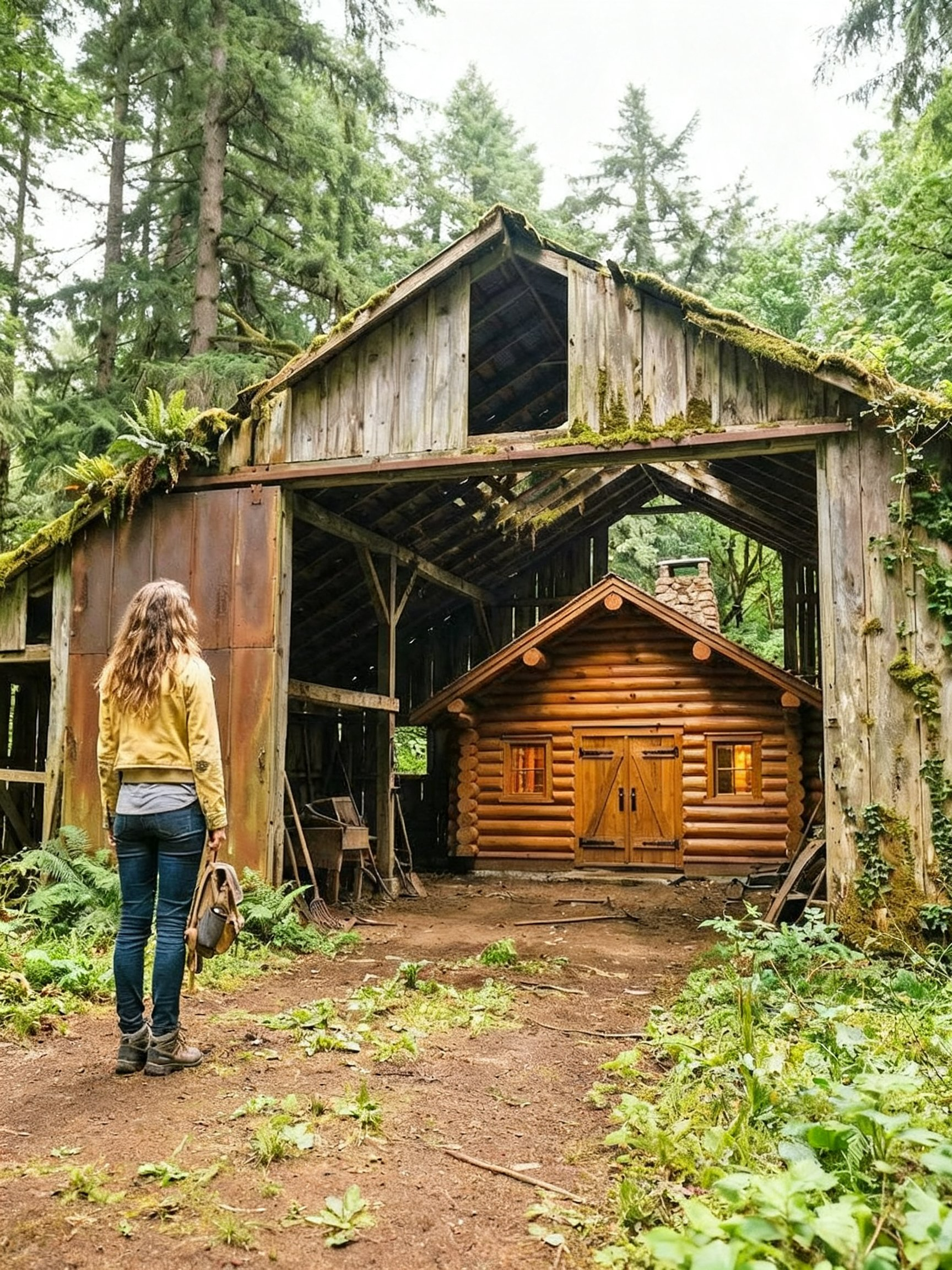
She Inherited a Rotting Barn Nobody Wanted—Then a Hidden Cabin Revealed Why Her Family Had Lied for Thirty Years
The first thing Emily Carter inherited from her grandfather was a barn everyone in her family called worthless.
The second thing she inherited was a warning.
And three days after the funeral, someone tried to burn the barn down.
Emily stood barefoot on the porch of her rental house outside Nashville, Tennessee, staring at the certified envelope in her hands while rain hammered the metal awning above her.
Her grandfather, Samuel Carter, had been dead for nine days.
They had not spoken for almost four years.
Now his lawyer had sent her a deed.
Not to his farmhouse.
Not to his savings.
Not to the seventy acres of pastureland Emily had heard her uncles arguing about before the funeral was even over.
Samuel Carter had left his thirty-four-year-old granddaughter one collapsing red barn on thirteen acres of wooded property outside the tiny town of Bellweather, Kentucky.
According to Emily’s mother, it was practically an insult.
“Your grandfather had money,” Diane Carter had said. “He had land. Equipment. Investments. And he leaves you a condemned barn?”
Emily hadn’t answered.
Not after spending half the funeral listening to relatives divide Samuel’s possessions while his coffin was still above ground.
Not after watching her uncle Richard pocket the keys to Samuel’s Ford pickup before the flowers had wilted.
Not after hearing her aunt Patricia complain that the silverware might not be real silver.
Not after remembering that Samuel had once been the only person in the family who treated Emily like she mattered.
And certainly not after reading the handwritten sentence tucked beneath the deed.
Emily recognized her grandfather’s blocky handwriting immediately.
Don’t sell it until you find the cabin.
That was all.
No explanation.
No apology for four years of silence.
Just six words that made absolutely no sense.
Because Emily had spent nearly every summer of her childhood on Samuel’s property.
There was no cabin.
Emily drove to Bellweather the following morning.
The trip north took a little over three hours.
By noon, the interstate had given way to narrow county roads bordered by tobacco fields, weathered fences, and hills covered in autumn oak and maple trees.
Samuel’s old barn stood exactly where Emily remembered it.
Except smaller.
And sadder.
Its once-red boards had faded almost gray. Several roof panels were missing. Kudzu climbed the eastern wall, and the double doors sagged inward on rusted hinges.
Behind it stretched thirteen acres of woods descending toward a creek.
Emily parked her Subaru in the gravel.
A black pickup truck was already waiting.
Her uncle Richard leaned against the driver’s door.
He was sixty-two, broad-shouldered, silver-haired, and dressed as if he were going to a country club instead of a decaying barn.
“I figured you’d come,” he said.
Emily shut her car door.
“Your mother.”
Richard looked toward the barn.
“Pretty rough, isn’t it?”
“I’ve seen worse.”
“Have you?”
Emily ignored him.
Richard followed her toward the doors.
“Look, Em, I wanted to save you some trouble.”
“That’s generous.”
“I’m serious. This place needs demolition. Taxes, cleanup, liability—you don’t need that.”
Emily stopped.
“What do you want?”
Richard smiled.
There it was.
The smile he used when he wanted something.
“I’ll give you forty thousand.”
Emily almost laughed.
“For a collapsing barn?”
“For the acreage.”
“You just told me it was a burden.”
“I’m trying to help.”
“Then why don’t you let me keep my burden?”
Richard’s smile disappeared.
For a second, something colder replaced it.
Then he shrugged.
“Think about it.”
He started toward his truck before turning back.
“Your grandfather wasn’t right toward the end, Emily.”
Her fingers tightened around the deed folder.
“He knew exactly what he was doing.”
Richard climbed into his truck.
Before closing the door, he said something Emily would remember later.
“Some things are better left buried.”
Then he drove away.
The barn smelled like dust, old hay, engine oil, and rainwater.
Emily switched on her phone flashlight.
Her grandfather’s ancient John Deere tractor still occupied one corner beneath a tarp. Rusted tools hung along the walls. Wooden stalls lined the back.
Nothing resembled a cabin.
She spent two hours searching anyway.
By late afternoon she was dirty, frustrated, and beginning to wonder whether Samuel’s note had been the confused message of a dying man after all.
Then she noticed the floor.
Most of the barn had packed dirt underfoot.
But the final horse stall had wooden planks.
Emily crouched.
One plank was newer than the others.
She found a crowbar on the tool bench and pried it upward.
Beneath it was a steel ring.
Her pulse quickened.
She pulled.
A section of flooring rose on hidden hinges.
Cold air climbed from below.
There were stairs.
“Grandpa,” Emily whispered.
She descended.
The staircase ended in a narrow underground passage reinforced with concrete blocks.
At the end stood a steel door.
Emily pushed it open.
Her flashlight swept across a room.
And she stopped breathing.
It was a cabin.
Not literally a freestanding cabin.
It was an entire log-walled room hidden beneath the barn, constructed to resemble the interior of one.
A bed sat against one wall.
There was a woodstove.
A writing desk.
Photographs.
A battery-powered lantern.
Dozens of boxes.
And covering the far wall were maps, property surveys, newspaper clippings, legal documents, and photographs connected with red string.
Emily stepped closer.
One photograph stopped her cold.
It showed Samuel standing beside a young woman.
The woman looked about twenty-five.
Golden-brown hair.
Green eyes.
A wide smile.
Emily knew that face.
She saw it in the mirror every morning.
On the back, Samuel had written:
Laura Bennett Carter, 1991.
Emily dropped the photograph.
Laura Carter was her mother.
At least, that was what Emily had been told until she was six.
Then Laura had disappeared.
Diane had married Emily’s father when Emily was seven and eventually adopted her.
The family story was simple.
Laura had been unstable.
Laura had abandoned her daughter.
Laura had run away.
Laura didn’t want to be found.
Emily had believed it for twenty-eight years.
Another photograph showed Laura holding a toddler.
Samuel stood beside them.
Someone had written a date.
October 12, 1994.
Emily turned toward the desk.
A thick envelope lay in the center.
Her name was written across it.
Her hands shook as she opened it.
Inside was a letter.
If you’re reading this, I’m gone, and the family has probably already told you the barn is worthless.
They’ve been lying to you about more than the barn.
Emily sat down.
Her grandfather’s letter continued for eight pages.
By page three, she was crying.
By page five, she was furious.
By page eight, everything she understood about her childhood had shattered.
Laura had never abandoned her.
She had tried to leave Emily’s father, Michael Carter.
Michael had controlled their money.
Richard had helped him hide assets.
Diane—then Michael’s secretary—had been having an affair with him.
Laura discovered it.
She filed for divorce.
Then she discovered something else.
Samuel had originally placed 240 acres of Carter family land into a trust meant to benefit all his grandchildren equally.
Richard and Michael secretly altered business documents connected to the property, intending to sell development rights without Samuel’s approval.
Laura found copies.
According to Samuel’s letter, she threatened to expose them.
Three weeks later, Laura disappeared.
The family told Emily she’d run away.
But Samuel never believed it.
Police investigated briefly.
No body was found.
No charges were filed.
Michael later married Diane.
And Emily grew up believing her biological mother had chosen another life over her.
Samuel had spent decades searching for proof.
That was why the cabin existed.
That was why he’d hidden it.
And that was why Richard wanted the barn.
At the bottom of the final page, Samuel had written:
I failed your mother because I trusted my sons longer than I should have.
Don’t make my mistake.
Emily found Box 17 beneath the bed.
Inside was an old cassette recorder, three tapes, property records, bank statements, and a sealed plastic folder.
She inserted the first tape.
Static crackled.
Then she heard Samuel’s voice.
“You sure you want this recorded?”
A woman answered.
Emily’s heart nearly stopped.
She knew instinctively.
“I need someone to know,” Laura said. “If something happens to me, Richard and Michael were involved.”
Emily covered her mouth.
Laura continued.
“They’re selling options on land they don’t own outright. They’ve been moving money through Blue Creek Holdings. Diane knows. I found her signature.”
Emily glanced at the papers.
Blue Creek Holdings.
The name appeared repeatedly.
Then Laura said something worse.
“Michael told me if I tried to take Emily away, I’d regret it.”
The recording ended.
Emily sat motionless.
Outside, thunder rolled across the hills.
Then came another sound.
Emily switched off the recorder.
Headlights swept through cracks in the barn floor above.
Someone had arrived.
She climbed the stairs quietly.
Through a gap in the wall, she saw Richard’s black pickup.
He wasn’t alone.
A second man stepped out.
Emily recognized him after a moment.
Calvin Moore.
Richard’s longtime business partner.
The two men carried gasoline cans.
Emily’s blood turned cold.
She grabbed her phone.
One bar of service.
She dialed 911 anyway.
“Bellweather County emergency.”
Emily whispered her location.
Then Richard’s voice echoed from inside the barn.
“I saw your car.”
“Emily, come on. We need to talk.”
She slipped back underground.
The emergency dispatcher told her deputies were coming.
Then she smelled gasoline.
They weren’t searching for her.
They were burning the evidence.
Emily grabbed Box 17 and Samuel’s letter.
She looked around frantically.
Another line in Samuel’s letter flashed through her mind.
Every good shelter needs two exits.
She searched behind the bed.
Behind the shelves.
Then she saw hinges behind a hanging quilt.
A narrow steel hatch.
She opened it.
Smoke began drifting down the staircase.
Emily crawled.
Behind her, flames roared overhead.
The tunnel was barely three feet high.
Dirt scraped her elbows.
She pushed Box 17 ahead of her.
Twenty feet.
Then the tunnel angled upward.
Emily shoved at a wooden panel.
It opened beneath blackberry bushes behind the barn.
She crawled into the rain.
The roof was already burning.
Richard and Calvin stood near their truck.
Richard saw her.
His face changed completely.
No performance.
Just panic.
“What did you take?” he shouted.
Richard chased her.
She reached her Subaru, threw Box 17 onto the passenger seat, and locked the doors.
Richard slammed both hands against her window.
“OPEN THE DOOR!”
Emily started the engine.
Blue lights appeared at the end of the gravel road.
Richard stepped back.
Calvin dropped the empty gasoline can.
The sheriff’s cruisers came fast.
Emily had never been so relieved to see flashing lights in her life.
The fire department saved part of the barn.
More importantly, investigators found accelerant.
Calvin confessed first.
Within forty-eight hours.
Richard had paid him ten thousand dollars to destroy the structure.
According to Calvin, Richard believed Samuel had kept “old family papers” there.
Arson charges followed.
But that was only the beginning.
Emily hired an attorney named Margaret Ellis, a fifty-eight-year-old former federal prosecutor with the unnerving habit of becoming quieter when she was angry.
Margaret spent six hours reviewing Box 17.
Then she looked at Emily.
“Your grandfather wasn’t collecting memories.”
“What was he collecting?”
Against Richard.
Against Emily’s late father.
Possibly against Diane.
And potentially against several people involved in a decades-old land fraud scheme.
“But my mother?”
Margaret hesitated.
“We need to separate what we can prove from what we fear.”
Emily hated the answer.
But Margaret was right.
They turned everything over to state investigators.
Financial records revealed that Blue Creek Holdings had existed.
It had received millions from land-option agreements dating back to the 1990s.
Samuel had discovered part of the scheme in 2001.
Richard convinced him Michael had been solely responsible.
Michael died from a heart attack in 2017.
Richard continued manipulating land titles afterward.
Then investigators found something unexpected.
Laura had opened a safe-deposit box two days before her disappearance.
It still existed.
The bank had been acquired twice, records digitized, boxes transferred.
But Laura’s remained unclaimed under a dormant account.
A court order opened it.
Inside were original documents.
A trust agreement.
Photographs.
And a videotape.
Emily watched the converted footage in Margaret’s office.
Laura appeared on screen.
She was sitting in what looked like a motel room.
She looked frightened.
But determined.
“My name is Laura Bennett Carter.”
Emily started crying before Laura finished the first sentence.
“If Emily ever sees this, I need her to know something.”
Laura looked directly into the camera.
“I didn’t leave you.”
Emily pressed a hand to her mouth.
“I would never leave you.”
Laura explained that she was planning to meet an investigator regarding the fraudulent land transfers.
She believed Michael had discovered her plans.
She intended to take Emily to Ohio and stay with her sister afterward.
Then came the detail that reopened the missing-person investigation.
Laura named the motel.
She named the investigator.
And she named the person who was supposed to drive her to the meeting.
Richard Carter.
Richard had always told police he hadn’t seen Laura that week.
Now there was evidence he had lied.
Diane arrived at Emily’s house three nights later.
Emily almost didn’t open the door.
Her adoptive mother looked twenty years older than she had at Samuel’s funeral.
“You found the tapes,” Diane said.
It wasn’t a question.
Emily stared at her.
“You knew.”
Diane began crying.
“You knew she didn’t abandon me.”
“I knew some things.”
“Twenty-eight years.”
“I was scared.”
“Twenty-eight years, Mom.”
Diane flinched at the word Mom.
Emily didn’t soften.
“You watched me spend my entire childhood wondering why she didn’t love me.”
“Your father told me—”
“My father is dead. Stop hiding behind dead men.”
Diane sat down.
Then she told Emily everything.
Michael had been possessive.
Controlling.
Diane admitted the affair.
She admitted helping Michael conceal money.
She admitted knowing Laura intended to expose them.
Then Emily asked the question.
“What happened to her?”
Diane stared at the floor.
“I don’t know.”
“That’s not good enough.”
“Did Richard?”
Diane looked up.
And that was the answer.
“What did he tell you?”
“Two days after Laura disappeared, Richard came to the house. Your father was drinking. They argued in the garage.”
“About what?”
“I heard Richard say, ‘You weren’t supposed to follow us.’”
Emily’s skin prickled.
“Michael said, ‘She wouldn’t stop screaming.’”
Silence swallowed the room.
Emily could hear the kitchen clock ticking.
Diane’s voice broke.
“I should have gone to the police.”
“I was twenty-nine. I was terrified.”
“You still should have gone.”
“And instead you married him.”
Diane closed her eyes.
That confession ultimately changed the investigation.
Four months later, state police searched an abandoned Carter family property twelve miles from the barn.
The land had once contained a limestone quarry.
Samuel’s maps included one location circled three times.
A drainage pit.
Investigators excavated it.
They found a car.
A 1992 white Chevrolet Cavalier.
Registered to Laura Carter.
Inside were personal belongings.
A bracelet visible in childhood photographs.
And human remains.
Dental records confirmed the identity.
Emily received the call at on a Tuesday morning.
For several minutes after hanging up, she sat on the kitchen floor.
She had spent twenty-eight years believing her mother was alive somewhere.
Sometimes she’d imagined California.
Sometimes Florida.
Once, when she was sixteen, Emily became convinced Laura lived in Seattle and spent weeks searching names online.
The truth hurt differently.
Laura hadn’t chosen another life.
She had been denied one.
Richard was charged with conspiracy, fraud, arson, obstruction, and later several offenses related to Laura’s death.
The prosecutors could not prove he had killed her alone.
They believed Michael had been present.
But Michael was dead.
Richard eventually accepted a plea agreement that guaranteed he would spend the remainder of his realistic life expectancy in prison.
Diane cooperated fully.
She was charged for her role in the historic financial fraud but received reduced penalties because of her testimony.
Emily attended sentencing.
Richard looked at her before guards led him away.
“You destroyed this family,” he said.
Emily almost smiled.
Then she walked out.
The financial case produced one more surprise.
Samuel’s trust had never been legally dissolved.
The fraudulent transfers had clouded ownership but had not eliminated Emily’s interest.
Over the decades, parts of the original Carter property had been leased to timber companies, telecommunications firms, and commercial developers.
Restitution negotiations took nearly two years.
By the time everything was settled, Emily received ownership of 117 acres, a substantial financial settlement, and controlling rights over the remaining family trust.
Her relatives suddenly became very interested in reconciliation.
Aunt Patricia sent flowers.
Cousins Emily hadn’t heard from in fifteen years called to say they had “always believed something wasn’t right.”
Her mother asked if they could rebuild their relationship.
Emily didn’t answer immediately.
Forgiveness, she learned, was not the same as pretending.
Eventually, she agreed to coffee with Diane.
Then another.
They talked.
Sometimes they cried.
Sometimes Emily walked away angry.
There was no magical reconciliation.
No single conversation repaired nearly three decades of lies.
But Diane stopped making excuses.
And Emily decided that accountability did not always require permanent hatred.
Their relationship became something new.
Not what it had been.
Not what it should have been.
Something honest.
One year after Laura’s remains were found, Emily returned to the barn.
The burned sections had been rebuilt.
Not replaced.
She insisted that every salvageable original board remain.
The hidden underground cabin had survived surprisingly well because of its concrete shell.
Emily restored that too.
But she didn’t turn it into a tourist attraction.
She kept Samuel’s desk.
She kept his maps.
She kept Laura’s photographs.
And above the desk she framed two things.
Samuel’s original note:
Don’t sell it until you find the cabin.
And beside it, one sentence from Laura’s video:
I would never leave you.
The surrounding acreage became the Laura Bennett Carter Foundation, providing temporary housing and legal assistance for women escaping financially controlling or abusive households.
The old barn became its headquarters.
The upstairs loft was transformed into offices.
The stalls became counseling rooms.
The underground cabin remained untouched except for repairs.
Emily visited it alone every October.
On the third anniversary of Samuel’s death, she sat at his desk and opened the final envelope investigators had recovered from the cabin.
She had deliberately saved it.
On the front Samuel had written:
ONLY AFTER EVERYTHING IS OVER.
Inside was one page.
If you made it this far, then you know I wasn’t leaving you a barn.
I was leaving you the truth.
Truth doesn’t always make life easier. Sometimes it tears down everything you thought was solid.
But a lie can become a prison if you live inside it long enough.
Your mother loved you.
Never doubt that again.
And whatever is left after the truth comes out—land, money, buildings—don’t spend your life protecting things.
Protect people.
That’s where I failed.
Maybe that’s where you can do better.
Emily read it twice.
Then she walked upstairs.
Outside, children were playing beneath the maple trees while their mothers met with attorneys inside the restored barn.
The autumn sun turned the surrounding hills gold.
A woman Emily had never met approached the entrance holding a suitcase in one hand and her seven-year-old daughter’s hand in the other.
She looked frightened.
“Is this the Carter Foundation?” she asked.
Emily looked at the barn her family had called worthless.
At the building Richard had tried to destroy.
At the place Samuel had filled with secrets because he couldn’t trust his own sons with the truth.
Then she looked at the little girl.
The woman swallowed.
“They told me you might be able to help us.”
Emily opened the door wider.
Years earlier, Emily had driven to Kentucky believing she’d inherited thirteen acres and a collapsing barn.
She had been wrong.
Samuel had left her evidence.
Laura had left her courage.
And the hidden cabin beneath the barn had given Emily something no amount of inherited money could have purchased.
It gave her back her mother’s love.
It gave her back her own history.
And once the lies were gone, it gave her the chance to build something better in their place.
Emily never sold the barn.
She never intended to.
Because sometimes the most valuable inheritance isn’t the property someone leaves behind.
Sometimes it’s the truth they finally leave you strong enough to uncover.
✓ Lynn R. Adams
She Inherited a Rotting Barn Nobody Wanted—Then a Hidden Cabin Revealed Why Her Family Had Lied for Thirty Years The first thing Emily Carter inherited from her grandfather was a barn everyone in her…