She Called Police to Kick Her Out of Her Own Home — Until the Officer Asked for the Deed and the Truth Came Out
She Called Police to Kick Her Out of Her Own Home — Until the Officer Asked for the Deed and the Truth Came Out
What do you do when the woman who tried to erase you from your own house didn’t know the house was never hers to give?
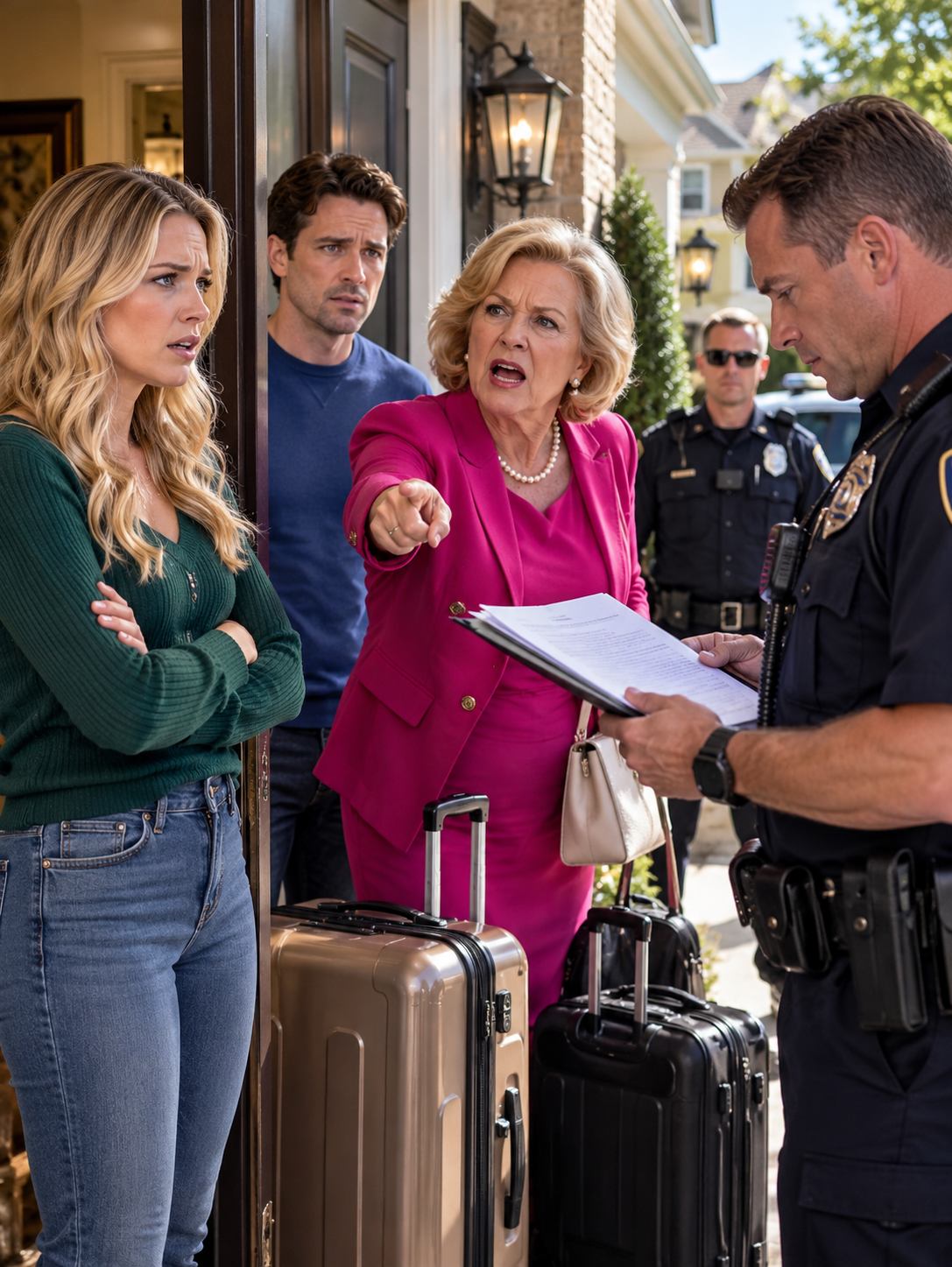
She stood on my front porch, dialed 911 right in my face, and told the dispatcher to send officers immediately — her son’s wife was blocking the door, refusing to let her move into the home that belonged to her family. She smoothed her silk blouse, adjusted her pearl necklace, and smiled like she’d already won. “This is just a formality, dear,” she said, voice dripping with pity. “Once they see reason, you’ll be gone by dinner.” She didn’t know I’d paid every down payment, signed every paper, and held the deed in my name alone. And she didn’t know my husband had never told her the truth.
I did not scream or slam the door in her face. I did not beg her to listen or remind her of every check I’d written. I did not let her see how tight my chest felt or how much her cruelty stung. I did not turn to my husband and plead for him to speak up — I already knew he would stay silent until he had no choice. I did not fight her version of reality. I simply waited for the moment reality itself would step through the door.
I stood straight and steady while she paced and boasted and acted like the lady of the manor. I watched her gesture at my furniture, my photos, my things as if they were already hers to rearrange. I listened to her list all the ways I’d never been good enough for her son. I kept my hands folded calmly in front of me and said nothing — because words would not be enough to undo what she’d built in her mind. Only proof would.
I looked at my husband then, quiet and shrinking beside her, and wondered how long he thought he could stand between her expectations and the truth written in black and white. I did not hate her in that moment. I pitied her. She had spent years dreaming of this moment — and she had no idea it was never going to happen the way she imagined.
If your own husband won’t defend you, what do you do when the law shows up and you have to stand alone?
My name is Elena Hayes. I bought this house three years before I married Garrett. Every dollar from my savings, every late shift, every sacrifice I’d made since I was nineteen went into this place. I picked the lot. I chose the layout. I signed the deed. Garrett moved in six months after our wedding. He paid half the utilities. He bought groceries. But he never owned a single square foot of this roof.
His mother, Margaret, had never liked it. “My boy should have a home in his name,” she’d sniffed at the reception. “Not live in someone else’s.” I’d smiled then. I’d thought it was just old‑fashioned pride. I hadn’t realized she meant to fix it.
Garrett and I had talked about adding his name. I’d said yes — eventually, when we’d been married longer, when the loan was smaller, when it felt like our home in every way. He’d agreed. Or so he’d said. But he’d never mentioned it to her. Instead, he’d let her believe the house was his. He’d let her plan. He’d let her dream.
And today, she’d showed up with four suitcases and a moving dolly.
“I’m moving in,” she’d announced, stepping past me like I was a doormat. “Garrett said it’s time. I’ve sold my place. This is my home now too.”
I’d stood in the doorway. “Margaret, this is my home. You can’t just move in.”
That was when she’d pulled out her phone and dialed.
The police arrived ten minutes later — two officers, calm and professional. Margaret stepped forward immediately. “Thank you for coming. My son’s wife is refusing to let me enter my son’s property. I have every right to be here. Please remove her.”
One officer turned to me. “Ma’am, is that correct?”
“It is not,” I said. “This is my property. My name is on the deed. Margaret was not invited. She does not live here.”
Margaret laughed. “That’s ridiculous! Garrett — tell them. Tell them this is your house.”
Every eye turned to him. He shifted his weight, looked at his shoes, then at me. “Well… technically… Elena’s name is on the papers, but it’s supposed to be ours. My mother is only trying to help.”
“Help what?” I asked quietly. “Take over?”
“I’m moving in,” Margaret said again, firmer. “Garrett wants me here. It’s family. Now please step aside before this gets unpleasant.”
The senior officer held up a hand. “Everyone hold on. Property ownership is determined by the deed. May I see it?”
Margaret’s smile widened. “Garrett, show him. Show him it belongs to you.”
“Garrett?” she prompted.
He wouldn’t meet her eyes. “Mom… the house… it’s Elena’s. Only Elena’s.”
The smile froze on her face. “What did you say?”
“I never put my name on it,” he mumbled. “She bought it before we met. It’s hers.”
“But — but you told me —”
“I told you we were going to fix it,” he said, voice barely audible. “I never said it was mine already.”
Margaret stared at him like she didn’t recognize him. “You let me sell my house. You let me pack everything. You let me think —”
“I know,” he said, looking at the floor. “I’m sorry.”
The officer turned to Margaret. “Ma’am, if the property is solely in Elena’s name, she has the right to decide who enters. If you do not have permission to be here, you are trespassing. Do you need us to escort you off the premises?”
Her face went from red to pale. She looked at me — really looked at me — for the first time in years. “You planned this,” she said, sharp and shaking. “You knew.”
“I told you from the beginning,” I said. “You just didn’t listen.”
She turned on Garrett then. “Say something! Tell them the truth!”
“I am,” he said, finally lifting his head. “The truth is I was embarrassed. I wanted you to be proud. I didn’t want to admit I couldn’t provide this on my own. I let you believe what made you happy. And I let Elena carry the weight of it all alone.”
Margaret stood there, suitcases at her feet, police officers waiting, and the reality settled over her slow and heavy. She had no claim. No right. No leverage. She had gambled everything on a lie her son had told — and lost.
The officers left after confirming I was the sole owner. Margaret stayed on the porch, stiff and defeated. “I’ll be at a hotel,” she said to Garrett, not looking at me. “Call me when you decide what you want.”
She dragged her suitcases back to her car and drove away. Garrett came inside and sat on the sofa, head in his hands. “I’m sorry,” he said. “I was so afraid of disappointing her. I didn’t know how to tell her no.”
“That’s not the only thing you didn’t say,” I told him. “You didn’t defend me. You didn’t protect our home. You let her treat me like an intruder in the place I built.”
“I know,” he said. “I’ll talk to her. I’ll fix this.”
But fixing it wasn’t simple. Margaret didn’t apologize. She called family members and told them I’d locked her out, that I was cruel, that I kept her son from his rightful home. Relatives messaged me. Cousins called. An aunt left a voicemail saying I should “do the right thing” and share what belonged to the family.
Garrett defended me — finally. But the damage was done. The story was out. And beneath it all, something felt off. Margaret had sold her house fast. Too fast. She’d given away furniture. She’d told friends she was moving into her son’s place for good. This wasn’t a sudden whim. It was a plan. And Garrett had known more than he admitted.
I went through old messages that night — his to her, hers to him. I found patterns I’d missed. Dates I hadn’t connected. The deed will be sorted soon, Garrett had written three months ago. She won’t have a choice once we’re married, Margaret had replied. Joint ownership is automatic after a certain number of years, isn’t it?
I sat back, cold. She hadn’t misunderstood. She’d researched. She’d believed that marriage alone gave her son rights — that I couldn’t keep it from him forever. And Garrett hadn’t corrected her. He’d let her hope. He’d let her prepare. And he’d hoped I’d give in before the truth came out.
I pulled the marriage records, the property deed, the letters I’d sent him years ago. I cross‑referenced everything. And then I found it — a single line in an email from Margaret to her sister, sent the week before she arrived: Once I’m there, she’ll have to sell. The property doubles in value when subdivided. Garrett will get his share one way or another.
Subdivided.
I froze. That was it. She hadn’t come to live with us. She’d come to pressure me into selling — to force Garrett to claim half, to cash out, to move on. She’d sold her own place because she expected the money from mine to buy something bigger, something better, something she could control.
I showed Garrett the messages. He read them slowly, his face falling. “I didn’t know,” he said. “I swear I didn’t.”
“Did you tell her we might sell?” I asked.
He hesitated. “I… I mentioned once that if things got tight, we could consider it. I didn’t know she was planning this.”
“But you didn’t tell her no,” I said. “You didn’t set a boundary. You let her think she was coming into an investment she could cash in.”
He looked away. “I was trying to keep everyone happy.”
“At my expense,” I said.
That night, I called Margaret. I didn’t argue. I didn’t accuse. I just read her the line about subdivision and waited.
She didn’t deny it. “Why shouldn’t he benefit?” she said, sharp and defensive. “You married him. He should have security. If you won’t provide it, I will.”
“By taking what’s mine?”
“By making it fair,” she said. “A man needs a home he can call his own. You’ve held this over his head from day one.”
“I never held anything over his head,” I said. “I offered to add his name. I offered to make this ours. He stalled. He hesitated. He never said why.”
Silence on the other end. Then: “Because he knew you’d never truly let him be equal. He’d always be living in your shadow.”
I ended the call. Not because I was angry — though I was — but because I realized something deeper was at play. This wasn’t just about money. It was about control. About who got to define what “family” meant. And Garrett had been caught in the middle his whole life, unable to stand up to her, unable to be honest with me.
The next few weeks were tense. Margaret reached out to Garrett constantly — texts, calls, visits — painting me as the villain, pleading her case, reminding him of everything she’d sacrificed for him. He wavered. He apologized. He promised to do better. Then he’d slip back into old habits — avoiding conflict, minimizing her behavior, telling me to “just give her time.”
I set a boundary. “She can visit. She can be family. But she does not get to decide what happens here. And you do not get to keep secrets with her against me.”
He agreed. But I noticed things shifting. He started asking about the house value. About refinancing. About whether we could “help” his mother with a down payment somewhere else. Every question led back to the same place — my money, my house, my sacrifice — treated like a solution to problems I hadn’t created.
I found myself pulling away. Sleeping in the guest room. Keeping the deed in my bag. Watching the man I loved choose silence over honesty again and again.
Then came the letter — not from Margaret. From a lawyer. A formal notice: Notice of Claim of Interest — Spousal Rights. Garrett was asserting that he had a legal stake in the property — that he’d contributed to improvements, maintenance, mortgage payments — and that my refusal to acknowledge it was unfair.
I sat at the kitchen table and read it twice. He hadn’t signed it. But his name was there. And Margaret’s return address was listed as the forwarding contact.
I confronted him. He looked guilty but resigned. “She said I should protect myself,” he said. “Just in case. I didn’t file it. I just had her ask about it.”
“You let her hire a lawyer against me,” I said. “In my own house.”
“It’s not against you,” he said. “It’s just… covering bases.”
“Against who, then?”
He didn’t answer.
That was when I knew. This wasn’t just his mother. It was the pattern she’d taught him — avoid conflict, hide the truth, let someone else fight your battles. She hadn’t just shown up at my door. She’d moved into the gaps he’d left open in our marriage. And now she was trying to pull the whole structure down.
I called a lawyer of my own the next morning. I gathered every document — deed, purchase agreement, payment receipts, emails, messages. I prepared for a fight I never thought I’d have with my own husband.
But then I found something else — a folded piece of paper tucked in the back of an old notebook Garrett had left behind. Dated six months before our wedding. In his handwriting: Mom says if I don’t get on the deed, she’ll help me force it. She says the courts favor the husband. I don’t want to hurt Elena, but I need security too.
My hands shook. This wasn’t new. It had been planned before we were even married. Before I said “I do.” He had walked down the aisle knowing he intended to claim what wasn’t his. And I had never known.
I laid the note on the kitchen table when he came home. He read it and sank into a chair, defeated. “I was scared,” he said. “Everyone I know gets divorced eventually. I didn’t want to end up with nothing.”
“So you planned to take everything from the start?”
“I wanted to believe we’d make it work,” he said. “But I listened to her. I listened and I believed her when she said you’d never truly share.”
“I offered to share,” I said. “You just didn’t trust it unless it was forced.”
He looked at me, eyes wet. “I see that now. I was wrong. Elena, I’m so sorry.”
But apologies felt thin. The betrayal ran too deep. He hadn’t just kept a secret. He’d entered our marriage with a hidden agenda — planted there by the woman who’d raised him to believe possession was the only proof of worth.
That night, I heard him on the phone with her, voice low and urgent. “She knows. Everything. We have to stop.”
Her reply carried through the wall, sharp and clear: “Don’t back down. If you leave now, she keeps it all. Stand your ground. I have the papers we need.”
I froze. Papers. What papers?
Garrett’s voice dropped. “What papers? Mom, what have you done?”
“Something to make sure he’s recognized as owner,” she said. “A corrected deed. Witnesses. It’s all been handled. By the time they notice, it’ll be too late.”
My blood turned to ice. She hadn’t just planned. She’d acted. She’d filed something — forged something — and neither of us knew how far it had gone.
I grabbed my keys and drove straight to the county recorder’s office. I pulled the property records. And there it was — a document filed two weeks earlier: Quitclaim Deed, transferring full ownership from me to Garrett and me jointly. My signature was there. Witnesses were listed. And it was not my handwriting.
I stood there in the fluorescent light, the paper trembling in my hand, and realized the truth was bigger than I’d imagined. She hadn’t just wanted a room. She hadn’t just wanted money. She wanted to erase me entirely — to rewrite history, to take the home I’d built with my own hands, and hand it to her son as if it had always been his.
And she’d used him to do it.
I walked out to the parking lot, phone in hand, and called the district attorney’s office. Then I called Garrett. “Come to the recorder’s office,” I said. “Now. And bring your mother.”
When they arrived, Margaret tried to smile. Tried to act innocent. Until I laid the deed on the hood of her car.
“You forged my signature,” I said. “You filed a false legal document. That’s fraud. That’s a felony.”
Her smile vanished. “I did it for Garrett. He deserves —”
“He deserves honesty,” I said. “And you deserve to be held accountable.”
Garrett went pale. “Mom… did you really?”
“I did what was necessary,” she said, not looking at him. “She was never going to share.”
The police arrived minutes later — called by the recorder’s staff the moment they saw the signature. Margaret was read her rights right there in the parking lot. Handcuffed. Led away. And Garrett stood alone, watching the car vanish, realizing the woman he’d defended his whole life had risked everything — including his freedom — to get what she wanted.
I turned to him. “Did you know?”
He shook his head, tears spilling over. “I suspected. I didn’t want to believe. Elena, I swear —”
“Did you sign anything?”
“No,” he said. “I never touched it.”
I didn’t know whether to believe him. Not fully. Not yet. But I knew one thing for certain — the woman who’d come to kick me out of my own home had ended up the one leaving in handcuffs. And the man standing beside me had a choice to make: stand with me in the truth, or follow her into the dark.
But as I looked down at the forged deed in my hand, I noticed something no one else had — a faint smudge on the witness signature line. A specific kind of ink, a specific date, a specific person’s name. Not Margaret’s. Not Garrett’s. Someone I’d trusted from the very beginning. Someone who’d been in our house the night it was signed. Someone who’d told me I could always count on them.
And I realized — she hadn’t acted alone.
✓ Lynn R. Adams
She Called Police to Kick Her Out of Her Own Home — Until the Officer Asked for the Deed and the Truth Came Out What do you do when the woman who tried to erase you from your own house didn’t know th…